0
contractor sites graded, one A
Across the whole CRO Index, a single site earned an A. The median landed at a D. The grade gap is a conversion gap.
You already get traffic in Virginia Beach. Most of it leaves without calling. We find the leaks and plug them, so the visitors you've got start booking jobs.
Starts with a Site Inspection, so you see the leaks before any fix begins.
“Attentive, listened to every revision request, delivered on time. Would work with him again.” — Hamza Najam
“Patient, on point, straightforward. Did amazing work. Would 100% recommend.” — Ruben Mederos, HyperTemp HVAC
“Responsive, creative, exceeded expectations. Already seeing greater engagement from our clients.” — George Jeorgy, Jeorgy's Landscape Construction
“Top-tier professionalism, real web design expertise, ideas I hadn't considered. Confidently recommend.” — Aws Nassani, Four Eleven Contracting




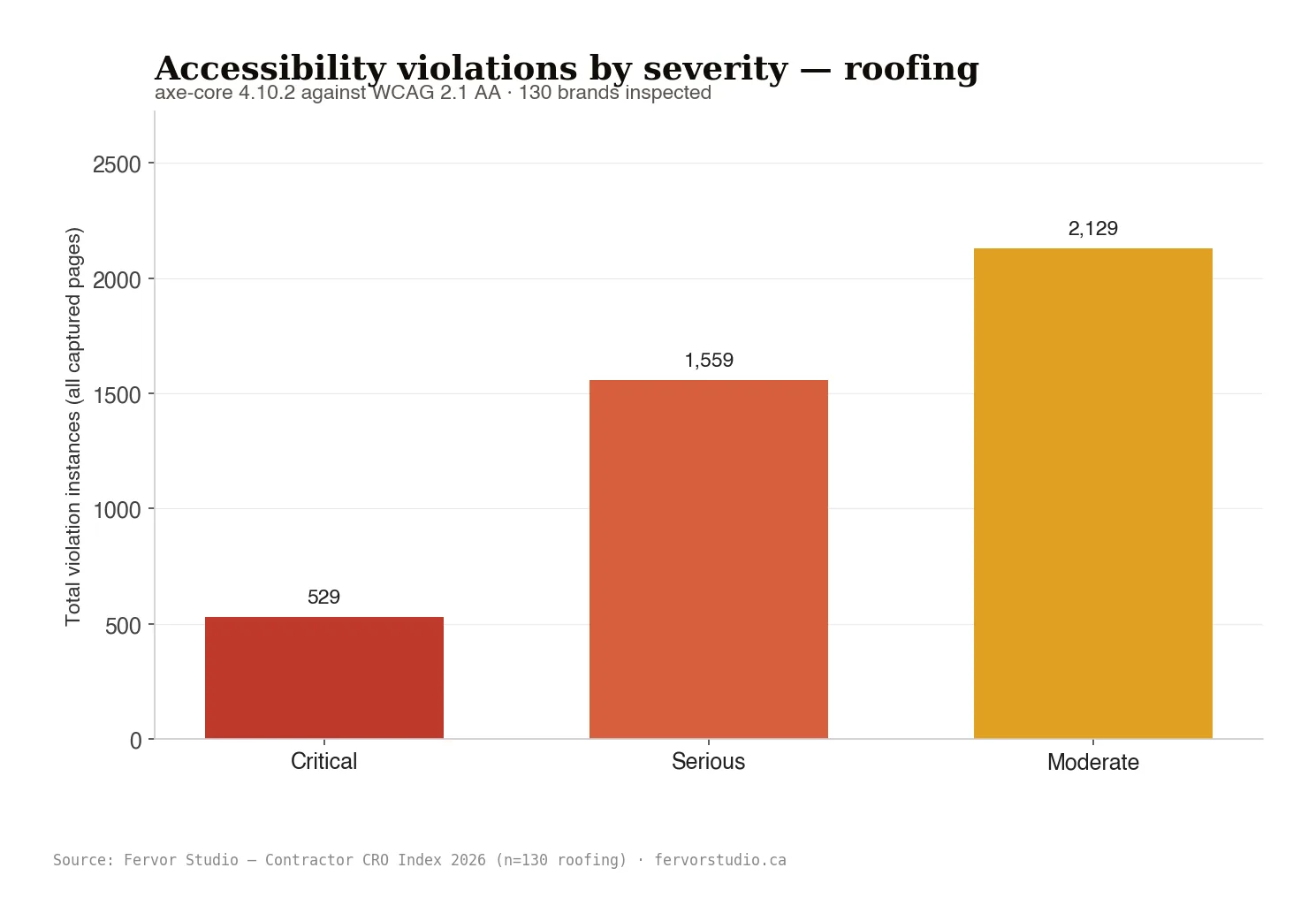
60.8% of roofing sites we tested fail a critical accessibility check
Digital State of the Roofing Industry 2026A grade out of 380 contractor sites
We graded 380 of them against one framework. Exactly one earned an A: Crown Industrial Roofing in Toronto, at 90 out of 100. The rest left money on the table. Here is what separates the top from the bottom.
The local detail
Every angle below comes from how Virginia Beach actually searches, buys, and regulates — built into the page, not bolted on.
Your homepage was built to do twelve jobs.
So here’s the test.
This is where most of the money disappears.
Here’s a mistake that quietly eats budgets.
So she submitted.
You're paying for clicks. Every one of them costs you somewhere between $8 and $25 in a competitive market like Hampton Roads. So when a homeowner in Kempsville taps your ad after a Nor'easter shreds half the shingles on her street, where does she land? If the answer is your homepage, you just lit money on fire. A real roofing landing page in Virginia Beach catches that click, answers her one worry, and gets her phone number before she backs out. And right now, for most shops, the homepage is doing the opposite.
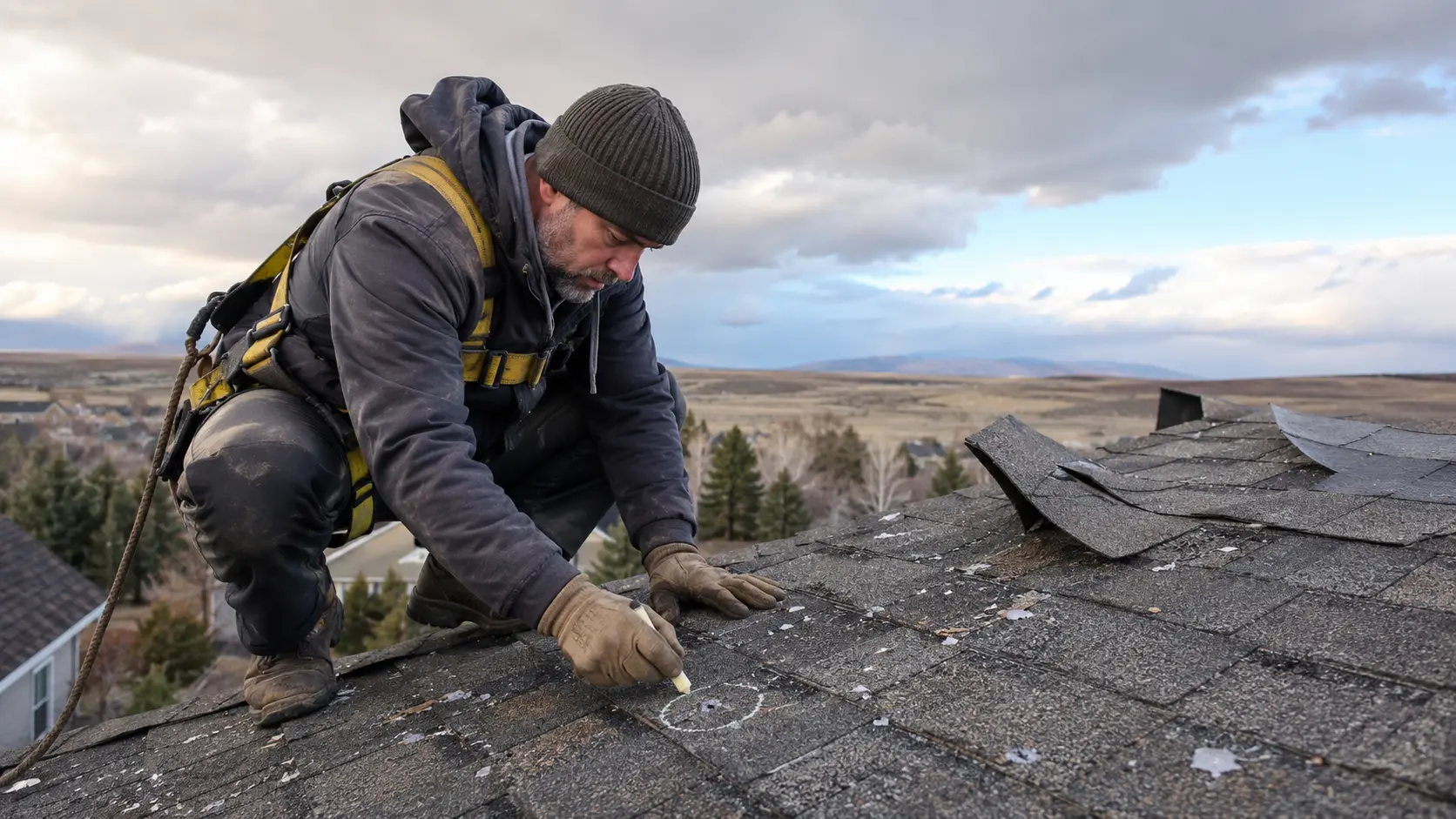
Your homepage was built to do twelve jobs. It introduces the company, lists every service, shows the truck wrap, links to the careers page, and somewhere down near the footer it asks for the lead. So that's fine for someone who Googled your business name. But it's a disaster for someone who just clicked a storm-repair ad at 9 p.m. with water spotting her bedroom ceiling.
So she scrolls. She sees gutters, siding, a blog post from 2021. She doesn't see the one thing she came for, which was "can you fix my roof this week and how much." And the click you paid for bounces.
So a focused page does one job. One offer, one ask, one clear next step. And that's the whole difference between a homepage and a page built to convert. But the math on that difference is brutal once you run it.
"97% of roofing customers expect a callback within one week. More than 50% expect a callback within two days." — Roofing Contractor Magazine (2024)
Think about what that means. Half the people clicking your ad have already decided they'll go with whoever calls back fast. Your homepage doesn't know that. A page built around speed-to-lead does.
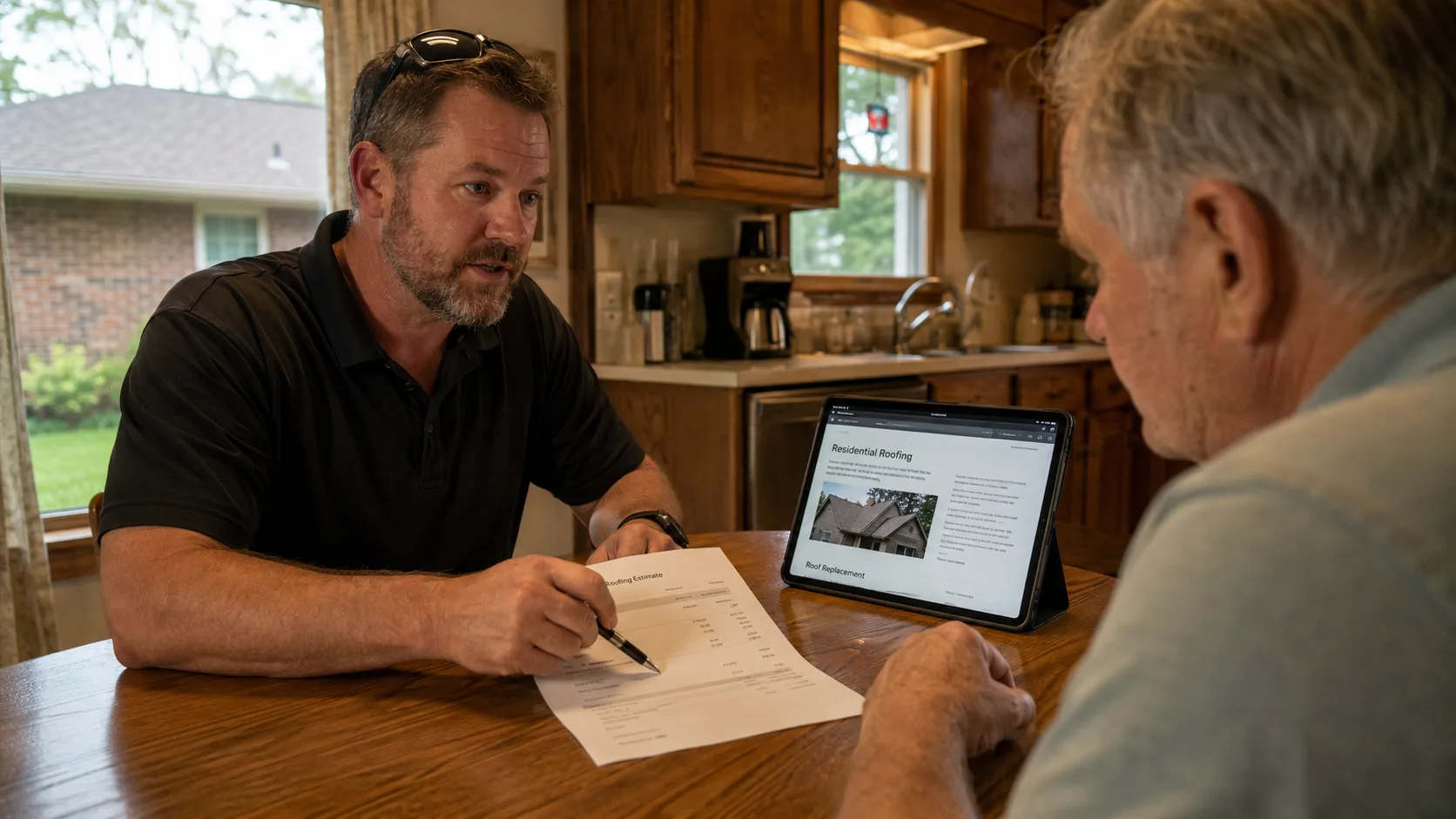
So here's the test. Open the page on a phone. Don't scroll. And can a homeowner in Great Neck see three things at once? The headline that matches the ad she clicked, a call button she can't miss, and one piece of proof sitting right next to the ask. If any of those three is below the fold, you're leaking.
If your ad said "Storm Roof Repair in Virginia Beach," the page headline better say almost the same thing. When the words match, her brain relaxes. She's in the right place. But when they don't, she wonders if she misclicked, and a confused visitor leaves in about three seconds. So write the headline to mirror the ad copy and name her actual worry, not your tagline.
Your phone number should be a tappable button, fixed to the top of the screen, visible the entire time she scrolls. Not text. A button. So one Virginia Beach shop I looked at buried their number in a gray footer that took four thumb-swipes to reach. And they were paying for clicks while hiding the phone. That's a $1,800-a-month ad budget pouring into a page that whispers.
And then there's proof. Reviews, a photo of your real crew on a Sandbridge tear-off, a manufacturer badge. Put one right next to the form so she trusts you in the same glance she decides to fill it out. But proof three screens down does nothing for the person deciding right now.
"In hail-prone states, average roof lifespan is 15 years vs 22 years in milder western states; 38% of U.S. homes have roofs in moderate to poor condition (Roofing Contractor) with 60% higher loss costs" — Verisk Analytics (2025)
Coastal Virginia takes a beating. Salt air, wind off the Chesapeake, the occasional hurricane band. A lot of those roofs are already in rough shape, which means the homeowner clicking your ad is often closer to buying than she lets on. Your job is to not get in her way.
This is where most of the money disappears. You finally got her to the page, she's interested, and then you hand her a form with eleven fields. Name, email, phone, address, roof type, roof age, square footage, preferred contact time, how she heard about you, a comment box, and a checkbox for the newsletter. She closes the tab.
And every field you add costs you submissions. The fix is simple and it hurts a little, because you want all that info. So cut it. Name, phone, address, and one line for what's wrong. That's it. You get the rest on the call.
Run the napkin math. Say your page gets 300 clicks a month. At an eleven-field form you might convert 4% to a lead, so 12 leads. Trim to four fields and conversion can climb to 8% or better, so 24 leads. Same ad spend. Double the calls. If you close one in four at a $9,000 average reroof, that jump is roughly $27,000 in extra signed work a month from deleting seven form fields.
"What's going on with your roof?" is one open box. She'll tell you it's leaking over the garage in Thalia, or a tree limb came down in Red Mill, and now you know more than any dropdown would've told you. And specs are your job anyway. So don't make her do it.
"In 2024, 22% of renovating homeowners undertook roofing upgrades, with a median spend of $13,000." — Houzz Inc. (2025)
That's the size of the decision sitting behind your four-field form. A $13,000 median job. People don't hand over that kind of money to a page that feels sloppy, and they don't fill out a form that feels like a tax document either. The form has to feel as easy as the job is big.
"Among homeowners who renovated in 2024, 84% used cash from savings and 29% used a credit card to fund renovation projects (multiple funding sources allowed)." — Houzz Inc. (2025)
And most of them are paying out of savings, which means they're cautious. They're comparing. A clean, fast, trustworthy page is what tips a cautious saver into hitting submit instead of bookmarking three competitors.
Here's a mistake that quietly eats budgets. You run three different ad campaigns and send all of them to one page. Storm damage, full replacement, energy-efficiency upgrades, all dumped onto the same generic destination. But each of those homeowners wants something different, and one page can't speak to all three.
This homeowner is scared and fast. She wants to know you'll show up this week. So the page should lead with emergency response, a same-day inspection promise, and that callback speed stat sitting right under the headline. And no mention of energy ratings. She doesn't care right now.
Different mindset entirely. This is the homeowner in Princess Anne whose roof is twenty years old and finally giving up. She's planning, not panicking. So show material options, financing, warranty, and crew photos. And she's got time to read, so give her substance.
"Among homeowners undertaking a roofing project, 63% choose asphalt roofing material (dimensional shingles 34%, three-tab shingles 19%, luxury shingles 10%), while 14% choose metal and 11% choose synthetic material or rubber." — Houzz Inc. (2024)
Roughly two in three of your replacement shoppers are landing on asphalt. So lead the replacement page with shingle options and pricing tiers, not a metal roof you sell twice a year. Match the page to what the data says these people really buy.
A smaller, savvier crowd. They've read about cool-roof shingles and attic ventilation cutting summer bills in a Virginia Beach July. Speak their language. Show the energy angle, the long-term savings, and let the storm-repair urgency sit on the other page where it belongs.
"Among renovating homeowners, 44% add or redo a roof as part of their exterior projects." — Houzz Inc. (2024)
Nearly half of exterior projects pull the roof into the job. So your energy and replacement pages can cross-sell siding or gutters without feeling pushy, because the homeowner is often already thinking that direction.
So she submitted. The clock starts now. The single biggest predictor of whether you book that estimate is how fast you call back, ahead of your price and ahead of your reviews. So wait an hour and she's already talking to the next guy who picked up on the first ring.
The moment she hits submit, three things should fire. A text to her phone confirming you got it. A text to your crew lead with her name and address. And a calendar link so she can book an inspection herself if she'd rather. None of that needs you sitting at a desk. It's a system, and you install it once.
"From 2021–2023, homeowners spent $93.5B on roofing across 8.3 million projects (AHS-based estimates)." — U.S. Census Bureau and U.S. Department of Housing and Urban Development (2024)
That's a $93.5 billion pile of work moving across the country, and your slice of Virginia Beach is in there. But you only get your slice if you reach the homeowner before your competitor does. The page captures the lead. The speed-to-lead system closes it.
And jobs keep getting bigger every year.
"The median spend on roofing upgrades in 2024 was 8% higher than in 2023 (median $13,000 in 2024)." — Houzz Inc. (2025)
Jobs are getting bigger. An 8% bump year over year means every lead you let go cold is worth more than the same lead was last year. So a slow callback in Hilltop or Lynnhaven costs you a bigger missed check than it would've twelve months ago. The math gets worse the longer you wait to fix the page.
We started by looking at the work, not by pitching. Before writing a word of strategy, we ran a full inspection of roofing websites across the trade, counting form fields, timing callback promises, checking which sites hid the phone and which made it impossible to miss. The gap between the top shops and everybody else wasn't budget. It was structure.
So when we build a page for your Virginia Beach shop, it's built around the few things that move the needle. One offer per page. A form trimmed to what you truly need on the first touch. A call button that follows the thumb. Proof beside the ask. And a speed-to-lead system that texts the homeowner back before she's done refreshing the next tab.
You don't have to take any of this on faith, and you don't have to sit through a sales call to find out where you stand. We'll run a free Site Inspection on your current setup and show you exactly where the leaks are, field by field, with the dollar figure attached to each one. You read it, you decide. No pitch, no pressure, just the numbers from someone who sat down and counted them.
The evidence
 Read the full report →
 0
contractor sites graded, one A
Across the whole CRO Index, a single site earned an A. The median landed at a D. The grade gap is a conversion gap.
0 %
of roofing sites fail a critical accessibility check
Scored against WCAG 2.1 AA with axe-core. A page that blocks a screen reader also blocks a paying customer.
Fervor Roofing State of the Industry, 2026
0 %
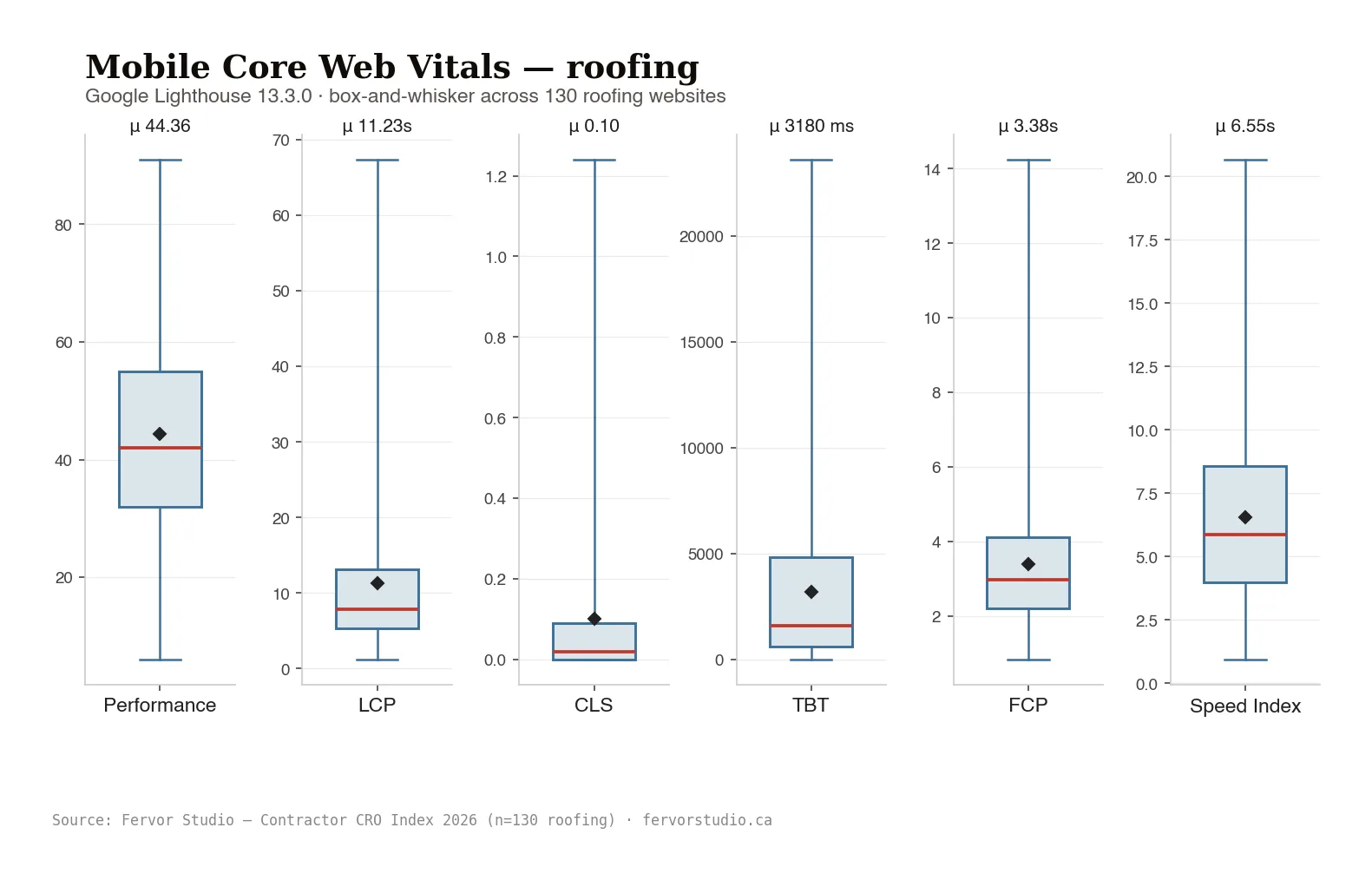
miss Google's mobile load-speed bar
Median mobile load lands at 7.88 seconds. Most of your traffic is on a phone, and most of them are gone before the hero paints.
Fervor Roofing State of the Industry, 2026
0 /100
is the average roofing grade
That is a D. The sites booking the work are not the ones with the biggest crews. They are the ones a few points higher on the things homeowners feel.
Two ways to start
Tell us where you are. We point you at the right next step — no sales call to get there.
Client review
“Nay did an amazing job, you know. He was really patient. He got the work done the way I told him and he was just on point with the website. Pretty straightforward process. No going around the bush. He just did amazing work and I would 100% recommend.”
How Fervor can help
Identify and patch the top conversion killers on your existing site. No full rebuild needed.
Monthly SEO, content, and CRO. Fixed deliverables. No credits, no rollover. The compound growth engine.
Complete website system built to convert storm leads, planned projects, and research-phase homeowners into booked jobs.
GBP optimization, citation building, and review system foundation. The infrastructure that gets you into the Map Pack.
One conversion-built landing page for the referrals, paid clicks, and cold-call leads you send. They land on a page built to book them, not your generic homepage.
Your move
Tell us where you are. We point you at the right next step — no sales call to get there.
Keep going