0
contractor sites graded, one A
Across the whole CRO Index, a single site earned an A. The median landed at a D. The grade gap is a conversion gap.
You already get traffic in St. John's. Most of it leaves without calling. We find the leaks and plug them, so the visitors you've got start booking jobs.
Starts with a Site Inspection, so you see the leaks before any fix begins.
“Attentive, listened to every revision request, delivered on time. Would work with him again.” — Hamza Najam
“Patient, on point, straightforward. Did amazing work. Would 100% recommend.” — Ruben Mederos, HyperTemp HVAC
“Responsive, creative, exceeded expectations. Already seeing greater engagement from our clients.” — George Jeorgy, Jeorgy's Landscape Construction
“Top-tier professionalism, real web design expertise, ideas I hadn't considered. Confidently recommend.” — Aws Nassani, Four Eleven Contracting




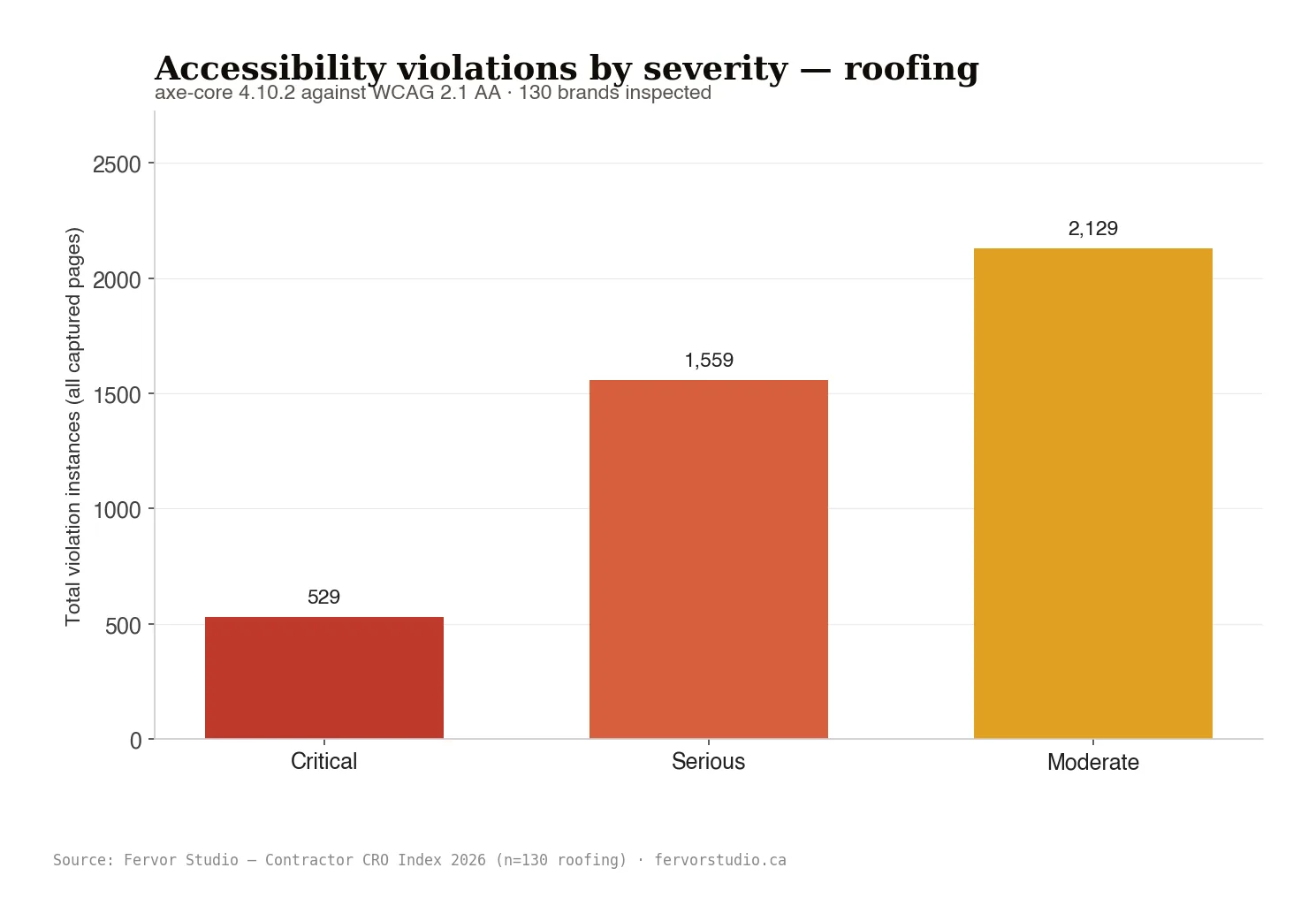
60.8% of roofing sites we tested fail a critical accessibility check
Digital State of the Roofing Industry 2026A grade out of 380 contractor sites
We graded 380 of them against one framework. Exactly one earned an A: Crown Industrial Roofing in Toronto, at 90 out of 100. The rest left money on the table. Here is what separates the top from the bottom.
The local detail
Every angle below comes from how St. John's actually searches, buys, and regulates — built into the page, not bolted on.
Your homepage is a lobby.
Picture the first screen on a phone, because 70% of these clicks come from a phone in a driveway.
Here is where most roofing pages bleed out.
The form gets submitted.
Run the napkin math, because it is the only number that matters to your shop.
You bought the click. A homeowner in Quidi Vidi searched "roof repair near me," tapped your ad, and landed on your homepage. And then they saw eleven menu items, a slideshow of past jobs, an About page link, and a contact form buried below the fold. So they backed out in under six seconds, and you paid for that anyway. That is the leak a roofing landing page in St Johns is built to plug. A homepage answers forty questions for forty visitors. But a paid click has exactly one job to do, and your homepage will not do it.
So let me walk you through what changes when the ad click lands somewhere built to convert, because the math underneath it is brutal and simple. You are already paying for the traffic. The only variable left is how many of those clicks turn into a phone ringing or a form filling, and that number is not fixed.
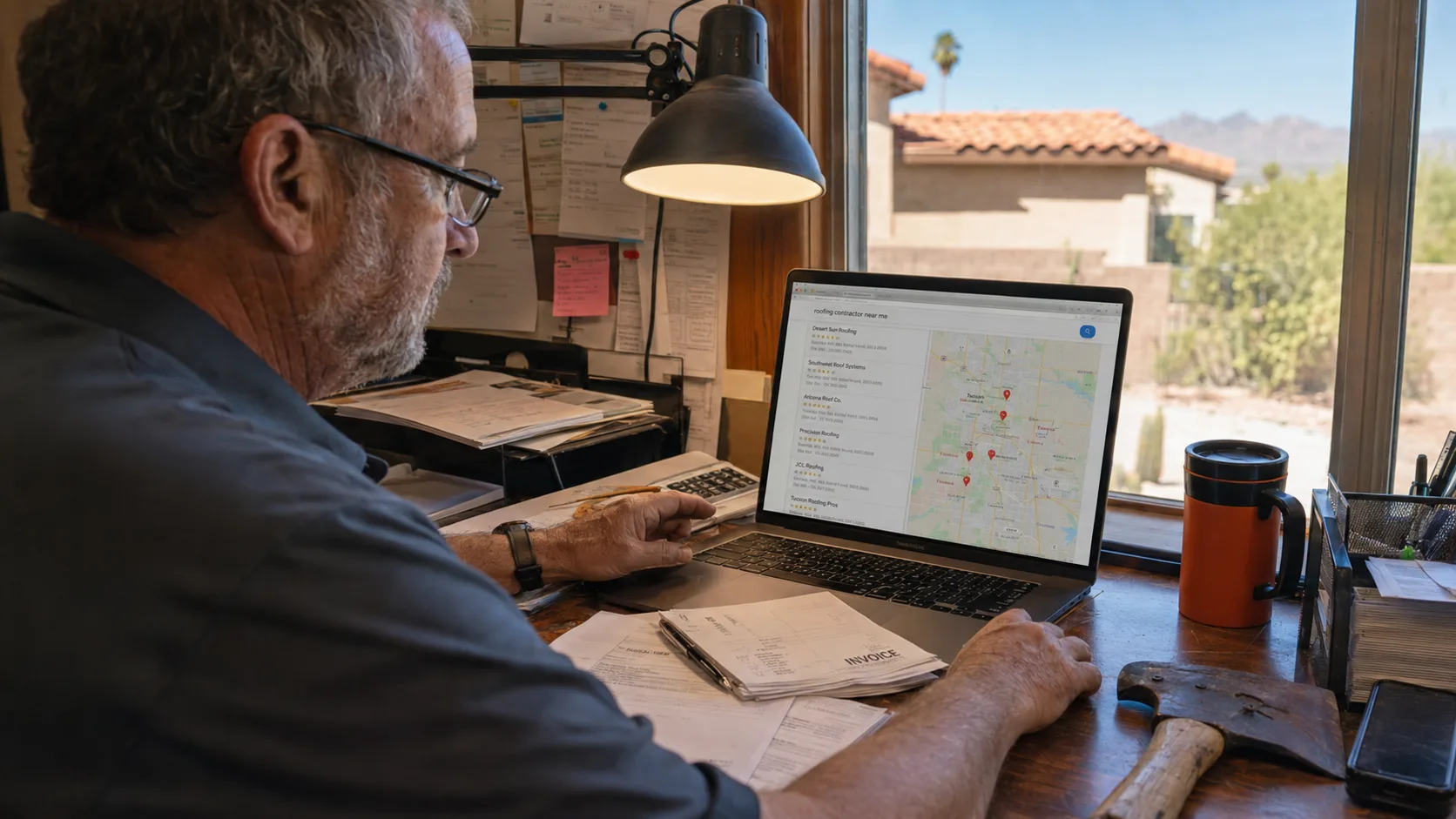
Your homepage is a lobby. It greets everybody and commits to nothing. And that is fine for someone Googling your brand name, but it is poison for a $9 paid click from a stressed homeowner in Mount Pearl who just found a wet patch on the ceiling.
So here is the gap. A homepage carries navigation to twelve other pages, and every one of those links is an exit. But a dedicated page strips the exits down to one action. That focus is the entire reason conversion rates split two and three times apart on the same ad spend.
"97% of roofing customers expect a callback within one week. More than 50% expect a callback within two days." — Roofing Contractor Magazine (2024)
And that expectation starts the second they click. So if the page makes them hunt for your phone number, you have already lost half of them to the next contractor in the ad stack. The homeowner in Paradise is not browsing. They want one thing handled, and you have one screen to prove you can handle it.
A paid click runs hot. That homeowner typed an urgent query, saw a promise in your ad, and expects the page to pick up exactly where the ad left off. But most homepages reset the conversation back to "Welcome, we are a family business since 1998." And so the heat cools, and the click dies.
Picture the first screen on a phone, because 70% of these clicks come from a phone in a driveway. You get a headline, a button, and one piece of proof. That is the whole budget before the homeowner decides to stay or bail.
So the headline matches two things at once. It echoes the exact words from the ad, and it names the worry. "St Johns roof leaking? Same-week inspection, no charge." The homeowner sees their own situation in your headline, and the click holds.
"32% of U.S. homes have roofs in moderate to poor condition, and in hail-prone states average roof lifespan is 15 years vs 22 years in milder western states, with 60% higher loss costs." — Verisk Analytics (2025)
And St Johns roofs take a beating that most of the country never sees. Wind-driven rain off the Atlantic, salt air in the Battery and Quidi Vidi, ice damming through a long winter. So a one-screen page that names that local punishment reads as trustworthy in a way a generic template never will.
Your phone number is a button, not a footer line. And it sticks to the bottom of the screen on mobile, tappable from any scroll position, so a homeowner in Torbay never has to pinch and search. One tap, the phone dials. That sticky call bar alone can lift call volume 20% to 30% on the same traffic, because you removed the friction between intent and action.
The button asks for trust. So proof has to sit beside it, not three scrolls down. A row of five-star Google ratings, a "licensed and insured in NL" line, two photos of real St Johns jobs. The homeowner is weighing risk in real time, and proof beside the ask is what tips them from "maybe" to "calling now."
Here is where most roofing pages bleed out. The form. A homeowner is ready, they reach the form, and it asks for nine fields including "how did you hear about us" and a dropdown of services. So they sigh and close the tab, and your $9 click is gone at the goal line.
"In 2024, 22% of renovating homeowners undertook roofing upgrades, with a median spend of $13,000." — Houzz Inc. (2025)
A $13,000 job, lost over four extra form fields. So cut the form to four: name, phone, address, and what is wrong. That is everything you need to call back and book the visit, and every field past four costs you roughly 10% of completions.
Name, phone, address, what is wrong. And the "what is wrong" field is a single open box, not a forced menu, because a homeowner in Goulds describing "shingles in the yard after last night" tells you more than any dropdown. So you book faster, and they feel heard instead of processed.
One page cannot serve every roofing buyer, because their worries are not the same. So you run a different page behind each ad.
"Among renovating homeowners, 44% add or redo a roof as part of their exterior projects." — Houzz Inc. (2024)
The storm and emergency page leads with speed and a 24-hour line. The full replacement page leads with financing and warranty and a gallery of finished St Johns roofs. And the energy-efficiency page leads with attic heat loss and winter heating bills. So each ad sends its click to the worry it was written for, and conversion climbs because the message never breaks.
The form gets submitted. So now the clock starts, and it is faster than you think. A homeowner who just filled four fields is sitting there with their phone in hand, and they will fill the next contractor's form in ninety seconds if you go quiet.
"More than 50% expect a callback within two days." — Roofing Contractor Magazine (2024)
But two days is the patience ceiling, not the winning move. So the win is calling back in five minutes, while the page is still open on their screen. The page should text them an instant "got it, calling you now" the second they hit submit, because silence after submit reads as "they did not get it," and they keep dialing down the list.
A lead that sits an hour is a different lead. The homeowner in Kilbride has moved on, called two others, maybe booked one. And you still paid the same $9 for that click. So a slow callback does not just lose the job, it wastes the ad dollar that bought the chance. Speed to lead is where the cheapest roofing leads in St Johns are made or wasted.
Run the napkin math, because it is the only number that matters to your shop. Say you spend $2,000 a month on roofing ads in St Johns and pull 200 clicks at $10 each. Your homepage converts those at 4%, so eight leads. And you close one in three, so roughly three jobs.
"The median spend on roofing upgrades in 2024 was 8% higher than in 2023 (median $13,000 in 2024)." — Houzz Inc. (2025)
Now a focused page converts the same 200 clicks at 8%. So sixteen leads, six jobs, on the exact same $2,000. You did not spend a dollar more. You just stopped sending hot clicks to a lobby, and three extra roofs at a $13,000 median is real money on top of spend you already committed.
Some owners hold back, sure the homeowner cannot pay. But the spend is already happening across the trade.
"Among homeowners who renovated in 2024, 84% used cash from savings and 29% used a credit card to fund renovation projects (multiple funding sources allowed)." — Houzz Inc. (2025)
So the money is there. The homeowner in Pleasantville is funding the roof from savings, and 84% of them are paying cash. Your page just has to be the one they call before someone else gets the booking.
You do not have to sell the material on the page, because the homeowner already leans one way.
"Among homeowners undertaking a roofing project, 63% choose asphalt roofing material (dimensional shingles 34%, three-tab shingles 19%, luxury shingles 10%), while 14% choose metal and 11% choose synthetic material or rubber." — Houzz Inc. (2024)
So a focused page leads with the booking, not a material catalog. And the scale of the category backs the bet.
"From 2021–2023, homeowners spent $93.5B on roofing across 8.3 million projects (AHS-based estimates)." — U.S. Census Bureau and U.S. Department of Housing and Urban Development (2024)
So you have a sense of the leaks now. The lobby homepage, the nine-field form, the slow callback, the one-page-fits-all ad spend. And the fix is one focused page per offer, a four-field form, a sticky call button, and a callback inside five minutes.
We map the worst leak first, because that is where the fastest money is. We looked at the same patterns across an inspection of roofing websites across the trade, and the same gaps show up shop after shop: hidden phone numbers, bloated forms, homepages catching paid clicks they were never built to hold.
You can see your own gaps before you spend another ad dollar. We run a free Site Inspection of your roofing page, no sales call required, and hand you the list of what is leaking and what it costs you in lost St Johns bookings every month. Then you decide what to fix and when. The ad spend is already out the door. So the only question left is how many of those clicks you keep.
The evidence
 Read the full report →
 0
contractor sites graded, one A
Across the whole CRO Index, a single site earned an A. The median landed at a D. The grade gap is a conversion gap.
0 %
of roofing sites fail a critical accessibility check
Scored against WCAG 2.1 AA with axe-core. A page that blocks a screen reader also blocks a paying customer.
Fervor Roofing State of the Industry, 2026
0 %
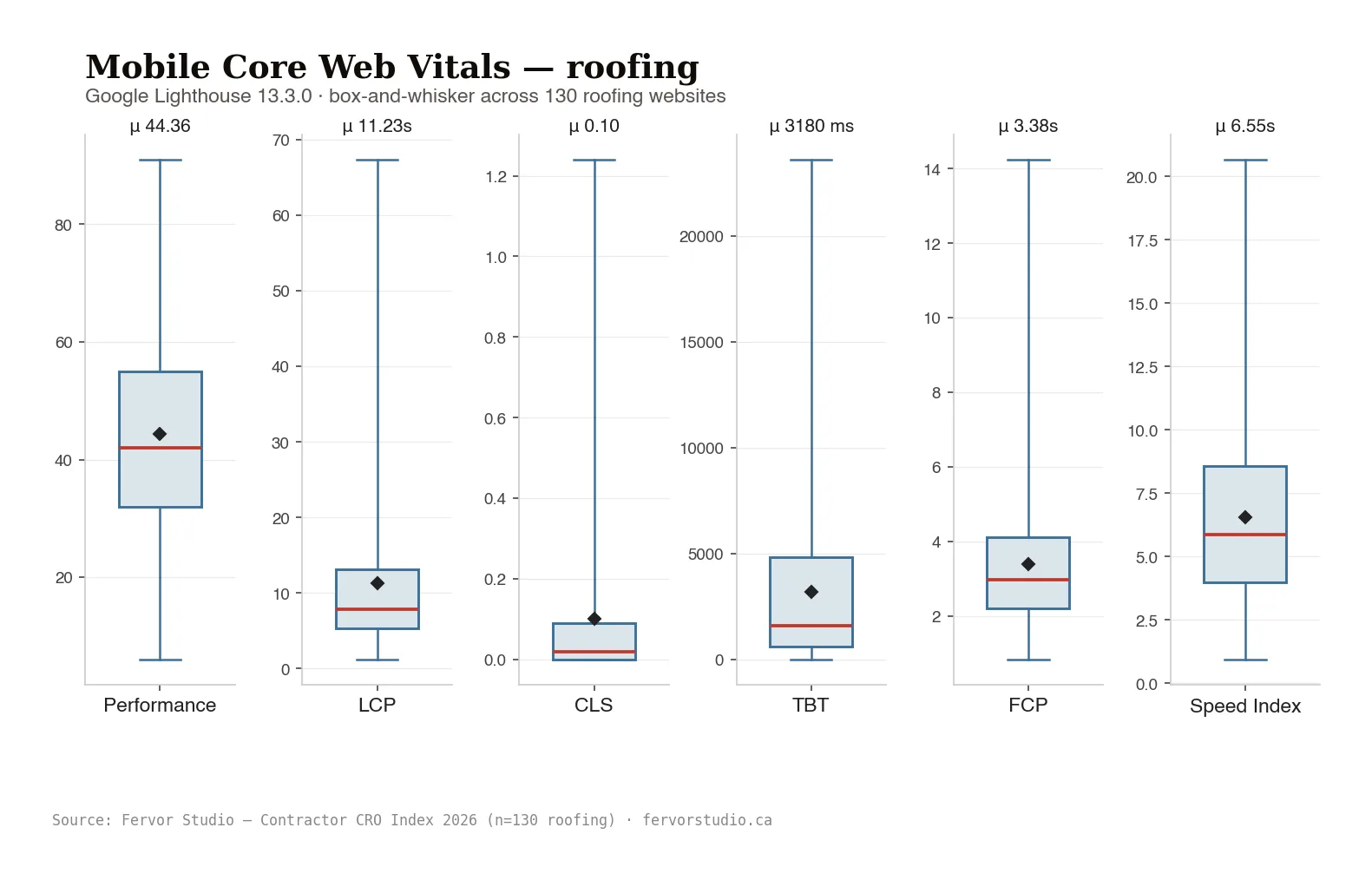
miss Google's mobile load-speed bar
Median mobile load lands at 7.88 seconds. Most of your traffic is on a phone, and most of them are gone before the hero paints.
Fervor Roofing State of the Industry, 2026
0 /100
is the average roofing grade
That is a D. The sites booking the work are not the ones with the biggest crews. They are the ones a few points higher on the things homeowners feel.
Two ways to start
Tell us where you are. We point you at the right next step — no sales call to get there.
Client review
“Nay did an amazing job, you know. He was really patient. He got the work done the way I told him and he was just on point with the website. Pretty straightforward process. No going around the bush. He just did amazing work and I would 100% recommend.”
How Fervor can help
Identify and patch the top conversion killers on your existing site. No full rebuild needed.
Monthly SEO, content, and CRO. Fixed deliverables. No credits, no rollover. The compound growth engine.
Complete website system built to convert storm leads, planned projects, and research-phase homeowners into booked jobs.
GBP optimization, citation building, and review system foundation. The infrastructure that gets you into the Map Pack.
One conversion-built landing page for the referrals, paid clicks, and cold-call leads you send. They land on a page built to book them, not your generic homepage.
Your move
Tell us where you are. We point you at the right next step — no sales call to get there.
Keep going