0
contractor sites graded, one A
Across the whole CRO Index, a single site earned an A. The median landed at a D. The grade gap is a conversion gap.
You're getting clicks in St. John's. They're just not calling. We rebuild your site around the one job that matters: turning a visitor into a booked job.
Starts with a Site Inspection, so you see the plan before any build begins.
“Patient, on point, straightforward. Did amazing work. Would 100% recommend.” — Ruben Mederos, HyperTemp HVAC
“Responsive, creative, exceeded expectations. Already seeing greater engagement from our clients.” — George Jeorgy, Jeorgy's Landscape Construction
“Top-tier professionalism, real web design expertise, ideas I hadn't considered. Confidently recommend.” — Aws Nassani, Four Eleven Contracting



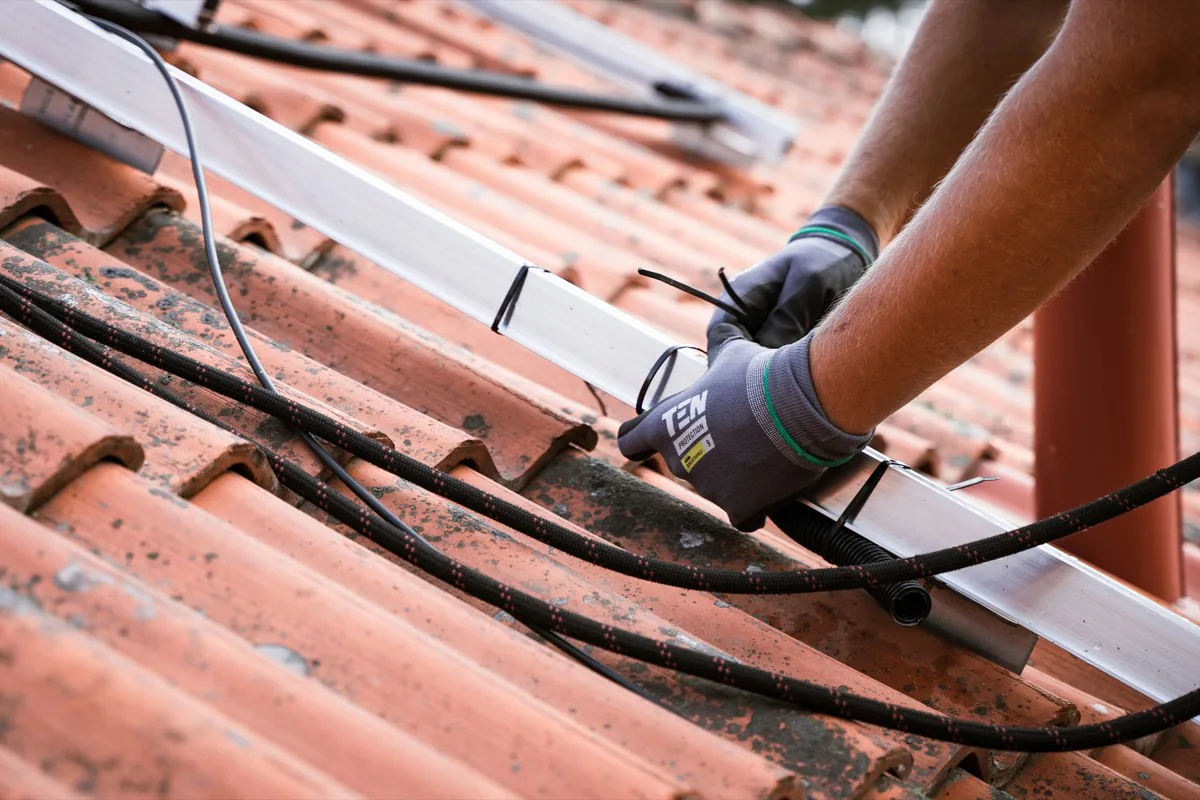
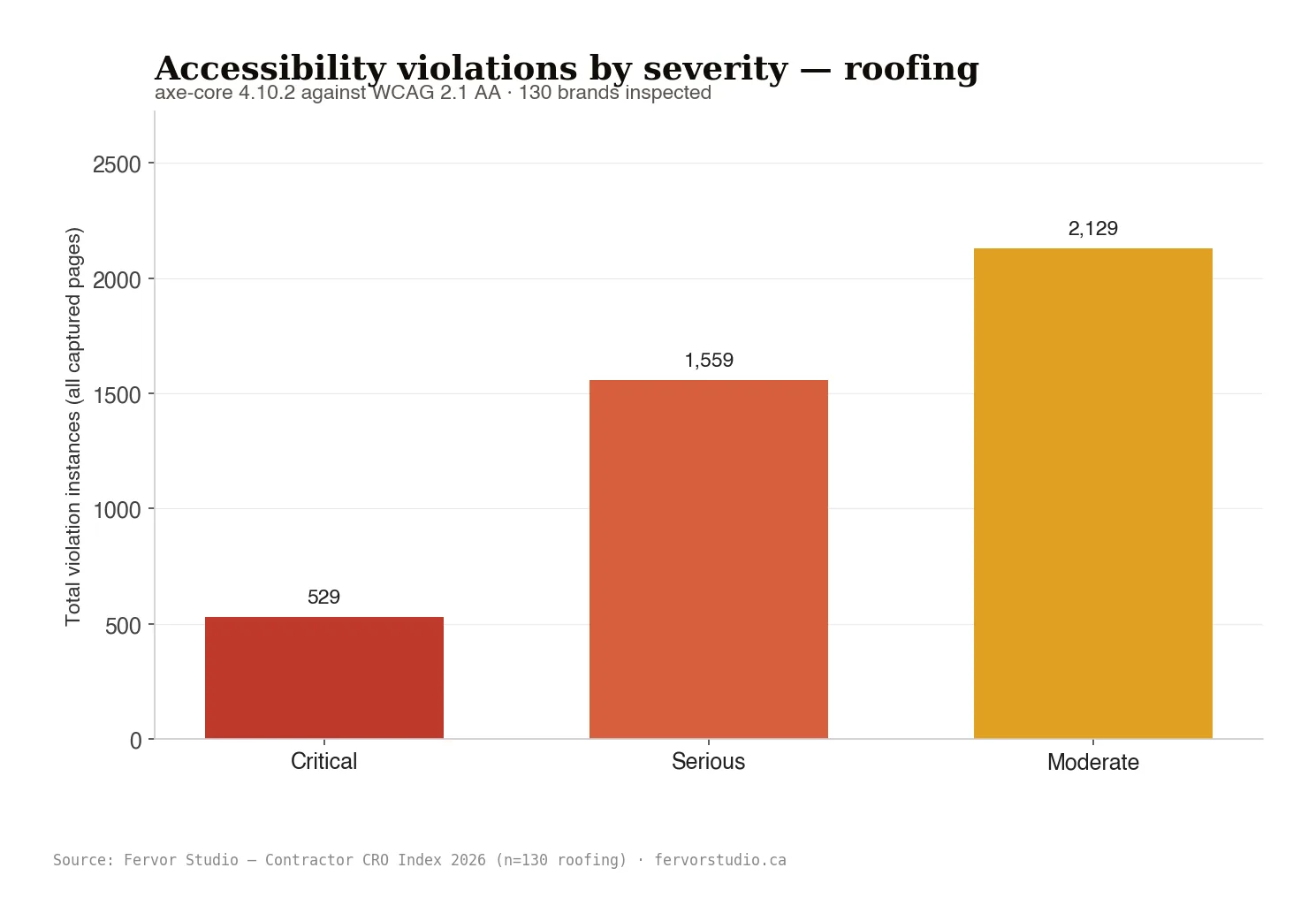
60.8% of roofing sites we tested fail a critical accessibility check
Digital State of the Roofing Industry 2026A grade out of 380 contractor sites
We graded 380 of them against one framework. Exactly one earned an A: Crown Industrial Roofing in Toronto, at 90 out of 100. The rest left money on the table. Here is what separates the top from the bottom.
The local detail
Every angle below comes from how St. John's actually searches, buys, and regulates — built into the page, not bolted on.
Roofing demand doesn’t trickle in.
Here’s the test that matters.
You’ve seen the eleven-field form.
This is where most owners get stuck.
Here’s the mistake that costs St.
A nor'easter rolls off the Atlantic, a shingle bundle peels off a neighbour's roof in Georgestown, and the homeowner two doors down pulls out her phone before the wind even drops. And that four-minute window is the whole game. So the roofing web design St John's owners should care about comes down to one thing: whether your site loads on cellular in her driveway, shows a phone number she can tap, and turns her panic into a booked estimate before she bounces to the next result. A prettier homepage does none of that. You run a good crew of six. The question is whether your site is awake when she searches.
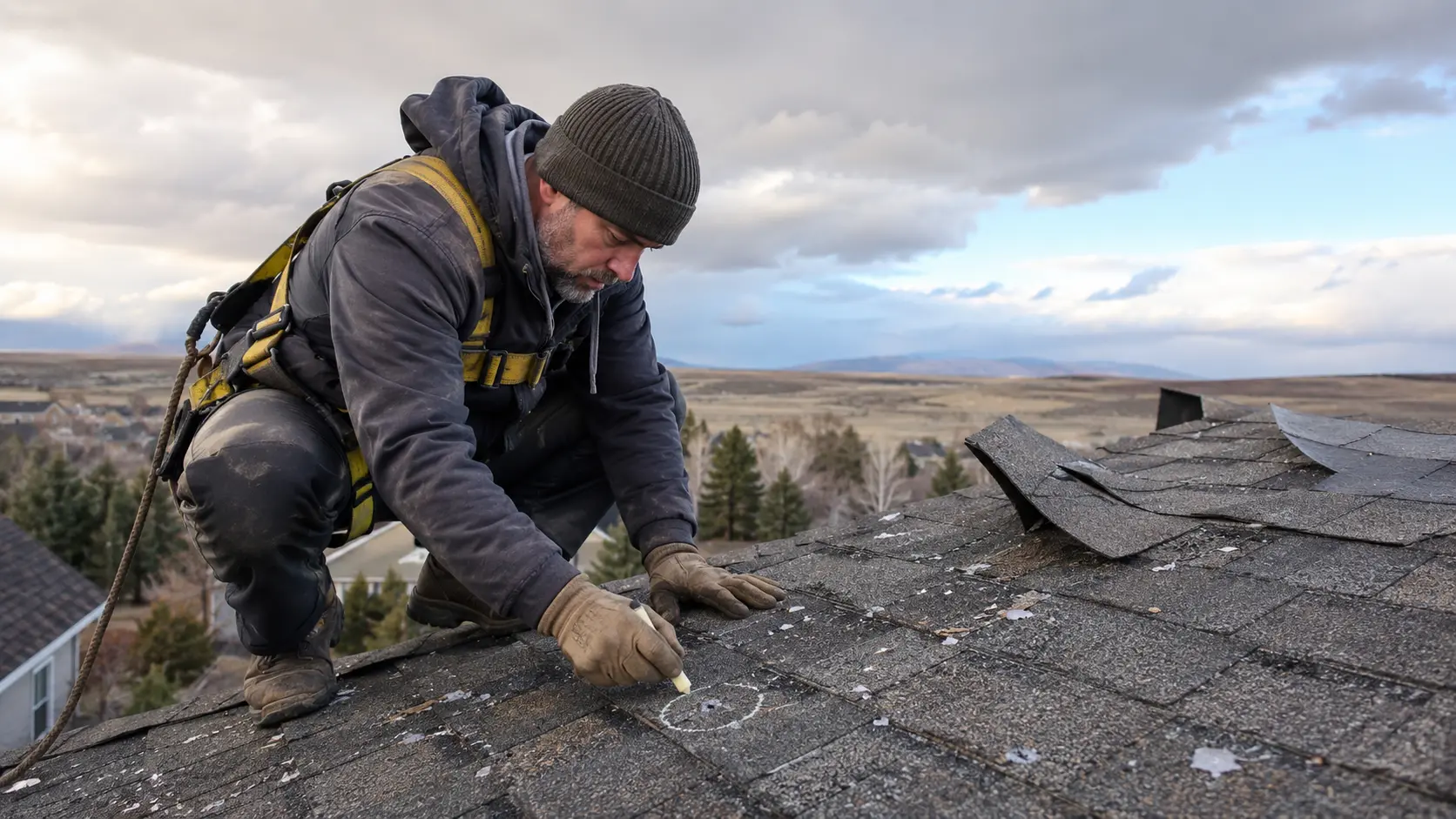
Roofing demand doesn't trickle in. It spikes. A bad December storm in St. John's can drive more roof searches in three days than the previous three months combined, and most of those searchers are deciding inside ten minutes.
"97% of roofing customers expect a callback within one week. More than 50% expect a callback within two days." — Roofing Contractor Magazine (2024)
So speed isn't a nice-to-have. Half of these people have already moved on if you make them wait. And the homeowner standing in her driveway in the Battery with wet socks isn't reading your About page. She's skimming for one thing: can this roofer come look at it today.
The Atlantic weather here is brutal on roofs. Salt-laden wind, the famous RDF (rain, drizzle, fog), and a freeze-thaw cycle that pries shingles loose all winter. That's industry-wide pressure too.
"In hail-prone states, average roof lifespan is 15 years vs 22 years in milder western states; 38% of U.S. homes have roofs in moderate to poor condition (Roofing Contractor) with 60% higher loss costs" — Verisk Analytics (2025)
But a brochure-style site treats every visitor the same calm way, whether it's a storm Tuesday or a quiet July. And that mismatch is exactly where you lose the search.
Picture a $4,000 reroof. If your site takes nine seconds to load over a weak Kenmount Road signal, she's gone by second four. So one bounced visitor a day during storm week is one lost $4,000 job a day. Over a five-day surge, that's $20,000 walking to the roofer whose site opened first. You didn't lose the bid. You lost the click.
Then there's the brochure-site trap. You paid someone $1,200 for a site three years ago. It has a gallery, a mission statement, and a contact form buried under the fold. But it was built to look fine on a laptop, not to convert a panicked homeowner on a phone. So it sits there, technically "live," doing nothing the week you need it most.
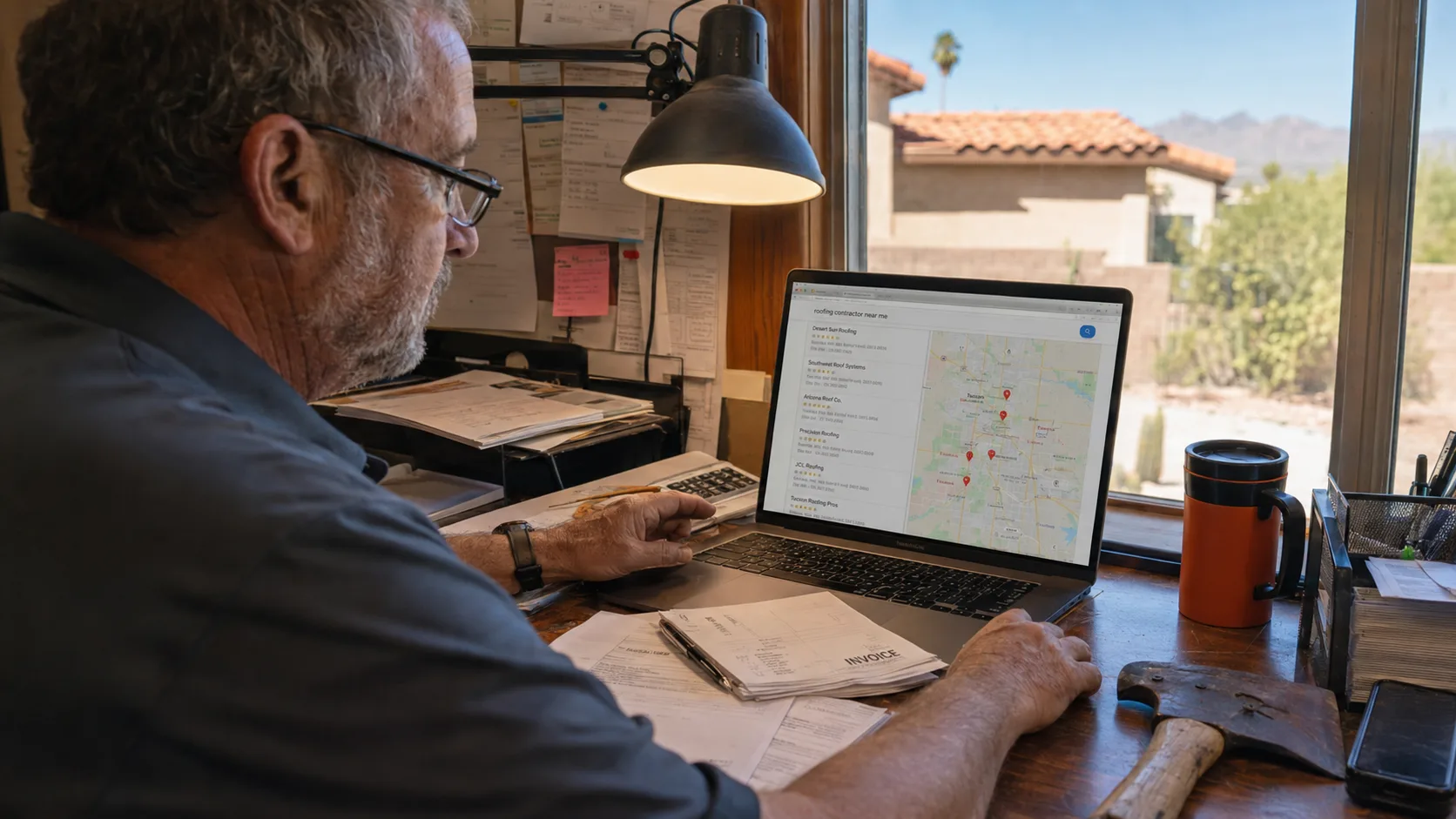
Here's the test that matters. Stand in a driveway in Rabbittown, drop to one bar of signal, and open your own site. Count the seconds. If you hit four before the phone number shows, you've already lost the slow searchers, and slow searchers are most of them during a storm.
Here's what trips up nearly every St. John's roofer. You test your site on shop Wi-Fi, see it load in a second, and assume it's fast. But your customer isn't on your Wi-Fi. She's outside, on cellular, often in weather. Mobile-first means the phone number, the call button, and the form load first, before the hero photo and the gallery and the animated logo.
A responsive theme that just reflows your desktop layout onto a smaller screen still ships the whole heavy page. So the photo gallery still downloads. The map widget still loads. The homeowner in Mount Pearl still waits. Real mobile-first roofing web design ships the lightweight, action-first version to the phone and saves the heavy stuff for desktop.
The single highest-value pixel on a roofing site is a tappable phone number she sees without scrolling. One tap, the call dials. No form, no menu, no "contact us" page. When 50% of your callers expect a response within two days, the fastest path to your phone wins the job. And a buried number on a mobile screen is the same as no number.
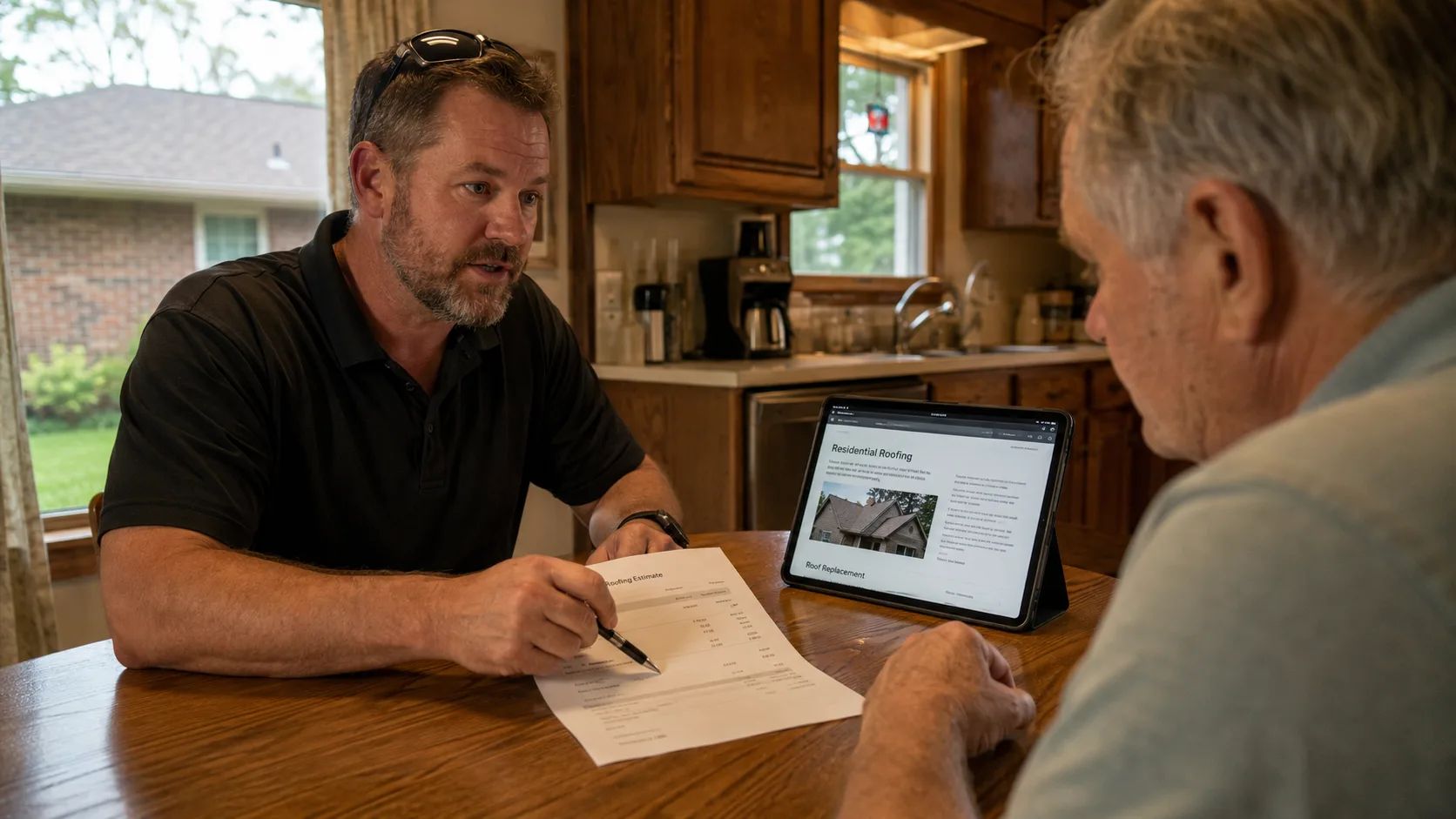
You've seen the eleven-field form. Name, email, phone, address, roof type, roof age, square footage, preferred date, how-did-you-hear, message, and a CAPTCHA. Every field is a reason to quit. So a panicked homeowner fills two and abandons the rest.
The form a storm searcher will finish asks for three things: name, phone, and "what happened." That's it. You get the address and the roof details on the callback. The form's only job is to capture the phone number before she bounces, so don't make it do anything else.
A three-field form on a fast page can triple your completion rate versus the eleven-field version. Run the math. If 20 storm-week visitors hit your site daily and your long form converts 5%, that's one lead. A short form at 15% is three. Across a five-day surge, that's the difference between five jobs and fifteen.
A homeowner in Churchill Square doesn't trust a form in a vacuum. She trusts the form when a five-star review and a real photo of a finished St. John's roof sit right next to it. So put the proof beside the button, not on a separate testimonials page nobody visits.
"Among renovating homeowners, 44% add or redo a roof as part of their exterior projects." — Houzz Inc. (2024)
And real roof photos beat stock every time. Show the asphalt shingle job you finished in Quidi Vidi last fall, because that's the material most of her neighbours are choosing.
"Among homeowners undertaking a roofing project, 63% choose asphalt roofing material (dimensional shingles 34%, three-tab shingles 19%, luxury shingles 10%), while 14% choose metal and 11% choose synthetic material or rubber." — Houzz Inc. (2024)
This is where most owners get stuck. A drag-and-drop template builder costs $30 a month and gets you live in a weekend. So why would you pay more for a custom build? Fair question.
A template gets a site online. It doesn't get it fast, and it rarely gets the storm-week mechanics right. The page weight is baked in. The form is whatever the builder ships. And you're sharing the exact same layout with every other roofer who picked that theme.
A template is fine in one case. If you're a brand-new one-truck operation testing whether you even want a web presence, it's a reasonable first step. There's no shame in it. But you'll outgrow it the first storm week it costs you a $4,000 job because it loaded too slow.
A growing shop with four to ten staff is past the experiment stage. You're spending real money on a roof every week and the demand is there.
"In 2024, 22% of renovating homeowners undertook roofing upgrades, with a median spend of $13,000." — Houzz Inc. (2025)
So at a $13,000 median project, you need your site to win roughly one extra job a year to pay for a custom build. One. Everything past that is profit. And the spend on roofs keeps climbing.
"The median spend on roofing upgrades in 2024 was 8% higher than in 2023 (median $13,000 in 2024)." — Houzz Inc. (2025)
There's a funding reality that changes how your form should work. And the money side moves fast too. These jobs rarely run through some long financing approval. They're paid fast, which means the buying decision is fast too.
"Among homeowners who renovated in 2024, 84% used cash from savings and 29% used a credit card to fund renovation projects (multiple funding sources allowed)." — Houzz Inc. (2025)
So she's ready to book the moment she trusts you. Your site's only job is to not get in the way.
Here's the mistake that costs St. John's roofers the most. They hire a designer to build the site, then a separate SEO person to "do the rankings." Two vendors, two invoices, two people pointing at each other when the phone stays quiet.
But the storm searcher in Goulds never types your company name. She types "roof repair near me," and Google decides whether you show up based on how your site is built. The design and the local SEO are the same wall. You can't paint half of it.
And here's why the split fails. A pretty site that loads slow ranks poorly, because page speed is a ranking signal and a conversion lever at the same time. So the designer who ignores speed hands the SEO person an unwinnable job. And the SEO person bolting keywords onto a slow brochure site is rearranging furniture in a house with no foundation.
When the same team builds the site and the local search presence together, the address markup, the service-area pages, the page speed, and the Google Business Profile all pull in one direction. The volume of roofing work out there is enormous.
"From 2021–2023, homeowners spent $93.5B on roofing across 8.3 million projects (AHS-based estimates)." — U.S. Census Bureau and U.S. Department of Housing and Urban Development (2024)
So your share of the Torbay Road and Paradise searches comes down to one question: does your site show up fast, and does it convert when it does.
We start by looking, not pitching. Before we ever quote a roofing web designer St John's owners can hire, we run the same test you should: open your live site on cellular, count the seconds, find the buried phone number, and count your form fields. Then we show you exactly where the storm-week leads leak out.
We've done this across the trade. You can see our inspection of roofing websites across the trade, where we scored real roofing sites on speed, mobile, and conversion mechanics. The patterns repeat. Slow loads, hidden numbers, eleven-field forms, proof stranded on a page nobody opens.
So here's the offer. We'll do a free Site Inspection of your current roofing website. No sales call to get it. We send you the findings, you read them, and you decide what to do next. If the inspection shows your site is already catching the storm search, we'll tell you that too. Either way, you'll know exactly what your site does the next time the wind comes off the water and a homeowner in your service area reaches for her phone.
The evidence
 Read the full report →
 0
contractor sites graded, one A
Across the whole CRO Index, a single site earned an A. The median landed at a D. The grade gap is a conversion gap.
0 %
of roofing sites fail a critical accessibility check
Scored against WCAG 2.1 AA with axe-core. A page that blocks a screen reader also blocks a paying customer.
Fervor Roofing State of the Industry, 2026
0 %
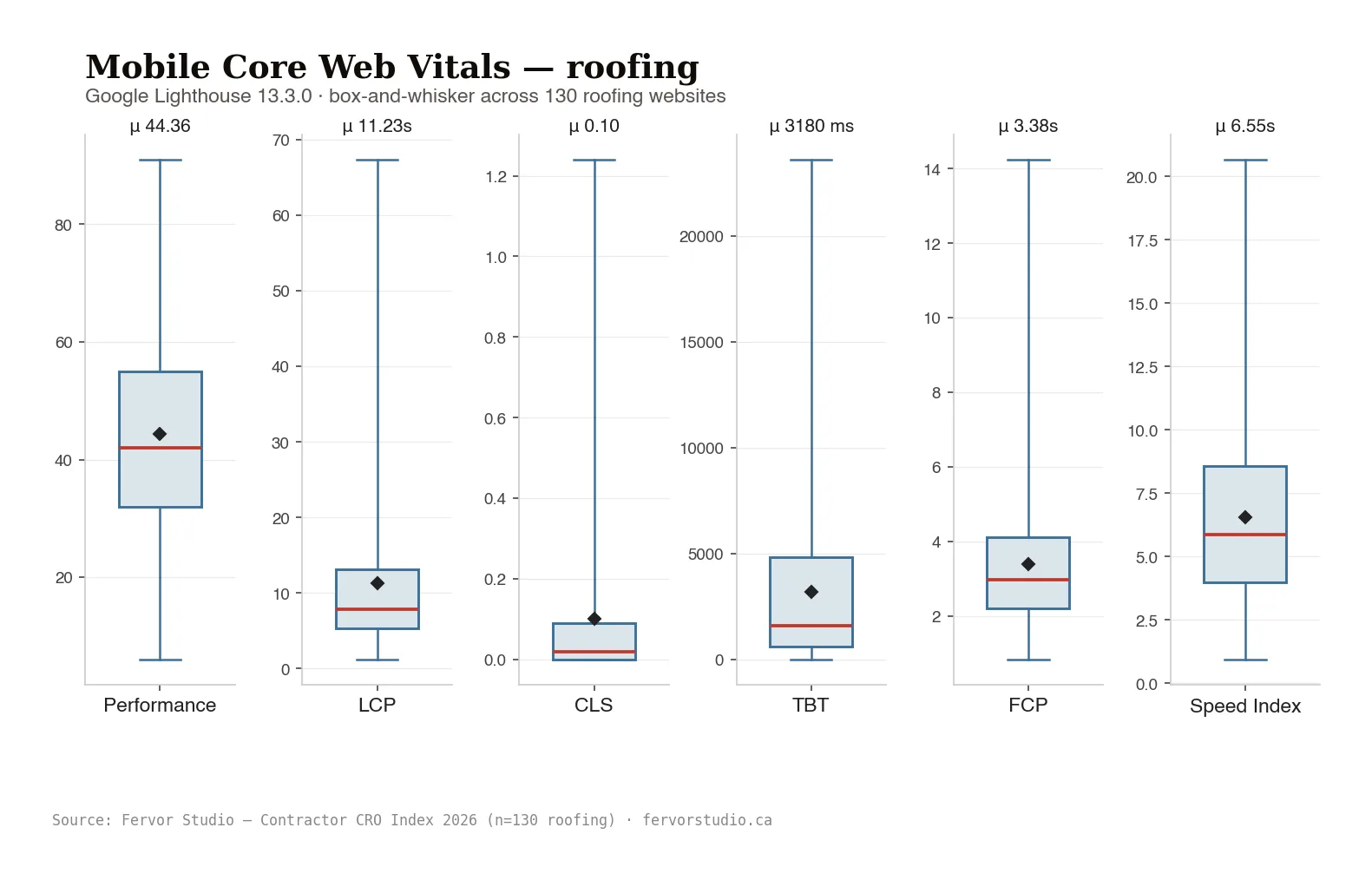
miss Google's mobile load-speed bar
Median mobile load lands at 7.88 seconds. Most of your traffic is on a phone, and most of them are gone before the hero paints.
Fervor Roofing State of the Industry, 2026
0 /100
is the average roofing grade
That is a D. The sites booking the work are not the ones with the biggest crews. They are the ones a few points higher on the things homeowners feel.
Two ways to start
Tell us where you are. We point you at the right next step — no sales call to get there.
Client review
“Nay did an amazing job, you know. He was really patient. He got the work done the way I told him and he was just on point with the website. Pretty straightforward process. No going around the bush. He just did amazing work and I would 100% recommend.”
How Fervor can help
Complete website system built to convert storm leads, planned projects, and research-phase homeowners into booked jobs.
Identify and patch the top conversion killers on your existing site. No full rebuild needed.
Monthly SEO, content, and CRO. Fixed deliverables. No credits, no rollover. The compound growth engine.
GBP optimization, citation building, and review system foundation. The infrastructure that gets you into the Map Pack.
One conversion-built landing page for the referrals, paid clicks, and cold-call leads you send. They land on a page built to book them, not your generic homepage.
Your move
Tell us where you are. We point you at the right next step — no sales call to get there.
Keep going