0
contractor sites graded, one A
Across the whole CRO Index, a single site earned an A. The median landed at a D. The grade gap is a conversion gap.
Right now, someone in Salt Lake City is Googling "roofer near me." We get you showing up first — then turn that click into a booked job.
A written report and a ranked fix list, in about three days.
“Patient, on point, straightforward. Did amazing work. Would 100% recommend.” — Ruben Mederos, HyperTemp HVAC
“Responsive, creative, exceeded expectations. Already seeing greater engagement from our clients.” — George Jeorgy, Jeorgy's Landscape Construction
“Top-tier professionalism, real web design expertise, ideas I hadn't considered. Confidently recommend.” — Aws Nassani, Four Eleven Contracting



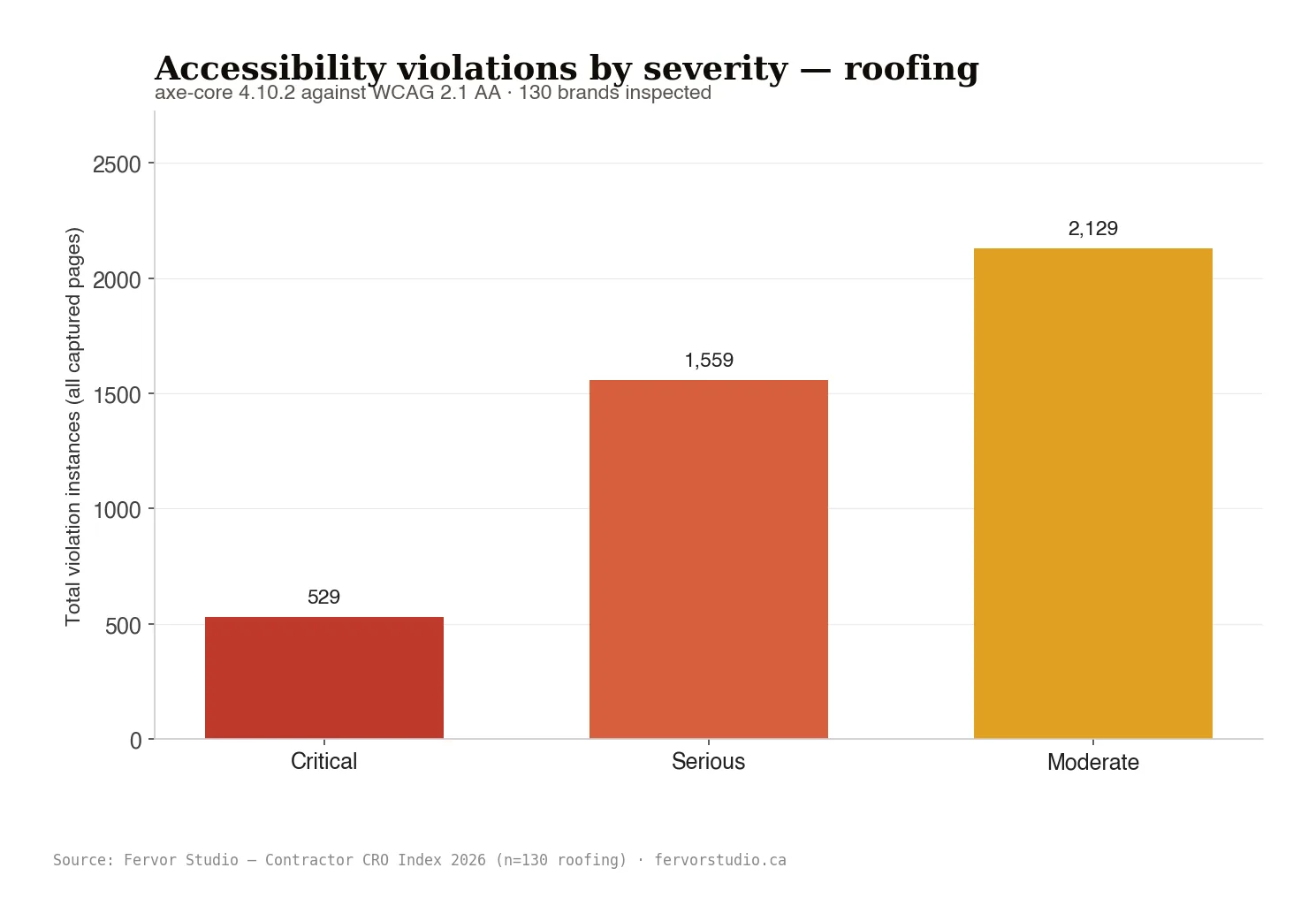
60.8% of roofing sites we tested fail a critical accessibility check
Digital State of the Roofing Industry 2026A grade out of 380 contractor sites
We graded 380 of them against one framework. Exactly one earned an A: Crown Industrial Roofing in Toronto, at 90 out of 100. The rest left money on the table. Here is what separates the top from the bottom.
The local detail
Every angle below comes from how Salt Lake City actually searches, buys, and regulates — built into the page, not bolted on.
But the valley is its own beast.
So let us look at what the buyer sees.
But ranking the profile is only step one.
So is search work worth it for a shop your size?
But every contractor’s inbox is full of pitches from agencies promising page-one rankings in 90 days.
So if you wanted to start tomorrow, here is the order that works.
So you own a roofing company along the Wasatch Front. Your trucks run out of West Valley or Murray, your crews chase hail repairs from Sugar House up to Cottonwood Heights, and your wife keeps asking why the phone went quiet in July. The honest answer is almost always the same. Your shop is invisible on the map that the homeowner sees first, and the three competitors above you are not better roofers. They are just easier to find. Roofing SEO Salt Lake City work fixes that gap, but only if you treat it like a system instead of a vibe.
So this page is for the owner who already runs a real crew, books 3 to 7 reroofs a week, and wants the next 50 jobs to come from search instead of door knocks. And you will see specific tactics, real neighborhoods, and the napkin math that tells you whether any of this is worth your Tuesday afternoon.
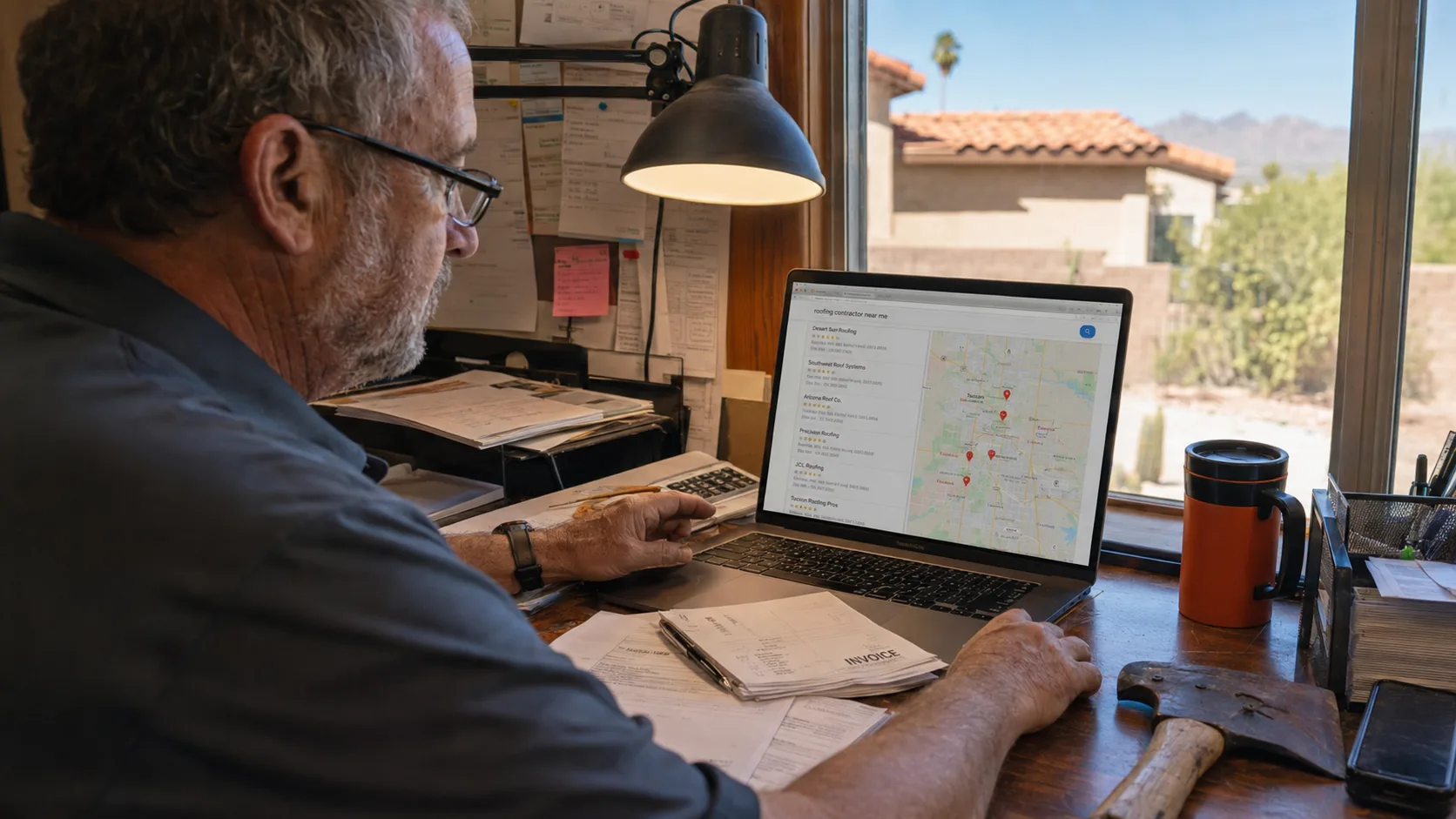
But the valley is its own beast. You sell to homeowners in Avenues bungalows from 1908, Daybreak townhomes from 2018, and tile-roof builds in Holladay that need a specialist nobody in Sandy has on staff. So the buyer in Federal Heights wants a slate quote and a designer's drawing. But the buyer in Magna wants the storm-damage check to clear by Friday. And one search bar serves all of them, and the homeowner is filtering by trust signals before you ever pick up the phone.
"97% of roofing customers expect a callback within one week. More than 50% expect a callback within two days." — Roofing Contractor Magazine (2024)
So speed matters before any keyword does. Because if your office returns leads on Monday morning after they came in Saturday night, every dollar you spend on rankings funds your competitor. And half the search audience already booked someone else by then.
And the climate writes a lot of your content for you. So Wasatch homes get pummeled with summer hail off the Oquirrhs, then sit through 40 freeze-thaw cycles a winter. And asphalt curls early here, valleys split at year 14, with the Verisk hail map keeping the entire Salt Lake basin in the moderate-loss tier.
"In hail-prone states, average roof lifespan is 15 years vs 22 years in milder western states; 38% of U.S. homes have roofs in moderate to poor condition (Roofing Contractor) with 60% higher loss costs" — Verisk Analytics (2025)
So your service pages should say the year, the material, and what fails first. But generic "we offer quality shingles" copy gets skipped by both buyers and the algorithm.
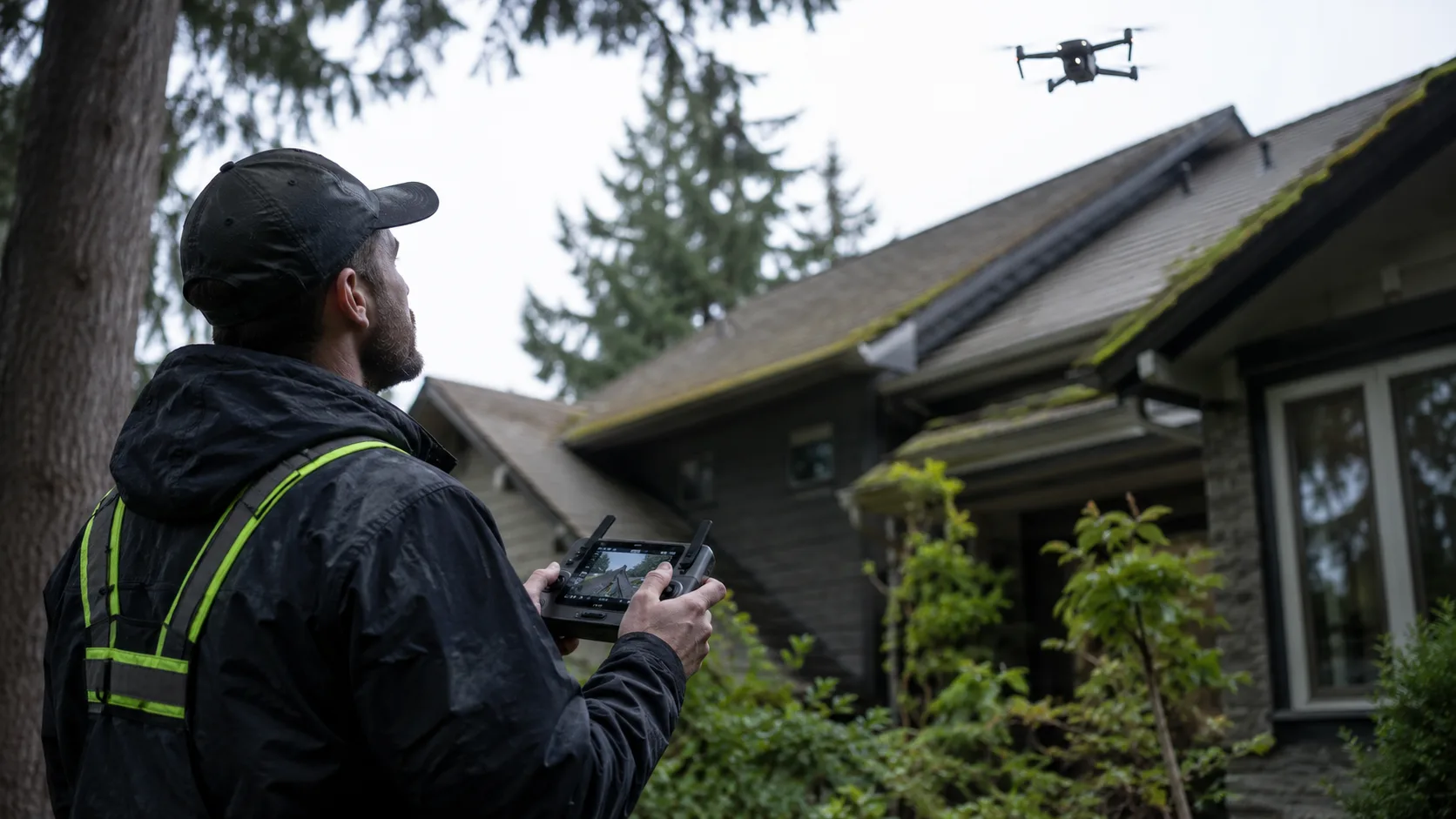
So let us look at what the buyer sees. So a homeowner in 84109 types "roof leak repair near me" on a Wednesday at 9pm. And Google shows three local listings above the fold, two ads at the very top, and then the organic blue links. So if your shop is not in those three local cards, you are competing for the 17% of clicks that scroll. But that is not a strategy. Because that is a tax.
So three things decide who lands in those cards. Proximity to the searcher, the strength of your Google Business Profile, and a layer of trust signals from the wider web. But plenty of shops fix the first two, then quit before doing the third, and wonder why a competitor in Bountiful outranks them in Holladay.
"Among homeowners undertaking a roofing project, 63% choose asphalt roofing material (dimensional shingles 34%, three-tab shingles 19%, luxury shingles 10%), while 14% choose metal and 11% choose synthetic material or rubber." — Houzz Inc. (2024)
And that mix matters because your map pack listing competes on relevance to the EXACT material the buyer typed. "Asphalt shingle replacement Sugar House" and "standing seam metal Federal Heights" should land on different service pages, both linked from your homepage in plain text.
Yet most owners treat the profile like a yellow-pages listing. Photo from 2019, hours that say "open" on the Sabbath when you take Sundays off, no Q&A, no products tab. But the profile is now a mini-website. So fill every field. And post weekly. Answer the questions yourself before a competitor does. And add geo-tagged photos from real job sites in Rose Park, Liberty Wells, and Glendale so Google sees you working those zip codes.
Reviews matter, but volume alone gets you nowhere if your last 1-star review is unanswered from 18 months ago. So read your bad reviews like a quality-control log. Because if three people mention sloppy cleanup, that is a process problem, not a marketing problem, and fixing it gives you the next 50 5-stars without paying for them.
But ranking the profile is only step one. And the buyer who finds you on the map then clicks through to your site, where most shops along the Wasatch lose the job. So Salt Lake city roofing contractor SEO is really three layers stacked on top of each other. The profile, the website, and the off-site signals telling Google your shop is a real business with real customers.
"From 2021–2023, homeowners spent $93.5B on roofing across 8.3 million projects (AHS-based estimates)." — U.S. Census Bureau and U.S. Department of Housing and Urban Development (2024)
So the demand is there. The question is whether your shop is the one collecting it. Here is what each layer should do.
Your site is the closer. So it should load fast on a phone (your buyer is on her phone, in her driveway, looking up at the curled ridge cap), it should show real photos of real Utah roofs, and it should make calling you the easiest action on every page. But plenty of contractor sites bury the phone number in a contact form that takes 4 fields and 18 seconds. So cut that to a tap-to-call button above the fold and watch your conversion rate move 30 percent the same week.
And every service you sell needs its own page. Asphalt reroof, tile repair, hail damage claim help, gutter and downspout, skylight, flat roof for the older flats in Marmalade. One page per service, one page per neighborhood you genuinely serve, none of them thin. Three hundred words of generic copy is worse than nothing because it tells Google your shop is shallow.
Yet the page itself is only half the work. So Google still wants outside corroboration. Local citations on the Utah Better Business Bureau, the BBB of Utah, ContractorsLicensing.utah.gov verification, the Salt Lake Chamber. And mentions in the Deseret News or the Salt Lake Tribune when you sponsor a Little League team in Rose Park. Because these are the receipts that say "real business, not a fly-by-night."
So is search work worth it for a shop your size? Run the napkin math. A reroof in your service area averages around $14,000 once you weight asphalt against the occasional cedar shake or metal in the Avenues. And your gross margin on that job is, conservatively, 30 percent, so $4,200 of contribution.
"In 2024, 22% of renovating homeowners undertook roofing upgrades, with a median spend of $13,000." — Houzz Inc. (2025)
And one extra reroof a week from organic search pays for a full year of search work three times over. So two extra reroofs a week and you are funding the next truck. Because the work compounds. A page that ranks today still ranks in 18 months, unlike a Google ad that stops the second you stop paying.
"The median spend on roofing upgrades in 2024 was 8% higher than in 2023 (median $13,000 in 2024)." — Houzz Inc. (2025)
So prices are rising too, which means the math gets friendlier every quarter you stay invested. And a shop that ranked in the map pack last year is collecting bigger checks on the same job count.
But here is the cost most owners miss. Every form fill that goes 19 hours without a callback is a $4,200 contribution leak. Because if your Saturday inquiries do not get answered until Tuesday at 9am, you are funding a small ad campaign for whichever local search company answered first. So search rankings without a fast intake just route more revenue to your faster competitor.
But every contractor's inbox is full of pitches from agencies promising page-one rankings in 90 days. So let us strip the jargon. The job is unglamorous. And it is finding the 40 search terms a homeowner in your service zone types in, writing one honest page per term, fixing the technical breakage that nobody sees (broken redirects, missing schema markup, slow Largest Contentful Paint scores), and earning a steady drip of mentions from sites Google already trusts.
"Among renovating homeowners, 44% add or redo a roof as part of their exterior projects." — Houzz Inc. (2024)
So your shop competes for a fat slice of the curb-appeal renovation market every season. And the agency's job is to make sure you show up before the buyer types "roofer" and starts comparing.
And there is a long list of pretty work that does nothing. Hero video on autoplay. A new logo. A "let us craft your story" homepage section. A blog post titled "5 Reasons You Need a New Roof" with no internal links. Because none of it ranks. So none of it answers a search the buyer is running.
Plain pages with real photos, real names, real warranties spelled out, real phone numbers above the fold, real schema markup behind the scenes, real backlinks from local non-profits and the regional trade press, real reviews answered within a week. Boring. It works.
So if you wanted to start tomorrow, here is the order that works.
First 30 days. So audit your Google Business Profile. And fix every blank field. Add 50 geo-tagged jobsite photos from real installs. So set up review-request texts the moment a final invoice gets signed. And block out two hours a week to answer reviews yourself.
Days 30 to 60. So pick the eight service pages that match the eight searches your service area types most often. And write them yourself, or hire someone who has swung a hammer. But add real material specs, real warranty terms, and a tap-to-call button above the fold on every one.
"Among homeowners who renovated in 2024, 84% used cash from savings and 29% used a credit card to fund renovation projects (multiple funding sources allowed)." — Houzz Inc. (2025)
So most of your buyers are paying out of pocket, which means trust signals (warranty language, license number, manufacturer certifications) carry more weight than financing banners. Your service pages should reflect that.
Days 60 to 90. Now the off-site work. So three local citations a week. And one guest piece in the Utah construction trades press. One sponsorship or charity tie-in in a neighborhood you want to win (Liberty Wells, the Avenues, Daybreak, take your pick). So track the map pack position from a fixed location every Monday morning and watch the slope.
So here is the way we run it. We start with a free Site Inspection of your current website (no sales call, no demo deck), then we hand back a written gap analysis of what is blocking the map pack and the organic links. If you have read our inspection of roofing websites across the trade, you already know the failure patterns. A heavy share of contractor sites score in the C and D range because the same five things keep breaking. Slow phone-callback systems. Missing schema markup. Service pages that all read like the homepage. No local citations beyond Yelp. And a Google Business Profile that has not been touched in 14 months.
And we work with established shops scaling past their first ops hire, the ones who can absorb a small commitment up front and grow the return over six quarters. But if your shop is below that range, the Site Inspection still helps. Because the gap analysis tells you exactly what to fix yourself before you hire anyone.
So that is the offer. A free written inspection, an honest assessment, and a 90-day plan you can run with or without us. And no sales call to get the inspection. So no commitment to do the work with our team. Just the analysis your shop needs to stop bleeding leads to a competitor in Bountiful who happened to fix their profile last spring.
The evidence
 Read the full report →
 0
contractor sites graded, one A
Across the whole CRO Index, a single site earned an A. The median landed at a D. The grade gap is a conversion gap.
0 %
of roofing sites fail a critical accessibility check
Scored against WCAG 2.1 AA with axe-core. A page that blocks a screen reader also blocks a paying customer.
Fervor Roofing State of the Industry, 2026
0 %
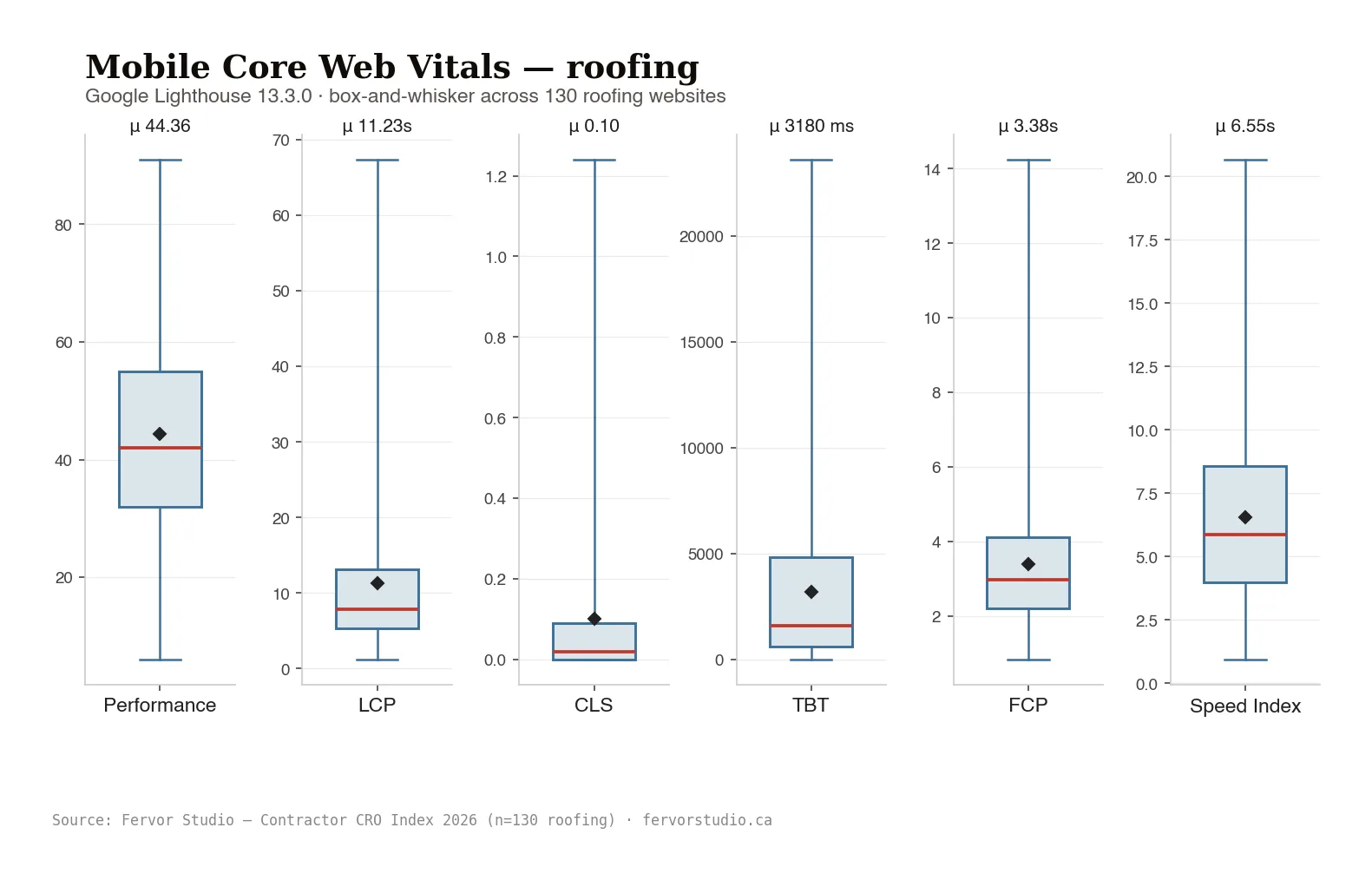
miss Google's mobile load-speed bar
Median mobile load lands at 7.88 seconds. Most of your traffic is on a phone, and most of them are gone before the hero paints.
Fervor Roofing State of the Industry, 2026
0 /100
is the average roofing grade
That is a D. The sites booking the work are not the ones with the biggest crews. They are the ones a few points higher on the things homeowners feel.
Two ways to start
Tell us where you are. We point you at the right next step — no sales call to get there.
Client review
“Nay did an amazing job, you know. He was really patient. He got the work done the way I told him and he was just on point with the website. Pretty straightforward process. No going around the bush. He just did amazing work and I would 100% recommend.”
How Fervor can help
Monthly SEO, content, and CRO. Fixed deliverables. No credits, no rollover. The compound growth engine.
Complete website system built to convert storm leads, planned projects, and research-phase homeowners into booked jobs.
Identify and patch the top conversion killers on your existing site. No full rebuild needed.
GBP optimization, citation building, and review system foundation. The infrastructure that gets you into the Map Pack.
One conversion-built landing page for the referrals, paid clicks, and cold-call leads you send. They land on a page built to book them, not your generic homepage.
Your move
Tell us where you are. We point you at the right next step — no sales call to get there.
Keep going