0
contractor sites graded, one A
Across the whole CRO Index, a single site earned an A. The median landed at a D. The grade gap is a conversion gap.
You're getting clicks. They're just not calling. We rebuild your site around the one job that matters: turning a visitor into a booked job.
Starts with a Site Inspection, so you see the plan before any build begins.
“Patient, on point, straightforward. Did amazing work. Would 100% recommend.” — Ruben Mederos, HyperTemp HVAC
“Responsive, creative, exceeded expectations. Already seeing greater engagement from our clients.” — George Jeorgy, Jeorgy's Landscape Construction
“Top-tier professionalism, real web design expertise, ideas I hadn't considered. Confidently recommend.” — Aws Nassani, Four Eleven Contracting



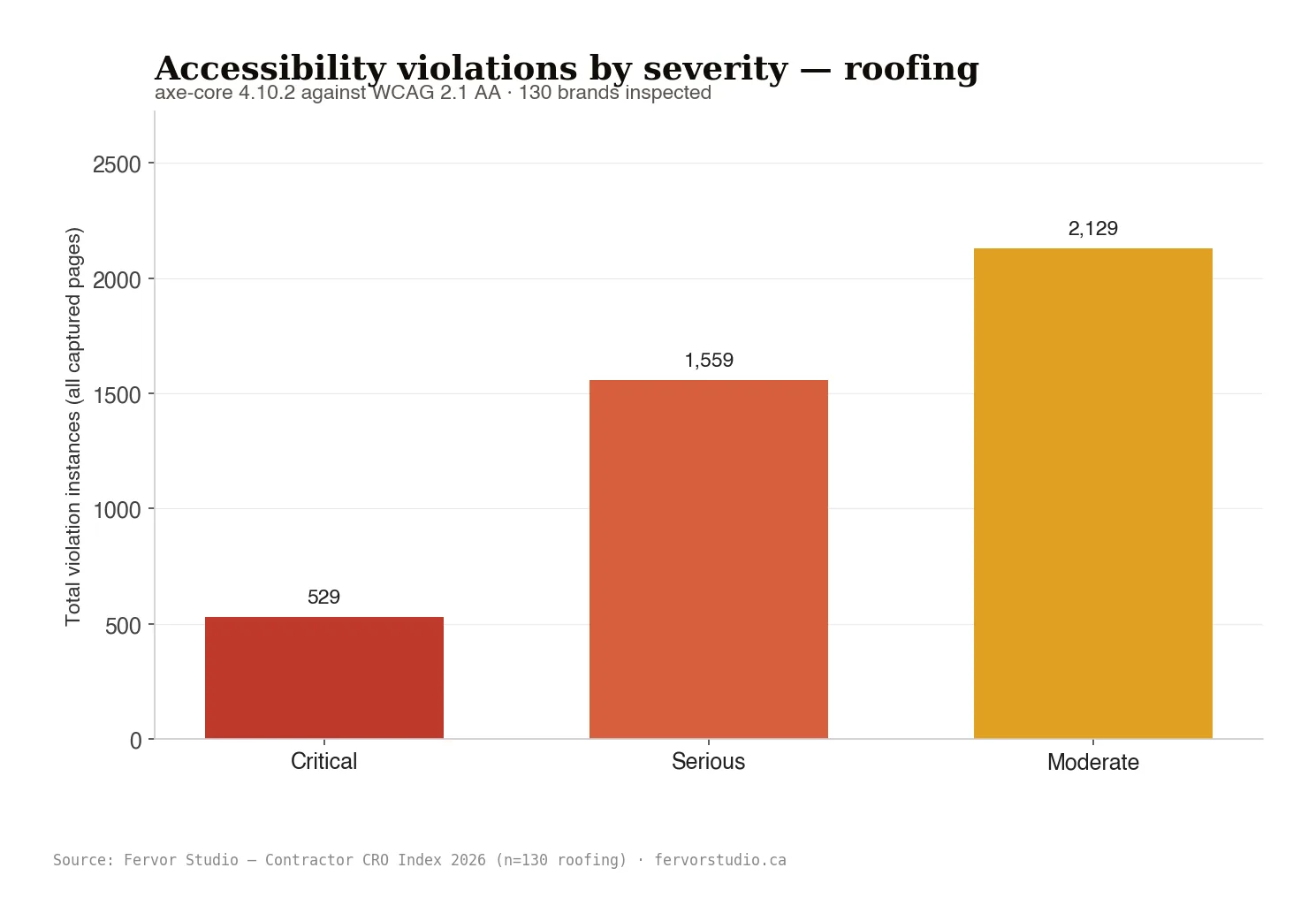
60.8% of roofing sites we tested fail a critical accessibility check
Digital State of the Roofing Industry 2026A grade out of 380 contractor sites
We graded 380 of them against one framework. Exactly one earned an A: Crown Industrial Roofing in Toronto, at 90 out of 100. The rest left money on the table. Here is what separates the top from the bottom.
The local detail
Every angle below is built into the page, not bolted on after.
There is a moment your website exists for, and most roofing sites are built for a different one entirely.
For roofers, speed decides whether you book the inspection or eat the bounce.
So a lot of roofers ask the same thing.
You cannot separate how your site is built from how it ranks.
A homeowner about to spend $13,000 on a roof is not buying shingles.
Let me name the failures I see most, because you’ve probably got at least one of them right now.
Your roofing web design has one job: catching the homeowner who just watched a shingle bundle blow off their neighbor's roof, pulled out their phone, and searched for someone, anyone, who can come look before the next storm. So if your site loads slow, hides your phone number, or reads like a brochure, that homeowner is already on the phone with the roofing website builder template your competitor bought for $40 a month. And he is winning the job you should have had.
You have probably been sold a redesign before. A new agency said your site "looked dated," shipped you something with bigger photos and the same broken skeleton, and disappeared after launch. So let's skip the part where someone tells you it should be modern. Let's talk about what roofing web design has to survive: a panicked search, on cellular data, at the exact moment a roof fails.
There is a moment your website exists for, and most roofing sites are built for a different one entirely.
So here is the moment that decides it. A hailstorm rolls through on a Thursday afternoon. By Friday morning, three streets in your service area have dented gutters and homeowners standing in driveways squinting up at their roofs. One of them searches "roof repair near me" on her phone, taps your result, and waits. Your five-megabyte hero image crawls down a cellular connection. Four seconds in, she's gone. Your ad spend paid for that tap, and your slow site refunded it straight to the roofer two listings down.
That is the test. Not whether your site looks good on the designer's desktop on office wifi. Whether it answers a sweating, worried homeowner in the four seconds before she backs out.
"From 2021–2023, homeowners spent $93.5B on roofing across 8.3 million projects (AHS-based estimates)." — U.S. Census Bureau and U.S. Department of Housing and Urban Development (2024)
That is the size of the pool your website is fishing in. And most roofing web design is built to skim the surface of it. Our inspection of roofing websites across the trade shows exactly where.
Most roofing websites are digital brochures. They describe the company. And they list services. They have an "About Us" page with a stock photo of a handshake. And none of that does the one thing the homeowner needs, which is to make calling you feel obvious and safe.
A brochure tells. A working roofing website does. And it shows the roof you replaced last week, the review you earned for it, and the phone number that connects to a person, not a voicemail tree.
Here is the quiet killer. Your site looks fine. It loads on your laptop. And the photos are nice. So nobody flags it, and the leads just quietly don't come, and you blame the market or the season instead of the thing that's leaking.
But "looks fine" is judged in an office. The homeowner judges in heat, in worry, on a phone, in seconds. Those are two completely different tests, and passing the first one tells you nothing about the second.
For roofers, speed decides whether you book the inspection or eat the bounce.
When a roof fails, the search happens on a phone, usually on cellular, often outdoors where the signal is weak. So every megabyte you make that homeowner download is a second you make them wait. And waiting, in that moment, means leaving.
Because nobody searches for an emergency roofer from a desk. They search from the driveway, looking up at the damage. Your roofing web design has to assume the small screen first and the desktop second, not the other way around.
That means a phone number that's tappable in the thumb zone. A hero that loads before the homeowner's patience runs out. Text big enough to read in glare. None of that is decorative. And all of it is the difference between a call and a miss.
If a homeowner has to scroll, pinch, or hunt to find how to reach you, you've already lost the anxious ones. And the anxious ones are the ones with the failing roof and the open wallet.
"32% of Canadian homeowners renovating their homes in the past three years did so to address a safety or maintenance issue." — Canada Mortgage and Housing Corporation (CMHC) (2025)
Nearly a third of recent renovations started with a safety or maintenance worry. That homeowner is not browsing. Because she is scared her roof is going to leak into the nursery. And when you make the call button impossible to miss, you catch her at exactly the moment she's ready.
So say your roofing supply costs and crew time mean an average reroof nets you $4,000. And say your site gets 1,000 mobile visits a month from ads and search. If a one-second speed improvement lifts your conversion by even half a percent, that's five more booked inspections a month. And if you close two of them, that's $8,000, every month, from making your site faster. Web design pays for itself in one storm week.
So a lot of roofers ask the same thing. Can't I just use a roofing website builder and skip the agency?
And yes, you can do that. For a brand-new one-truck operation, a template beats nothing. But you're scaling past that stage now, hiring your first ops person, building systems instead of scrambling. The template that got you here is the thing capping you now.
A roofing website builder gives you a layout someone else designed for someone else's market. It gives you stock photos of roofs that aren't yours. And it gives you the same skeleton your three closest competitors are also using, because they bought the same template.
That's fine for looking present. But it's useless for standing apart. When every roofer in town runs the same builder template, the homeowner can't tell you apart, so she picks on price. And you do not want to win on price.
And search "how to make a roofing website," and you'll get a hundred tutorials on picking a template and dragging photos around. None of them mention the four-second load test, click-to-call placement, or the search terms a homeowner types when a roof fails.
So you end up with a site that's technically a website and functionally a dead end. It exists, but it just doesn't work. Roofer website development is not about assembling pages. It's about engineering the path from a scared search to a signed estimate.
You cannot separate how your site is built from how it ranks. A beautiful roofing website that loads slow and lacks structure is invisible, and invisible doesn't book jobs.
Google judges your site by how fast it loads, how it's structured, and whether it answers what the searcher asked. So website search engine optimization for roofers gets baked into the roofing web design from the first decision. Bolt it on after launch and you're already behind.
When a local SEO roofing contractor build is done right, the speed, the structure, the service-area pages, and the schema all work together. And search engine optimization for roofing company sites fails when SEO and design are treated as separate invoices from separate vendors who never talk.
If you cover six suburbs, you need six real pages, each speaking to that suburb's homes, weather, and roofing patterns. Not one "Service Areas" page with a list of town names stuffed at the bottom. That's the difference between google seo for roofers that works and the kind that just spins.
"74% of Canadian first-time homebuyers plan to renovate their home within the next five years." — Canada Mortgage and Housing Corporation (CMHC) (2025)
Most first-time buyers plan to renovate within five years, and a lot of those start with the roof. Rank in their suburb now and you're the name they remember when the roof becomes the project.
And plenty of roofing seo pros digital marketing shops will sell you rankings as a separate monthly line item, divorced from the site itself. So be careful here. If the agency optimizing your SEO isn't the one who controls the build, you get a fast-talking report and a slow website. Best seo practices for roofing businesses start with a site that's built to be found.
A homeowner about to spend $13,000 on a roof is not buying shingles. She's buying the confidence that you won't disappear, botch it, or balloon the price. Your roofing web design either builds that confidence or it doesn't.
"In 2024, 22% of renovating homeowners undertook roofing upgrades, with a median spend of $13,000." — Houzz Inc. (2025)
That's real money, and people are careful with it. So proof can't be an afterthought. It has to be the spine of the site.
Your galleries should lead with your own roofs. The commercial shingle roof you finished in March. The new construction roof you wrapped for a builder. The driftwood GAF shingles a homeowner picked after agonizing over timberline roof colors for a week. Real roofs, in your market, photographed by you. That's what tells a stranger you do this.
A roofing website builder will offer you a gallery widget and fill it with someone else's roofs. So resist that urge. A real photo of a timberline weathered wood shingles install you did beats a flawless stock shot every time, because the homeowner knows the difference even when she can't say why.
So don't bury reviews on a testimonials page nobody visits. So put them next to the call button, next to the estimate form, at the exact spots where the homeowner is deciding whether to trust you. Proof works where the choice is made, not where it's filed.
And homeowners research. They search timberline roof colors, they wonder about pvc rubber roofing for a flat section, they ask whether a rubber roofing company is different from their shingle guy. Pages that answer those questions do two jobs at once. They rank, and they make you look like the roofer who knows things.
If you do commercial, say so clearly, because the homeowner who manages a strip mall is a different searcher entirely. Someone searching commercial roof inspection tulsa ok or best commercial roofing broken arrow has a budget and a deadline. A page built for commercial shingle roof work and tulsa commercial roof maintenance speaks their language, not the residential pitch.
Let me name the failures I see most, because you've probably got at least one of them right now.
A giant background video or a 5MB photo that looks stunning on the designer's monitor and never finishes loading on a phone in a parking lot. The homeowner sees a white screen, assumes you're broken, and leaves.
Tucked in a header that collapses on mobile, or worse, baked into an image so it isn't even tappable. Every tap a homeowner can't make is a call your competitor gets instead.
Eleven fields, including "how did you hear about us," before a worried homeowner can even ask you to come look. So cut it down to name, phone, and address. You can qualify on the call. The form's only job is to start the conversation.
A homeowner who likes your site still hesitates before booking, because the last contractor who came out was late, vague, and $2,000 over the verbal quote. So your site has to do the reassuring your competitors skip. So show your license number, show how the estimate works step by step so there are no surprises, and show the warranty in plain words instead of a PDF nobody opens. Every one of those is a small anxiety you dissolve before the homeowner ever picks up the phone, and dissolving it on the page is cheaper than dissolving it on a call that never happens. The roofer who explains the process up front gets the inspection. The one who stays vague gets compared on price and forgotten.
"Canadian homeowners paid 8.4% more for maintenance and repairs (including roofing) in April 2023 than in April 2022." — Statistics Canada (2023)
Repair costs have climbed, and homeowners know it, so silence on price reads as "expensive and hiding it." You don't have to post exact numbers. But a roofing website that explains how roofing is priced, what drives cost, and what a fair range looks like disarms the sticker shock before it kills the lead.
"28% of Canadian homeowners cited making their home more energy-efficient as a reason to renovate." — Canada Mortgage and Housing Corporation (CMHC) (2025)
More than a quarter of renovations are driven by efficiency. If your roofing web design never mentions ventilation, reflective shingles, or how the roof affects the energy bill, you're missing a whole class of buyer who's ready to spend.
But we don't start with a template or a mood board. We start with the moment your site exists for, and we build backward from the call you want to ring.
And every page is built mobile-first and judged on a throttled cellular connection, not office wifi. If the hero doesn't load fast on a phone in a driveway, it doesn't ship. That's not a preference. It's the standard.
The site, the service-area pages, the schema, and the speed are one project, not four invoices. Website seo for roofers that moves rankings comes from a build that was structured to rank from day one, not patched afterward.
"38% of Canadian homeowners who pursued energy-efficient upgrades in 2024 improved their home's insulation." — Canada Mortgage and Housing Corporation (CMHC) (2024)
We build the pages that catch those efficiency-driven searches too, because insulation and roof ventilation are the kind of work that pays well and proves expertise.
It all comes back to your roofs, your reviews, and your market. The galleries get built around the jobs you've done, because that's what turns a stranger into a caller.
You don't have to take my word that your current site is leaking. The first step is a free Site Inspection, where we go through your roofing web design the way a homeowner on a phone would, and show you exactly where the leads fall out. No sales call required to get the findings. You look at the gaps, and you decide.
So before you spend on another redesign that "looks modern" and books nothing, get the inspection. See what a homeowner sees in the four seconds that decide whether your phone rings. Then we'll talk about building the site that catches them.
The evidence
 Read the full report →
 0
contractor sites graded, one A
Across the whole CRO Index, a single site earned an A. The median landed at a D. The grade gap is a conversion gap.
0 %
of roofing sites fail a critical accessibility check
Scored against WCAG 2.1 AA with axe-core. A page that blocks a screen reader also blocks a paying customer.
Fervor Roofing State of the Industry, 2026
0 %
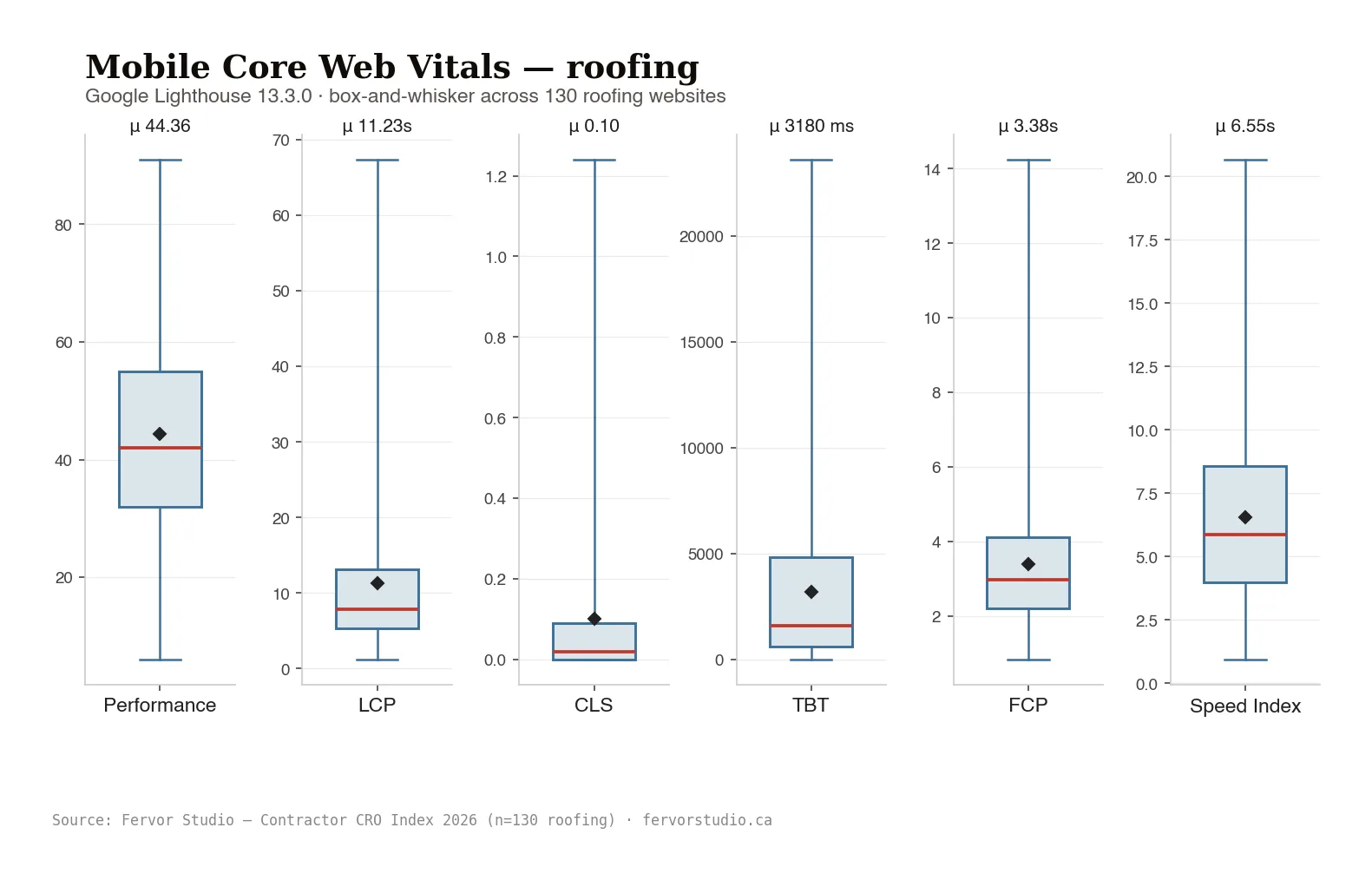
miss Google's mobile load-speed bar
Median mobile load lands at 7.88 seconds. Most of your traffic is on a phone, and most of them are gone before the hero paints.
Fervor Roofing State of the Industry, 2026
0 /100
is the average roofing grade
That is a D. The sites booking the work are not the ones with the biggest crews. They are the ones a few points higher on the things homeowners feel.
Two ways to start
Tell us where you are. We point you at the right next step — no sales call to get there.
Client review
“Nay did an amazing job, you know. He was really patient. He got the work done the way I told him and he was just on point with the website. Pretty straightforward process. No going around the bush. He just did amazing work and I would 100% recommend.”
How Fervor can help
Complete website system built to convert storm leads, planned projects, and research-phase homeowners into booked jobs.
Identify and patch the top conversion killers on your existing site. No full rebuild needed.
Monthly SEO, content, and CRO. Fixed deliverables. No credits, no rollover. The compound growth engine.
GBP optimization, citation building, and review system foundation. The infrastructure that gets you into the Map Pack.
One conversion-built landing page for the referrals, paid clicks, and cold-call leads you send. They land on a page built to book them, not your generic homepage.
Your move
Tell us where you are. We point you at the right next step — no sales call to get there.
Keep going