0
contractor sites graded, one A
Across the whole CRO Index, a single site earned an A. The median landed at a D. The grade gap is a conversion gap.
You already get traffic. Most of it leaves without calling. We find the leaks and plug them, so the visitors you've got start booking jobs.
Starts with a Site Inspection, so you see the leaks before any fix begins.
“Attentive, listened to every revision request, delivered on time. Would work with him again.” — Hamza Najam
“Patient, on point, straightforward. Did amazing work. Would 100% recommend.” — Ruben Mederos, HyperTemp HVAC
“Responsive, creative, exceeded expectations. Already seeing greater engagement from our clients.” — George Jeorgy, Jeorgy's Landscape Construction
“Top-tier professionalism, real web design expertise, ideas I hadn't considered. Confidently recommend.” — Aws Nassani, Four Eleven Contracting




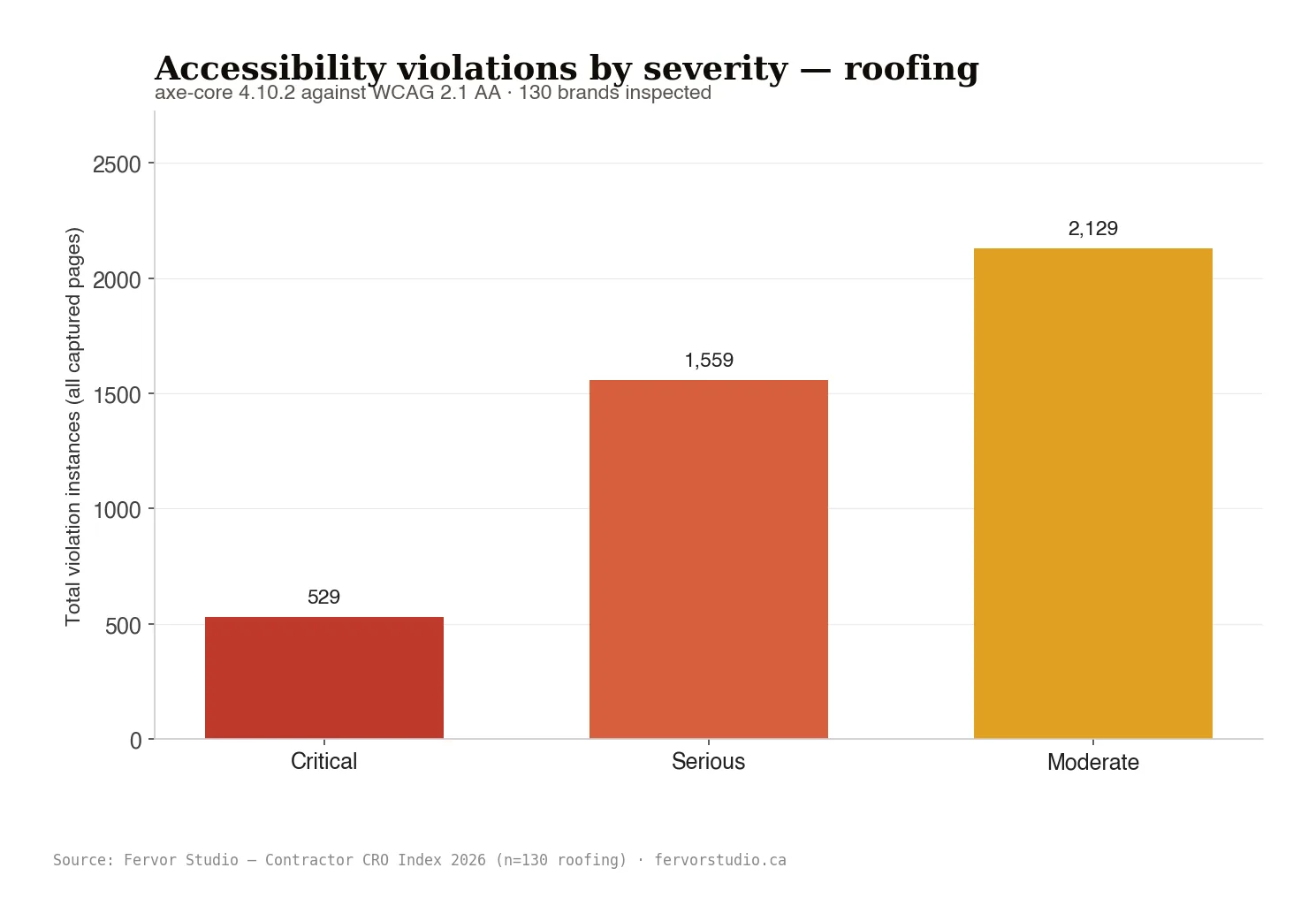
60.8% of roofing sites we tested fail a critical accessibility check
Digital State of the Roofing Industry 2026A grade out of 380 contractor sites
We graded 380 of them against one framework. Exactly one earned an A: Crown Industrial Roofing in Toronto, at 90 out of 100. The rest left money on the table. Here is what separates the top from the bottom.
The local detail
Every angle below is built into the page, not bolted on after.
Your homepage is built for everyone.
The homeowner decides in seconds, on a phone, before she scrolls.
The form is the narrowest point in the funnel.
Not every click is the same job, and one page can’t speak to all of them.
The page’s job isn’t over when she taps the button.
You’re past the scramble stage now, and you want the numbers before you commit.
A roofing landing page has one job: take the homeowner who just clicked your ad and turn her into a booked estimate before she backs out. So if you're paying for clicks and sending them to your homepage, or to a page that makes her hunt for a phone number, you're funding traffic that leaks straight back out. And your cost per lead climbs every month you let it.
You've probably run ads before. Maybe Google, maybe Facebook, maybe both. The clicks came, the calls didn't match, and you blamed the platform. But the ad usually does its job. The leak is where it sends people. A roofing landing page that's built to convert is the difference between ad spend that compounds and ad spend that drains.

Your homepage is built for everyone. A landing page is built for one person with one problem. And those are completely different jobs.
When a homeowner clicks an ad for roof repair, she has a specific worry and a short fuse. Your homepage greets her with a navigation bar, an About section, a services menu, and six other things to click. So she clicks none of them, or she wanders, and the moment passes. The homepage gave her choices when she needed a clear next step.
"From 2021–2023, homeowners spent $93.5B on roofing across 8.3 million projects (AHS-based estimates)." — U.S. Census Bureau and U.S. Department of Housing and Urban Development (2024)
That's a massive pool of intent, and a lot of it arrives through paid clicks. So sending it to a page that wasn't built to catch it is the most expensive mistake roofers make with their marketing budget. Our inspection of roofing websites across the trade shows how often it happens.
And here's the part that stings. The homepage works fine. It's doing exactly what a homepage should: introduce a company to someone who has time to browse. But the homeowner with a leak doesn't have time to browse. She has a problem and a thumb, and every extra choice you put in front of her is a chance to lose her. A dedicated page removes the choices and leaves one: call now, or request the estimate. That's the whole point.
The homeowner decides in seconds, on a phone, before she scrolls. So the top of the page has to carry the whole argument.
If your ad said "Storm damage? Roof inspected today," the page has to repeat that promise instantly. A mismatch between the ad and the page reads as a bait-and-switch, and she's gone. The landing page headline confirms she's in the right place for her exact problem.
"32% of Canadian homeowners renovating their homes in the past three years did so to address a safety or maintenance issue." — Canada Mortgage and Housing Corporation (CMHC) (2025)
Nearly a third of renovations start from a safety worry, and that homeowner is anxious, not casual. So a tappable call button and a short form have to sit right there, above the fold, before she has to think. And make her hunt, and you've lost the anxious buyer who was ready to pick up the phone.
A stranger about to spend $13,000 needs a reason to trust you in the same glance where you ask her to call. So reviews, a star count, and a photo of a real roof you finished belong right beside the button, not buried on another page.
The form is the narrowest point in the funnel. And most roofers make it far too wide.
Eleven fields, a dropdown asking how she heard about you, a required email, a "preferred contact time" she has to think about. Every field is a small reason to quit. So cut it to the bone: name, phone, address, and what's wrong. You qualify on the call. The form's only job is to start the conversation, not finish it.
"Canadian homeowners paid 8.4% more for maintenance and repairs (including roofing) in April 2023 than in April 2022." — Statistics Canada (2023)
Costs are up, and homeowners feel it. So a roofing landing page that explains how the estimate works, what's free, and what happens next removes the money anxiety that makes people abandon the form. Silence on process reads as a trap. Clarity reads as safe.
Not every click is the same job, and one page can't speak to all of them. So the roofers who convert best run a different page for each offer.
This homeowner wants someone on the roof today. The page leads with speed, availability, and the call button. No long story, no gallery tour. Just confirmation that you can come now and proof that you're real. So the headline names the emergency, the button sits under her thumb, and a line like "crews available this week" answers the only question she's asking. Everything else waits.
"In 2024, 22% of renovating homeowners undertook roofing upgrades, with a median spend of $13,000." — Houzz Inc. (2025)
A $13,000 decision needs more reassurance, so this page can carry financing options, material choices, and a gallery of completed roofs. The buyer is researching, and the page that answers her questions is the one that earns the estimate. So give her the warranty in plain words, the rough range so the number isn't a surprise on the call, and photos of roofs in her own neighborhood. Every answer you put on the page is one less reason for her to keep clicking competitors.
"28% of Canadian homeowners cited making their home more energy-efficient as a reason to renovate." — Canada Mortgage and Housing Corporation (CMHC) (2025)
More than a quarter of renovations are driven by efficiency. So a landing page built around ventilation, reflective shingles, and attic upgrades catches a buyer your generic page never speaks to.
The page's job isn't over when she taps the button. The seconds right after the form goes through decide whether that lead turns into a job or a missed call. So the page has to keep working past the click.
A lead that gets a callback in five minutes converts far better than one that waits an hour. So the page should fire an instant alert to your phone, not just an email someone checks at lunch. The roofer who calls back while the homeowner is still standing in the driveway, still worried, wins the job over the one who calls back tomorrow. That speed is a design decision, built into how the page handles the submission, not an afterthought you bolt on later.
After she submits, don't drop her on a blank "thanks, we'll be in touch." Use that screen to set expectations: when you'll call, what to have ready, and a number she can dial right now if it's an emergency. So the moment of highest intent doesn't go to waste while she waits. That page is also where a second proof point, another review or a photo of a finished roof, keeps her confident she chose right.
You can't improve what you don't measure. So the page has to track which ad, which headline, and which offer produced each lead. Most roofers run three campaigns and have no idea which one books jobs. Clean tracking turns guessing into knowing, and knowing is what lets you pour budget into the version that converts and cut the one that doesn't.
You're past the scramble stage now, and you want the numbers before you commit. So let's run them.
So say you spend $3,000 a month on roofing ads. And say your current page converts 4% of clicks into leads. Lift that to 8%, which a purpose-built roofing landing page routinely does, and you've doubled your leads for the same spend. If those extra leads turn into three more $4,000 jobs, that's $12,000 a month from fixing the page, not the budget. The ad spend didn't change. The page did.
"74% of Canadian first-time homebuyers plan to renovate their home within the next five years." — Canada Mortgage and Housing Corporation (CMHC) (2025)
Most first-time buyers plan to renovate within five years, and many start with the roof. So a page that converts today also captures buyers who'll need you again. The lift compounds.
We don't hand you a template and wish you luck. We build the page around the exact click you're paying for, and we show you where your current page leaks before we change a thing.
"38% of Canadian homeowners who pursued energy-efficient upgrades in 2024 improved their home's insulation." — Canada Mortgage and Housing Corporation (CMHC) (2024)
We build pages for the high-value work too, the insulation and ventilation jobs that pay well and prove you know roofs. And every page is matched to its ad, stripped to one decision, and tuned for the phone in a homeowner's hand.
The first step is a free Site Inspection. We walk your current page the way a homeowner who just clicked your ad would, on a phone, in a hurry, with a problem overhead, and we show you exactly where she quits. We point to the form that's too long, the button that's too low, the proof that's missing, and the slow load that loses her before the page even paints. No sales call required to get the findings. You see the leaks, you see the fixes for each one in plain language, and you decide what to do next. So before you pour another month of budget into a page that converts at 4%, get the inspection first. Then we'll build the page that finally catches the clicks you're already paying for.
The evidence
 Read the full report →
 0
contractor sites graded, one A
Across the whole CRO Index, a single site earned an A. The median landed at a D. The grade gap is a conversion gap.
0 %
of roofing sites fail a critical accessibility check
Scored against WCAG 2.1 AA with axe-core. A page that blocks a screen reader also blocks a paying customer.
Fervor Roofing State of the Industry, 2026
0 %
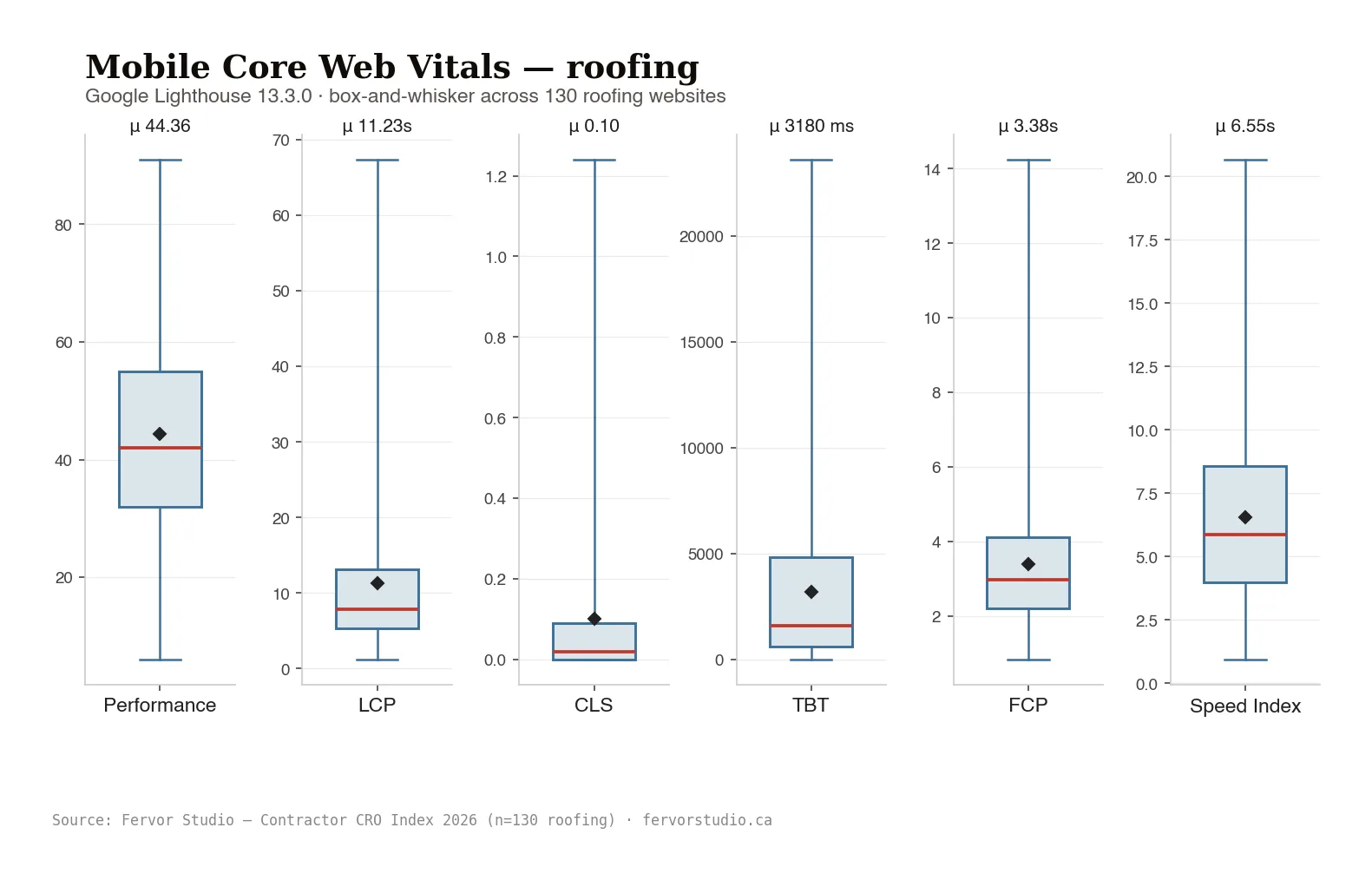
miss Google's mobile load-speed bar
Median mobile load lands at 7.88 seconds. Most of your traffic is on a phone, and most of them are gone before the hero paints.
Fervor Roofing State of the Industry, 2026
0 /100
is the average roofing grade
That is a D. The sites booking the work are not the ones with the biggest crews. They are the ones a few points higher on the things homeowners feel.
Two ways to start
Tell us where you are. We point you at the right next step — no sales call to get there.
Client review
“Nay did an amazing job, you know. He was really patient. He got the work done the way I told him and he was just on point with the website. Pretty straightforward process. No going around the bush. He just did amazing work and I would 100% recommend.”
How Fervor can help
Identify and patch the top conversion killers on your existing site. No full rebuild needed.
Monthly SEO, content, and CRO. Fixed deliverables. No credits, no rollover. The compound growth engine.
Complete website system built to convert storm leads, planned projects, and research-phase homeowners into booked jobs.
GBP optimization, citation building, and review system foundation. The infrastructure that gets you into the Map Pack.
One conversion-built landing page for the referrals, paid clicks, and cold-call leads you send. They land on a page built to book them, not your generic homepage.
Your move
Tell us where you are. We point you at the right next step — no sales call to get there.
Keep going