0
contractor sites graded, one A
Across the whole CRO Index, a single site earned an A. The median landed at a D. The grade gap is a conversion gap.
You're getting clicks in Milwaukee. They're just not calling. We rebuild your site around the one job that matters: turning a visitor into a booked job.
Starts with a Site Inspection, so you see the plan before any build begins.
“Patient, on point, straightforward. Did amazing work. Would 100% recommend.” — Ruben Mederos, HyperTemp HVAC
“Responsive, creative, exceeded expectations. Already seeing greater engagement from our clients.” — George Jeorgy, Jeorgy's Landscape Construction
“Top-tier professionalism, real web design expertise, ideas I hadn't considered. Confidently recommend.” — Aws Nassani, Four Eleven Contracting



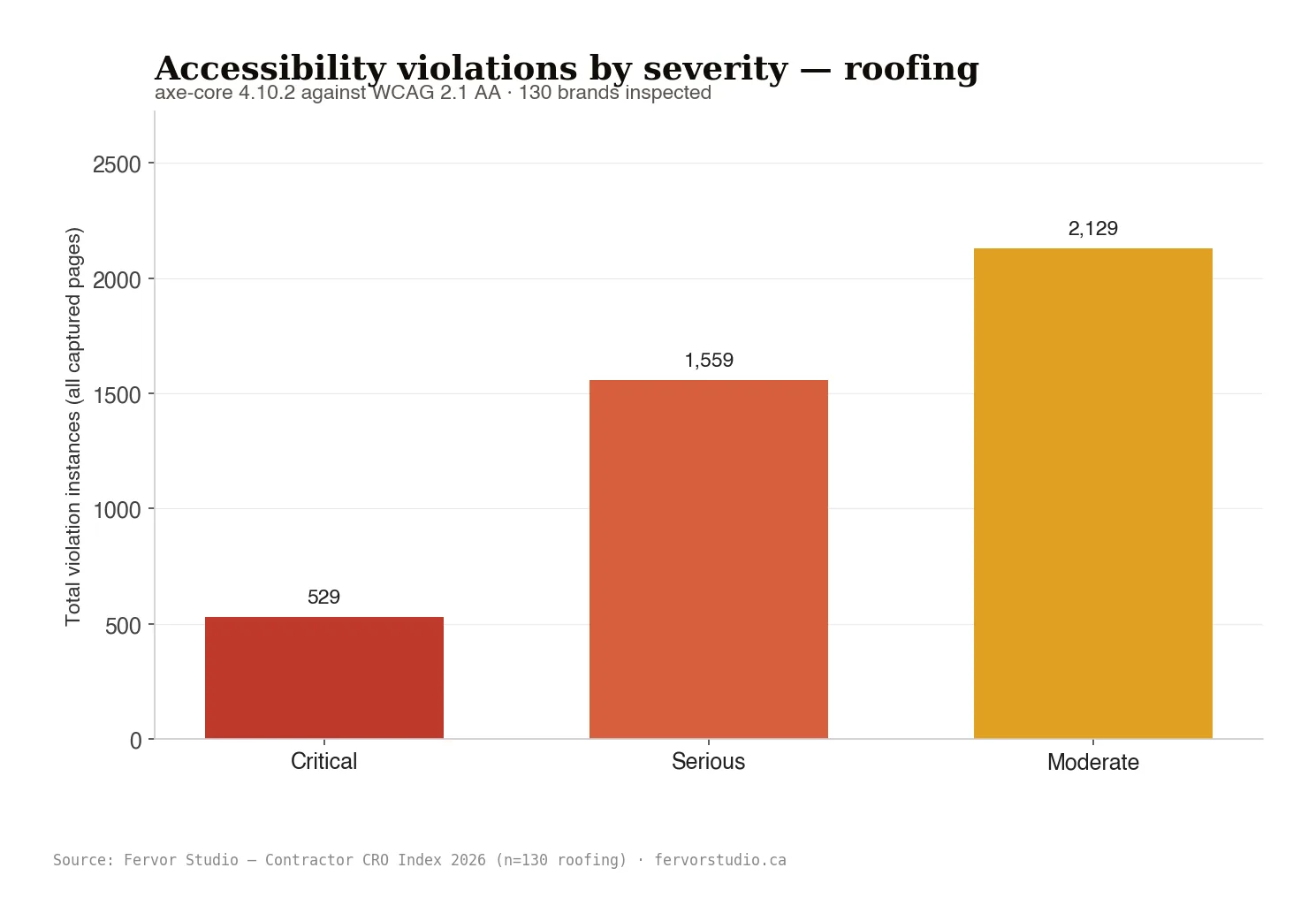
60.8% of roofing sites we tested fail a critical accessibility check
Digital State of the Roofing Industry 2026A grade out of 380 contractor sites
We graded 380 of them against one framework. Exactly one earned an A: Crown Industrial Roofing in Toronto, at 90 out of 100. The rest left money on the table. Here is what separates the top from the bottom.
The local detail
Every angle below comes from how Milwaukee actually searches, buys, and regulates — built into the page, not bolted on.
You know the storms.
Picture the homeowner from Riverwest standing in her yard, rain still dripping off the gutters.
So should you grab a $40-a-month template or pay for something built?
Here’s the mistake that costs Milwaukee roofers the most.
There’s one more thing about who’s tapping your link.
A bundle of shingles blows off a roof in Wauwatosa. The neighbor watches it happen, pulls out her phone on the front step, and types "roof repair near me" before the wind even dies down. So here's the question that decides whether your shop or someone else's books that job: when she taps your link, what happens in the next four seconds? Good roofing web design Milwaukee shops can win on starts right there, in the driveway, on a phone, on cellular. And if your site stalls or makes her hunt for a number, she's already gone. That's the whole game. One search, one shot, one tap.
So let's talk about what catches her, because it isn't the thing most contractors think it is.
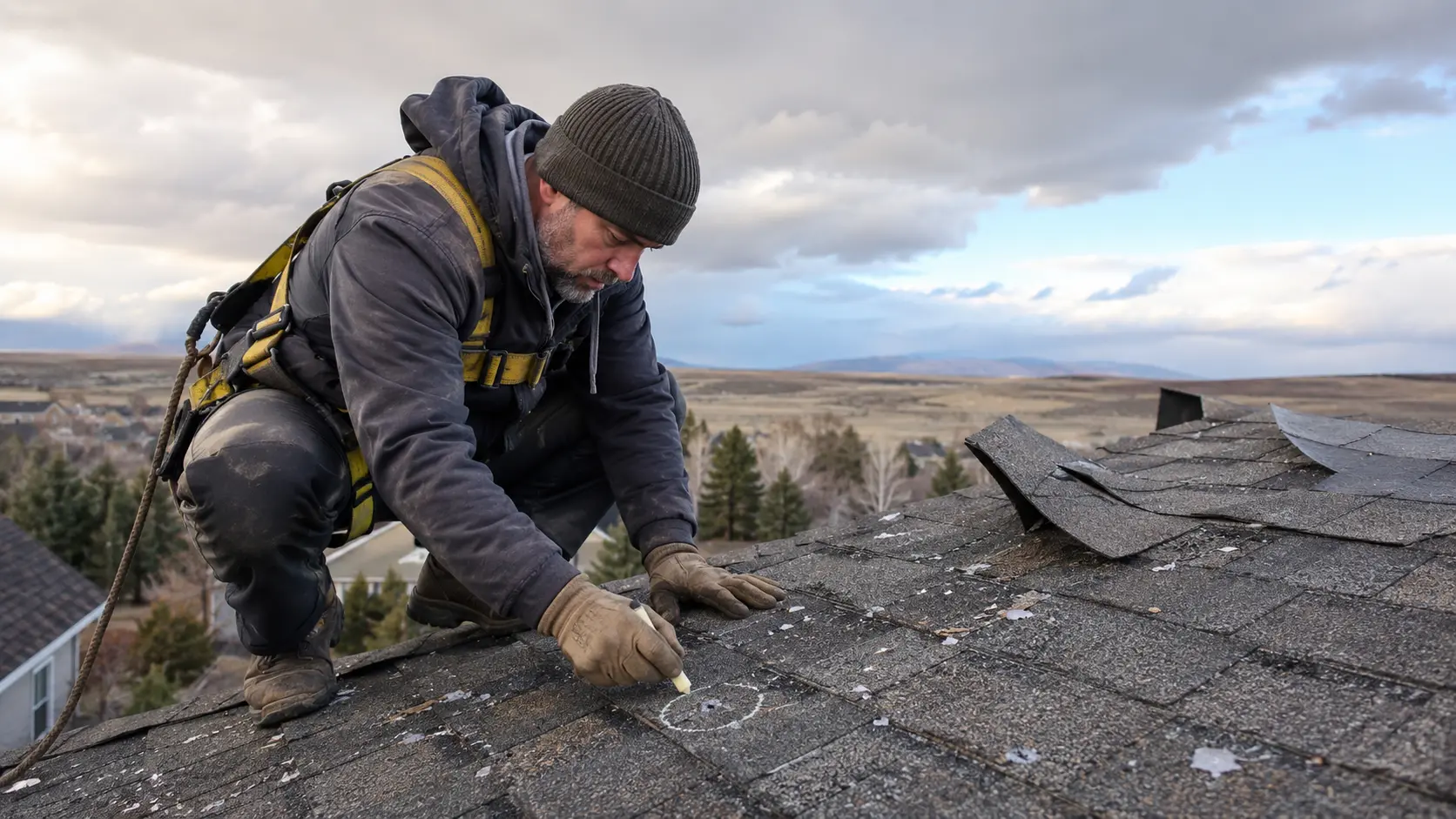
You know the storms. The June straight-line winds that flatten fences off Capitol Drive. The hail that hammers Bay View one July afternoon and skips Greenfield entirely. When a system rolls through Milwaukee County, search volume for roof help spikes for about 72 hours, and that window is when most of your year's emergency jobs get claimed.
But here's what trips up a good shop. You're up on a roof in Shorewood at 2pm when the calls start. You can't answer. So the homeowner taps the next result. And if that next result loads in two seconds with a phone number she can press, you just lost a $4,000 reroof you never knew existed.
"97% of roofing customers expect a callback within one week. More than 50% expect a callback within two days." — Roofing Contractor Magazine (2024)
Read that again. Half of them won't wait two days. And the storm-week buyer? She won't wait two hours. Your website is the thing that answers when you're 30 feet up with a nail gun in your hand.
So many older contractor sites were built as brochures. Pretty homepage, an "About Us" with a stock photo, services buried three clicks deep. That's a printed pamphlet pretending to be a website. It tells. It doesn't catch.
And a brochure has no job to do when a panicked homeowner lands on it. It doesn't ask for the call. It doesn't show the truck. It just sits there looking nice while she bounces back to the search results and dials the shop that made the ask.
But there's a quieter filter killing your storm-week leads before the brochure problem even matters. Google measures how fast your page paints on a phone, and so does the homeowner's patience. A site that takes six seconds on a driveway LTE connection loses roughly half its visitors before they see a word. You paid for that click through ads or ranking. Then the load time threw it away.
So the first fix is almost never copy. It's weight. Strip the bloated theme, compress the roof photos, and get that page on screen in under four seconds on cellular. That one change recovers leads you're already paying to attract.
Picture the homeowner from Riverwest standing in her yard, rain still dripping off the gutters. She's on a five-inch screen. Her thumb is the only tool she's got. Every design decision either helps that thumb or fights it.
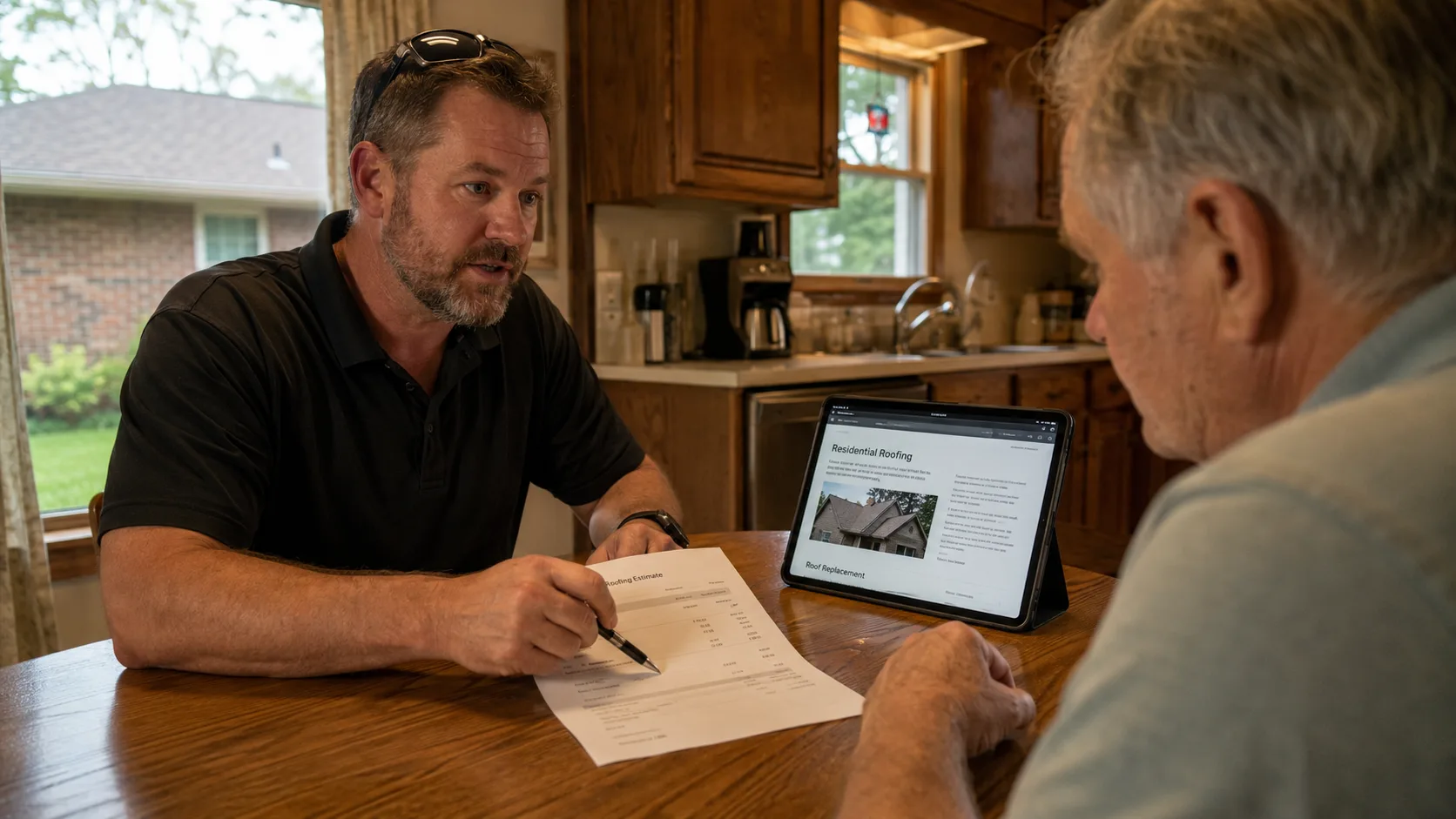
"In 2024, 22% of renovating homeowners undertook roofing upgrades, with a median spend of $13,000." — Houzz Inc. (2025)
A $13,000 median ticket is real money walking past your door. So the site's whole job is to make saying yes feel safe and fast for her, on that phone, in that moment.
The first thing she should see, before she scrolls, is a tappable phone number and a button that says "Get my free roof estimate." Not a hamburger menu hiding the contact page. Not a slider of award badges. A number her thumb can hit in one motion.
And put the call function in the sticky header too, so it follows her down the page. The shop that makes calling a one-tap reflex beats the shop that makes her dig for it. Every time.
Here's where good shops bleed out. Your form asks for name, email, phone, address, roof age, square footage, shingle type, insurance carrier, preferred date, and "how did you hear about us." Eleven fields. On a phone. In the rain.
Cut it to three: name, phone, and "what's going on up there." That's it. And you can ask the rest when you call her back. Every field you remove lifts completions, and on storm week a 30% lift in form fills is the difference between a booked Saturday and an empty one.
She doesn't know you yet. So show her, don't tell her. Put a row of real Google reviews and three photos of actual Milwaukee roofs you've done next to the estimate button.
"In hail-prone states, average roof lifespan is 15 years vs 22 years in milder western states; 38% of U.S. homes have roofs in moderate to poor condition (Roofing Contractor) with 60% higher loss costs" — Verisk Analytics (2025)
Wisconsin winters and freeze-thaw cycles age roofs hard, so a lot of homes in your service area are sitting in that "moderate to poor" group right now. Real photos of a tear-off in West Allis tell her you've handled exactly her problem. A stock image of a roof in California tells her nothing.
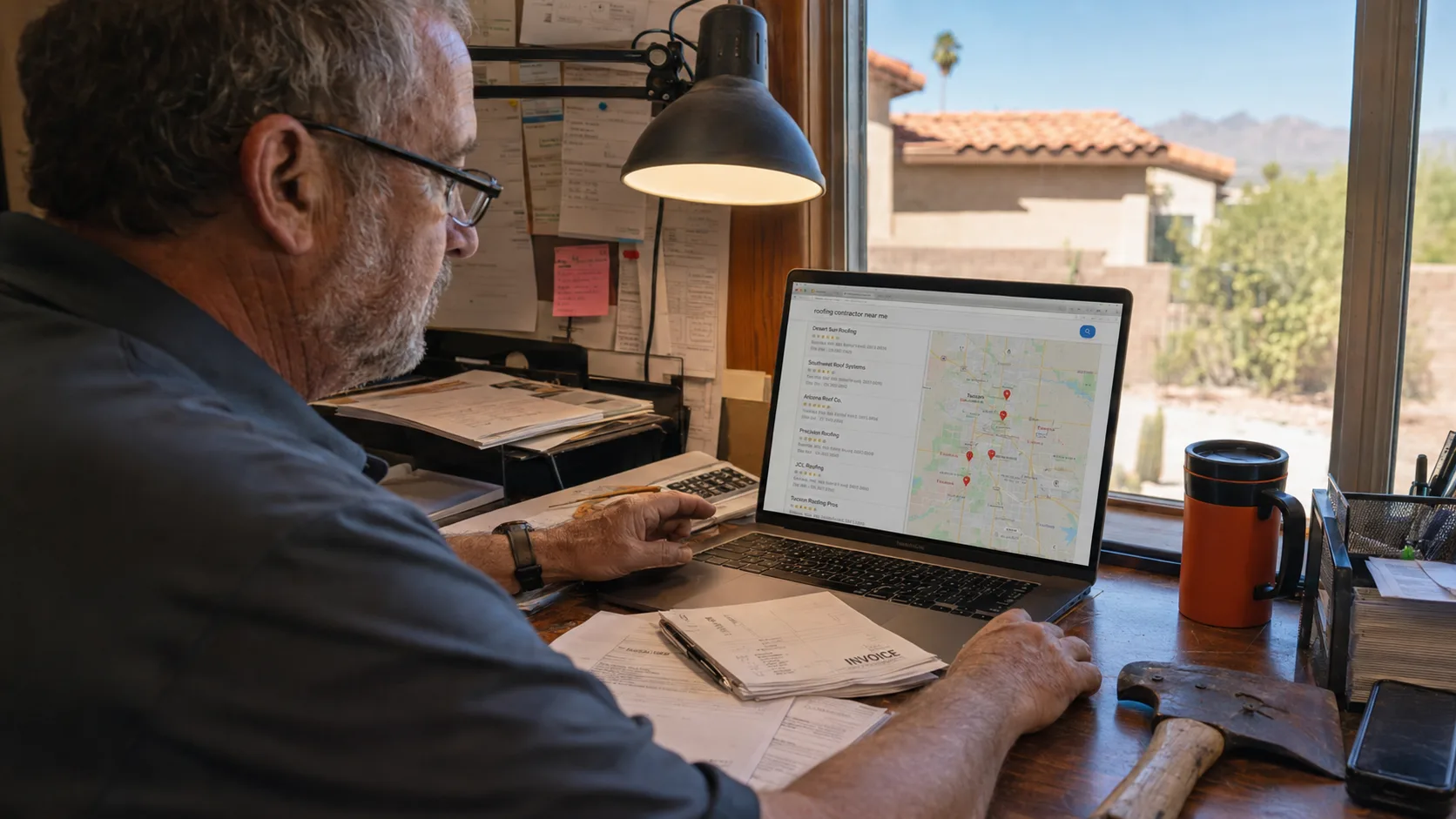
So should you grab a $40-a-month template or pay for something built? Fair question, and the honest answer depends on what you're trying to win.
A template gets you online cheap and fast. But it loads the same bloated code for every contractor using it, the call button sits wherever the theme decided, and the photos are someone else's. You can't move the pieces that catch the storm buyer.
"From 2021–2023, homeowners spent $93.5B on roofing across 8.3 million projects (AHS-based estimates)." — U.S. Census Bureau and U.S. Department of Housing and Urban Development (2024)
That's the size of the pie. You don't need a big slice of $93.5B to fill your calendar. You need the handful of Milwaukee homeowners searching this week to land on a page that books them.
So when is a template fine? If you're a one-truck shop testing whether you even want to grow, a clean template beats no site at all. Get the basics right, the number visible, the form short, and you'll catch a few jobs. But the moment you're staffing four to ten people and competing for the same Brookfield and Wauwatosa jobs as three other shops, the template ceiling shows up fast. You can't tune what you don't control.
Custom roofing website Milwaukee work earns its keep when speed and conversion are the whole point. You control the load weight, the call placement, the proof layout, and the way the page reads on a phone in a driveway.
"The median spend on roofing upgrades in 2024 was 8% higher than in 2023 (median $13,000 in 2024)." — Houzz Inc. (2025)
Run the math. If a tuned site catches just two extra reroofs a month at $13,000 each, that's $26,000 in work the old brochure was letting walk. The build pays for itself before the first snow.
Here's the mistake that costs Milwaukee roofers the most. They hire a roofing web designer Milwaukee shops recommend, get a pretty site, then a year later hire a separate SEO vendor to "fix the rankings." Two invoices. Two timelines. Two finger-pointing sessions when the phone still doesn't ring.
But the site that loads fast, names your neighborhoods, and answers the homeowner's question IS the SEO. Google ranks the page that serves the searcher. So design and search are the same build, decided at the same time, by people who talk to each other.
A page that says "roofing in Milwaukee" ranks against the whole city. A page that names Glendale, Cudahy, and Saint Francis, with photos and jobs from each, ranks for the homeowner standing in Glendale. Google rewards the page that proves it knows the ground.
And your service-area pages do double duty. They catch the search and they reassure the buyer that you work her street, not just the zip code on your truck.
"Among renovating homeowners, 44% add or redo a roof as part of their exterior projects." — Houzz Inc. (2024)
Nearly half of exterior projects touch the roof, so your visitor is often weighing siding or gutters too. A page built for both search and conversion answers her actual question fast, then points her at the estimate. That's the join most shops skip.
"Among homeowners undertaking a roofing project, 63% choose asphalt roofing material (dimensional shingles 34%, three-tab shingles 19%, luxury shingles 10%), while 14% choose metal and 11% choose synthetic material or rubber." — Houzz Inc. (2024)
About two in three of your Milwaukee buyers want asphalt, so a smart site leads with shingle options and a clear price range, then offers metal or synthetic as the upgrade. You meet her where she already is.
There's one more thing about who's tapping your link. She's usually paying cash, and that changes how careful she is before she calls.
"Among homeowners who renovated in 2024, 84% used cash from savings and 29% used a credit card to fund renovation projects (multiple funding sources allowed)." — Houzz Inc. (2025)
When 84% are spending their own savings, trust does the heavy lifting. So your site has to earn it before the phone call, not after.
Put your licensing, your workmanship warranty, and a few before-and-after shots from Whitefish Bay right where she's deciding. So a homeowner spending $13,000 from her savings reads every reassurance you give her. Give her plenty, plainly stated.
And end every section with one clear move. Tap to call, or get the free estimate. Don't make her guess. The site that tells her exactly what happens next is the site she trusts with her roof and her savings.
We started by counting. Before we wrote a line of code, we ran an inspection of roofing websites across the trade and tallied load times, form lengths, and how many sites hid their phone number below the fold. The pattern was ugly and consistent: fast on the home page, broken at the moment of decision.
So our build starts from the storm-week tap and works backward. Under four seconds on cellular. Click-to-call above the fold. A three-field form. Real Milwaukee roofs and real reviews sitting beside the ask. Search and design decided together, in one project, not billed as two.
You don't have to commit to find out where your current site leaks. Start with a free Site Inspection. We'll show you exactly where the storm buyer is bouncing and what it's costing you, no sales call required. Then you decide what to do with what you see.
The evidence
 Read the full report →
 0
contractor sites graded, one A
Across the whole CRO Index, a single site earned an A. The median landed at a D. The grade gap is a conversion gap.
0 %
of roofing sites fail a critical accessibility check
Scored against WCAG 2.1 AA with axe-core. A page that blocks a screen reader also blocks a paying customer.
Fervor Roofing State of the Industry, 2026
0 %
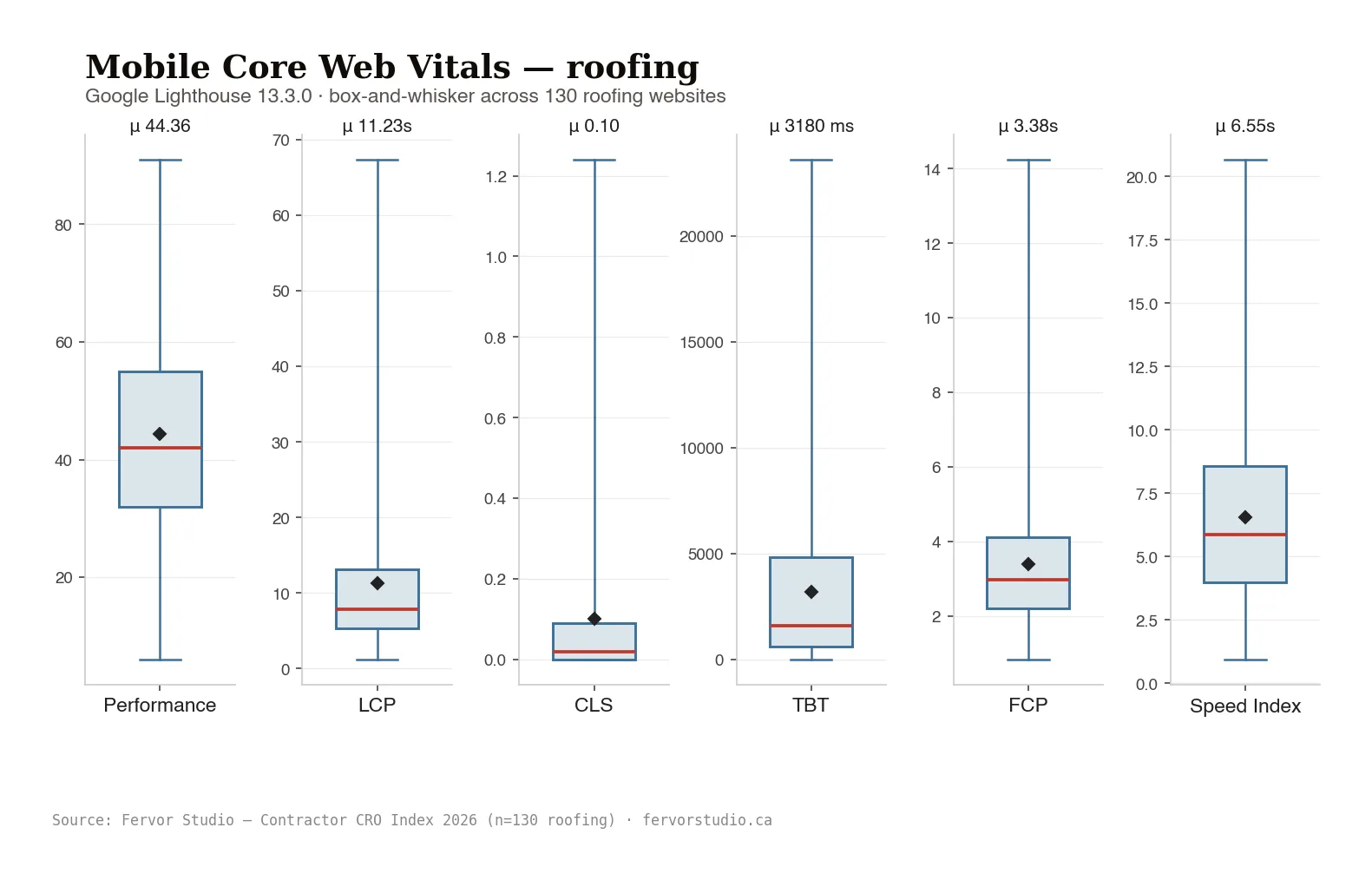
miss Google's mobile load-speed bar
Median mobile load lands at 7.88 seconds. Most of your traffic is on a phone, and most of them are gone before the hero paints.
Fervor Roofing State of the Industry, 2026
0 /100
is the average roofing grade
That is a D. The sites booking the work are not the ones with the biggest crews. They are the ones a few points higher on the things homeowners feel.
Two ways to start
Tell us where you are. We point you at the right next step — no sales call to get there.
Client review
“Nay did an amazing job, you know. He was really patient. He got the work done the way I told him and he was just on point with the website. Pretty straightforward process. No going around the bush. He just did amazing work and I would 100% recommend.”
How Fervor can help
Complete website system built to convert storm leads, planned projects, and research-phase homeowners into booked jobs.
Identify and patch the top conversion killers on your existing site. No full rebuild needed.
Monthly SEO, content, and CRO. Fixed deliverables. No credits, no rollover. The compound growth engine.
GBP optimization, citation building, and review system foundation. The infrastructure that gets you into the Map Pack.
One conversion-built landing page for the referrals, paid clicks, and cold-call leads you send. They land on a page built to book them, not your generic homepage.
Your move
Tell us where you are. We point you at the right next step — no sales call to get there.
Keep going