0
contractor sites graded, one A
Across the whole CRO Index, a single site earned an A. The median landed at a D. The grade gap is a conversion gap.
You're getting clicks in Manchester. They're just not calling. We rebuild your site around the one job that matters: turning a visitor into a booked job.
Starts with a Site Inspection, so you see the plan before any build begins.
“Patient, on point, straightforward. Did amazing work. Would 100% recommend.” — Ruben Mederos, HyperTemp HVAC
“Responsive, creative, exceeded expectations. Already seeing greater engagement from our clients.” — George Jeorgy, Jeorgy's Landscape Construction
“Top-tier professionalism, real web design expertise, ideas I hadn't considered. Confidently recommend.” — Aws Nassani, Four Eleven Contracting



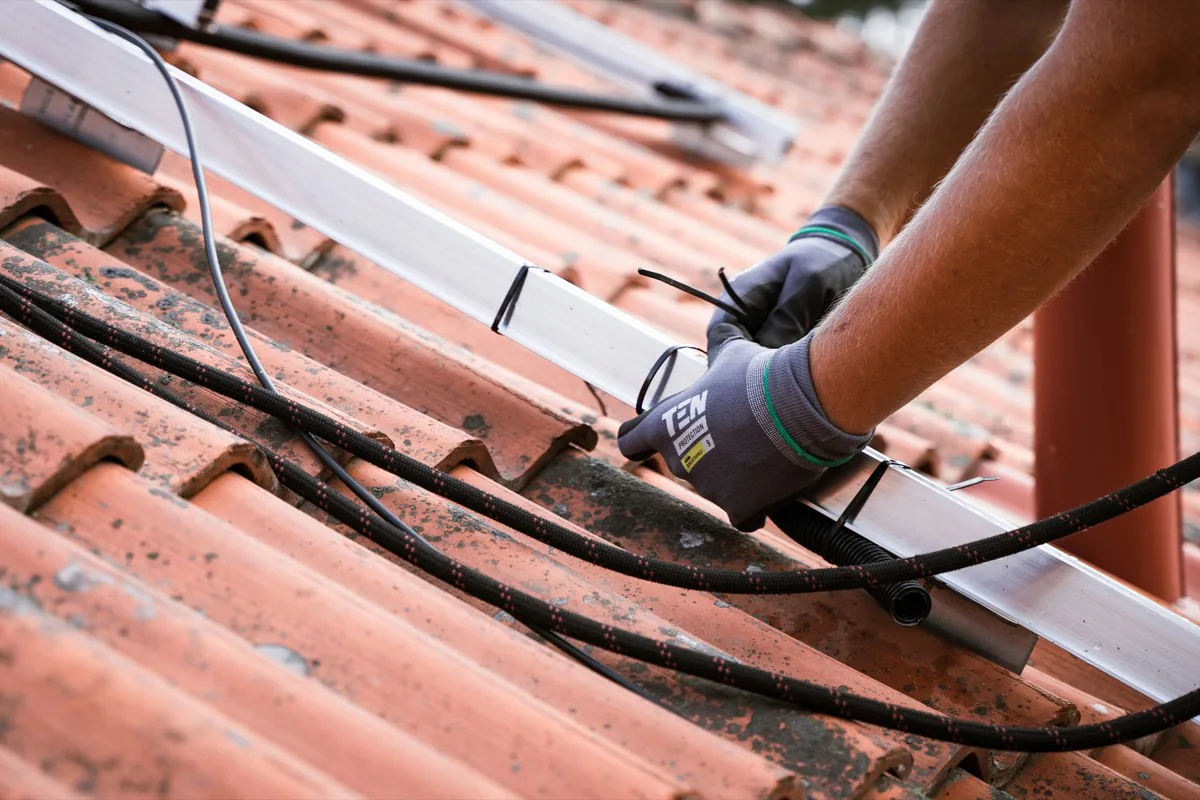
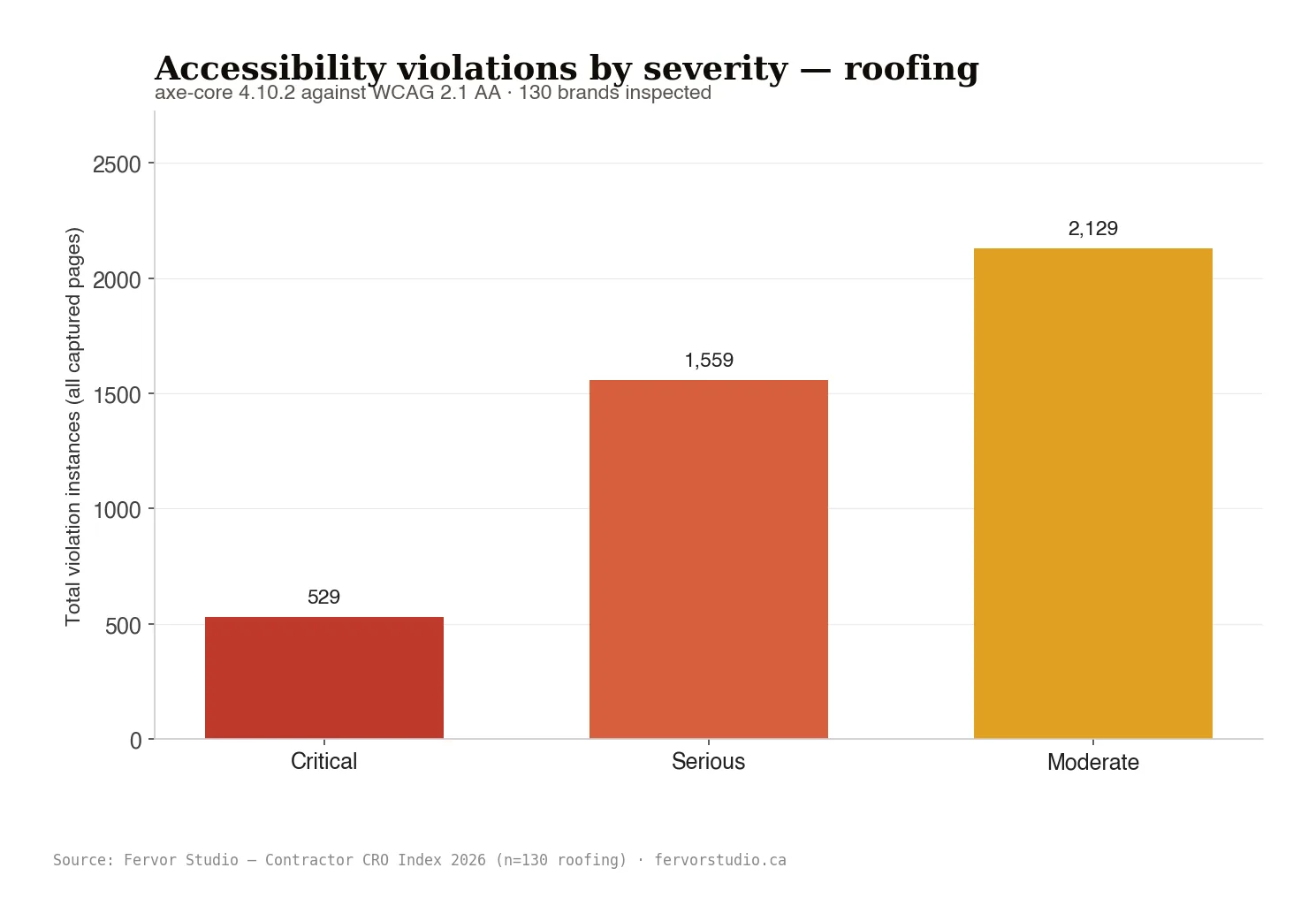
60.8% of roofing sites we tested fail a critical accessibility check
Digital State of the Roofing Industry 2026A grade out of 380 contractor sites
We graded 380 of them against one framework. Exactly one earned an A: Crown Industrial Roofing in Toronto, at 90 out of 100. The rest left money on the table. Here is what separates the top from the bottom.
The local detail
Every angle below comes from how Manchester actually searches, buys, and regulates — built into the page, not bolted on.
So let’s talk about the four seconds.
So she lands.
So she’s found your number.
So should you grab a $40-a-month template builder or have a roofing website company in Manchester build you something custom?
So here’s the mistake that costs growing roofers the most: treating the website as one invoice and local SEO as a second one, months later.
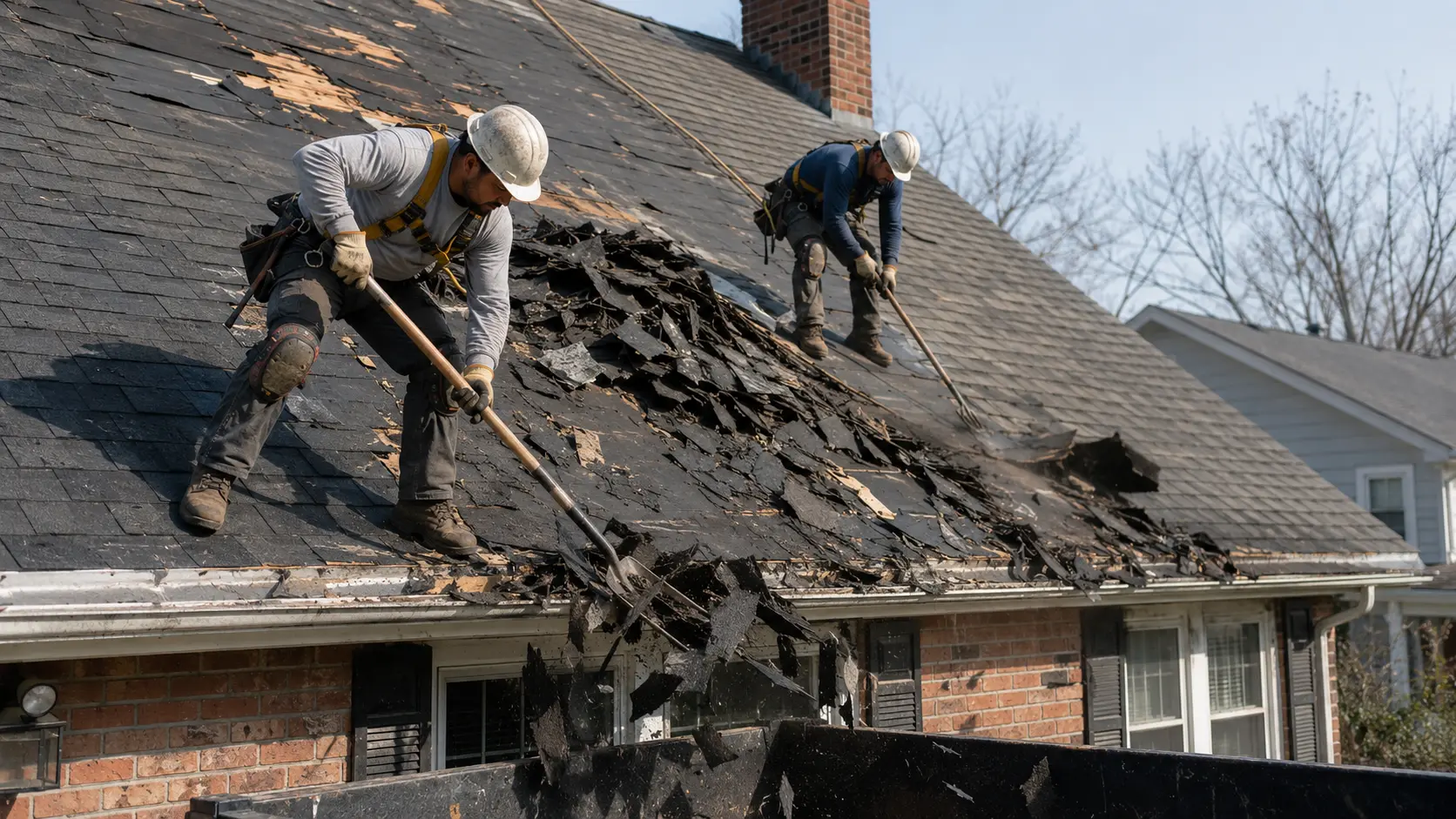
So a nor'easter clips Manchester on a Tuesday, and by dinnertime a homeowner in the North End is standing in her driveway watching a shingle bundle skate across her neighbor's lawn. She pulls out her phone. And she thumbs "roofer near me," and roofing web design in Manchester decides, in about four seconds, whether your shop gets that call or the guy two ZIP codes over does. So that's the whole game. Your truck wrap, your twenty years, your stacked reviews count for nothing if her thumb bounces before your site paints. And it bounces fast.
Here's the part nobody tells a growing roofing shop. The storm doesn't pick the busiest crew. It picks the fastest site.
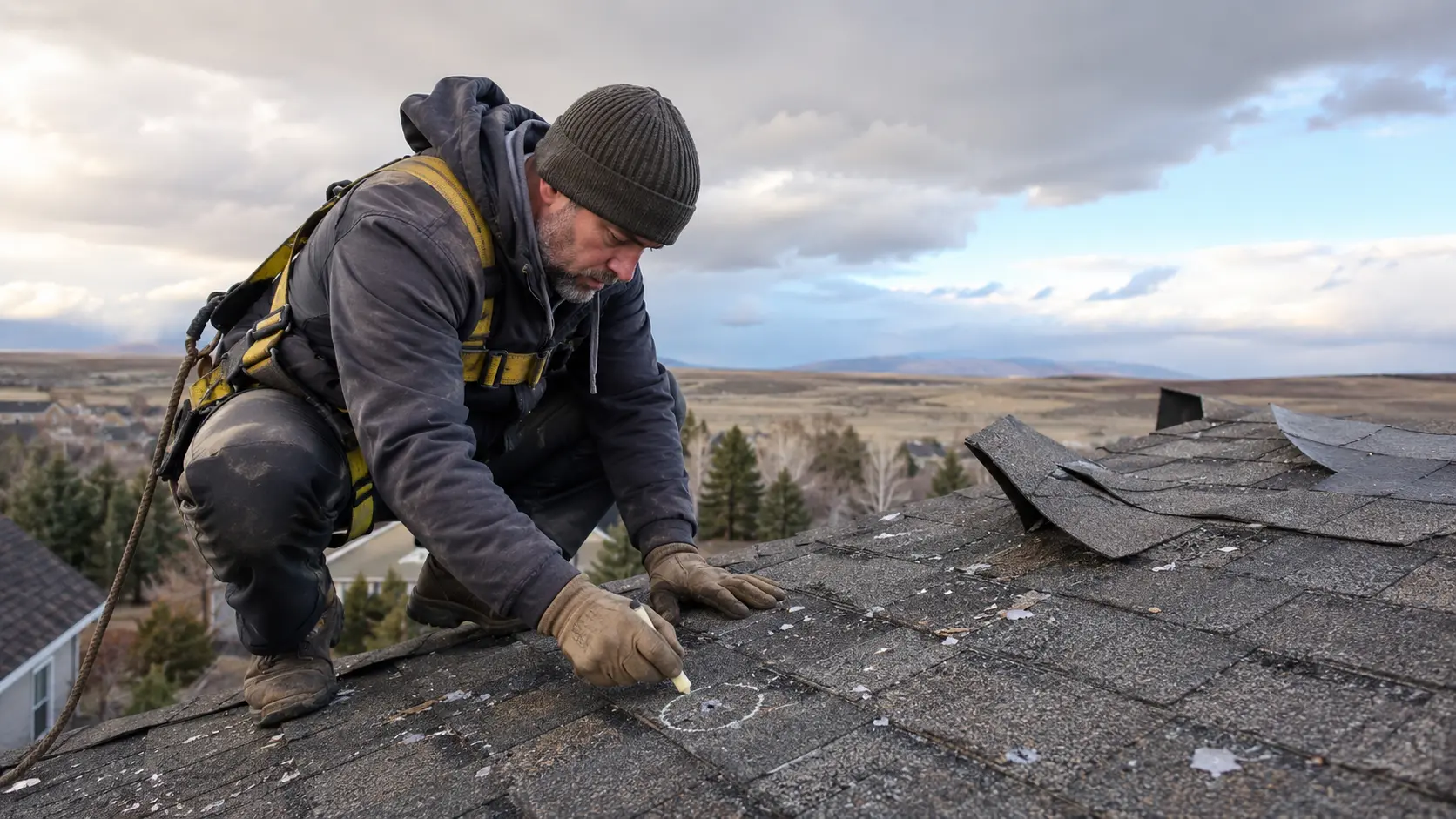
So let's talk about the four seconds. Cellular in a driveway isn't your office Wi-Fi. She's on one bar of LTE, the tower three streets over jammed with every other rattled homeowner doing the same search, and your brochure-style site is trying to load a 4MB hero video before it shows a phone number. And by the time the spinner stops, she's tapped the second result. You didn't lose the bid. You lost the load.
And the demand behind that search is not small. Roofing is the single most common exterior renovation homeowners reach for after weather knocks something loose.
"Among renovating homeowners, 44% add or redo a roof as part of their exterior projects." — Houzz Inc. (2024)
So picture the napkin math. Say storm week sends 60 of those panicked searches your way. A slow site that bleeds half of them before the page loads just handed 30 booked-estimate shots to whoever ranked next to you. At a $13,000 median job, that's a down payment on a second truck.
But "slow" is vague, so pin it down. Her patience on cellular runs out around three seconds, and every second past that sheds visitors. And a brochure site stuffed with carousel sliders, autoplay video, and six tracking scripts doesn't load in three seconds on one bar in the Hollow. It loads in eight. So eight might as well be never.
So why do so many roofing sites look like glossy pamphlets? Because a designer sold the owner on pretty. Big stock photo of a roof, a slow fade-in headline, an "About Us" tab front and center. Pretty doesn't catch the storm search. And pretty makes her wait. So you want the homeowner in Bedford or Goffstown to see a phone number before the hero image has even decided to show up.
So if you take one thing from this page, take this. She is on her phone, in a driveway, on a bad signal, and your roofing web design either respects that or it doesn't. Mobile-first means a literal build order: phone screen first, desktop second, every decision made for the thumb on a small bright screen in the cold.
And the math on roofs being old enough to fail is brutal in a region that takes real winters and the occasional hailstorm.
"In hail-prone states, average roof lifespan is 15 years vs 22 years in milder western states; 38% of U.S. homes have roofs in moderate to poor condition (Roofing Contractor) with 60% higher loss costs" — Verisk Analytics (2025)
So a big slice of the roofs in Manchester's older neighborhoods, the triple-deckers off Elm Street, the capes in the South End, are one ice dam away from a leak. And when that leak shows up at 9pm, she's searching on her phone, in the dark, with a bucket under the ceiling. So your site has four seconds to be the answer.
But here's where most roofing web designer setups in Manchester go wrong. They test the site on a fast laptop in a quiet office and call it done. You have to test it the way she'll see it: throttled to slow cellular, on a mid-range Android, with a cold cache. So hold yourself to one number: a usable first paint by second four, or you keep cutting weight.
So what's eating the seconds? Usually three things. A hero video nobody watches. A slider plugin loading 200KB of JavaScript to rotate photos she'll never swipe. And a stack of marketing scripts firing before the phone number renders. So strip those, serve compressed images, and the same content that took eight seconds now takes three. None of that takes a bigger budget. It takes discipline about what loads first.
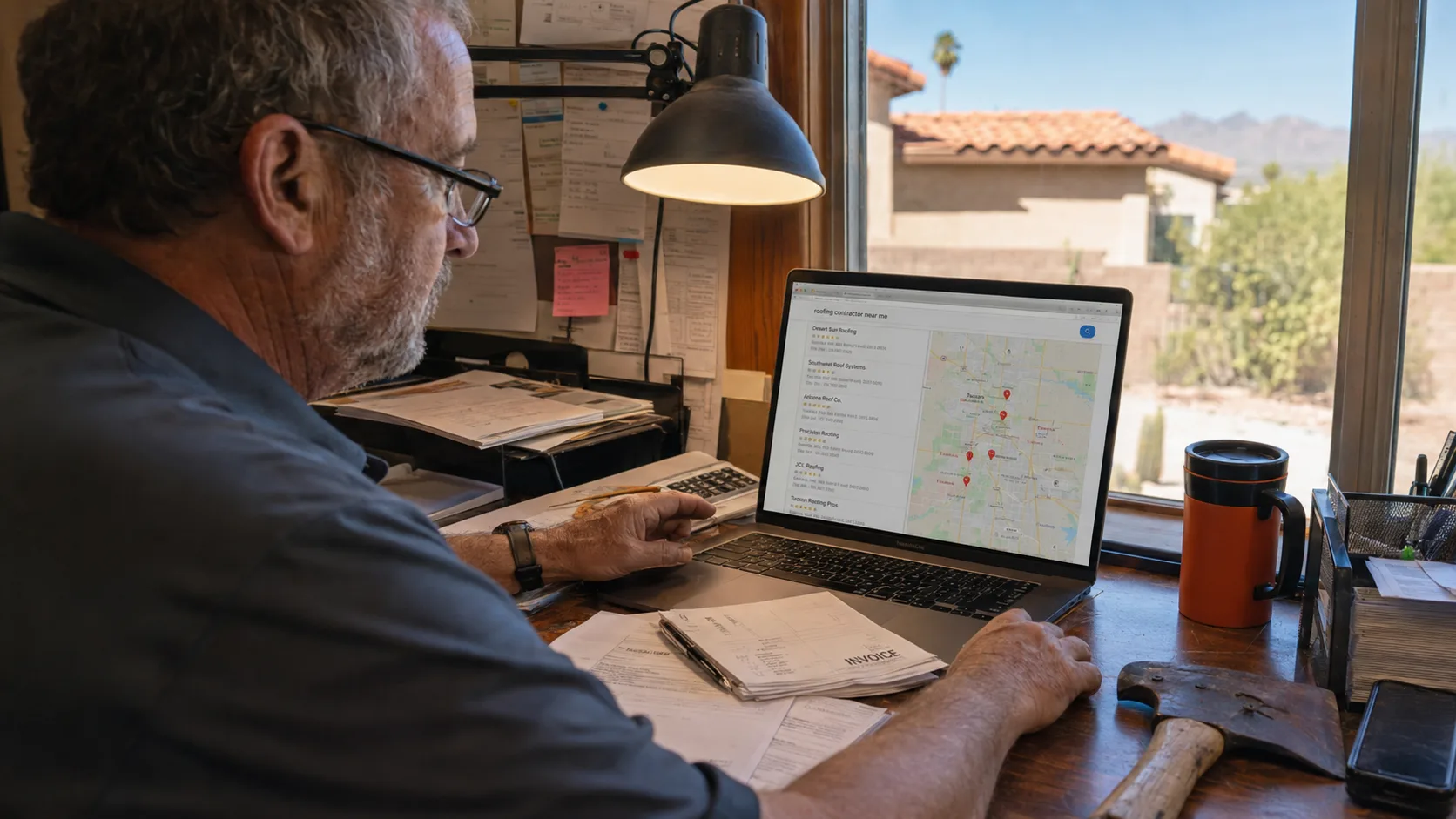
So she lands. The page paints. Now what does her thumb find first? On a roofing contractor website in Manchester that converts, the answer is a phone number she can tap, above the fold, before she scrolls a pixel. Not buried in a footer. Right there, big, tappable, with a line telling her you pick up.
And the reason that matters is timing. So homeowners don't wait around.
"97% of roofing customers expect a callback within one week. More than 50% expect a callback within two days." — Roofing Contractor Magazine (2024)
So if half your prospects expect to hear back inside two days, the site needs to make calling you the path of least resistance. One tap. No form gymnastics first. The phone is the conversion on storm week, and the form is the backup for the homeowner who's calling around and would rather type.
But here's a leak you might not see. The form asks for first name, last name, email, phone, street address, roof type, square footage, preferred date, how she heard about you, and a 500-character message box. Eleven fields. And she abandons it at field five. Every field past name, phone, and "what's going on" is a field she quits at. So three fields book more estimates than eleven. Cut the form down to what you need to call her back, and ask the rest on the phone.
So make the call button impossible to miss. It should be the brightest, biggest element above the fold on mobile, full stop. A homeowner in Manchester's West Side, water spotting her ceiling, should not have to hunt for how to reach you. And if she has to think for even two seconds about where to tap, you've added friction to a moment that has none to spare.
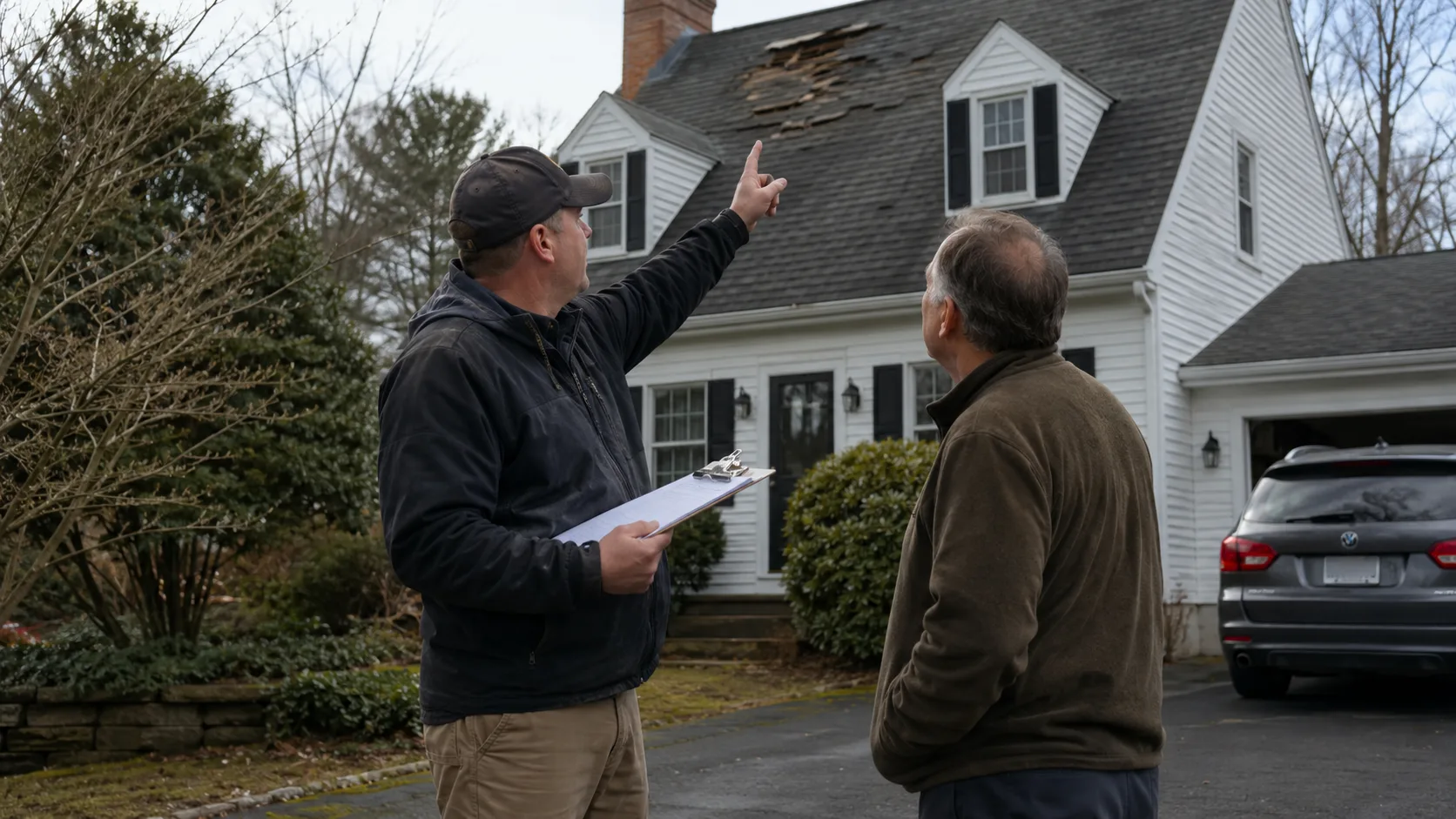
So she's found your number. What makes her tap it instead of backing out to call three roofers? Proof. Real proof, sitting right next to the call button, not parked on a separate "Testimonials" page she'll never visit.
And proof for a roof is specific. It's reviews from her neighborhood, and photos of real roofs your crew nailed down, not stock images of a generic suburb. When she sees a five-star review from someone two streets over in Manchester's Rimmon Heights, and a before-and-after of a tear-off on a house that looks like hers, the decision gets easy. She's spending real money, most of it out of pocket.
"Among homeowners who renovated in 2024, 84% used cash from savings and 29% used a credit card to fund renovation projects (multiple funding sources allowed)." — Houzz Inc. (2025)
So when 84% of her funding is cash she scraped together, she's not gambling it on a stranger. She wants to see you've done this exact thing, on this kind of house, nearby. Proof beside the ask turns a tap-and-leave into a booked estimate.
But a word on the photos. A stock photo of a pristine roof tells her nothing. A photo of your crew on a Manchester triple-decker, tear-off in progress, branded truck in the driveway, tells her you're real and local. So shoot every job. Even ten honest jobsite photos beat the prettiest stock library, because she can tell the difference in half a second.
So pull your Google reviews onto the page and tag them by area. A review that says "great work in the North End" lands harder than a five-star with no context. She's matching her situation to someone else's, and the closer that someone lives, the more the proof works.
So should you grab a $40-a-month template builder or have a roofing website company in Manchester build you something custom? It depends on where your shop is. A template gets a brand-new one-truck operation online cheap, and that beats no site. But you're a growing shop, four to ten people, and templates start working against you fast.
And here's why. A template loads every feature its theme ships with, whether you use it or not, which is exactly the weight that blows past four seconds on cellular. You don't control what loads first. And when you want a Manchester-specific landing page for the East Side that ranks, you're stuck with whatever the builder allows.
"In 2024, 22% of renovating homeowners undertook roofing upgrades, with a median spend of $13,000." — Houzz Inc. (2025)
So run the math at a $13,000 median job. A custom site that books two extra estimates a month, and closes one, pays for itself many times over inside a season. The template that costs less up front but bleeds the storm-week search costs you the jobs you never knew you missed. Cheap is expensive when it loses the load.
But I'm not going to tell you templates are always wrong. For a side-hustle roofer doing six jobs a year, a clean template is plenty. The line gets crossed when leads become your growth constraint. So once you're hiring crew and the phone not ringing is what's holding you back, a custom build you control end to end becomes the cheapest lead source you've got.
So the fear with custom is always time. "I don't have six months for a website." Fair. But custom doesn't mean endless. A focused build, scoped to the pages that book roofing estimates, ships in weeks, not seasons. You keep running crews. The site gets built around your jobs, not the other way around.
So here's the mistake that costs growing roofers the most: treating the website as one invoice and local SEO as a second one, months later. They're one project. The site has to be built to rank the day it launches, or you've bought a beautiful page nobody in Manchester finds.
And the reason is simple. The fast, mobile-first, click-to-call structure that converts the storm-week visitor is the same structure Google reads to decide who shows up in the map pack for "roofer Manchester." Page speed is a ranking signal. So the thing that books the estimate is the thing that earns the ranking. Same build.
"From 2021–2023, homeowners spent $93.5B on roofing across 8.3 million projects (AHS-based estimates)." — U.S. Census Bureau and U.S. Department of Housing and Urban Development (2024)
So with that much roofing money moving across the country, the contractors who win Manchester tend to pour their custom roofing website and local SEO as a single foundation, on one invoice, at one time. A custom roofing website in Manchester scoped this way ranks and converts from the same bones.
But what does "one project" look like in practice? Service pages structured for the searches homeowners type. Schema markup baked in so Google reads your service area cleanly. Neighborhood pages for the Hollow, Bakersville, and Hallsville that target real local intent. So it's all one build, where every part pulls double duty.
So every month you run a site that can't rank is a month of storm searches landing on a competitor. And material choice tells you how often these jobs come up.
"Among homeowners undertaking a roofing project, 63% choose asphalt roofing material (dimensional shingles 34%, three-tab shingles 19%, luxury shingles 10%), while 14% choose metal and 11% choose synthetic material or rubber." — Houzz Inc. (2024)
And those costs keep climbing, which means the jobs you miss are worth more every year.
"The median spend on roofing upgrades in 2024 was 8% higher than in 2023 (median $13,000 in 2024)." — Houzz Inc. (2025)
So here's how we think about it. Before we touch a build, we look at what's broken, on your site and across the trade. We run a free Site Inspection of your current site, with no sales call attached, and we show you exactly where the storm-week search is leaking. You'll see your load time on throttled cellular, where your click-to-call sits, how many fields your form asks for, and whether your proof is beside the ask or buried.
And we don't guess at the standard. We pull from our inspection of roofing websites across the trade, so you can see how your site stacks up against the roofers you're competing with for the same Manchester searches.
So the offer is plain. You get a free Site Inspection, no sales call, no obligation. And you keep the findings whether you work with us or not. The storm's coming either way. The only question is whose site she taps when it does.
The evidence
 Read the full report →
 0
contractor sites graded, one A
Across the whole CRO Index, a single site earned an A. The median landed at a D. The grade gap is a conversion gap.
0 %
of roofing sites fail a critical accessibility check
Scored against WCAG 2.1 AA with axe-core. A page that blocks a screen reader also blocks a paying customer.
Fervor Roofing State of the Industry, 2026
0 %
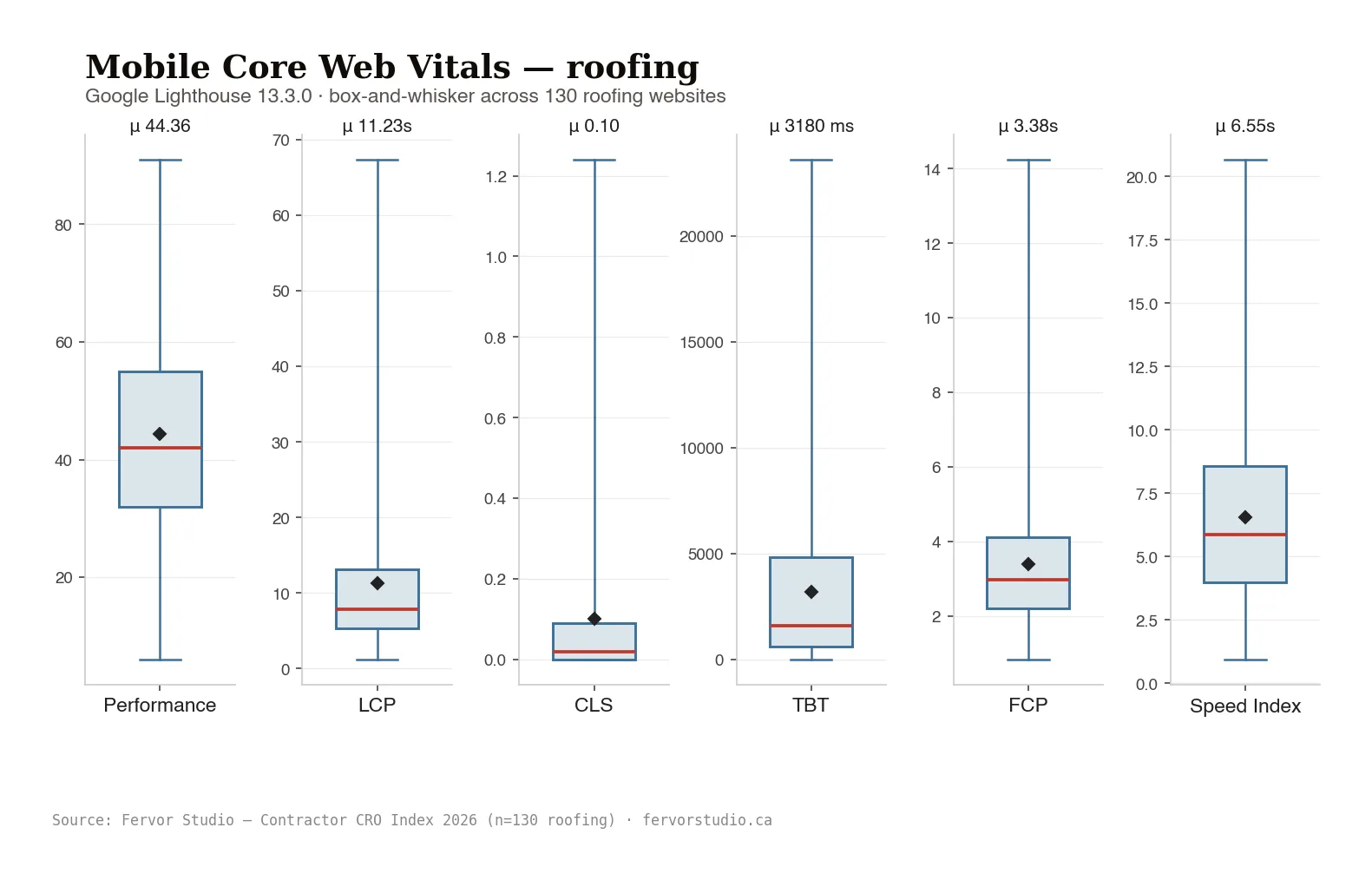
miss Google's mobile load-speed bar
Median mobile load lands at 7.88 seconds. Most of your traffic is on a phone, and most of them are gone before the hero paints.
Fervor Roofing State of the Industry, 2026
0 /100
is the average roofing grade
That is a D. The sites booking the work are not the ones with the biggest crews. They are the ones a few points higher on the things homeowners feel.
Two ways to start
Tell us where you are. We point you at the right next step — no sales call to get there.
Client review
“Nay did an amazing job, you know. He was really patient. He got the work done the way I told him and he was just on point with the website. Pretty straightforward process. No going around the bush. He just did amazing work and I would 100% recommend.”
How Fervor can help
Complete website system built to convert storm leads, planned projects, and research-phase homeowners into booked jobs.
Identify and patch the top conversion killers on your existing site. No full rebuild needed.
Monthly SEO, content, and CRO. Fixed deliverables. No credits, no rollover. The compound growth engine.
GBP optimization, citation building, and review system foundation. The infrastructure that gets you into the Map Pack.
One conversion-built landing page for the referrals, paid clicks, and cold-call leads you send. They land on a page built to book them, not your generic homepage.
Your move
Tell us where you are. We point you at the right next step — no sales call to get there.
Keep going