0
contractor sites graded, one A
Across the whole CRO Index, a single site earned an A. The median landed at a D. The grade gap is a conversion gap.
You're getting clicks in Little Rock. They're just not calling. We rebuild your site around the one job that matters: turning a visitor into a booked job.
Starts with a Site Inspection, so you see the plan before any build begins.
“Patient, on point, straightforward. Did amazing work. Would 100% recommend.” — Ruben Mederos, HyperTemp HVAC
“Responsive, creative, exceeded expectations. Already seeing greater engagement from our clients.” — George Jeorgy, Jeorgy's Landscape Construction
“Top-tier professionalism, real web design expertise, ideas I hadn't considered. Confidently recommend.” — Aws Nassani, Four Eleven Contracting



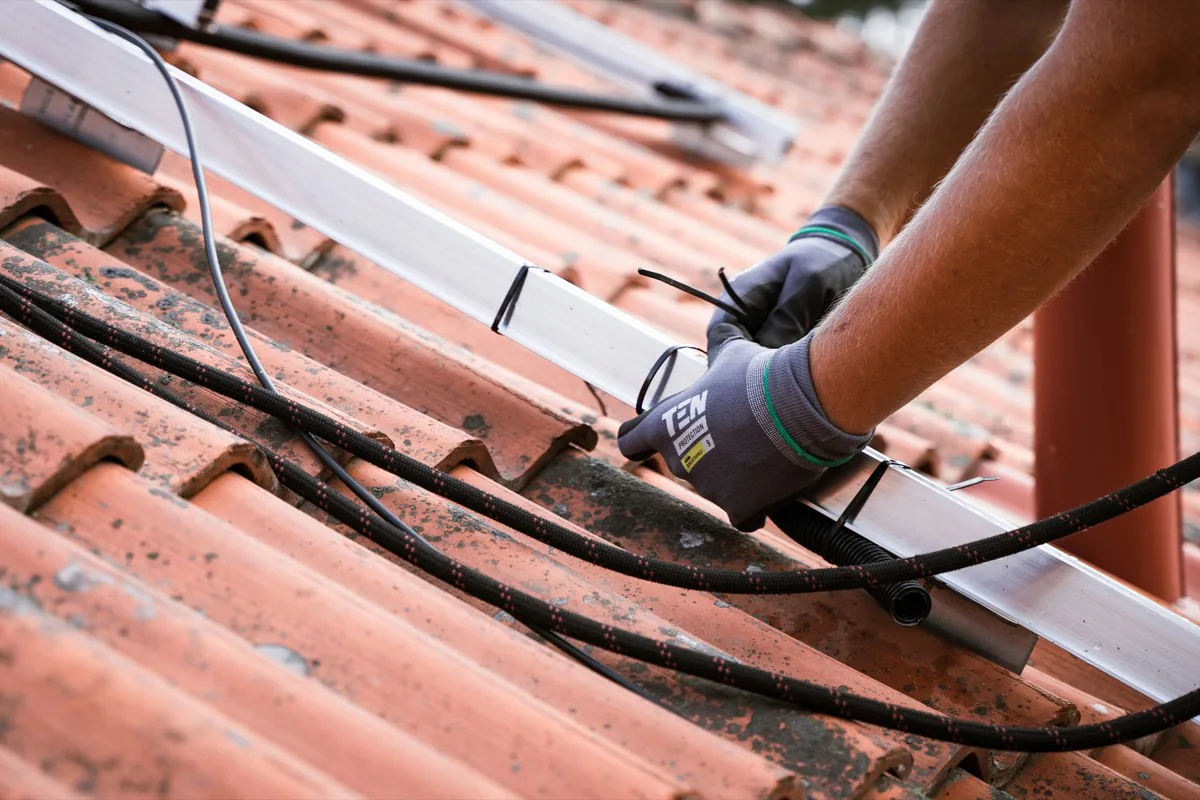
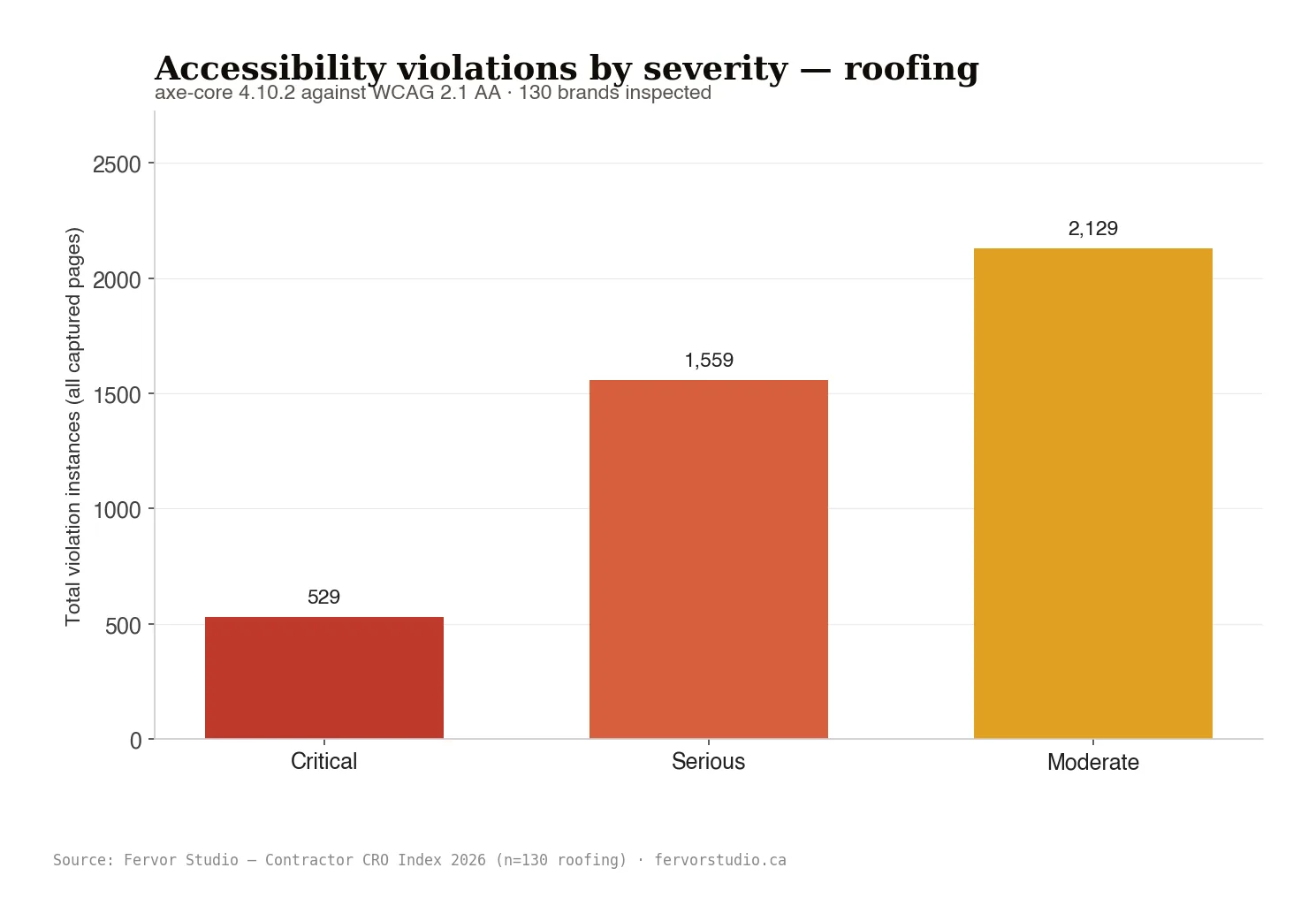
60.8% of roofing sites we tested fail a critical accessibility check
Digital State of the Roofing Industry 2026A grade out of 380 contractor sites
We graded 380 of them against one framework. Exactly one earned an A: Crown Industrial Roofing in Toronto, at 90 out of 100. The rest left money on the table. Here is what separates the top from the bottom.
The local detail
Every angle below comes from how Little Rock actually searches, buys, and regulates — built into the page, not bolted on.
Storm weeks are when your phone should ring off the hook.
She isn’t on a desktop in an office.
Here’s the simplest fix that almost every shop botches.
Some sites bury an eleven-field form that asks for everything but a blood sample.
Reviews and photos are the most persuasive thing on your whole site, and most shops exile them to a tab nobody clicks.
So which builder do you pick?
A bundle of shingles just peeled off a roof on Kavanaugh Boulevard during a Hillcrest squall. The homeowner is standing in her driveway, phone out, thumb already typing. She wants somebody on a ladder this week, not a brochure. So roofing web design Little Rock shops should treat that 30-second window as the whole ballgame. Because if your site stalls or buries the phone number, she taps the next result and you never knew she existed. That is the job. Catch the panicked search and turn it into a booked estimate before she bounces to the competitor two listings down.
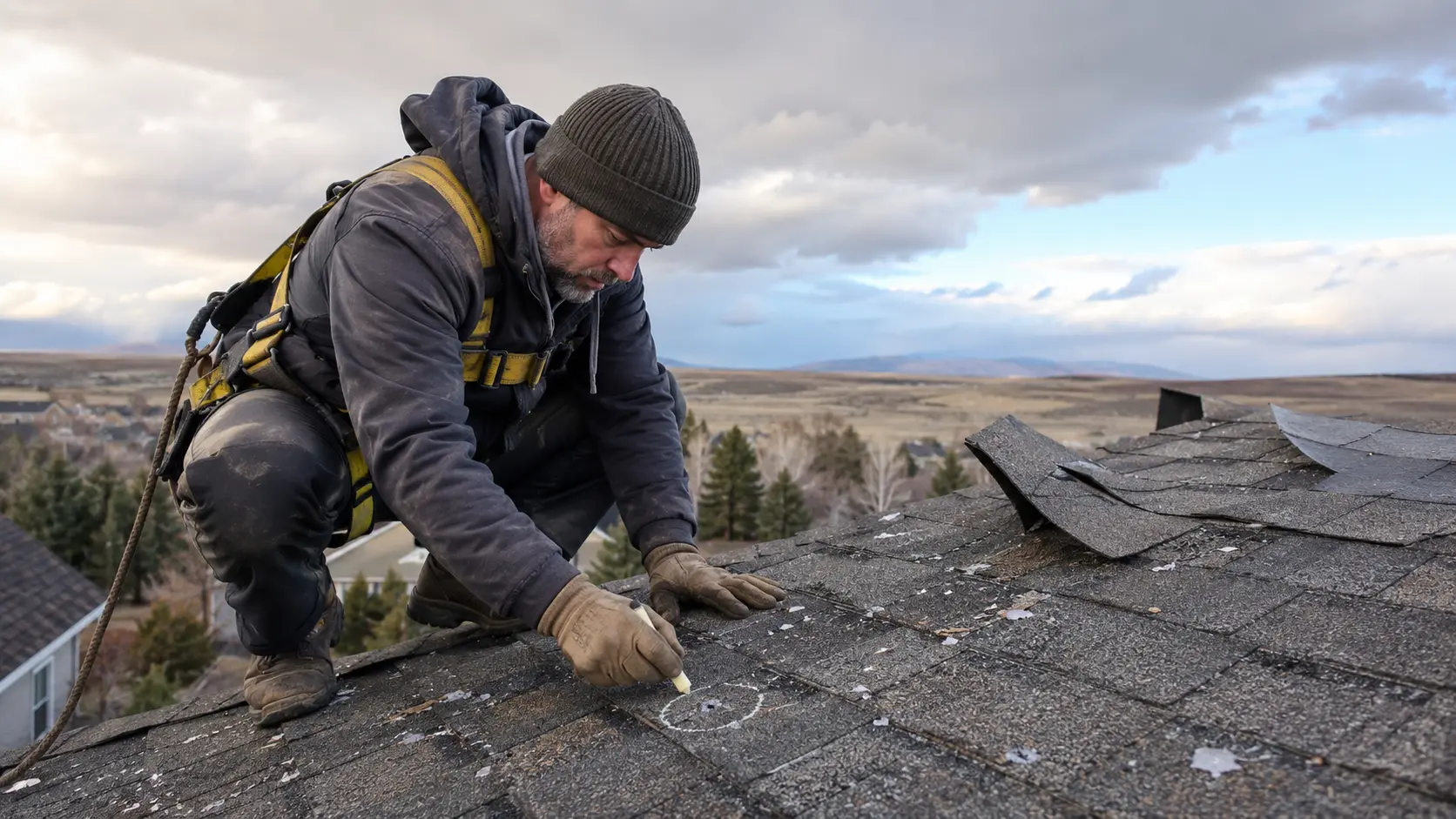
Storm weeks are when your phone should ring off the hook. April and May line squalls roll through Pulaski County, hail dents gutters in Otter Creek, and half of West Little Rock starts searching the same afternoon. But a site that takes six seconds to paint on a phone has already lost most of those people. Google's own field data pegs the drop-off near 50% once mobile load creeps past three seconds. So every wasted second is a coin flip you keep losing.
And the homeowner isn't browsing for fun. She's scared the next storm finishes the job the last one started.
"97% of roofing customers expect a callback within one week. More than 50% expect a callback within two days." — Roofing Contractor Magazine (2024)
So if your page makes her hunt for a phone number, she's already mentally dialing someone else. The damage compounds, too, because Arkansas roofs take a beating that drier states never see.
"In hail-prone states, average roof lifespan is 15 years vs 22 years in milder western states; 38% of U.S. homes have roofs in moderate to poor condition (Roofing Contractor) with 60% higher loss costs" — Verisk Analytics (2025)
Your old site probably reads like a paper flyer. About us, our values, a stock photo of a generic suburb. But the woman in the driveway doesn't care about your mission statement. She wants to know you can be on her roof in Cammack Village by Thursday. So lead with the action, not the autobiography.
You never see the 40 people who left in two seconds. You only see the three who called. So the leak feels small when it's the biggest hole in the shop. One booked reroof around here runs maybe $13,000, and the national pattern backs that number up.
"In 2024, 22% of renovating homeowners undertook roofing upgrades, with a median spend of $13,000." — Houzz Inc. (2025)
So lose four of those a month to a slow page and you're down $52,000 before you've spent a dollar on ads.
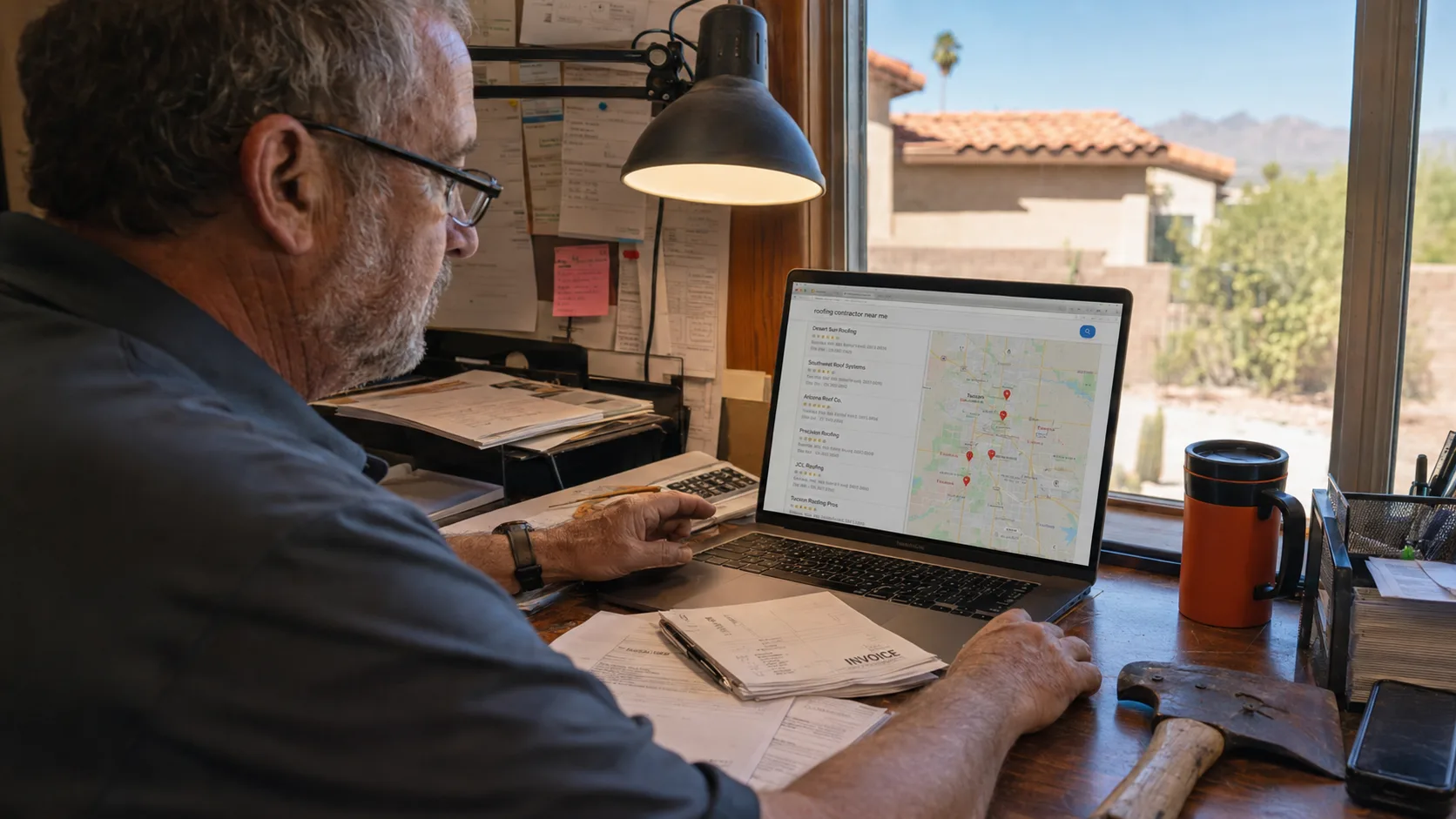
She isn't on a desktop in an office. She's on a phone, on cellular, standing in a driveway in The Heights with one bar and a cracked screen. So the site has to paint fast on a mid-range Android over a so-so connection, not just on the new iPhone you tested it on. And four seconds is the ceiling, not the goal. Aim for two.
And the trade-show templates a contractor buys were rarely tested on a real phone in a real yard. They look sharp on the salesman's laptop and then choke on the curb.
Roofers love big hero photos of finished roofs, and you should keep them. But a 4MB drone shot of a Chenal job will tank your load time on cellular. So compress every image to WebP, lazy-load anything below the fold, and you'll claw back two or three seconds without losing a single pixel of pride.
Your developer tests on fast office WiFi and a $1,200 phone. Your customer is on a $300 handset and spotty LTE near Pinnacle Mountain. So the only test that counts is the cheap-phone-on-cellular test. If it's slow there, it's slow where the money is.
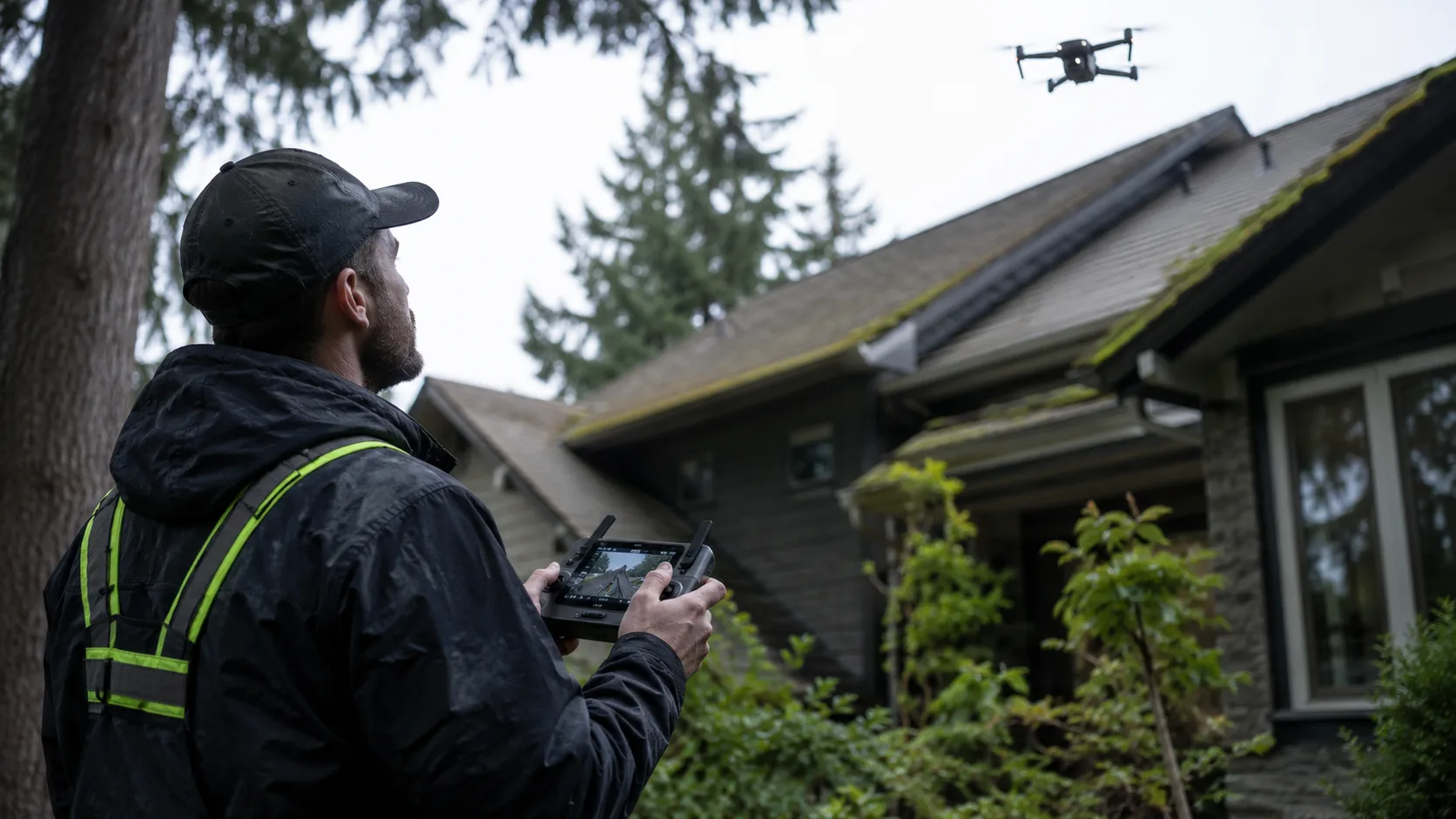
Here's the simplest fix that almost every shop botches. The phone number has to be a tappable button, in the top bar, visible before she scrolls. Not a footer link. Not an image of a number she has to retype. A real tel: button her thumb can hit in the half-second before she gives up. So if she has to scroll to find you, you've already lost her to the shop that didn't make her work.
She's holding a phone in one hand and a coffee in the other. So the call button has to be reachable by a single thumb, big enough to hit without zooming, and sticky so it follows her down the page. That's it. The whole funnel can hinge on a 44-pixel button in Briarwood.
If you can't see which storm week drove which calls, you're flying blind. So wire call tracking into the button from day one. Then you'll know that the hail event over Walton Heights drove 11 calls and the spring mailer drove two, and you'll spend your next dollar where it pays.
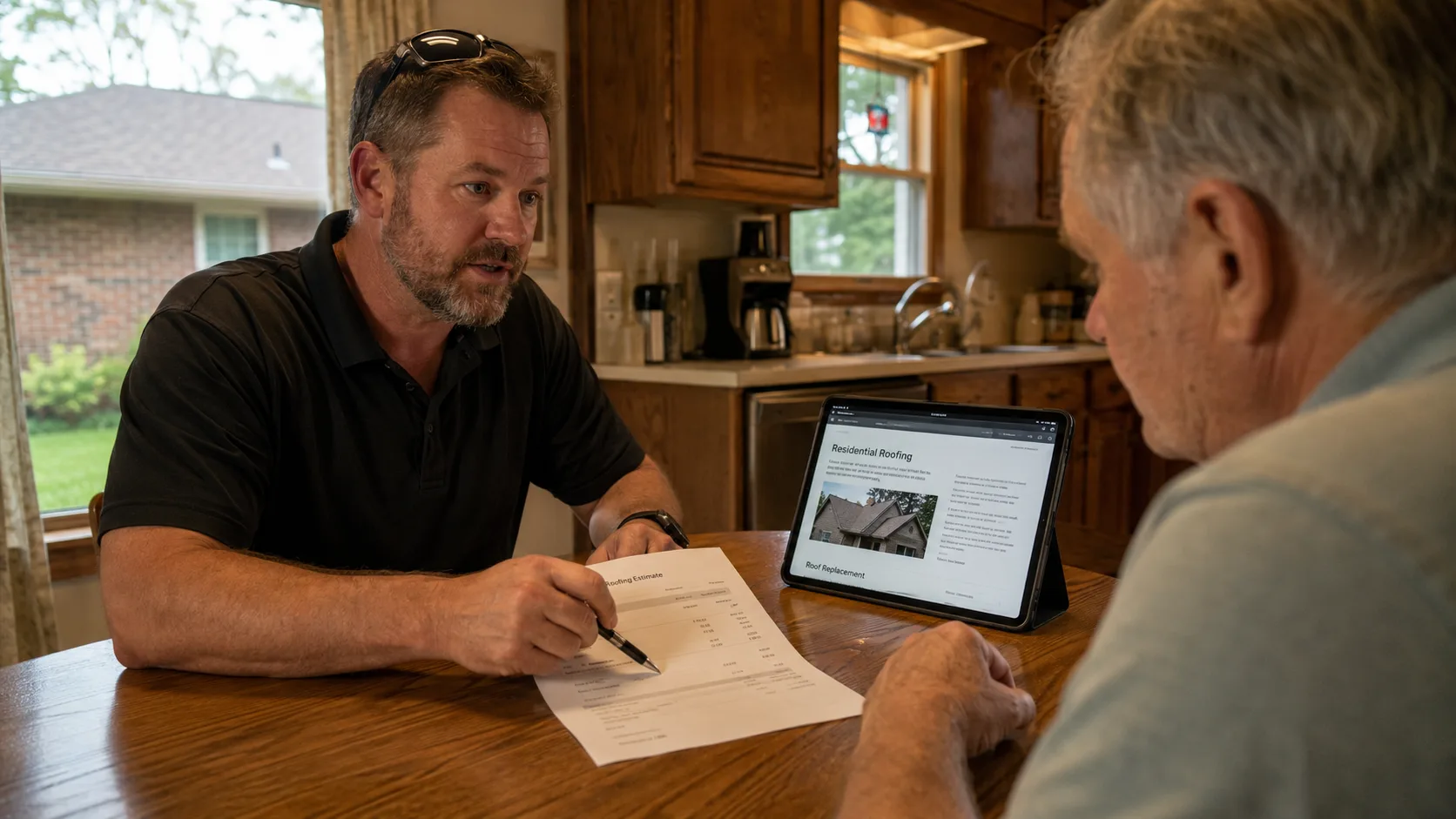
Some sites bury an eleven-field form that asks for everything but a blood sample. Name, email, phone, address, roof age, square footage, preferred contact time, budget range. So she fills out two boxes, hits a required field she can't answer, and quits. Every field you add past three is a leak. Ask for a name, a phone, and a one-line "what happened," and let your office get the rest on the callback.
She's probably paying out of pocket, so the form shouldn't feel like a loan application.
"Among homeowners who renovated in 2024, 84% used cash from savings and 29% used a credit card to fund renovation projects (multiple funding sources allowed)." — Houzz Inc. (2025)
So drop the budget-range dropdown. It scares off a cash buyer who'd have happily booked a $13,000 job after one friendly call.
A form floating alone feels like a void. So stack your best reviews and a few real-roof photos right beside the ask. Then the decision to type her number feels safe, because she just saw three neighbors in Robinwood who trusted you and got a clean job out of it.
Reviews and photos are the most persuasive thing on your whole site, and most shops exile them to a tab nobody clicks. So bring them up to the fold, next to the phone button, where the scared homeowner sees them. Real photos of real Little Rock roofs beat any stock image, because she recognizes the brick ranch two streets over.
A stock photo of a flawless roof on a mansion says nothing. But a phone shot of the tear-off and reroof you did in Hillcrest last month says everything. So show the asphalt shingle work, since that's what most of your buyers are choosing anyway.
"Among homeowners undertaking a roofing project, 63% choose asphalt roofing material (dimensional shingles 34%, three-tab shingles 19%, luxury shingles 10%), while 14% choose metal and 11% choose synthetic material or rubber." — Houzz Inc. (2024)
A five-star average is worthless if she has to dig for it. So pin two or three named reviews right beside the form, not three clicks away. And a roof is a big-ticket, infrequent buy, which is exactly when social proof carries the most weight.
"Among renovating homeowners, 44% add or redo a roof as part of their exterior projects." — Houzz Inc. (2024)
So which builder do you pick? A $40-a-month template gets you online fast and cheap, and for a brand-new shop that's a fine start. But templates share code, share layouts, and rarely pass the cheap-phone load test. A custom build costs more up front and earns it back by loading fast, ranking well, and bending to your actual sales process. The roofing market is huge, so the math on winning a few more of those searches adds up quickly.
"From 2021–2023, homeowners spent $93.5B on roofing across 8.3 million projects (AHS-based estimates)." — U.S. Census Bureau and U.S. Department of Housing and Urban Development (2024)
A lot of contractors pay one company to build the site and another to do local SEO, and the two never talk. So the site launches gorgeous and invisible. The build and the search ranking are the same project, because page speed, clean code, and local schema are what Google reads to decide who shows up when Sherwood searches. Pay for them together or they fight each other.
The jobs are getting bigger, too, which means every caller you catch is worth more than last year's.
"The median spend on roofing upgrades in 2024 was 8% higher than in 2023 (median $13,000 in 2024)." — Houzz Inc. (2025)
So a page that catches one extra caller a week is the cheapest crew member you'll ever hire, and it never calls in sick during a hail event in Maumelle.
We start by looking at what's losing you calls, not by pitching a redesign. So we run the same checks we ran in our inspection of roofing websites across the trade: load speed on a real phone, whether the call button survives the fold, how many fields the form demands, and whether your proof sits where a scared homeowner can see it.
Then you get a free Site Inspection of your own site. No sales call, no pitch deck, no obligation. Just a plain readout of where the storm-week caller is slipping through, and what you'd fix first to plug the biggest leak. You decide what to do with it. And if you handle the fixes yourself, good. The point is that you stop losing the woman in the driveway to the shop two listings down.
The evidence
 Read the full report →
 0
contractor sites graded, one A
Across the whole CRO Index, a single site earned an A. The median landed at a D. The grade gap is a conversion gap.
0 %
of roofing sites fail a critical accessibility check
Scored against WCAG 2.1 AA with axe-core. A page that blocks a screen reader also blocks a paying customer.
Fervor Roofing State of the Industry, 2026
0 %
miss Google's mobile load-speed bar
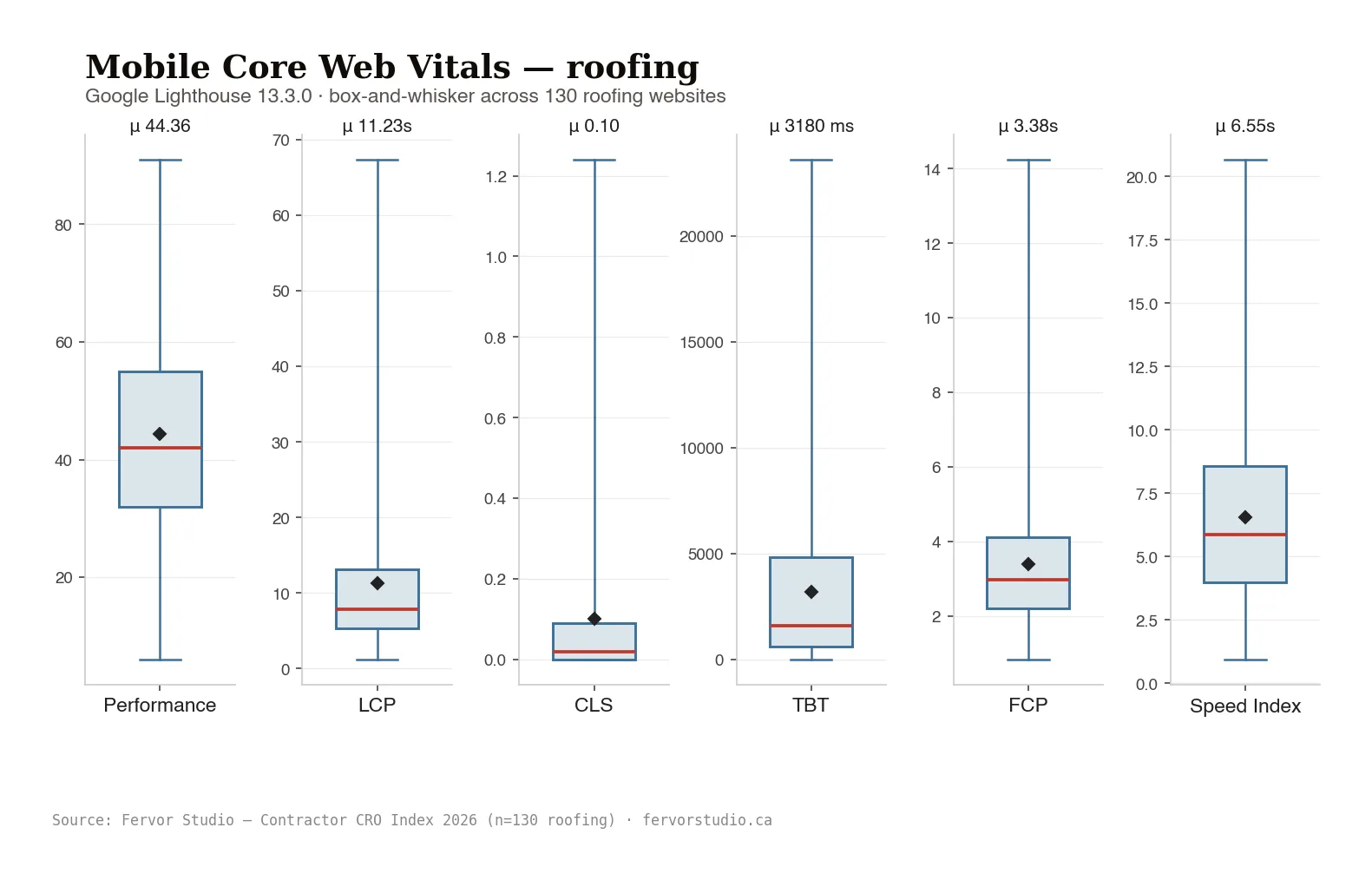
Median mobile load lands at 7.88 seconds. Most of your traffic is on a phone, and most of them are gone before the hero paints.
Fervor Roofing State of the Industry, 2026
0 /100
is the average roofing grade
That is a D. The sites booking the work are not the ones with the biggest crews. They are the ones a few points higher on the things homeowners feel.
Two ways to start
Tell us where you are. We point you at the right next step — no sales call to get there.
Client review
“Nay did an amazing job, you know. He was really patient. He got the work done the way I told him and he was just on point with the website. Pretty straightforward process. No going around the bush. He just did amazing work and I would 100% recommend.”
How Fervor can help
Complete website system built to convert storm leads, planned projects, and research-phase homeowners into booked jobs.
Identify and patch the top conversion killers on your existing site. No full rebuild needed.
Monthly SEO, content, and CRO. Fixed deliverables. No credits, no rollover. The compound growth engine.
GBP optimization, citation building, and review system foundation. The infrastructure that gets you into the Map Pack.
One conversion-built landing page for the referrals, paid clicks, and cold-call leads you send. They land on a page built to book them, not your generic homepage.
Your move
Tell us where you are. We point you at the right next step — no sales call to get there.
Keep going