0
contractor sites graded, one A
Across the whole CRO Index, a single site earned an A. The median landed at a D. The grade gap is a conversion gap.
You're getting clicks in Las Vegas. They're just not calling. We rebuild your site around the one job that matters: turning a visitor into a booked job.
Starts with a Site Inspection, so you see the plan before any build begins.
“Patient, on point, straightforward. Did amazing work. Would 100% recommend.” — Ruben Mederos, HyperTemp HVAC
“Responsive, creative, exceeded expectations. Already seeing greater engagement from our clients.” — George Jeorgy, Jeorgy's Landscape Construction
“Top-tier professionalism, real web design expertise, ideas I hadn't considered. Confidently recommend.” — Aws Nassani, Four Eleven Contracting



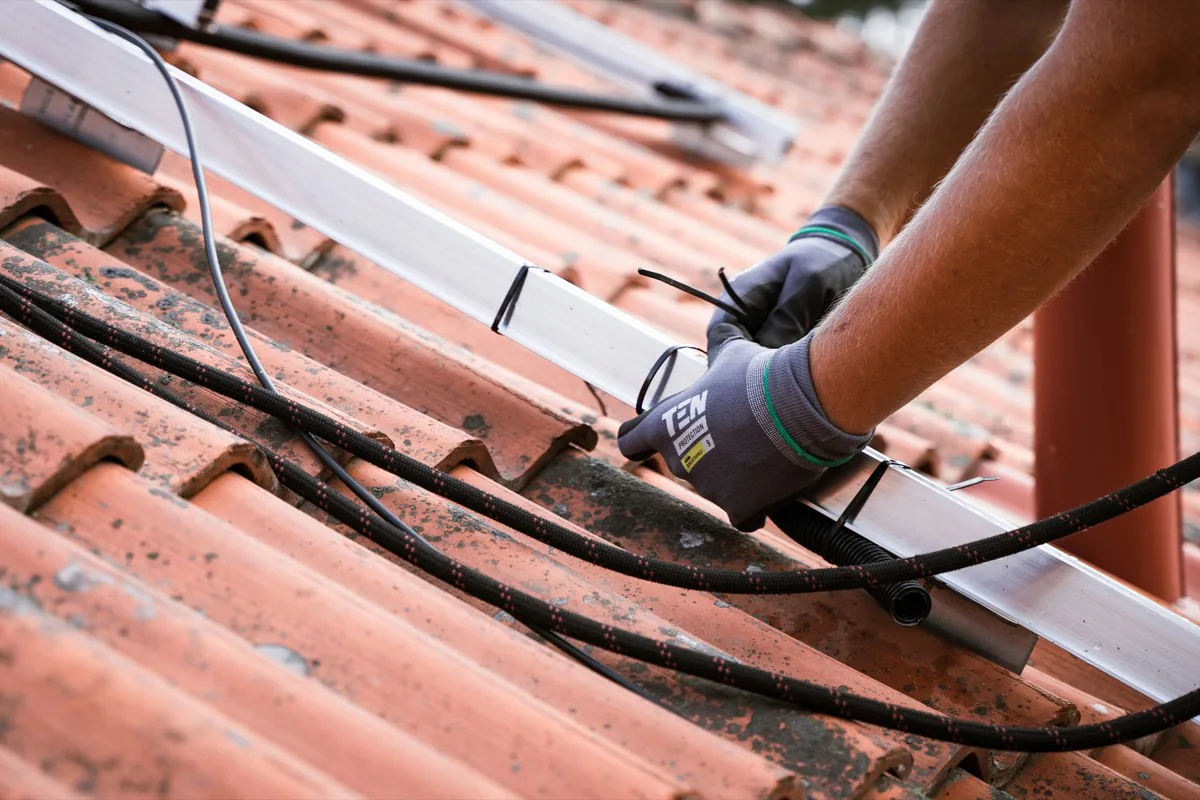
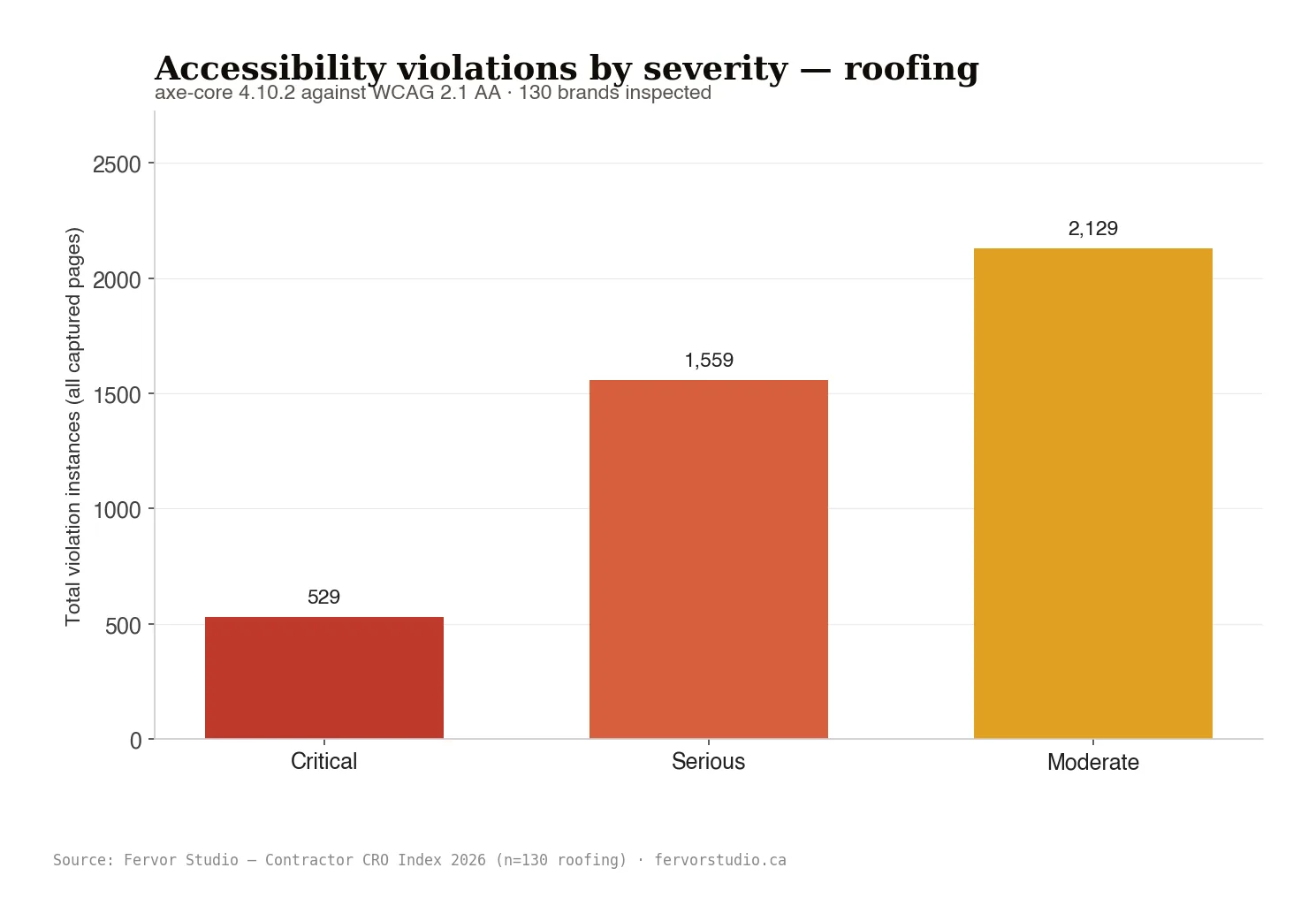
60.8% of roofing sites we tested fail a critical accessibility check
Digital State of the Roofing Industry 2026A grade out of 380 contractor sites
We graded 380 of them against one framework. Exactly one earned an A: Crown Industrial Roofing in Toronto, at 90 out of 100. The rest left money on the table. Here is what separates the top from the bottom.
The local detail
Every angle below comes from how Las Vegas actually searches, buys, and regulates — built into the page, not bolted on.
Vegas doesn’t get much rain.
Your customer isn’t at a desk.
So she found your number.
Now the question every owner asks me.
Here’s where a lot of owners get split in half by vendors.
So picture the homeowner in Summerlin who just watched a bundle of shingles peel off her neighbor's roof in a 60 mph monsoon gust. She's standing in her driveway, phone already out, thumbing "roofer near me" before the wind even dies down. That single search is the whole game. And roofing web design Las Vegas owners pay for either catches her in those ninety seconds or it doesn't. Your site has one job in that moment. Turn her panic into a booked estimate before she taps back and calls the next guy. Most of the work on this page is about that ninety-second window, because that's where your money lives.
But here's the part nobody tells you. The lead was never lost to your competitor's better roof. It was lost to his faster phone.
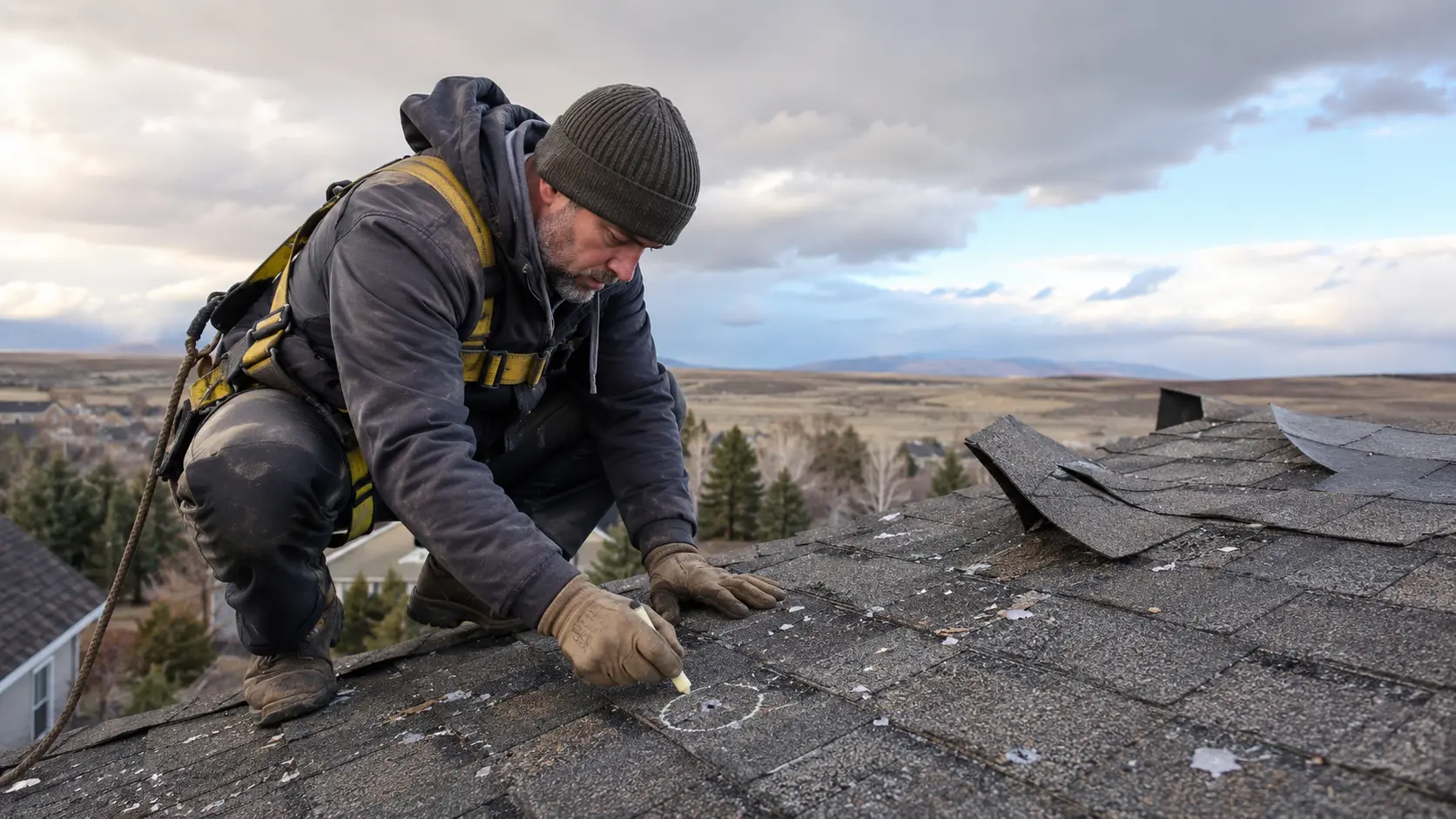
Vegas doesn't get much rain. So when it does, it comes mean. A single July microburst can drop an inch in twenty minutes and strip tabs off a hundred roofs in Henderson before lunch. That's your demand spike, and it lasts maybe three days. After that the search volume drops back to its quiet baseline and you're waiting on the next storm.
So every second your site takes to load during that spike is a lead leaking out the bottom. And here's the brutal math on it.
"97% of roofing customers expect a callback within one week. More than 50% expect a callback within two days." — Roofing Contractor Magazine (2024)
She's not waiting two days. She's waiting four seconds. If your page is still painting on her phone while she stands in the sun off Eastern Avenue, she's gone. And she took a $9,000 reroof with her.
A lot of roofers in town are running what I'd call a brochure. Pretty homepage. A photo of a truck. A "Contact Us" tab buried in a menu. It loads fine on your office wifi, so you assume it's fine. But it was built to be looked at, not to be used in a driveway on cellular with one bar.
So you never see the bounce. You just see a slow month and blame the weather.
Your nephew built you a nice-looking site. But did anyone test it on a real phone, on a real LTE connection, in a real parking lot in North Las Vegas? That's the only test that counts. A four-second load on cellular is the bar. Get past four and you start shedding a measurable chunk of every storm-week visitor before they ever see your number.
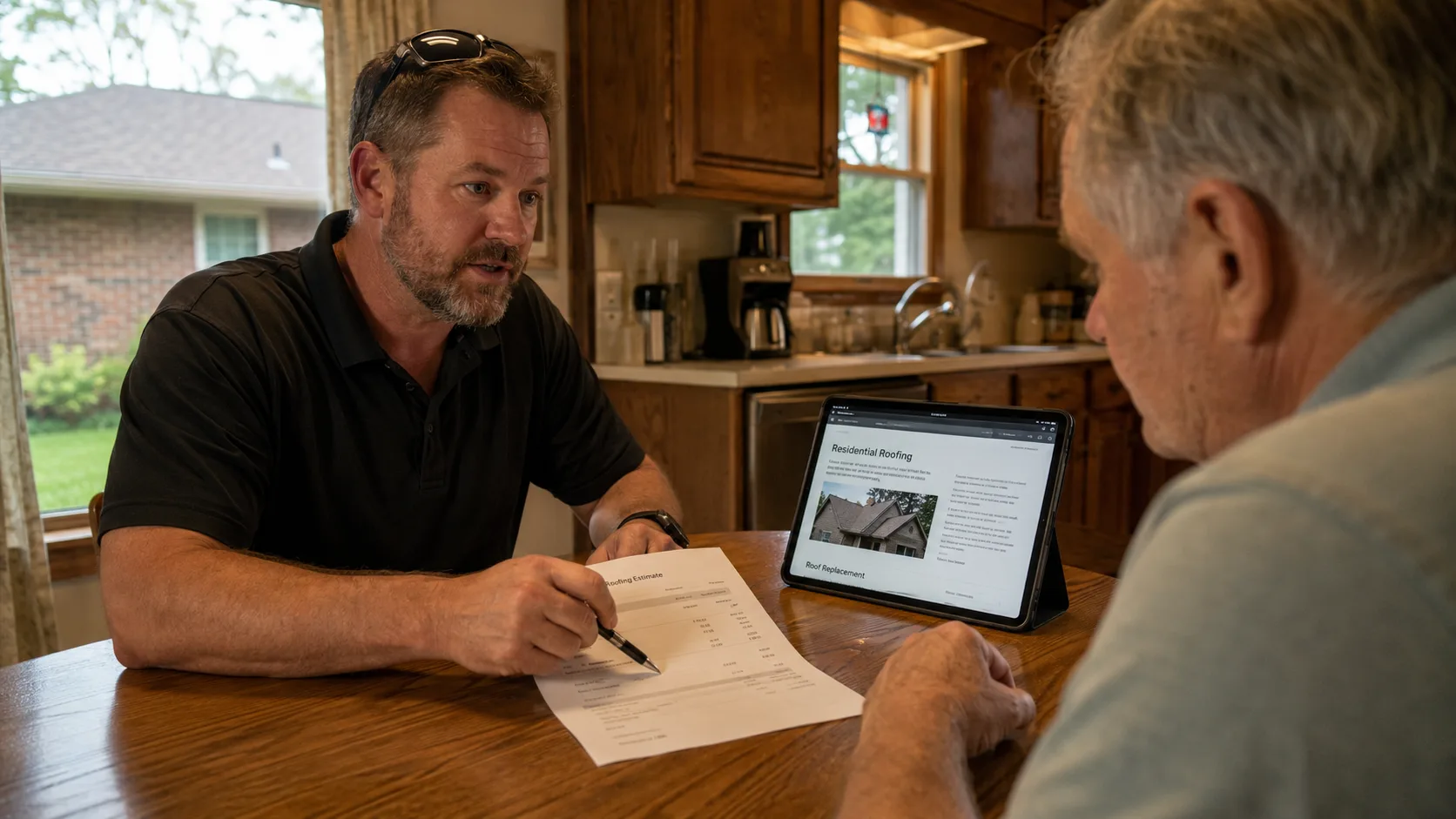
Your customer isn't at a desk. And she's on a 6-inch screen, one-handed, distracted, a little stressed. So the whole thing gets designed for her thumb first and the desktop second. That's what mobile-first means. Not "it shrinks down okay." But built for the phone from the first pixel.
And the homeowners doing this are not a niche.
"In 2024, 22% of renovating homeowners undertook roofing upgrades, with a median spend of $13,000." — Houzz Inc. (2025)
So more than one in five renovating households touched a roof last year, and the typical job ran $13,000. That's the size of the fish swimming past your site every storm week. A mobile build that fumbles even ten of them a season is leaving real money on the table.
Here's the single highest-value pixel on the page. A big, thumb-sized call button she can hit without scrolling. Above the fold, before the hero photo, before the reviews, before anything. She's panicking. Don't make her hunt. Make the phone the first thing her thumb finds.
And when she doesn't want to call, give her a form she can finish at a red light. Name, phone, address, "what happened." Four fields. Not eleven. Every field you add past four is another spot she quits. I've watched roofers in Spring Valley bury a quote request behind a wall of dropdowns and then wonder why the form never fires.
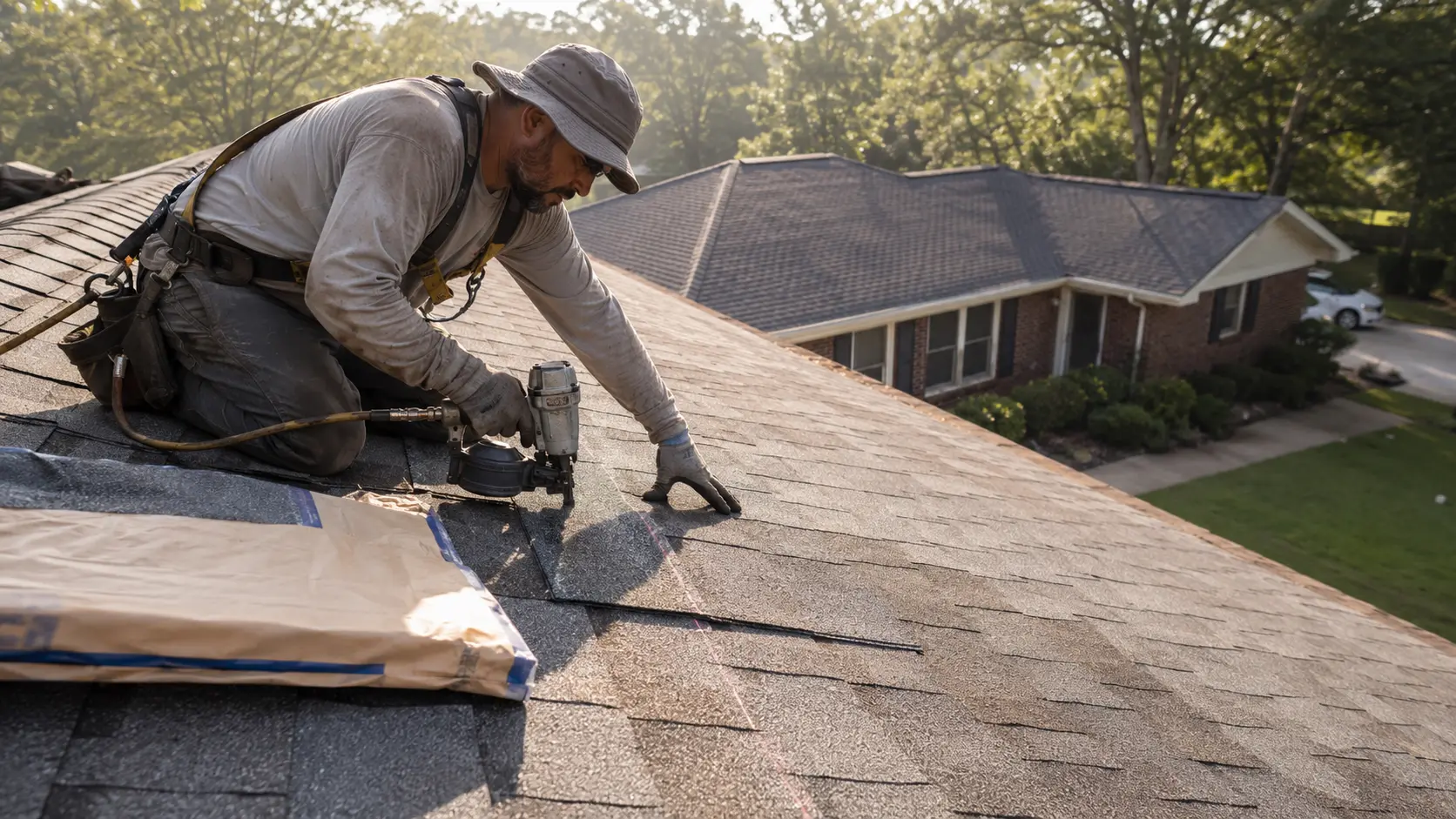
So she found your number. Now she needs one reason to trust you over the other six tabs she opened. That reason is proof, and it has to sit right beside the call button, not three scrolls down on an "About" page nobody reads.
"Among renovating homeowners, 44% add or redo a roof as part of their exterior projects." — Houzz Inc. (2024)
Nearly half of exterior projects involve the roof, so she's comparing you against everyone else chasing that same job. Proof is your tiebreaker.
A five-star rating is fine. A review that says "showed up in Centennial Hills the day after the storm and had us dry by Tuesday" is gold. Local detail makes it real. She's in Henderson; she wants to see you've worked Henderson. So pull the reviews that name a zip code and put those first.
And kill the stock photography. The smiling family under a perfect blue sky? She's seen it on forty sites. Show your actual crew tearing off a sun-blistered roof in Aliante, your flashing detail on a real chimney, your truck in a real driveway. Vegas sun bakes asphalt to a 15-year lifespan out here, so a photo of a fresh tear-off says you've handled the exact failure she's staring at.
"In hail-prone states, average roof lifespan is 15 years vs 22 years in milder western states; 38% of U.S. homes have roofs in moderate to poor condition (Roofing Contractor) with 60% higher loss costs" — Verisk Analytics (2025)
So a big slice of the roofs around you are already in rough shape. The homeowner photographing her ceiling stain is part of that 38%. Your site has to speak to a roof that's failing today, not a hypothetical one.
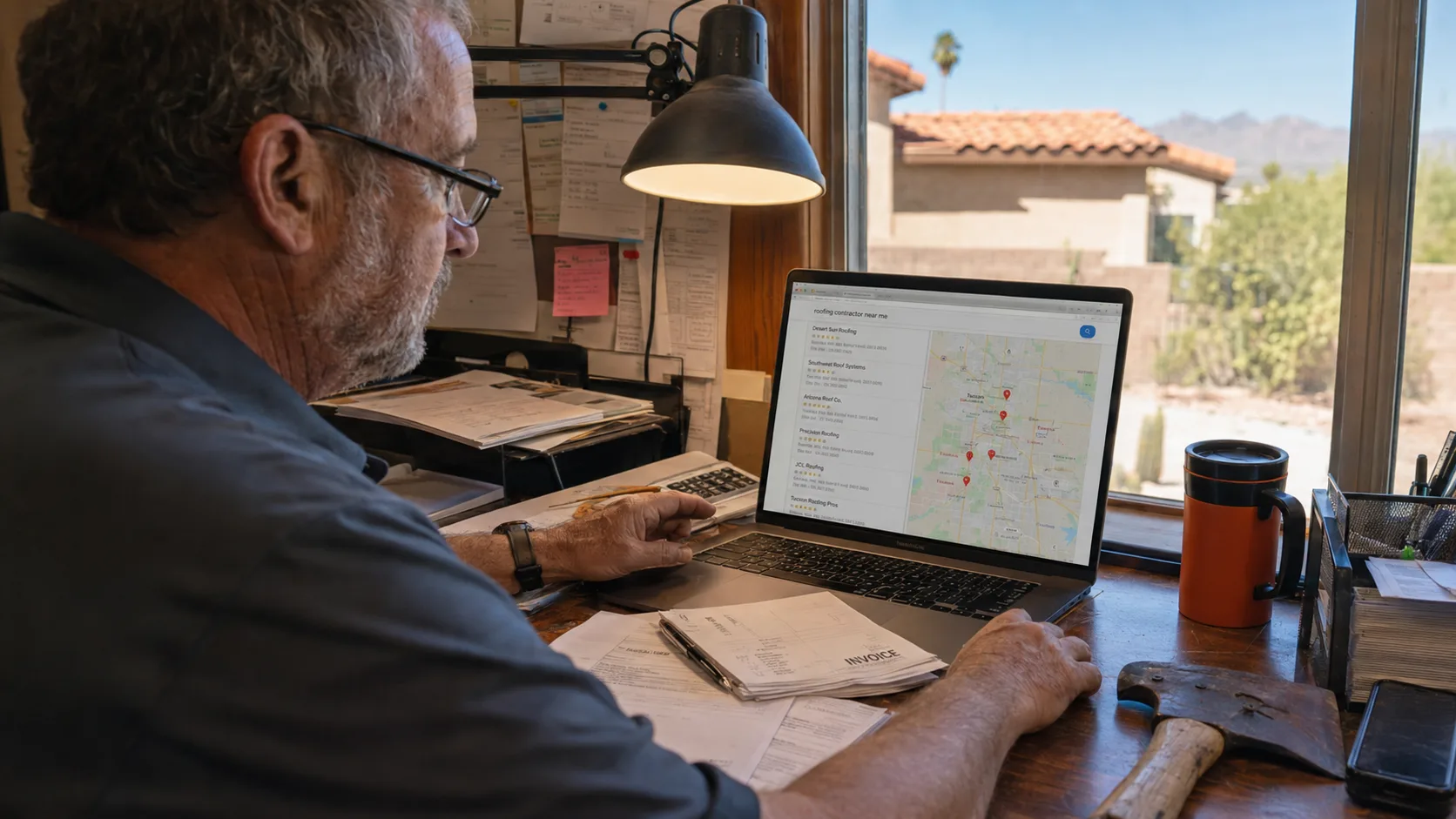
Now the question every owner asks me. Should you grab a $40-a-month template or pay for a custom build? And the honest answer depends on what you're trying to catch.
A template gets you online fast and cheap. But it's a generic shell that a thousand other roofers are also running, with the same layout, the same speed problems, the same buried call button. You're renting a brochure.
So if you do two reroofs a month and just need a digital business card, a template's fine. But the second you're competing for the storm-week spike against a roofer with a fast, purpose-built site, the template starts costing you jobs you'll never know you lost. One missed $13,000 job a quarter pays for the custom build several times over.
And custom shouldn't mean expensive-for-its-own-sake. It means the page loads in under four seconds on cellular, the call button is engineered to be the first tap, the form is short, and the whole thing's built around your specific market. That's the difference between a site that looks nice and one that does a job.
"The median spend on roofing upgrades in 2024 was 8% higher than in 2023 (median $13,000 in 2024)." — Houzz Inc. (2025)
So jobs are getting more valuable, not less. The math on a build that captures a few extra of them keeps getting easier.
Here's where a lot of owners get split in half by vendors. One company builds the pretty site. Another sells you "SEO" as a separate monthly bill. And the two never talk, so you pay twice for a site that still doesn't rank when the storm hits.
But the search and the structure are the same project. The page that loads in four seconds is also the page Google ranks. The reviews that convince her are the same reviews that lift your map pack. Split them across two invoices and you get a site that's fast but invisible, or visible but slow. You need both, built together, by people who treat them as one thing.
And don't assume homeowners can't pay. They can.
"Among homeowners who renovated in 2024, 84% used cash from savings and 29% used a credit card to fund renovation projects (multiple funding sources allowed)." — Houzz Inc. (2025)
So most of your buyers are paying cash. The money's there. The only question is whether your site shows up fast enough to get the call before someone else does.
And while she's deciding, she's wondering what you'll even put on her roof.
"Among homeowners undertaking a roofing project, 63% choose asphalt roofing material (dimensional shingles 34%, three-tab shingles 19%, luxury shingles 10%), while 14% choose metal and 11% choose synthetic material or rubber." — Houzz Inc. (2024)
So most of her neighbors land on asphalt. A page that names the shingle lines you install, and what holds up best against the Mojave sun in Sunrise Manor, answers her question before she has to ask it. That's one less reason to bounce.
And the volume behind all this is not small.
"From 2021–2023, homeowners spent $93.5B on roofing across 8.3 million projects (AHS-based estimates)." — U.S. Census Bureau and U.S. Department of Housing and Urban Development (2024)
So there's a $93.5 billion pool out there, and your slice of it depends on a site that catches the search the second it happens.
So how do we think about it. We don't start with a redesign. We start by looking at what your current site does the moment a homeowner in Enterprise or Paradise lands on it from her phone, mid-storm, with one bar of signal.
We've done that kind of teardown across the trade. You can see our inspection of roofing websites across the trade and exactly where most sites leak the storm-week lead: slow loads, hidden call buttons, eleven-field forms, proof buried where nobody scrolls.
And before you spend a dollar with us, you can get a free Site Inspection of your own site. No sales call. We look at your load time on cellular, your call button placement, your form, your proof, and we hand you the list of what's costing you jobs. You decide what to do with it. That's the whole offer. The site that catches the next monsoon search is the one you build before the clouds show up, not after.
The evidence
 Read the full report →
 0
contractor sites graded, one A
Across the whole CRO Index, a single site earned an A. The median landed at a D. The grade gap is a conversion gap.
0 %
of roofing sites fail a critical accessibility check
Scored against WCAG 2.1 AA with axe-core. A page that blocks a screen reader also blocks a paying customer.
Fervor Roofing State of the Industry, 2026
0 %
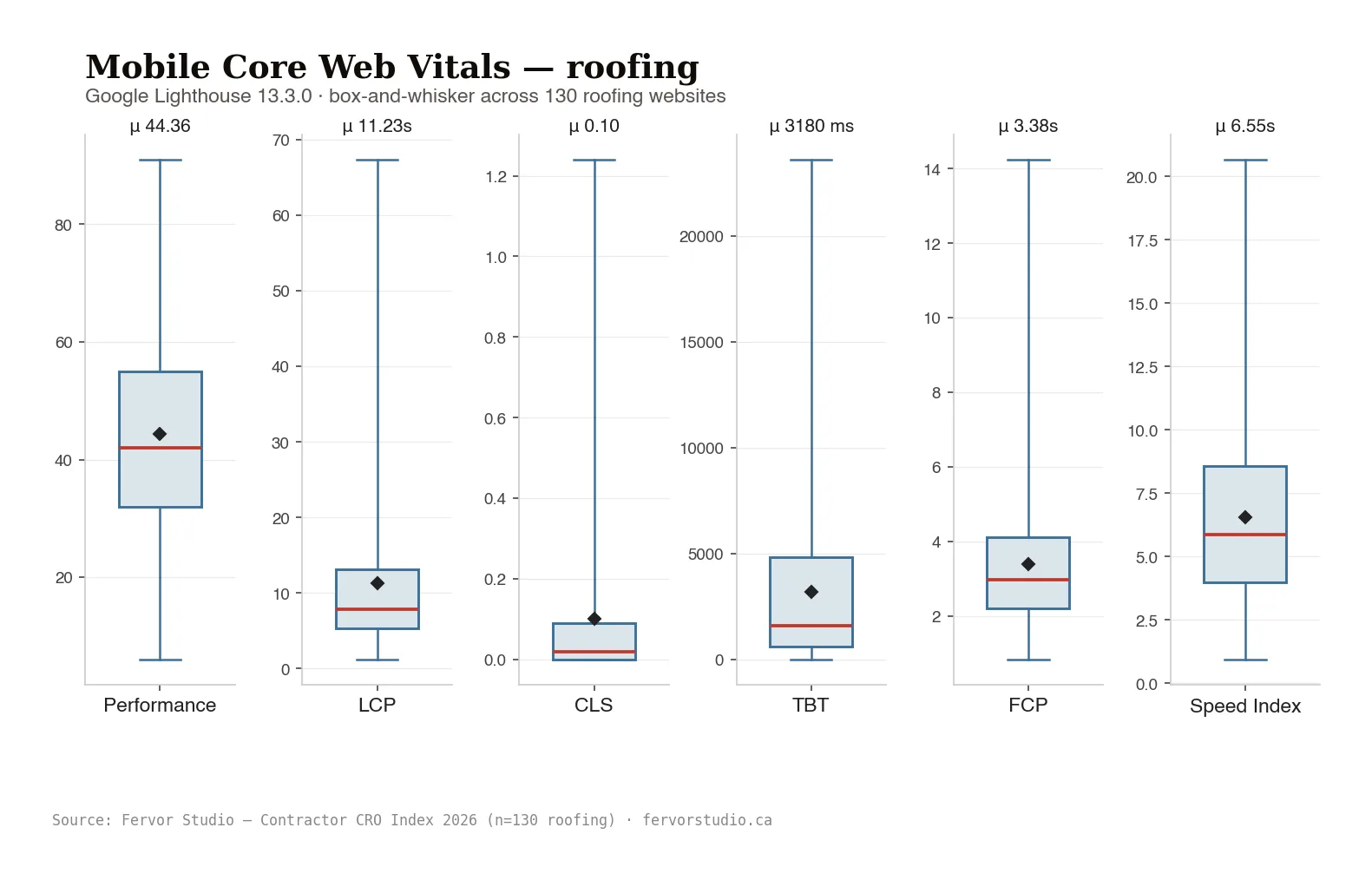
miss Google's mobile load-speed bar
Median mobile load lands at 7.88 seconds. Most of your traffic is on a phone, and most of them are gone before the hero paints.
Fervor Roofing State of the Industry, 2026
0 /100
is the average roofing grade
That is a D. The sites booking the work are not the ones with the biggest crews. They are the ones a few points higher on the things homeowners feel.
Two ways to start
Tell us where you are. We point you at the right next step — no sales call to get there.
Client review
“Nay did an amazing job, you know. He was really patient. He got the work done the way I told him and he was just on point with the website. Pretty straightforward process. No going around the bush. He just did amazing work and I would 100% recommend.”
How Fervor can help
Complete website system built to convert storm leads, planned projects, and research-phase homeowners into booked jobs.
Identify and patch the top conversion killers on your existing site. No full rebuild needed.
Monthly SEO, content, and CRO. Fixed deliverables. No credits, no rollover. The compound growth engine.
GBP optimization, citation building, and review system foundation. The infrastructure that gets you into the Map Pack.
One conversion-built landing page for the referrals, paid clicks, and cold-call leads you send. They land on a page built to book them, not your generic homepage.
Your move
Tell us where you are. We point you at the right next step — no sales call to get there.
Keep going