
Diane is fifty-four. She has been running a plumbing company in Houston for nineteen years. Started as the only office person at her father-in-law's shop, took over the operations side in 2010, bought him out in 2017. Her crew handles everything from slab leaks in Pearland to tankless retrofits in The Woodlands. Master plumber? Of course. Texas RMP-licensed? Since 2014. BBB accredited with an A+ rating? Eleven years and counting.
Her techs show up in clean uniforms. They don't crush the lawn with the truck. They call back the customer who messaged eight months later about a faucet handle. That kind of shop.
Then a hard freeze sweeps Harris County the second week of January. Pipes burst from Katy to Sugar Land to Spring. Insurance phones jam by Tuesday morning. Plumbers booked out three weeks across the metro before the local news has finished its first segment on the storm. Every plumbing company within thirty miles of the Beltway should be drowning in calls.
Diane's phone rings nine times that week.
Across town, a company operating out of a strip-mall office near Cypress has been open four years. No master plumber on staff (the owner uses a rotating contracted RMP). Crew of seven. No BBB listing. But their phone? Two hundred and forty-seven inbound calls in the same six days. They signed $412,000 in new work before the freeze warnings cleared.
It wasn't experience. It wasn't reputation. It wasn't skill. It was the marketing system underneath the business.
Diane's website was the same six-page template her son-in-law built in 2018. Loaded in 5.4 seconds on cellular. No service-area pages for any of the suburbs her techs actually drive to. Google Business Profile last updated in March 2024. No call tracking. No CRM integration. The Cypress competitor had eighteen suburb pages, a 1.7-second mobile load, weekly Google Business Profile posts with photos, and CallRail dynamic-number-insertion routing freeze-week calls into a Housecall Pro queue with a $0 unanswered-call rate.
Diane's site wasn't broken in any way she could see. It was broken in the ways search engines can see, and customers feel, and competitors exploit. And in a metro of seven million people, an invisible failure week was the most expensive seven days in her business's history.
Marketing isn't a brochure. Marketing isn't a luxury. Both are infrastructure that compounds.

What Home Services Marketing Actually Is
Home services marketing is the discipline of generating booked jobs for residential service trades using digital channels that can be measured back to revenue per visitor. That's the working definition. And the part that matters most is the last clause, because most agencies skip it.
And the trades inside the category are wider than the phrase suggests. HVAC, plumbing, electrical, roofing, siding, garage door, fencing, painting, landscaping, decks, foundation repair, restoration, kitchen and bath remodels, custom home building, pool building, solar. Every one of those has a different ticket size, a different buyer journey, a different seasonal curve, and a different competitive density on Google. So home services marketing isn't one playbook. It's an umbrella over twenty-plus trade-specific playbooks that share five operating principles.
Spending
"The U.S. home services market is valued at approximately $485 billion."
— Joint Center for Housing Studies of Harvard University (2025)
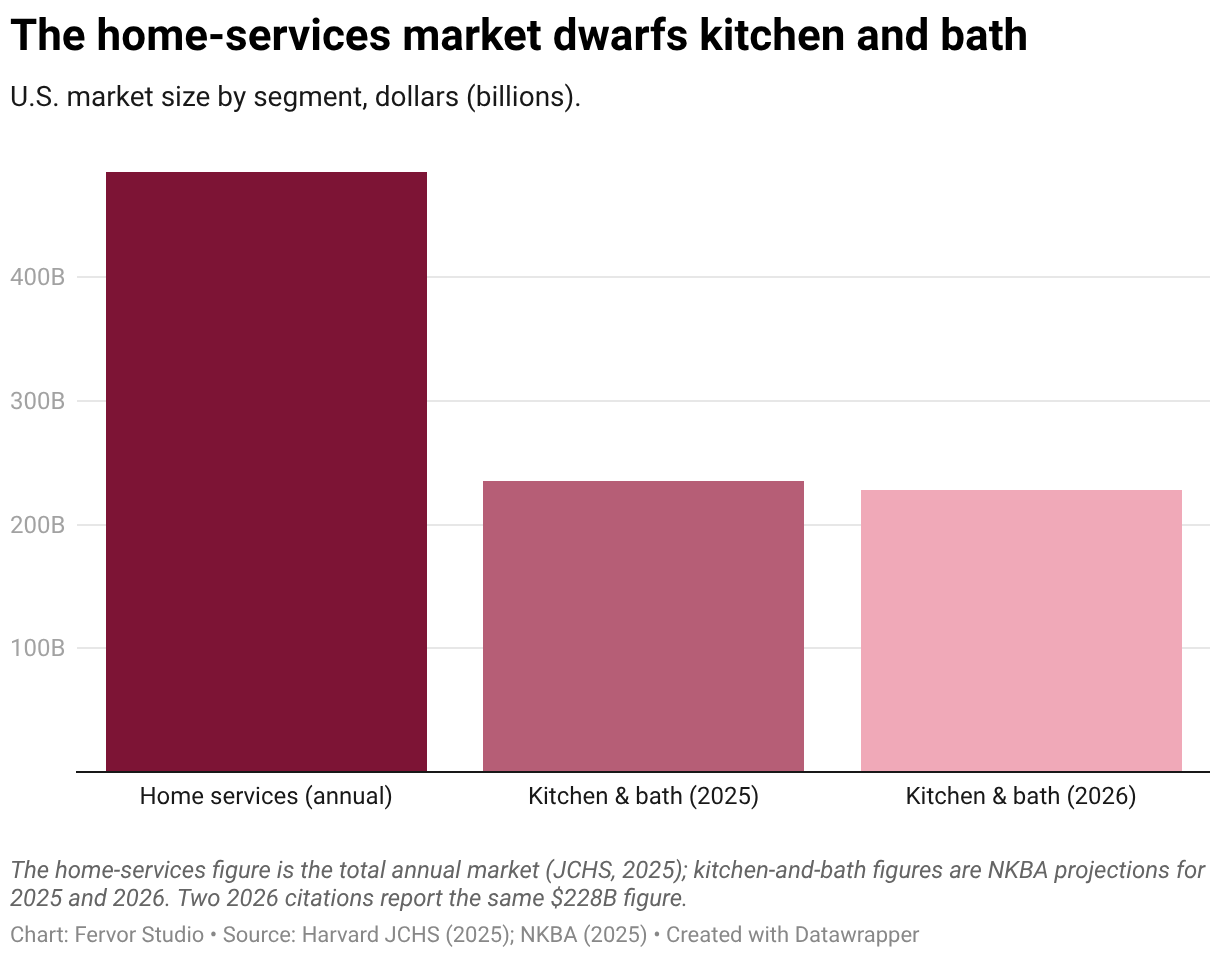
$485 billion is the addressable market. And the channels that capture meaningful share inside it are narrower than most agencies will admit. Organic search for local queries (the Map Pack and "near me" patterns). Google Local Services Ads with the Google Guarantee badge. Regular Google Ads search campaigns for queries LSAs don't cover. Meta retargeting for buyers in the consideration window. Email and SMS for past-customer nurture. And the conversion architecture on the website itself, which is where most paid traffic dies before it ever turns into a phone call.
Notice what's not on that list. SEO content programs publishing two blog posts a week with no link to revenue. Display ad budgets running on Performance Max defaults. Social media managers posting "tip Tuesday" graphics that no homeowner has ever clicked. Those line items are easy to sell and impossible to attribute, which is the agency-revenue model masquerading as strategy. (The test, when you read a marketing proposal, is simple: can the agency show you in writing how each channel ties to a booked job? If they can't, it's vendor sprawl wearing a strategy costume.)

The 1% Problem
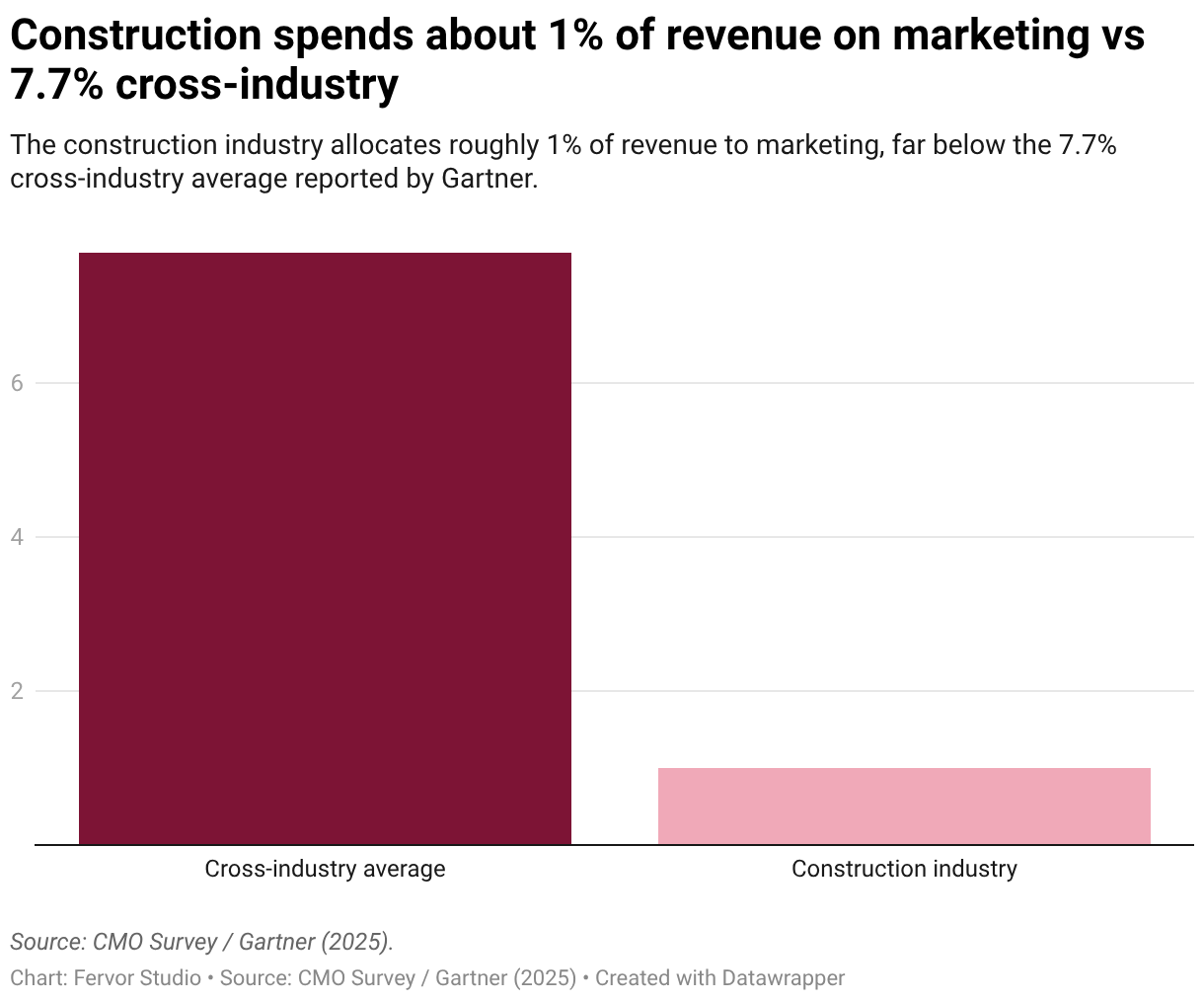
So here's the structural fact that explains most of the dysfunction in this category. The construction industry, and home services as a sub-category, spends almost nothing on marketing relative to other industries.
Comparison
"The construction industry spends approximately 1% of revenue on marketing — dramatically below the cross-industry average of 7.7% of revenue (Gartner 2025 CMO Spend Survey). This gap represents both an industry norm and a competitive opportunity for contractors willing to invest more strategically."
— CMO Survey / Gartner (2025)
So a $2M residential service company spending 1% of revenue ($20,000 a year, ~$1,700 a month) is at the industry baseline. That's not a strategy. It's a default. The competitive floor in any reasonably populated metro is closer to 5% ($100,000 a year, ~$8,300 a month). And the cross-industry average (7-8%) is what builds compounding pipeline, assuming the system actually attributes booked jobs back to channels. That last clause is what most engagements skip.
And the underspend isn't just an awareness gap. It compounds against the operator. While owners are spending 1% on home services marketing, the private-equity-rolled-up competitors in their market are spending 8-12% on consolidated platforms with revenue-tracking dashboards. So the small operator falls behind on every Map Pack ranking, every retargeting impression, every Local Services Ads slot. They hire a generalist, who runs them at 1% of revenue across five disconnected channels, and the gap widens every quarter the owner waits to fix it.

CAC, LTV, Payback by Trade
Before you spend another dollar, three numbers need to live on a sticky note above your desk. Customer acquisition cost. Lifetime value. Payback period. Without them, every dollar of marketing is a guess. And in a category where average tickets range from $300 plumbing service calls to $75,000 kitchen renovations, the guesses get expensive fast.
Here's the rough shape across the trades. HVAC: average ticket on a furnace replace runs $5,500 to $9,000, with maintenance contract LTV layered on top, and a healthy CAC sits at $250 to $500 per booked job. Roofing: ticket runs $8,000 to $25,000, so the CAC ceiling is meaningfully higher (workable at $400 to $900 per booked job). Plumbing service calls: lower ticket ($300 to $1,200) means CAC has to come down hard, $80 to $180 per call. Electrical: $400 to $3,000 ticket, CAC range $120 to $350. Remodeling and kitchen-and-bath: $25,000 to $75,000 ticket, payback works fine even at $1,500 to $3,000 CAC. Solar installs: $15,000 to $45,000 ticket, CAC range $400 to $1,200.
Those numbers aren't fabricated. They reflect typical national cost-per-call ranges visible across Google Ads transparency reporting and Local Services Ads disclosed pricing. But the point isn't the numbers. The point is the math itself. If you don't know which trade column you're in, no amount of paid spend will fix the unit economics. So the first work in any home services marketing engagement is naming those three numbers per service line. Everything downstream is built on top of them.
Why the math is where most agencies refuse to start
Agencies generally sell time, not outcomes. So starting from CAC and payback exposes whether their channel mix actually pays back inside six months, and most channel mixes don't. (A blog post that ranks in nine months for a query with no purchase intent has a CAC the agency can't compute, which is exactly why they sell it.) Your math is the disinfectant. Bring it to every conversation. And if you want a running start on who to have that conversation with, we ran the same payback test across the field in our ranking of the contractor marketing agencies.

Channels That Move the Phone
The channel hierarchy isn't ambiguous if you start from the math. Local Services Ads first, where eligible (HVAC, plumbing, electrical, roofing, garage door, locksmith, pest, lawn, water damage). LSAs sit above standard search ads, charge per qualified lead instead of per click, and the Google Guarantee badge does heavy lifting on conversion. So for the trades that qualify, LSAs are usually the highest-intent channel available and the best place to start.
Regular Google Ads search campaigns cover queries LSAs don't. "AC install Cypress," "kitchen remodel cost Austin," "emergency electrician Sunday." These get search ads with landing-page handoff. Negative keywords matter as much as positive ones, and the Performance Max defaults will burn budget on tire-kicker queries fast in any reasonably populated metro. So manual campaign management with weekly reviews is the discipline that separates spend from waste.
Organic local SEO is the third leg, with two surfaces inside it. The Map Pack (Google Business Profile + reviews + service areas) and traditional organic results (service pages, location pages, content). Both compound. Both need investment from week one. Both reward operators who keep showing up.
Then there's retargeting via Display and YouTube. The buyer who didn't call on the first visit is the one who calls on the third. Retargeting at $0.05 to $0.15 per impression keeps you top-of-mind cheap. And finally, email and SMS for past-customer nurture and reactivation. The cheapest home services lead generation on the planet is the customer who already paid you for one job and forgot you exist.
The non-negotiable across every channel: CallRail dynamic-number-insertion on every campaign, every booked call routes to your CRM (ServiceTitan, Housecall Pro, or Jobber), and every booked job attributes back to channel + keyword + landing page. Without that loop, paid spend is a leaky bucket.

Phone Calls: The Revenue Multiplier
So the phone call is the conversion event in this category. Not the form fill. Not the chat widget. The call. And the data on this is unambiguous.
Revenue multiplier
"Phone calls convert to 10-15x more revenue than web leads for home services businesses. Callers convert 30% faster than web leads. Caller retention rate is 28% higher than web lead retention rate."
— BIA/Kelsey + Forrester (via Invoca) (2025)
Ten to fifteen times. So if your digital marketing for home services is optimizing for form submissions while your phone sits at the same call volume it had a year ago, the math is broken. Every channel you run should be measured first by the calls it generates, second by the form fills, and third by the activity metrics agencies love to report.
And there's a brutal corollary that most owners learn the hard way.
Comparison
"18% of home services calls go unanswered on weekdays, while 41% go unanswered on weekends. Each unanswered call is revenue left on the table and a lead handed to a competitor."
— Invoca (2025)
41% of weekend calls. Unanswered. So before you spend another dollar on paid traffic, the highest-ROI move available is fixing the call-answer system. A business phone like Unitel Voice with auto-attendant and after-hours routing costs less per month than the revenue from one missed call. A live answering service costs less than a single missed remodel lead. Until that infrastructure is in place, every paid dollar amplifies a leaky funnel.
Comparison
"84% of marketers report phone calls having higher conversion rates with larger average order value compared to other forms of engagement. 80% of customers say the experience a company provides is as important as its products or services."
— Invoca + Salesforce (2025)
So the channel hierarchy and the call-handling infrastructure are the same conversation. Home services advertising that sends 800 visits a month to a website that catches 2% of them and routes calls to a voicemail box is throwing money at a problem that lives downstream of the ad spend.

Why It Differs From SaaS, Retail, B2B
And the single most common reason this work fails is that it's run with playbooks built for other categories. SaaS marketing optimizes for trial signups and 14-day activation cycles. Retail marketing optimizes for cart conversion and AOV. B2B marketing optimizes for MQLs and sales-accepted leads through a six-month nurture. None of those models map onto residential services.
The buyer journey here has two shapes, and they're roughly opposites. The emergency buyer (burst pipe, AC failure during a heat wave, roof leak after a storm) decides in minutes, calling the first credible result, often the LSAs slot or the top organic listing. The project buyer (kitchen remodel, custom home build, full HVAC retrofit, solar install) takes 6 to 12 months from first search to signed contract, and the brand they remember at the end is the one whose content they encountered repeatedly during research. So home services marketing has to run two different playbooks simultaneously: emergency-speed conversion potential on one side, long-cycle authority content on the other.
"40% of home services consumers who call from search make a purchase. Consumers searching for plumbing, appliance repair, and fencing services are most likely to call after making a search."
— Google (via Invoca) (2025)
40% close rate from search-driven calls. That's a number SaaS marketers would frame and hang on the wall. Yet most agency programs still treat search like a brand-awareness channel and call tracking like an afterthought. The category-specific shape of the funnel demands its own playbook: high intent at the top, two-step path to conversion (visit then call), revenue events 10-15x larger than typical web leads. Trying to use a SaaS playbook here is like running a roofing company with HVAC tools. They're both blue-collar businesses. The work isn't transferable.

Vendor Sprawl: The Most Expensive Failure
Three patterns show up in nearly every Site Inspection Fervor runs on a home services operator. Vendor sprawl. Package thinking. Quarterly review cycles. Each one is fixable, and each one quietly costs more than the owner thinks.
Vendor sprawl is the most common. The owner has a website agency, an SEO vendor, a Google Ads agency, a social media person, and maybe a content writer on Upwork. None of them talk to each other. None of them sees the booked jobs from any of the others. The result is five disconnected reports going to the owner, none of which include the only number that matters: revenue per dollar of marketing spend. Buying leads outright looks like the way out of that, which is why we split the field into the firms that build pipeline you own and the marketplaces that resell it, in the lead generation companies for contractors.
Comparison
"85% of home services companies outsource at least some aspect of their marketing. Among those, 78% use two or more external vendors — creating disconnected tools, agencies, and platforms that often don't communicate with each other."
— Scorpion (2025)
78% of operators use two or more vendors. So what looks like specialization (SEO firm, ad firm, web firm, content firm) is actually fragmentation. The booked-job number lives across all the channels, so the agency that owns the booked-job number has to own the whole stack, or attribution falls apart between vendors and the owner can't tell what's working from what's wasting.
Package thinking is the second pattern. Plenty of agencies sell home services marketing in tiers (Entry, Competitive, Aggressive) built around bundled deliverables. Web design plus SEO plus a bit of social. The packages aren't the problem on their own. The problem is that none of them start from your CAC, your LTV, your payback period, broken down by trade and channel. Without that, the package is a guess, and guesses don't compound.
The third is the quarterly review cycle. A campaign bleeding budget in week two doesn't get caught until week ten if the agency reports quarterly. Ten weeks of waste against a $5,000-a-month spend is $11,500 the owner could have stopped. Multiply by every channel running with a quarterly cadence, and the cost gets serious.

Local SEO and the Map Pack
The Google Map Pack (that three-pack of businesses with the map, reviews, and tappable phone numbers) is where 40-60% of "near me" clicks go for home services queries. So local seo for home services isn't a sub-category of marketing. It's the conversion surface that the rest of the program feeds.
The Google Business Profile is the anchor. But most contractor profiles are incomplete, inconsistent, or abandoned. Wrong service areas listed. No categories beyond the primary one. Zero posts in the last six months. Photos from 2021. No products or services listed. And the reviews? Maybe a handful, with no responses from the business owner. Each of those is a ranking signal Google uses to decide whether to put you in the three-pack or push you to position eleven on the regular results page.
NAP consistency matters. (That's name, address, phone number.) If it's different on Yelp than on your website than on your Google Business Profile, Google doesn't trust any of them. The citation profile across the platforms that matter for residential services. Your review velocity compared to competitors in your specific trade and geography. All of that is the daily work of seo for home services, and most of it is unsexy enough that DIY operators stop after the first two months. The companies that don't stop are the ones who own the Map Pack three years later.
Service-area pages are the second piece. A site treating an entire metro as one market loses to companies that have built dedicated pages per neighborhood, suburb, and adjacent city. The hyperlocal angle is what wins SERPs in metros with serious competitive density. (For more on this, see SEO Audit Chicago for a full breakdown of how that plays out in a 9.5-million-person metro.)

Measurement and Review Cadence
Agencies typically report monthly at best, quarterly at worst. The data lag means a campaign that's bleeding budget in week two doesn't get caught until week ten. That's not a software problem. It's an operational discipline that most engagements lack.
"Businesses that evaluate marketing performance weekly achieve an average 6x ROI, while those reviewing quarterly average 4.8x ROI. The frequency of review — not the amount spent — is the distinguishing factor."
— Scorpion (2025)
So the operators running weekly reviews outperform the quarterly ones by ~25% on ROI. Not by spending more. By looking more often. Spending the same dollar with a weekly cadence beats spending two dollars with a quarterly one. And the work doesn't require a software upgrade. It requires a recurring 60-minute meeting on Friday afternoons where someone reads the booked-job report by channel, by keyword, by landing page, and adjusts what's bleeding before another week's budget runs through it.
That's the measurement spine. Without it, every other recommendation in this page is decoration. With it, the math compounds.

What Fervor Actually Does
Fervor's home services marketing engagements start with one number: booked-job revenue per visitor. Not traffic, not impressions, not rankings. Booked revenue. From there, the work splits into three layers.
The traffic layer is SEO plus Google Ads (Local Services and search) plus retargeting, sized to your CAC tolerance per trade. The conversion layer is the website. Page speed, mobile click-to-call, form length, social proof, and the call-answer infrastructure that catches the calls the homepage generated. The measurement layer is CallRail dynamic-number-insertion plus your CRM (ServiceTitan, Housecall Pro, or Jobber) plus a weekly review cadence that ties channel spend to booked jobs in 7-day windows.
The five Fervor offers map onto this stack in a specific order. The Site Inspection is the free diagnostic that scores where in the system your leak lives. Leak Plug Sprint (from {svcBySlug['leak-plug-sprint'].priceValue}) fixes the highest-impact conversion gap in 30 days. The Local Pick ({svcBySlug['the-local-pick'].priceValue} one-time) installs the Google Business Profile, citation, and Map Pack infrastructure. Booked by Design™ (from {svcBySlug['booked-by-design'].priceValue}) rebuilds the website around revenue-per-visitor math over 30-60 days. And Performance Partner™ (from {svcBySlug['performance-partner'].priceValue}) runs the weekly review cadence on an ongoing basis with day-one asset ownership.
None of that is novel as a stack. The novel part is the measurement spine that holds it together. Most programs report on activity. Fervor reports on booked-job revenue per channel per week. That's the only frame the math actually works inside.
If you want a read on whether your current marketing is leaking, the free Site Inspection scores your site across six categories and tells you where the gap lives. Twenty seconds to submit. The report lands in your inbox. And if the leak is further upstream, before anybody reaches the site at all, the Local SEO Diagnostic checks where you show up across the area you serve.
Back to the contractor master guide · Mechanical Contractors · Exterior Contractors · Remodelers & Builders
Reviewed by the people we built sites for
Real feedback from real builds, straight from our Google Business Profile.
5.0 / 5 across 5 Google reviews.
Fervor Studios did an incredible job creating our website. From the design to the functionality, everything was handled professionally and exceeded our expectations. The team was responsive, creative, and made the entire process smooth from start to finish. They truly brought our vision to life and delivered a modern, high-quality website that we're proud to showcase. We're already seeing greater engagement from our clients and look forward to working with Fervor Studios again. Highly recommend Fervor Studios to anyone looking for top-tier web design and development services!
Working with Ney was a pleasure. He was attentive, he listened to each and every one of my 100+ revision requests (it wasn't actually that much). He created a beautiful page that has served me well for a year. He did everything as asked/expected/on time and I would love to work with him again.