
What we found on sunrun.com
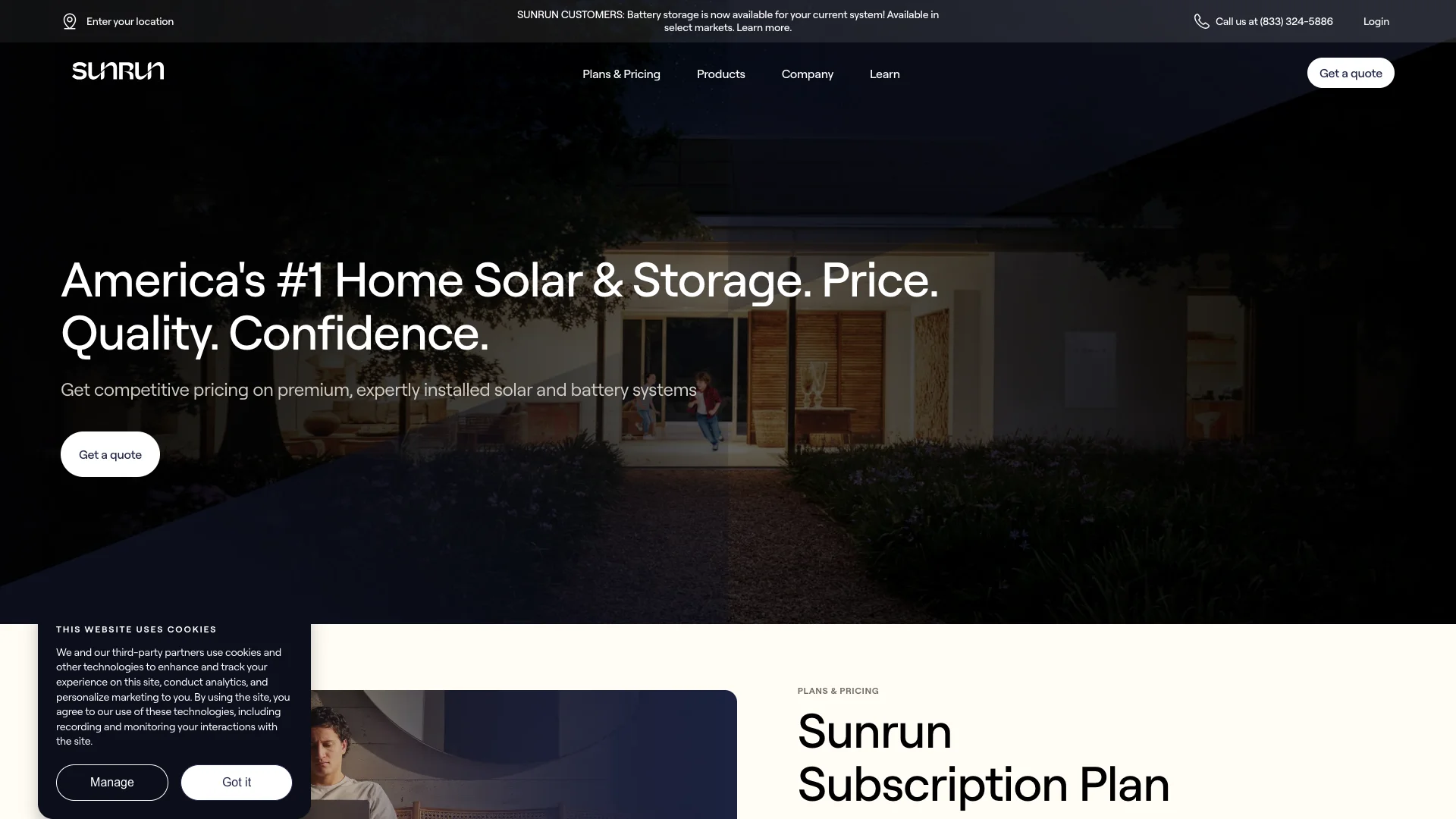
Sunrun is one of the largest residential solar companies in the United States. According to Ahrefs, sunrun.com pulls 179.1K monthly organic visitors with an estimated traffic value of $388.5K. That makes them the third-biggest brand in the entire CRO Index by traffic, behind only a handful of national service franchises.
The pages we tore down:
- my.sunrun.com, the customer login portal (22.1K monthly organic visitors, 13% traffic share, the highest-traffic page on the site)
- Solar panels cleaning blog, a maintenance content article (6.3K monthly visitors, 4% share)
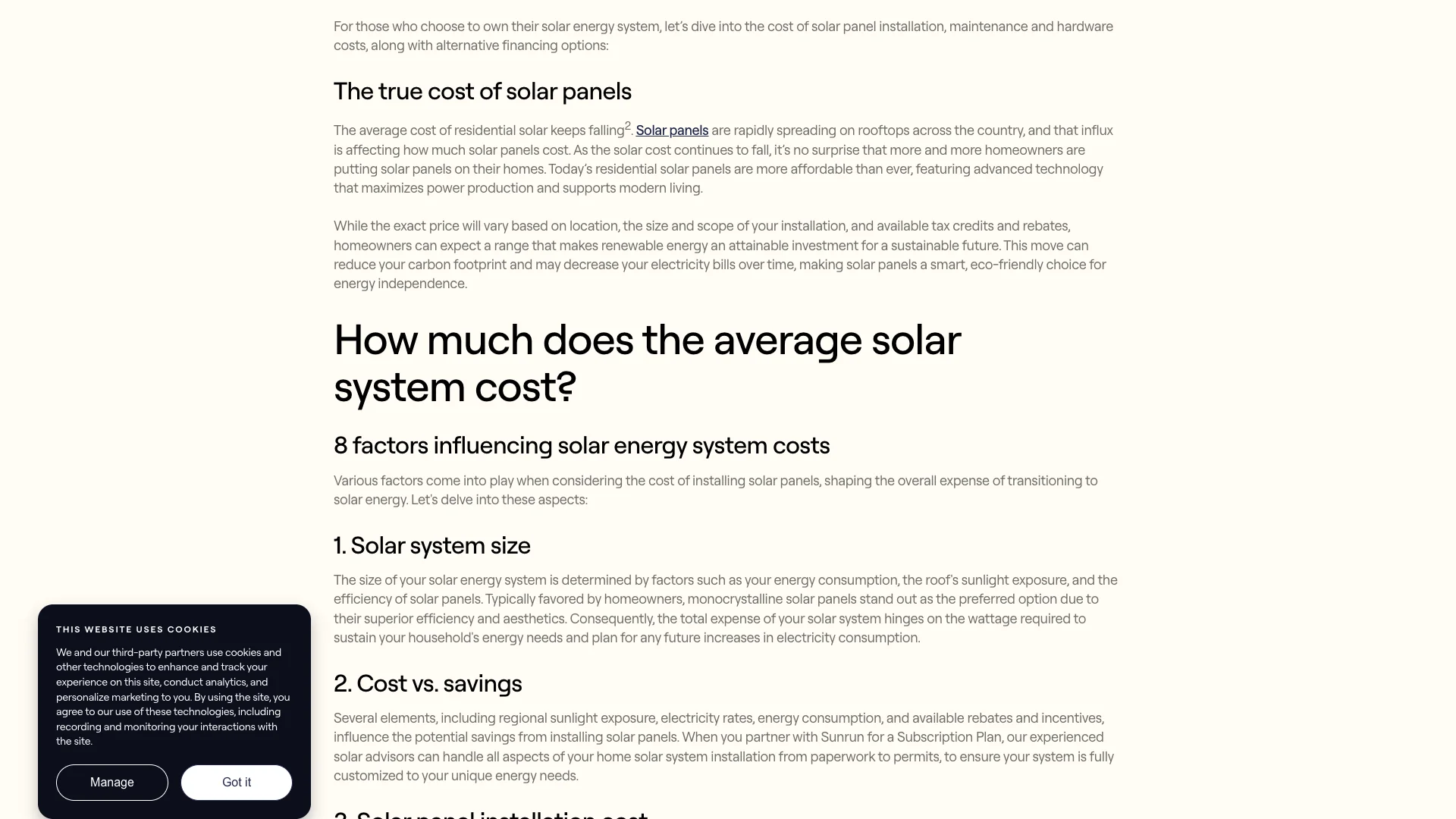
- Cost of solar page, a pricing and financing content page (6.2K monthly visitors, 4% share)
And the first thing to note is that my.sunrun.com returned no data. It's a customer login portal behind authentication. Our audit couldn't access it, which means there's no performance score, no trust signal data, and no form inventory for the highest-traffic page on the entire site. So this teardown covers the two remaining pages. And on both of them, the trust signal audit came back empty. Zero Google Reviews. Zero trust badges. One form per page. For the third-biggest brand in the CRO Index, that's a gap you can't ignore.
"25% of homeowners say trusting contractors is their top challenge when planning home improvement projects."
— Houzz Inc. (2025)
Performance: 40 to 43 on Google's mobile lab test
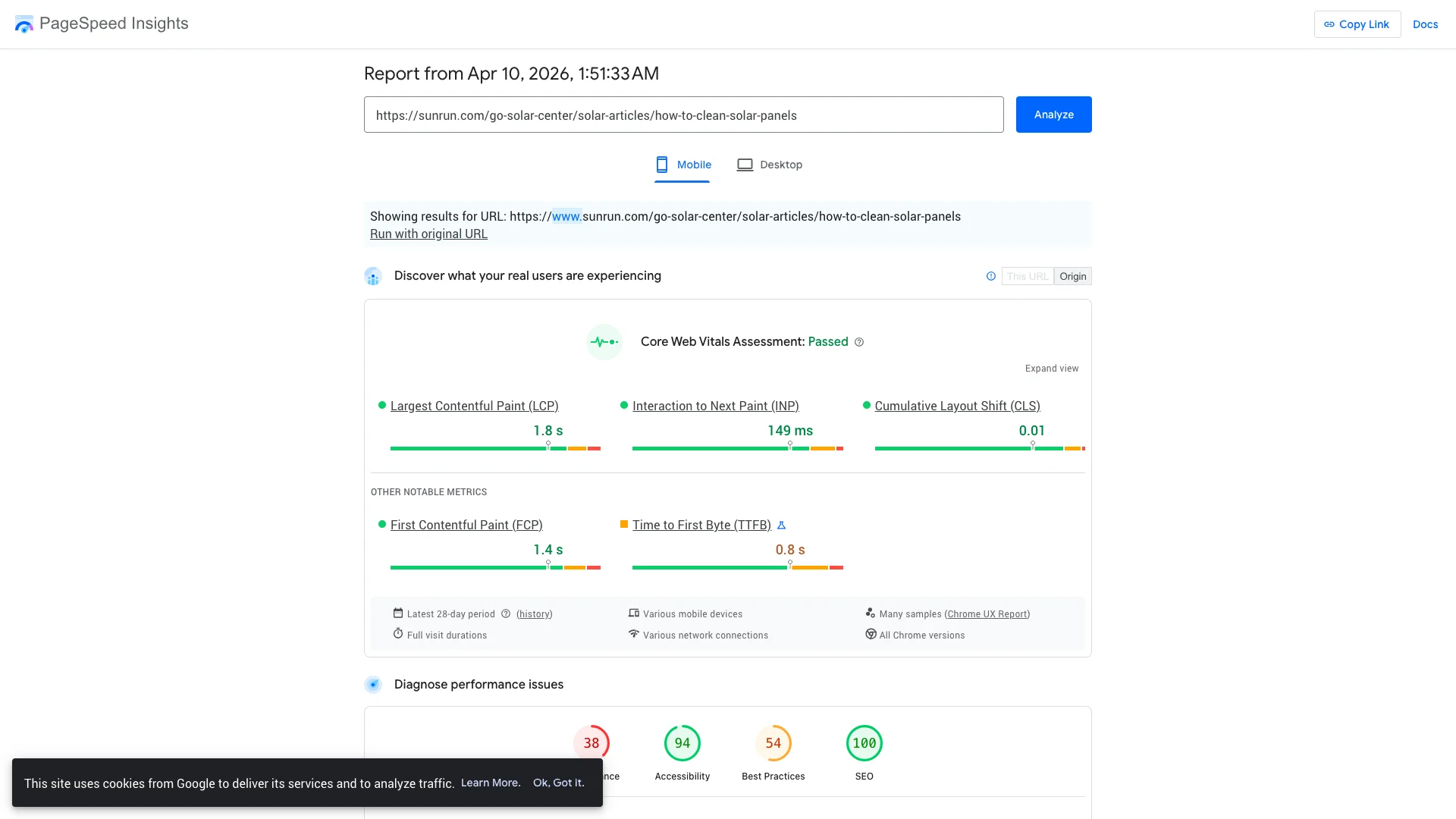
Google PageSpeed Insights runs a simulated slow-phone lab test. The scores are worst-case, not what you experience with a fast connection. But Google uses them as a ranking factor, and for a brand pulling 179K visitors a month, even a small ranking improvement translates to thousands of additional visitors.
The solar panels cleaning blog scored 40 out of 100. The cost of solar page scored 43. Both are in the red zone, and both are eating a search-ranking penalty.
"53% of mobile users abandon sites that take longer than 3 seconds to load."
— Google / SOASTA (2017)
Layout stability is clean though. The solar panels cleaning blog scores 0.000 on layout shift. The cost of solar page scores 0.005. Content doesn't jump around as these pages load. For a homeowner scrolling through either page, the reading experience feels stable. Nothing shifts. Nothing pops in late and pushes content down the screen.
So the performance problem is load time, not page structure. The pages are heavy (scripts, tracking, third-party embeds), but they're architecturally stable. That's actually a better starting point for optimization than a page that loads fast but shifts everything around. Sunrun could compress images, defer non-critical scripts, and lazy-load below-the-fold content to push these scores from the low 40s toward 70+. And with 12.5K combined monthly visitors on just these two pages, that improvement would reduce bounce rates on a meaningful volume of traffic.
Compounding effect
"Conversion rates drop approximately 12% for each additional second of page load time."
— Google / Deloitte (2020)
Lead capture: a solid inline form on every page, no chat

Sunrun actually has a well-structured inline lead form on both auditable pages. The solar panels cleaning blog and the cost of solar page each carry a 5-field lead capture form: first name, last name, email, zip code, and phone number, plus a "Do you own your own home?" yes/no qualifier. That's a real lead form with a smart qualifying question built in. The homeownership qualifier filters out renters before the lead hits the sales team, which is exactly what a solar installer needs.
No chat widget on either page though. And while the phone number (833) 324-5886 is visible in the header, it's not prominently repeated in the body content. So the conversion path is: inline form or header phone. That's two paths, which is more than Sunnova (zero forms) and enough for a research-stage visitor. The missing piece is a chat widget for the homeowner who wants a quick answer about cost without filling out a full form.
"68% of users wouldn't submit a form if it required too much personal information."
— Baymard Institute (2024)
And the cost of solar page is particularly interesting. A homeowner on that page is actively researching pricing. They're further along in the buying process than someone reading about panel cleaning. That page should have multiple conversion paths: a form at the top, a form at the bottom, a phone number, and ideally a chat widget for the homeowner who wants a quick answer about cost without filling out a full quote request. Sunrun leaves that page with a single form and nothing else.
Trust signals: the biggest gap for the biggest brand
The trust signal audit across both auditable pages came back empty.
- Google Reviews: Not found on either page.
- Trust badges: Not found on either page.
- Review widgets: Not found on either page.
- Chat widget: Not found on either page.
- BBB badge: Not found on either page.
- Certifications: Not found on either page.
Zero for six. On the third-biggest brand in the CRO Index. A homeowner reading the cost of solar page sees pricing information, financing details, and a form. But they don't see a single review from another homeowner. They don't see a trust badge. They don't see any third-party validation that Sunrun is legitimate and does good work.
Comparison
"83% of consumers use Google to find local business reviews; 74% use two or more review platforms when researching."
— BrightLocal (2025)
Compare that to Blue Raven Solar (18.1K visitors), which has Google Reviews on every tested page. Or TrueDecks (321 visitors), which has reviews, badges, and a chat widget on every page. Sunrun has 10x the traffic of Blue Raven and 550x the traffic of TrueDecks. But both of those smaller brands outperform Sunrun on trust signals by a wide margin. Size doesn't guarantee execution.
What Sunrun does well
Sunrun's tested pages aren't strong on trust or conversion. But there are a few things worth noting.
Clean layout stability. 0.000 to 0.005 across both pages. Content doesn't jump around as the pages load. For a homeowner reading about solar costs or panel maintenance, the experience feels stable and polished. That's better than many brands in the CRO Index that have layout shift scores above 0.1.
Content that matches search intent. The solar panels cleaning blog targets homeowners who already have panels and want to maintain them. The cost of solar page targets homeowners researching pricing. Both pages deliver relevant content for the query that brought the visitor there. They're not stuffed with irrelevant keywords or generic filler.
Massive traffic volume. 179.1K monthly visitors is significant. That volume means even small conversion improvements translate to real lead numbers. If Sunrun adds Google Reviews to these pages and improves the form visibility, the impact at 179K visitors per month is substantial.
"64% of homeowners say having recommendations or references is a top-three factor in choosing a contractor."
— Houzz Inc. (2025)
What the gaps mean for solar contractors
Sunrun proves that traffic alone doesn't mean your website is converting well. If you're a solar contractor, the lessons from this teardown are about what happens when you have the audience but not the trust infrastructure.
Put Google Reviews on every page. Sunrun has 179K monthly visitors and zero reviews on either tested page. If you're a solar contractor with even a fraction of that traffic, adding a Google Reviews widget to your blog posts, location pages, and service pages is the single easiest trust improvement you can make. Blue Raven does it. TrueDecks does it. You should too.
Add more conversion paths to high-intent pages. Sunrun's cost of solar page has one form. A homeowner researching solar pricing is close to making a decision. That page should have a form near the top, a form at the bottom, a phone number in the content, and a chat widget. Four conversion paths instead of one. The visitor who misses the first form still has three more chances to convert.
"48% of customers say that if a site does not work well on mobile, it signals the company does not care about their business."
— Google Consumer Insights (2018)
Don't assume brand recognition replaces trust signals. Sunrun is a publicly traded company with national advertising. But a homeowner on the cost of solar page doesn't know that unless you show them. Reviews, badges, certifications, and case studies all reinforce the brand promise. Without them, even a well-known brand feels anonymous on the page.
Account for login portal traffic in your analytics. Sunrun's highest-traffic page is a customer login portal (22.1K visitors, 13% share). That traffic is existing customers, not prospects. If you're a solar contractor and your analytics include a customer portal, make sure you're filtering that traffic out when you measure conversion rates on your marketing pages. Otherwise your conversion rate looks artificially low because you're counting visitors who were never going to convert.
Frequently asked questions
How does Sunrun score on Google's mobile test?
The solar panels cleaning blog scored 40 out of 100 on Google PageSpeed Insights mobile. The cost of solar page scored 43. Both are in the red zone and eating a search-ranking penalty. Layout stability is clean (0.000 to 0.005), so the pages don't jump around as they load.
Does Sunrun display Google Reviews on its website?
No. Neither of the two auditable pages displays Google Reviews, review widgets, trust badges, or any other trust signals. For the third-biggest brand in the CRO Index by traffic, that's a significant gap compared to smaller solar brands that show reviews on every page.
What is my.sunrun.com?
my.sunrun.com is Sunrun's customer login portal. It accounts for 22.1K monthly organic visitors (13% of total traffic), making it the highest-traffic page on the site. Because it's behind authentication, our audit returned no performance, trust, or form data. It serves existing customers, not new prospects.
How much organic traffic does sunrun.com get?
According to Ahrefs data from March 2026, sunrun.com receives approximately 179.1K monthly organic visitors with an estimated traffic value of $388.5K. The my.sunrun.com portal accounts for 22.1K visitors (13%). The solar panels cleaning blog accounts for 6.3K (4%). The cost of solar page accounts for 6.2K (4%).