
What we found on servpro.com
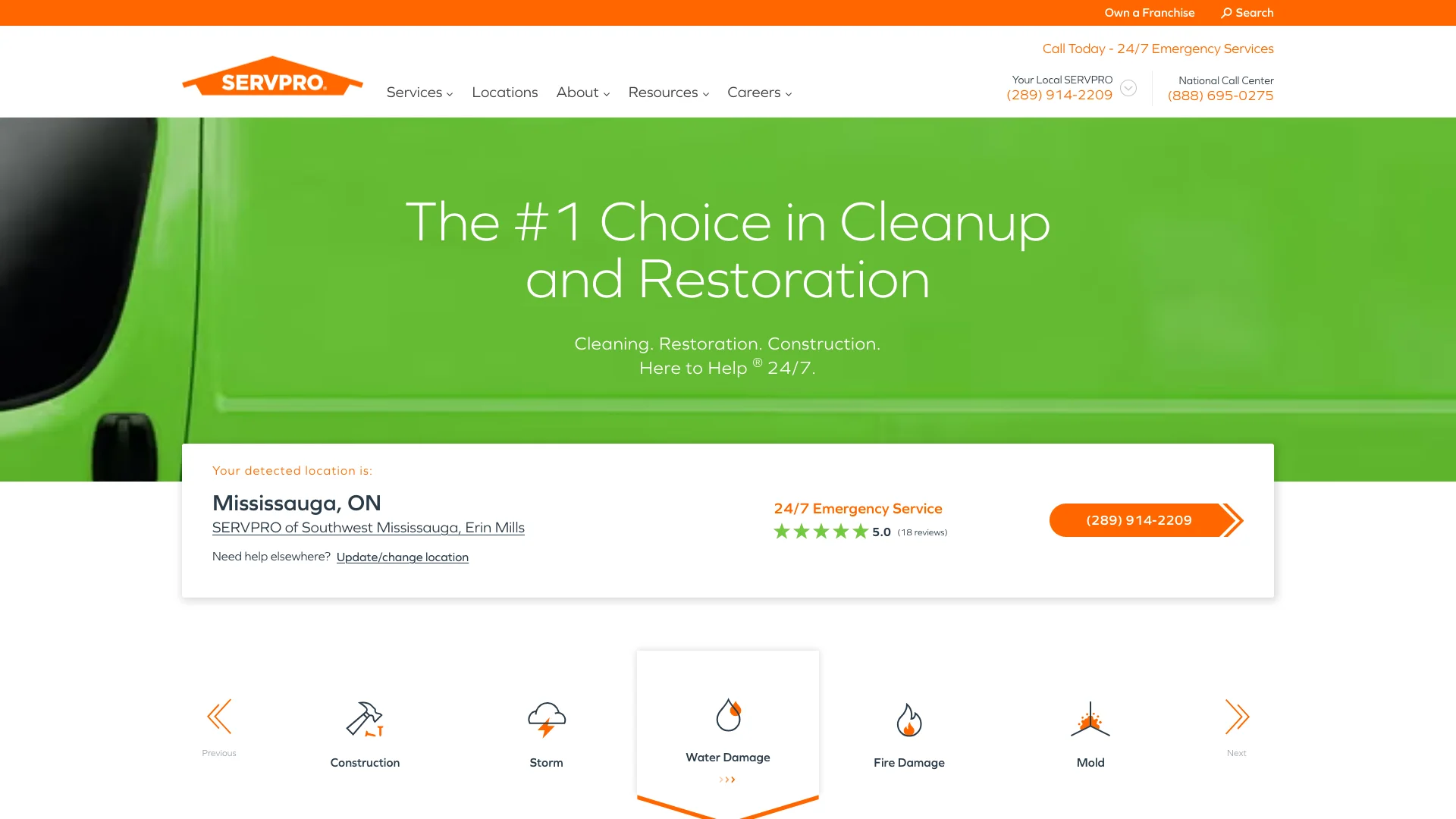
SERVPRO is a restoration franchise. According to Ahrefs, the domain pulls 643.7K monthly organic visitors with an estimated traffic value of $3.1M. That's serious authority in the restoration space. And the three service pages we tore down cover their core offerings: water damage, mold remediation, and air duct cleaning.
So we ran their site through our standard teardown protocol. Three service pages. PageSpeed Insights API for performance. Manual form-field counts. Trust signal audits. Navigation structure analysis. And the form count came back zero.
Not one form. Not a short form behind a button. Zero forms across all three pages. The only conversion path is a phone call. If you're a homeowner with water pouring through your ceiling at 2 a.m. and you don't want to dial a number — there's nowhere to go.
The pages we tore down:
- Water Damage page — their highest-traffic service page (117.5K monthly organic visitors, 19% traffic share)
- Mold Remediation page — second-tier service page (53.1K monthly organic visitors, 9% traffic share)
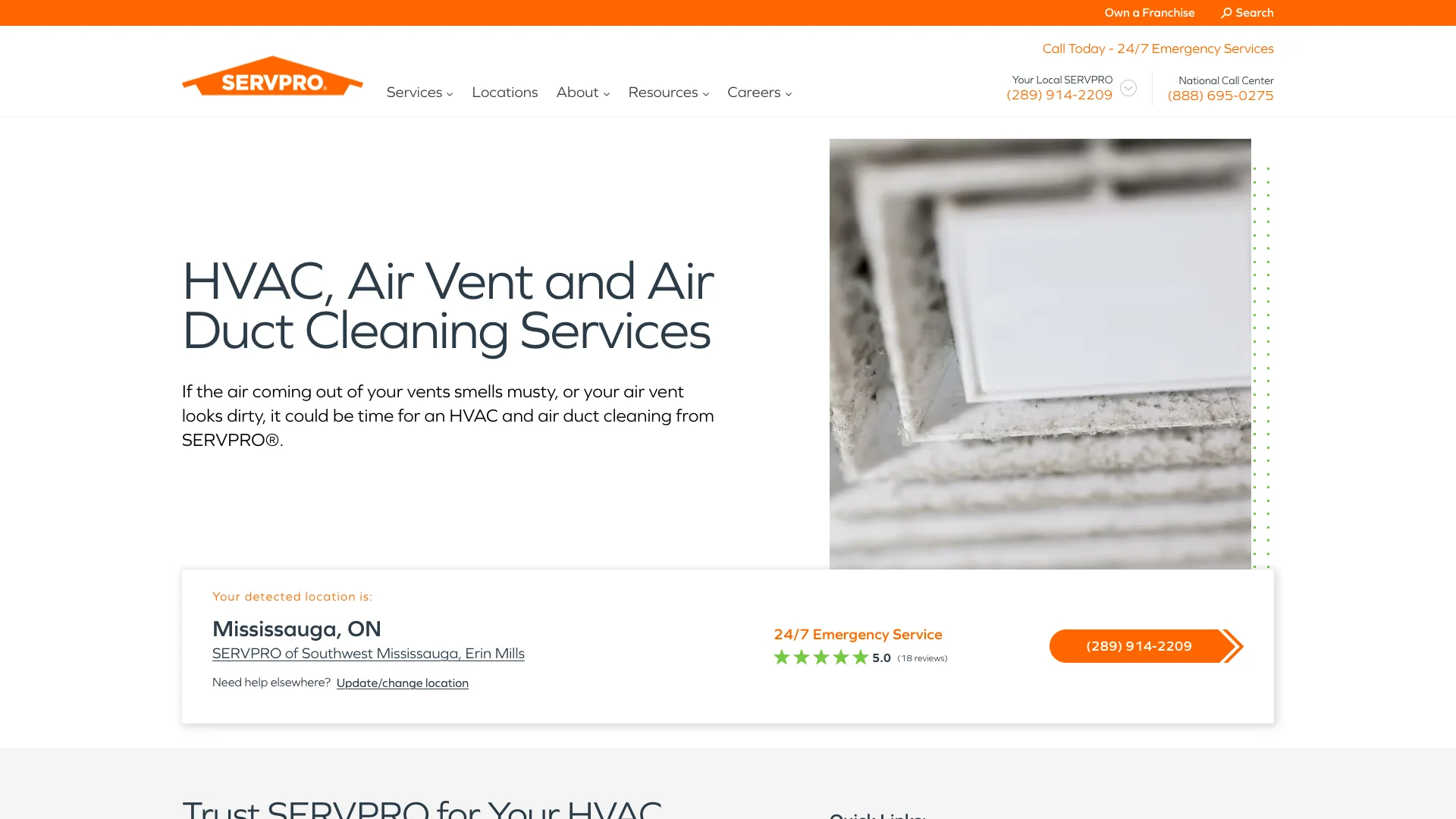
- Air Duct Cleaning page — third-tier service page (52.2K monthly organic visitors, 9% traffic share)
"53% of mobile users abandon sites that take longer than 3 seconds to load."
— Google / SOASTA (2017)
Performance: 50 to 95 out of 100
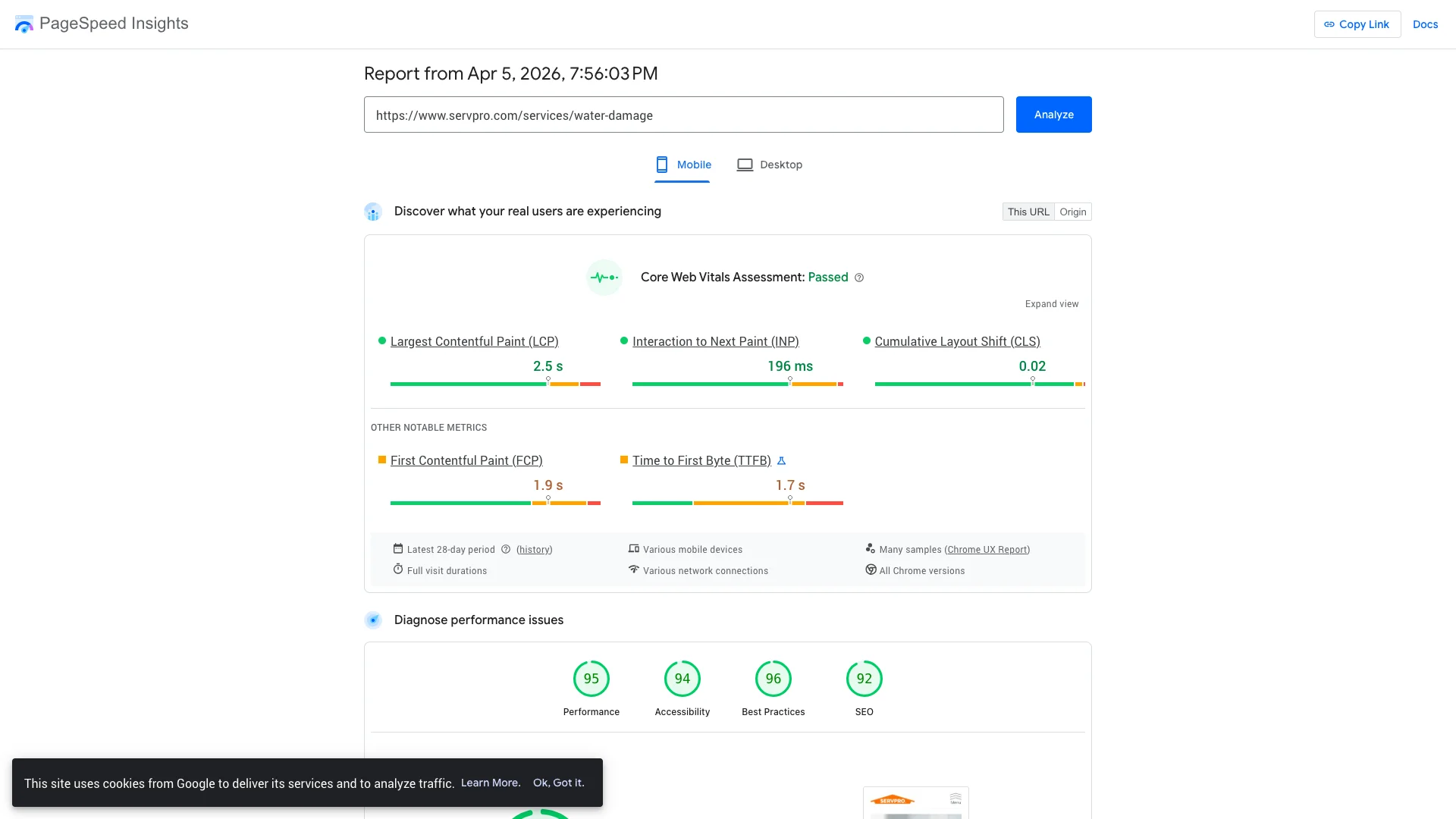
Here's the honest truth about SERVPRO's performance scores: the water damage page scored 95/100 on our recheck — a dramatic improvement from the 54/100 recorded in the original March 2026 audit. That's the highest single-page score we've seen across the nine companies in this CRO Index series. The mold and air duct pages, however, still scored 50 and 66 respectively.
That split tells you something interesting. SERVPRO appears to have invested in performance optimization on their highest-traffic page while the rest of the site remains in the 50-66 range. The mold and air duct pages still fail Core Web Vitals.
Air Duct Cleaning page: Performance score 66/100. LCP of 7.5 seconds. FCP of 2.0 seconds. CLS of 0.000 — actually perfect layout stability. TBT of 329ms. Speed Index of 3.4 seconds. This is the fastest page in the set, and LCP is still triple Google's good threshold.
Water Damage page: Performance score 95/100 on recheck (originally 54/100 in the March 2026 audit). This page pulls 117,500 monthly visitors. It's their money page — and SERVPRO appears to have significantly optimized it since our original data collection.
Mold Remediation page: Performance score 50/100. LCP of 8.7 seconds. FCP of 1.7 seconds. CLS of 0.000. TBT of 978ms — nearly a full second of blocked main thread time. Speed Index of 4.5 seconds. The slowest page in the set, and the one where homeowners are probably most anxious. Mold isn't a "browse around and think about it" situation. It's a "this needs to get fixed" situation.
Compounding effect
"Conversion rates drop approximately 12% for each additional second of page load time."
— Google / Deloitte (2020)
A note on what these scores mean in context. The water damage page's jump to 95/100 shows what's possible when a team actually invests in performance optimization. The mold and air duct pages, still stuck in the 50-66 range with LCP times of 7.5-8.7 seconds, show what happens when they don't. For a restoration company where the visitor might be standing in a flooded basement, those extra seconds matter more than they do on a decking product page.
Lead capture: phone numbers and nothing else
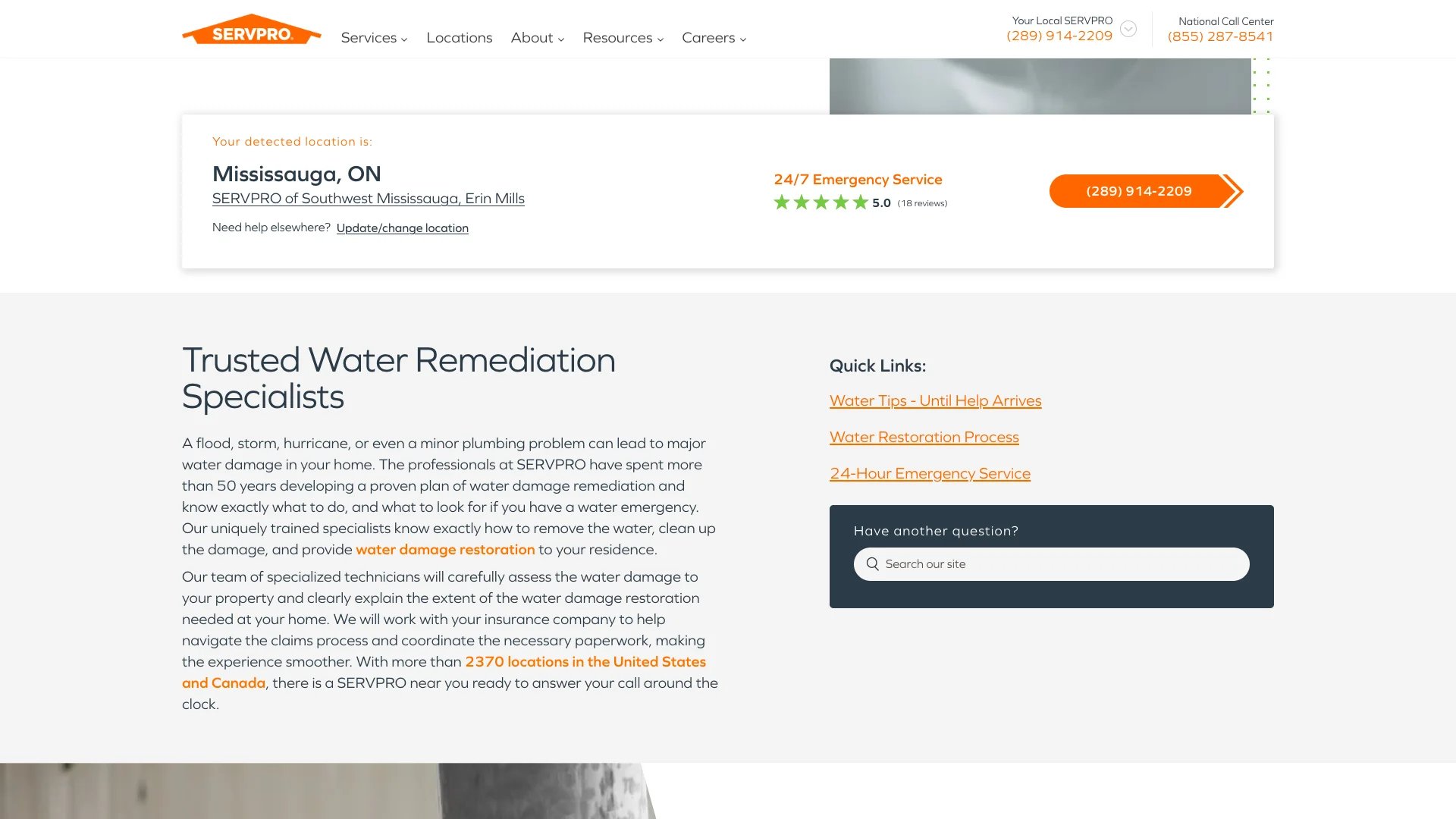
This is the same pattern we found on Roto-Rooter — but in restoration instead of plumbing. Massive organic traffic. National brand recognition. And the only way to convert is by picking up the phone.
Across all three pages: zero forms. The conversion paths are phone calls — (800) 737-8776 and (842) 672-1226 — plus CTAs that say "Contact Us," "Call for Service," "National Call Center," "24-Hour Emergency Contact," and "Find a Location." Every single one of those either dials a number or routes you to a franchise locator. None of them open a form.
And look — for emergency restoration, phone-first makes sense. If your basement is flooding right now, you're probably calling, not filling out a 7-field form. But that logic breaks down in at least two scenarios that SERVPRO's traffic data confirms are real.
First: mold. The mold page gets 53,100 monthly visitors. Mold isn't usually an emergency. It's a slow-burn problem. Homeowners find it, research it, want to understand the process and cost before committing. Those visitors are comparison shoppers. And comparison shoppers fill out forms. They don't cold-call a franchise they've never spoken to. (Side note — this is the exact demographic that reads every word on your page before deciding. They're researchers. Give them a research-friendly conversion path.)
Second: air duct cleaning. The air duct page gets 52,200 monthly visitors. Air duct cleaning is a scheduled service, not an emergency. Nobody's calling at midnight because their ducts are dirty. These are homeowners who want a quote, want to compare prices, want to book when it's convenient. A simple 3-field form — name, zip, best time to call — captures that lead. A phone number alone loses it.
"68% of users would not submit a form if it required too much personal information."
— Baymard Institute (2024)
There's also a navigation gap. No CTA in the main nav. No phone number visible in the nav. No sticky navigation to keep the contact option accessible as visitors scroll through 1,000-3,000 words of service content. You scroll past the hero, and the conversion path disappears until you reach the footer or find a text link embedded in the body copy.
Trust signals: inconsistent at best
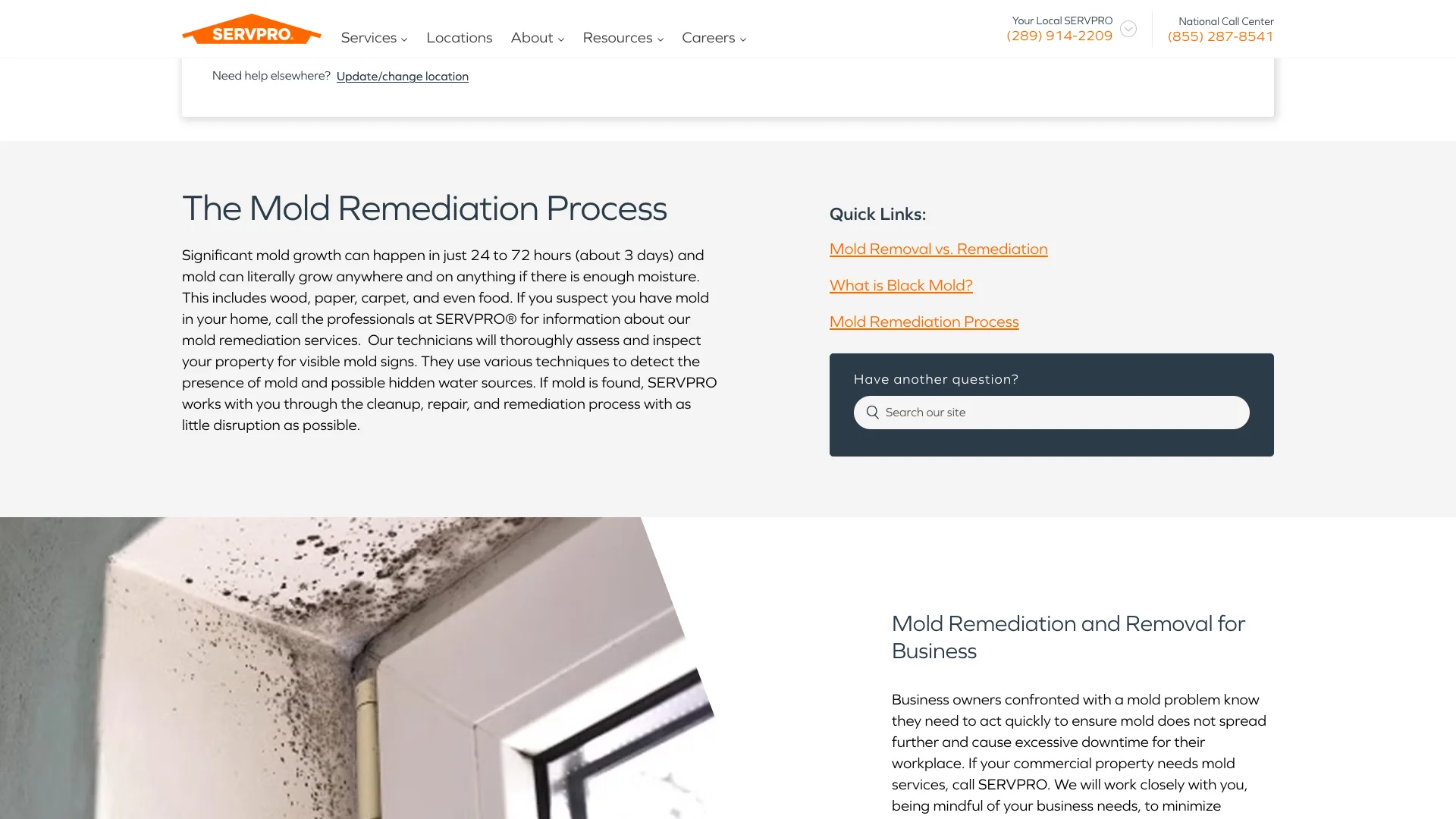
SERVPRO has trust badges on two of the three pages we tore down — the water damage page and the air duct page. But the mold page? Nothing. No badge. No widget. No visible third-party validation.
That inconsistency is the kind of thing that seems small until you think about who's landing on the mold page. Someone who just found mold in their home. Someone who's probably anxious about health implications, cost, and whether the company they hire actually knows what they're doing. And the page that should reassure them the most has the fewest trust signals.
Across all three pages, here's what's missing:
- Google Reviews: Chrome verification found "19 reviews" text rendered via JavaScript on the water damage page.
- BBB badge: Not found.
- Review widgets: Not found.
- Certifications: Not found on any of the three service pages we tested.
- Chat widget: Not found on any page.
Comparison
"97% of consumers read reviews when browsing for businesses online. 41% 'always' read reviews."
— BrightLocal (2026)
And here's where it gets interesting from a franchise perspective. SERVPRO's national site is an awareness and routing engine — it educates the homeowner, then routes them to a local franchise. But the local franchise is the one with the Google reviews, the BBB rating, the before-and-after photos. The national site strips all of that away. So the homeowner reads 3,024 words about water damage restoration, feels reasonably informed, and then has to call a phone number with zero indication of whether the franchise that picks up is any good. That's a trust gap you could drive a truck through.
The accessibility scores tell a related story. All three pages scored 94-96 on accessibility — solid numbers. SERVPRO's code is clean on that front. But accessibility and trust are different things. You can have a perfectly accessible page that still doesn't give the visitor a reason to trust you.
What SERVPRO does well
A teardown that only lists problems isn't useful. SERVPRO gets several things right, and if you're an independent restoration contractor, these are worth studying.
Schema markup. All three pages carry four types of structured data: WebSite, Organization, WebPage, and BreadcrumbList. That's more schema coverage than most contractor websites manage on their entire site, let alone on individual service pages. Google gets clean signals about what each page is, who published it, and where it sits in the site hierarchy. That's foundational SEO done right.
Content depth. The water damage page has 3,024 words. The mold page has 1,610. The air duct page has 1,085. These aren't thin service descriptions. The water damage page in particular reads like a comprehensive guide — covering the restoration process, what to expect, damage categories, and why professional extraction matters. That kind of depth earns rankings. And it does — 117,500 monthly visitors on the water damage page alone.
Internal linking density. The water damage page has 85 internal links. The mold page has 80. The air duct page has 75. That's a deliberate cross-linking strategy that passes authority between service pages, location pages, and commercial services. It keeps the visitor on the site and it keeps the crawl budget distributed.
CLS scores. Two of the three pages scored 0.000 on Cumulative Layout Shift. The water damage page scored 0.015. That's remarkable stability. The pages don't jump around while they load. In a world where most contractor sites have CLS problems from lazy-loaded images without dimensions, SERVPRO's layout discipline is genuinely impressive. Someone on their dev team cared about this, and it shows.
"48% of customers say that if a site does not work well on mobile, it signals the company does not care."
— Google Consumer Insights (2018)
What the gaps mean for local restoration contractors

SERVPRO is a franchise. You're independent. And that difference is your biggest advantage — because everything SERVPRO can't do at the national level, you can do at the local level.
Add a form. Any form. SERVPRO's service pages convert through phone calls only. That works for the 2 a.m. flood. It doesn't work for the homeowner who found mold on a Tuesday afternoon and wants to get three quotes before committing. A 3-field form — name, phone, zip — on your water damage page instantly captures the leads SERVPRO is losing. You don't need to be clever about this. Just give people a way to reach you that doesn't require a phone call.
Your reviews are your moat. SERVPRO's national site shows zero Google Reviews despite having franchises with hundreds of reviews each. But your Google review count displays on every search result, every Google Maps listing, and it should display on every page of your website. If you have 200 reviews and the SERVPRO franchise down the street has 200 reviews but doesn't show them on their service pages, you win the trust comparison every single time.
Beat their speed on non-optimized pages. SERVPRO's water damage page now scores 95/100 — proof that they can optimize when they choose to. But their mold and air duct pages still score 50-66/100 with LCP times of 7.5-8.7 seconds. A properly optimized restoration site should score 85+ across every page, not just the flagship one. That's achievable with compressed images, deferred scripts, and a modern build.
Add the schema they're missing. SERVPRO uses WebSite, Organization, WebPage, and BreadcrumbList. That's good. But they don't have FAQPage schema despite having FAQ-worthy content on every page. They don't have Service schema. They don't have LocalBusiness schema. You should have all five. FAQPage schema can earn FAQ rich results in search. LocalBusiness schema ties your site to your service area. Service schema describes exactly what you do. Those are competitive advantages that cost nothing to implement.
"25% of homeowners say trusting contractors is their top challenge."
— Houzz Inc. (2025)
And there's a positioning angle worth considering. SERVPRO's franchise model means the national site does the awareness work — ranking for "water damage restoration," educating the homeowner, establishing the brand. But the conversion happens locally. The homeowner reads SERVPRO's 3,024-word water damage page, learns what the process involves, and then searches for a local provider. If your site loads faster, shows reviews, has a contact form, and displays your certifications — you're the obvious next step. You don't have to outrank SERVPRO. You have to out-convert the local franchise that picks up their phone.
That's a lower bar than you think. Because right now, the local SERVPRO franchise is inheriting the national site's gaps: no forms, no reviews, inconsistent trust signals, and 7-8 second LCP. Your site just needs to not have those problems.
Frequently asked questions
What is SERVPRO's website performance score?
SERVPRO's water damage page scored 95/100 on our recheck — a dramatic improvement from the 54/100 recorded in the original March 2026 audit. The air duct cleaning page scored 66/100, and the mold remediation page scored 50/100. The mold and air duct pages still fail Core Web Vitals due to LCP times of 7.5-8.7 seconds — well above Google's 2.5-second "good" threshold.
Does SERVPRO have contact forms on their website?
No. As of our March 2026 teardown, SERVPRO's service pages have zero contact forms. The only conversion paths are phone numbers — (800) 737-8776 and (842) 672-1226 — and CTAs that route to phone calls or a franchise locator. This matches the pattern we found on Roto-Rooter: massive organic traffic, national brand recognition, phone-only conversion. It works for true emergencies but leaves non-emergency leads (mold assessment, air duct scheduling) without a web-based path.
Can a local restoration contractor compete with SERVPRO online?
Yes — and you're not really competing with SERVPRO directly. SERVPRO's national site builds awareness. Your site converts locally. Their gaps are your opportunities: add a simple contact form, display your Google reviews, show your certifications, and implement schema markup they're missing (FAQPage, Service, LocalBusiness). The homeowner who reads SERVPRO's water damage page and then searches for a local provider will land on your site next. Make sure it converts.
How much organic traffic does servpro.com get?
According to Ahrefs data from our March 2026 collection, servpro.com receives approximately 643.7K monthly organic visitors with an estimated traffic value of $3.1M. The water damage page accounts for 117.5K of that (19% share), the mold remediation page accounts for 53.1K (9%), and the air duct cleaning page accounts for 52.2K (9%). That's 222,800 monthly visitors across just three service pages — roughly 35% of total site traffic concentrated on the pages we tore down.