
What we found on rotorooter.com
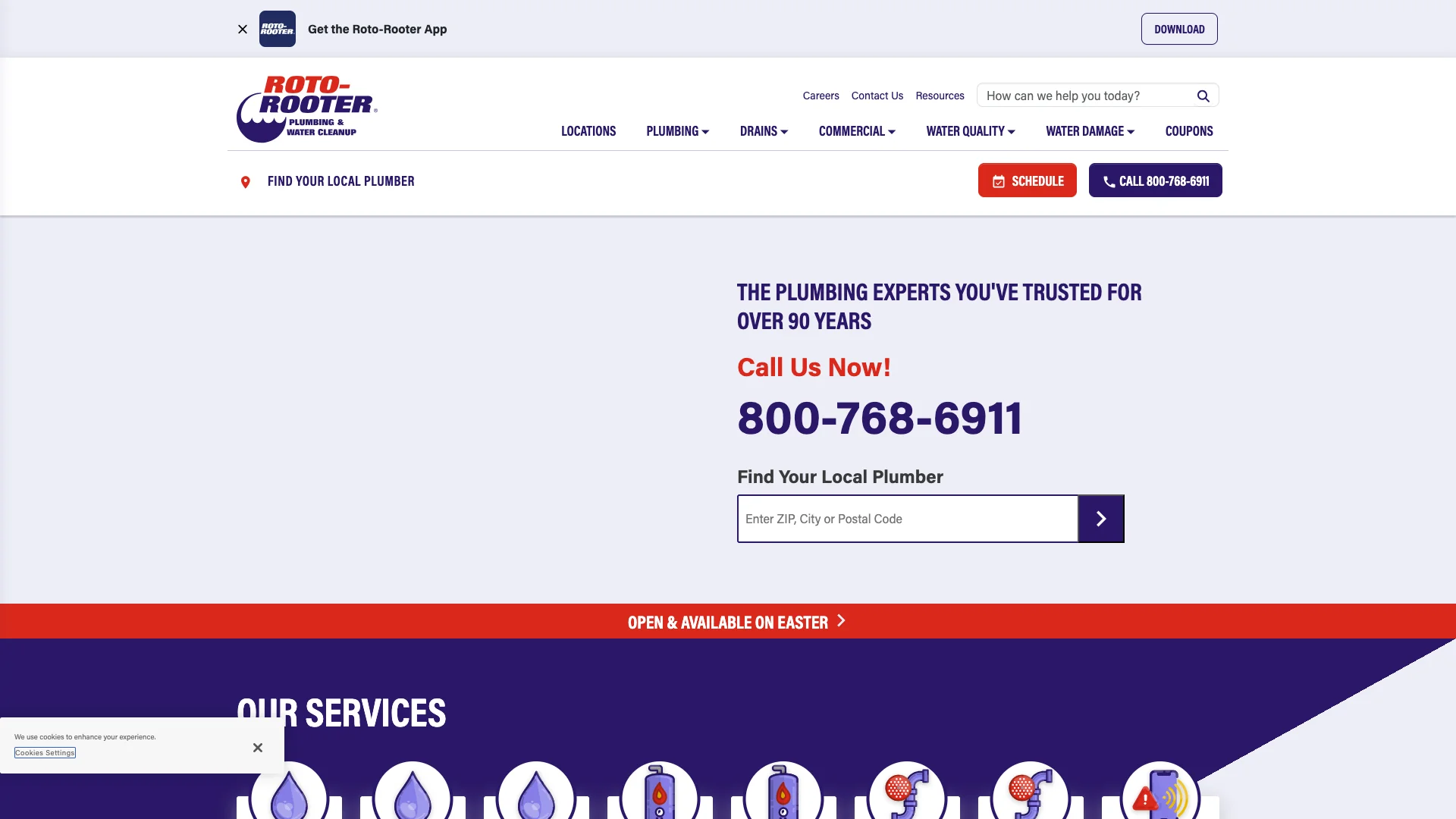
Roto-Rooter is one of the most recognized plumbing brands in the United States. According to Ahrefs, the domain pulls 652.6K monthly organic visitors with an estimated traffic value of $4 million. That's not a typo. Four million dollars in equivalent paid search value, every month, for free.
So we ran three of their highest-traffic service pages through our standard teardown protocol. PageSpeed Insights API for performance. Form-field counts. Trust signal audits. Navigation analysis.
And the finding that stopped us wasn't the performance scores. It wasn't the content depth. It was something missing.
The pages we tore down:
- /plumbing/emergency-plumber/ — their emergency plumber page (77K monthly organic visitors, 13% traffic share)
- /plumbing/drain-cleaning/ — drain cleaning services (64.7K monthly organic visitors, 11% traffic share)
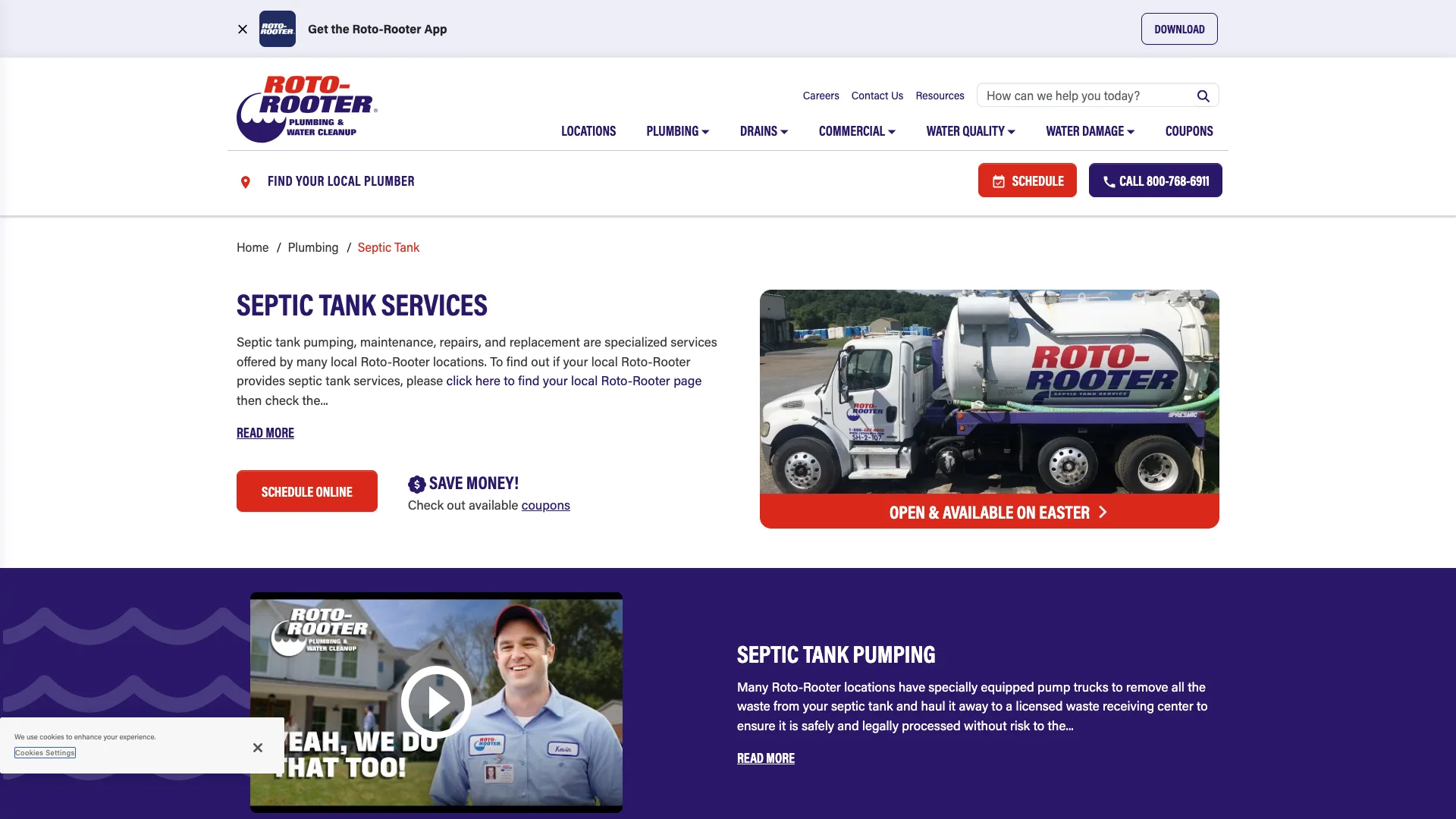
- /plumbing/septic-tank/ — septic tank services (42.1K monthly organic visitors, 7% traffic share)
Combined, these three pages pull 183,800 monthly organic visitors. And not one of them has a lead capture form.
"25% of homeowners say trusting contractors is their top challenge when planning home improvement projects."
— Houzz Inc. (2025)
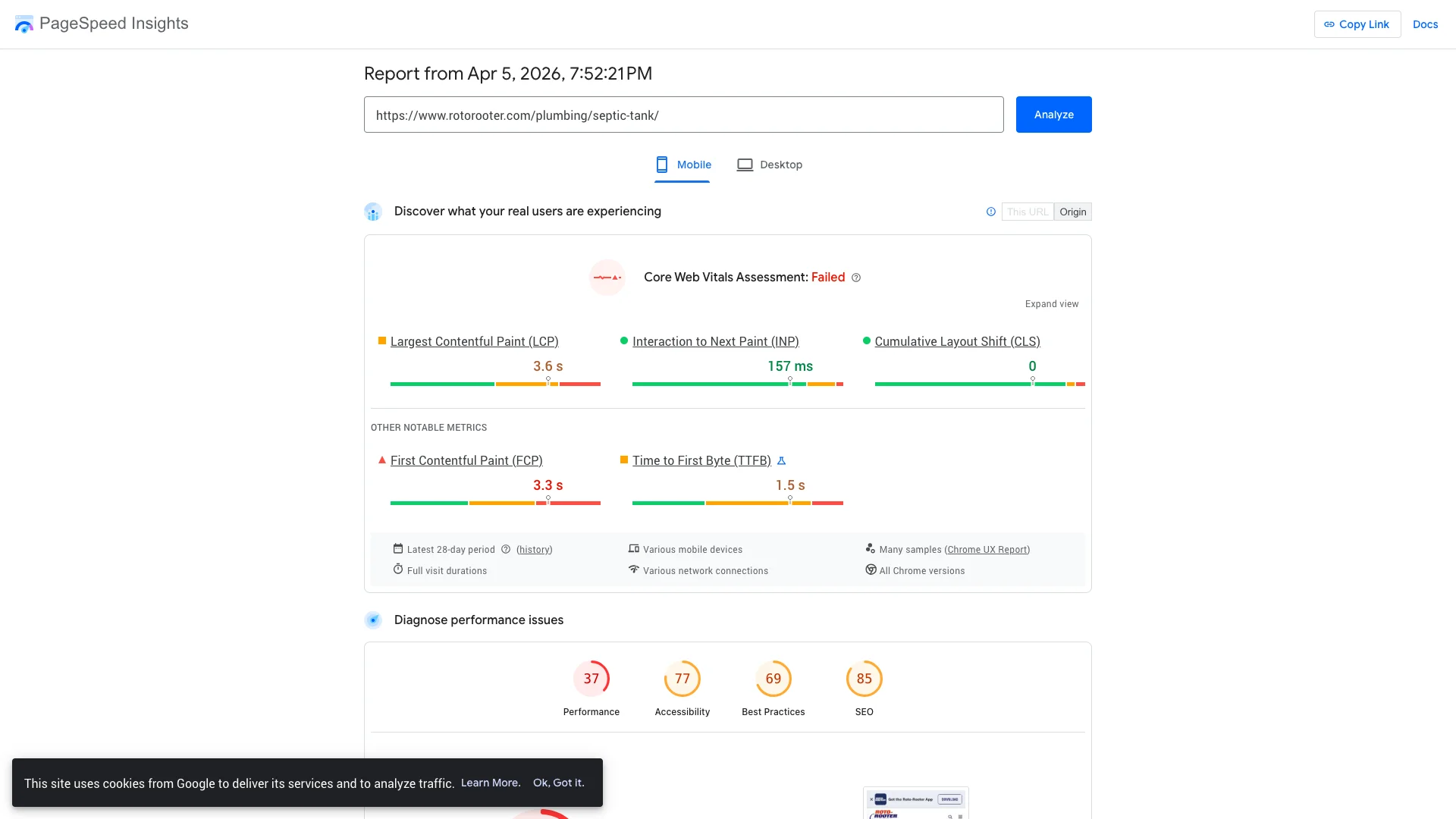
Performance: 37 to 38 out of 100
The performance scores are mediocre but not catastrophic. Compared to some of the other national brands we've torn down (looking at you, Trex), Roto-Rooter at least loads within single-digit seconds on most pages.
Emergency plumber page (/plumbing/emergency-plumber/): Performance score 38/100. LCP of 5.6 seconds. FCP of 4.8 seconds. CLS of 0.000. TBT of 1,841ms. Speed Index of 5.9 seconds. This is the page that ranks for "emergency plumber" — the highest-intent, most-urgent search in plumbing. And the main content takes 5.6 seconds to appear on a first mobile visit.
Drain cleaning page (/plumbing/drain-cleaning/): Performance score 38/100. LCP of 5.7 seconds. FCP of 4.8 seconds. CLS of 0.000. TBT of 1,892ms. Nearly identical to the emergency page. Same template, same performance ceiling.
Septic tank page (/plumbing/septic-tank/): Performance score 37/100. LCP of 9.4 seconds. FCP of 4.6 seconds. CLS of 0.000. TBT of 1,983ms. The worst performer of the three, with an LCP almost double the other pages.
One genuinely good number across all three: CLS of 0.000. Zero layout shift. The page doesn't rearrange itself while you're trying to read it. That's better than most sites we audit.
"53% of mobile users abandon sites that take longer than 3 seconds to load."
— Google / SOASTA (2017)
Lead capture: the most recognized plumber in America doesn't ask for your phone number
This is the part that's hard to believe until you actually look at the pages.
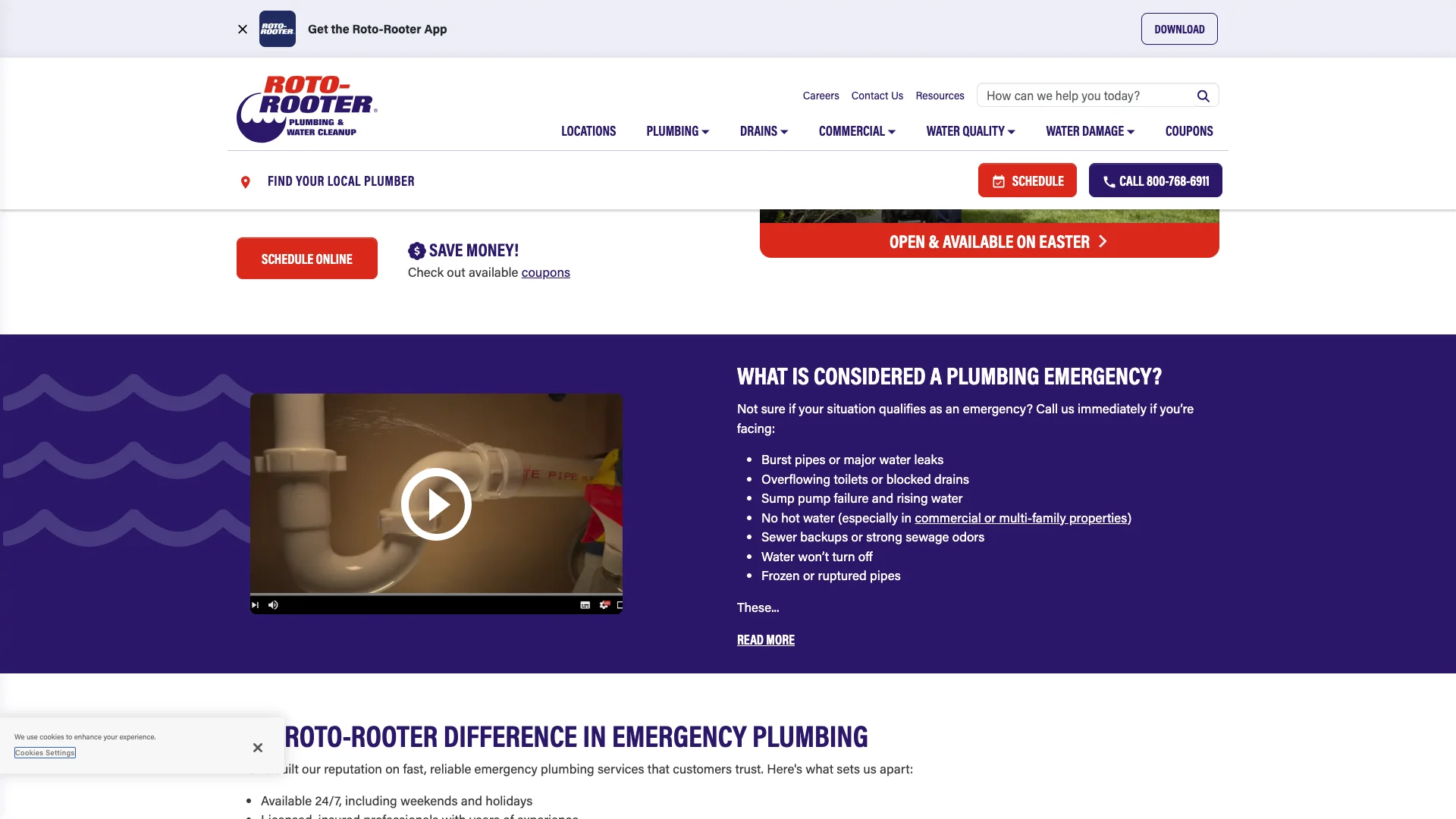
Roto-Rooter gets 652,600 organic visitors every month. Their emergency plumber page alone gets 77,000. And on that page — the page where someone has a burst pipe at 2 AM and just typed "emergency plumber" into Google — there's no form. No "enter your name and phone number and we'll call you back." No "describe your problem and we'll dispatch someone." Nothing.
The only form element on any of the three pages is a search bar in the navigation with the placeholder text "How can we help you today?" That's a site search input. It's not a lead capture mechanism.
So how does Roto-Rooter convert? Phone calls. The number 800-768-6911 appears on every page. There's a "Schedule" button in the nav. There's a "Schedule Online" CTA in the body. But no form that captures contact information from the visitor before they leave.
"68% of users would not submit a form if it required too much personal information."
— Baymard Institute (2024)
Look, there's an argument that this is intentional. Roto-Rooter's business model runs on phone calls. Their brand recognition means people call them directly. The 800 number is the conversion path. And for a brand this recognizable, maybe that works. Maybe the phone rings enough that they don't need a form.
But think about this from the homeowner's perspective. It's 2 AM. Pipe burst. You found this page. You don't want to call anyone right now — you want to submit your info and have someone call you in the morning. Or you want to describe the problem in writing so you don't have to explain it on the phone. Or you're at work and can't make a call. For all of those people, Roto-Rooter's site has no answer except "call us."
And there's the data question. With zero forms, Roto-Rooter has no way to capture visitor intent data from people who aren't ready to call. No email for follow-up. No phone number for a callback. No zip code for routing to the right franchise. Every visitor who leaves without calling is gone. There's no retargeting, no nurture sequence, no second chance.
Trust signals: strong brand, inconsistent execution
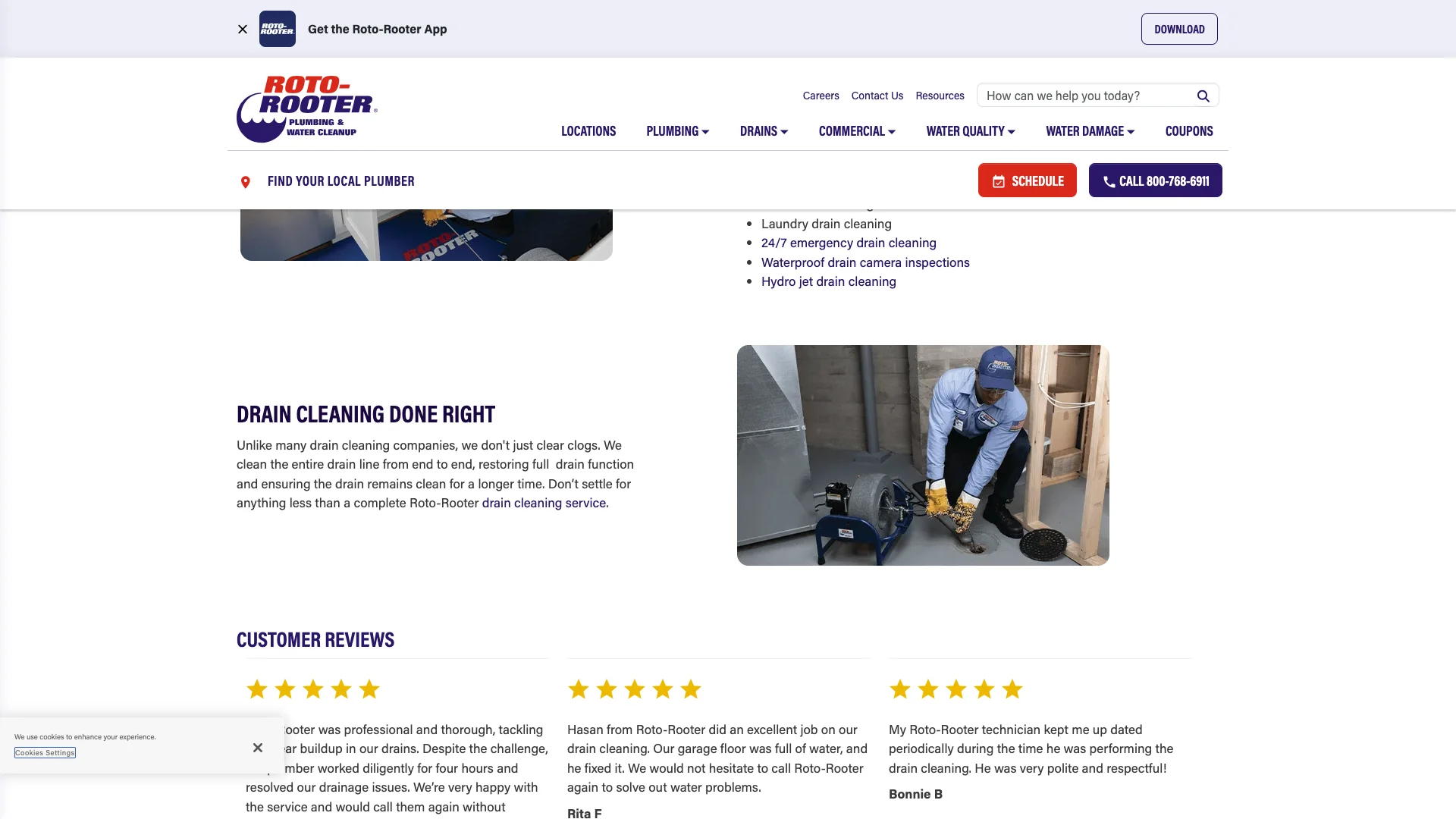
Roto-Rooter's trust signal situation is interesting. They have Google Reviews widgets and trust badges showing on all three pages. That's more than most national brands manage consistently. And the review widgets returned "true" in our scrape, which means they're rendering — not just present in the code but invisible on screen.
But no BBB badge on any of the three pages. No certifications displayed. And the review count itself came back as "NOT_FOUND" in our automated extraction — meaning either the count isn't rendered in a standard format, or it's loaded dynamically in a way our scraper couldn't capture. Either way, if the review count isn't visible to a quick glance, it's not doing its job.
Comparison
"97% of consumers read reviews when browsing for businesses online. 41% 'always' read reviews, up from 29% in 2025."
— BrightLocal (2026)
And the schema markup tells a story about intent. All three pages use LocalBusiness + Plumber schema. The emergency and drain pages both carry FAQPage schema. That's solid structured data — it tells Google exactly what these pages are and who they serve. But the septic page doesn't have FAQPage schema, even though it covers a topic homeowners have plenty of questions about.
The accessibility scores are worth noting too. The emergency page scored 80/100. The drain and septic pages both scored 77/100. Those are passing but not strong. For a brand that serves every demographic including elderly homeowners who may use screen readers, accessibility in the high 70s leaves room.
What Roto-Rooter does well
Even with the form gap, Roto-Rooter executes on several fundamentals that local plumbers routinely miss.
Zero layout shift. CLS of 0.000 on all three pages. The page loads and stays put. No images popping in and shoving content down. No ads reflowing the layout. No cookie banners that push the hero off-screen. That's genuinely difficult to achieve, and it means the mobile experience — while slow to start — is stable once it arrives.
Phone number everywhere. 800-768-6911 appears in the navigation bar, in the hero section, in the body copy, and in the CTAs. A homeowner never has to scroll or search for how to call. If your conversion strategy is phone calls, make the phone number impossible to miss. Roto-Rooter does this.
Schema markup done right. LocalBusiness + Plumber schema on every page. FAQPage schema where FAQ content exists. BreadcrumbList for site structure. WebPage and WebSite schemas for general site context. That's four to five schema types per page. Most plumbing contractors we audit have zero.
Clear service taxonomy. The navigation breaks services into logical categories: Plumbing, Drains, Commercial, Water Quality, Water Damage. A homeowner with a clogged drain doesn't have to guess where to click. That clarity extends to the URLs — /plumbing/emergency-plumber/ tells you exactly what you'll find.
"83% of consumers use Google specifically to find local business reviews."
— BrightLocal (2025)
What the gaps mean for local plumbers

Roto-Rooter's brand does something your local plumbing company can't replicate: it converts on name recognition alone. Someone searches "emergency plumber," sees Roto-Rooter, and calls because they know the brand. That phone-only strategy works when you're a household name with a jingle.
But you're not a household name. So you need the things Roto-Rooter skipped.
A lead capture form on every service page. Three fields: name, phone, zip code. "Describe your issue" as an optional textarea if you want it. The homeowner who finds you at 2 AM and doesn't want to call right now needs a way to say "I exist, call me tomorrow." Roto-Rooter loses that person. You don't have to.
Performance that loads before patience runs out. Roto-Rooter's pages take 5-9 seconds to render main content. Your emergency plumber page should load in under 2. When a pipe burst forces someone to Google at 2 AM on a slow phone, the first site that actually loads wins the call. Score 85+ on PageSpeed and you've beaten every national brand in our index.
Content depth on high-intent pages. Roto-Rooter's septic page has 359 words. Their drain cleaning page has 961. Their emergency page has 1,158. Those are thin for pages that rank nationally. Your local service page doesn't need to outrank Roto-Rooter nationally — it needs to outrank the three other plumbers in your zip code. But it should have enough content to answer the homeowner's actual questions: what does this cost, how long does it take, what should I do right now.
A callback option. Roto-Rooter's entire conversion path is "call us." Add a callback request form — name, phone, preferred time — and you've created a conversion path that the biggest plumbing brand in America doesn't offer. That's not a small thing. That's a structural advantage over a company with $4 million in monthly traffic value.
Compounding effect
"Conversion rates drop approximately 12% for each additional second of page load time."
— Google / Deloitte (2020)
And here's the positioning angle that matters most. Roto-Rooter is a franchise. When a homeowner calls 800-768-6911, they don't get the owner. They get a dispatcher. They get a technician assigned by rotation. The homeowner has no idea who's showing up. You, as a local plumber, can put your face and name on the site. "Call Mike directly." That personal accountability is something a franchise structurally cannot offer. And 25% of homeowners say trusting contractors is their top challenge (Houzz 2025). Your name and face on the page addresses that challenge in a way Roto-Rooter's 800 number never will.
Frequently asked questions
What is Roto-Rooter's website performance score?
The emergency plumber page scored 38/100 on Google PageSpeed Insights (mobile) as of March 29, 2026. The drain cleaning page also scored 38/100, and the septic tank page scored 37/100. LCP ranged from 5.6 to 9.4 seconds across the three pages. CLS was 0.000 on all pages — meaning zero layout shift, which is genuinely good. TBT ranged from 1,841ms to 1,983ms.
Does Roto-Rooter have lead capture forms on their website?
No. The three highest-traffic service pages we analyzed have zero lead capture forms. The only form element is a search bar in the navigation with the placeholder "How can we help you today?" Roto-Rooter's conversion strategy relies on phone calls to 800-768-6911 and a "Schedule Online" button. There's no way for a visitor to submit their contact information for a callback.
Can a local plumber compete with Roto-Rooter online?
Yes — and on several fronts, a well-built local site has structural advantages. Roto-Rooter's site has no lead forms on service pages, performance scores of 37-38/100, thin content on key pages (359 words on septic), and no BBB badge. A local plumber with a fast site, a 3-field lead form, visible Google reviews, and owner accountability ("Call Mike directly") delivers a better digital experience for homeowners who aren't ready to dial an 800 number. The brand recognition gap is real. But the conversion infrastructure gap favors you.
How much organic traffic does rotorooter.com get?
According to Ahrefs data from our March 2026 collection, rotorooter.com receives approximately 652.6K monthly organic visitors with an estimated traffic value of $4 million. Their emergency plumber page accounts for 77K of that (13% share), drain cleaning accounts for 64.7K (11%), and septic tank accounts for 42.1K (7%). That's 183.8K combined across just three pages.