
What we found on petro.com
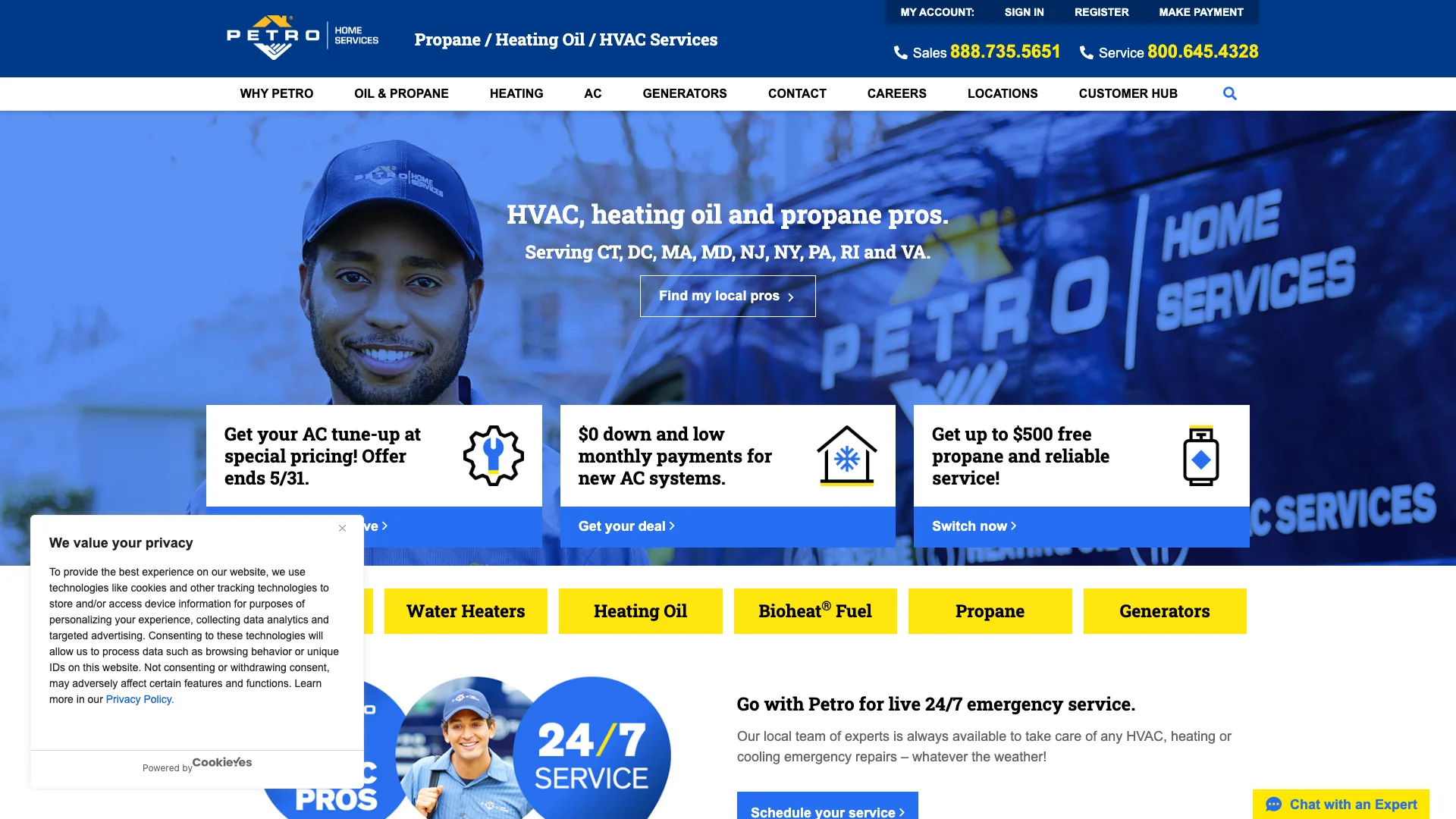
Petro Home Services is a northeast heating oil and HVAC company, primarily serving customers in states like New York, New Jersey, Connecticut, and Pennsylvania with home heating oil delivery plus HVAC service and installation. According to Ahrefs, petro.com pulls 65.3K monthly organic visitors with an estimated traffic value of $122.5K. So we picked the three highest-traffic pages we could verify and ran them through the standard teardown protocol.
The pages we tore down:
- /resource-center/why-ac-freezing-up, a long-tail informational article on why an air conditioner freezes up (2.9K monthly organic visitors, 5% traffic share)
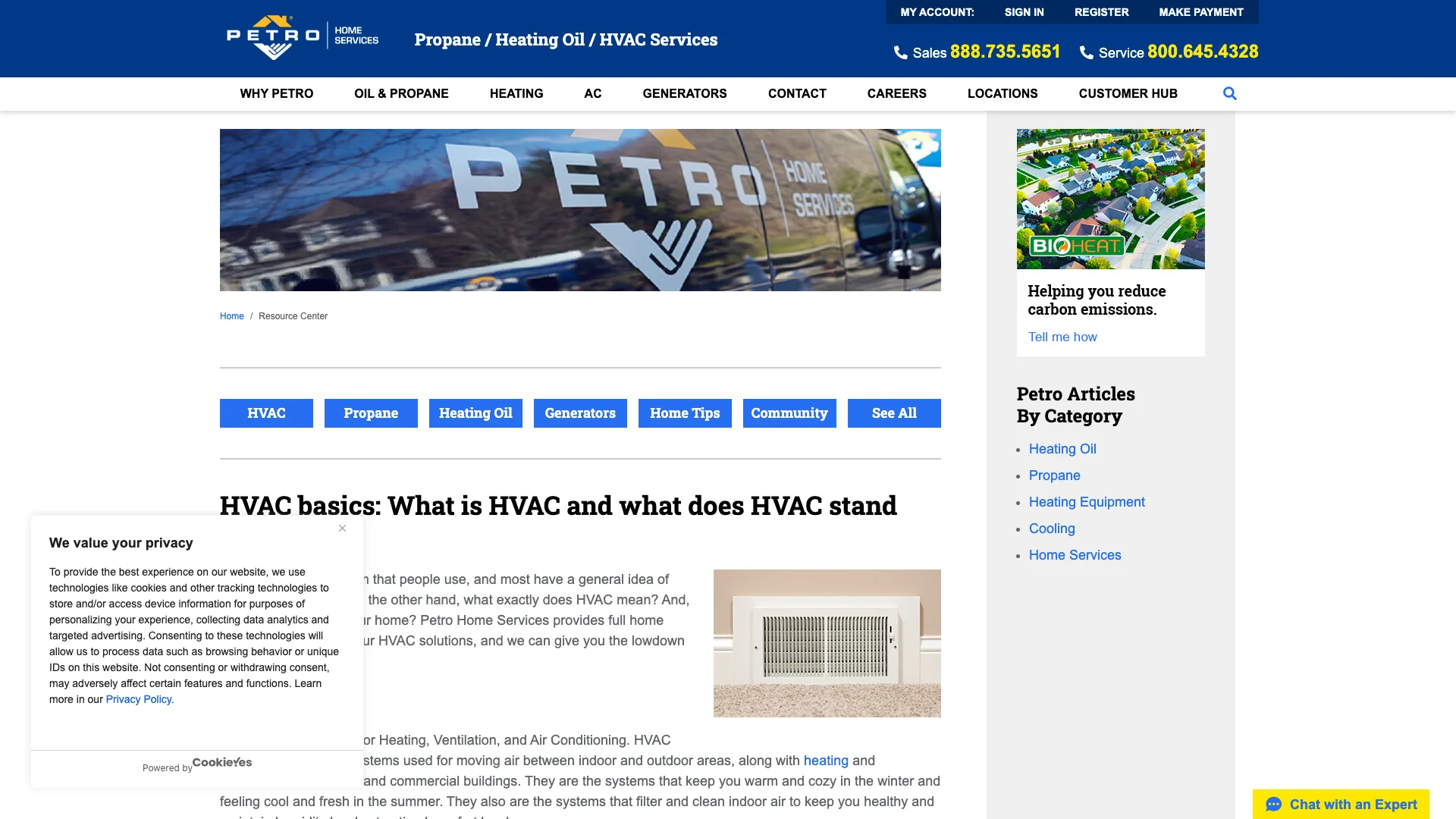
- /resource-center/what-is-hvac, a basic explainer on HVAC (2.5K monthly visitors, 4% share)
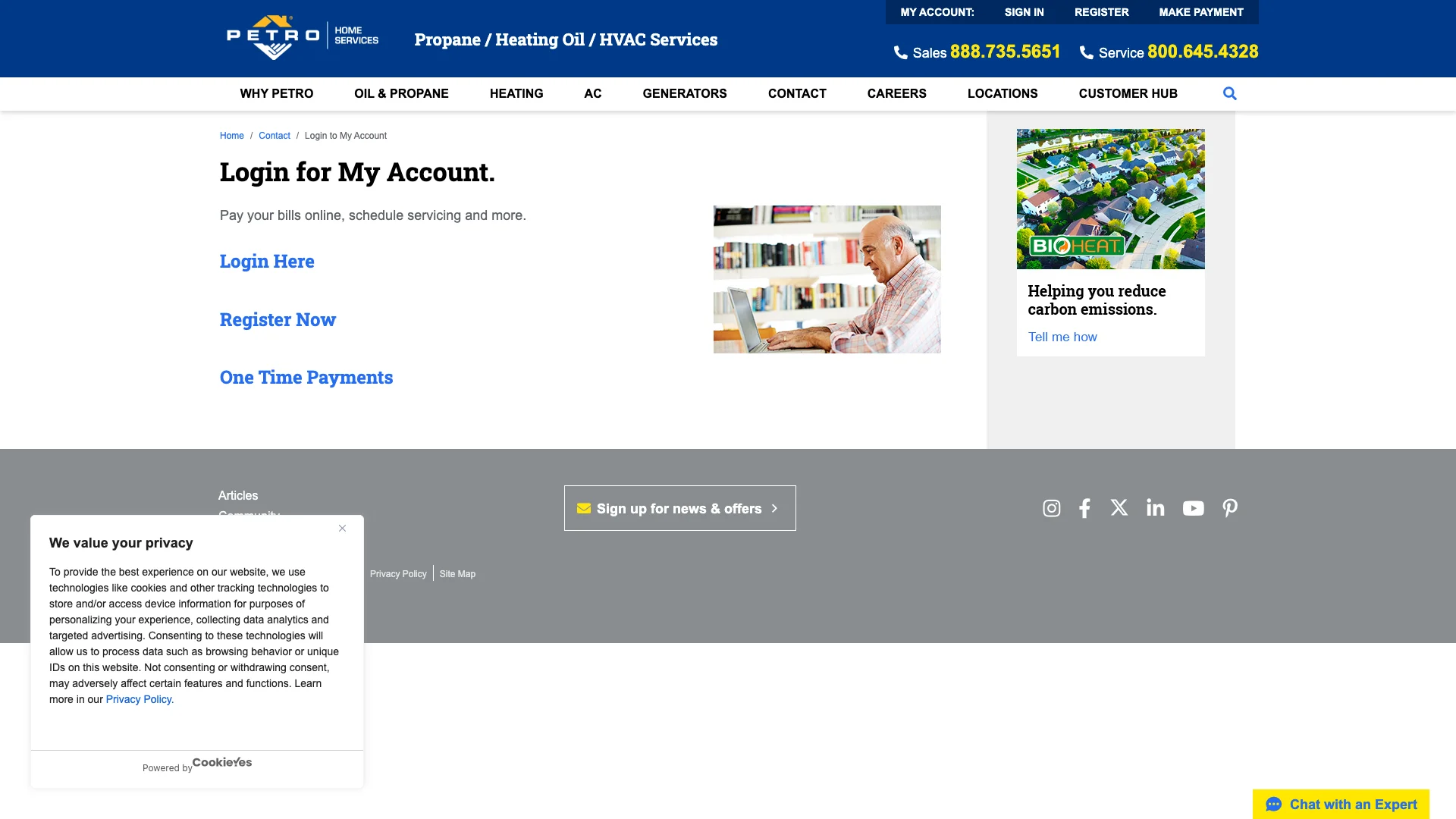
- /contact-petro/login, the customer account login page (2.3K monthly visitors, 4% share)
And one quirk from the data is worth pulling out before we get into the rest of the audit. The "why is your AC freezing up" article returned a headline field with two values instead of one. The real headline is there ("Why Your AC is Freezing Up & What to Do"). But sitting right next to it in the markup is a second headline value that reads literally: "This is Modal Body". That is the default template text inside a hidden popup element. Somebody dropped a popup into the page template, left the template's placeholder text inside it, and never replaced it with real copy. The "what is HVAC" article has the same leftover text. It is not visible on the page unless the popup opens (and we did not trigger the popup in our audit to verify what it actually displays). But the text is sitting in the page structure, waiting to show up when a homeowner clicks whatever trigger opens the modal. That is the kind of thing nobody at the company catches because nobody on the team actually loads the live page from a clean browser and clicks around.
"25% of homeowners say trusting contractors is their top challenge when planning home improvement projects."
— Houzz Inc. (2025)
Performance: all three pages in the low 40s on Google's mobile test
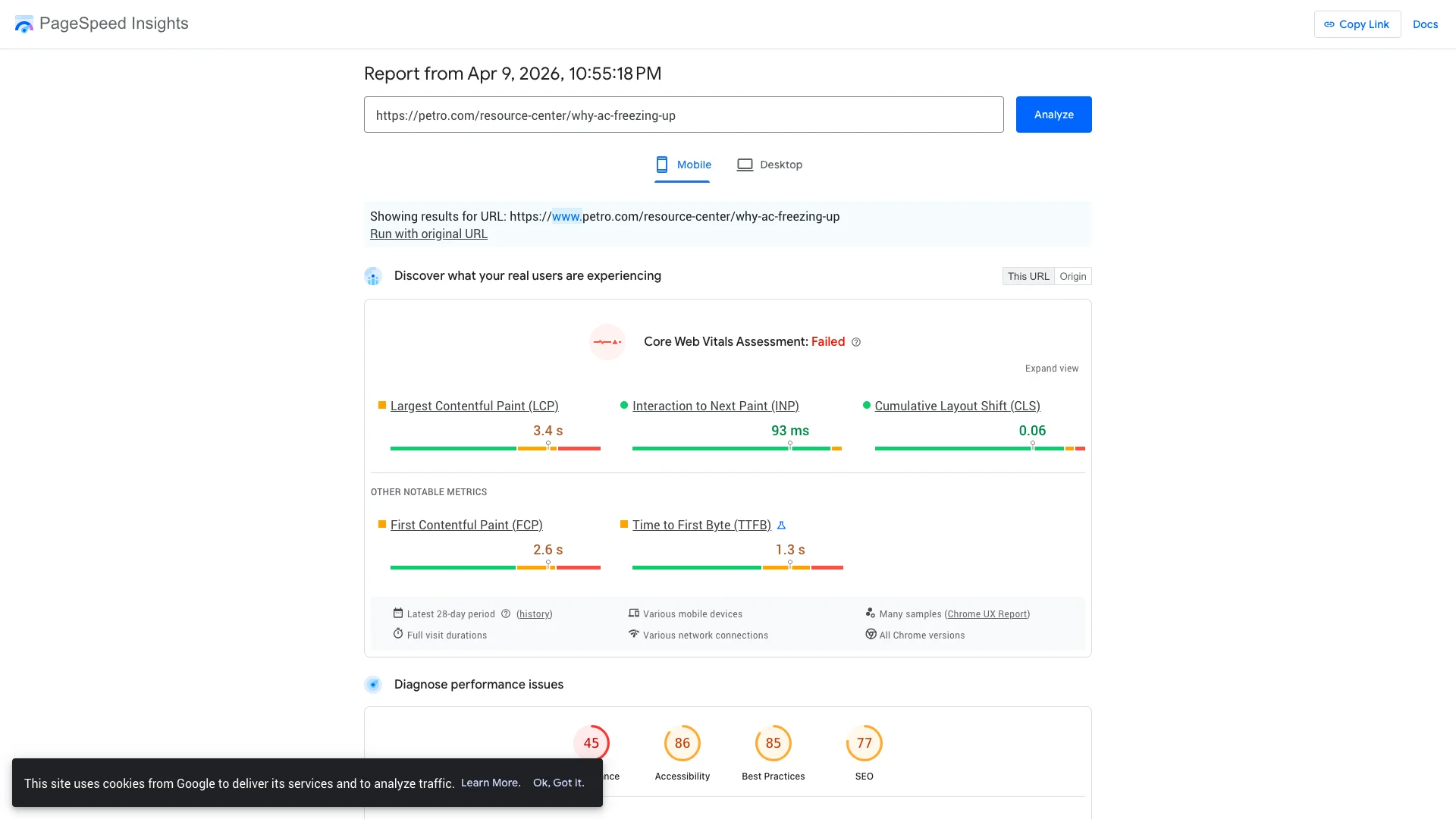
Quick framing note before we dig in. Google PageSpeed Insights runs a simulated slow-phone lab test, so the scores it reports are worst-case scenarios, not what you experience when you open the site yourself on your phone with good WiFi. The pages probably feel fine when you open them. That is honest. But Google uses these lab scores as a factor in its search rankings, and Petro is eating a ranking penalty on every keyword these three pages compete for.
The "why is your AC freezing up" article scored 43 out of 100. The "what is HVAC" article scored 49. The account login page scored 41. All three sit in the low 40s. Google's "good" threshold is 90. Petro is nowhere near it.
"53% of mobile users abandon sites that take longer than 3 seconds to load."
— Google / SOASTA (2017)
Layout stability is decent across all three pages. Content does not visibly jump around as the pages load. That is the one performance metric homeowners can actually feel regardless of their connection speed, and Petro gets it right. The problem Google is penalizing is something different: the pages are heavy, and the browser has to download a lot of stuff before it can paint anything on the slow-connection test Google runs. That is mostly third-party tracking scripts, uncompressed images, and the kind of CMS bloat that piles up on older enterprise sites over a decade of incremental additions.
The account login page scoring 41 is particularly odd. A login page should be one of the lightest pages on any website (nothing to load except a form). Petro's login page is doing enough work to score 41 out of 100, which means it is loading the full site header, the full footer, tracking scripts, and probably a bunch of other stuff that has no business being on a simple login page. Most of that could be stripped out in a day of focused work, and the login page would score 90+.
Compounding effect
"Conversion rates drop approximately 12% for each additional second of page load time."
— Google / Deloitte (2020)
Lead capture: zero contact forms, two phone numbers, seven "go somewhere else" CTAs
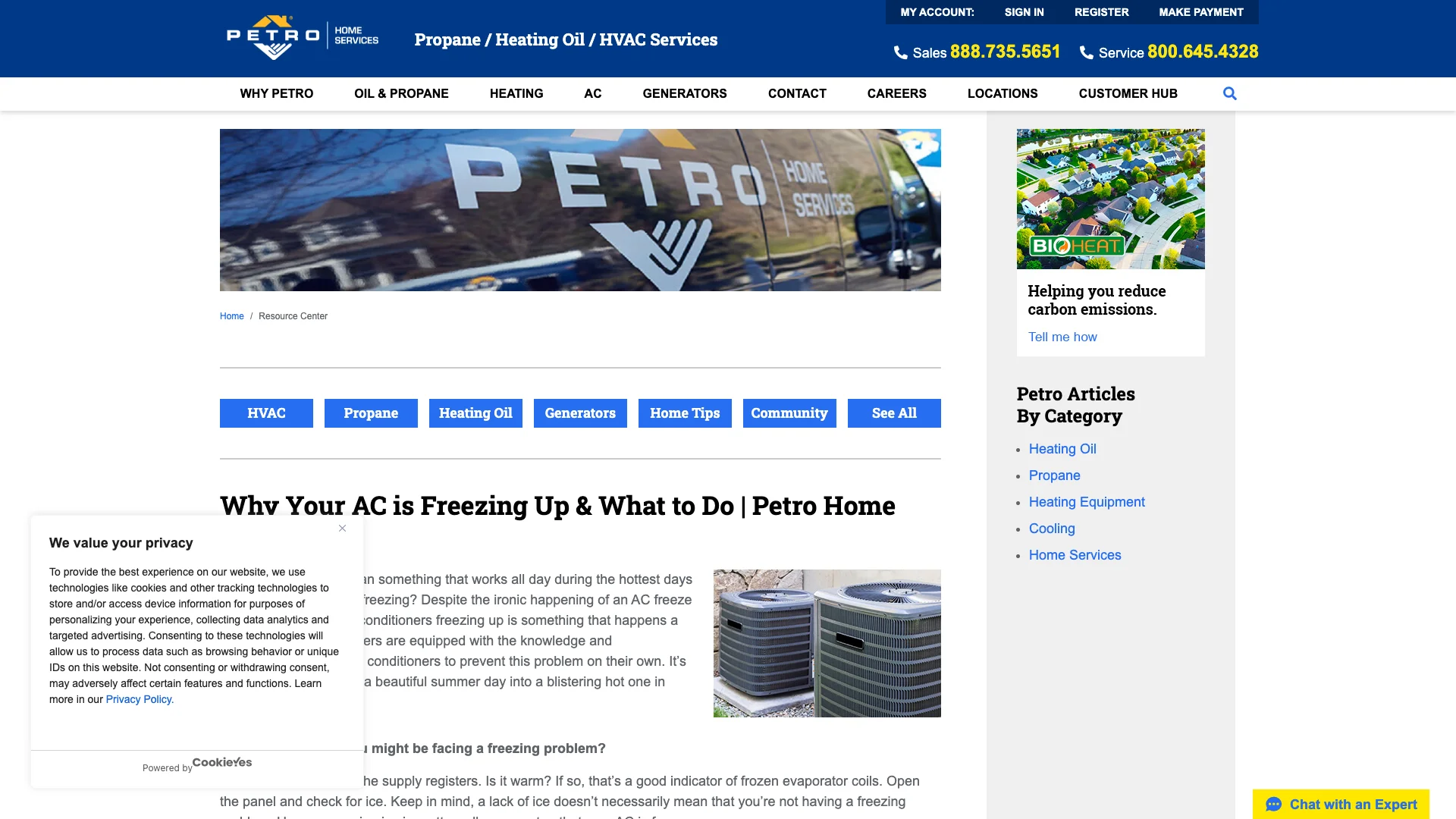
The form audit on Petro came back empty on all three pages. Zero contact forms. Zero quote request forms. Zero service appointment bookers. Nothing. Not on the AC article, not on the HVAC article, not on the login page. The login page is obviously allowed to be form-free (it has the login form, which we are not counting as a contact form). But the two content articles pulling 5,400 combined monthly organic visitors have no way for a homeowner to leave their name and phone number without clicking away to a different page first.
Instead, Petro relies on seven different CTAs that all route to somewhere else on the site:
- "Get your deal"
- "Contact"
- "Contact us overview"
- "Contact us"
- "Request a quote"
- "Schedule an appointment"
- "Request a call back"
Four of those seven are basically the same thing ("Contact," "Contact us overview," "Contact us," "Request a call back"). The homeowner has to read the CTAs, figure out which one matches what they want, click it, wait for the next page to load, and then actually fill out whatever form is on the destination page. That is at minimum two clicks of friction on a conversion path that should be one step.
"68% of users would not submit a form if it required too much personal information."
— Baymard Institute (2024)
Plus the phone numbers. Every page carries two visible phone numbers: (888) 735-5651 and (800) 645-4328. Two phones is not a disaster (we have seen sixty-four on one Happy Hiller page), but two different 800 numbers on the same page raises the same question. Which one do you call? Probably the first one in the header. But the page presents both as equally valid, and a homeowner reading the article has to pick one without any context for why there are two.
The fix for Petro's lead capture is the same fix for almost every site in this series. Embed a 3-field contact form (name, phone, zip) directly in the article. Above the fold. Right next to the phone number. A research-stage visitor reading "why is my AC freezing up" who decides "I need a professional to look at this" can leave their information in ten seconds without clicking away to a different page.
Trust signals: none visible on any page
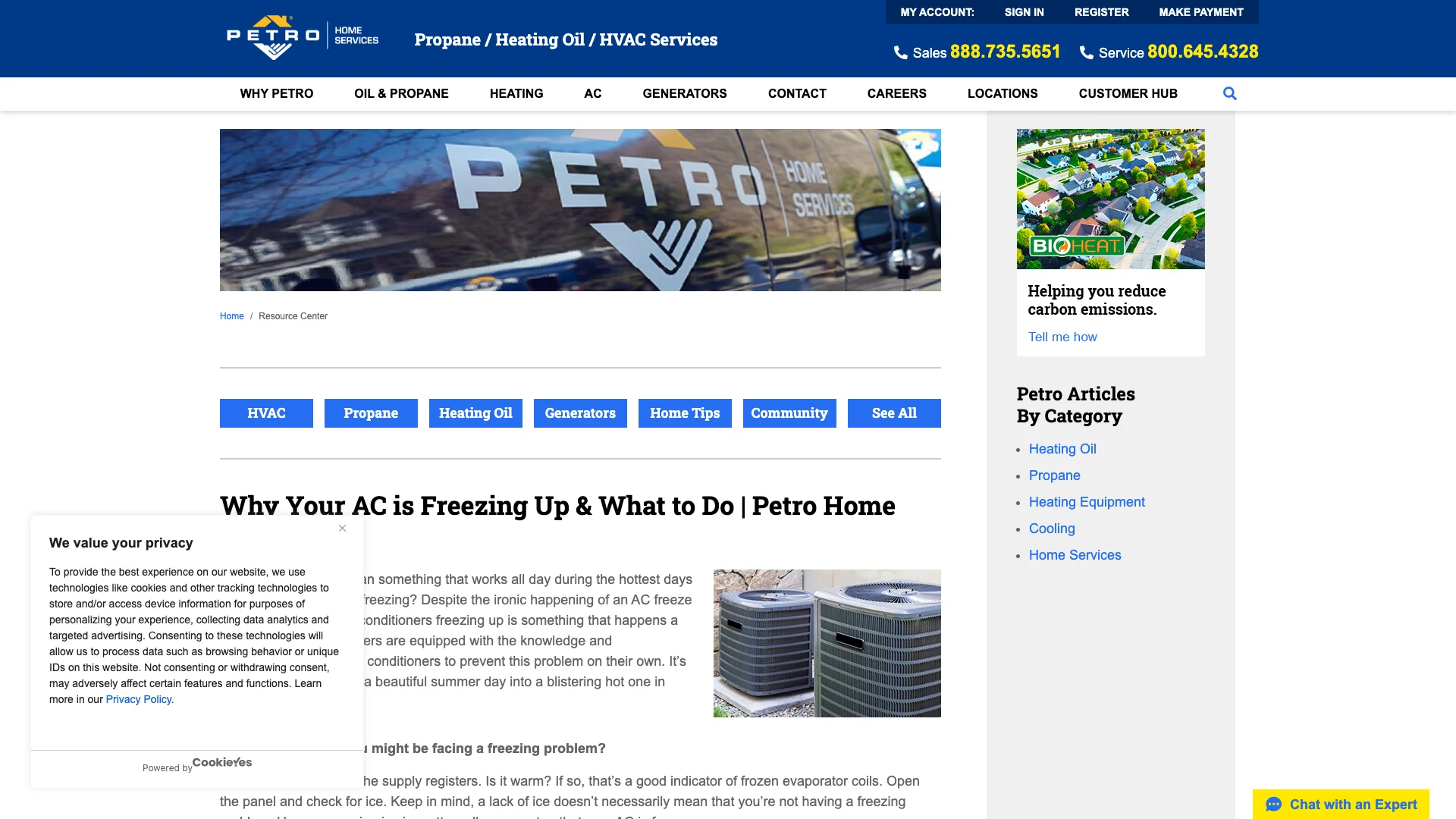
The trust signal audit on Petro is the most barren of any site in this batch:
- BBB badge: Not found on any page.
- Google Reviews widget: Not found on any page.
- Review count: Not found on any page.
- Review widgets (any platform): Not found on any page.
- Certifications: Not found on any page.
- Trust badges: Not found on any page.
- Chat widget: Not found on any page.
Every field came back empty. That is an unusual result. Most of the franchise sites we audit at least have generic "trust badges" of unspecified origin sitting in the footer. Petro does not have those either. A homeowner reading the "why is my AC freezing up" article has nothing on the page to anchor the question of whether Petro is a reputable company (no reviews, no ratings, no certifications, no accreditations, no badges).
Comparison
"83% of consumers use Google to find local business reviews; 74% use two or more review platforms when researching."
— BrightLocal (2025)
Petro is a real company with real customers, so the reviews exist somewhere. They are just not on the pages that pull Google traffic. A homeowner who wants to verify Petro is legit has to open a new tab, search for "Petro Home Services reviews," and evaluate the brand from a completely separate source. That is extra effort the homeowner is not going to spend, which means most of them just close the tab and move on.
The behind-the-scenes code labels are also bare. The AC article and the HVAC article each carry one hidden label: a "news article" label. That is it. No "this is a business" label. No "this is an HVAC business" label. No "this is a FAQ section" label. The login page carries no labels at all. So Google knows the articles are articles (which earns them some rankings on content queries), but Google does not know that Petro is an HVAC and heating oil business, and Google does not have any trade-specific context for the pages.
What Petro does well
A teardown that just lists problems is not useful. Petro does some things right, and the things they do right are worth noting.
Accessibility scores are strong. All three Petro pages scored 86 out of 100 or better on accessibility (a measure of how usable the page is for people with visual, motor, or cognitive disabilities). The AC article scored 86. The HVAC article scored 86. The login page scored 86. That is the highest accessibility score of any site in our HVAC batch. Somebody on the Petro development team cared enough about keyboard navigation, color contrast, and screen-reader compatibility to get the score right. Most contractor sites score in the 60s and 70s on accessibility. Petro is at 86 across the board.
Content depth on the articles. The AC article is 1,966 words. The HVAC article is 1,398 words. These are substantial informational pieces, not thin stubs. They earn their organic traffic by being thorough. Whoever owns content at Petro knows how to write long-form explainer articles.
Internal linking density. 170 internal links on the AC article. 170 on the HVAC article. 161 on the login page. That is a lot of cross-linking between related pages, and Google's search engine uses those links to understand which pages are related and important. It is one of the reasons Petro ranks for as much long-tail HVAC content as it does despite the other gaps.
Layout stability across the board. No content shifting around as the pages load. That is the performance metric homeowners can actually feel regardless of their connection speed, and Petro gets it right on every page we tested.
Two distinct phone numbers. Two phone numbers is fewer than two phones is a problem on this particular page, but it is also worth noting that Petro is running clean phone routing: (888) 735-5651 and (800) 645-4328 are consistent across all three pages. No regional number sprawl like we saw on Happy Hiller. No dummy phone leftover from staging like we saw on some other sites. The two numbers they have are the ones they use consistently.
"64% of homeowners say having recommendations or references is a top-three factor in choosing a contractor."
— Houzz Inc. (2025)
What the gaps mean for local HVAC and fuel contractors
Petro is a regional brand and you are independent. The gaps in their site are the gaps you can close with a few weeks of focused work.
Display Google Reviews on every service page and every article. Petro has zero Google Reviews visible across three pages pulling 7,700 monthly visitors. Yours should have a Google Reviews widget with the star rating, review count, and "read all reviews" link directly under your headline on every service page. On every blog post. On every location page. The social proof should be wherever the homeowner is reading.
Embed a short contact form in your articles. Petro has zero forms on either of their highest-traffic articles. Yours should have a 3-field contact form (name, phone, zip) embedded directly in the article, above the fold, right next to a callout like "need a professional to take a look? leave your info and we'll call you back." That captures the research-stage homeowner who decides "this is bigger than I can handle on my own" halfway through reading the article. Petro is losing that visitor every time.
Add trust signals that are actually visible on the page. BBB accreditation if you have it. Google Reviews widget. Industry certifications from whatever trade associations you belong to. A "years in business" badge. Before-and-after photos from recent jobs. Any of these are better than what Petro has on its pages, because Petro has nothing visible at all.
Clean up your dev leftovers. Petro has a literal "This is Modal Body" template placeholder text sitting in the structure of its highest-traffic article, probably inside a hidden popup that was never finished. That is the kind of thing nobody on the team catches because nobody loads the live pages from a clean browser and clicks around. You should. Open your own site once a month in an incognito window, on a phone, from a connection outside your office. Click every button. Tap every form. Open every popup. If anything looks like a default placeholder or a broken link, fix it before a homeowner notices. It takes twenty minutes a month.
"48% of customers say that if a site does not work well on mobile, it signals the company does not care about their business."
— Google Consumer Insights (2018)
The positioning angle is straightforward. Petro has been in business for decades and has strong organic traffic authority, but the actual experience on the page is basic. No reviews visible. No forms visible. Heavy pages that fail Google's performance check. Leftover template text inside a hidden popup that nobody fixed. Your site can do all of those things better with a developer who cares and a couple of weeks of focused effort. And on the homeowner's side, a page that shows reviews, has a short contact form, loads reasonably on mobile, and does not have "This is Modal Body" hiding in the code looks meaningfully more trustworthy than a bigger brand's page that does not.
Frequently asked questions
How does Petro Home Services score on Google's mobile test?
All three Petro pages we tested scored between 41 and 49 out of 100 on Google PageSpeed Insights mobile as of March 29, 2026. The "why is your AC freezing up" article scored 43 out of 100. The "what is HVAC" article scored 49. The account login page scored 41. Google uses these scores as a ranking factor in its search results, and Petro is eating a measurable penalty across every query these pages compete for. For reference, Google's "good" threshold is 90.
Does Petro Home Services have contact forms on their website?
No. All three pages we audited returned zero contact forms. The only conversion paths are the (888) 735-5651 and (800) 645-4328 phone numbers, plus a set of link-style CTAs like "Request a quote," "Schedule an appointment," and "Request a call back" (which route to other pages rather than opening an inline form on the article the homeowner is reading).
What is the "This is Modal Body" text on Petro's website?
It is the default template placeholder text from a hidden popup element that was never replaced with real copy. The "why is your AC freezing up" article and the "what is HVAC" article both have a secondary headline-type field in their markup reading literally "This is Modal Body" (the default text in bootstrap and similar popup libraries). It is not visible on the page unless the popup opens, and we did not trigger the popup to verify what it displays. But the text is sitting inside the page structure, waiting to surface whenever a homeowner clicks the button that opens the modal. That is the kind of bug nobody catches because nobody loads the live pages from a clean browser.
How much organic traffic does petro.com get?
According to Ahrefs data from our March 2026 collection, petro.com receives approximately 65.3K monthly organic visitors with an estimated traffic value of $122.5K. The "why is your AC freezing" article accounts for 2.9K of that (5% share), the "what is HVAC" article accounts for 2.5K (4%), and the account login page accounts for 2.3K (4%). That is 7.7K monthly visitors across just three pages on a site that relies heavily on long-tail informational content for its traffic.