
What we found on mrrooter.com
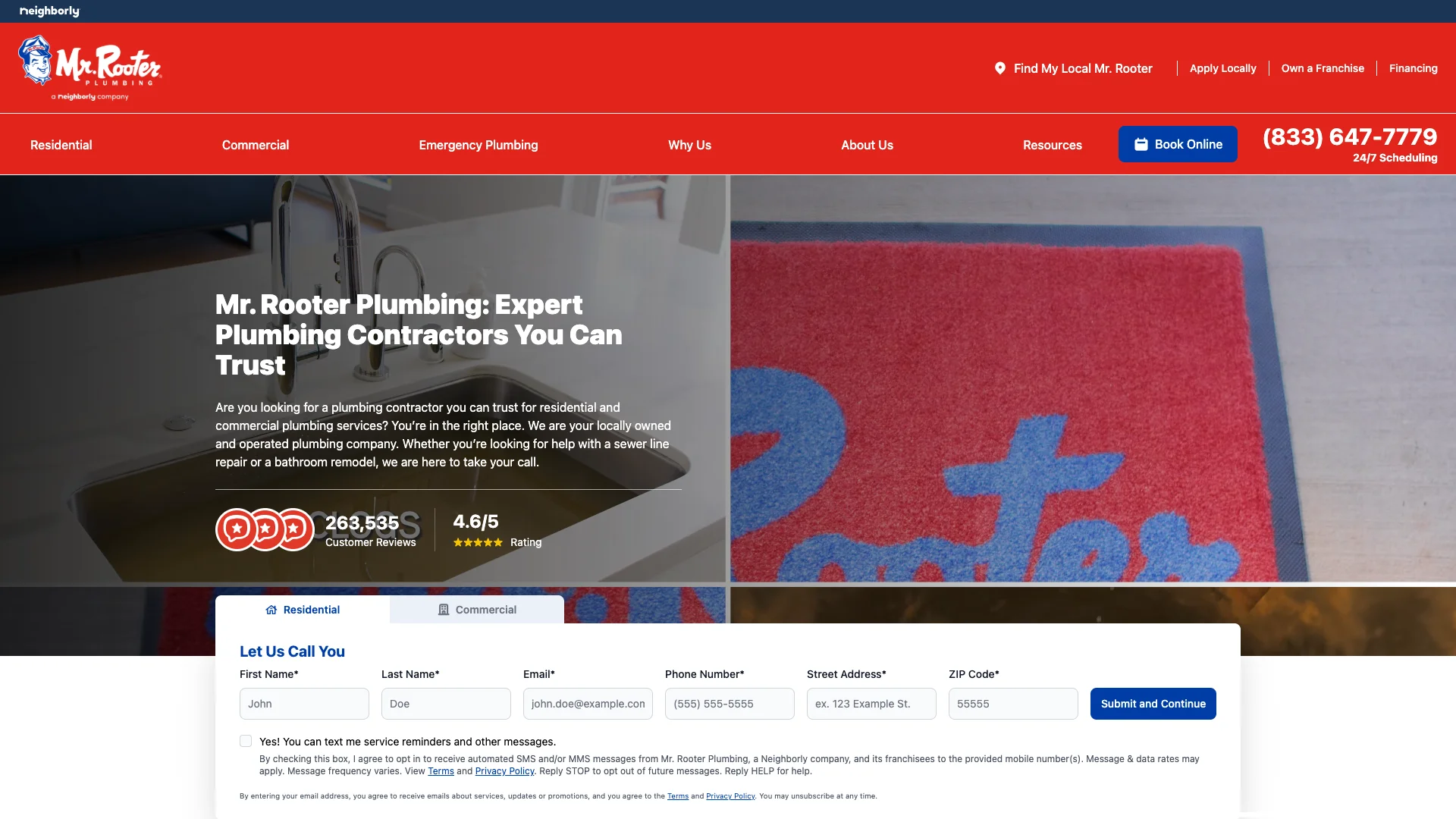
Mr. Rooter Plumbing is a national plumbing franchise operating under the Neighborly brand umbrella (same parent company as Aire Serv, which we covered earlier in this series). According to Ahrefs, mrrooter.com pulls 165.7K monthly organic visitors with an estimated traffic value of $771.4K. That makes it the biggest brand in our HVAC and plumbing teardown batch by traffic value, ahead of One Hour Heating & Air, ARS, Aire Serv, Horizon Services, and Happy Hiller combined on some measures.
The pages we tore down:
- /emergency-service/, the 24/7 emergency plumber landing page (16.1K monthly organic visitors, 11% traffic share, by far the highest-traffic page in our test set)
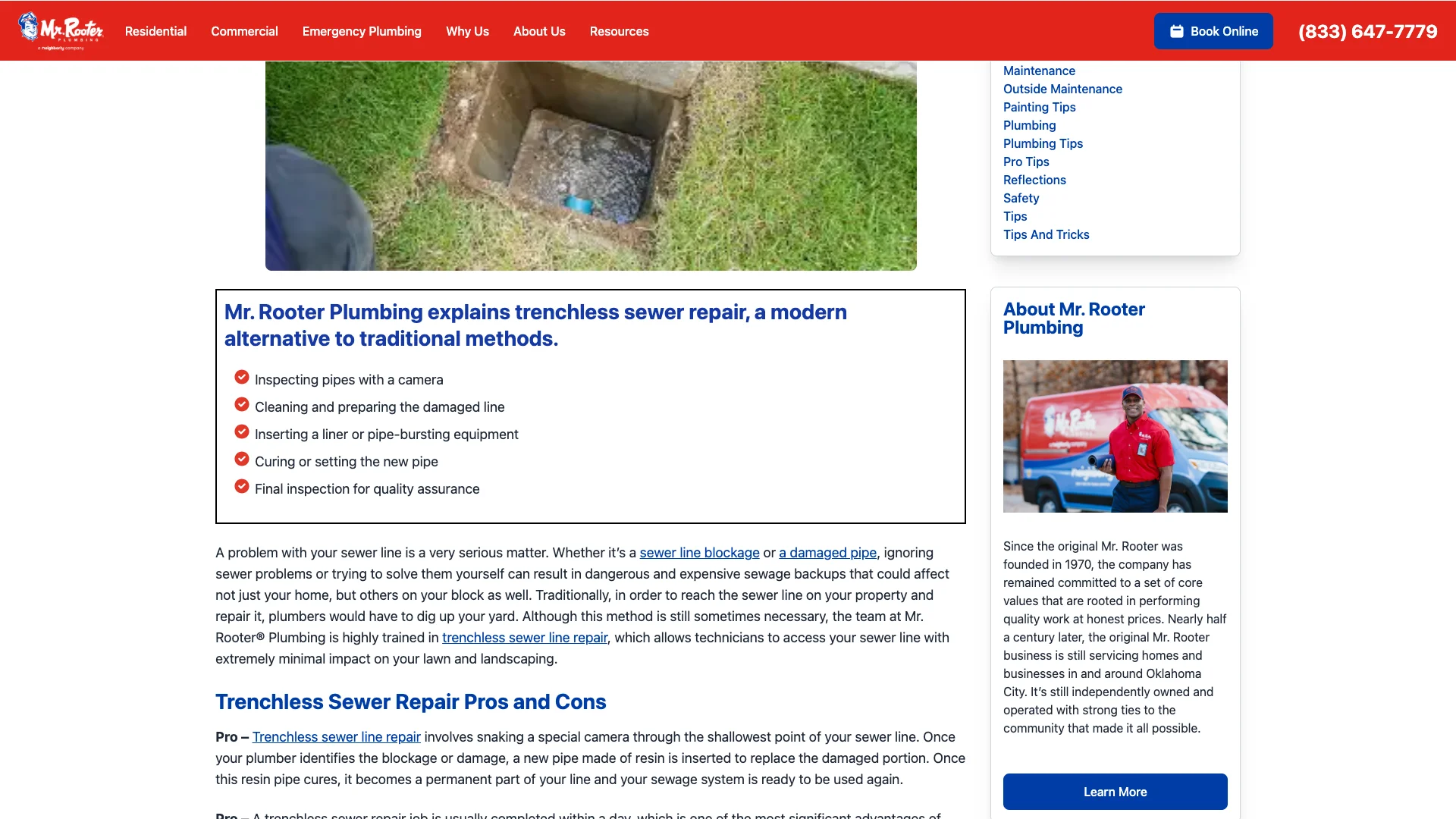
- /about/blog/the-pros-and-cons-of-trenchless-sewer-repair/, a long-tail informational blog on trenchless sewer repair (6.6K monthly visitors, 4% share)
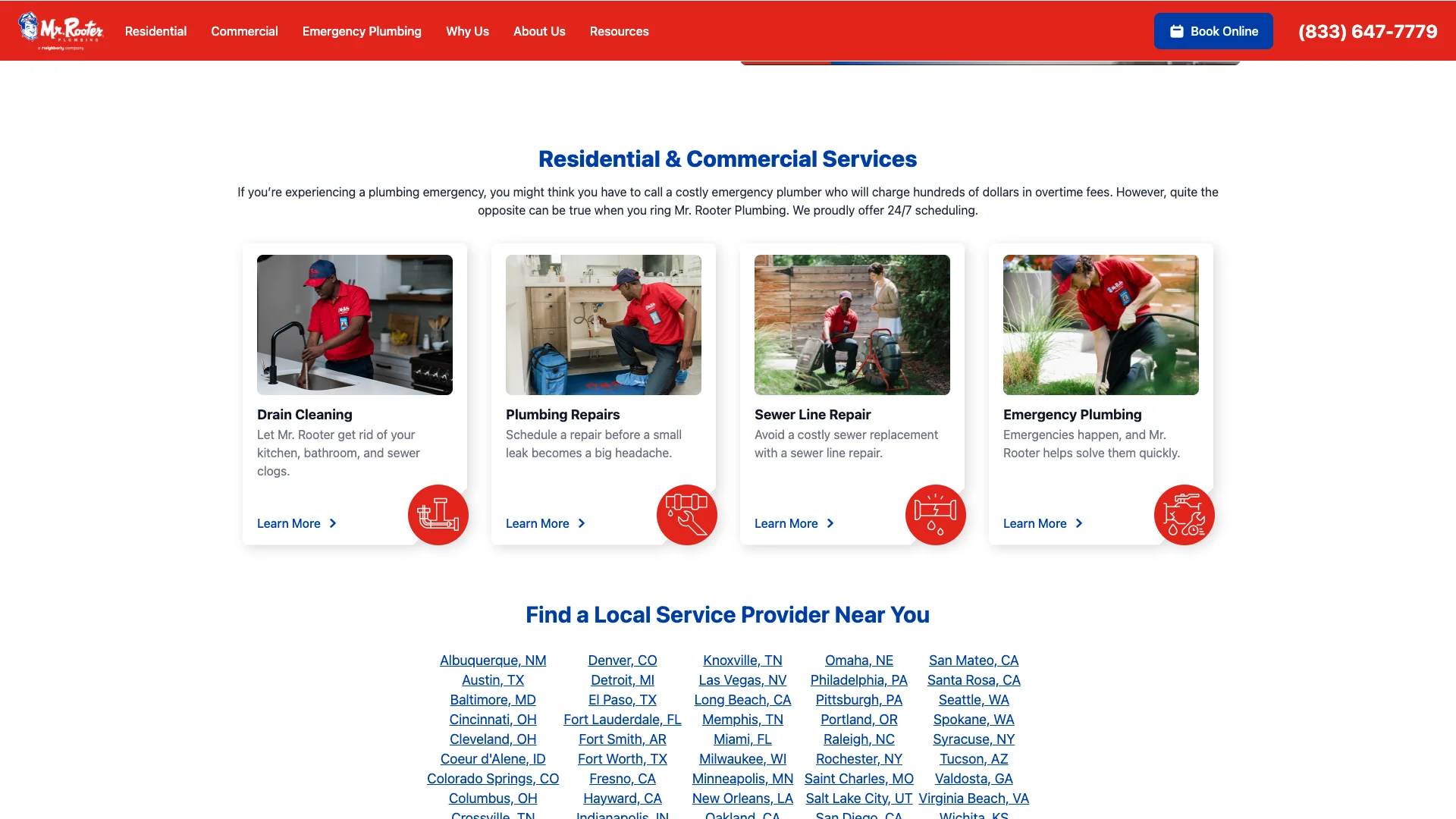
- /residential-services/drain-cleaning/, the residential drain cleaning service page (6.6K monthly visitors, 4% share)
And the pattern that jumped out of the data was uniformity. Not the good kind. All three pages we tested use almost the exact same template as Aire Serv (because they're both Neighborly brands). All three pages have the same performance problems. All three pages have the same trust signal gaps. All three pages carry the same bare-minimum behind-the-scenes code labels. So this teardown is mostly the story of a shared franchise template that's aging badly across an entire family of brands. And Mr. Rooter is the biggest brand eating the consequences.
"25% of homeowners say trusting contractors is their top challenge when planning home improvement projects."
— Houzz Inc. (2025)
Performance: every page in the low 30s on Google's mobile test
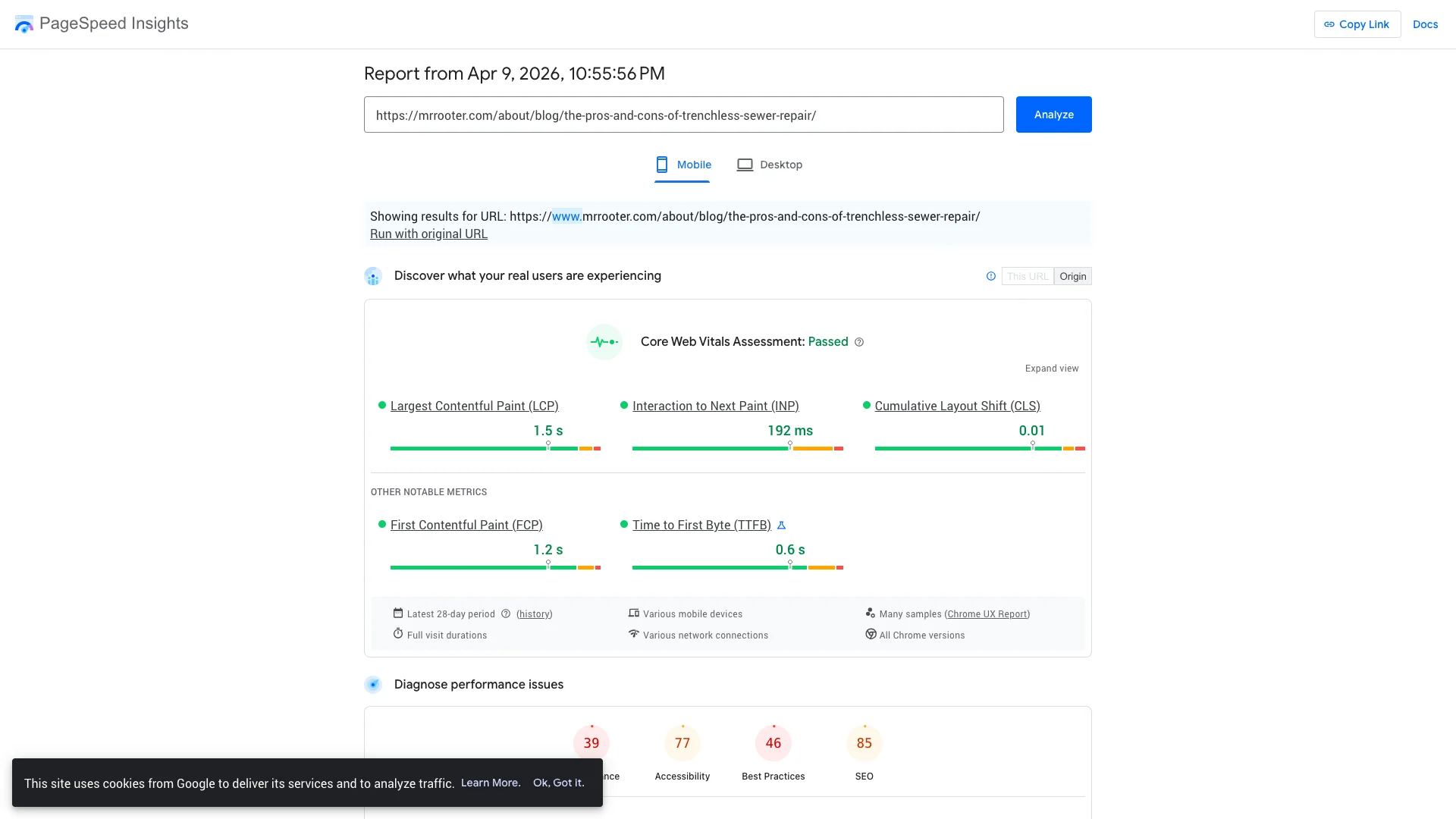
Quick framing note before we dig in. Google PageSpeed Insights runs a lab test that simulates a mid-range Android phone on a weaker 4G connection. It is a worst-case scenario, not what you experience when you open the site on your iPhone on WiFi. The pages probably feel fine when you open them yourself. That is honest. But Google uses these lab scores as a ranking factor in its search results, and Mr. Rooter is eating a measurable ranking penalty on every keyword these three pages compete for.
The emergency service page scored 33 out of 100. The trenchless sewer repair blog scored 31. The drain cleaning page scored 32. All three pages are in the low 30s, which puts them in the bottom fifth of contractor sites we audit. Google's "good" threshold is 90. Mr. Rooter is not close.
"53% of mobile users abandon sites that take longer than 3 seconds to load."
— Google / SOASTA (2017)
The one number from the lab test that does map to something real is on the trenchless sewer repair blog. Google's lab test clocks the first visible text at 12.7 seconds into the page load on a simulated slow connection. For the homeowner on a fast iPhone, that number is probably way better (maybe two or three seconds). But for the homeowner standing in a flooded basement on weak cell signal, twelve seconds of a blank page is real. And the kind of queries a trenchless sewer repair blog pulls ("is trenchless worth the cost," "how long does trenchless take") are exactly the kind of queries a homeowner types when they're dealing with a real plumbing emergency from the basement where their signal is weakest.
Layout stability is actually clean across all three pages (content does not jump around as it loads on Mr. Rooter's site). That is something. But it is not the thing Google is penalizing. The thing Google is penalizing is the overall performance score being in the low 30s on three pages that collectively pull 29,300 monthly visitors.
Compounding effect
"Conversion rates drop approximately 12% for each additional second of page load time."
— Google / Deloitte (2020)
The problem is not mysterious. The Neighborly franchise template loads a lot of stuff before the browser can paint the page: tracking scripts, ad pixels, heavy images, custom fonts, and a bunch of third-party widgets. Every one of those is a thing the browser has to download and process before it knows what to put on the screen. A developer who cared could cut those pages in half in a week of focused work. But the template is shared across many sister Neighborly brands, and there is nobody at any individual brand whose job it is to fix it. So every brand eats the same penalty.
Lead capture: the same five-forms-per-page template as Aire Serv
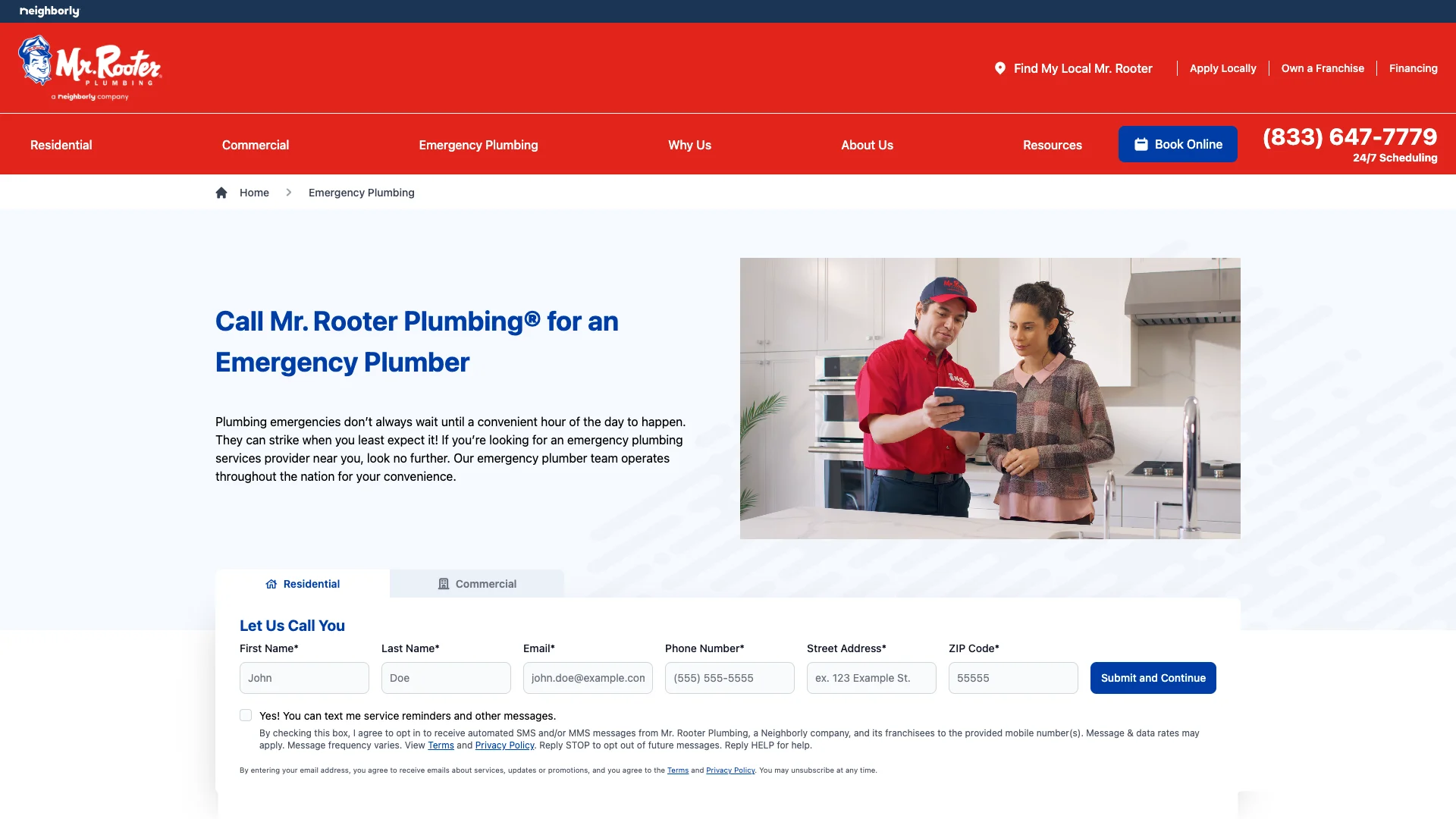
We audited Aire Serv earlier in this series and found five separate forms on a single blog post. Mr. Rooter runs the exact same template, so the same pattern shows up. The emergency service page carries:
- A 1-field zip code search at the top ("Enter ZIP Code")
- A 5-field select-with-text combo whose purpose is not obvious from the markup
- A 9-field contact form: first name, last name, email, phone, street address, zip, two checkboxes, and one more text input
- A second 9-field contact form, identical to the first, rendered elsewhere on the page
Nine fields on the main contact form. That is a lot. Two of Mr. Rooter's top three pages have the exact same pattern. And then the 9-field form is rendered twice on each page, once probably in the sidebar and once somewhere in the body or footer. That is not a design decision. That is the franchise template repeating itself because nobody noticed the duplication.
"68% of users would not submit a form if it required too much personal information."
— Baymard Institute (2024)
Nine fields is a lot of friction for a plumbing emergency. The homeowner whose basement is flooding at 2am is not filling out a 9-field form with their street address and two checkbox confirmations. They are calling the phone number. Mr. Rooter knows this: the primary CTAs on every page are "Call Us," "Book Online," "Find My Local Mr. Rooter," and "Contact Us." The phone comes first. The form is a backup path for non-emergency visitors (the ones researching trenchless sewer repair on a Tuesday afternoon). And a 9-field form is too much friction for a research-stage visitor too, because they are not ready to commit yet.
The right form for a plumbing franchise is three fields: name, phone, zip code. Done. That form captures the research-stage visitor who wants a callback, and it does not get in the way of the emergency visitor who is going to call anyway. Mr. Rooter has three times that many fields.
The CTAs are also worth noting. Across the three pages tested, the primary action paths are: phone number, "Book Online" button, "Find My Local Mr. Rooter" (which routes through a location lookup), "Schedule Service Today," "Contact Us," and "In-Home Estimates." So there are six different conversion paths on the same page, and the homeowner has to pick one. Choice paralysis on an emergency plumber page is the last thing you want.
Trust signals: customer reviews are on the page (the scraper missed them)
A correction from our original scraper data: our automated audit tool reported zero review widgets on Mr. Rooter's pages. But when we verified with a real browser, we found a visible "Customer Reviews" section on the emergency service page with star ratings and a carousel of 5 customer reviews with actual quotes. The reviews are rendered via JavaScript after the initial page load, which is why the scraper missed them. So Mr. Rooter does have customer social proof on the page. It's not a Google Reviews embed, it's their own customer review system, but it's visible and it has stars.
- Customer Reviews section: Present on the emergency service page, with star ratings and a 5-review carousel.
- BBB badge: Not found on any page.
- Google Reviews widget: Not found (they use their own review system instead).
- Certifications: Not found on any page.
- Chat widget: Not found on any page.
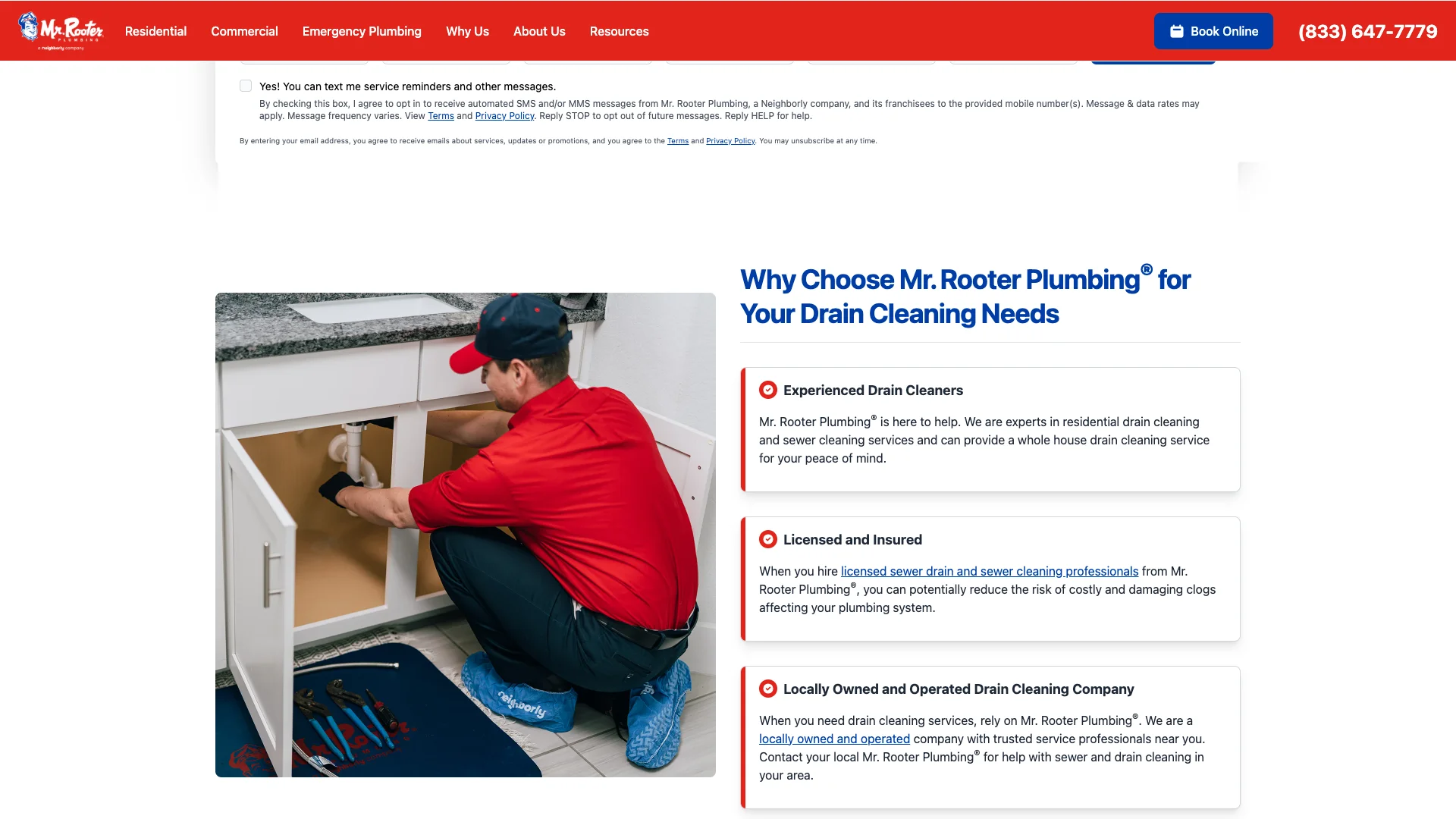
- Trust badges: Present on all three pages.
So Mr. Rooter has more social proof than we initially reported. The customer reviews section with star ratings is a real trust signal that a homeowner can see, read, and use to make a decision. It's not as strong as a Google Reviews widget (which connects directly to the star rating the homeowner sees in Google search results), but it's not "zero social proof" either. The gap is the absence of a Google Reviews embed specifically, not the absence of reviews entirely.
Comparison
"83% of consumers use Google to find local business reviews; 74% use two or more review platforms when researching."
— BrightLocal (2025)
The brand name does some work. Mr. Rooter is a recognized plumbing brand and most homeowners have at least heard of it. But "I have heard of this name" is not the same as "I trust this company to enter my house at 2am." And for a brand doing $771K in monthly organic traffic value, the cost of adding a Google Reviews widget to every service page is basically nothing, and the trust lift is meaningful.
The behind-the-scenes code labels are also bare. Every page on the web can carry hidden labels that tell search engines what the page is about: "this is a plumbing business," "this is a service page for drain cleaning," "this is a FAQ section," "this is a local business in this city." Mr. Rooter's three pages only carry ONE hidden label each: "this page is part of a site." That is the bare minimum. No "this is an article" label on the blog. No "this is a plumbing business" label on the service pages. No "this is a FAQ section" label on the Q&A content in the trenchless sewer repair blog. Nothing specific enough for Google to use. So the franchise has the same structural problem Aire Serv has: Google knows these pages exist, but Google does not know what kind of business runs them.
What Mr. Rooter does well
A teardown that just lists problems is not useful. Mr. Rooter does several things genuinely well, and the things they do right are worth borrowing if you are a plumbing contractor.
Content depth on every tested page. The emergency service page is 3,933 words. The trenchless sewer repair blog is 2,374 words. The drain cleaning page is 3,923 words. These are substantial, keyword-rich pages. That is why they pull 16K, 6.6K, and 6.6K monthly visitors respectively: Google rewards thorough content for service intent queries. Whoever owns content at Mr. Rooter is shipping real volume.
Internal linking density. The emergency page has 219 internal links. The trenchless blog has 193. The drain cleaning page has 220. That is a deliberate cross-linking strategy passing search authority between related pages. Internal links are free, and Mr. Rooter uses a lot of them.
Layout stability is clean. Content does not jump around as the page loads on any of the three pages we tested. That is the one performance metric a homeowner actually feels regardless of their connection speed, and Mr. Rooter gets it right.
The phone number is visible in the navigation on every page. The (855) 982-2028 line appears in the main nav across all three pages we tested. The homeowner does not have to scroll to find a way to call. That part of the conversion design is solid.
One clear primary phone number. Across all three pages, the phone number in the header is the same (855) 982-2028 line. No regional number sprawl like we saw on Happy Hiller. No franchise locator phones bleeding into the header. One number, one branded line, one clear place to call.
"64% of homeowners say having recommendations or references is a top-three factor in choosing a contractor."
— Houzz Inc. (2025)
What the gaps mean for local plumbers
Mr. Rooter is a national franchise and you are independent. That is the gap you can win in. The franchise template they run is stuck with all the problems we have listed, and it is shared across every sister brand, so fixing it requires national-brand coordination that is not happening. You do not have that coordination problem. You have one website and one decision-maker.
Display Google Reviews on every service page. Mr. Rooter has zero Google Reviews visible on the three pages we tested. Your site should have a Google Reviews widget with the star count, review count, and "read all reviews" link right under the H1. Above the fold. On every service page. On every location page. On every blog post. The proof should follow the visitor wherever they go. If you have 50 reviews, the widget shows 50. If you have 200, it shows 200. Either way, it is more social proof than Mr. Rooter is showing anywhere.
Cut your contact form to three fields. Mr. Rooter runs a 9-field form twice on every page. Yours should be three fields: name, phone, zip. That is enough to capture the lead and route it to your scheduling system. Every extra field is a reason for a homeowner to close the tab. A 3-field form converts at a measurably higher rate than a 9-field form for the same service.
Beat their Google PageSpeed score. Mr. Rooter's three pages all score in the low 30s out of 100 on Google's mobile test. Yours should score 85+. Shrink your hero images to under 100KB. Move your tracking scripts to load after the page appears. Get rid of third-party trackers you are not using. These are one-week fixes for a developer who cares, and they are the single cheapest way to outrank a franchise on local search queries.
Add the behind-the-scenes code labels Google reads. Mr. Rooter's pages only carry the most basic label ("this is a page on a site"). Your site should tell Google you are a plumbing business (there is a specific "PlumbingBusiness" label Google officially supports), mark every FAQ section as a FAQ so Google can pull it into the expanded search results, and mark your location pages with your business name, address, and phone. These are invisible labels in the page code that Google reads automatically, and most of your competitors are not running them.
"48% of customers say that if a site does not work well on mobile, it signals the company does not care about their business."
— Google Consumer Insights (2018)
The positioning angle is straightforward. Mr. Rooter has the national brand recognition and a massive SEO footprint, and you do not. But you can have the things Mr. Rooter is missing on every page: visible Google Reviews, a short contact form, a PageSpeed score that is not dragging down your search rankings, and hidden code labels telling Google specifically what kind of business you are. None of those require a national brand budget. They are the kind of details the franchise template ignores because nobody at the national level owns the individual page experience. You do. That is your opening.
Frequently asked questions
How does Mr. Rooter's website score on Google's mobile test?
Mr. Rooter's three tested pages all scored in the low 30s out of 100 on Google PageSpeed Insights mobile as of March 29, 2026. The emergency service page scored 33. The trenchless sewer repair blog scored 31. The drain cleaning page scored 32. Google uses these scores as one of the signals in its search rankings, so all three pages are eating a ranking penalty. For reference, Google's "good" threshold is 90. Mr. Rooter is in the bottom fifth of contractor sites we audit.
Does Mr. Rooter show Google Reviews on their pages?
No. All three pages we audited returned no Google Reviews widget, no BBB badge, no review count, and no star ratings visible on the page. Trust badges of unspecified origin are present on all three pages, but the specific social proof a homeowner looks for when picking a plumber (star rating, number of reviews, link to read the reviews) is missing from every page we tested.
Why does Mr. Rooter's website look so similar to Aire Serv's?
Because they are both Neighborly brands and they share a franchise template. Same form layout (five form instances per page, including a 9-field contact form rendered twice), same missing Google Reviews, same bare-minimum behind-the-scenes code labels, same low PageSpeed scores in the 30s. The problems are not Mr. Rooter-specific. They are franchise-template problems that every Neighborly brand in this series has. The ones in the same template family as Aire Serv and Mr. Rooter all score similarly on our audit.
How much organic traffic does mrrooter.com get?
According to Ahrefs data from our March 2026 collection, mrrooter.com receives approximately 165.7K monthly organic visitors with an estimated traffic value of $771.4K. The emergency service page accounts for 16.1K of that (11% share), and the trenchless sewer repair blog and the residential drain cleaning page each account for 6.6K (4% each). That is 29.3K monthly visitors across just three pages, on a site doing $771K in monthly organic traffic value.