What we found on mrroof.com
Mr. Roof is a regional roofing brand operating in multiple markets across the Midwest. According to Ahrefs, mrroof.com pulls 24.1K monthly organic visitors with an estimated traffic value of $145K. And the trust and local-search setup is where this one gets interesting. Google Reviews on every tested page. LocalBusiness and Product hidden code labels on both location pages. Trust badges on 2 of 3 pages. But Google's mobile lab test returned the same story on every page: 37-38 out of 100.
The pages we tore down:
- /gutters/, the gutters service page (2.8K monthly organic visitors, 12% traffic share, scored 38 on Google's mobile lab test)
- /louisville/, the Louisville, Kentucky location page (834 monthly visitors, 4% share, scored 37)
- /cincinnati-roofing/, the Cincinnati, Ohio roofing location page (826 monthly visitors, 4% share, scored 37)
And the consistency of the scores is the most notable thing about them. 38, 37, 37. Every page hits almost exactly the same number. That's not a page-specific problem (like a heavy image on one page or a broken widget on another). That's a site-wide performance baseline. Whatever is slowing these pages down is present on every page: the same tracking scripts, the same fonts, the same widget stack. Fix it once and every page benefits.
"53% of mobile users abandon sites that take longer than 3 seconds to load."
— Google / SOASTA (2017)
Performance: 37-38 across the board
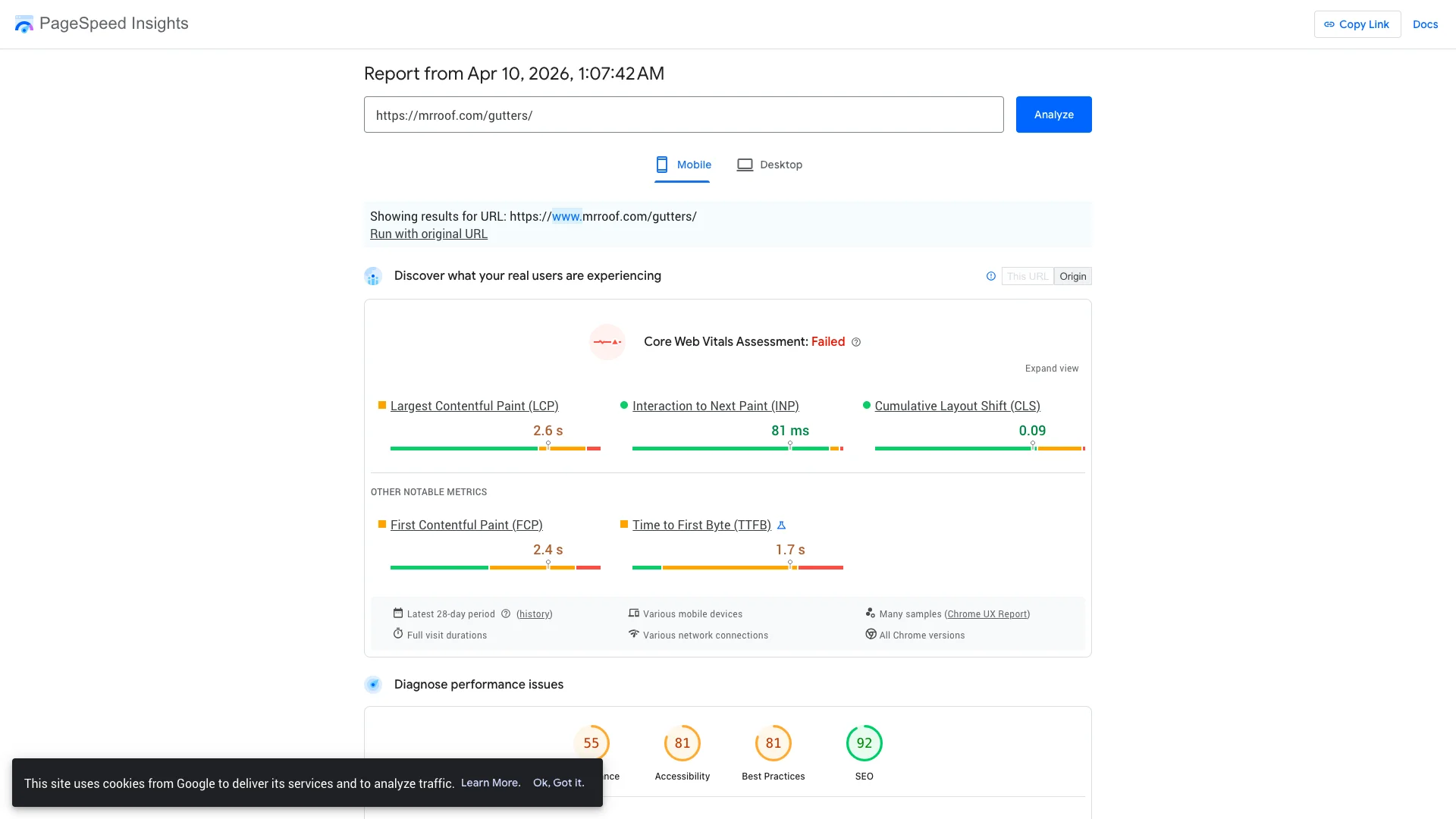
Google PageSpeed Insights runs a simulated slow-phone lab test. The scores are worst-case, not what you see on your phone with WiFi. But Google uses them as a ranking factor in search results.
The gutters page scored 38 out of 100. The Louisville location page scored 37. The Cincinnati roofing page scored 37. All three are deep in the red zone, and all three are eating a search-ranking penalty because of it. For comparison, DaBella's siding page scored 92 and Ram Jack's foundation repair page scored 76. Mr. Roof is leaving a significant ranking advantage on the table.
Compounding effect
"Conversion rates drop approximately 12% for each additional second of page load time."
— Google / Deloitte (2020)
But here's the upside of consistency: because every page scores the same, the fix is probably one thing. Not three different problems on three different pages. It's likely a site-wide issue: a heavy tracking script, unoptimized images served in older formats, render-blocking fonts, or a widget stack that loads synchronously instead of after the page renders. Identify the one bottleneck and every page in the 37 range jumps together.
Layout stability tells a cleaner story. All three pages have identical layout shift of 0.073. That's just under Google's 0.1 threshold. Content doesn't jump around enough for homeowners to notice on any of the tested pages. So the pages are slow to load, but once they do load, everything stays in place. That's a better situation than Ram Jack (fast but shifting) and much better than DaBella's blog (0.810 layout shift).
"48% of customers say that if a site does not work well on mobile, it signals the company does not care about their business."
— Google Consumer Insights (2018)
Lead capture: one form on one page
The Louisville location page has 1 form. The gutters page has zero forms. The Cincinnati roofing page has zero forms. So the page with the highest traffic (the gutters page, 2.8K monthly visitors, 12% of total traffic) has no way for a homeowner to leave their information.
That's 2,800 visitors per month landing on a page about gutters with no form, no chat widget, and no prominent conversion path beyond clicking to another page and finding a form there. Every click between "I need new gutters" and "I submitted my info" is a drop-off point. And for a service like gutters, where the homeowner has already decided they need the service, the conversion path should be as short as possible.
"68% of users wouldn't submit a form if it required too much personal information."
— Baymard Institute (2024)
The Cincinnati roofing page has the same problem. 826 monthly visitors landing on a location-specific page with no form. A homeowner in Cincinnati who searches for roofing and finds Mr. Roof's Cincinnati page is about as targeted as organic traffic gets. They know what service they need, and they know what city they're in. A 3-field form ("Get your free Cincinnati roofing estimate") would capture that intent immediately.
The Louisville page does have a form, and that's why it's the template for what every other page should look like. If Mr. Roof added the same form to the gutters page and the Cincinnati page, every high-traffic page would have a direct conversion path. No clicking around. No hunting for the contact page. Just: read the content, fill out the form, done.
Trust signals: Google Reviews plus a local-search powerhouse setup
The trust signal audit on Mr. Roof produced one of the strongest local-search setups in the CRO Index. Both location pages carry two hidden code labels: LocalBusiness and Product. That combination tells Google two things: this is a local business in a specific market, and this page describes something you can purchase. Most contractors use just LocalBusiness or nothing at all. Mr. Roof has both.
- Google Reviews: Present on all three tested pages.
- Trust badges: Present on 2 of 3 tested pages.
- Hidden code labels: LocalBusiness + Product on both location pages.
- Review widgets: Not found on tested pages.
- Chat widget: Not found on tested pages.
- BBB badge: Not found.
Comparison
"83% of consumers use Google to find local business reviews; 74% use two or more review platforms when researching."
— BrightLocal (2025)
The LocalBusiness label on a location page is standard. It's what Google expects to see when a page represents a business in a specific city. But the Product label on top of that is unusual. It tells Google the page also describes something purchasable, which can qualify the page for product-style rich results in search. For a roofing company, that might mean Google shows the page with enhanced formatting when someone searches for "roofing Louisville" or "Cincinnati roofing services."
Google Reviews on all three pages is consistent and valuable. A homeowner landing on the gutters page sees reviews. A homeowner landing on the Louisville page sees reviews. A homeowner landing on the Cincinnati page sees reviews. That consistency means no page feels like a dead end from a trust perspective.
The gap is trust badges. Present on 2 of 3 pages, but not all three. And no chat widget on any page. Adding a chat option would give the "I don't fill out forms" homeowner an alternative conversion path, especially on the gutters page where there's currently no form at all.
What Mr. Roof does well
Mr. Roof's strengths are concentrated in the trust and local-search layers. And for a roofing company that serves specific metro areas, those are exactly the right things to get right.
Google Reviews on every page. All three tested pages render Google Reviews. That's consistent trust coverage that most roofing brands in this series can't match. A homeowner sees social proof no matter which page they land on from search.
LocalBusiness + Product labels on both location pages. This is the hidden code label combination that gives Mr. Roof the strongest local-search setup in the roofing category of the CRO Index. LocalBusiness tells Google it's a local company. Product tells Google the page describes a purchasable service. Together, they qualify the pages for enhanced search result formatting that most competitors aren't getting.
Consistent layout stability. 0.073 on every tested page. Just under the 0.1 limit. Content doesn't jump around as these pages load. That consistency means every homeowner gets the same stable experience regardless of which page they visit.
Trust badges on location pages. Whatever industry certifications, manufacturer authorizations, or warranty programs Mr. Roof participates in, they're visible on the location pages where homeowners are making market-specific decisions. That's the right placement for trust badges: on the pages where homeowners are deciding whether to hire you in their specific city.
"25% of homeowners say trusting contractors is their top challenge when planning home improvement projects."
— Houzz Inc. (2025)
What the gaps mean for roofing contractors
Mr. Roof is a case study in what it looks like when the local-search setup is strong but the performance layer is holding everything back. And for roofing contractors who serve specific metro areas, every lesson applies directly.
If every page scores the same on Google's mobile lab test, it's one problem. Mr. Roof's 37-38 scores across all three pages mean the bottleneck is site-wide. It's not a heavy image on the gutters page or a broken widget on the Louisville page. It's something that runs on every page: tracking scripts, fonts, a chat platform that loads synchronously, unoptimized image formats. Ask your developer to run a performance audit. The fix that moves the gutters page from 38 to 65 will also move Louisville and Cincinnati to 65. One fix, three pages improved.
Add LocalBusiness labels to your location pages if you don't have them. Mr. Roof has LocalBusiness labels on both location pages. If you serve specific metro areas and your location pages don't have this label, Google doesn't know the page represents a local business in that market. Your developer can add it in under an hour. And if you want to go further, add the Product label like Mr. Roof does. It tells Google the page describes a purchasable service, which can qualify you for enhanced search result formatting.
Every page that gets organic traffic needs a form. Mr. Roof's gutters page gets 2,800 monthly visitors with no form. That's the highest-traffic page on the site among the tested pages, and there's no conversion path. If a homeowner reads about your gutters and decides they want a quote, they should be able to request one right there. Not on the next page. Not after hunting for the contact page. Right there. Name, phone, zip. "Get your free gutter estimate."
Put trust badges on every page, not just most. Mr. Roof has badges on 2 of 3 pages. That third page is still getting organic traffic. If a homeowner lands on a page without badges, they're missing proof that every other page provides. Make the trust signal stack identical on every page. No exceptions.
"64% of homeowners say having recommendations or references is a top-three factor in choosing a contractor."
— Houzz Inc. (2025)
Frequently asked questions
How does Mr. Roof score on Google's mobile test?
Every tested page scored 37-38 out of 100. The gutters page scored 38. Both location pages scored 37. All three are in the red zone and eating a search-ranking penalty. The consistent scores suggest a site-wide performance issue rather than page-specific problems.
Does Mr. Roof display Google Reviews?
Yes. All three tested pages returned Google Reviews as present. Trust badges are present on 2 of 3 pages. That combination gives Mr. Roof a solid trust signal foundation on most pages.
What hidden code labels does Mr. Roof use?
Both location pages (Louisville and Cincinnati) carry LocalBusiness and Product hidden code labels. LocalBusiness tells Google the page represents a local business location. Product tells Google the page describes something you can purchase. That combination is one of the strongest local-search setups we've seen in the CRO Index series.
How much organic traffic does mrroof.com get?
According to Ahrefs data from March 2026, mrroof.com receives approximately 24.1K monthly organic visitors with an estimated traffic value of $145K. The gutters page accounts for 2.8K visitors (12% share). The Louisville location page accounts for 834 (4%). The Cincinnati roofing page accounts for 826 (4%).