
What we found on horizonservices.com
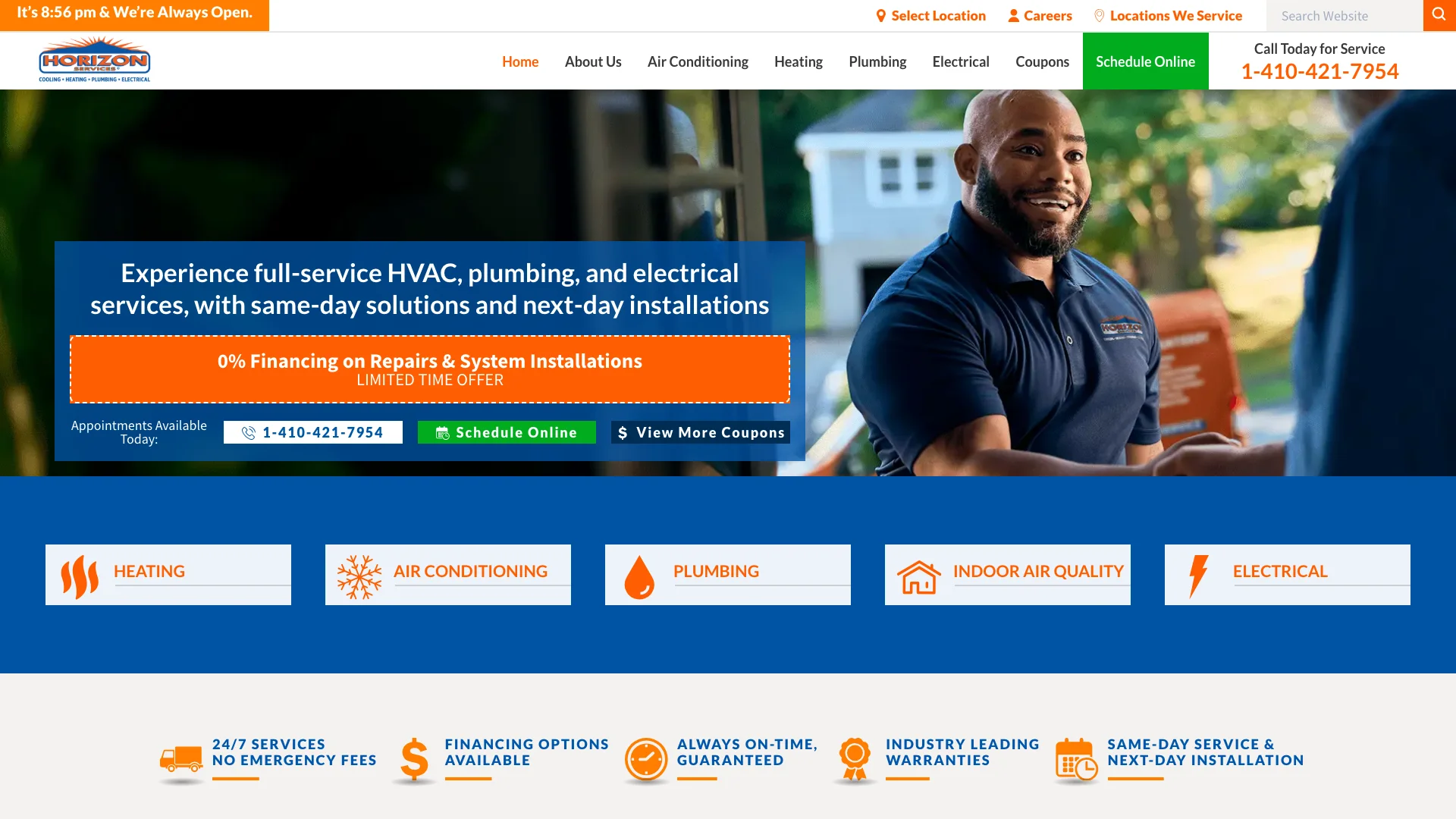
Horizon Services is a mid-Atlantic multi-trade contractor running HVAC, plumbing, and electrical work across Maryland, Pennsylvania, Delaware, and New Jersey. According to Ahrefs, horizonservices.com pulls 20.4K monthly organic visitors with an estimated traffic value of $82.1K. So we picked the three highest-traffic pages we could verify and ran them through the standard teardown protocol.
The pages we tore down:
- /locations/maryland/germantown/, the Germantown Maryland location page (6.9K monthly organic visitors, 33% traffic share, by far the highest-traffic page on the site)
- /about-us/why-horizon/24-7-emergency-service/, the 24/7 emergency service explainer (1.3K monthly visitors, 6% share)
- /about-us/blog/4-ways-to-unclog-your-outdoor-drain/, a long-tail troubleshooting blog (408 monthly visitors, 2% share)
And the form audit came back with something I had to read twice. The forms array on every page returned exactly one entry. Field count: 1. Field type: text. Field name: "s". Placeholder: "Search Website". That's the WordPress default search input. The default. The thing that ships out of the box with every WordPress install. It's the only form element rendered anywhere on the three pages we tested. Not a contact form. Not a quote request. Not a service appointment booker. A search bar.
"25% of homeowners say trusting contractors is their top challenge when planning home improvement projects."
— Houzz Inc. (2025)
Performance: the Germantown page is visibly unstable as it loads
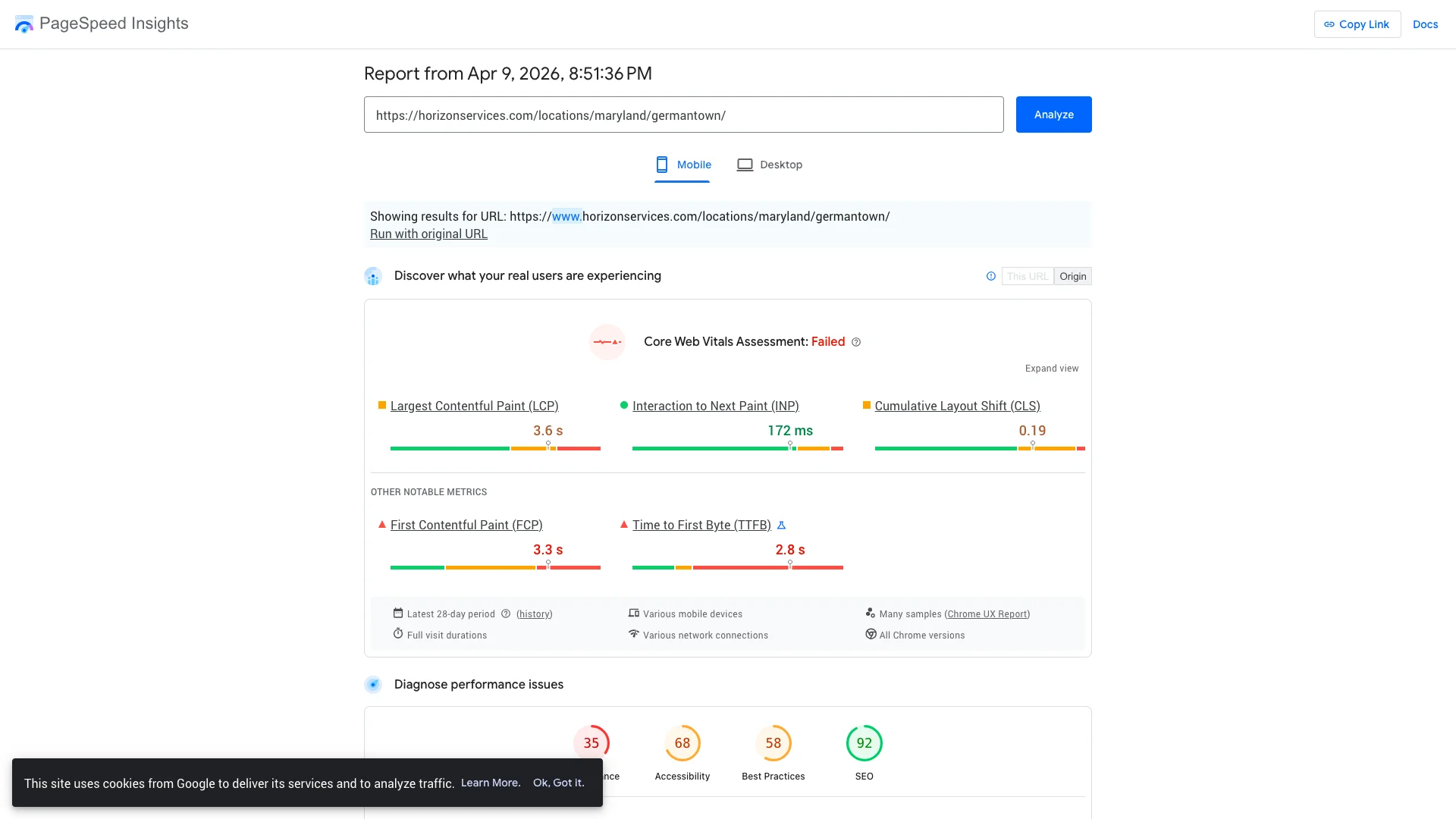
Quick framing note. Google PageSpeed Insights runs a simulated slow-phone lab test, and the scores it reports are worst-case scenarios, not what a real user experiences on a modern phone with good WiFi. The Horizon pages probably feel fine when you open them yourself. That's honest. But Google uses these lab scores as a ranking factor, and the Germantown location page is eating a real ranking penalty on the single most valuable keyword Horizon Services competes for.
The Germantown MD location page scored 36 out of 100 in the lab test. The 24/7 emergency service page scored 44. The outdoor drain blog scored 50. So the page that drives a third of all traffic on the entire site is also the lowest-scoring page. Same pattern we saw on Happy Hiller: the location pages (the high-intent traffic) are worse-scored than the blog and the generic service content. Which is exactly backwards from how you'd want it if you were thinking about conversion.
"53% of mobile users abandon sites that take longer than 3 seconds to load."
— Google / SOASTA (2017)
Where the Germantown page has a problem that a real homeowner can actually see, independent of connection speed, is layout stability. Google's layout shift threshold for "good" is 0.1. The Germantown page comes in at 0.123, which fails. In practice that means: as the page loads, content visibly shifts around. Images fill in and push paragraphs down, sections that load only when scrolled into view materialize and move the text next to them, sticky elements reflow the layout after first paint. A homeowner trying to tap "Book Now" on the Germantown page is trying to tap a button that keeps moving while their finger is already in motion. That's the kind of experience you feel on any device, not just a simulated slow phone.
The 24/7 emergency page and the outdoor drain blog both have good layout stability (0.012 and 0.010, well within the "good" zone). So the layout-shift score problem is specific to the Germantown location page, not a sitewide template issue. Same site, same CMS, one page has it and two don't. Which suggests a content module on the Germantown page (maybe a promo block, maybe a reviews widget, maybe a map embed) is reflowing the layout after first paint and nobody noticed because the other templates don't use that module.
Compounding effect
"Conversion rates drop approximately 12% for each additional second of page load time."
— Google / Deloitte (2020)
Lead capture: a search bar is not a form
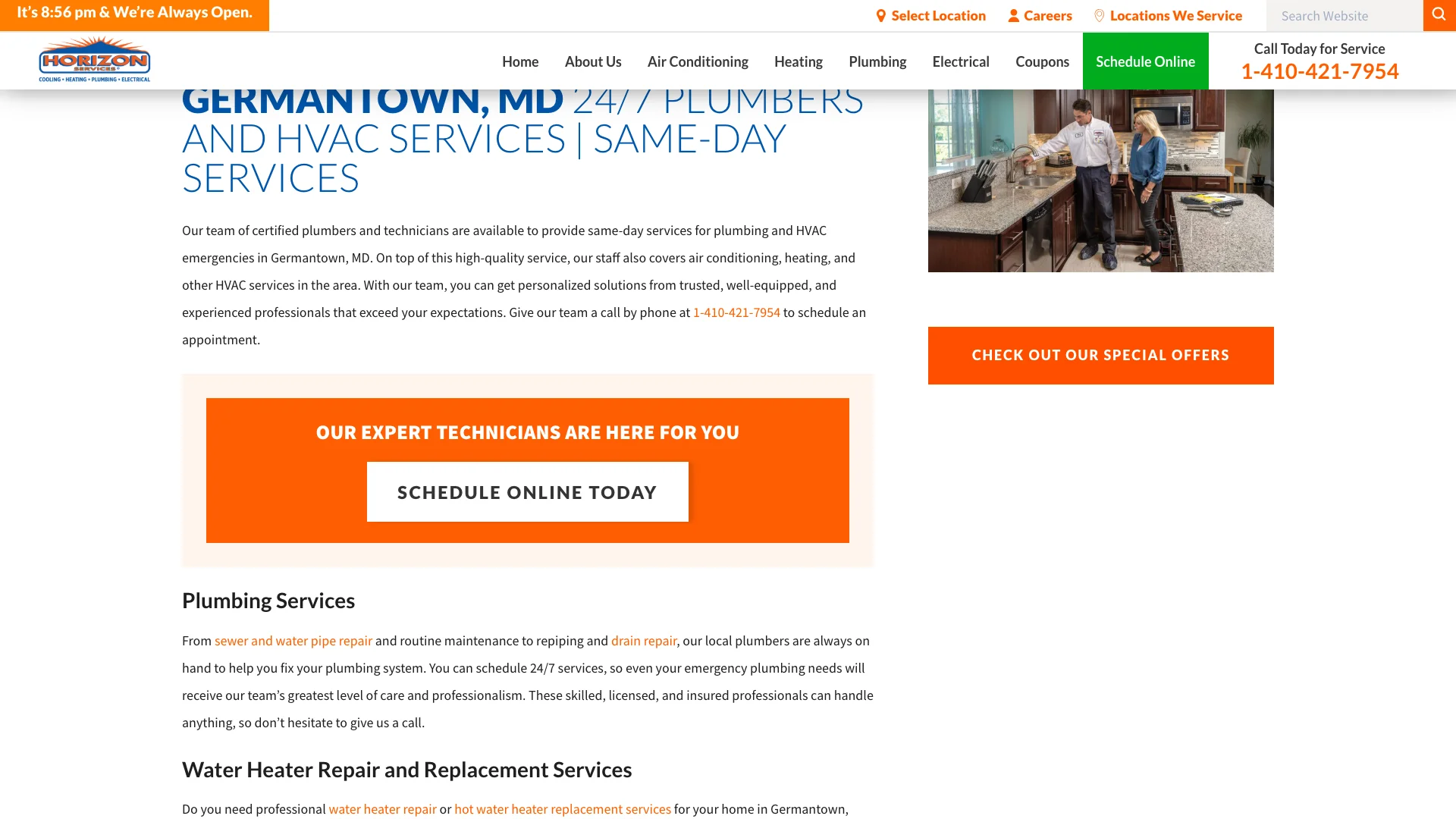
I want to spend a minute on this because it's the cleanest example of a form-audit problem we've found in this entire teardown series. Roto-Rooter and SERVPRO had zero forms (we covered both of those in earlier teardowns). Horizon Services has one form. And that one form is the WordPress default site search input. Field name "s". Placeholder text "Search Website." It's the search box you get when you install WordPress and don't add anything else.
That input lets a homeowner search the site. It does not let them request a quote. It does not let them book an appointment. It does not let them leave their name and phone number for a callback. It does not let them describe what's broken. It does the one thing search inputs do: route to a /search/?s=their-query results page.
So the conversion paths on the Germantown page (and on every other page we tested) are:
- The (800) 642-4419 phone number in the header
- "Book Now!" CTA buttons
- "SCHEDULE ONLINE" / "Schedule Online" / "Schedule Online Today" links
- "Book Online" link
- "Contact Us" link
Every single one of those is either a phone call or a click-out to another page where (presumably) a real form lives. There is no inline form on the page. A homeowner who's just landed on the Germantown HVAC location page after searching "HVAC Germantown MD" cannot fill out a form. Their options are: call now, click "Book Now" and hope the next page loads in under 6 seconds, or back to Google.
"68% of users would not submit a form if it required too much personal information."
— Baymard Institute (2024)
Two more details from the phone field. The phoneNumbers array on every page contains exactly two values: "(800) 642-4419" and "(180) 064-24419". That second one is a malformed version of the first. It looks like a phone number formatter ran on the source string and split it incorrectly somewhere. So the page is rendering the same phone number twice, once correctly and once as a broken anchor that won't dial properly if a homeowner taps it. Whether that's a pattern matching artifact in the page teardown tool or an actual rendering issue on the site is a question for whoever owns the front-end at Horizon. Either way, it's a small example of the kind of build-hygiene problem that piles up when nobody is checking the live page source on a regular cadence.
And one more thing. The CTAs on the location pages include a list of city names rendered as buttons or links: "Freemansburg, PA", "New Freedom, PA", "Freeland, MD", "Georgetown, MD". Those are sister-location links rendered as CTAs. So when a homeowner in Germantown is looking for a way to take action, they're seeing a list of other locations in Pennsylvania and Maryland mixed in with their actual conversion paths. Decision fatigue. Same problem as the Happy Hiller phone flood, just with locations instead of numbers.
Trust signals: badges yes, reviews no
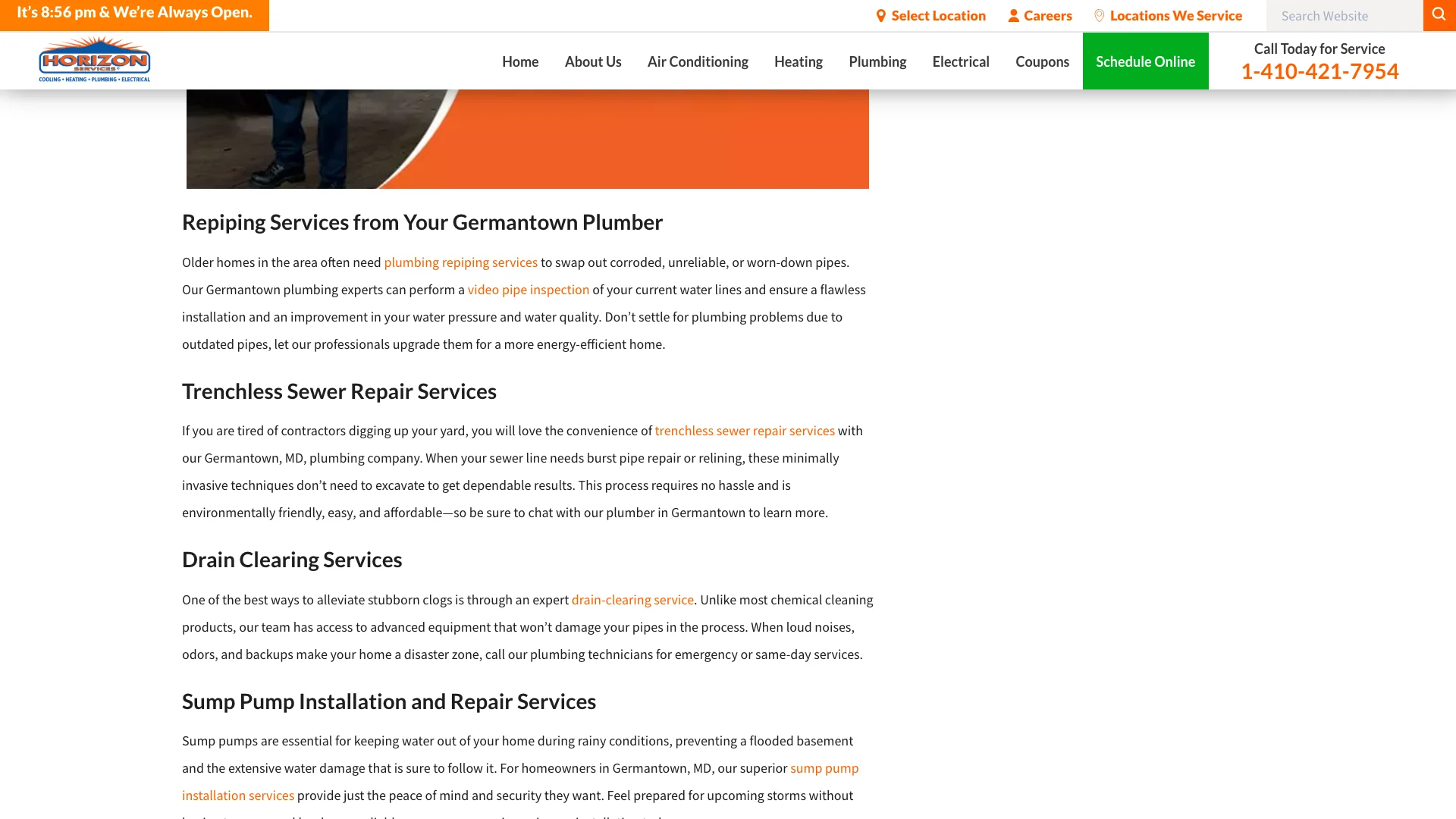
The trust signal audit on Horizon Services is the most consistent of any of the four HVAC sites in this batch. Consistently incomplete.
- BBB badge: Not found on any page.
- Google Reviews widget: Not found on any page.
- Review count: Not found on any page.
- Review widgets (any platform): Not found on any page.
- Certifications: Not found on any page.
- Chat widget: Not found on any page.
- Trust badges: Present on all three pages tested.
So a homeowner who lands on the Germantown HVAC location page sees trust badges of unspecified origin (the audit data flags "trustBadges: true" but doesn't specify which badges) and nothing else for social proof. No Google rating. No BBB accreditation. No customer testimonials with names and photos. No "as seen on" media badges. Just the unspecified trust badges and the brand name itself.
The brand name does some work. Horizon Services has been operating in the mid-Atlantic for years and has the kind of recognition that comes from a long radio and TV ad presence in DC, Baltimore, and Philadelphia. So the homeowner who already knows the brand from a jingle is probably willing to call. But the homeowner who landed on the Germantown page from a Google search and has never heard of Horizon? They're looking for proof. And the proof isn't on the page.
Comparison
"83% of consumers use Google to find local business reviews; 74% use two or more review platforms when researching."
— BrightLocal (2025)
The behind-the-scenes labels Google reads tells a more positive story. The Germantown location page carries five code labels: a generic "web page" label, image labels, a site-hierarchy label, a generic "website" label, and a "business" label. The 24/7 emergency page carries six: those five plus Service. The outdoor drain blog carries seven: those six plus Article and Person. So the schema stack actually gets richer as you move from location pages to service pages to blog content. That's unusual, and not in a bad way. Most contractor sites do it the other way around (rich schema on locations, basic on blogs). Whoever built the Horizon templates put thought into behind-the-scenes tags.
What's missing from the schema stack: an "HVAC business" label. a "plumbing business" label. an "electrical business" label. Any of the trade-specific versions. Horizon is using the generic a "business" label type instead of the specific an "HVAC business" label type that would tell Google "this page represents an HVAC service location in Germantown, MD." It's a small thing, but it's the difference between Google understanding the page as "some kind of business" and "an HVAC business specifically."
What Horizon Services does well
A teardown that just lists problems isn't useful. Horizon Services does several things right, and the things they do right are worth borrowing.
The 24/7 emergency page positioning. The page title is "24/7 Emergency HVAC, Plumbing, and Electrical Services, No Overtime Fees, Ever." That last clause is the kind of objection-killing copy most contractors don't write. Homeowners who call an emergency service line at 11pm are bracing for a surcharge. "No overtime fees, ever" preempts that anxiety in the title tag. It's a strong positioning move that earns the click from search results.
Schema markup density on blog content. Seven code labels on the outdoor drain blog: Article, a generic "web page" label, image labels, a site-hierarchy label, a generic "website" label, a "business" label, Person. That's a textbook behind-the-scenes tags stack for a long-form blog post. Article and Person together give Google enough to render the post in news-style results with author attribution. Whoever set up the blog template at Horizon clearly knew what they were doing on the SEO side.
Phone in nav, CTA in nav. Every page tested has the (800) 642-4419 phone number visible in the main navigation, plus a "Book Now" or "Schedule Online" CTA. That's a conversion-focused nav design. The visitor doesn't have to scroll to find a way to take action.
Content depth across the board. 3,686 words on the Germantown location. 5,458 words on the 24/7 emergency page. 3,654 words on the outdoor drain blog. None of these are thin-content templates. They're all substantial, keyword-rich pages with the kind of word counts that earn rankings for the queries they target. The 33% traffic share on the Germantown page didn't happen by accident.
layout-shift score on the non-Germantown pages. The 24/7 emergency page has a layout-shift score of 0.012. The outdoor drain blog has a layout-shift score of 0.010. Both well under Google's 0.1 threshold for layout stability. So the layout discipline is there on most of the site. The Germantown location page is the outlier at 0.123, which means the fix is probably template-specific rather than sitewide.
"64% of homeowners say having recommendations or references is a top-three factor in choosing a contractor."
— Houzz Inc. (2025)
What the gaps mean for local HVAC contractors
Horizon Services is a regional multi-trade brand with name recognition in the mid-Atlantic. You're independent. And the gaps in their build are fixable in a couple of weeks of focused work, without a multi-state ad budget.
Put a real form on every location page. Horizon's Germantown page has one form on it: the WordPress default search input. Yours should have a 3-field contact form (name, phone, zip) embedded directly into the location page hero. Above the fold. Right next to the phone number. Not a "Schedule Online" link that routes somewhere else. An actual "<form>" with "<input>" tags and a submit button that posts to your CRM. The visitor who lands from "HVAC Germantown" should be able to leave their information without leaving the page they're on.
Fix the layout-shift score on your highest-traffic page first. Horizon's Germantown page has a layout-shift score of 0.123 on the page that pulls 33% of all site traffic. The other pages on the same site have layout-shift score under 0.013. So the layout discipline exists. It's just absent on the most important page. If you have a page that drives most of your traffic, treat it like the most important page on your site. Set explicit width and height on every image. Reserve space for elements that load after the rest of the page. Don't let it shift while a homeowner is reading.
Display Google Reviews on every service page. Horizon has trust badges of unspecified origin and nothing else for social proof. You should have a Google Reviews widget right under your H1 with the star count, the review count, and a "read all reviews" link. Above the fold. On every service page. On every location page. On every blog post. The proof should follow the visitor wherever they go on your site.
Add an "HVAC business" label schema, a "plumbing business" label, an "electrical business" label. Horizon uses the generic a "business" label type. You should use the trade-specific subtypes: an "HVAC business" label for HVAC service pages, a "plumbing business" label for plumbing pages, an "electrical business" label for electrical pages. Schema.org has all three. Google reads them as more specific local-business signals than generic a "business" label. It's a free upgrade to your behind-the-scenes tags stack and most contractor sites are leaving it on the table.
"48% of customers say that if a site does not work well on mobile, it signals the company does not care about their business."
— Google Consumer Insights (2018)
The positioning angle is straightforward. Horizon has the brand recognition. You don't. But you can have the conversion path they're missing: a real form, a page that doesn't jump around as it loads, a reviews widget, and trade-specific code labels telling Google what kind of business you are. None of those things are expensive. They're a couple of focused days from a developer who cares. And on the homeowner's side, they look like the difference between a real local business that wants the lead and a regional franchise template that's been collecting traffic for years without optimizing the conversion side.
Frequently asked questions
What is Horizon Services' website performance score?
Horizon Services' Germantown Maryland location page scored 36/100 on Google PageSpeed Insights mobile as of March 29, 2026, with 6.5 seconds to finish loading, a layout-shift score of 0.123 (failing Google's page-quality check), and a 1.4 seconds of frozen page. The 24/7 emergency service page scored 44/100 with 7.1 seconds to finish loading and a much better layout-shift score of 0.012. The outdoor drain blog scored 50/100 with 7.1 seconds to finish loading. The Germantown location page is the highest-traffic page on the site (33% share) and also the lowest-scoring.
Does Horizon Services have a contact form on their website?
Not in the way most contractors think of a contact form. The only form element returned by our audit on any of the three pages we tested is a search bar with field name "s" and placeholder "Search Website" (the WordPress default site search input). There is no inline contact form, no quote request form, and no service appointment booker on the audited pages. Conversion paths are limited to phone calls, "Book Now" buttons, and "Schedule Online" links that route to other pages where (presumably) a real form lives.
Does Horizon Services display Google Reviews?
No Google Reviews widget appears on any of the three pages we tested. BBB badge, review widgets, review count: all returned not present in our audit. Trust badges of unspecified origin are present on all three pages, but no Google Reviews widget renders the social proof a homeowner would actually look for when evaluating an emergency HVAC, plumbing, or electrical provider.
How much organic traffic does horizonservices.com get?
According to Ahrefs data from our March 2026 collection, horizonservices.com receives approximately 20.4K monthly organic visitors with an estimated traffic value of $82.1K. The Germantown Maryland location page accounts for 6.9K of that (33% share, by far the highest of any single page on the site), the 24/7 emergency service page accounts for 1.3K (6%), and the outdoor drain blog accounts for 408 visitors (2%). The Germantown page alone drives a third of all organic traffic to the site.