
What we found on happyhiller.com
Happy Hiller is a multi-trade contractor running HVAC, plumbing, and electrical services across the southeast. According to Ahrefs, happyhiller.com pulls 26.5K monthly organic visitors with an estimated traffic value of $136.1K. So we picked the three highest-traffic pages we could verify and ran them through the standard teardown protocol.
The pages we tore down:
- /blog/10-causes-of-low-water-pressure-in-your-home/, a long-tail troubleshooting blog (1.6K monthly organic visitors, 6% traffic share)
- /locations/nashville/hvac-services/, the Nashville HVAC service location page (1.3K monthly visitors, 5% share)
- /locations/chattanooga/electrician-services/, the Chattanooga electrician service location page (1.3K monthly visitors, 5% share)
And then I started reading the data. Most of the audit looked routine. The kind of franchise-template patterns we see across this index. Then I hit the phone number list for the Nashville page. Sixty-four different numbers. The Chattanooga page had the same thing. Most of the franchise locations Happy Hiller operates across Tennessee, Alabama, Kentucky, Florida, Georgia, and Mississippi have their phone numbers written somewhere into the Nashville page. So the homeowner who lands on the Nashville HVAC page gets Nashville's number (good), but if they scroll to the area of the page that lists all the sister locations, they also see Pensacola, Knoxville, Murfreesboro, Memphis, and Huntsville numbers. The homeowner who doesn't scroll that far just gets the Nashville experience, which works fine. The homeowner who does scroll that far gets directory-page confusion on a local service page.
"25% of homeowners say trusting contractors is their top challenge when planning home improvement projects."
— Houzz Inc. (2025)
Performance: the location pages carry 6,900 words and 215 links each
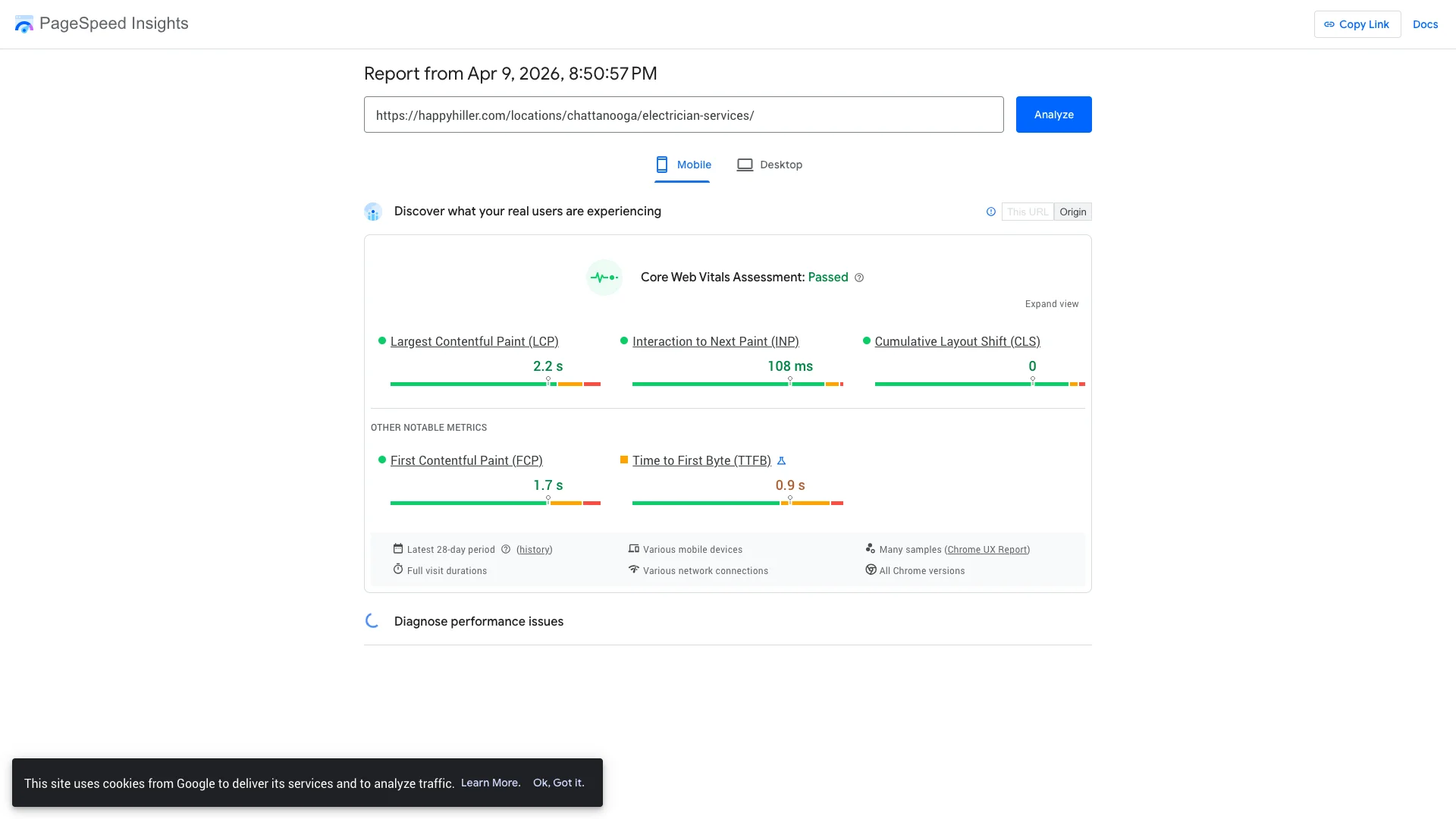
Quick framing note. Google PageSpeed Insights runs a simulated slow-phone lab test, so the scores it reports are a worst-case scenario, not what a real user on a good connection experiences. The pages probably feel fine when you open them yourself. That's honest. But Google uses these lab scores as a ranking factor, and Happy Hiller is eating a ranking penalty on every query those pages compete for.
The low-water-pressure blog scored 54 out of 100. The Nashville HVAC location page scored 44. The Chattanooga electrician location page scored 41. So the two most valuable pages on the site (the location pages pulling "HVAC Nashville" and "Chattanooga electrician" intent traffic) are also the two lowest-scoring pages in the set. And they're only low-scoring for one reason: they're doing too much work.
"53% of mobile users abandon sites that take longer than 3 seconds to load."
— Google / SOASTA (2017)
The Nashville HVAC page is 6,924 words. The Chattanooga electrician page is 7,003 words. Each of those pages has 215 and 222 internal links respectively. And each page renders a list of 60+ regional phone numbers in the footer area (we'll cover that in the next section). So the browser lands on a location page, downloads 7,000 words of content, parses 220 links for internal links, and renders 60+ tappable phone numbers for every regional number the franchise operates. That's a lot of work before the browser can figure out the layout. On a fast connection it still works fine. On the kind of connection the lab test simulates (weak 4G), it's measurably slower than the blog.
The blog is lighter. 2,856 words, 123 internal links, 1 to 2 forms. The browser has less to parse, so it renders faster in the lab. Lab score of 54 instead of 44. Still not great, but better. The blog also has one strength the location pages don't: layout stability is actually decent on the blog. Content doesn't jump around much as the page loads. On the location pages, the Nashville page has a layout-shift score of 0.098 (right at the edge of Google's "acceptable") and the Chattanooga page is fine at 0.001. So layout stability isn't Happy Hiller's biggest problem.
The homeowner who searched "HVAC Nashville" is the most valuable visitor on the site. That's not a research-stage query. That's "I need an HVAC company in Nashville and I'm picking one in the next ten minutes." Losing search ranking on that query to a 44/100 PageSpeed score is the most expensive penalty in the Happy Hiller marketing funnel, and it's fixable with a lighter template.
Compounding effect
"Conversion rates drop approximately 12% for each additional second of page load time."
— Google / Deloitte (2020)
Lead capture: a zip search, a newsletter signup, and sister-location numbers
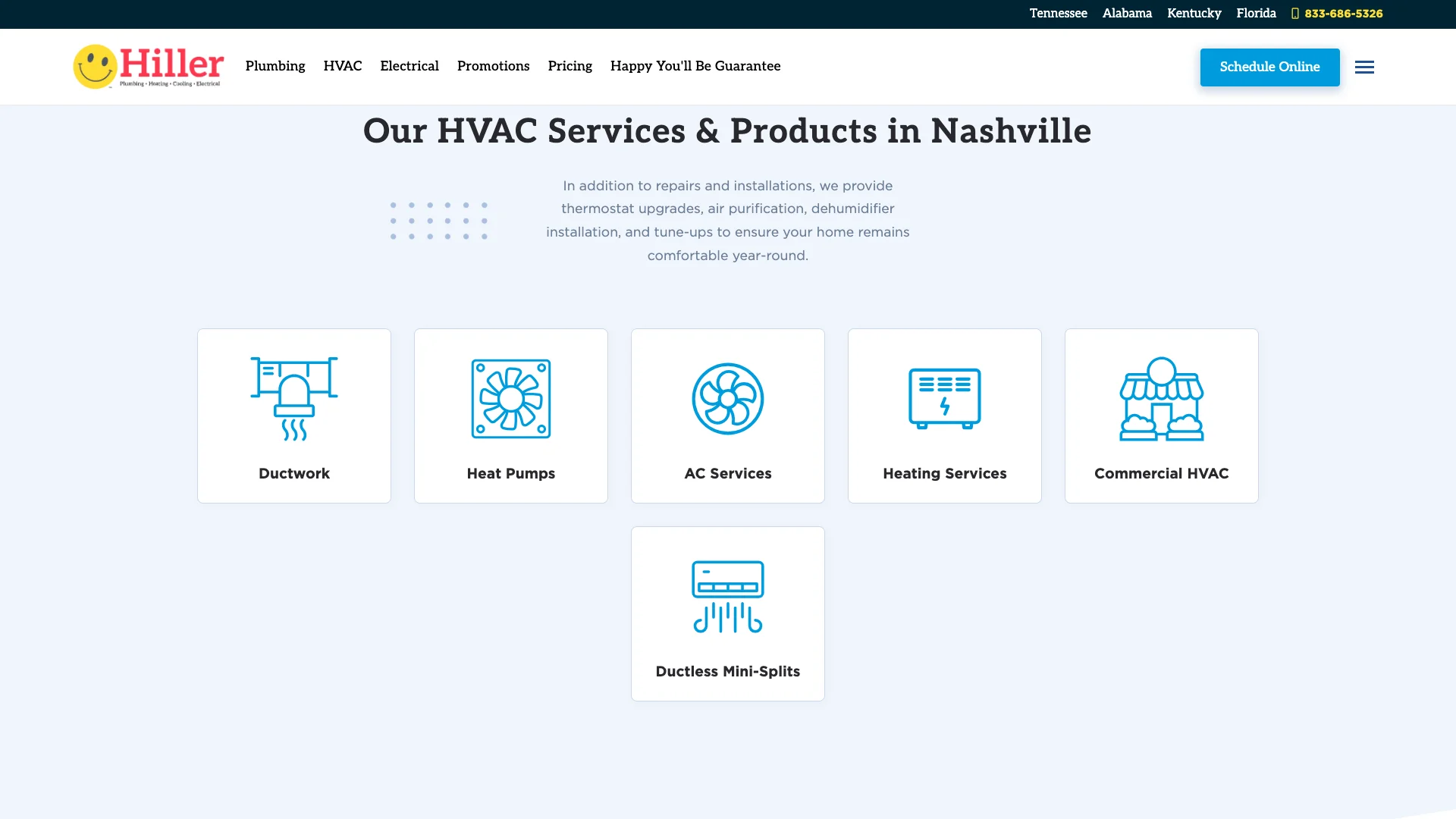
The form audit on Happy Hiller is almost the opposite of what we saw on Aire Serv. Where Aire Serv had five forms per page, Happy Hiller has two. And both of them are vestigial.
The Nashville HVAC page (and the other two pages) carries exactly two forms: a 1-field email signup with placeholder "Email Address" and a 1-field zip code search with placeholder "What". That's the actual placeholder text, the word "What" sitting in a zip code input. Neither of those is a contact form. Neither captures a service request. The email form is for the newsletter. The zip search probably routes to a location lookup. There is no "request a quote" or "schedule a service" form embedded anywhere on the page we audited.
So the conversion path is phone-only. And the phone path has a quirk. The Nashville HVAC page has 64 different phone numbers written into it. About fifteen of them are tappable phone numbers (the main franchise line and a handful of sister locations). The other forty-nine are plain text scattered through what looks like a franchise directory somewhere on the page. Including:
- The main (844) 694-4553 line
- (615) 292-6110 for Nashville
- (865) 855-6354 for Knoxville
- (615) 437-0376 for Murfreesboro
- (423) 299-6110 for Chattanooga
- (901) 557-0553 for Memphis
- (205) 578-1234 for Birmingham
- (256) 251-6028 for Huntsville
- (850) 273-4173 for Pensacola
- ...and 55 more numbers spanning every market Happy Hiller operates in
That's not a phone-first conversion strategy. That's a sister-location directory hiding on a local service page. A homeowner in Nashville who lands on the Nashville HVAC page should see one phone number (the Nashville one), large, tappable, repeated maybe twice on the page. Instead they get the Nashville number up top (which works fine) and, if they scroll far enough, a wall of unrelated phone numbers from sister franchises in other states. The homeowner who doesn't scroll that far doesn't see the directory, so the damage is contained. But the damage that IS there is the kind of thing that makes a Nashville visitor go "wait, why does this Nashville page have a Pensacola number?" and click back to Google.
"68% of users would not submit a form if it required too much personal information."
— Baymard Institute (2024)
This is almost certainly a build-side problem rather than a marketing decision. The franchise probably has a master "all locations" component that renders every regional phone number, and someone forgot to filter it down to the location-specific number on the location page. The fix is straightforward. Detect the page's location slug, render only the matching phone number, hide the rest. It's a half-day of focused work for a developer. And it would dramatically clean up both the user experience and the page weight (64 different phone links on one page adds up).
The CTA inventory is also worth noting. Across all three pages, the CTAs are: Schedule a FREE Inspection, Schedule Online, Contact Us, plus blog teasers like "Cold Snap Alert: When Do Pipes Freeze?" and "Tankless Water Heaters Starting at $69/mo." So the action paths exist. "Schedule Online" and "Schedule a FREE Inspection" both suggest a booking flow somewhere. But there's no inline booking widget, no embedded contact form. To take action, the homeowner has to click out of the page they're on and go find the booking flow somewhere else on the site.
Trust signals: present on locations, missing on the blog
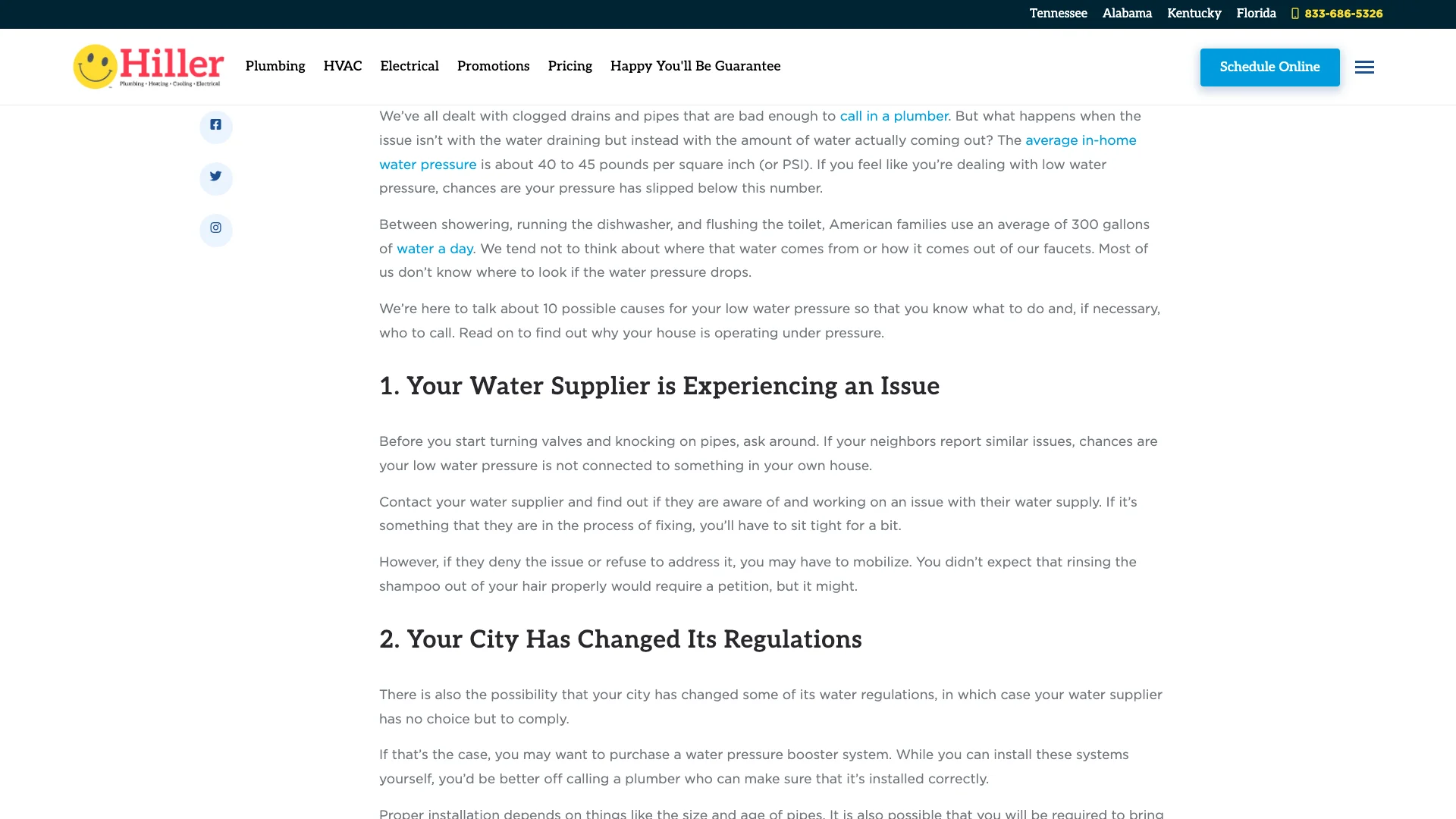
The trust signal audit splits the site into two camps.
The blog page came back with: BBB false, Google Reviews false, review count not found, trust badges false, certifications not found, review widgets not found. The chat widget is present. So a homeowner who lands on the low-water-pressure blog after a Google search has effectively zero trust signals to anchor on. The article itself is 2,856 words and well-written, but there's no proof on the page that Happy Hiller is a real, credentialed, well-reviewed business.
The Nashville location page came back with: Google Reviews true, trust badges true, review widget present on the page, BBB false. So the location page actually has the trust signals. The social proof is rendering somewhere on the page. That's the right move on a location page, where the homeowner is making a buy decision and needs to see the reviews.
The Chattanooga location page came back with: trust badges true, review widget false, Google Reviews false. So Chattanooga has the badges but not the reviews. Inconsistent with Nashville. Same template, different output.
So Happy Hiller has a trust signal stack that's shipped on one of the three pages tested, partially shipped on a second, and absent on the third. A homeowner browsing two location pages on the same site sees a different experience on each. That inconsistency is the kind of thing that creates "wait, why is this page different?" moments. And any moment a homeowner pauses to question the site is a moment they're closer to leaving.
Comparison
"83% of consumers use Google to find local business reviews; 74% use two or more review platforms when researching."
— BrightLocal (2025)
The hidden code labels Google reads tell a similar story. The blog post is actually the best page on the site for this: it has six different labels in its code, including an "article" label and a "person" label that identifies the author. That's textbook search-engine markup for a long-form blog. The Nashville and Chattanooga location pages only carry three or four generic labels that basically tell Google "this is a page on a website." Nothing trade-specific. No "HVAC business" label. No "service" label. No "local business" label with Happy Hiller's business name, address, and phone. On a location page targeting "HVAC Nashville," not having a "local business" label is leaving the fancy Google Maps and local-search results on the table.
What Happy Hiller does well
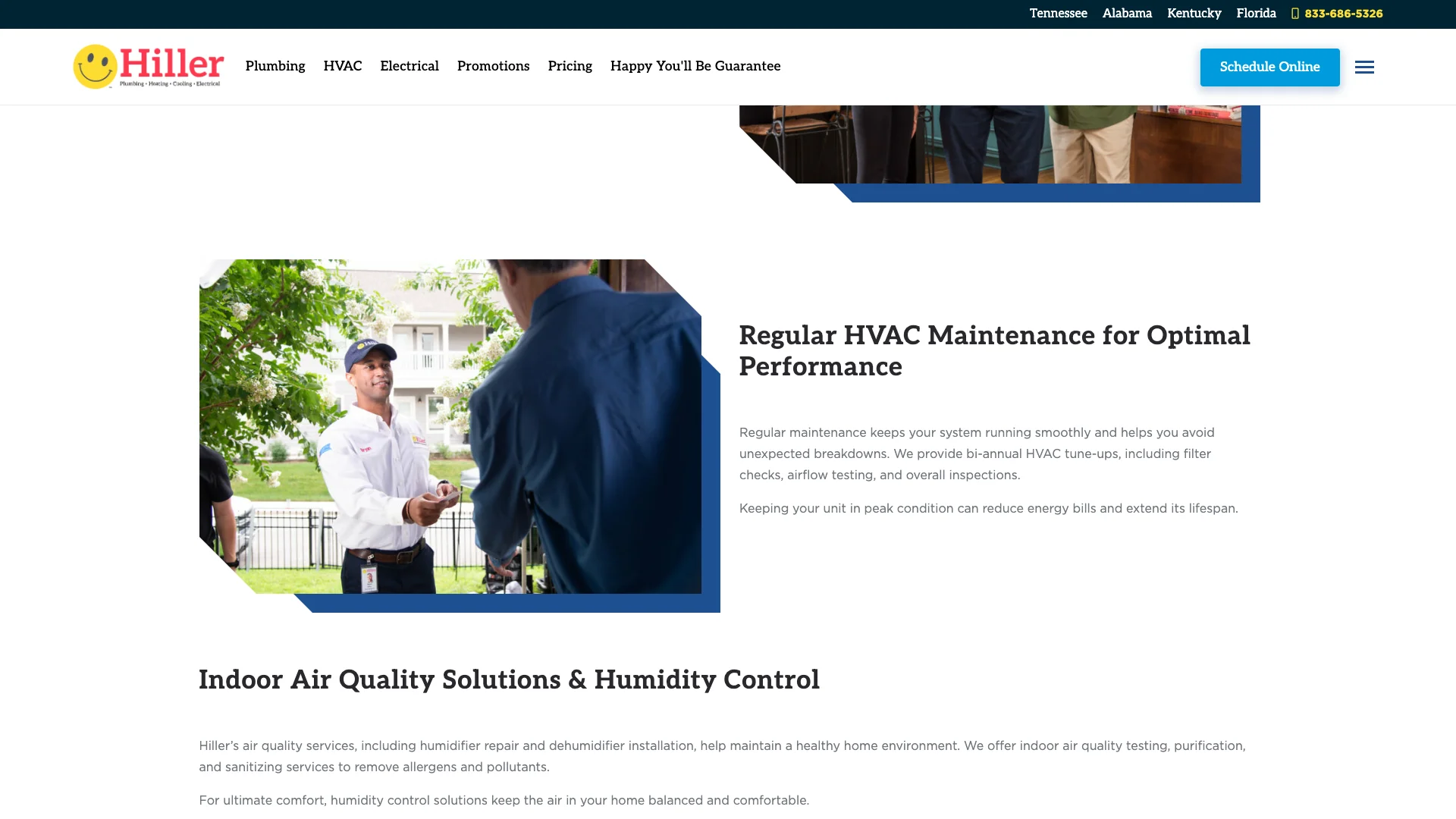
A teardown that just lists problems isn't useful. Happy Hiller does several things genuinely well, and the things they do right are worth borrowing if you're a multi-trade contractor running an HVAC, plumbing, and electrical operation.
Schema markup on the blog. Six code labels on the low-water-pressure blog post: Article, a generic "web page" label, image labels, a site-hierarchy label, a generic "website" label, Person. That's the kind of behind-the-scenes tags stack most contractor blogs are missing entirely. The Article schema lets Google render the post in news-style results. The the "person" label connects content to an author entity. The combination is meaningful for both ranking and click-through rate. Whoever set up the blog template knew what they were doing.
Content depth on the location pages. Nashville HVAC: 6,924 words. Chattanooga electrician: 7,003 words. That's thorough, substantive location content, the kind of depth that earns local rankings even against the big franchise sites. Most contractor location pages we audit are 800 to 1,200 words and feel like templates. Happy Hiller's are 5x that and read like they actually want to inform the homeowner.
Internal linking density. 215 links on the Nashville page. 222 on the Chattanooga page. That's a deliberate cross-linking strategy that passes equity between location pages, service categories, and the blog. The flip side is that those links contribute to page weight, but the SEO benefit is real.
The Nashville location page actually has the reviews. Of the three pages tested, the Nashville HVAC location page is the one with Google Reviews returning true and a review widget present. That's the right page to have it on. The location page is where the buy decision happens. If the same template were applied consistently to every location, the site would have a much stronger trust signal stack.
The main phone numbers work. The fifteen-ish phone numbers that ARE tappable on the Nashville page dial correctly. The Nashville number in the header works. The main franchise 1-800 line works. The sister-location numbers that are tappable dial the right franchise. Whatever the rendering issue is with the extra forty-nine plain-text numbers, the core conversion path (header phone to Nashville franchise) is functional. That's the foundation you'd build on if you owned this template.
"64% of homeowners say having recommendations or references is a top-three factor in choosing a contractor."
— Houzz Inc. (2025)
What the gaps mean for local HVAC contractors
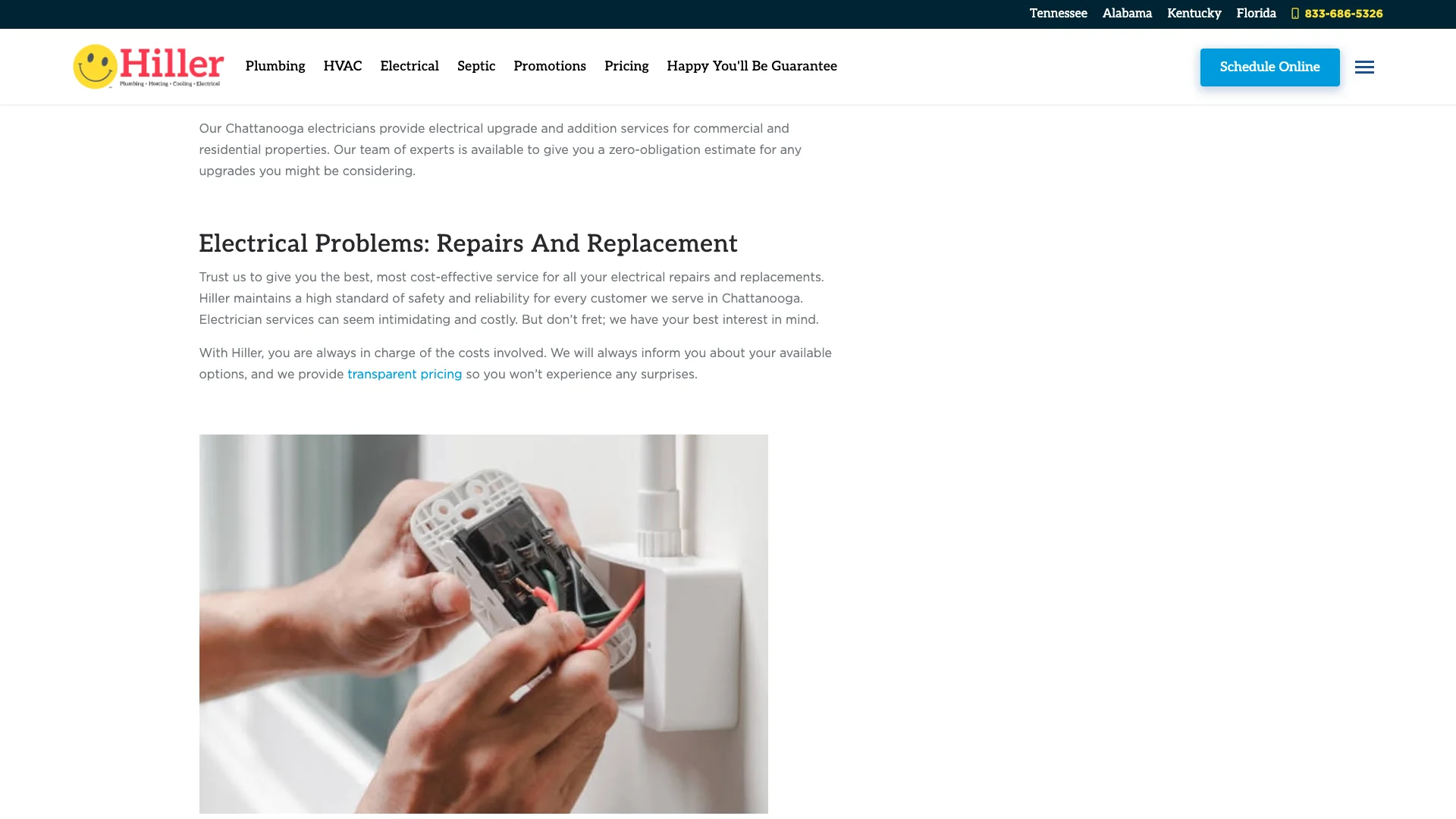
Happy Hiller is a regional multi-trade operator. You're independent, single-trade, single-market. And the gaps in their build are the gaps you can close with a clean location page and a couple of weeks of focused work.
One phone number per location page. Not sixty-four. Happy Hiller's Nashville page lists every regional phone number their franchise operates. Yours should list one. The local number. In the header, in the body, in the footer. Click-to-call. 24-point or larger. If you operate in multiple markets, build a separate location page for each market and render only the location-specific phone on each one. The dynamic phone insertion is a one day of focused work. The clarity it creates is permanent.
Add an inline contact form on every location page. Happy Hiller's location pages have a 1-field zip search and a 1-field newsletter signup. Neither of which is a service request form. Yours should have a 3-field contact form (name, phone, zip, maybe a service category dropdown if you really need it) embedded directly into the location page hero. Above the fold. Right next to the phone number. A homeowner who doesn't want to call should be able to leave their information in three taps.
Beat their PageSpeed score on your location pages. Happy Hiller's location pages scored 41 and 44 out of 100 on Google's lab test. Yours should be 85+. Lighten the page weight to get there: you don't need 215 links to sister pages, you don't need 64 sister-location phone numbers, you don't need 7,000 words of content crammed into a local page. Cut your location pages down to the essentials: hero, local phone, Google Reviews widget, a 3-field contact form, a short intro paragraph, and your service area. Then move non-critical scripts to load after the page appears, and shrink your hero images to under 100KB. That's how you close the ranking gap with a franchise on "HVAC [city name]" searches.
Match Happy Hiller's blog schema, then beat their location schema. Their blog has six code labels and their location pages have four. You should have six on every page. Add a "service" label on every service page. Add a "local business" label with your full NAP on every location page. Add an "HVAC business" label as a more specific subtype if you do HVAC work. Add a "FAQ section" label on any post with Q&A content. Schema markup is free. Most contractors don't ship it. Happy Hiller has more than most. You can have more than them.
"48% of customers say that if a site does not work well on mobile, it signals the company does not care about their business."
— Google Consumer Insights (2018)
The positioning angle is straightforward. Happy Hiller has the regional footprint and the SEO authority. You have something they can't have on a location page: a single phone number, a single contact form, and a PageSpeed score that isn't dragging down your search rankings. Those things are not expensive. They're the difference between feeling like a real local business and feeling like a national franchise template that didn't get cleaned up before launch.
Frequently asked questions
What is Happy Hiller's website performance score?
Happy Hiller's low-water-pressure blog scored 54/100 on Google PageSpeed Insights mobile as of March 29, 2026, with 10.1 seconds to finish loading. The Nashville HVAC location page scored 44/100 with 13.8 seconds to finish loading. The Chattanooga electrician page scored 41/100 with 14.0 seconds to finish loading. The location pages are the slowest pages in the set, likely because they're rendering 6,900 to 7,000 words of content alongside 215+ internal links and 60+ regional phone numbers.
How many phone numbers are on a Happy Hiller location page?
The Nashville HVAC location page has sixty-four different phone numbers written into it, only about fifteen of which are actually tappable. The rest are plain text, scattered across a list of every franchise location across six states (Tennessee, Alabama, Kentucky, Florida, Georgia, Mississippi). The Chattanooga electrician page has the same pattern. It is a multi-location franchise rendering the full sister-location list on every local page rather than filtering to just the one the homeowner landed on. The fix is one day of focused work for a developer: detect which location page the visitor is on, show that location's phone, hide the rest.
Does Happy Hiller display Google Reviews on every page?
No, only on one of the three pages we tested. The Nashville HVAC location page returned googleReviews: true with a review widget present on the page. The blog post returned googleReviews: not found and no widget. The Chattanooga location page returned googleReviews: not found despite having trust badges. The trust signal stack is inconsistent across pages: present on Nashville, partial on Chattanooga, absent on the blog.
How much organic traffic does happyhiller.com get?
According to Ahrefs data from our March 2026 collection, happyhiller.com receives approximately 26.5K monthly organic visitors with an estimated traffic value of $136.1K. The low-water-pressure blog accounts for 1.6K of that (6% share), and the Nashville and Chattanooga location pages each account for 1.3K (5%). The location pages are the highest-intent traffic on the site, and also the slowest.