
What we found on ars.com
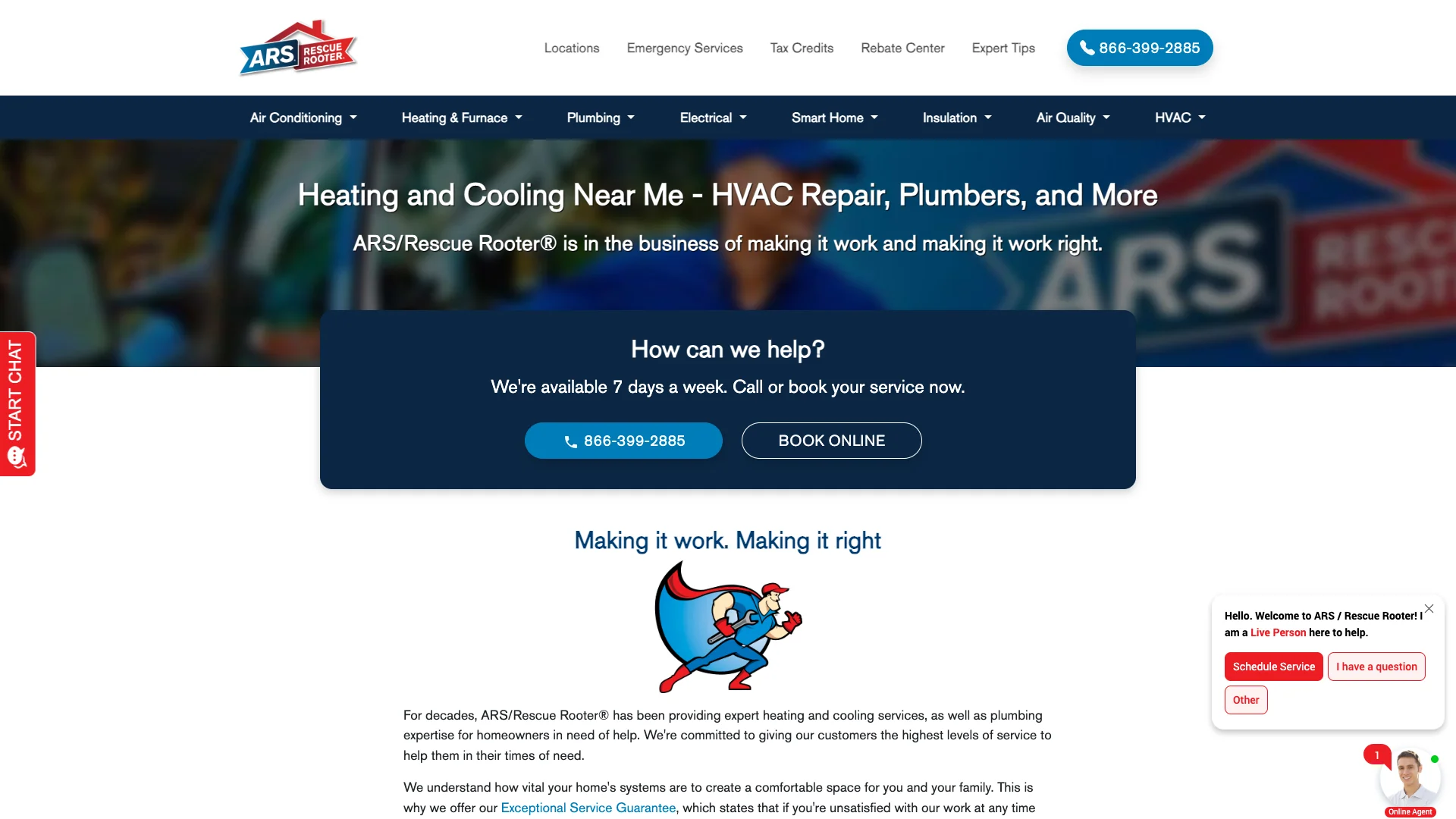
ARS/Rescue Rooter is an HVAC and plumbing franchise. According to Ahrefs, ars.com pulls 58.6K monthly organic visitors with an estimated traffic value of $236.5K. So we picked the three highest-traffic pages we could verify and ran them through the standard teardown protocol.
The pages we tore down:
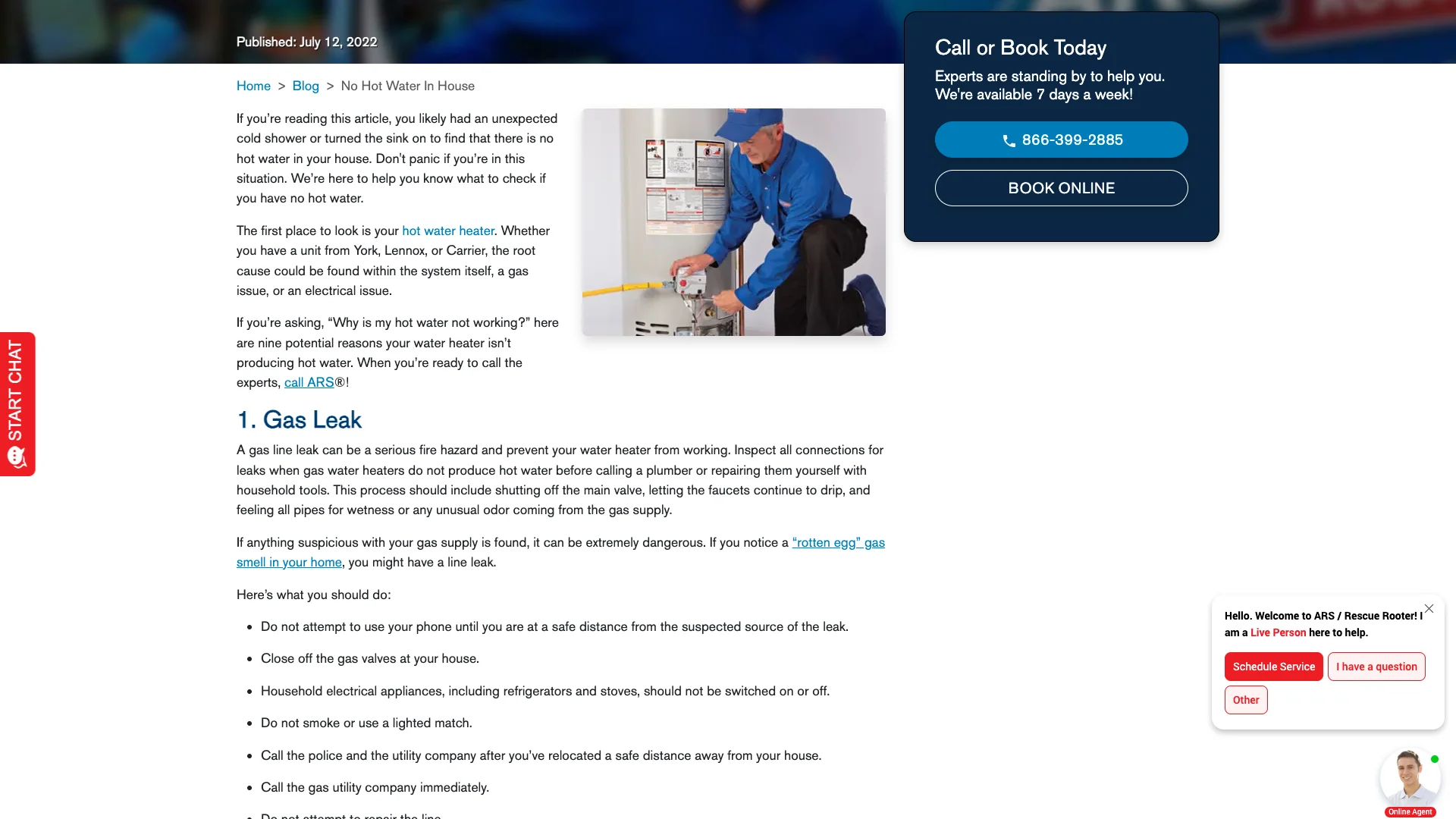
- /blog/no-hot-water-in-house, a long-tail troubleshooting blog (2.6K monthly organic visitors, 5% traffic share)
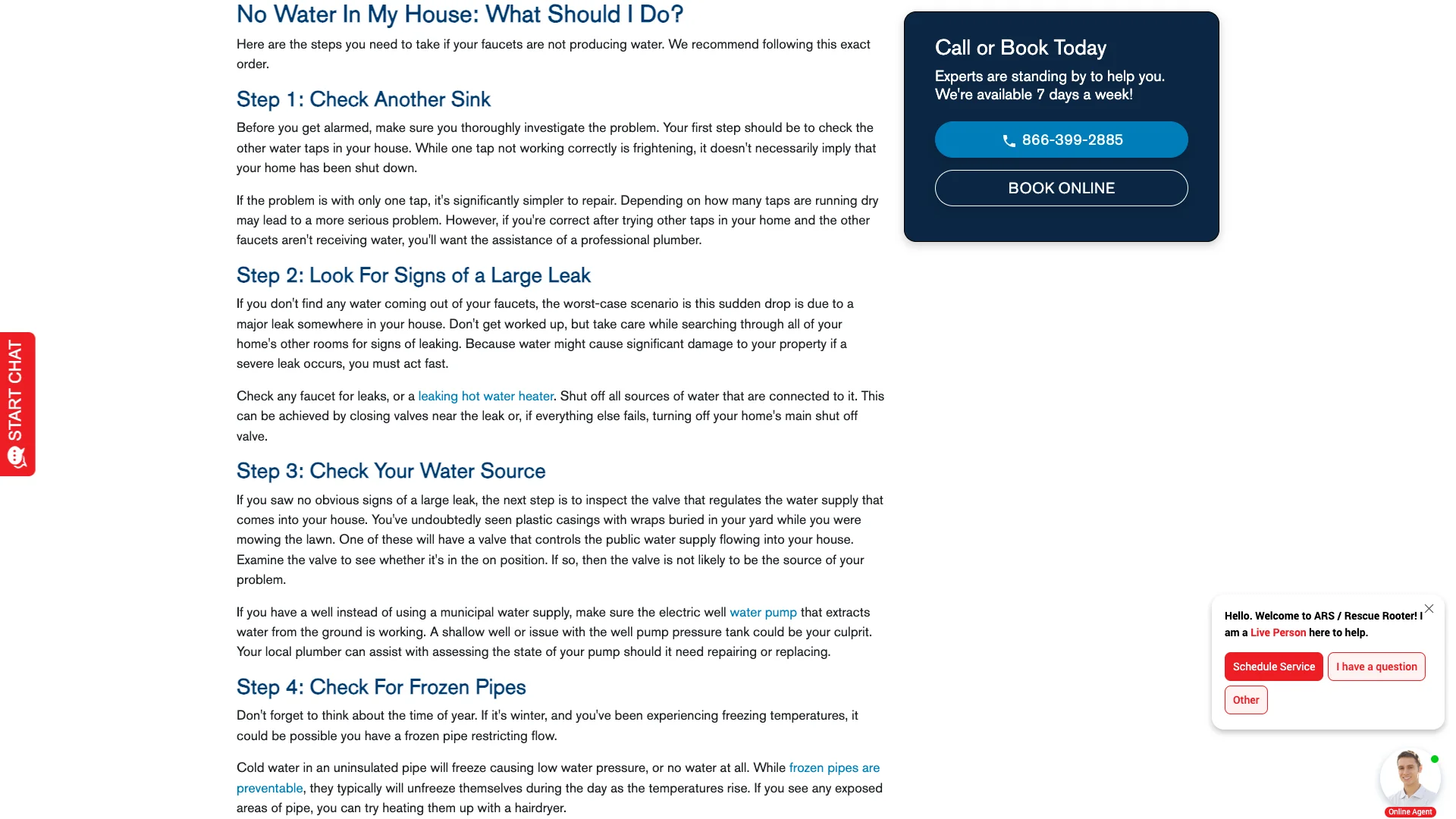
- /blog/no-water-in-my-house, a sibling troubleshooting blog (2.4K monthly visitors, 4% share)
- /apps/tracking/, an extranet tracking app that returned a fetch failure (1.4K monthly visitors, 2% share, content not auditable)
So this teardown is mostly built on the two blog pages that fetched cleanly. The extranet wouldn't render in our our audit tool, likely a login wall, which means the 1.4K visitors a month landing there are an interesting traffic note but not something we can audit. Two blog pages it is. And the second I started parsing the data, one number jumped out and didn't fit anywhere. The review-count data field on both pages came back with the value 134,039. A hundred and thirty-four thousand thirty-nine reviews. That's not a typo. That's the franchise's actual aggregated review count, sitting in the metadata we pulled. And it doesn't appear on either page we tested.
"25% of homeowners say trusting contractors is their top challenge when planning home improvement projects."
— Houzz Inc. (2025)
Performance: the blogs visibly jump around as images load in
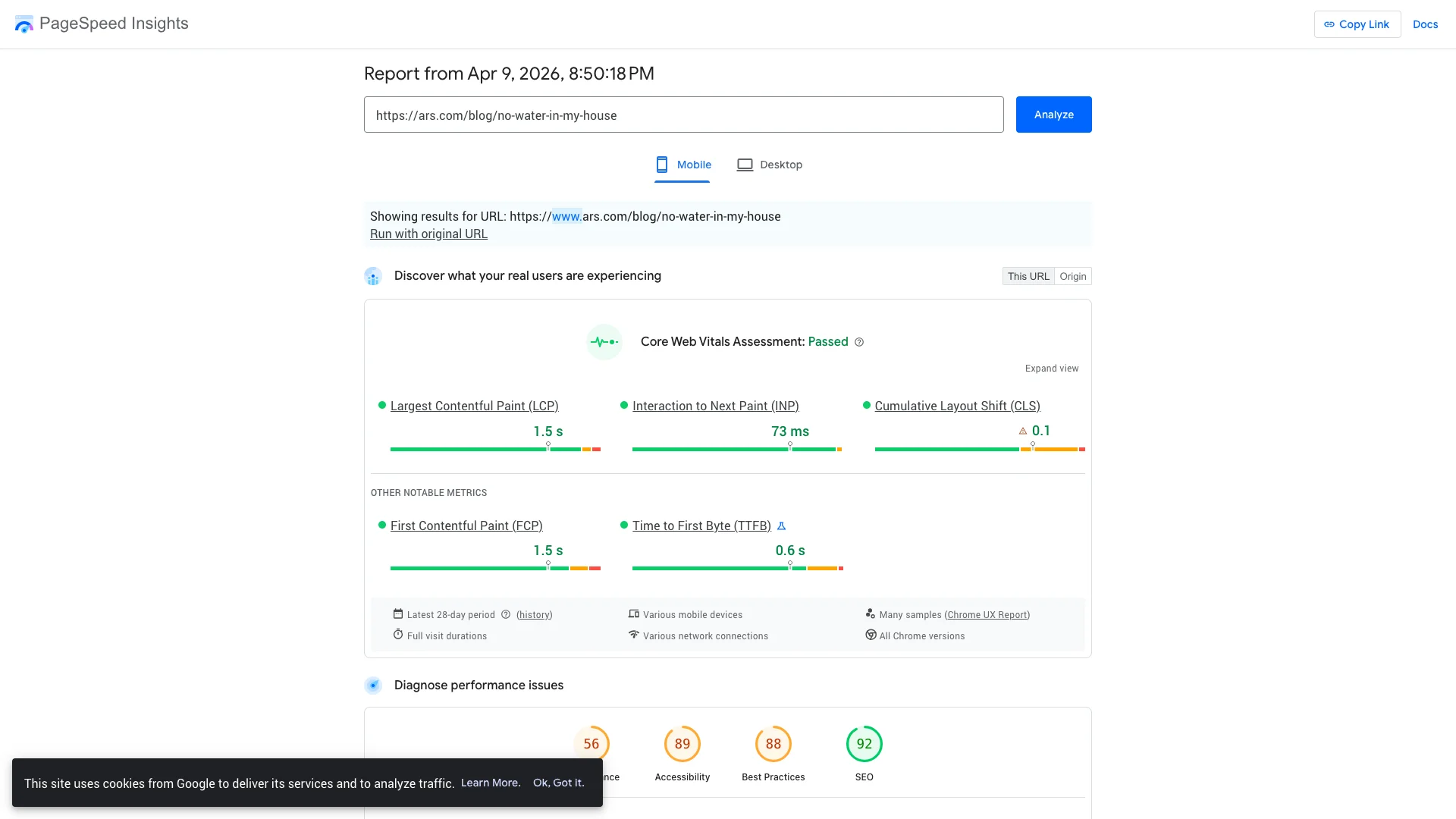
Quick framing note. Google PageSpeed Insights runs a simulated slow-phone lab test, and the scores it reports are a worst-case scenario, not what you see when you open the site on your iPhone on WiFi. The ARS blogs probably feel fine when you open them yourself. That's fair. But Google uses these lab scores as a ranking factor, which means ARS is earning or losing search authority on every query these blogs compete for.
The no-hot-water blog scored 73 out of 100 in the lab test, which is actually the highest score we've recorded across the HVAC teardown batch. Not great, but competitive. The sibling no-water blog (same site, same template, same category) scored 52 out of 100, which is a typical franchise-site score. Same URL path, same author, same template, different outcomes. Somebody optimized one and not the other.
"53% of mobile users abandon sites that take longer than 3 seconds to load."
— Google / SOASTA (2017)
Where the experience actually matters for a normal homeowner is layout stability. Both ARS blogs have content that visibly jumps around as the page loads. Google's layout shift threshold for "good" is 0.1. The no-hot-water blog comes in at 0.121. The no-water blog at 0.117. Both fail. In practice that means: as the page loads, images fill in and push paragraphs down, ad slots materialize and move the next block of text, sticky elements shift content sideways. A homeowner trying to read "nine things that cause no hot water" is reading a list that keeps relocating under their thumb. The step they wanted to tap moves while their finger is already heading for it.
That's the one performance metric that isn't just a ranking factor; it's something homeowners feel directly, regardless of their connection speed. Both ARS blogs have it, for the same structural reason: nobody reserved space in the blog template for the elements that load after the rest of the page.
The page responsiveness (how quickly the page responds to a tap once it's loaded) is actually impressively fast on both ARS blogs. Measurements in the 89ms to 162ms range, which are the lowest numbers in our entire HVAC teardown batch. If you tap the chat widget, it opens quickly. If you tap the phone number, it dials. So the issue isn't responsiveness once content is on the screen. It's visible content motion while the page loads, and it's ranking scores that are eating search authority.
Lead capture: zero forms, two phone numbers, one chatbot
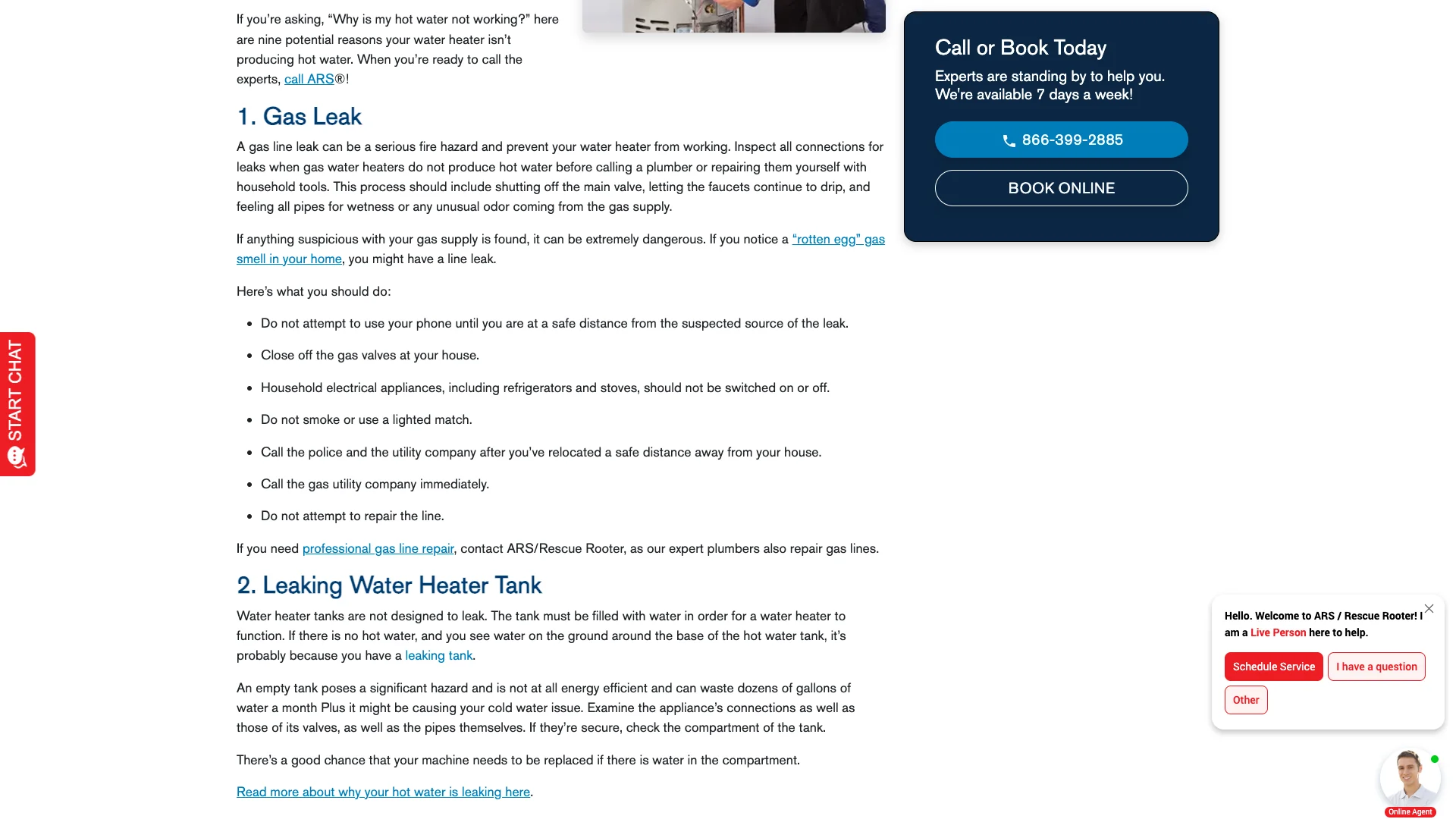
This is where ARS lines up almost exactly with what we saw on Roto-Rooter and SERVPRO. Massive long-tail SEO footprint. Brand recognition. And the only way to convert a visitor is by picking up the phone or starting a chat.
Across both blog pages: zero forms. The audit returned an empty "forms[]" array. Not a hidden form behind a button. Not a popup form on scroll. Not an exit-intent form. Zero. The only conversion paths are the (866) 399-2885 phone number, the chat widget that appears on both pages, and CTAs labelled "call ARS," "contact a plumbing specialist," "find your nearest ARS/Rescue Rooter location," "Schedule Service Today," and "BOOK ONLINE." Every one of those either dials a number, opens the chat, or routes to a franchise locator.
And look, for true plumbing emergencies, phone-first makes sense. If your hot water just died on a Sunday morning, you're calling, not filling out a 6-field form. But the no-hot-water blog is also pulling visitors from non-emergency queries, homeowners researching common causes, comparing whether they need a plumber or a part swap, trying to understand what the diagnostic process even looks like. Those visitors are research-stage. They're not calling. They want a way to leave their information and get a quote without committing to a phone conversation. ARS doesn't offer that path. So the research-stage visitors bounce.
"68% of users would not submit a form if it required too much personal information."
— Baymard Institute (2024)
The chat widget is the saving grace. Both pages have it. A homeowner can tap the chat icon and at least start a text conversation without dialing a number. That's a real conversion path for the non-emergency visitor. But a chat widget is not a form, it's a synchronous interaction that requires someone on the other end. If the chat is staffed 24/7 with a competent rep, it works. If it's bot-first with a long wait time to reach a human, it underperforms. We didn't test that side of it. Just noting that "chat widget" and "contact form" are not interchangeable conversion paths.
One more thing on the CTA inventory. The "BOOK ONLINE" button suggests an online booking flow exists somewhere. But neither blog page links to an embedded form, an inline calendar, or a booking widget. Whatever "BOOK ONLINE" routes to, it's not on the page we tested, which means a homeowner has to commit to leaving the article they're reading to find it. That's a click of friction that shouldn't exist on a service blog with five-figure monthly traffic.
Trust signals: 134,039 reviews and nowhere to put them
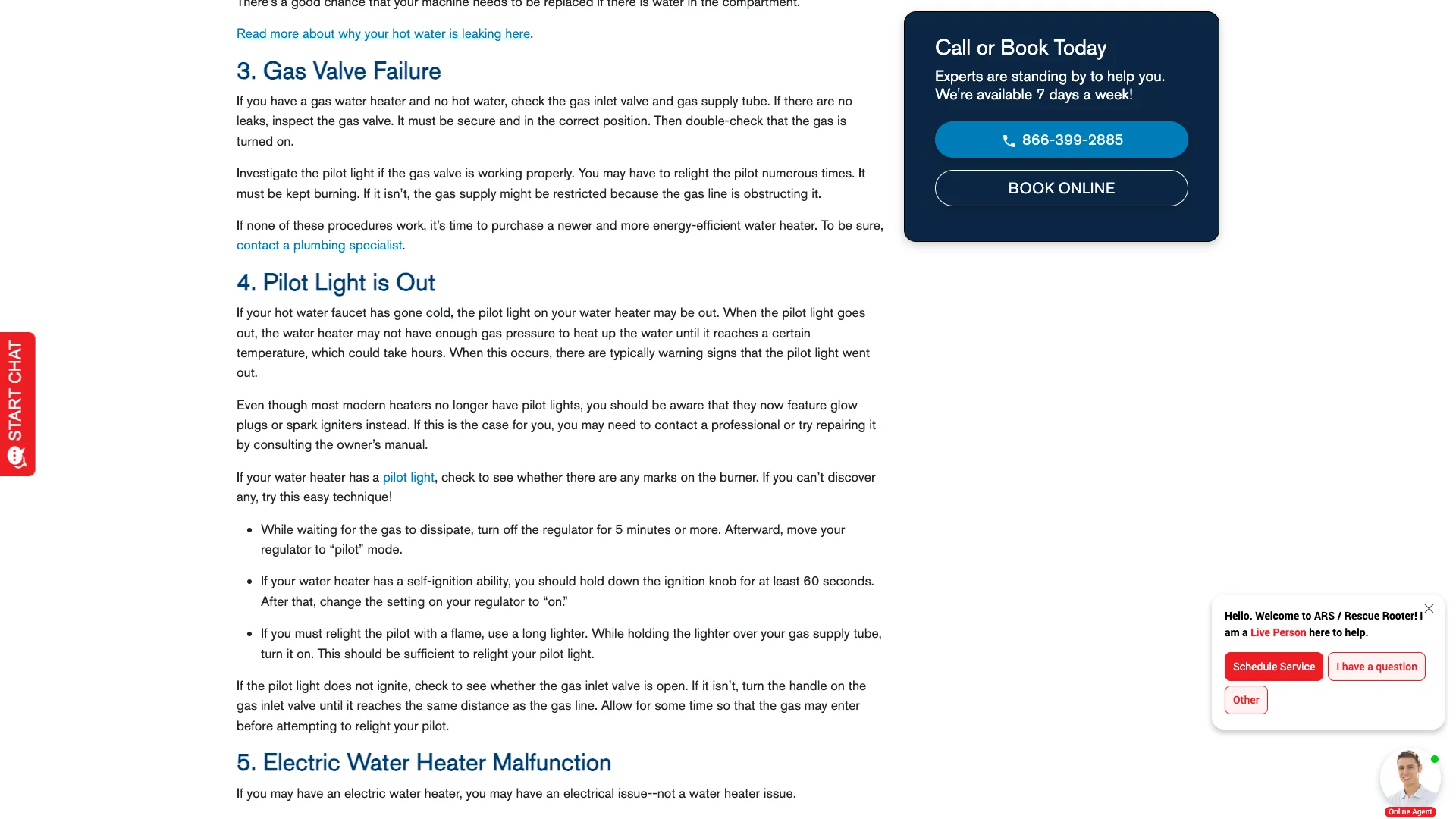
A correction from our initial scraper data: our automated tool reported the 134,039 review count as hidden. But Chrome browser verification found that the page DOES display "4.8/5 Stars" and "Based on 134,039 reviews" in a rating section further down the page. The reviews are rendered via JavaScript after the initial page load, which is why the scraper missed them. So ARS isn't hiding their reviews. They're displaying them. The 134,039 count and the 4.8 star rating are visible to homeowners who scroll far enough down the page.
The trust signal audit:
- BBB badge: Not found.
- Google Reviews widget: Not found.
- Review widget (any platform): Present (4.8/5 Stars rating section with review count, rendered via JavaScript).
- Review count display: Present ("Based on 134,039 reviews" visible further down the page).
- Certifications: Not found.
- Trust badges: Present on both pages.
- Chat widget: Present on both pages.
So the franchise has trust badges. They have a chat widget. They have 134,039 reviews aggregated somewhere. And they don't show the review count on the page that needs it most, the long-tail blog post pulling research-stage homeowners who are evaluating whether ARS is even worth a phone call. A homeowner reads the article, decides ARS sounds plausible, scrolls looking for proof, and finds trust badges of unspecified origin and a chat icon. The 134,039 number is invisible.
Comparison
"83% of consumers use Google to find local business reviews; 74% use two or more review platforms when researching."
— BrightLocal (2025)
And the hidden labels that tell Google what each page is about are just as bad. Every page on the web can carry invisible code labels that tell search engines things like "this is a business," "this is an article," "this is a FAQ section," "this is a local business in this city." Search engines use them to show richer-looking results (think of the question-and-answer boxes that show up in Google search under some results , those come from FAQ labels). Both ARS blog pages carry zero of these labels. Not a single one. Two long-form blog posts with 2,000+ words each, and nothing in the code telling Google what they are. ARS is leaving the fancy search-result slots on the table. A FAQ label alone, with four or five of the article's Q&A sections marked up, could earn them the expanded search results that boost click-through rate.
It's a strange combination. A franchise with the resources to aggregate 134,039 reviews across a national footprint, the budget to staff 24/7 chat, the infrastructure to maintain a content blog at scale, and zero behind-the-scenes tags on the highest-traffic pages. That's not a lack of capability. That's a lack of attention.
What ARS does well
ARS does several things genuinely well. If you're a local HVAC or plumbing contractor competing against franchise sites in your market, these are worth borrowing.
The chat widget actually exists. Most of the franchise sites in this teardown series don't have one. ARS does, on every blog page we tested. That's a real conversion path for the homeowner who doesn't want to call but is willing to type. A chat icon in the bottom-right corner is a low-cost addition that captures a slice of leads no phone-only flow can reach.
tap-response delay is impressively low. 89 milliseconds on the no-hot-water page and 162 milliseconds on the no-water page. Most of the sites in this index are sitting between 500ms and 1,800ms of total blocking time. ARS is running a much leaner page responsiveness on these blog templates than the competition. Whoever owns the frontend over there is doing something right, they're just losing the load time fight to image-loading and page-stalling somewhere else.
One single phone number. Across both pages, there's exactly one phone number visible: (866) 399-2885. No franchise locator phones bleeding through. No multiple regional numbers. One number, one branded line, one place to call. That's the right approach. We saw the opposite on Happy Hiller, sixty-plus phone numbers on a single page. ARS keeps it clean.
Word counts that earn rankings. 2,324 words on the no-hot-water blog. 2,046 on the no-water blog. Both substantial enough to compete for the long-tail queries they target. Whoever owns content at ARS is shipping real volume, and the SEO results show it (5% and 4% traffic share for two single blog posts is a lot of concentrated authority).
"64% of homeowners say having recommendations or references is a top-three factor in choosing a contractor."
— Houzz Inc. (2025)
What the gaps mean for local plumbing and HVAC contractors
ARS is a national franchise with a six-figure review pool. You're independent. And the gap between what they have and what they show is the gap you can win in.
If you have reviews, show them on the page. ARS has 134,039 reviews aggregated somewhere in their data stack and zero of them visible on the pages we tested. That's the most expensive marketing miss in this entire teardown. If your business has 50 Google reviews, put a widget right under the H1 with the star rating, the review count, and a "read all reviews" link. If you have 200, the widget gets bigger. If you have 500, you put it above the fold and below the fold. The reviews are the trust signal a homeowner is actually looking for. Hiding them in your data layer instead of rendering them on the page is leaving the win on the table.
Add a contact form. Even a small one. ARS converts through phone and chat only. That works for emergencies. It loses non-emergency leads, the homeowner who's researching, comparing, getting three quotes before committing. A 3-field contact form (name, phone, zip) on every service blog captures the visitor who wants to leave their information and get a callback. That's the homeowner who'll never dial your number unprompted but will absolutely return your call when their schedule clears.
Add the hidden labels that tell Google what your pages are. ARS has zero of these labels on the pages we tested. Your site should have: a label on every blog post saying "this is an article," a label on every FAQ section saying "this is a FAQ" (which unlocks the expanded Q&A search results that drive traffic), a label on every service page saying "this is a plumbing service" or "this is an HVAC service," and a label on every location page with your business name, address, and phone. These are invisible code tags in the page. They are free to add. A developer who knows what they're doing can install all five in an afternoon. And most of your competitors do not have them.
Don't let your page jump around as it loads. Both ARS blogs shift content after first paint: images push paragraphs down when they finally appear, ad slots fill in and relocate the text around them. A homeowner trying to read your content is trying to read something that keeps moving under their thumb. Yours should not move at all after first paint. Set explicit width and height on every image (the browser reserves the space before the image downloads, instead of inserting it after). Reserve space for any element that loads late (chat widgets, fixed-position banners, modules that load after the rest of the page). It's a one-day day of focused work.
"48% of customers say that if a site does not work well on mobile, it signals the company does not care about their business."
— Google Consumer Insights (2018)
The positioning angle is clean. ARS has the franchise scale. You don't. But you can have the trust signals they're hiding, the lead capture they're missing, the behind-the-scenes tags they're ignoring, and the layout stability they haven't fixed. None of those things require a national footprint. They require attention to detail, the kind of attention you bring to a customer's HVAC system every day. Bring it to your website too.
Frequently asked questions
How well does ARS/Rescue Rooter's website work on mobile?
It depends which page you land on. The no-hot-water blog shows text within about three and a half seconds of a tap, which is the best load time in our HVAC set. But the sibling no-water blog (same site, same template, same category) scored 52 out of 100 on Google's lab test versus 73 on the no-hot-water blog. Both pages also have a layout stability problem: content shifts around as images and ads load in, so the homeowner trying to read the article is trying to read something that keeps moving. The first blog scored 73 out of 100 on Google PageSpeed Insights mobile; the second scored 52.
Does ARS/Rescue Rooter have contact forms on their service pages?
No. Both blog pages we audited returned zero forms on the page. The only conversion paths are the (866) 399-2885 phone number, a chat widget that appears in the bottom corner, and CTAs labelled "Schedule Service Today" and "BOOK ONLINE", both of which route to a phone call or franchise locator rather than an inline form. This matches the phone-first pattern we found on Roto-Rooter and SERVPRO: massive organic traffic, brand recognition, and zero web-form lead capture.
Does ARS show their reviews on their website?
Not on the pages we tested. The audit data carries a review count value of 134,039, the franchise's aggregated review total, but the review widget data field returned not present on both blog pages, and no Google Reviews widget, BBB badge, or visible review count was rendered on either page. Trust badges of unspecified origin were present, but the six-figure social proof number isn't being displayed where homeowners can see it.
How much organic traffic does ars.com get?
According to Ahrefs data from our March 2026 collection, ars.com receives approximately 58.6K monthly organic visitors with an estimated traffic value of $236.5K. The no-hot-water blog accounts for 2.6K of that (5% share), and the no-water-in-house blog accounts for 2.4K (4%). A third URL we attempted, the /apps/tracking/ extranet, returned a fetch failure and is not included in this teardown.