
What we found on aireserv.com
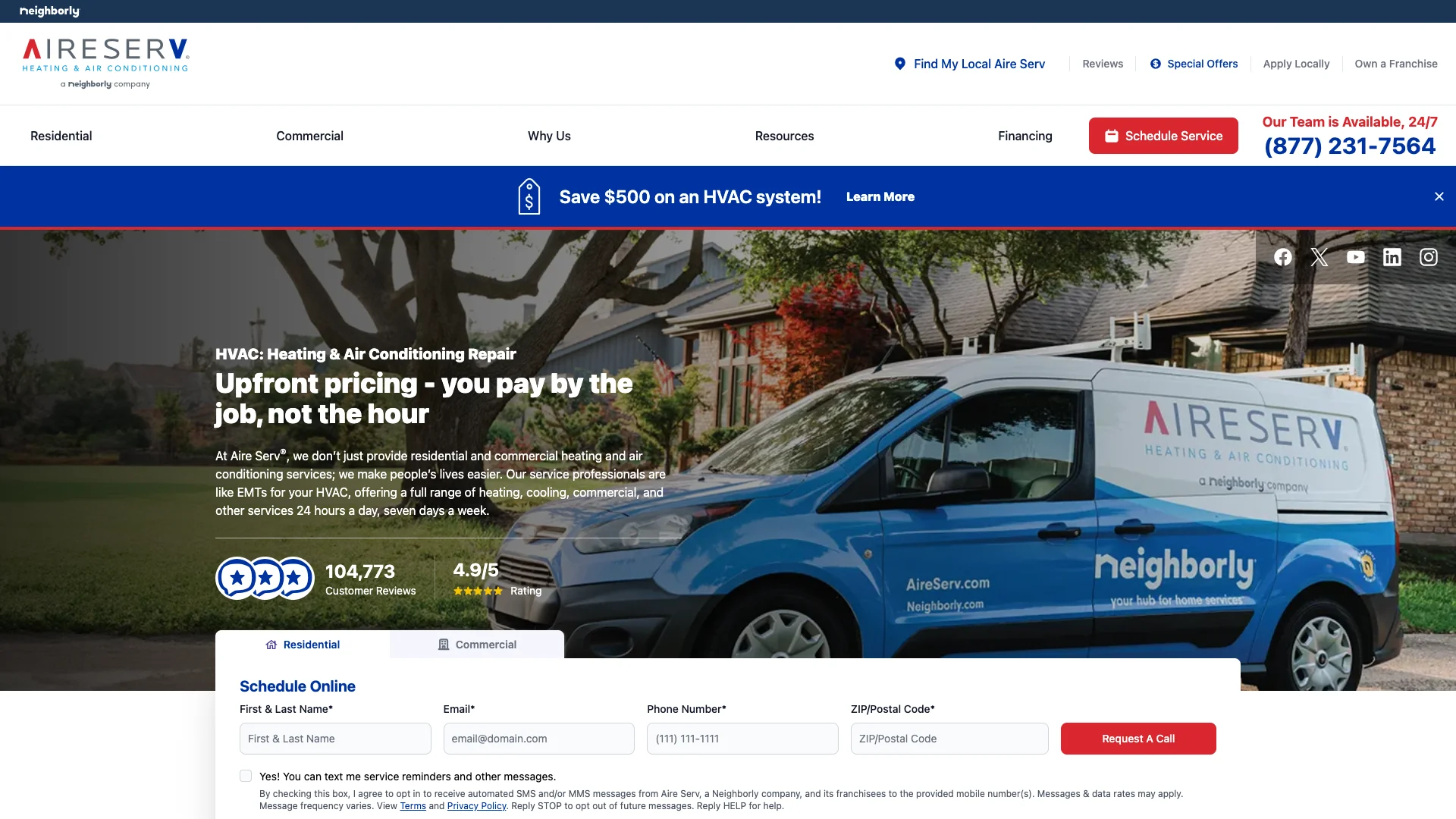
Aire Serv is an HVAC franchise operating under the Neighborly brand umbrella. According to Ahrefs, aireserv.com pulls 114.8K monthly organic visitors with an estimated traffic value of $356.6K. So we picked the three highest-traffic pages we could verify and ran them through the standard teardown protocol.
The pages we tore down:
- /about/blog/the-thermostat-wire-color-code-you-need-to-know/, a long-tail DIY blog post on thermostat wiring (6K monthly organic visitors, 6% traffic share, the highest-traffic page in our set)
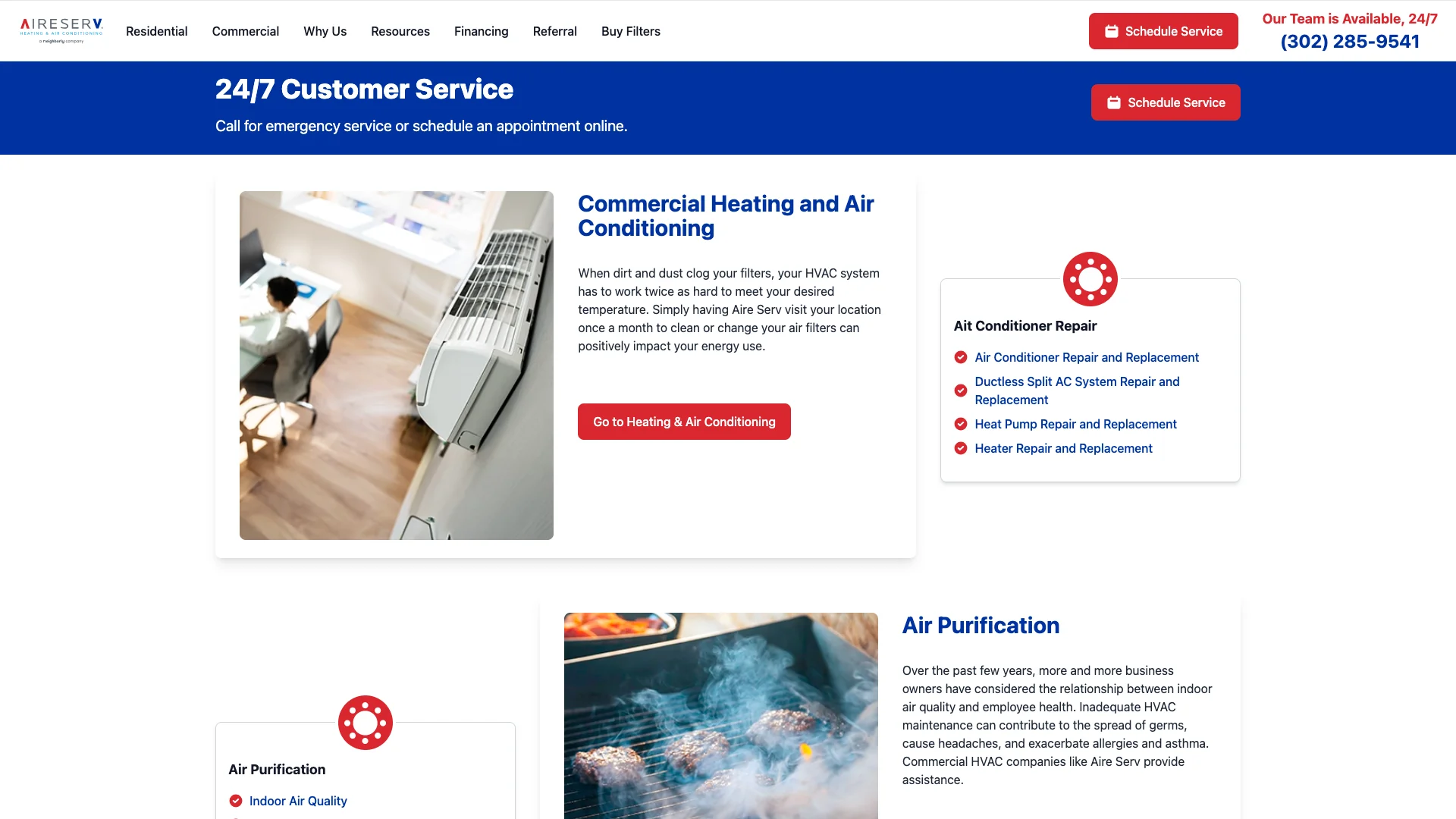
- /services/commercial/, the commercial HVAC services page (3.7K monthly visitors, 4% share)
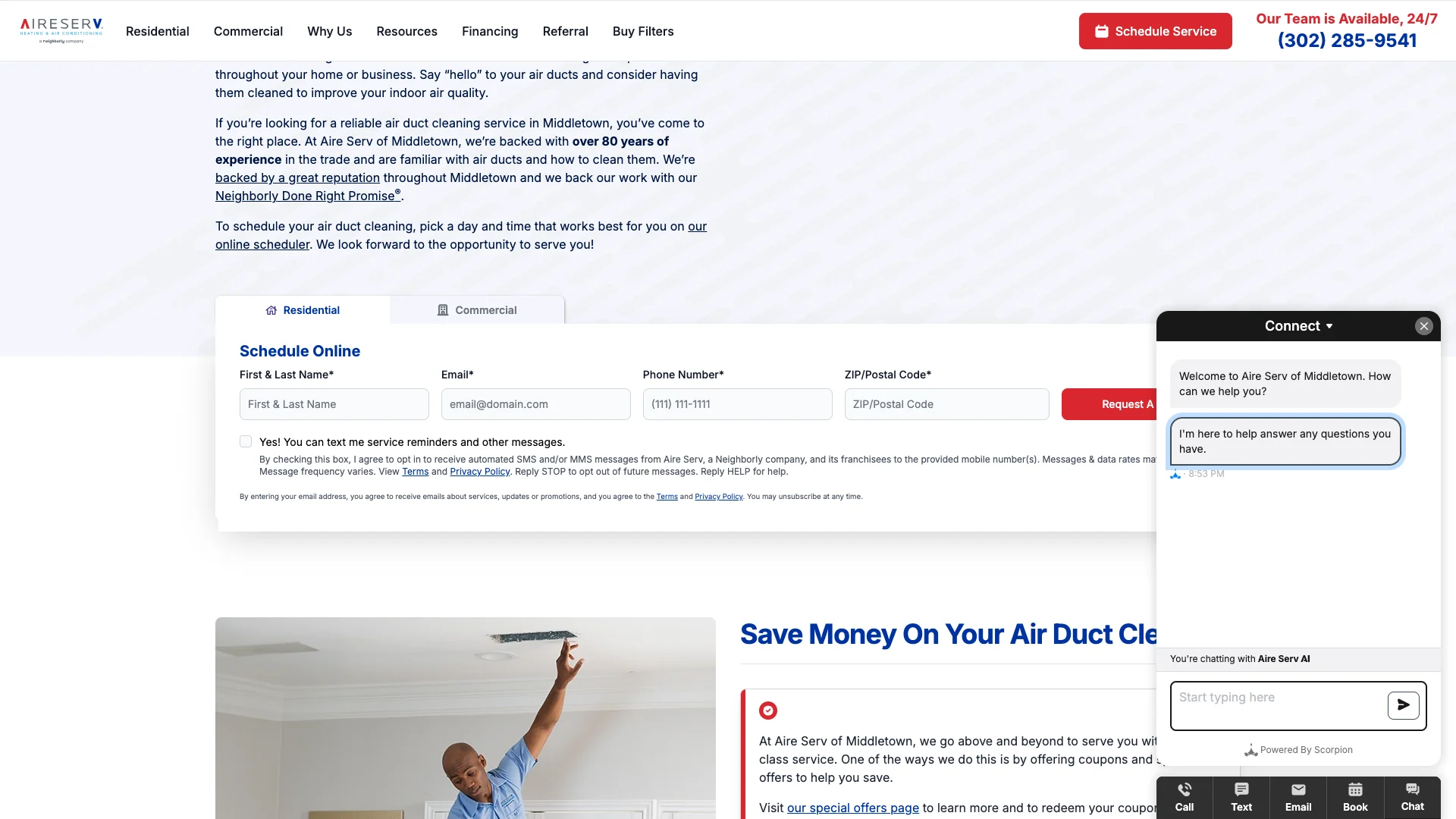
- /middletown/services/other-services/duct-cleaning/, a single-location duct cleaning service page in Middletown, Delaware (3.4K monthly visitors, 3% share)
And the pattern that jumped out of the data was inconsistency. Not just in one place. In three places. The performance scores vary wildly across the three templates. The trust signal stack is present on one page and missing on two. The hidden labels that tell Google what each page is about are rich on one page and almost empty on two. Same domain, same brand, three pages, three very different audit results. So we'll walk through each of those three inconsistencies and what they mean.
"25% of homeowners say trusting contractors is their top challenge when planning home improvement projects."
— Houzz Inc. (2025)
Performance: Google's lab test scores them 32 out of 100
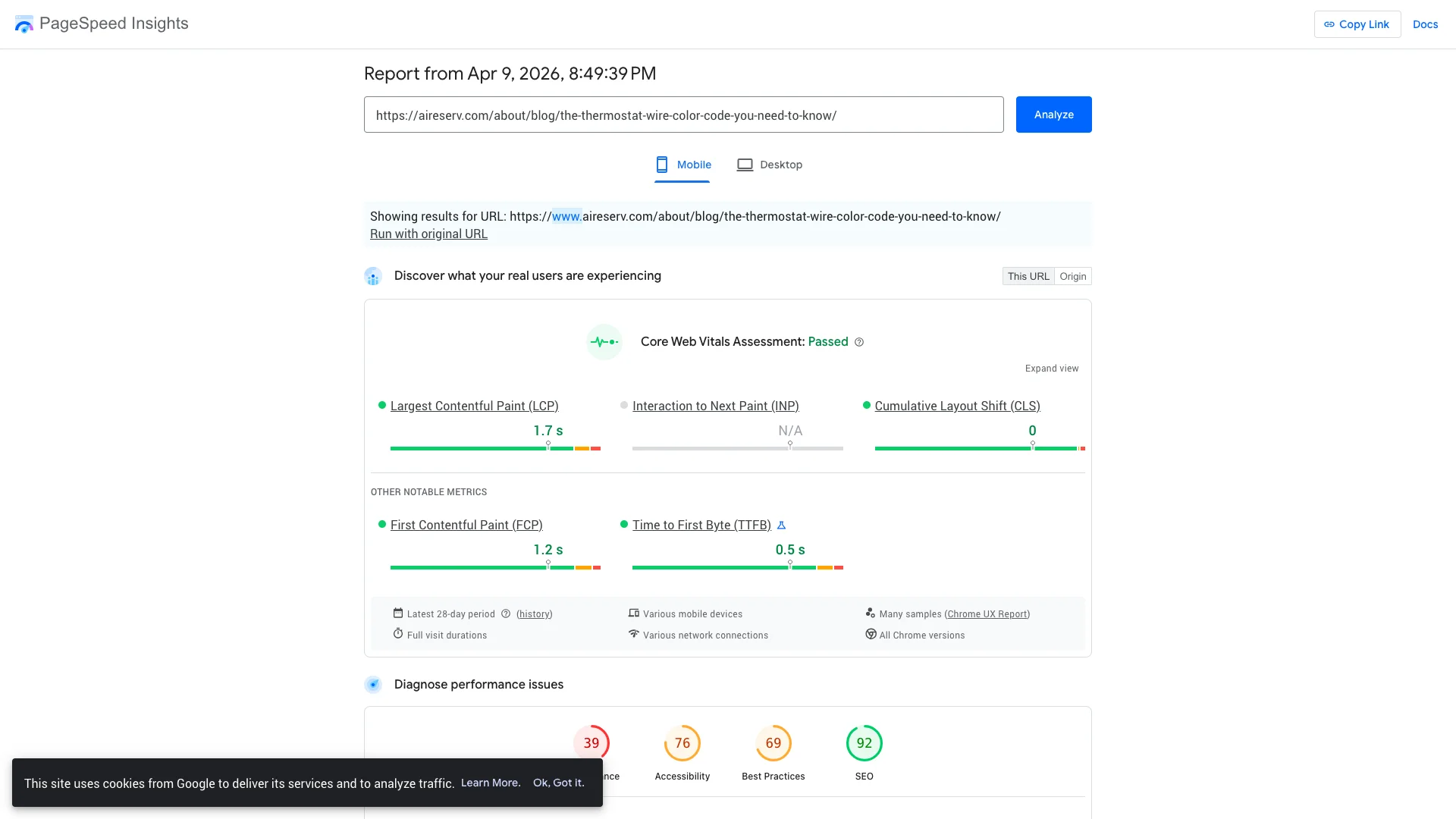
Quick note on what these numbers actually mean before we dig in. Google PageSpeed Insights runs a lab test that simulates a mid-range Android phone on a throttled 4G connection. It's a worst-case scenario, not what you see when you open the site on your iPhone 15 on WiFi. The site probably "seems fine" to you. That's fair. But Google uses these lab scores as a ranking factor, and the worst-case scenario is exactly what the homeowner on a rural LTE connection or an older phone actually gets.
With that framing: the Aire Serv thermostat blog scored 32 out of 100 on mobile performance. The commercial HVAC page also scored 32. The Middletown duct cleaning page scored 42. Two of the three highest-traffic pages on a $356K traffic value site are sitting in the red zone on Google's own measurement. That's a ranking penalty Aire Serv is eating on every query those pages compete for, and it's the kind of penalty that compounds over time as Google's algorithm leans harder on Google's page-quality check.
"53% of mobile users abandon sites that take longer than 3 seconds to load."
— Google / SOASTA (2017)
For the homeowner on a good connection, the page still loads. Maybe in two or three seconds instead of sixteen. For the homeowner on a bad connection (weak cell signal, crowded WiFi, an older device), the experience is closer to what the lab shows: a long wait, then content dribbling in. That's the slice of users getting the worst of it, and it's not trivial. A meaningful chunk of mobile HVAC searches come from people standing in an attic or a basement or a yard, which is where the signal is usually weakest and where a slow page becomes a dead page.
The duct cleaning page is the fastest of the three in the lab test, at 42/100. Better than the brand templates above it, which is unusual. Usually location pages are heavier and slower, not lighter. Whoever built the Middletown template stripped out some of the scripts and tracking tags that are slowing down the thermostat blog and the commercial HVAC page. Proof that the franchise CAN build a faster template. They just haven't rolled it out everywhere.
What's more useful than fixating on the scores is what the scores are penalizing. When the lab runs slow on a page, it's because the browser is chewing through a lot of work before it can paint. Usually that work is: third-party trackers (analytics, ad pixels, retargeting scripts) (analytics, ad pixels, retargeting scripts), large unshrunk images, scripts that stall the page, and custom fonts that load slowly. On the Aire Serv thermostat blog, all four of those are happening at once. A developer who cared could cut the score in half in a day by deferring the scripts and compressing the hero image. It's not that hard a problem. It's just not on anyone's priority list at the franchise.
Lead capture: zip code searches and contact forms, spread across five form instances
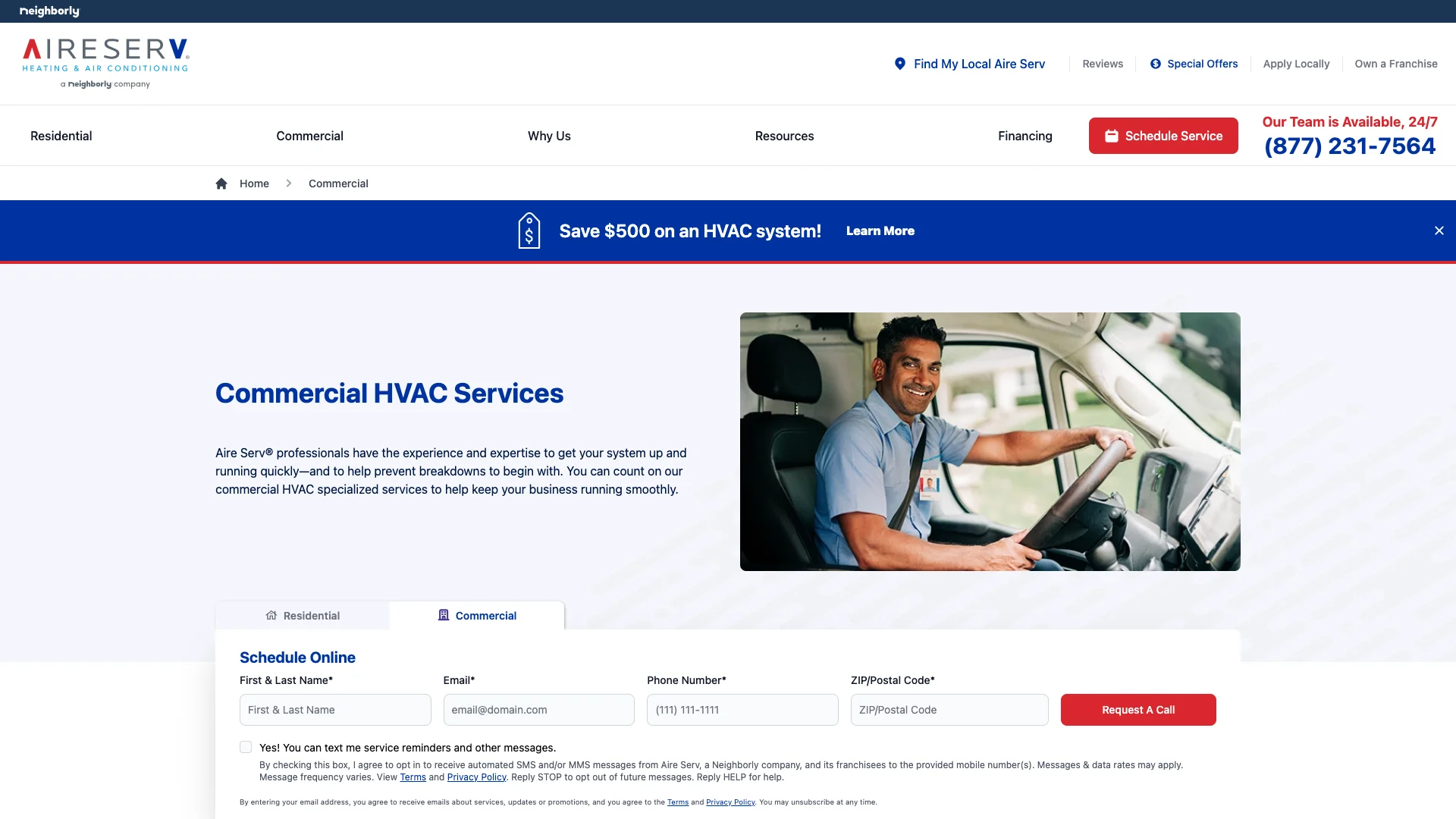
The form audit on Aire Serv is where the franchise template starts showing its age. The thermostat blog page carries five form instances on the page. Not five unique forms, five instances. Here's the breakdown:
- A 1-field zip search (placeholder "Enter ZIP Code") at the top of the page
- A 5-field combo with four text inputs and a select dropdown, which looks like a multi-step lead qualifier
- A 6-field contact form: first and last name, email, phone, zip, a checkbox, and a hidden text field
- A second 6-field contact form, identical to the first, rendered elsewhere on the page
- A second 1-field zip search (placeholder "Enter ZIP/Postal Code") at the bottom
So the template is rendering the same zip code search twice and the same 6-field contact form twice on one long blog post. That's not five unique conversion paths. That's one zip search, one contact form, and one mystery 5-field qualifier, each duplicated so the homeowner encounters them multiple times as they scroll. Which might be intentional (give the reader the form wherever they stop scrolling) or might be a template artifact (the sidebar and the footer each render their own form instance without deduplication). Either way, the page source is heavier than it needs to be.
The CTA inventory is broader: Schedule Service, Find My Local Aire Serv, Apply Locally, Call Us, Contact Us, Find Local Help, Find Nearest Location, and a text link that reads "request professional thermostat installation." That last one is the single CTA that would actually solve the homeowner's problem on the thermostat blog, and it's a text link in the body copy, not a button. The page that should be funneling DIY-stuck homeowners into a service call buries the relevant conversion path in a paragraph of supporting text.
"68% of users would not submit a form if it required too much personal information."
— Baymard Institute (2024)
The 6-field form is also a friction question. Name, email, phone, zip, plus a checkbox and one more text input. Most of the high-converting HVAC lead forms we audit run three or four fields, not six. Adding two more fields to the minimum viable contact form pushes friction up without an obvious payoff. The checkbox is probably a consent toggle. The extra text input is probably a message field. Both are things the homeowner can fill in after the initial contact. On a page where every second of friction costs conversion, the template is adding friction instead of removing it.
Trust signals: missing on two of three pages
The thermostat blog came back empty on the trust signal audit:
- BBB badge: Not found.
- Google Reviews widget: Not found.
- Review count: Not found.
- Trust badges: Not found.
- Certifications: Not found.
- Chat widget: Not found.
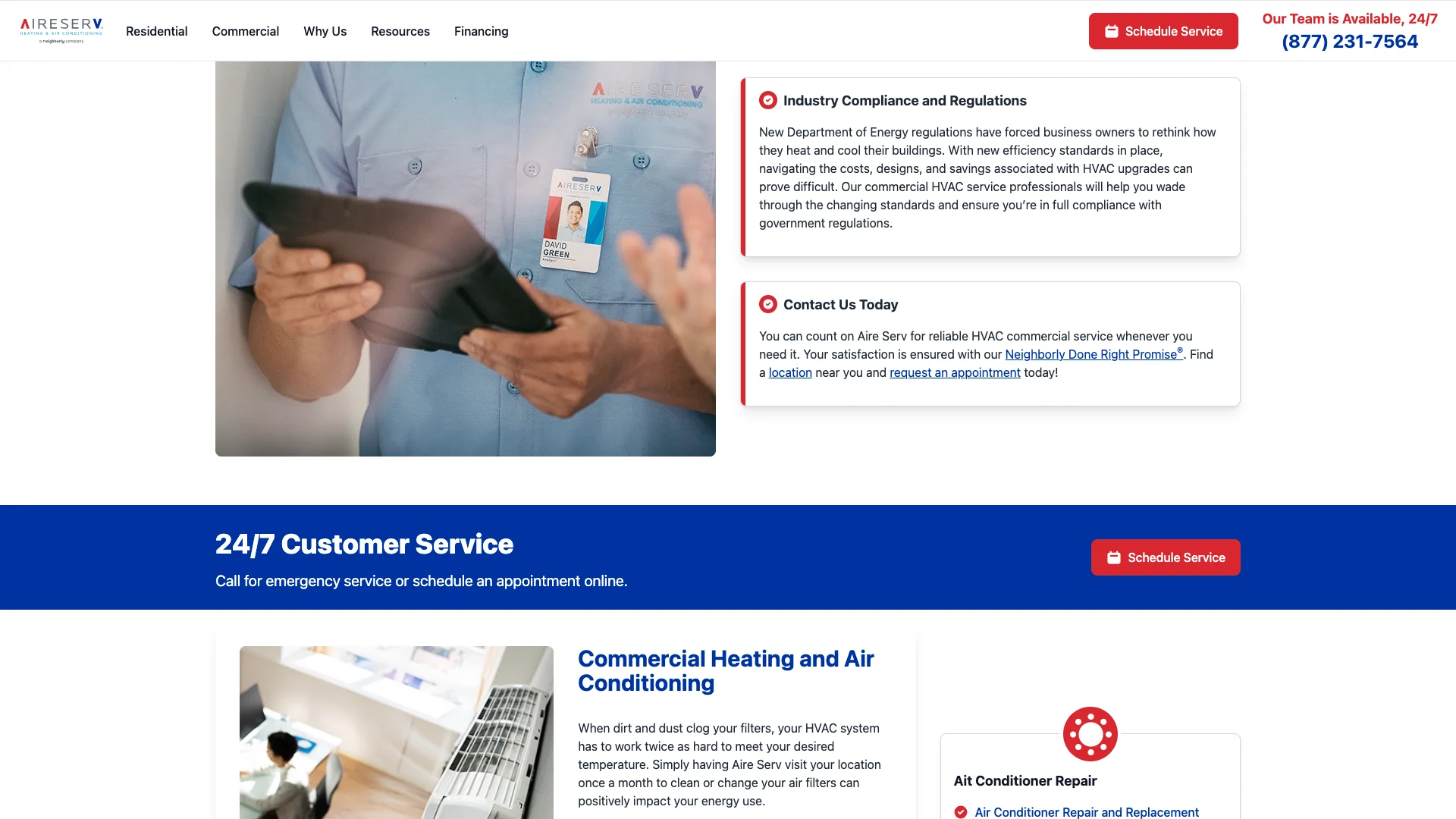
The commercial HVAC page tells a different story. It renders customer reviews directly on the page, with star ratings and review text visible to visitors who scroll past the service content. So the franchise does have a review display system. It's just not present on the thermostat blog, which is the page pulling 6K monthly visitors. The page with the most traffic has zero social proof. The commercial page, with 3.7K visitors, has reviews but buries them below the fold.
So a homeowner hits the thermostat blog from a Google search, fights through the 16.2-second load, and has nothing on the page to anchor the question of whether Aire Serv is a real, accredited, well-reviewed business or just another contractor site to bounce from. No reviews. No BBB. No certifications. No trust badges. The only social proof on the page is the Aire Serv brand name itself, which does some work (it's a recognizable franchise brand under a parent company most homeowners have heard of), but it's the only proof on the page.
Comparison
"83% of consumers use Google to find local business reviews; 74% use two or more review platforms when researching."
— BrightLocal (2025)
The Middletown duct cleaning page is the exception. That one carries trust badges and, more importantly, it has a hidden label in the code that tells Google "this is an HVAC business" (the only page in the set with that label). Why that one page and not the others? Best guess: someone built a newer location-page template that includes the behind-the-scenes tags and the badge module, and the brand-level templates were never updated to match. Or it's a different team entirely. Either way, the inconsistency is the story. A homeowner browsing two pages on the same site shouldn't see a different trust signal stack on each one.
Here's what that means in plain terms. Every page can carry hidden labels in the code that tell Google what kind of content it is: "this is an article," "this is a business," "this is a service page," "this is an HVAC business," "this is a FAQ section." Search engines use those labels to decide which pages to show for which searches. The thermostat blog and the commercial page on Aire Serv only carry ONE label: "this page is part of a site." Nothing about what kind of business Aire Serv is. Nothing about the article being an article. Nothing about the FAQ-style content being a FAQ (even though it is). The Middletown duct cleaning page is the exception. It carries the "HVAC business" label plus the site-hierarchy label. Google knows that one page is an HVAC service location, and Google doesn't know that about the other two. On a franchise site where the entire SEO strategy depends on showing up for local HVAC searches, that's a meaningful miss.
What Aire Serv does well
A teardown that just lists problems isn't useful. Aire Serv does some things right, and the things they do right are worth lifting, especially if you're a local HVAC contractor competing in their markets.
Content depth on every page tested. The thermostat blog is 3,717 words. The commercial page is 3,209 words. The Middletown duct cleaning page is 3,730 words. Those aren't placeholder pages. They're substantial, keyword-rich service and education content with the kind of word counts Google's algorithm tends to reward for service intent. Whoever owns content over there is shipping real volume, and the long-tail SEO footprint on the site shows it.
Internal linking density. 141 links on the thermostat blog. 171 on the commercial page. 149 on the duct cleaning page. That's a deliberate cross-linking strategy that passes equity between blog content, service pages, and location pages. It's also part of why the franchise dominates long-tail HVAC search the way it does. Internal links are free, and Aire Serv is using a lot of them.
The HVAC business label on the duct cleaning page. One page on the entire site has a hidden code label that tells Google "this is an HVAC business in this specific location," and the Middletown duct cleaning page is the one that has it. Google officially supports an "HVAC Business" label type for trade contractors, and most contractor websites do not use it. Aire Serv does on at least one page, which is more than most contractor sites we audit manage. If you are an HVAC contractor and your site does not tell Google what kind of business you are, that is a low-cost, high-leverage thing for your developer to fix in an afternoon.
Phone number in nav, CTA in nav. Both the (855) 679-0011 phone number and the primary CTA appear in the main navigation on every page tested. That's a conversion-focused nav design. The visitor doesn't have to scroll to find a way to take action. That part is right.
"64% of homeowners say having recommendations or references is a top-three factor in choosing a contractor."
— Houzz Inc. (2025)
What the gaps mean for local HVAC contractors
Aire Serv is a franchise. You're independent. And the gaps in their build are gaps you can close in a couple of weeks of focused work, without a national brand budget.
Beat their PageSpeed score and stop eating the ranking penalty. Aire Serv scored 32/100 on Google's lab test on two of the three pages we audited. That score hurts their search rankings. Yours should be 85+ (Google's acceptable limit). The gap is mostly third-party tracking scripts, large unshrunk images, and custom fonts that load slowly. Compress every image on every page to under 100KB. Defer non-critical JavaScript so it loads after the page paints. Audit every third-party tracker you've installed in the last twelve months and delete the ones you're not using. That's a one-day day of focused work, and it's the single cheapest way to outrank a franchise on Google Maps and local search.
Display Google Reviews on every service page. Aire Serv has zero reviews rendered on the two brand-level pages we tested. Yours should have a Google Reviews widget right under the headline. Not in the footer. Not buried. Above the fold. With the star count. With the review count. With a link to read the full reviews. 83% of consumers use Google to find local business reviews (BrightLocal 2025). Bring the proof to the page they're already on.
Tell Google what kind of business you are on every page. Aire Serv has the "HVAC business" code label on one page and nowhere else. Your site should tell Google you are an HVAC business on every service page, describe each service offering with its own label, mark any FAQ sections as FAQs so Google can pull them into search results, and mark your location pages with your business name, address, and phone. These are hidden labels that Google reads automatically. They are free to add. They take one afternoon of focused work from a developer who knows what they are doing. And most of your competitors are not running them.
Simplify the form inventory. Aire Serv's thermostat blog carries five form instances. Yours shouldn't need more than two: one primary contact form (3 fields, above the fold) and one zip search for location routing if you operate in multiple markets. Don't duplicate the contact form at the top and bottom of the page, don't add a mystery 5-field qualifier in the middle, don't bury the relevant CTA as a text link in the body copy. One form, one CTA, repeated in two obvious places. That's enough for 80% of HVAC visits.
"48% of customers say that if a site does not work well on mobile, it signals the company does not care about their business."
— Google Consumer Insights (2018)
The positioning angle is straightforward. Aire Serv has the franchise brand and the long-tail SEO footprint. You don't. But you can have the things they're missing: a Google Reviews widget right where the homeowner is making the decision. A hidden code label telling Google "this is an HVAC business" on every service page, not just one. A single contact form that lets the visitor leave their information in three taps. And a PageSpeed score that isn't quietly hurting your search rankings every time Google crawls your site. Those things are not expensive. They're a Tuesday afternoon and a developer who cares about details.
Frequently asked questions
What is Aire Serv's Google PageSpeed Insights score?
Two of three pages we tested scored 32 out of 100 on Google PageSpeed Insights mobile as of March 29, 2026: the thermostat blog and the commercial HVAC page. The Middletown duct cleaning page scored 42 out of 100. All three sit well below Google's acceptable limit of 90. These are lab scores on a simulated mid-range Android phone, which Google also uses as an ranking factor. On modern phones with strong connections, the pages load in two to three seconds. On older devices, weak cell signals, or crowded WiFi, the experience gets closer to what the lab reports.
Does Aire Serv display Google Reviews on their service pages?
The thermostat blog has zero trust signals: no Google Reviews, no BBB badge, no trust badges, no review widgets, no review count. The commercial HVAC page does render customer reviews with star ratings, but no BBB badge or third-party trust badges. And the Middletown duct cleaning page carries trust badges plus an HVAC-business label in the code. So the franchise has a review system, it just isn't deployed on the highest-traffic page in the set.
Does Aire Serv tell Google what kind of business they are?
Only on one of the three pages we audited. The Middletown duct cleaning page carries a hidden code label telling Google it is an HVAC business. The thermostat blog and the commercial HVAC page only tell Google where the page sits in the site hierarchy, and nothing else. No "this is an article" label on the blog. No "this is a business" label on the commercial page. No "this is a FAQ section" label on either, despite the FAQ-shaped content. So only one of three pages on a major HVAC franchise tells Google specifically what kind of business runs it.
How much organic traffic does aireserv.com get?
According to Ahrefs data from our March 2026 collection, aireserv.com receives approximately 114.8K monthly organic visitors with an estimated traffic value of $356.6K. The thermostat color code blog accounts for 6K of that (6% share), the commercial HVAC page accounts for 3.7K (4%), and the Middletown duct cleaning page accounts for 3.4K (3%). Across just those three pages, that's 13.1K monthly visitors, about 11% of total site traffic, landing on pages that score between 32 and 42 out of 100 on mobile performance.