What we found on westshorehome.com
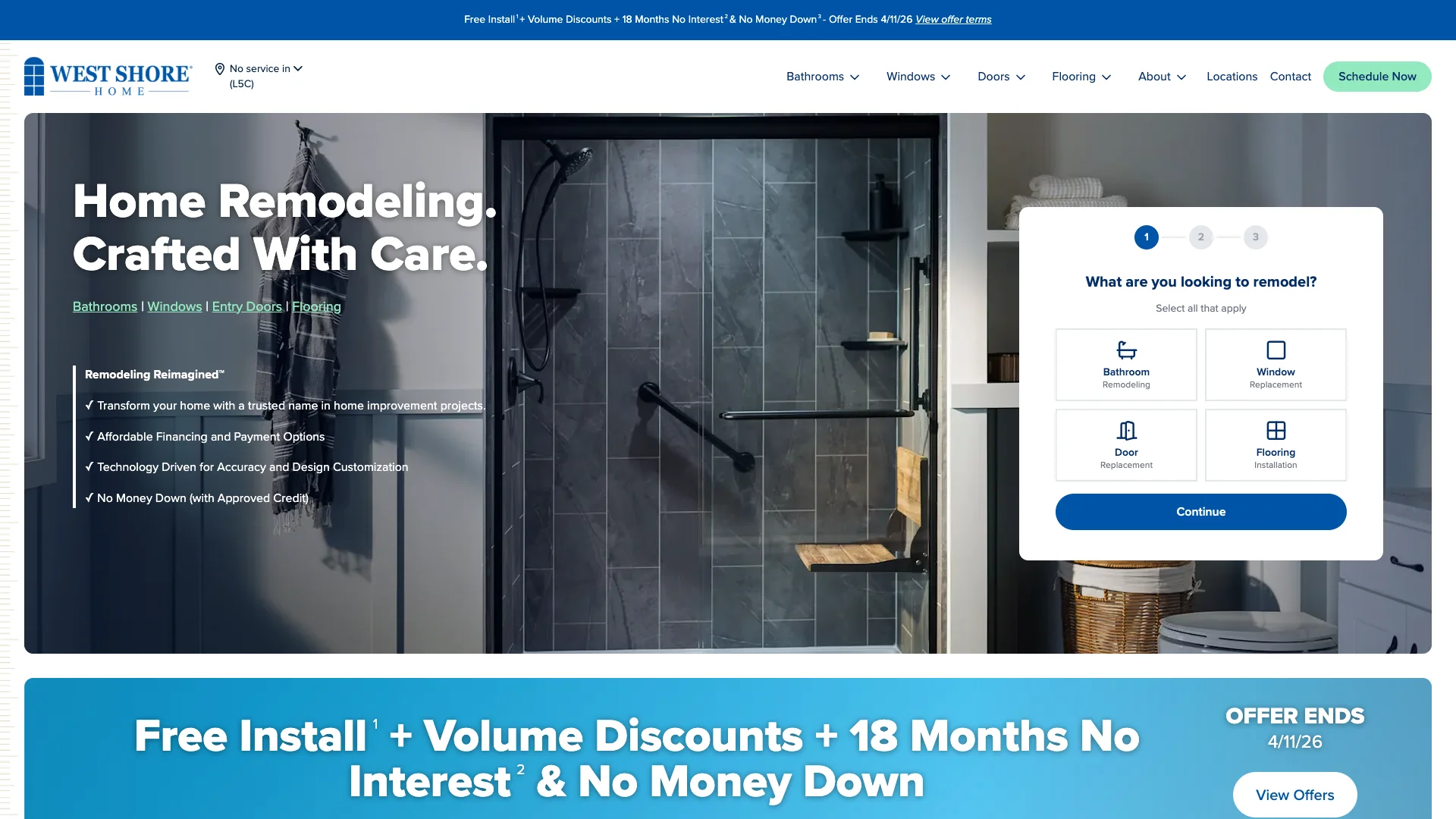
West Shore Home specializes in bathrooms, windows, and doors. According to Ahrefs, the domain pulls 52.7K monthly organic visitors with an estimated traffic value of $229.6K.
So we ran three pages through our standard teardown protocol. And the first number that came back made us check the API response twice.
68.5 seconds.
That's not a typo. The bathroom remodeling page — their highest-traffic service page, the one that gets 7,700 monthly organic visitors — takes 68.5 seconds to render its main content on a simulated mobile device. Over a minute. You could microwave a burrito in less time than it takes this page to load.
The pages we tore down:
- /bathroom-remodeling/ — their main service page (7.7K monthly organic visitors, 16% traffic share)
- /read-reviews/ — the reviews page (2.2K monthly organic visitors, 5% traffic share)
- /locations/tampa-fl/ — the Tampa franchise page (1.7K monthly organic visitors, 4% traffic share)
Comparison
"84% of homeowners hire professionals for their bathroom renovation, most commonly general contractors (45%)."
— Houzz Inc. (2025)
Performance: a 68-second wait
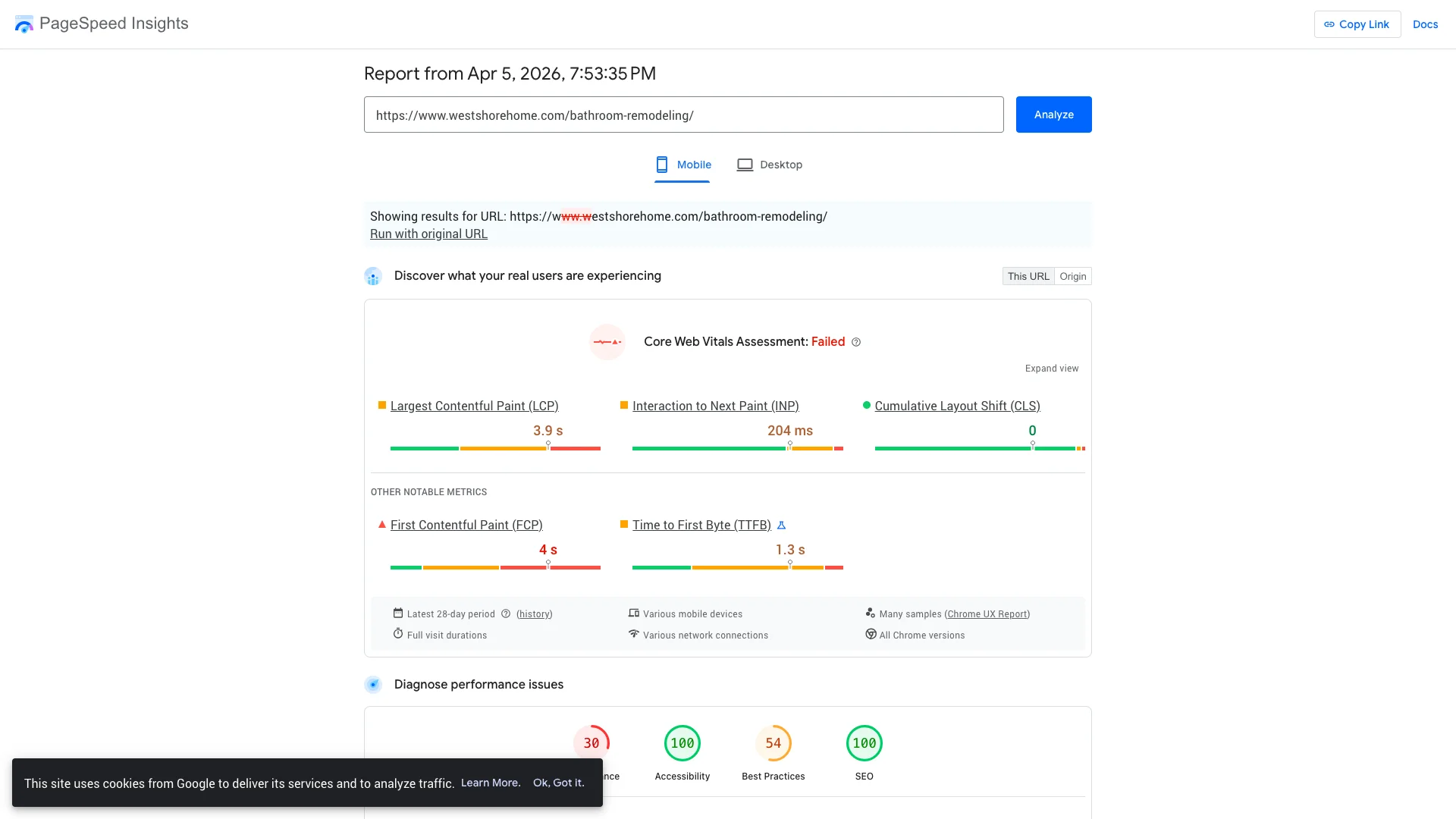
Let's be specific about what "68.5-second LCP" means. Largest Contentful Paint is the metric Google uses to measure when the page's main content is visually complete. On the bathroom remodeling page, that main content — the hero image, the headline, the primary content block — doesn't finish rendering until 68.5 seconds after the page starts loading. First Contentful Paint (when anything at all appears) is 14.7 seconds. Speed Index is 14.7 seconds. TBT is 1,287ms.
But the performance score is 30/100. How does a page with a 68.5-second LCP score 30 instead of single digits? Because Lighthouse weights multiple metrics, and some of West Shore Home's other numbers are less catastrophic. The CLS is 0.000 (no layout shift on this page), and the TBT is relatively low at 1,287ms. So the composite score lands at 30 instead of near zero.
Reviews page (/read-reviews/): Performance score 20/100. LCP of 19.6 seconds. FCP of 13.9 seconds. CLS of 0.182 — seven times the "good" threshold of 0.025. TBT of 1,838ms. This is the page where homeowners go to read what other customers think. And the layout shifts enough to earn a 0.182 CLS, meaning content visibly rearranges as the page loads. When you're trying to read a review, the text jumps. That's not a great experience for building trust.
Tampa location page (/locations/tampa-fl/): Performance score 32/100. LCP of 24.2 seconds. FCP of 18.1 seconds. CLS of 0.000. TBT of 1,130ms. Speed Index of 18.1 seconds.
One bright spot across all three: accessibility scores of 100/100. Every single page we tested scored perfect on accessibility. That's rare. And it means West Shore Home's development team is paying attention to screen reader compatibility, heading structure, color contrast, and interactive element labeling. They just aren't paying the same attention to load times.
Compounding effect
"Conversion rates drop approximately 12% for each additional second of page load time."
— Google / Deloitte (2020)
Form friction: 9 fields with product checkboxes
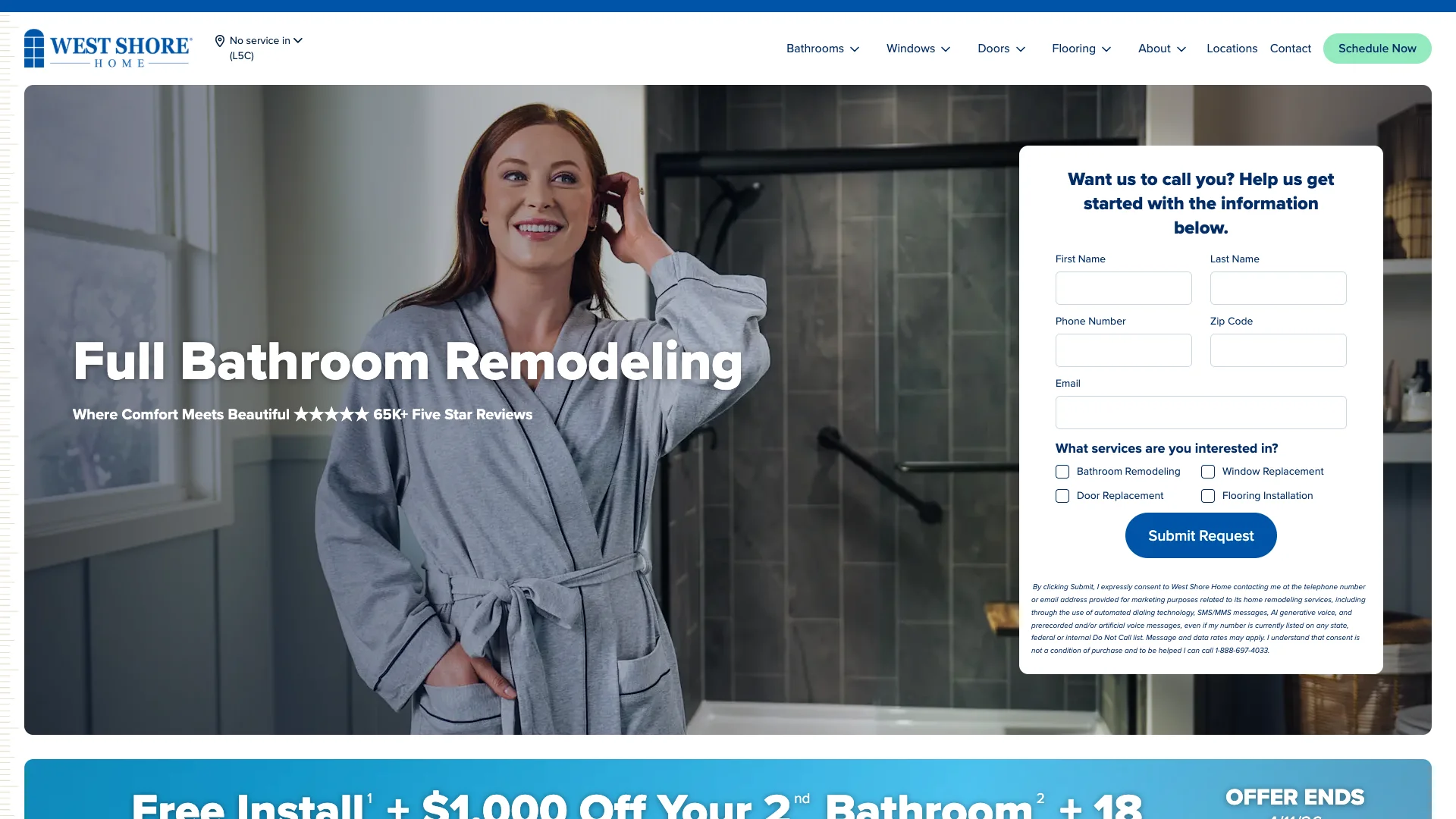
The bathroom remodeling and Tampa location pages each carry two instances of the same form. Nine fields: first name, last name, phone, zip code, email, and four product-interest checkboxes (Bath, Windows, Doors, Other). The checkboxes are a segmentation play — they route leads to the right department before anyone picks up the phone.
And honestly? The form design itself isn't terrible. Five text fields plus four checkboxes is more manageable than a 15-field monster. The checkboxes don't require typing. They're quick taps on mobile. And the CTAs are varied: "Schedule Now," "Submit Request," "Get My Free Quote," "Schedule My Consultation." Different labels for different intent levels. That shows some thought about conversion paths.
But the reviews page has no form at all. A homeowner reads reviews, gets convinced, and then... has to navigate elsewhere to convert. There's no "Ready to get started?" form below the reviews. There's a "Schedule Now" button in the sticky nav, but that's a navigation element, not an embedded conversion point on the page itself. For a page designed to build trust and push homeowners toward action, the absence of an inline form is a missed conversion touchpoint.
"In a usability study of digital form formats, the single-page layout achieved higher usability (average SUS=76) than multi-page (SUS=67) and conversational formats (SUS=57), and had the shortest completion time."
— JMIR Human Factors (via ScienceDirect) (2021)
Trust signals: present on some pages, gone on others
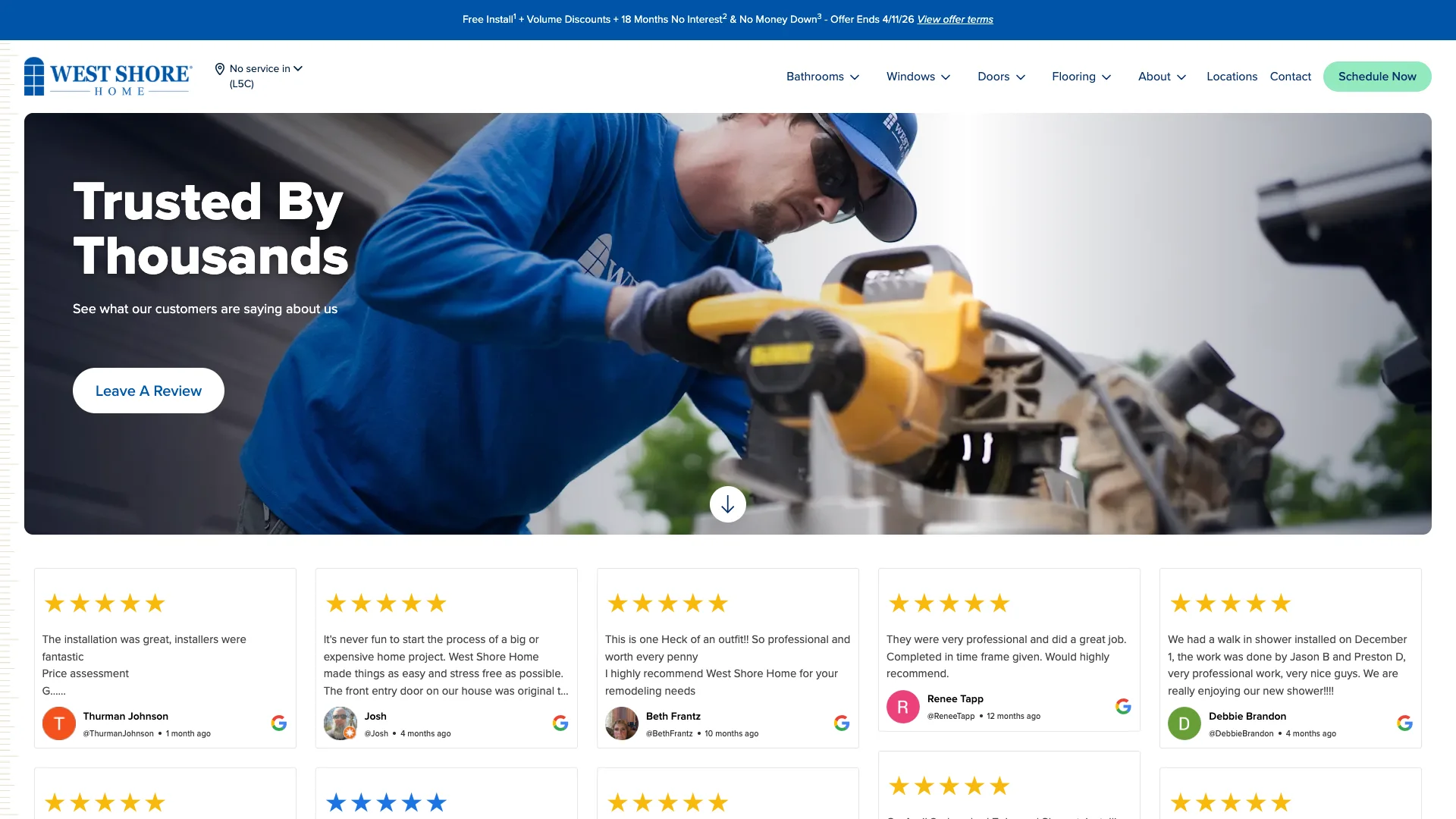
West Shore Home's trust signal situation follows the same pattern we saw with Re-Bath: good on some pages, missing on others.
The Tampa location page has everything you'd want. BBB badge: present. Google Reviews widget: present. Trust badges: present. Review count: 692. That's a page that tells a homeowner, "real people used this company and reviewed it, and a third-party organization certifies it." That's the standard every page should meet.
But the bathroom remodeling page — the page with 4.5 times the traffic of the Tampa page — drops the BBB badge and trust badges. Google Reviews widget is still there, review count still shows 692, but the third-party verification signals are gone. And the reviews page itself (the one literally dedicated to showing reviews) has the Google Reviews widget but no BBB badge and no trust badges.
So a homeowner's journey looks like this: they land on the bathroom remodeling page and see Google reviews but no BBB badge. They click through to the reviews page and see more Google reviews, still no BBB. They then navigate to their local page (Tampa) and suddenly there's a BBB badge. The signal inconsistency raises a question the homeowner shouldn't have to ask: does this company actually have BBB certification everywhere, or just on some pages?
"91% of consumers say that local branch reviews of a multi-location brand impact their overall perceptions of big brands in some way."
— BrightLocal (2024)
And here's a gap that's easy to miss: zero schema markup on all three pages. No LocalBusiness schema. No Review schema. No FAQPage schema. No BreadcrumbList. Nothing. That means Google has no structured data to work with for rich results — no star ratings in search, no FAQ dropdowns, no service area information baked into the SERP. For a multi-location company, missing LocalBusiness schema is leaving local search visibility on the table.
What West Shore Home does well
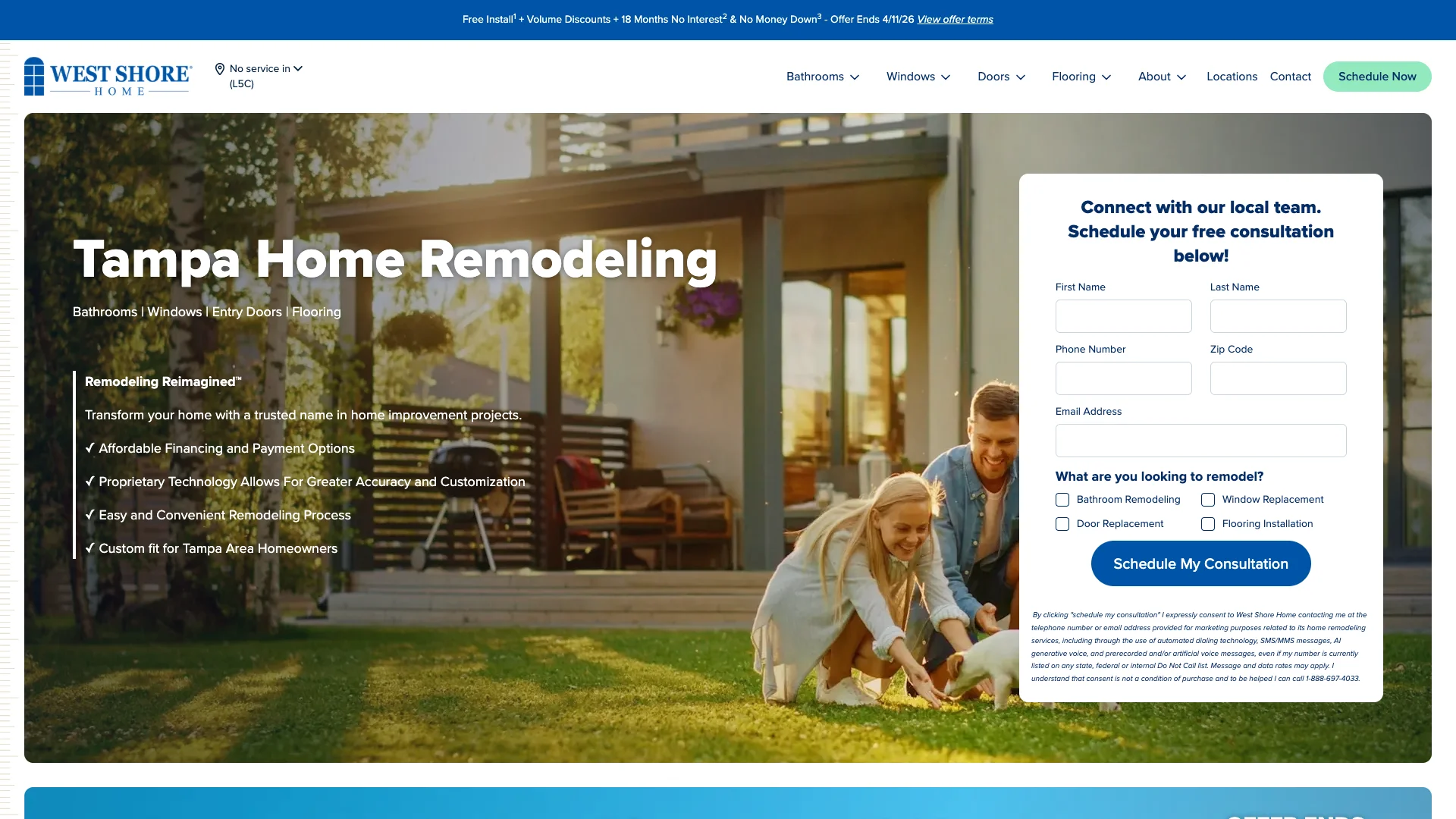
Despite the performance numbers, West Shore Home gets several things right.
Perfect accessibility. 100/100 on all three pages. That's not an accident. It means every image has alt text, every heading follows sequential order, every interactive element is labeled, every color contrast ratio passes WCAG standards. We've audited dozens of contractor sites. Most score in the 70s and 80s. Scoring 100 on three different page templates means accessibility is built into their development process, not patched on after the fact.
Sticky navigation with CTA. The nav sticks to the top as you scroll, keeping the "Schedule Now" button and phone number visible at all times. That's a conversion micro-optimization that most contractor sites skip. If you're scrolling through content and decide you want to call, the number is right there. No scrolling back up.
Multiple phone numbers on location pages. The Tampa page shows four phone numbers: a corporate number (717-697-4033), a toll-free number (888-697-4033), and two local numbers. Having a local area code number alongside the toll-free option signals local presence. And 692 Google reviews displayed with the widget gives social proof with a specific number, not a vague "trusted by thousands."
Product checkboxes in the form. Those Bath/Windows/Doors/Other checkboxes do double duty — they segment the lead for internal routing AND they reduce follow-up friction. When a rep calls back, they already know what the homeowner wants. That's a small detail that improves the sales conversation downstream.
Spending comparison
"The median spend on major bathroom remodels was $22,000 in 2024 (up from $21,000 in 2023)."
— Houzz Inc. (2025)
What the gaps mean for local bathroom contractors

West Shore Home's 68.5-second LCP is the kind of number that makes you check the data twice. And then a third time. But it's real, and it's an opening for every local bathroom contractor competing in their markets.
Speed wins emergency intent. A homeowner dealing with a bathroom renovation isn't usually in emergency mode — they're in research mode. They're comparing. They're browsing multiple sites. And if your site loads in 2 seconds and West Shore Home's takes 68, the comparison happens before the homeowner finishes reading their first paragraph on westshorehome.com. Score 85+ on PageSpeed. That's the bar.
Schema markup is free visibility. West Shore Home has zero structured data on the three pages we tested. If you add LocalBusiness schema, Review schema, and FAQPage schema to your service pages, you're giving Google information that West Shore Home isn't. Star ratings in search results. FAQ dropdowns. Service area information. Those rich results get clicks that plain blue links don't.
Consistent trust signals on every page. West Shore Home's BBB badge appears on location pages but drops off service pages. Your BBB badge, Google review count, license number, and insurance details should appear on every single page. No exceptions. A homeowner shouldn't have to navigate to a specific page to find proof that you're legitimate.
Put a form on the reviews page. If you have a reviews or testimonials page, add a lead form directly below the reviews. The homeowner just read proof that you do good work. They're primed. Don't make them navigate somewhere else to convert. West Shore Home's reviews page has no form. Yours should.
"68% of homeowners consider special needs (accessibility) when planning their bathroom projects."
— Houzz Inc. (2025)
And steal the one thing West Shore Home actually nails: accessibility. Their 100/100 scores mean every element on every page is usable by everyone, including homeowners using screen readers, voice commands, or keyboard navigation. Most contractors treat accessibility as an afterthought. West Shore Home treats it as a standard. That's worth copying.
The median major bathroom remodel costs $22,000 (Houzz 2025). Every lead that bounces off a 68-second page load is a potential $22,000 job walking away. Your site doesn't need to match West Shore Home's brand. It needs to load faster, show trust signals consistently, use schema markup, and put a form where the homeowner is most ready to fill it out.
Frequently asked questions
What is West Shore Home's website performance score?
The bathroom remodeling page scored 30/100 on Google PageSpeed Insights (mobile) as of March 29, 2026, with an LCP of 68.5 seconds and FCP of 14.7 seconds. The reviews page scored 20/100 with a CLS of 0.182. The Tampa location page scored 32/100 with an LCP of 24.2 seconds. Accessibility was 100/100 across all three pages.
How many form fields does West Shore Home's website have?
West Shore Home uses a 9-field form on service and location pages: first name, last name, phone, zip code, email, and four product-interest checkboxes (Bath, Windows, Doors, Other). Two instances of this form appear on both the bathroom remodeling page and the Tampa location page. The reviews page has no form.
Can a local bathroom contractor compete with West Shore Home online?
Yes. West Shore Home has brand recognition and a national presence, but their website has measurable structural gaps: a 68.5-second LCP on their top service page, inconsistent trust signals across page types, zero schema markup, and no form on their reviews page. A local contractor with a fast-loading site, consistent BBB badge and review count on every page, LocalBusiness schema markup, and a post-reviews lead form has a better digital infrastructure than West Shore Home currently deploys.
How much organic traffic does westshorehome.com get?
According to Ahrefs data from our March 2026 collection, westshorehome.com receives approximately 52.7K monthly organic visitors with an estimated traffic value of $229.6K. The bathroom remodeling page accounts for 7.7K of that (16% share), the reviews page accounts for 2.2K (5%), and the Tampa location page accounts for 1.7K (4%).