What we found on warnersdecking.com
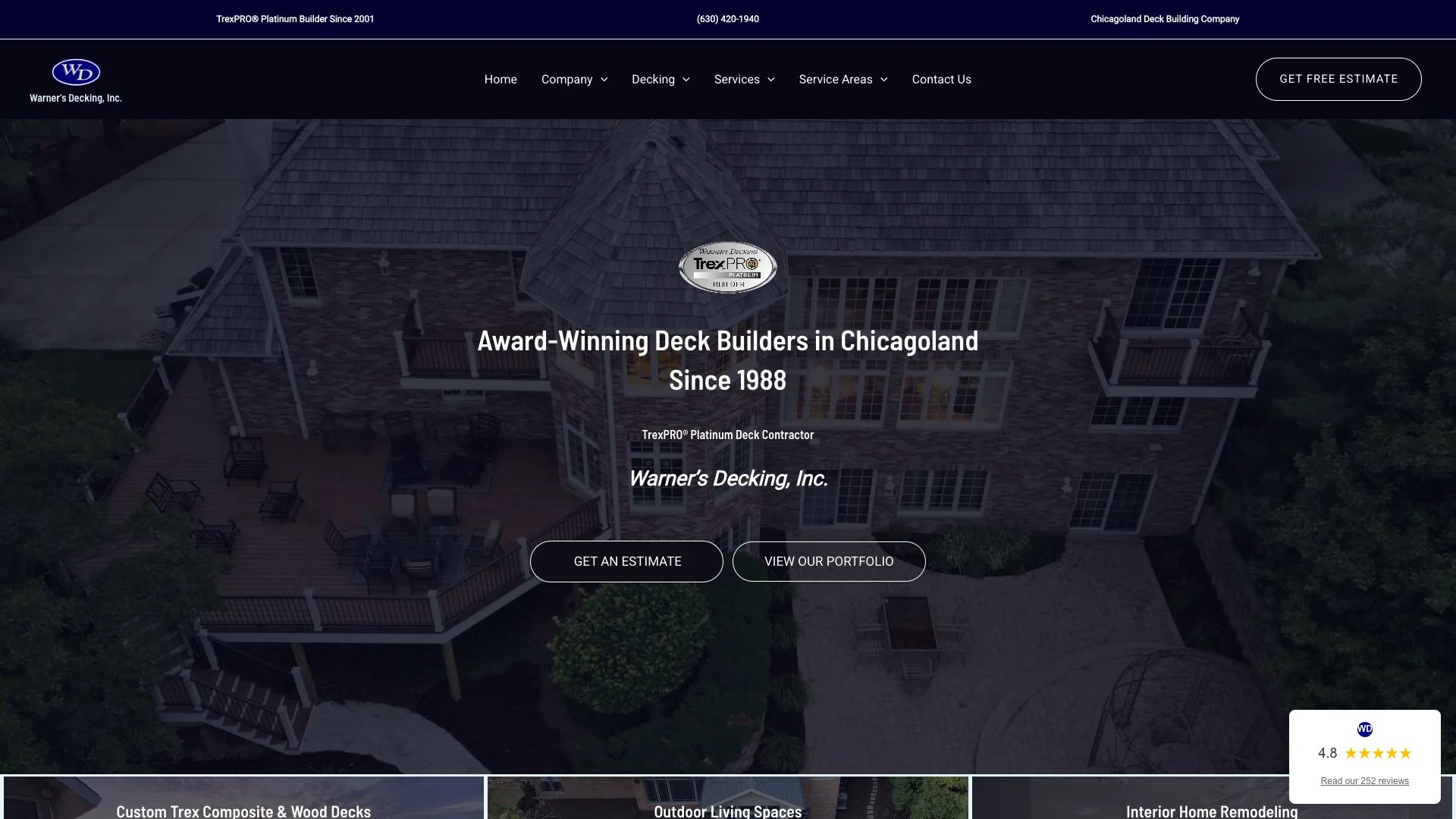
Warner's Decking is a deck builder pulling 2.1K monthly organic visitors with an estimated traffic value of $1,500. And by the numbers alone, it looks like just another small contractor site. But this teardown tells a completely different story. Warner's Decking is the best-executed small brand in the entire CRO Index series.
The pages we tore down:
- Tech vs Trex blog, a comparison blog post pulling 590 monthly organic visitors (29% traffic share, scored 55 on Google's mobile lab test, layout shift 0.000)
- How much does Trex cost blog, a pricing-focused blog post pulling 315 monthly visitors (16% share, scored 48, layout shift 0.000)
- Deck skirting ideas blog, a design inspiration post pulling 194 monthly visitors (10% share, scored 42, layout shift 0.144)
So what makes Warner's Decking the gold standard? Google Reviews are TRUE with 252 reviews rendered on ALL pages. Trust badges appear on ALL pages. The hidden code labels (the invisible markup Google reads to understand your business) include HomeAndConstructionBusiness, GeneralContractor, FAQPage, BlogPosting, and Person. That's the most complete label setup we've audited across every brand in this series. And layout stability is perfect on two of three pages.
All three top pages are blog posts. That's a content-first strategy working exactly as intended. The Tech vs Trex comparison blog alone pulls 29% of all organic traffic. A single blog post earning almost a third of total visitors. And the homeowners finding these pages are searching purchase-intent queries: "is Trex worth it," "how much does Trex cost," "deck skirting ideas." These aren't casual browsers. They're people thinking about building a deck.
"25% of homeowners say trusting contractors is their top challenge when planning home improvement projects."
— Houzz Inc. (2025)
Performance: 42 to 55 on Google's mobile lab test
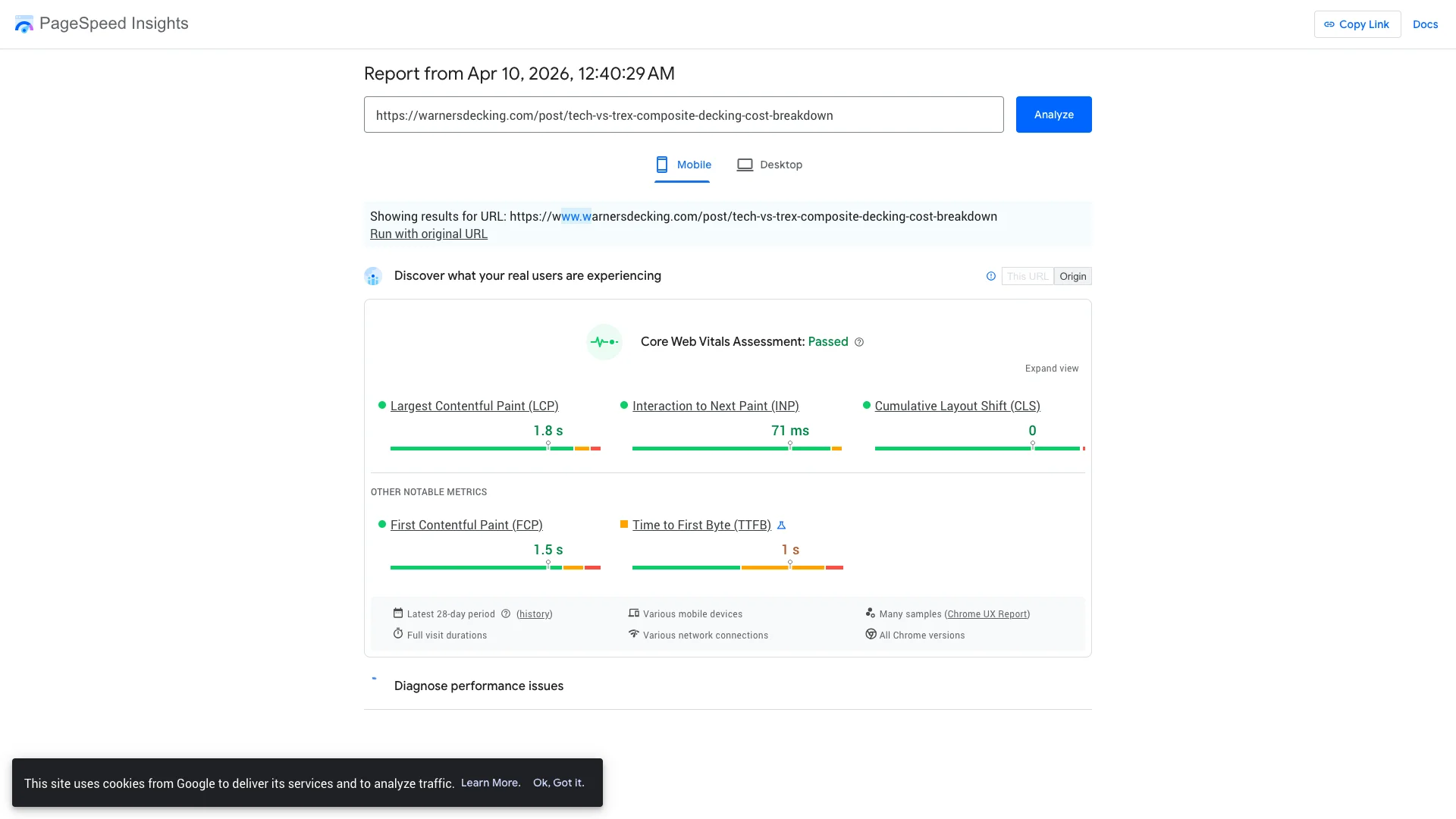
Google's mobile lab test simulates a slow phone on a throttled connection. The scores are worst-case, not what you see browsing on your own phone with WiFi. But Google uses them as a ranking factor in search results, so they matter whether you like it or not.
The Tech vs Trex blog scored 55 out of 100. That's the highest score in this batch, barely scraping into the orange zone. The Trex cost blog scored 48. The deck skirting ideas blog scored 42. All three are below the green threshold (90+), and all three are taking some search-ranking penalty because of it.
But here's the context that matters. Scores between 42 and 55 aren't catastrophic. They're in the "needs work but isn't broken" range. Compare that to Presidential Pools (27-33) or some of the franchise brands in the series that score in the low 20s. Warner's Decking isn't winning any speed awards, but it isn't getting crushed either.
"53% of mobile users abandon sites that take longer than 3 seconds to load."
— Google / SOASTA (2017)
The layout stability numbers are where Warner's Decking separates itself. The Tech vs Trex blog scores 0.000. The Trex cost blog scores 0.000. Content doesn't jump around at all on those two pages. The skirting ideas blog is the exception, scoring 0.144 on layout shift. That's above the acceptable threshold (0.1), meaning content jumps around noticeably as that page loads. So two pages are perfect. One needs attention.
And the performance gap is fixable. Scores in the 42-55 range usually mean the pages are loading heavy images, third-party tracking scripts, or unoptimized fonts. Compressing the images, deferring non-essential scripts, and cleaning up font loading could push these pages into the 70-85 range. For a 2.1K-visitor site where every ranking position matters, that improvement would translate directly into more organic traffic.
The skirting blog's 0.144 layout shift is probably caused by images loading without defined dimensions or a widget that pops in after the page renders. Finding that single element and giving it a fixed size would bring the score below 0.1. One fix, one page, and all three pages hit clean stability.
Compounding effect
"Conversion rates drop approximately 12% for each additional second of page load time."
— Google / Deloitte (2020)
Lead capture: blog content driving traffic, but where do they go next?
All three of Warner's Decking's top pages are blog posts. That's worth pausing on. The Tech vs Trex blog alone drives 29% of total organic traffic. The Trex cost blog drives 16%. The skirting ideas blog drives 10%. So over half of all organic visitors are landing on blog content, not service pages.
And that changes the lead capture question entirely. A homeowner reading "Tech vs Trex" is in research mode. They're comparing materials, weighing options, trying to figure out what's worth the money. They aren't ready to call. But they might be ready to leave their name and email if you offered them something useful in return (a material comparison PDF, a cost estimator, a project planning checklist).
The same logic applies to the Trex cost blog. A homeowner searching "how much does Trex cost" is doing price research. They want a number. They want to know if Trex fits their budget. And after they get that answer, they need a next step. Right now, the next step is "call us." But a form asking "Want a custom estimate for your deck?" would capture the homeowner who isn't ready to talk yet but would respond to an email follow-up.
The skirting ideas blog targets a different intent entirely. A homeowner browsing skirting ideas is in the inspiration stage. They're looking at pictures, imagining what their deck could look like with different skirting options. They don't need a price quote yet. They need a "save these ideas" or "get more inspiration" action. An email signup embedded in the article ("Get our deck design guide with 40+ skirting photos") would capture that visitor and start a nurture sequence.
"68% of users wouldn't submit a form if it required too much personal information."
— Baymard Institute (2024)
The trust signals are doing the heavy lifting right now. Google Reviews with 252 reviews on every page. Trust badges on every page. So the homeowner who does decide to call has plenty of social proof. But the homeowner who isn't ready to call? They read the blog, learn something useful, and leave. A simple 3-field form (name, email, zip code) embedded in each blog post would capture that research-stage visitor and give Warner's Decking a follow-up path.
And there's no chat widget either. TrueDecks (321 monthly visitors) has a chat widget on every page. Warner's Decking (2.1K visitors) doesn't. So the only conversion path right now is a phone call. For blog readers at 9 PM on a Tuesday, that path doesn't work.
Trust signals: 252 Google Reviews on every page
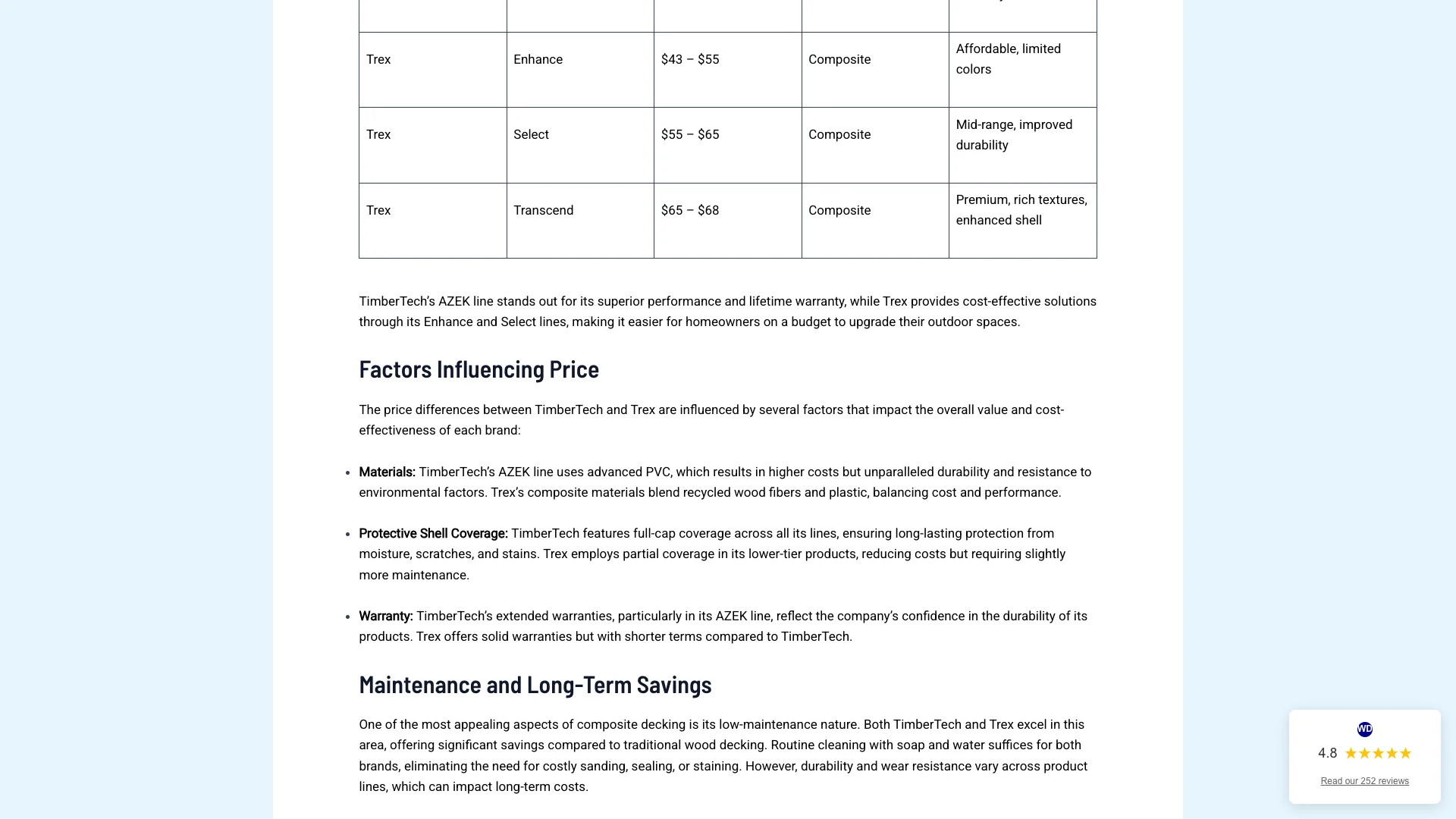
This is the section where Warner's Decking sets the standard. The trust signal audit across all three pages:
- Google Reviews: TRUE on all three pages, with 252 reviews displayed.
- Trust badges: Present on all three pages.
- Review count: 252, visible on every tested page.
- BBB badge: Not found.
- Chat widget: Not found.
- Certifications: Not found.
Two out of the six trust signal types are present on every page, and they're the two that matter most. Google Reviews with an actual count (not just a "we have reviews" claim, but 252 of them rendered and visible) plus trust badges. Compare that to Archadeck (zero trust signals on tested pages) or Bath Tune-Up (trust badges only). Warner's Decking, with 2.1K monthly visitors, is outperforming brands with 10x to 50x their traffic on the trust signal front.
And 252 reviews is a strong number for a local deck builder. That's not a number you accumulate by accident. That's years of asking satisfied customers to leave reviews, following up after projects, and making the review process easy. It signals to every homeowner who visits the site that this company has completed hundreds of projects and hundreds of people cared enough to rate their experience.
Comparison
"83% of consumers use Google to find local business reviews; 74% use two or more review platforms when researching."
— BrightLocal (2025)
And the hidden code labels are the real standout. Warner's Decking runs HomeAndConstructionBusiness, GeneralContractor, FAQPage, BlogPosting, and Person labels. That's five distinct label types telling Google exactly what this business is, what kind of content each page contains, who runs the company, and that some pages are structured FAQ content. Most contractor sites have zero or one. The bigger franchises in this series typically have two or three. Warner's Decking has five. It's the most complete label setup we've audited in the entire CRO Index.
The HomeAndConstructionBusiness label is particularly smart. It tells Google this isn't just a "local business" or a generic "organization." It's specifically a home and construction business. And GeneralContractor narrows it further. Google can surface Warner's Decking for contractor-specific searches, construction-specific searches, and home improvement searches, all because the labels are specific enough to match those queries.
The FAQPage label deserves attention too. When a page has FAQ content marked with the FAQPage label, Google can pull those questions and answers directly into search results as expandable snippets. That means a homeowner searching for "Trex vs Tech deck differences" might see Warner's FAQ answers right there on the search results page, before they even click through to the site. That kind of visibility is free advertising, and it comes directly from having the right hidden code labels in place.
And the Person label ties everything together. Google doesn't just know what the business does. Google knows who runs it. That's important for credibility signals, especially for small local businesses where the owner's reputation is the company's reputation. A homeowner searching for "Warner's Decking reviews" gets a richer result because Google can connect the business to a real person.
What Warner's Decking does well
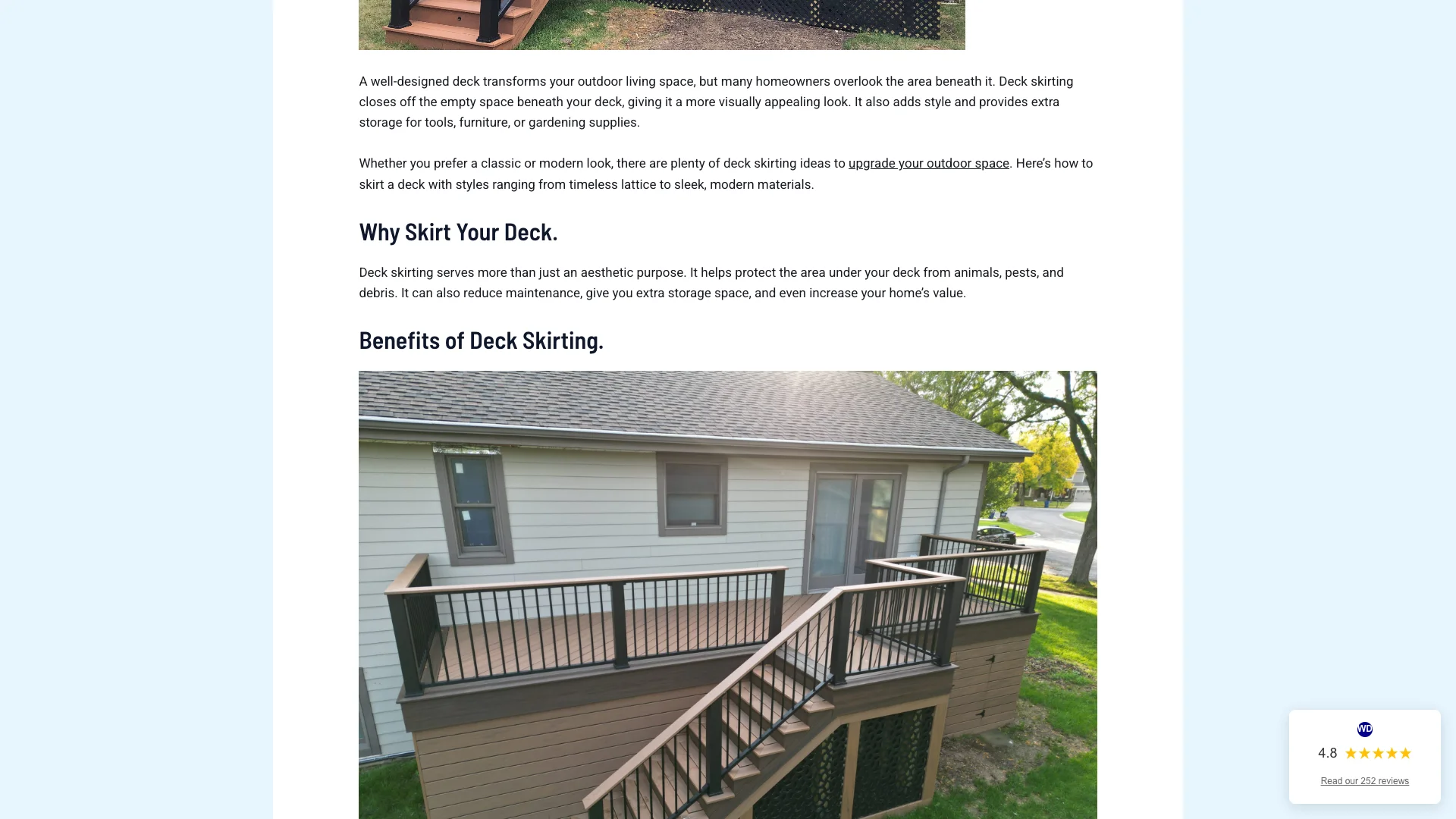
Warner's Decking is a small brand doing big-brand things. And the specifics are worth studying if you're a deck builder (or any contractor) trying to figure out what a well-built website actually looks like.
252 Google Reviews, rendered everywhere. Not hidden. Not on a separate testimonials page. Rendered on every single page we tested. A homeowner can't land anywhere on the site without seeing social proof. That's the single most effective trust signal a contractor can deploy, and Warner's Decking nails it. The review count alone communicates experience, reliability, and a track record of completed projects.
The most complete hidden code labels in the series. Five label types. HomeAndConstructionBusiness tells Google this is a home construction company. GeneralContractor tells Google the specific trade. FAQPage tells Google that FAQ content is structured for rich results. BlogPosting tells Google the blogs are articles. Person tells Google who runs the business. That level of specificity is rare even on enterprise contractor sites. And it's the kind of thing most deck builders don't even know exists.
Blog content driving real traffic. The Tech vs Trex blog alone accounts for 29% of total organic visitors. That's a single blog post earning almost a third of all traffic. And the content targets the exact questions homeowners ask when researching deck materials. "Is Trex worth it?" "How much does Trex cost?" "What are some deck skirting ideas?" These are purchase-intent queries. The homeowner asking "how much does Trex cost?" is already thinking about building a deck.
Perfect layout stability on 2 of 3 pages. 0.000 on both the Tech vs Trex blog and the Trex cost blog. Content doesn't move at all as those pages load. The skirting blog is the exception at 0.144, but the overall stability is well above average for this series. And for blog content where the homeowner is reading long-form comparisons, stable pages matter. Nobody wants the article to jump around while they're reading about Trex versus cedar pricing.
Content targeting purchase-intent keywords. "Tech vs Trex," "how much does Trex cost," and "deck skirting ideas" aren't general awareness queries. They're questions from homeowners actively evaluating deck options. That means the 2.1K visitors landing on these pages are higher-quality traffic than the 15K visitors landing on a generic "swimming pool designs" page. Quality over quantity, and Warner's Decking is getting quality.
"64% of homeowners say having recommendations or references is a top-three factor in choosing a contractor."
— Houzz Inc. (2025)
What the gaps mean for deck builders
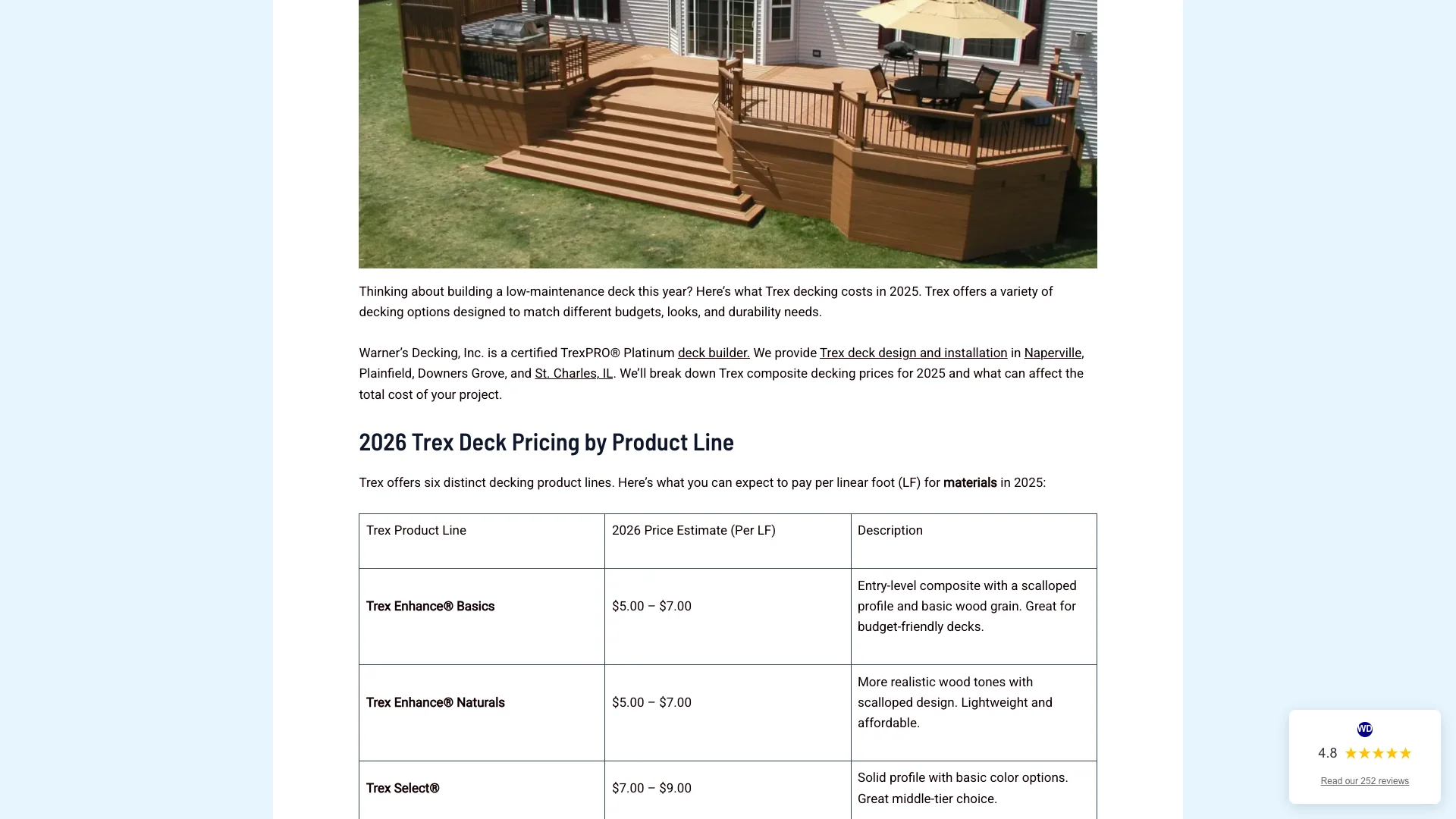
Warner's Decking is what we'd point to if a deck builder asked "what should my website look like?" It's not perfect. But the foundation is stronger than most brands 10x its size. So the gaps here are small, fixable, and high-leverage.
Fix the skirting blog's layout shift. Two pages score 0.000. The skirting blog scores 0.144. That means content jumps around as that specific page loads, probably from images loading without defined dimensions or a widget popping in late. Finding the element that shifts and giving it a fixed height would solve it. One page fix, and all three pages hit perfect stability.
Push Google's mobile scores from orange to green. Scores between 42 and 55 aren't terrible, but they're costing Warner's Decking search rankings. Compressing images, deferring non-essential scripts, and optimizing font loading could push all three pages above 70. For a site where blog content drives the majority of traffic, faster pages mean higher rankings, which means more homeowners reading those comparison articles. And for a small brand competing against Archadeck and Trex's own content, every ranking position matters.
Add a lead capture form to the blog posts. Over half of all organic traffic lands on blog content. These are homeowners researching materials and costs. A 3-field form ("Thinking about a new deck? Tell us about your project.") would capture the research-stage visitor who isn't ready to pick up the phone. Right now, those visitors read, learn, and leave. A form gives Warner's Decking a way to follow up.
Add a chat widget. Warner's Decking has the trust signals and the content. But for the homeowner who wants to ask a quick question without committing to a phone call, a chat widget is the lowest-friction conversion path. TrueDecks (321 monthly visitors) has one on every page. Warner's Decking (2.1K visitors) should too.
Consider adding BBB and certification badges. Warner's Decking already displays trust badges and Google Reviews. But BBB accreditation and manufacturer certifications (Trex Pro Platinum, TimberTech certified installer, etc.) add another layer of credibility. Especially for a site where the top blog post compares Trex materials. If Warner's Decking is a certified Trex installer, that badge belongs on the Tech vs Trex blog post. It turns a comparison article into an implicit recommendation: "we compared them, and we're certified to install the winner."
"48% of customers say that if a site does not work well on mobile, it signals the company does not care about their business."
— Google Consumer Insights (2018)
Frequently asked questions
How does Warner's Decking score on Google's mobile test?
The Tech vs Trex blog scored 55 out of 100. The Trex cost blog scored 48. The deck skirting ideas blog scored 42. The top page barely scrapes into the orange zone, and the other two sit in the red. Google uses these scores as a ranking factor, so all three pages are taking some search-ranking penalty. But layout stability is perfect on two of three pages (0.000), and the hidden code labels are the most complete in the entire series.
Does Warner's Decking display Google Reviews?
Yes. All three tested pages display Google Reviews with 252 reviews rendered. Trust badges also appear on all three pages. That combination makes Warner's Decking the most trust-complete deck builder in the CRO Index. And 252 reviews is a strong number that signals years of completed projects and satisfied customers.
What hidden code labels does Warner's Decking use?
Warner's Decking runs five hidden code label types: HomeAndConstructionBusiness, GeneralContractor, FAQPage, BlogPosting, and Person. That tells Google the business type, the specific trade, the content format, and who runs the company. It's the most complete label setup we've audited across every brand in this series. Most contractor sites don't have even two of those labels.
How much organic traffic does warnersdecking.com get?
According to Ahrefs data from March 2026, warnersdecking.com receives approximately 2,100 monthly organic visitors with an estimated traffic value of $1,500. The Tech vs Trex blog accounts for 590 visitors (29% share). The Trex cost blog accounts for 315 (16%). The deck skirting ideas blog accounts for 194 (10%). Blog content drives over half of all organic traffic to the site.
Does Warner's Decking have contact forms?
The form inventory wasn't the focus of this teardown, but the blog-first traffic pattern suggests an opportunity. Over half of all organic visitors land on blog content where the primary conversion path is a phone call. Adding a 3-field lead capture form to each blog post would give research-stage homeowners a way to leave their information without calling. That's the gap between "good blog traffic" and "good blog traffic that actually generates leads."
How does Warner's Decking compare to TrueDecks?
Both are small deck builders with strong trust signals. TrueDecks (321 visitors) has Google Reviews, review widgets, trust badges, and a chat widget on every page, plus perfect layout stability. Warner's Decking (2.1K visitors) has Google Reviews with 252 reviews and trust badges on every page, plus the most complete hidden code labels in the series. Warner's has 6x the traffic and far richer code labels. TrueDecks has more trust signal variety (chat widget, review widgets) and a tighter layout stability record. Both outperform brands with 10x their traffic on the trust signal front.