What we found on toprailfences.com
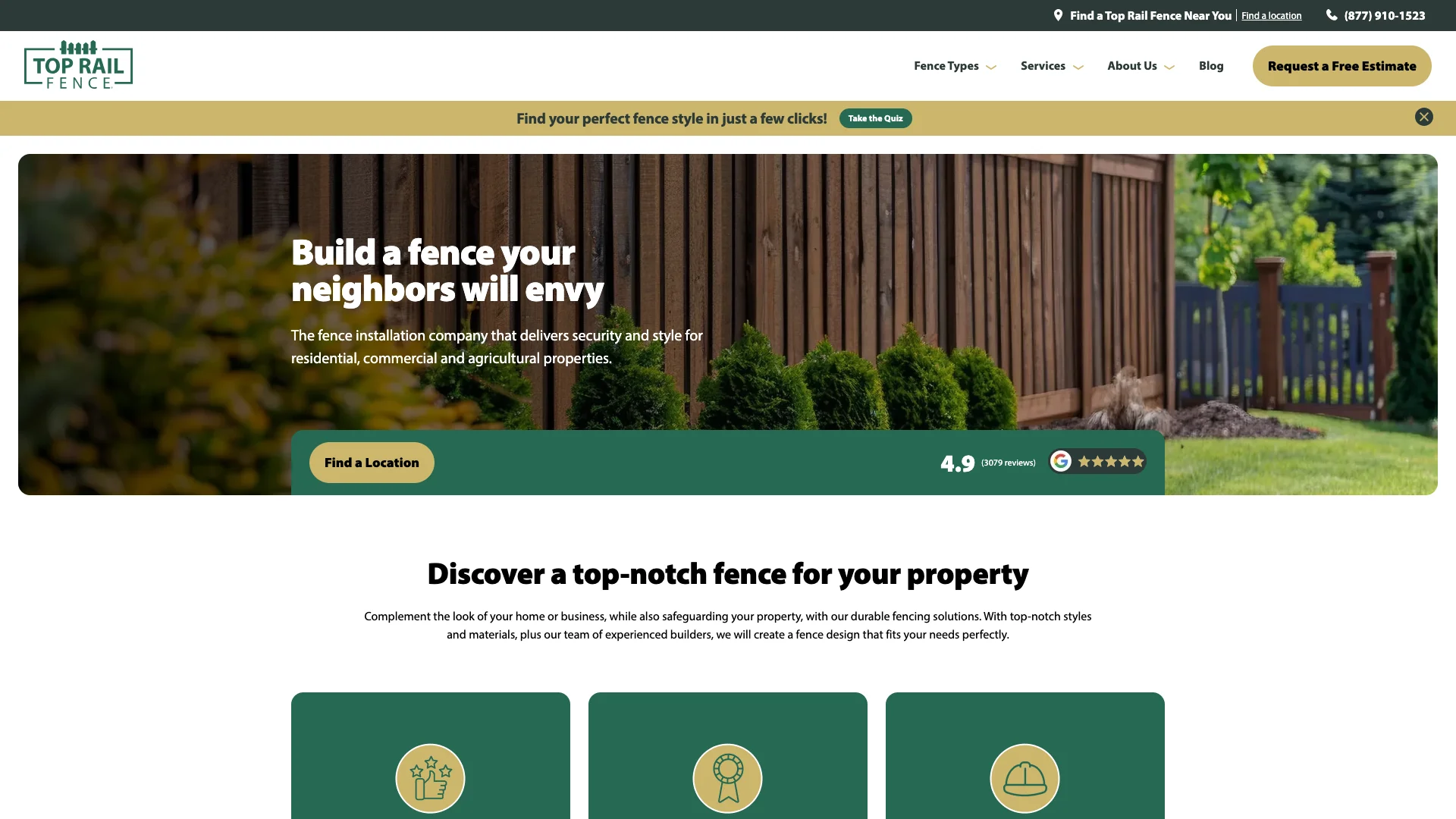
Top Rail Fence is a fencing franchise with locations across the United States. According to Ahrefs, toprailfences.com pulls 1.8K monthly organic visitors with an estimated traffic value of $2.4K. Smaller than Superior Fence and Rail in both traffic and traffic value. But the Google scores tell a different story.
The pages we tore down:
- /blog/taller-fence/, a blog post about taller fence options (83 monthly organic visitors, scored 66 on Google's mobile lab test, layout shift 0.037, 1 form)
- /blog/painting-ideas/, a blog post about fence painting ideas (82 monthly visitors, scored 59, layout shift 0.019, 1 form)
- /franchising/, the franchise opportunity page (78 monthly visitors, scored 62, layout shift 0.007, 0 forms)
And the performance story is strong. Scores from 59 to 66. That's the best average in the fencing batch. Layout shift under 0.04 on every page. Content doesn't jump around at all. The pages are fast, stable, and clean. But then you look at the trust signals, and there's nothing. Zero reviews. Zero badges. Zero chat widget. The technical foundation is solid. The persuasion layer doesn't exist.
That combination creates an interesting problem. Top Rail Fence has pages that Google likes more than most competitors' pages. The pages load faster. They're more stable. They don't shift around. But when a homeowner lands on one of those fast, stable pages, there's nothing telling them that other homeowners had a good experience with this company. The speed gets them there. The trust keeps them from converting.
"25% of homeowners say trusting contractors is their top challenge when planning home improvement projects."
— Houzz Inc. (2025)
Performance: 59 to 66 on Google's mobile lab test
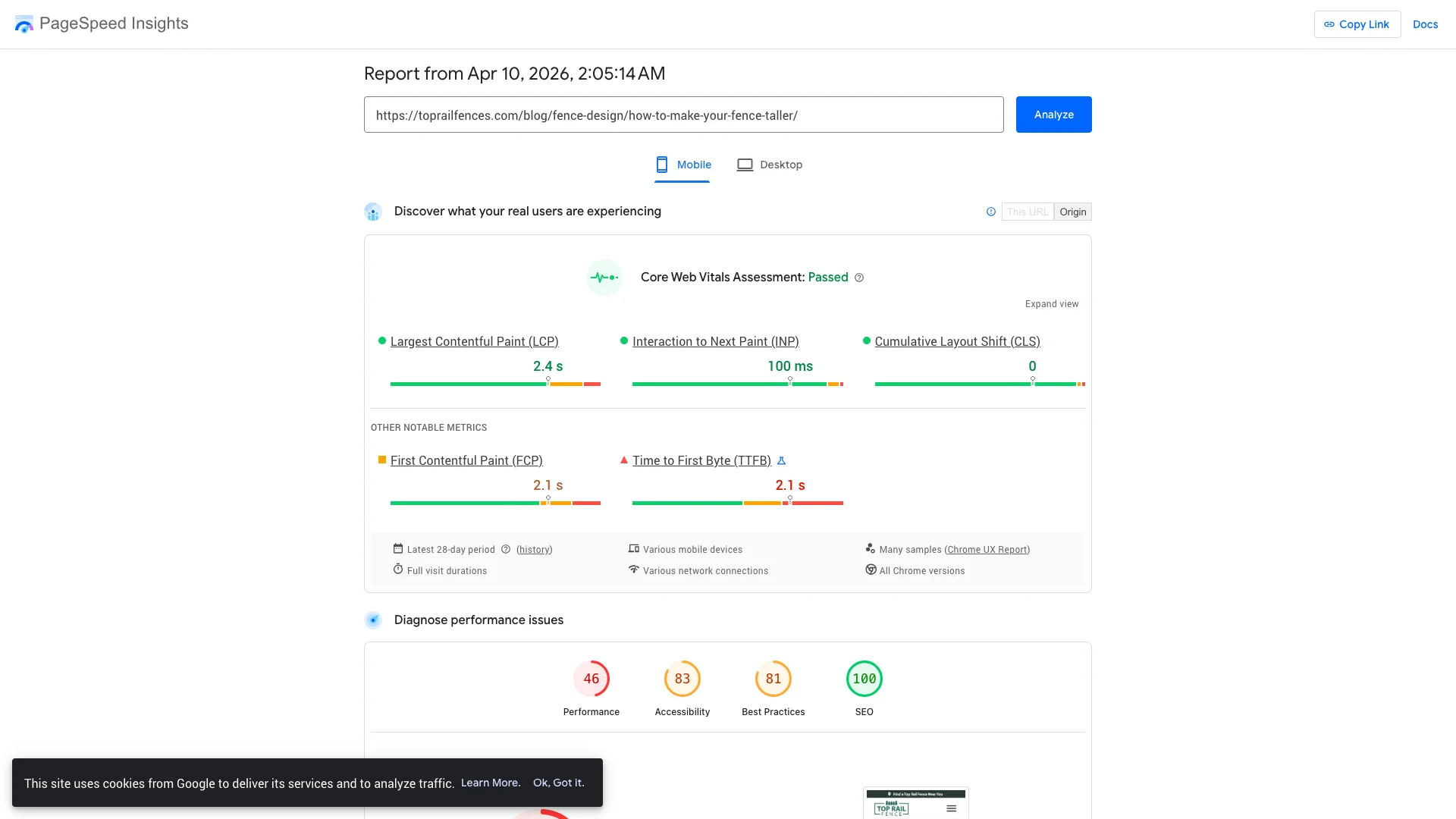
Google PageSpeed Insights runs a simulated slow-phone lab test. The scores are worst-case, not what you see on your phone with WiFi. But Google uses them as a ranking factor in search results.
The taller fence blog scored 66. The franchising page scored 62. The painting ideas blog scored 59. All three land in the yellow zone. Not great, but significantly better than the red-zone scores we see on most brands in this series. Lawn Doctor scored 27. The Grounds Guys scored 36. Top Rail Fence is scoring nearly double those numbers.
And in the fencing batch specifically, Top Rail's average score is higher than Superior Fence and Rail's. Superior Fence's estimate page hit 75 (higher single-page score), but Superior's locations page dragged the average down to 66 with its score of 53. Top Rail is more consistent. All three pages in the 59-66 range. No single page drags the average down significantly.
"53% of mobile users abandon sites that take longer than 3 seconds to load."
— Google / SOASTA (2017)
Layout stability is clean across the board. The taller fence blog has a layout shift of 0.037. The painting ideas blog sits at 0.019. The franchising page scores 0.007. All three are well under the 0.1 threshold. Content doesn't jump around at all as these pages load. Homeowners aren't going to accidentally tap the wrong link because something shifted at the last second.
So the performance foundation is strong. Getting from the low 60s to the green zone (90+) is a bigger jump than getting from 27 to 60, but it's still achievable. Compressing images, deferring non-critical scripts, and lazy-loading below-the-fold elements could push these pages into the 70s or 80s. And for a smaller brand where every ranking position matters, that improvement translates directly to more visitors finding these blog posts and franchise pages.
Lead capture: 1 form per blog, zero on franchising
The blog pages each have 1 form. The franchising page has 0 forms. That's a straightforward setup for the blogs, but a missed opportunity on the franchising page.
A homeowner reading about taller fences or painting ideas hits one form during their visit. One conversion point. For a blog post, that's acceptable but not aggressive. Two forms (one mid-content, one at the bottom) would catch more visitors without feeling pushy. The homeowner who's convinced halfway through the article shouldn't have to scroll to the bottom to find the form.
But the franchising page with zero forms is the bigger issue. Someone reading about franchise opportunities is a high-intent visitor. They're not casually browsing. They're evaluating whether to invest in a Top Rail Fence location. And when they finish reading, there's no form on the page to capture that interest. They have to navigate somewhere else to express interest. That friction loses prospects. And franchise prospects are worth significantly more per lead than homeowner leads. Each one represents a potential new location generating ongoing royalty revenue.
"68% of users wouldn't submit a form if it required too much personal information."
— Baymard Institute (2024)
The blog forms themselves are functional. They're embedded in the content, visible during the reading experience, and they don't require an excessive number of fields. But without any social proof nearby (no star ratings, no review count, no customer testimonial), the form is asking for trust it hasn't established. A homeowner who reads about taller fence options and decides they want one still has to make a leap of faith to submit their information to a company they've never heard of and can't verify on this page.
Trust signals: zero across the board
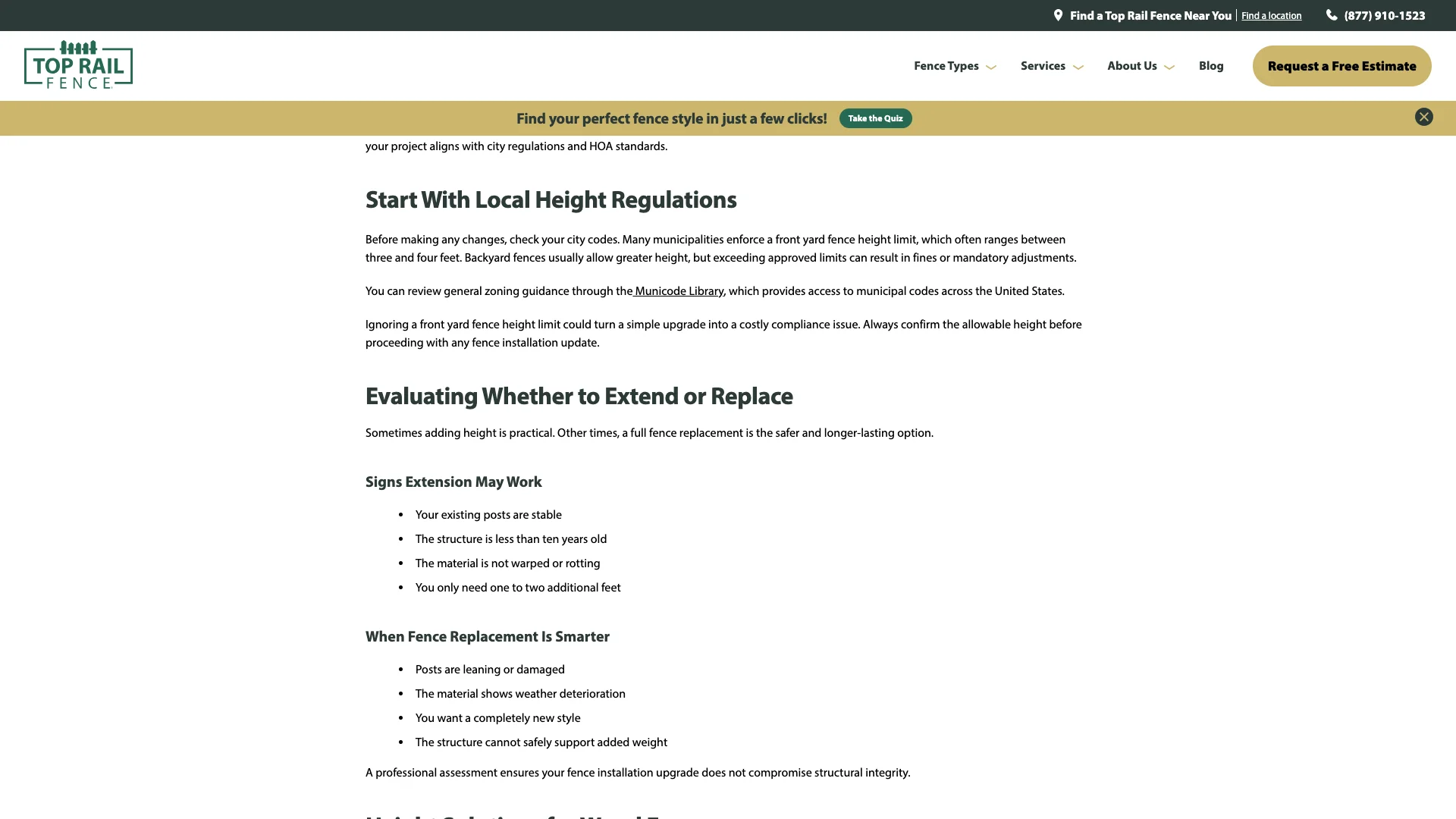
Top Rail Fence has the best Google scores in the fencing batch. And then this:
- Google Reviews: Not present on any page.
- Review widgets: Not present on any page.
- Trust badges: Not present on any page.
- Chat widget: Not present on any page.
- BBB badge: Not found.
- Certifications: Not found.
Zero out of six trust signal types. On every tested page. The contrast with Superior Fence and Rail is stark. Superior Fence has Google Reviews on every page and trust badges on two of three. Top Rail has nothing. A homeowner comparing these two fencing brands side by side will pick Superior Fence every time, even though Top Rail has better Google scores and cleaner layout stability.
And that's the core tension of this teardown. Performance and trust are both important, but they serve different functions. Performance determines whether Google shows your page to the homeowner. Trust determines whether the homeowner fills out your form. Top Rail wins on performance. Superior Fence wins on trust. And trust is what drives conversions. A fast page with no reviews converts worse than a slow page with great reviews.
Comparison
"83% of consumers use Google to find local business reviews; 74% use two or more review platforms when researching."
— BrightLocal (2025)
The hidden code labels are minimal. Basic navigation and site structure labels are present, but nothing trade-specific. Google doesn't have explicit signals telling it these pages belong to a fencing contractor. Adding "fence installation service" or "fencing contractor" hidden code labels would help Google categorize the content correctly instead of relying purely on text analysis.
What Top Rail Fence does well
Top Rail Fence won't win any awards for trust signals. But the performance foundation is the best in its category, and that matters.
Best average scores in the fencing batch. 59 to 66 on Google's mobile lab test. That's significantly above the red-zone scores that dominate this series. Top Rail's pages load faster and render cleaner than almost every other fencing brand we've tested. That's a competitive advantage in search rankings that compounds over time as Google continues to weight page experience in its algorithm.
Clean layout stability. 0.007 to 0.037 across all three pages. Content doesn't jump around. The pages are predictable and smooth for the visitor. Compare that to Superior Fence's 0.282 on the locations page, and you can see that Top Rail has the better structural discipline across its entire site.
Clean, readable blog content. The blog posts are focused and well-structured. No cluttered sidebars. No competing pop-ups. No autoplay videos. Just content, a form, and a clean layout. That readability keeps visitors on the page longer, which sends positive engagement signals to Google and increases the chance they'll scroll far enough to reach the form.
"64% of homeowners say having recommendations or references is a top-three factor in choosing a contractor."
— Houzz Inc. (2025)
What the gaps mean for fencing contractors
Top Rail Fence is a case study in getting the technical side right and skipping the human side. If you're a fencing contractor, the lessons are pointed.
Performance without trust is wasted. Top Rail has the best mobile scores in the fencing batch. But without Google Reviews, trust badges, or any social proof, those fast-loading pages aren't converting as well as they could. Speed gets the homeowner to the page. Trust gets them to fill out the form. You need both. And adding trust signals to a page that already loads fast is the easier fix compared to speeding up a page that already has trust signals.
Add Google Reviews to every page. This is the single highest-impact change Top Rail could make. A Google Reviews embed widget showing star ratings and recent customer reviews would transform every page from "clean and fast" to "clean, fast, and trusted." It takes less than an hour to install. The conversion impact starts immediately. And for a smaller brand pulling 1.8K monthly visitors, even a modest improvement in conversion rate means meaningfully more leads per month.
Put a form on the franchising page. A page about franchise opportunities with zero forms is a page that loses prospects. Add a 4-field form: name, email, phone, preferred market. "Interested in owning a Top Rail Fence franchise? Tell us about yourself." That form captures the high-intent visitor who's ready to take the next step but doesn't want to hunt for a separate contact page.
"48% of customers say that if a site does not work well on mobile, it signals the company does not care about their business."
— Google Consumer Insights (2018)
Add a second form to blog posts. One form per blog is minimal. Two forms (one mid-content, one at the bottom) would catch visitors at different stages of reading. The homeowner convinced by the second paragraph shouldn't have to scroll past ten more paragraphs to find the form.
Install a chat widget. For a fencing business, the homeowner's first question is almost always about pricing or material options. A chat widget answers that question in real time instead of asking them to fill out a form and wait. It's the difference between catching the impulse and losing it to a competitor who answers faster.
Frequently asked questions
How does Top Rail Fence score on Google's mobile test?
The taller fence blog scored 66. The franchising page scored 62. The painting ideas blog scored 59. All three are in the yellow zone, which is the best average in the fencing batch. Layout stability is clean across the board (0.007 to 0.037), so content doesn't jump around as the pages load.
Does Top Rail Fence display Google Reviews on its website?
No. All three tested pages returned zero trust signals. No Google Reviews, no review widgets, no trust badges, no chat widget. Despite having the best mobile performance scores in the fencing batch, Top Rail Fence has no social proof on any tested page. That contrast between strong performance and absent trust is the defining gap of this teardown.
How many forms does Top Rail Fence have per page?
The two blog pages each have 1 form. The franchising page has 0 forms. That means the highest-intent page on the site (franchise opportunities) has no way for a prospect to leave their information directly on the page.
How much organic traffic does toprailfences.com get?
According to Ahrefs data from March 2026, toprailfences.com receives approximately 1.8K monthly organic visitors with an estimated traffic value of $2.4K. The three tested pages each pull roughly 78 to 83 monthly visitors, making this one of the smaller brands in the CRO Index.