
What we found on statewideremodeling.com
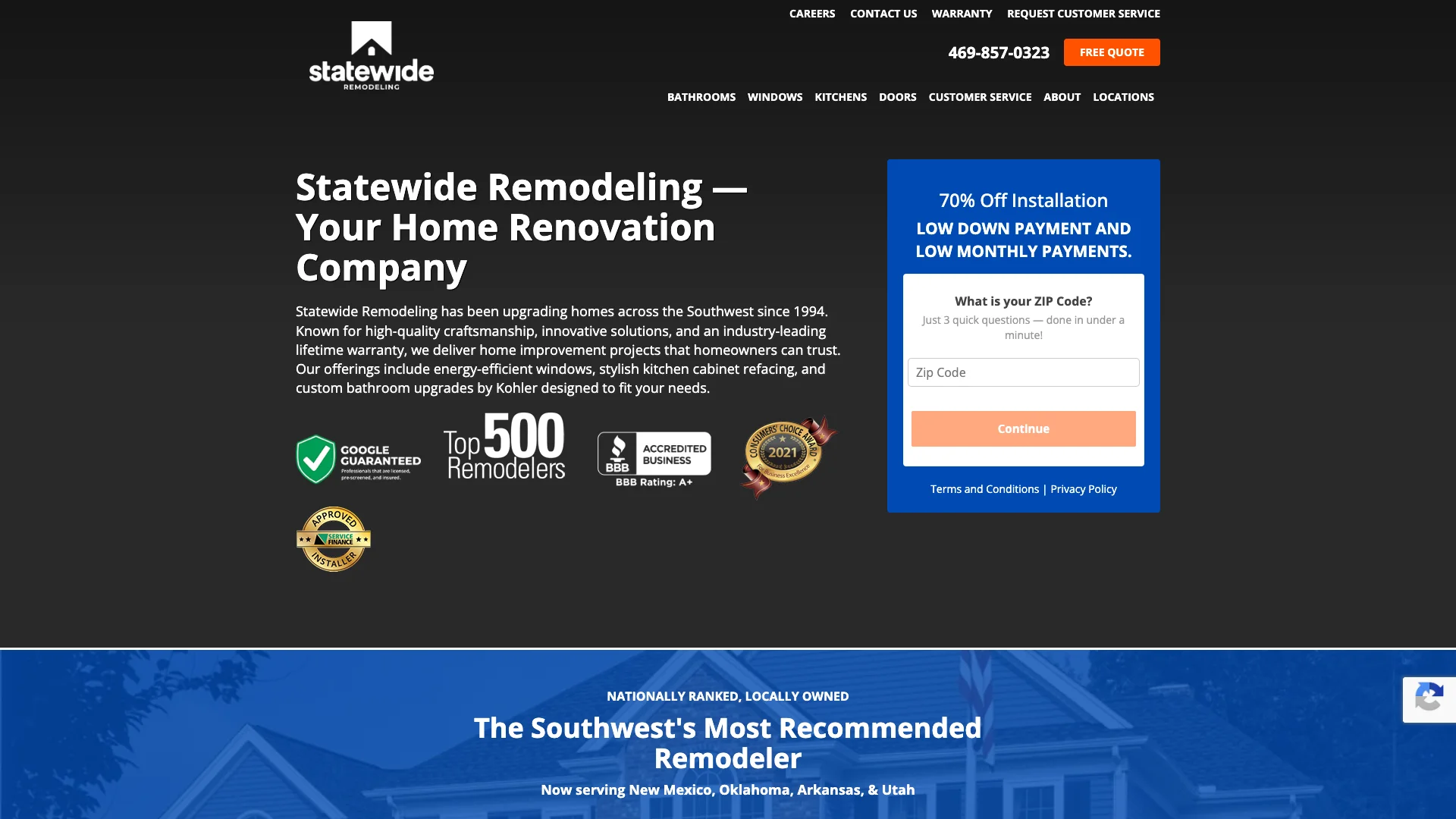
Statewide Remodeling is a kitchen and bath remodeling company based in Texas. According to Ahrefs, statewideremodeling.com pulls 5.2K monthly organic visitors with an estimated traffic value of $17.9K. Not a massive site. Not a national franchise. But what they are doing with the invisible markup that Google reads behind the scenes is the most sophisticated setup we have found in the entire CRO Index series. So we picked three pages and ran them through the standard teardown protocol.
The pages we tore down:
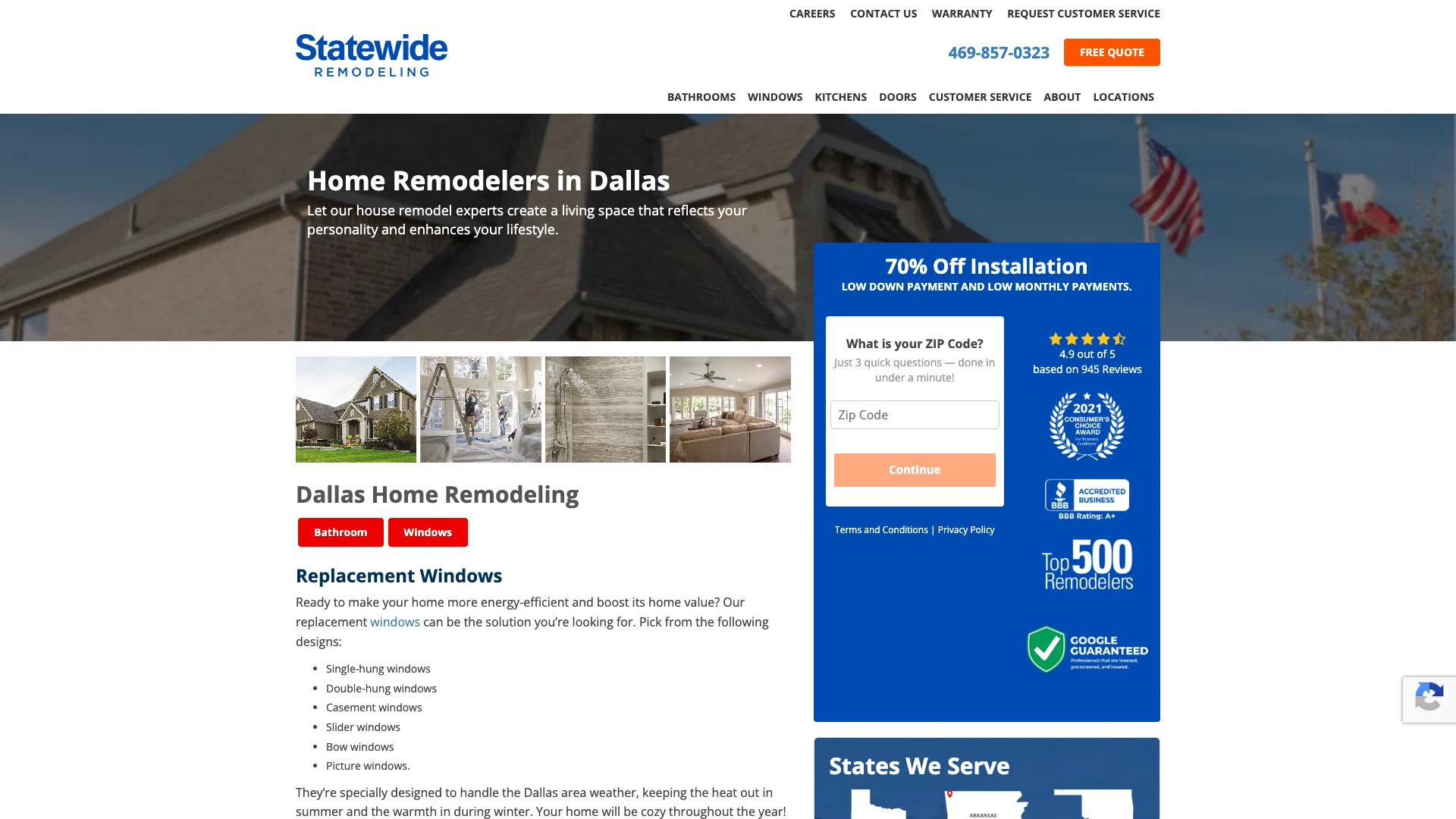
- Dallas TX location page (317 monthly organic visitors, 6% traffic share, scored 47/100 on Google's mobile lab test)
- Florida room blog post (252 monthly visitors, 5% share, scored 46/100)
- Kitchen cabinet blog post (246 monthly visitors, 5% share, scored 44/100)
And the story on this one isn't about what is broken. It is about what is unusually right. Seven different hidden code label types. Google Reviews actually rendering on the page (not just hiding in the data). Chat widgets. Trust badges. A 7-field form that captures everything a remodeler needs to route a lead. Statewide Remodeling has built the trust infrastructure that most contractors in this series are missing entirely. The catch is that their Google mobile test scores are still stuck in the mid-40s, which means the ranking penalty from page speed is eating into the traffic that all of that trust work should be earning.
"25% of homeowners say trusting contractors is their top challenge when planning home improvement projects."
— Houzz Inc. (2025)
Performance: all three pages land in the mid-40s
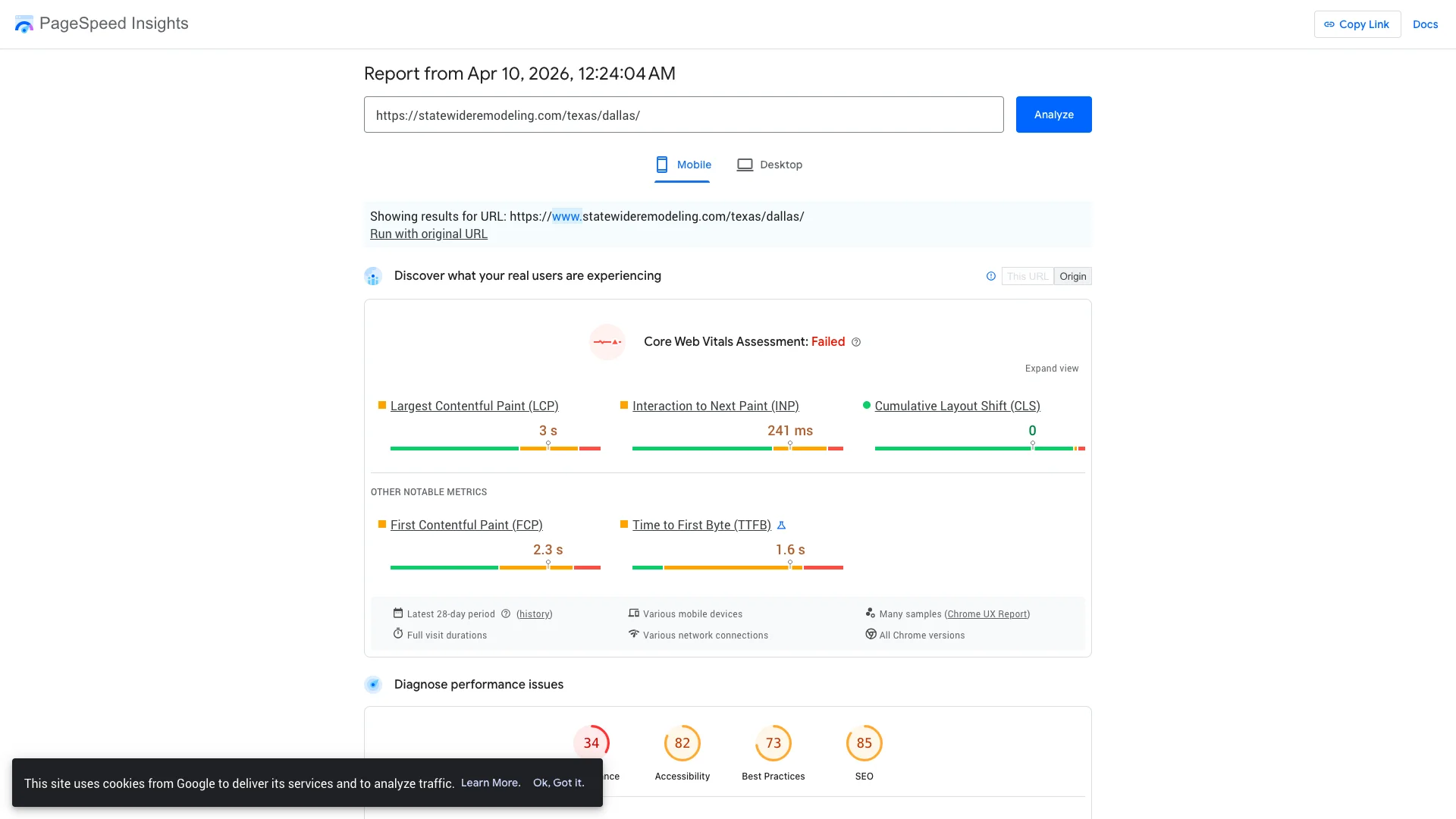
Quick framing note before we dig in. Google PageSpeed Insights runs a simulated slow-phone lab test, so the scores it reports are worst-case numbers, not what a real user on a fast phone with good WiFi experiences. The pages probably feel fine when you open them yourself. But Google uses these lab scores as a ranking factor in its search results, which means every page scoring in the 40s is eating a real search-ranking penalty.
The Dallas TX location page scored 47 out of 100. The Florida room blog scored 46. The kitchen cabinet blog scored 44. All three are in a tight band, which tells us the template is the bottleneck, not the individual page content. Whether it is a location page or a blog post, the score lands in the same range.
"53% of mobile users abandon sites that take longer than 3 seconds to load."
— Google / SOASTA (2017)
For context: 47 isn't catastrophic. It is better than the Neighborly franchise sites (which score in the 30s) and better than Archadeck (which scores 21 on one page). But it is still in the orange zone on Google's test, which means a ranking penalty is in play. A kitchen and bath remodeler competing for "kitchen remodel Dallas" or "bathroom remodel Texas" needs to clear 85 to outrank the competitors who have already optimized.
The bright spot is layout stability. The Dallas page scores 0.002 on layout shift, and the two blog posts both score 0.000. That is effectively perfect. Nothing jumps around as the page loads. The homeowner taps a button and it stays where it was. That is a detail most sites in this series get wrong, and Statewide gets it right on every page.
Compounding effect
"Conversion rates drop approximately 12% for each additional second of page load time."
— Google / Deloitte (2020)
Lead capture: a 7-field form that actually makes sense for remodeling
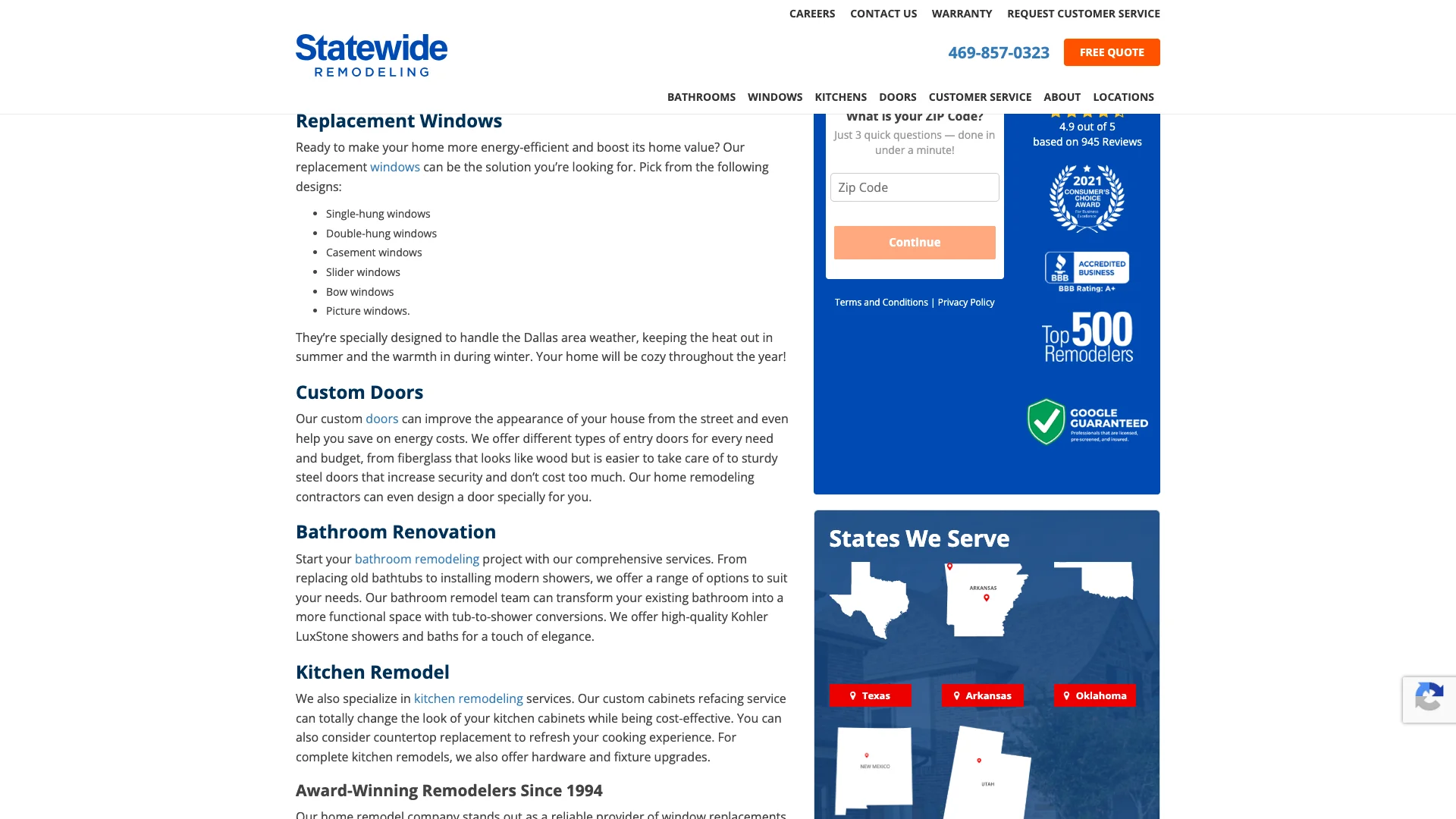
The Dallas location page carries 5 form instances. The two blog posts carry 3 each. The main form across all three pages is a 7-field contact form: name, email, phone, address, spam check, message, and a service selection dropdown. That is more fields than we would normally recommend (we usually push for three: name, phone, zip), but for a kitchen and bath remodeler doing $30K-$80K projects, a longer form actually qualifies the lead. The address tells them whether the homeowner is in their service area. The service dropdown tells them whether it is a kitchen, bath, or something else. The message field lets the homeowner describe the project scope.
So the form length is justified for this trade, as long as it isn't buried at the bottom of the page. Remodeling isn't an emergency call. It is a considered purchase. A homeowner who fills out 7 fields for a kitchen remodel is a more qualified lead than a homeowner who fills out 3 fields for an emergency plumber.
"68% of users wouldn't submit a form if it required too much personal information."
— Baymard Institute (2024)
The spam check field is a small but smart detail. It filters out bot submissions without adding a visual puzzle that slows down a real homeowner. And the service selection dropdown routes the lead to the right department before anyone on the Statewide team has to read the message. That is operational efficiency baked into the form design.
The gap is the blog posts. Three form instances on each blog is fine, but a homeowner reading a blog post about Florida rooms or kitchen cabinets is earlier in the buying cycle than a homeowner on the Dallas location page. The blog forms should be lighter (name, email, zip) with a softer CTA like "Get a Free Estimate" instead of the full 7-field contact form. Same form on every page type is a missed opportunity to match the form to the intent.
Trust signals: the most complete setup in the CRO Index
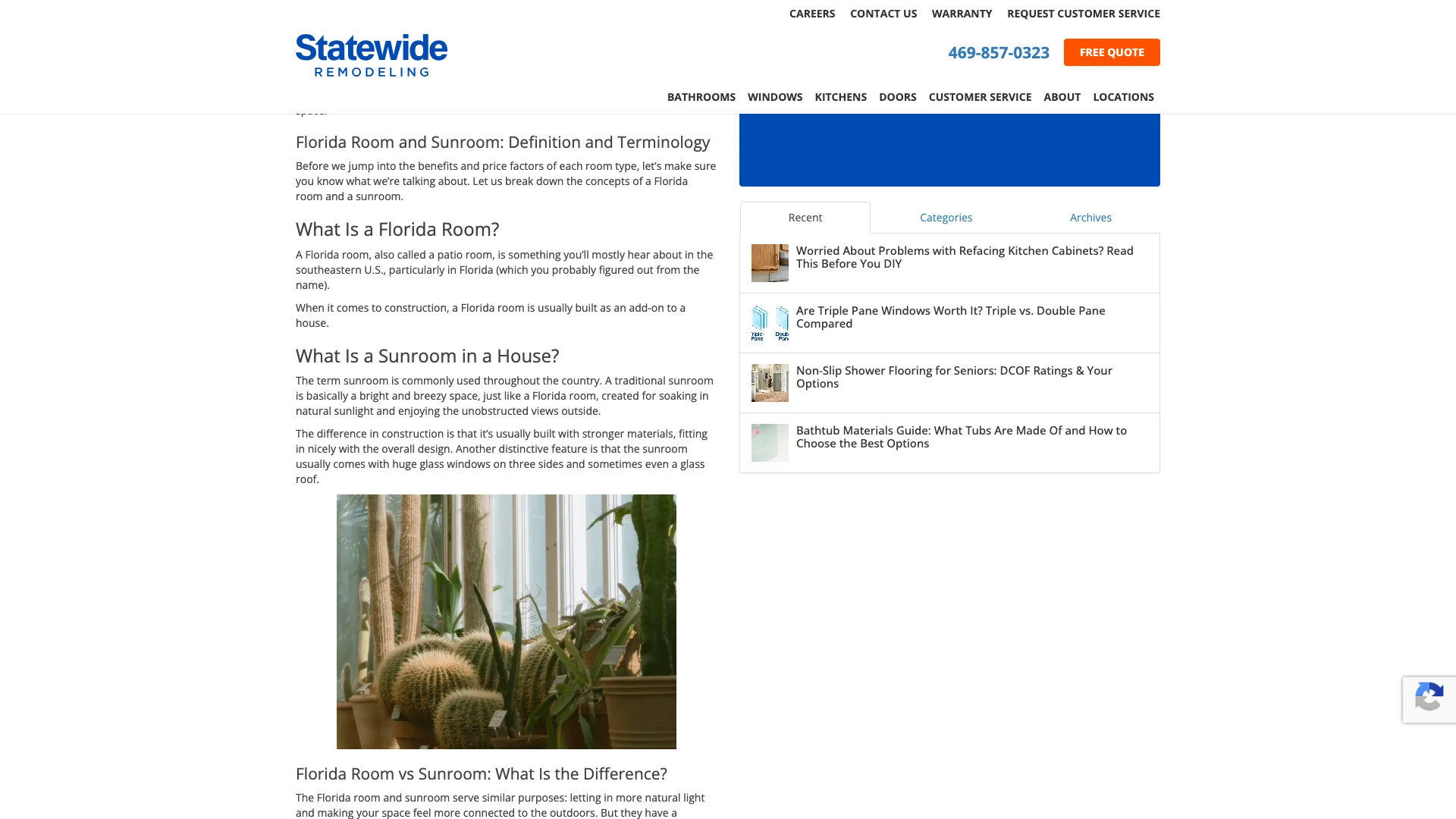
This is where Statewide Remodeling separates from every other brand in this series. The trust signal audit is the most complete we have recorded.
The full trust signal audit across the three pages:
- Google Reviews: TRUE on all three pages, with review widgets actually rendering and visible to the homeowner.
- Chat widget: Present on all three pages.
- Trust badges: Present on the Dallas location page.
- Hidden code labels: 7 different types, including HomeAndConstructionBusiness (the trade-specific label that tells Google this is a construction and remodeling company, not a generic local business) and Review labels that feed review data directly to Google's search results.
Comparison
"83% of consumers use Google to find local business reviews; 74% use two or more review platforms when researching."
— BrightLocal (2025)
The HomeAndConstructionBusiness label deserves its own paragraph. Most kitchen and bath contractors we audit either have no hidden code labels at all or use the generic "LocalBusiness" label that covers everything from a dentist to a dry cleaner. Statewide is using the specific construction label that tells Google exactly what trade they are in. That is a direct signal that helps Google match the page to "kitchen remodel near me" and "bathroom renovation [city]" queries. We have audited over 40 brands in this series and this is the first time we have seen it.
The Review labels are the other standout. Most brands in this series have reviews hiding in the background data but nothing rendering on the page. Statewide has the reviews in the data AND the widgets on the page AND the code labels telling Google to pull those reviews into search results. That is the full chain: data, display, and markup, all working together.
What Statewide Remodeling does well
A teardown that just lists problems isn't useful. Statewide Remodeling is actually the model for what most contractors in this series should be doing on the trust side.
Seven hidden code label types. HomeAndConstructionBusiness, Review, and five others. This is the most comprehensive invisible markup setup we have recorded in over 40 brand teardowns. Most contractors have zero or one label type. Statewide has seven. That gives Google specific, structured information about the business type, the reviews, and the content on every page.
Google Reviews widgets that actually render. In brand after brand in this series, we find reviews hiding in the background data with no widget showing them to the homeowner. Statewide has the widget on all three tested pages. The homeowner sees the star rating, the review count, and the social proof without leaving the page or searching on a third-party platform.
Chat widget on every page. A homeowner with a quick question about a kitchen remodel doesn't want to fill out a 7-field form. The chat widget gives them an instant path to a conversation. Present on all three pages.
Layout stability is nearly perfect. 0.002 on the Dallas page and 0.000 on both blogs. Nothing jumps around as the page loads. That is a conversion detail most contractors ignore, and Statewide gets it right.
The form is appropriately detailed for the trade. A 7-field form is too long for an emergency plumber. But for a $50K kitchen remodel, the address field and the service dropdown qualify the lead before the sales team ever picks up the phone. The form matches the buying cycle.
"64% of homeowners say having recommendations or references is a top-three factor in choosing a contractor."
— Houzz Inc. (2025)
What the gaps mean for kitchen and bath contractors
Statewide Remodeling is doing more things right than most brands in this series. But the mid-40s scores on Google's mobile test are holding back the traffic that all of that trust work should be earning. If you are a kitchen and bath contractor, the lesson is clear: trust signals without speed optimization is like building a showroom nobody can find.
Copy the code label strategy. Statewide uses HomeAndConstructionBusiness, which is the hidden label that tells Google this is specifically a construction and remodeling company. If you are a kitchen and bath contractor, ask your web team to add this label plus the Review labels to every page. It is a one-time setup that gives Google structured data about your trade, your reviews, and your business details. Most of your competitors have zero labels. Statewide has seven. Match that.
Get your Google Reviews widget on every page. Statewide does this already. If you don't, that is the single highest-impact trust signal you can add. The star rating, the review count, and a "read all reviews" link, all visible above the fold on every service page and location page. Not in the footer. Not on a separate page. On every page where a homeowner is deciding whether to call you.
Fix the speed to unlock the trust investment. Statewide has done the trust work. The scores in the mid-40s are the one thing holding the site back from ranking higher. For your site: compress images, defer third-party widgets until after the page appears, and audit every tracking script. A page that scores 85+ with the same trust signals Statewide already has is the best competitive position in kitchen and bath search results.
Match the form to the page type. Statewide runs the same 7-field form on location pages and blog posts. Your location pages should keep the detailed form (it qualifies the lead). Your blog posts should run a lighter 3-field form (name, email, zip) with a softer CTA. The homeowner reading a blog about cabinet styles isn't ready for 7 fields. The homeowner on your "kitchen remodel Dallas" page probably is.
"48% of customers say that if a site doesn't work well on mobile, it signals the company doesn't care about their business."
— Google Consumer Insights (2018)
Frequently asked questions
How does Statewide Remodeling score on Google's mobile test?
The Dallas TX location page scored 47 out of 100 on Google's mobile lab test. The Florida room blog scored 46. The kitchen cabinet blog scored 44. All three pages land in a tight band in the mid-40s, which tells us the template is the bottleneck, not the individual page content. Google uses these scores as a ranking factor, so all three pages are eating a penalty despite doing many trust and conversion things correctly.
Does Statewide Remodeling use hidden code labels Google reads?
Yes, and this is the headline finding. Statewide runs 7 different hidden code label types across the three pages we tested, including HomeAndConstructionBusiness (the trade-specific label most kitchen and bath contractors never implement) and Review labels. This is the most comprehensive code label setup we have found across over 40 brand teardowns in the CRO Index series. Most contractors have zero or one. Statewide has seven.
Does Statewide Remodeling show Google Reviews on their pages?
Yes. Google Reviews are marked as TRUE in the audit data, with review widgets actually rendering and visible to the homeowner on all three tested pages. This is one of the few brands in the CRO Index where the reviews aren't just in the background data but are actually displayed on the page. The homeowner sees the social proof without needing to search for reviews on a third-party platform.
How much organic traffic does statewideremodeling.com get?
According to Ahrefs data from our March 2026 collection, statewideremodeling.com receives approximately 5.2K monthly organic visitors with an estimated traffic value of $17.9K. The Dallas TX location page accounts for 317 of that (6% share). The Florida room blog accounts for 252 (5%). The kitchen cabinet blog accounts for 246 visitors (5%).