
What we found on shastapools.com
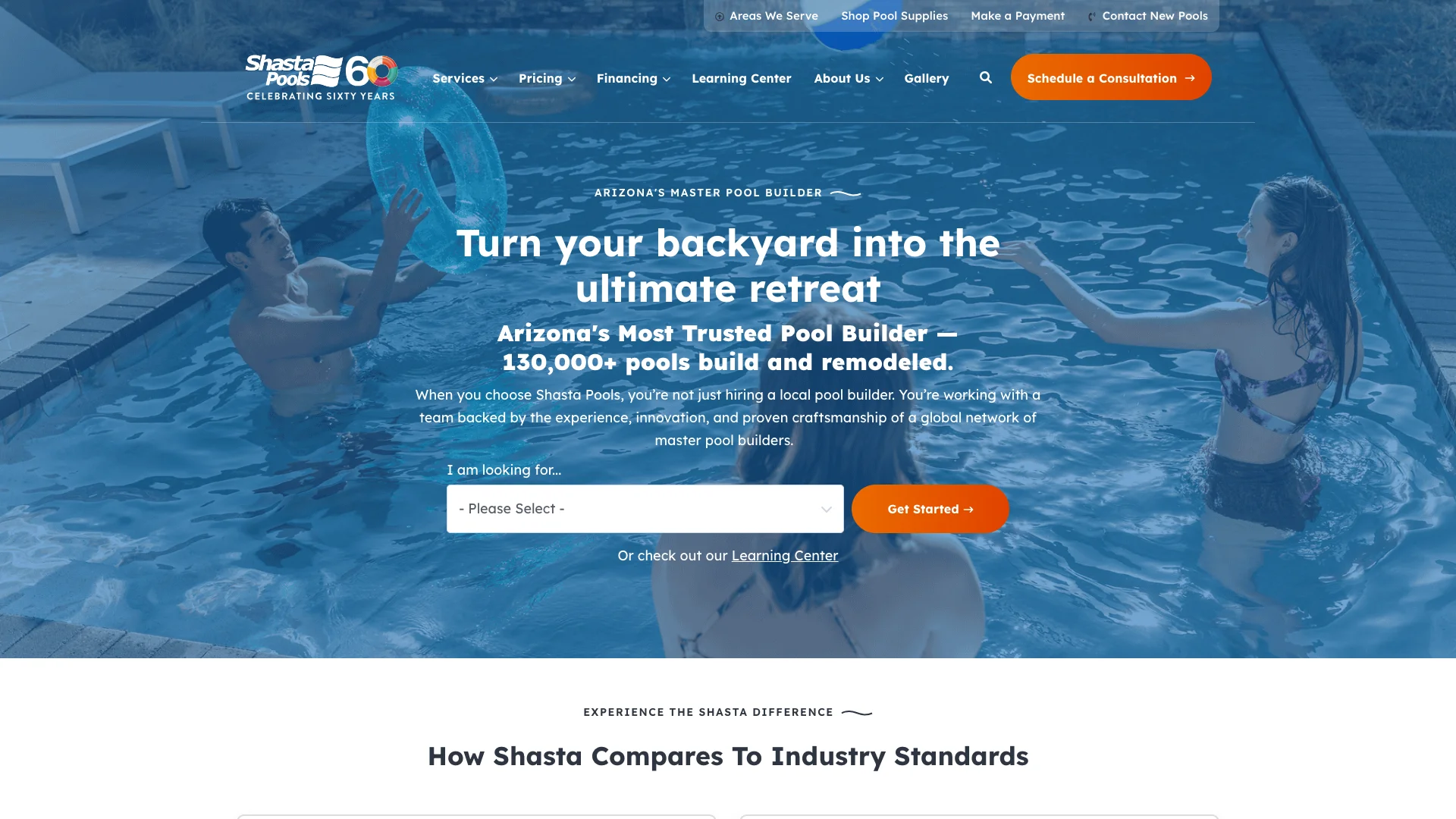
Shasta Industries (operating as Shasta Pools) is an Arizona-based pool builder. According to Ahrefs, shastapools.com pulls 2,500 monthly organic visitors with an estimated traffic value of $3,700. Not a small brand, but not a national franchise either. And the technical execution underneath the site is surprisingly sharp.
The pages we tore down:
- Saltwater pool blog (289 monthly organic visitors, 12% traffic share, scored 60 on Google's mobile lab test)
- Inground pool cost blog (281 monthly visitors, 12% share, scored 62)
- Pool cost blog (215 monthly visitors, 9% share, scored 46)
And what stood out immediately was the performance story. Scores of 60 and 62 on Google's mobile lab test are the highest we've recorded in the pool builder batch. Most pool builder pages in the CRO Index land in the 20s and 30s. Shasta's blogs are outperforming them by 2x or more. But the trust signal layer is a different story entirely. Zero Google Reviews. Zero review widgets. Zero trust badges. So a homeowner reading a 4,500-word blog post about pool costs gets excellent page speed and deep content, but no social proof whatsoever.
"25% of homeowners say trusting contractors is their top challenge when planning home improvement projects."
— Houzz Inc. (2025)
Performance: 46 to 62 on Google's mobile test
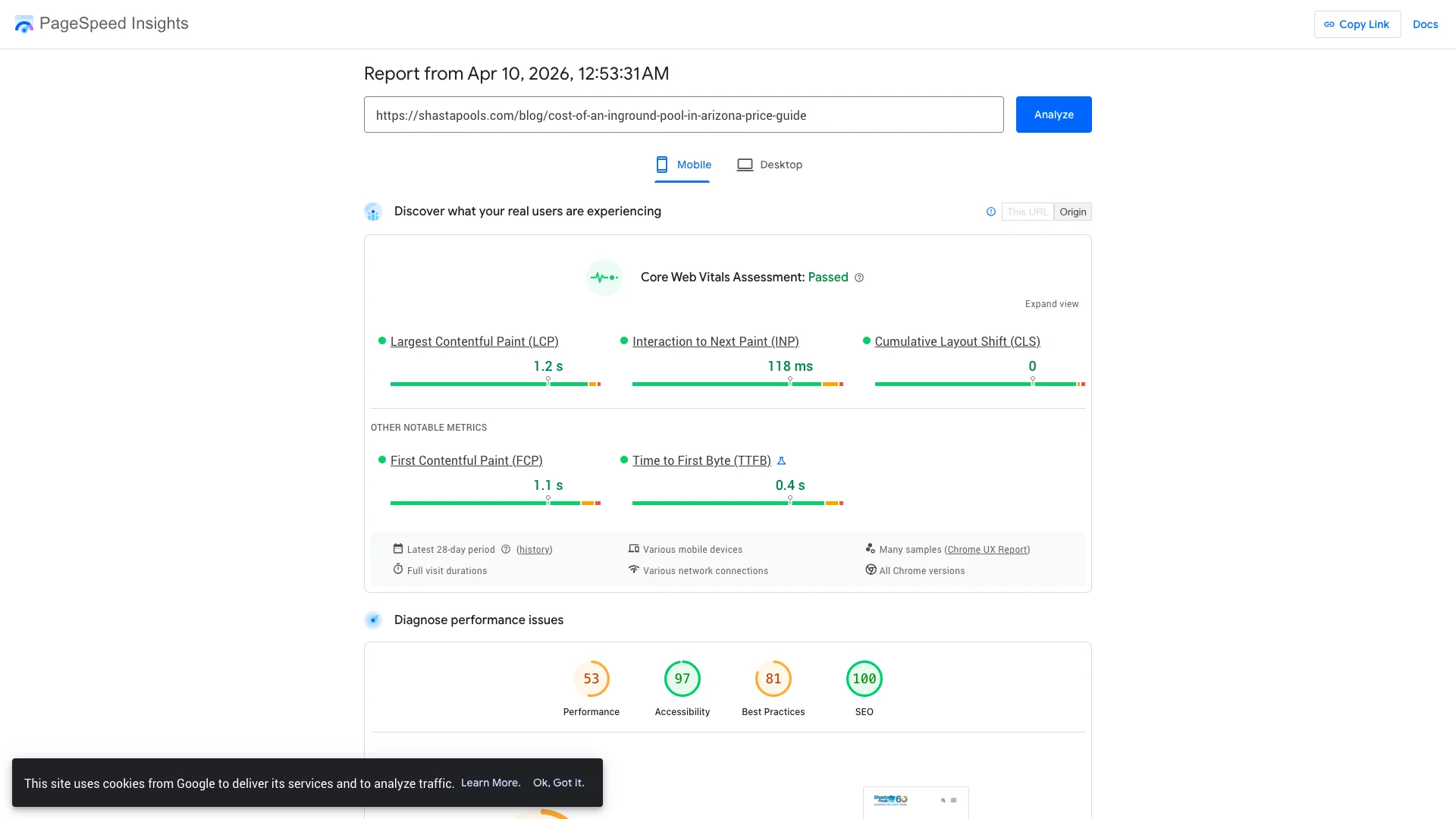
Google PageSpeed Insights runs a simulated slow-phone lab test. The scores are worst-case, not what you see on your phone with WiFi. But Google uses them as a ranking factor in search results.
The inground pool cost blog scored 62 out of 100. The saltwater pool blog scored 60. The pool cost blog scored 46. Two of the three pages are in the orange zone, and one dips into the red. For pool builder blogs, those orange-zone scores are genuinely good. Most competitors in this series are stuck in the 20s and 30s.
"53% of mobile users abandon sites that take longer than 3 seconds to load."
— Google / SOASTA (2017)
Layout stability is clean across all three pages. The saltwater blog scores 0.009. The inground pool cost blog scores 0.001. The pool cost blog scores 0.004. Content doesn't jump around as these pages load. That means a homeowner scrolling through a 4,500-word cost guide isn't going to lose their place because an ad or an image pushed the text down. It sounds like a small thing, but it's the difference between a reader who finishes the article and a reader who bounces.
So Shasta's performance profile is the inverse of what we usually see in the CRO Index. Most contractor sites have terrible Google scores and mediocre layout stability. Shasta has strong Google scores and excellent layout stability. The technical foundation is solid. It's everything else on top of that foundation that needs work.
Compounding effect
"Conversion rates drop approximately 12% for each additional second of page load time."
— Google / Deloitte (2020)
Lead capture: one form per page, no chat
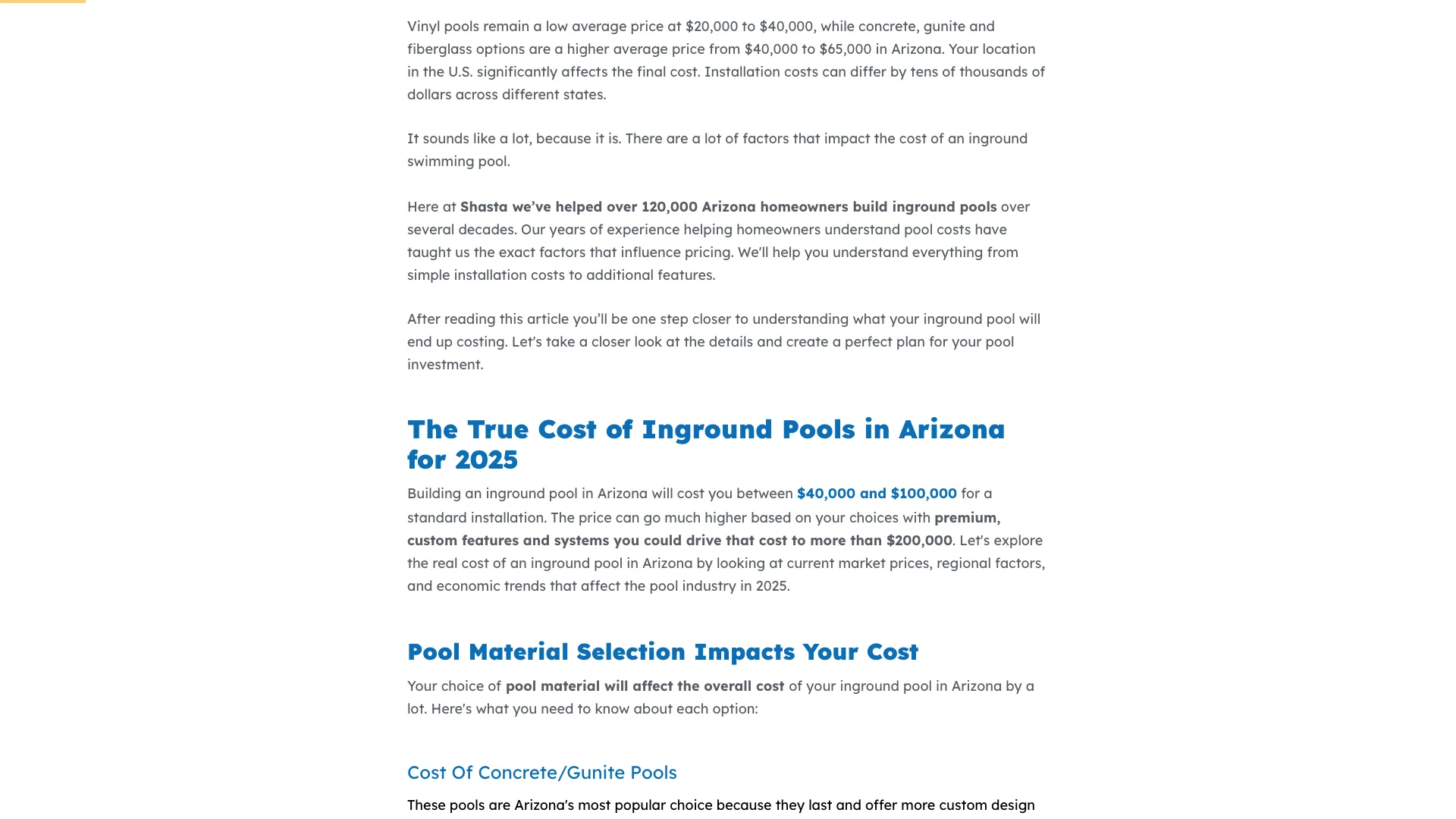
Every tested page has one form. That's better than zero, which is what a lot of brands in this series deliver on their blog pages. But it's still just one conversion path on pages that are pulling 200 to 289 monthly visitors each.
No chat widget. No callback request. No sticky mobile CTA. So a homeowner who finishes reading 4,531 words about inground pool costs has exactly one option: find the form and fill it out. Or leave. And most of them leave.
"68% of users wouldn't submit a form if it required too much personal information."
— Baymard Institute (2024)
The content depth is impressive. The saltwater blog runs 2,531 words. The inground pool cost blog runs 4,531 words. The pool cost blog runs 3,187 words. That's genuinely deep content for a pool builder. But deep content without multiple conversion paths means you're educating homeowners and then letting them walk away without a way to reach you. A sticky phone bar on mobile, a chat widget, or even a mid-article CTA that says "want a quote for your pool?" would turn readers into leads. Right now, the content does the hard work of ranking and attracting visitors, and the lead capture does almost nothing with them.
Trust signals: zero reviews, zero badges
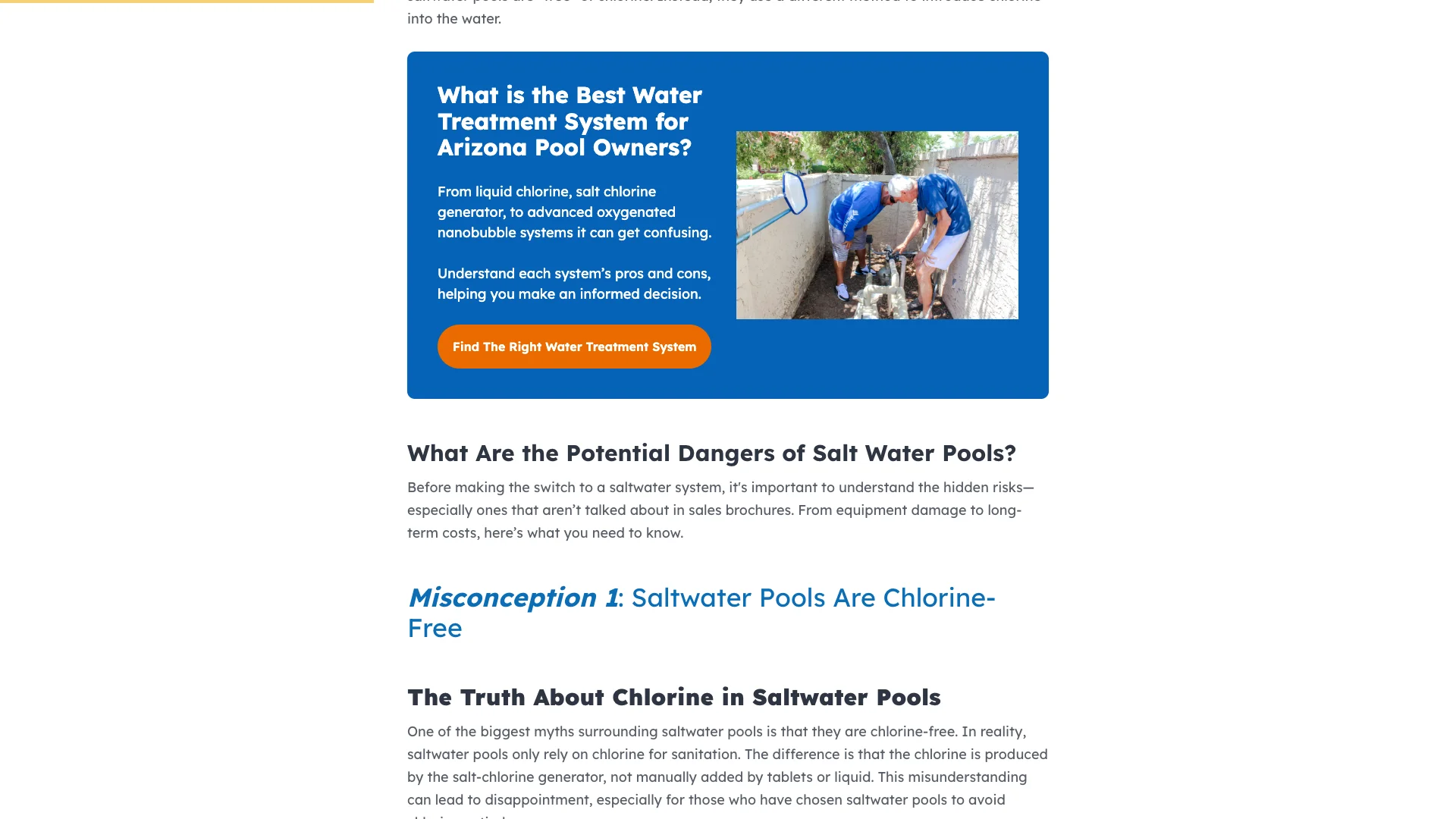
The trust signal audit came back empty across all three pages:
- Google Reviews: Not found on any page.
- Review widgets: Not found on any page.
- Trust badges: Not found on any page.
- Chat widget: Not found on any page.
- BBB badge: Not found.
- Certifications: Not found.
Zero out of six. That's a complete blank on the trust side. And it's particularly striking because the technical side is so strong. Shasta's got the best Google scores in the pool builder batch, clean layout stability, deep content, and rare code labels. But a homeowner reading a 4,500-word article about pool costs has no way to know whether Shasta's customers are actually happy. No stars. No testimonials. No "Licensed and Insured" badge. Nothing.
Comparison
"83% of consumers use Google to find local business reviews; 74% use two or more review platforms when researching."
— BrightLocal (2025)
The hidden code labels, though, are where Shasta separates from the pack. BlogPosting labels on the blog pages (tells Google these are blog articles). FAQPage labels (tells Google there are Q&A sections eligible for rich results). And one page carries SpeakableSpecification. That label tells Google which sections of the page can be read aloud by voice assistants. It's extremely rare on contractor websites. In the entire CRO Index, Shasta is one of the only brands using it. So when a homeowner asks Google Assistant a question about saltwater pools, Shasta's blog has a better chance of being the spoken answer. That's forward-thinking technical work. It just needs trust signals to match.
What Shasta does well
Shasta's strengths are all on the technical and content side. And they're genuine strengths, not participation trophies.
Best Google mobile scores in the pool builder batch. 60 and 62 on the blog pages. Most pool builders in this series score in the 20s and 30s. Shasta's blogs are loading faster, rendering sooner, and eating a smaller ranking penalty than nearly every competitor. That advantage compounds over time as Google continues to weight page speed in its algorithm.
Content depth that earns rankings. 2,531 to 4,531 words per page. The inground pool cost blog at 4,531 words is one of the deepest content pieces in the pool builder batch. And depth matters here because pool cost queries are high-intent. A homeowner searching "how much does an inground pool cost" is closer to buying than someone searching "pool ideas." Shasta's content answers that question thoroughly.
SpeakableSpecification code label. This is the rarest label we've found in the entire CRO Index. It tells Google which parts of the page can be read aloud by voice assistants. As voice search grows (and it's growing fast in home services), having this label is like reserving a seat at a table most contractors don't know exists yet.
Clean layout stability. 0.001 to 0.009 across all three pages. Content stays put as the pages load. That stability matters for a 4,500-word article because a reader who loses their scroll position is a reader who leaves.
"64% of homeowners say having recommendations or references is a top-three factor in choosing a contractor."
— Houzz Inc. (2025)
What the gaps mean for pool builders
Shasta's teardown is a lesson in contrast. The technical side is some of the best we've seen. The trust and conversion side is some of the weakest. And if you're a pool builder, both halves of that story contain something useful.
Don't skip trust signals just because the technical side is strong. Shasta proves you can have excellent Google scores, rare code labels, and deep content, and still leave money on the table by having zero reviews and zero badges on the page. A homeowner who reads 4,500 words about pool costs is interested. But "interested" doesn't become "contact us" without social proof. Add a Google Reviews widget. Add your manufacturer certifications. Add a "Licensed, Bonded, Insured" badge. Those additions take an afternoon and they change the conversion math on every page.
Copy the code label strategy. BlogPosting, FAQPage, and SpeakableSpecification are three labels that most pool builders don't have. BlogPosting and FAQPage are straightforward for any developer to add. SpeakableSpecification takes a bit more planning (you need to identify which text blocks are suitable for voice readback), but it's a competitive edge that almost nobody in the pool builder space is using. If you're writing long-form blog content, these labels help Google understand what the content is and how to feature it.
Add more conversion paths to long-form content. One form on a 4,500-word page isn't enough. A mid-article CTA at the 1,500-word mark catches readers who've seen enough to be interested. A sticky mobile phone bar catches the reader who wants to call but doesn't want to scroll back to the top. A chat widget catches the reader who has one quick question before committing. Three conversion paths on a long blog post will capture more leads than one form at the bottom.
Invest in layout stability on your own site. Shasta's 0.001 to 0.009 scores prove that clean layout stability is achievable on content-heavy pool builder pages. If your pages have content jumping around as they load, look at what Shasta's doing. Properly sized image containers, deferred ad loading, and stable font rendering. It's not glamorous work, but it directly affects whether homeowners finish reading your content or leave.
"48% of customers say that if a site does not work well on mobile, it signals the company does not care about their business."
— Google Consumer Insights (2018)
Frequently asked questions
How does Shasta Pools score on Google's mobile test?
The inground pool cost blog scored 62 out of 100. The saltwater pool blog scored 60. The pool cost blog scored 46. Two of the three are in the orange zone, and one is in the red. For pool builder blogs, those are the best scores in the batch. Most competitors land in the 20s and 30s. Layout stability is clean (0.001 to 0.009), so content doesn't jump around as the pages load.
Does Shasta Pools display Google Reviews on its website?
No. All three tested pages returned zero Google Reviews and zero review widgets. Trust badges are also absent. Despite having the best technical performance in the pool builder batch and rare code labels like SpeakableSpecification, Shasta has no visible social proof on any tested page.
What is SpeakableSpecification and why does it matter?
SpeakableSpecification is a hidden code label that tells Google which sections of a page can be read aloud by voice assistants like Google Assistant. It's extremely rare on contractor websites. Shasta is one of the only brands in the CRO Index that uses it. When a homeowner asks a pool-related question through voice search, pages with this label have a better chance of being the spoken answer.
How much organic traffic does shastapools.com get?
According to Ahrefs data from March 2026, shastapools.com receives approximately 2,500 monthly organic visitors with an estimated traffic value of $3,700. The saltwater pool blog accounts for 289 visitors (12% share). The inground pool cost blog accounts for 281 (12%). The pool cost blog accounts for 215 (9%). All three tested pages are blog content, which means Shasta's organic traffic leans heavily on educational content rather than service pages.