
What we found on schumacherhomes.com
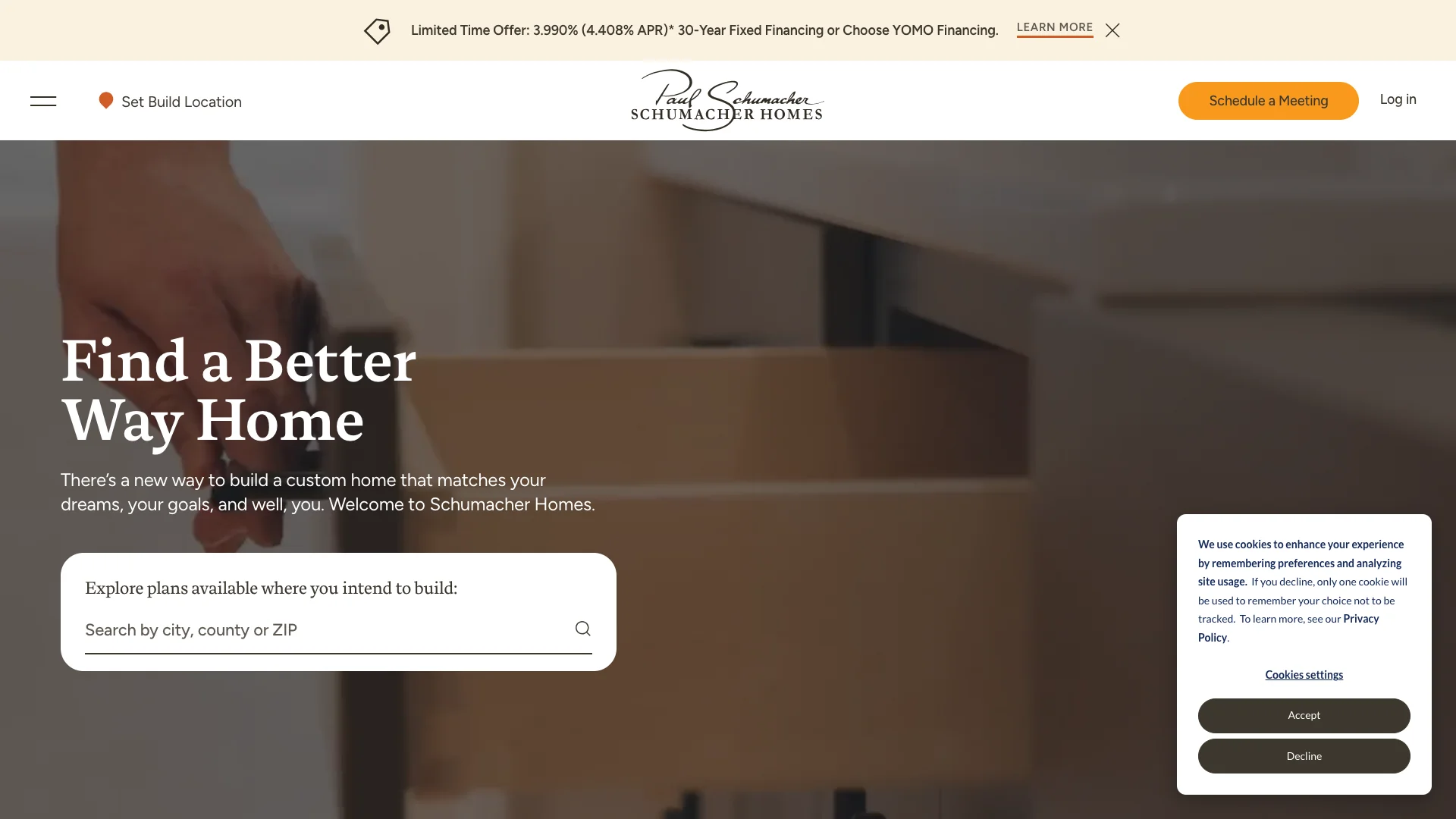
Schumacher Homes is a custom home builder operating across multiple states, with a strong presence in Ohio, West Virginia, Pennsylvania, and Indiana. According to Ahrefs, schumacherhomes.com pulls 48,900 monthly organic visitors with an estimated traffic value of $54,000. That puts them in the mid-tier of the CRO Index for custom home builders. Not a small brand. Not the biggest. But big enough that the website should be doing more heavy lifting than it is.
The $54,000 traffic value tells you that the keywords driving visitors to this site carry real commercial intent. Homeowners searching for custom home builders in Ohio or browsing house plans aren't casual researchers. They're people who are seriously considering a new-build home. That makes the trust signal gaps even more significant, because these visitors are closer to a buying decision than most.
The pages we tore down:
- Ohio state page, the regional landing page for Ohio custom home builds (1,600 monthly organic visitors, scored 29 on Google's mobile lab test, CLS 0.018, 3 forms, Google Reviews TRUE)
- House plans page, the main floor plan browsing page (1,600 monthly visitors, scored 30, CLS 0.000, 1 form, Google Reviews FALSE)
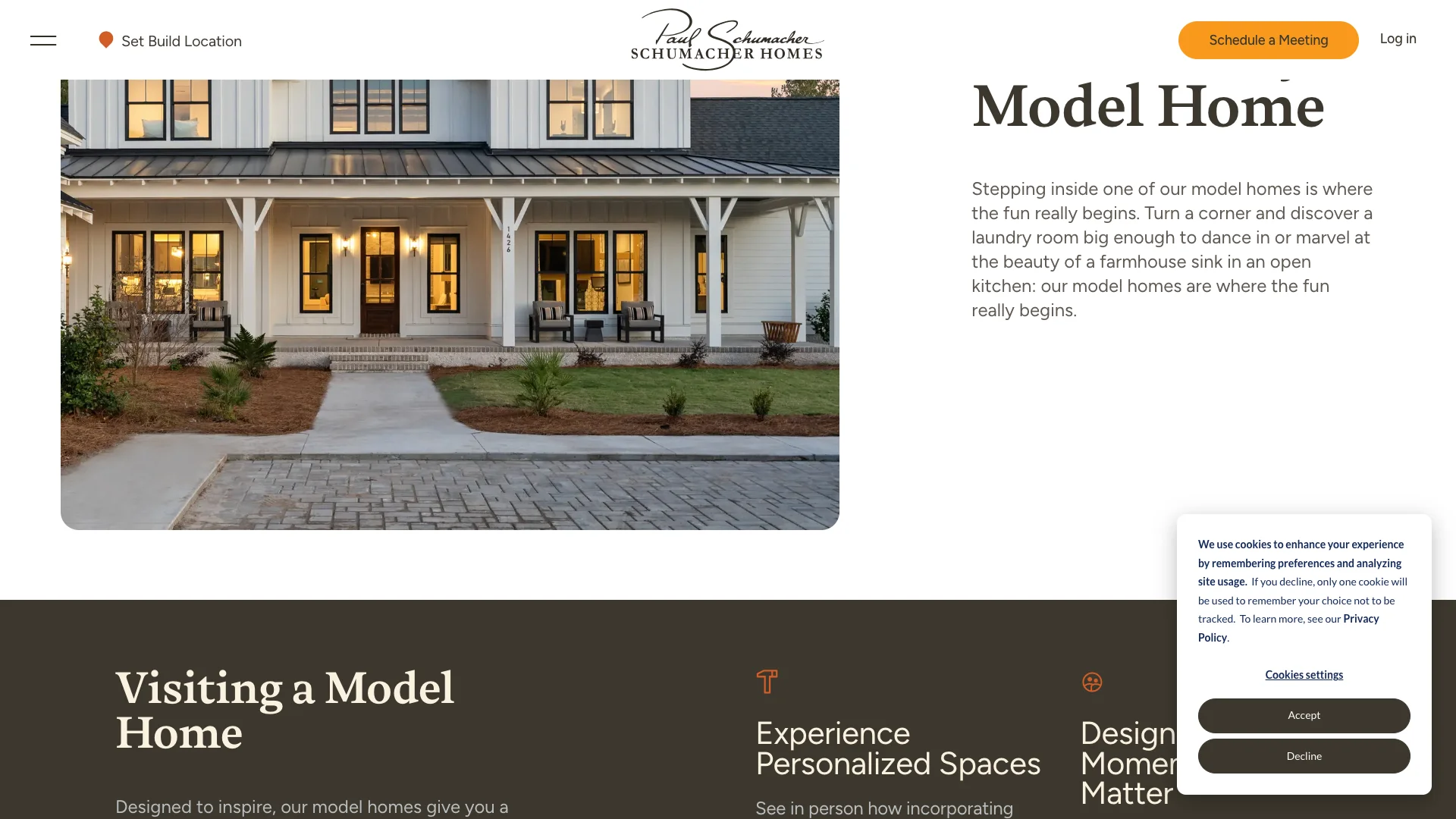
- Model homes page, the model home showcase page (1,300 monthly visitors, scored 28, CLS 0.018, 2 forms, Google Reviews TRUE)
And the pattern that jumped out immediately: Google Reviews are rendering on two of three pages but completely absent on the third. The house plans page, where a homeowner is actively browsing floor plans and comparing options, has zero social proof. No reviews. No badges. No third-party validation. Just plans and a single form.
That gap matters because the house plans page gets the same traffic as the Ohio state page. Same volume of visitors, different trust experience. One page says "other homeowners built with us and were happy." The other page says nothing at all.
The scoring tells a consistent story across all three pages. 28, 29, 30. All red zone. All eating a ranking penalty on Google's mobile lab test. But the layout stability numbers are clean: 0.000 on the house plans page, 0.018 on the Ohio and model homes pages. So the pages aren't frustrating to use. They're just slow to load and missing the trust layer that would convert the visitors who do arrive.
When you combine a 48,900-visitor brand with red-zone performance scores, inconsistent reviews, and zero trust badges, you get a site that's attracting homeowners but not giving them enough reasons to pick up the phone. The bones are solid. The trust layer needs work. And that's fixable.
"25% of homeowners say trusting contractors is their top challenge when planning home improvement projects."
— Houzz Inc. (2025)
Performance: 28 to 30 on Google's mobile lab test
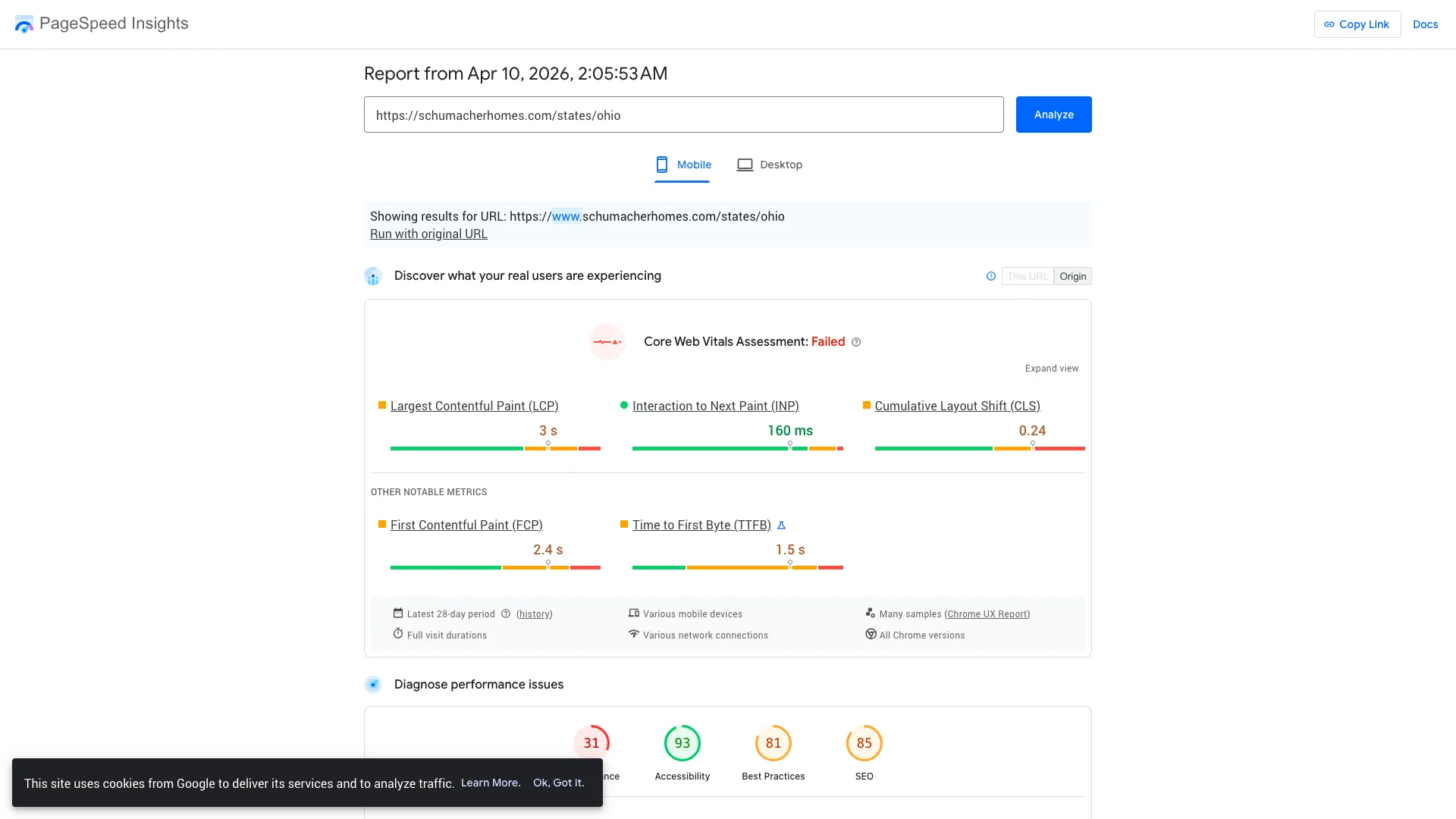
Google PageSpeed Insights runs a simulated slow-phone lab test. The scores are worst-case, not what you see on your phone with WiFi. But Google uses them as a ranking factor in search results.
The Ohio state page scored 29. The house plans page scored 30. The model homes page scored 28. All three are in the red zone, and all three are eating a search-ranking penalty because of it. For a brand pulling nearly 49,000 monthly visitors, those scores are leaving rankings on the table.
"53% of mobile users abandon sites that take longer than 3 seconds to load."
— Google / SOASTA (2017)
But layout stability tells a better story. The house plans page scores 0.000 on layout shift, meaning content doesn't jump around at all as the page loads. The Ohio page and model homes page both score 0.018, which is well under the 0.1 threshold Google considers acceptable. So while the pages are slow to load, they aren't frustrating once they do load. Content stays put. Nothing shifts under the homeowner's thumb as they scroll.
And that distinction matters because it points to a fixable problem. The page structure is solid. The images are sized correctly in the layout. Fonts aren't causing reflows. The issue is raw page weight: tracking scripts, widget embeds, uncompressed images, custom fonts loading synchronously. Strip the weight. Keep the structure. A focused sprint could move these scores from the low 30s to the mid-60s without touching the design at all.
For a custom home builder where a single project is worth $300,000 or more, the ROI on that speed work is hard to beat. Even a modest improvement in Google rankings could mean two or three additional qualified visitors per day. Over a year, that's a meaningful pipeline increase from a one-time investment.
The consistency of the scores also tells you something useful. A 2-point spread (28 to 30) across three different page types means the performance issues aren't page-specific. They're site-wide. That's actually good news because it means one round of optimization (compressing images globally, deferring tracking scripts in the site header, lazy-loading common widgets) would lift every page at the same time. You don't need three separate fixes. You need one.
Compounding effect
"Conversion rates drop approximately 12% for each additional second of page load time."
— Google / Deloitte (2020)
Lead capture: 1 to 3 forms per page, but backwards
The form count varies across the three tested pages, and the variation tells you something about priorities. The Ohio state page has three forms. The model homes page has two. The house plans page has one.
So the page where a homeowner is comparing floor plans, the most research-heavy page on the site, has the fewest conversion paths. That homeowner is deep in the decision process. They're looking at square footage, bedroom counts, layout options. And the only way to reach Schumacher from that page is a single form.
Compare that to the Ohio state page where three forms are available. A visitor who already knows they want to build in Ohio gets three chances to convert. A visitor who's still narrowing down their floor plan gets one. That's backwards. The research-stage visitor needs more touchpoints, not fewer, because they're further from a decision and more likely to leave without taking action.
"68% of users wouldn't submit a form if it required too much personal information."
— Baymard Institute (2024)
The fix isn't complicated. Add a lightweight form to the house plans page. Three fields: name, phone, zip code. "Want to see this plan in person? Tell us where you're building." That captures the browsing visitor who likes a plan but isn't ready to call. And it gives the sales team a warm lead with a specific floor plan attached to the inquiry, which is infinitely more useful than a generic "contact us" submission.
And there's a second layer to the form problem. The pages with Google Reviews (Ohio and model homes) also have the most forms. The page without reviews (house plans) has the fewest forms. So the trust gap and the conversion gap stack on top of each other. A homeowner on the house plans page gets the least social proof and the fewest ways to reach out. Both problems need fixing, and both fixes are simple.
The other thing worth noting: none of the three pages have a chat widget. So the conversion paths are limited to forms only. No phone number prominently displayed with a click-to-call button. No live chat. No text-us option. For a custom home builder where the sales conversation is inherently consultative, a chat widget or prominently placed phone number would give the homeowner who's ready to talk a faster path to the sales team.
Think about the homeowner's mindset. They're on the house plans page. They see a plan they love. They want to ask one question: "Can you build this in my area?" That's not a form submission question. That's a quick-answer question. A chat widget or a visible phone number answers it in 30 seconds. A form submission means waiting hours or days for a callback. The faster path converts more visitors. Every contractor site we tear down that has a chat widget converts better on its informational pages than the ones that rely on forms alone.
Trust signals: reviews on two pages, nothing on the third
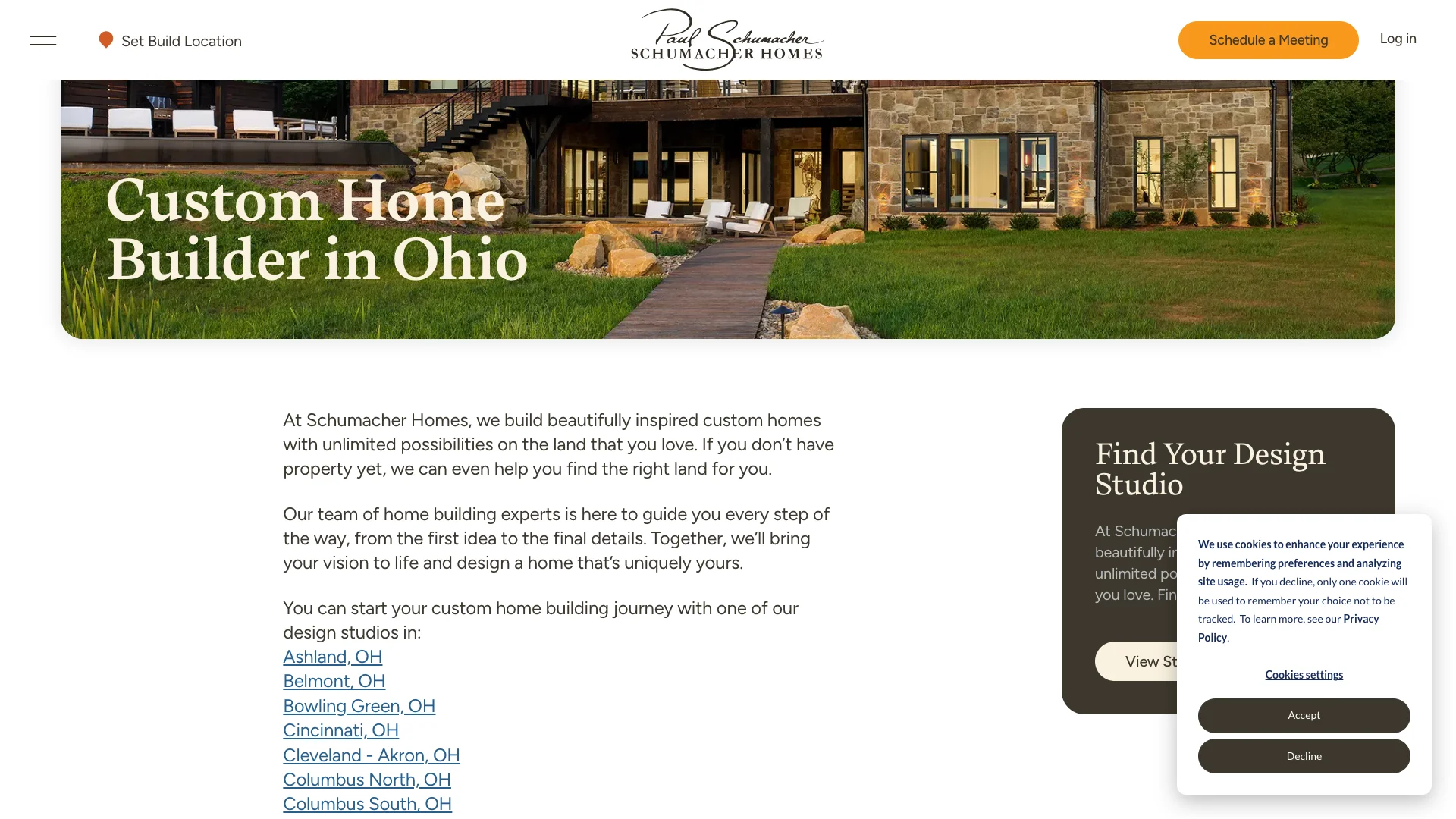
This is the section that defines the Schumacher teardown. The trust signal audit across all three pages:
- Google Reviews: Present on Ohio state page and model homes page. Absent on house plans page.
- Trust badges: Not found on any page.
- Review widgets: Not found on any page.
- Chat widget: Not found on any page.
- BBB badge: Not found.
- Certifications: Not found.
Two out of six trust signal types on two pages. One out of six on the third. And zero trust badges across the board. For a custom home builder where a single project can run $300,000 to $500,000 or more, that gap is significant. A homeowner doesn't hand over a $300,000 contract without seeing social proof. They want to know other people built with Schumacher and were happy with the result.
Comparison
"83% of consumers use Google to find local business reviews; 74% use two or more review platforms when researching."
— BrightLocal (2025)
The hidden code labels Google reads are minimal too. None of the three pages carry trade-specific labels that would tell Google "this is a custom home builder." Basic navigation and hierarchy labels are present, but nothing that signals the business category. Adding a "construction business" or "home builder" label to the service pages would help Google understand what Schumacher actually does, which feeds into how those pages appear in search results.
And the inconsistency itself sends a signal. When reviews show up on the Ohio page and model homes page but vanish on the house plans page, it suggests the review widget was added manually to some pages but not all. That's a template problem. If the review widget were part of the site-wide template, it would render on every page automatically. Instead, somebody installed it on two pages and either forgot the third or deliberately excluded it. Either way, the homeowner browsing floor plans is the one who pays the price.
The absence of trust badges is a separate issue. Even on the two pages where Google Reviews are present, there are no badges for industry associations, manufacturer partnerships, or warranty programs. For a custom home builder operating in multiple states, those credentials exist. Schumacher almost certainly has manufacturer partnerships, construction warranties, and industry memberships. But if they're not on the website, they're not doing any work for the homeowner who's comparing builders online.
A homeowner comparing Schumacher to a local custom builder who displays NAHB membership, Energy Star certification, and manufacturer warranty badges is going to feel more confident in the builder who shows those credentials. That's not a theory. That's how trust works when the purchase price is six figures.
What Schumacher Homes does well
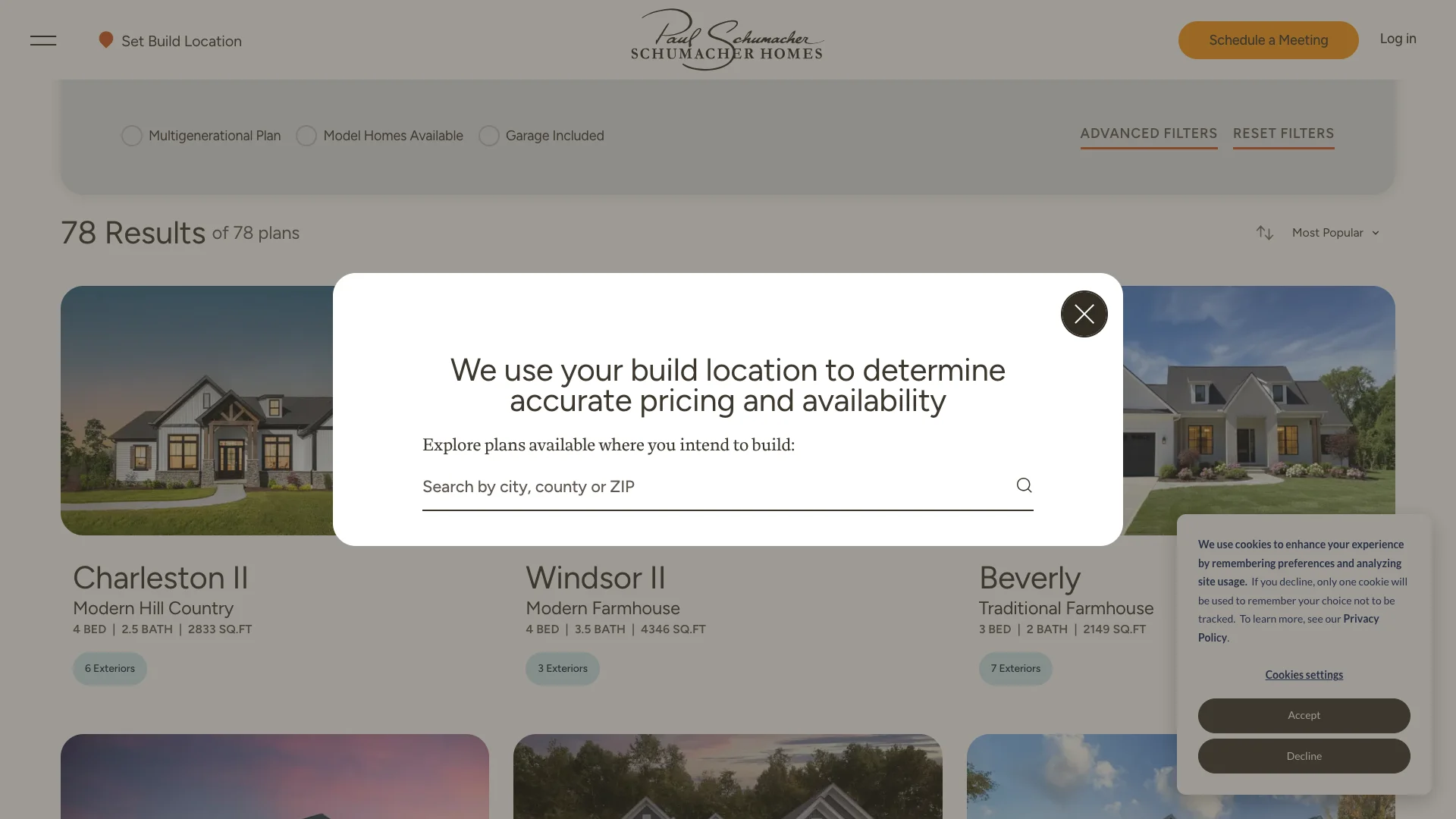
Schumacher gets a few things right that are worth calling out, especially for custom home builders at a similar scale.
Clean layout stability. 0.000 to 0.018 across all three pages. Content doesn't jump around as the pages load. That's the gold standard for user experience, and Schumacher nails it. Homeowners browsing floor plans or reading about Ohio builds aren't fighting a page that keeps shifting under their fingers. Compare that to builders in the CRO Index with layout shift scores of 0.2 or higher, where content is jumping around nearly 2x the acceptable limit.
Consistent scoring. 28 to 30 across all three pages. The scores are low, but they're consistently low. That means the performance issues are systemic (site-wide image compression, script loading, tracking overhead) rather than page-specific. Systemic problems are easier to fix because one round of optimization improves every page at once. You don't need to diagnose three separate issues. You need to fix one systemic bottleneck.
Google Reviews where they exist. On the Ohio state page and model homes page, reviews are actually rendering. That's more than a lot of national builders manage. The problem isn't that Schumacher doesn't have reviews. The problem is they aren't showing them on every page.
Multiple forms on key pages. Three forms on the Ohio state page gives a visitor multiple chances to convert. That's a solid approach for a regional landing page where the visitor has already self-selected by searching for Ohio custom homes. The issue is that the same thinking didn't carry over to the house plans page, where the browsing intent is just as strong.
And when you look at the overall picture, Schumacher is doing more right than wrong. The layout is clean. The Google Reviews exist (just not everywhere). The forms are present (just not evenly distributed). This isn't a site that needs a rebuild. It's a site that needs its existing strengths applied uniformly. The foundation is already better than most custom home builder websites in the CRO Index.
"64% of homeowners say having recommendations or references is a top-three factor in choosing a contractor."
— Houzz Inc. (2025)
What the gaps mean for custom home builders
Schumacher is a peer for any custom home builder doing 49K or more monthly visitors. The lessons here are about consistency, not capability. The foundation is there. The execution just isn't uniform across all pages.
If you're a custom home builder reading this, the takeaway isn't "Schumacher is doing it wrong." The takeaway is "Schumacher has the right pieces but hasn't put them on every page." That's a different problem than starting from scratch. And it's a much easier one to fix.
Put reviews on every page. If you've got Google Reviews rendering on some pages, put them on all pages. The house plans page is where homeowners are actively comparing options. That's arguably the most important page for social proof because the visitor is in research mode. They're asking "should I trust this builder with my floor plan?" Reviews answer that question. Without them, the visitor has to navigate to another page to find validation, and most won't bother. They'll just leave.
Add trust badges. Zero trust badges across all three tested pages. If Schumacher has any industry certifications, manufacturer partnerships, warranty programs, or association memberships, those badges need to be visible on every page. Custom home building is a high-anxiety purchase. A $300,000 commitment needs every reassurance the website can provide. Badges reduce that anxiety. And they cost nothing to add.
Fix page speed before scaling content. Scores of 28 to 30 mean Google is penalizing every page in search results. For a brand with 48,900 monthly visitors, even a 10% improvement in rankings could mean 5,000 additional visitors per month. Compress images, defer scripts, lazy-load below-the-fold content. A focused speed sprint could move these scores into the 60s or 70s within a week.
Match form density to visitor intent. The Ohio state page has three forms. The house plans page has one. Flip that logic. The research-stage visitor browsing floor plans needs more conversion paths, not fewer. Add a contextual form tied to the specific plan they're viewing: "Love this layout? Tell us where you want to build it." That bridges the gap between browsing and inquiring.
Add hidden code labels for the trade. None of the three pages tell Google that Schumacher is a custom home builder. Adding a "construction business" label with the company name and service area would help Google understand the pages better. That label takes five minutes to add and improves how the pages show up in search results for builder-related queries.
Add a chat widget or visible phone number. Right now, forms are the only conversion path. A homeowner with a quick question ("Do you build in my county?") has to fill out a form and wait for a callback. Adding a chat widget or a click-to-call phone number prominently in the header gives that homeowner an instant path to the answer. For high-ticket services like custom home building, the speed of the first response often determines whether the homeowner chooses your company or the competitor who picked up the phone.
The bottom line for Schumacher: this isn't a website that needs a teardown and rebuild. It needs the existing trust signals and conversion paths applied consistently across every page. Put reviews everywhere. Add badges. Give the house plans page more forms. Speed up the load times. Those changes would take a week of focused work and would improve conversion rates across a 48,900-visitor site.
"48% of customers say that if a site does not work well on mobile, it signals the company does not care about their business."
— Google Consumer Insights (2018)
Frequently asked questions
How does Schumacher Homes score on Google's mobile test?
The Ohio state page scored 29 out of 100 on Google PageSpeed Insights mobile. The house plans page scored 30. The model homes page scored 28. All three are in the red zone and eating a search-ranking penalty. Google uses these scores as a ranking factor, so every page on the site is being pushed lower in search results than it needs to be.
But layout stability is clean (0.000 to 0.018), so the pages don't jump around as they load. That means the speed problem is raw page weight (images, scripts, tracking code), not structural issues with how the pages are built.
Does Schumacher Homes display Google Reviews?
On two of three tested pages, yes. The Ohio state page and model homes page both show Google Reviews. But the house plans page returns reviews as FALSE. That inconsistency means a homeowner comparing floor plans won't see any social proof on one of the site's most important pages.
Zero trust badges appear on any of the three tested pages. So even where reviews are present, there's no additional third-party validation from industry associations, manufacturer partnerships, or warranty programs.
How many forms does schumacherhomes.com have?
Form counts range from one to three across the tested pages. The Ohio state page has three forms. The model homes page has two. The house plans page has just one. The highest-intent browsing page has the fewest conversion paths, which is the opposite of what you'd want.
No chat widget or prominently displayed click-to-call phone number was found on any tested page. Forms are the only conversion mechanism, and the page with the most research-heavy visitors has the fewest of them.
How much organic traffic does schumacherhomes.com get?
According to Ahrefs data from March 2026, schumacherhomes.com receives approximately 48,900 monthly organic visitors with an estimated traffic value of $54,000. The Ohio state page accounts for 1,600 visitors. House plans accounts for 1,600. Model homes accounts for 1,300. Those three pages represent about 9% of total site traffic.
The traffic value of $54,000 means the organic keywords Schumacher ranks for carry meaningful commercial intent. Homeowners searching for custom home builders in Ohio are ready to have real conversations about building a home, not just browsing for fun.