
What we found on restoration1.com
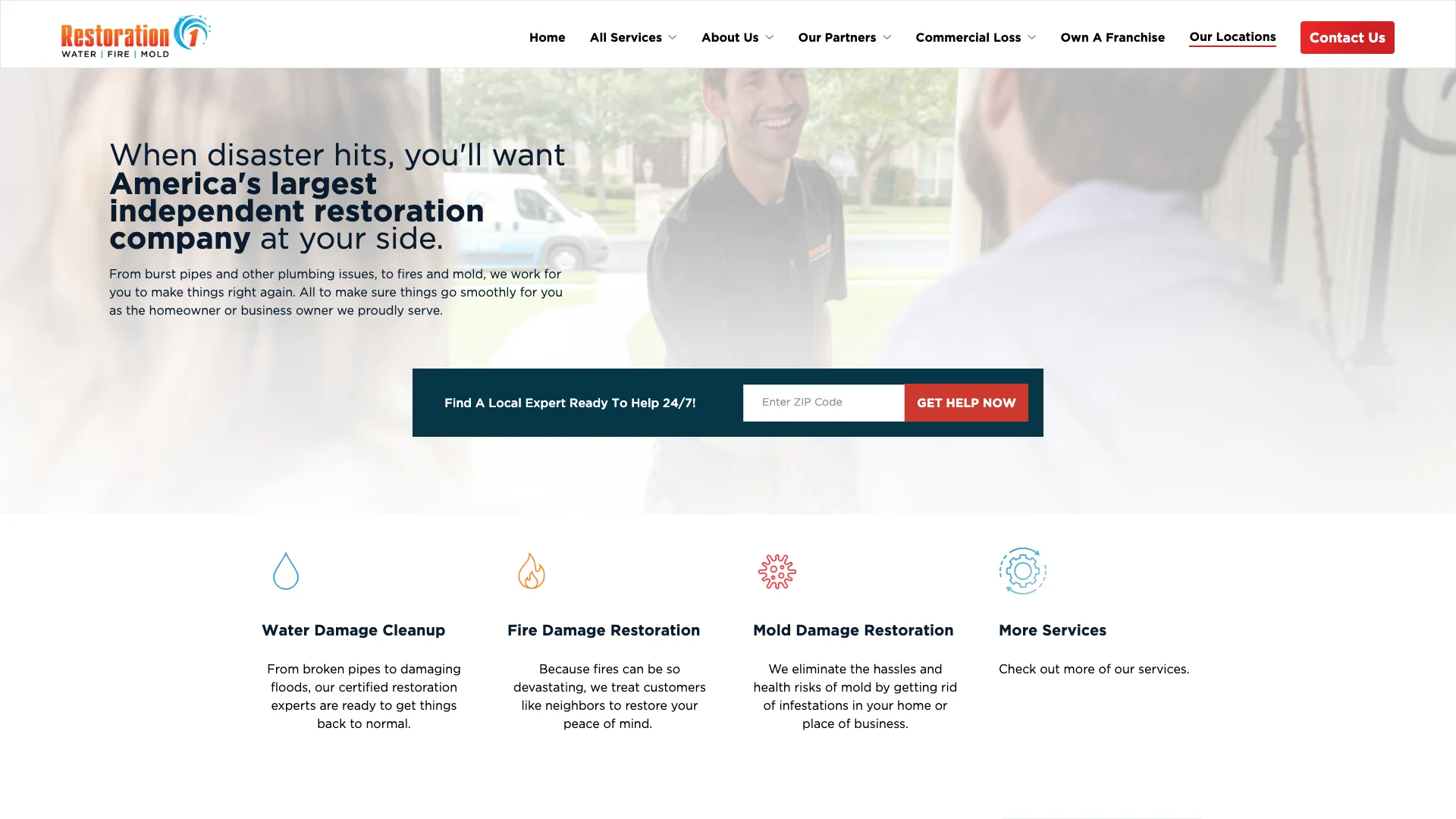
Restoration 1 is a restoration franchise operating across the United States. According to Ahrefs, restoration1.com pulls 41,300 monthly organic visitors with an estimated traffic value of $220,800. And the interesting story on this teardown isn't the traffic numbers. It's the local search setup.
The pages we tore down:
- Smoke alarm blog (2,300 monthly organic visitors, 6% traffic share, no performance data available)
- Myrtle Beach location page (1,700 monthly visitors, 5% share, scored 64 on Google's mobile lab test)
- North Myrtle Beach location page (1,500 monthly visitors, 4% share, scored 33)
The location pages are where the story gets interesting. Both have Google Reviews present. Both have trust badges. Both carry ProfessionalService and City code labels, which tell Google "this page represents a professional service in this specific city." That's the kind of code label setup most restoration contractors don't have and should. Two forms per location page give homeowners multiple ways to reach out. But the score variance between sibling locations is wild: one scores 64, the other scores 33. Same franchise, same template, 31-point gap. Something on the North Myrtle Beach page is dragging performance down hard.
"25% of homeowners say trusting contractors is their top challenge when planning home improvement projects."
— Houzz Inc. (2025)
Performance: 33 to 64 on Google's mobile test
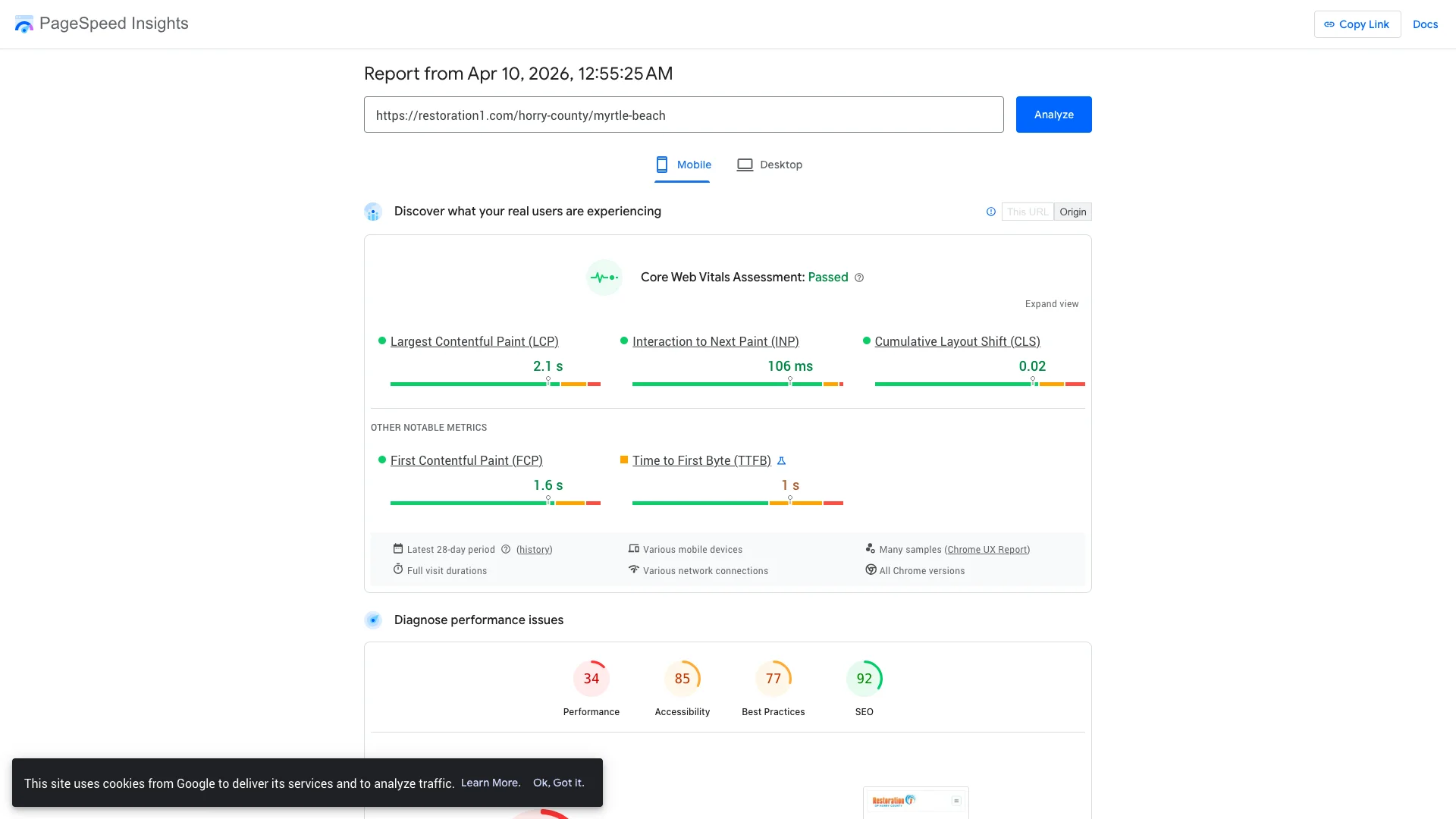
Google PageSpeed Insights runs a simulated slow-phone lab test. The scores are worst-case, not what you see on your phone with WiFi. But Google uses them as a ranking factor in search results.
The Myrtle Beach location page scored 64 out of 100. That's in the orange zone and respectable for a location page with reviews, forms, and embedded content. The North Myrtle Beach location page scored 33. That's in the red zone and eating a significant ranking penalty. And the smoke alarm blog had no performance data available, which means either the page wasn't indexed at the time of testing or it returned an error during the speed test.
"53% of mobile users abandon sites that take longer than 3 seconds to load."
— Google / SOASTA (2017)
That 31-point gap between two sibling location pages is unusual. Both pages should be running on the same template. Same layout, same components, same basic structure. So the difference is almost certainly coming from page-specific content: additional images that aren't optimized, extra third-party embeds, a larger review widget, or tracking scripts that only fire on one page. Finding and fixing whatever's dragging the North Myrtle Beach page from 64 down to 33 is a high-leverage task because the fix would likely apply to every other low-scoring location page in the franchise.
Layout stability is 0.048 on both location pages. That's below the 0.1 threshold where Google flags it as a problem, but it's not perfect either. Content shifts slightly as these pages load. It's the kind of shift a homeowner might notice (a button that moves, a section that jumps) but not the kind that destroys the reading experience. Still, tightening it from 0.048 to 0.01 or lower would eliminate any ranking penalty from layout shift entirely.
Compounding effect
"Conversion rates drop approximately 12% for each additional second of page load time."
— Google / Deloitte (2020)
Lead capture: two forms per location page
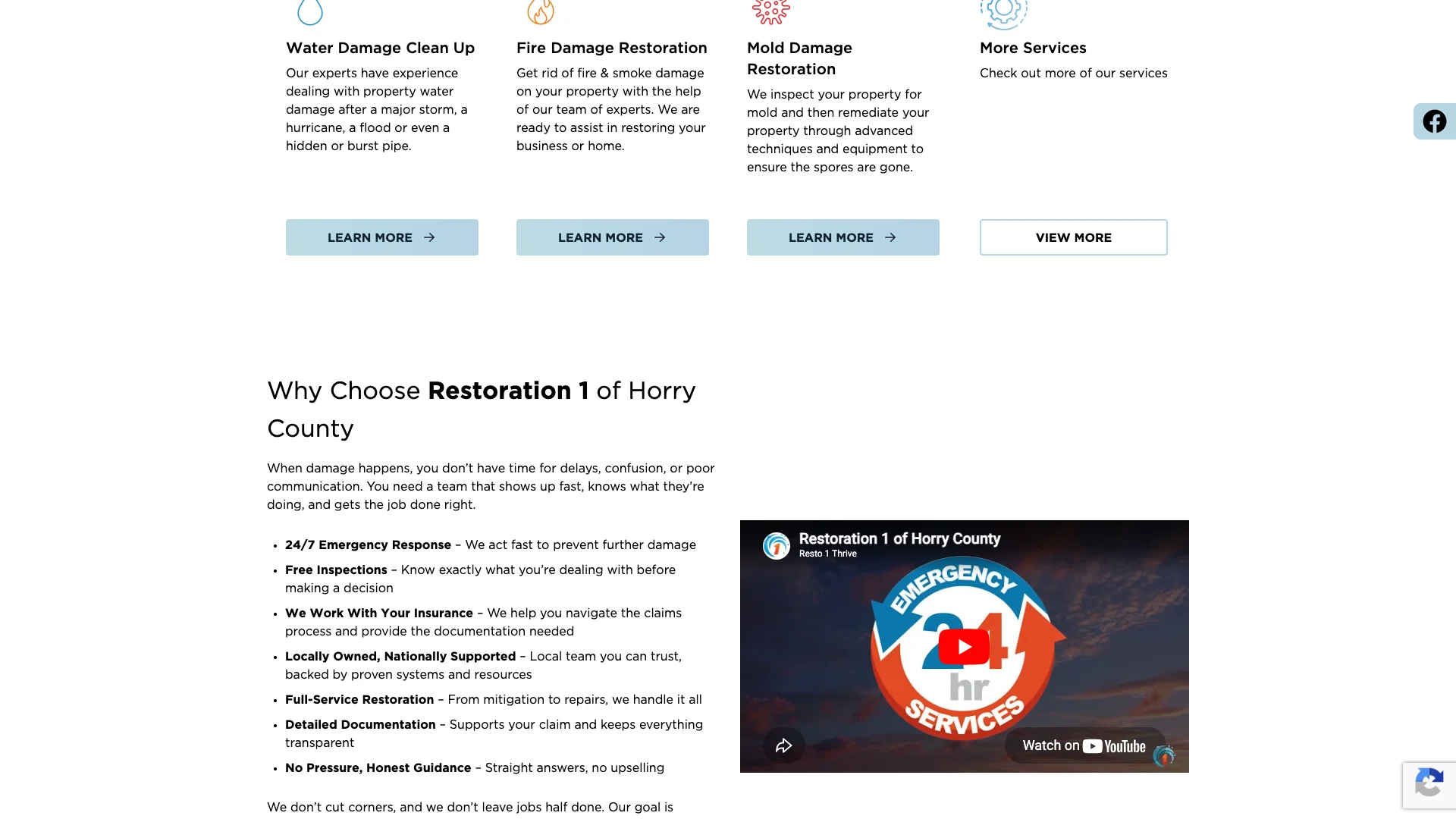
Both location pages have two forms each. That's a solid setup for location pages. A homeowner who lands on the Myrtle Beach restoration page and decides they need help has two opportunities to leave their information as they scroll through the content. No need to hunt for a contact page or scroll back to the top.
"68% of users wouldn't submit a form if it required too much personal information."
— Baymard Institute (2024)
The smoke alarm blog's form count wasn't available in the data, which is worth noting. Blog pages in the CRO Index often have zero forms (PuroClean's blogs, for instance, have zero across the board). So it's possible the blog is a content-only page with no conversion path, while the location pages carry the lead capture load.
What's working about this setup is the combination. Two forms plus Google Reviews plus trust badges on the location pages means a homeowner can see social proof, feel confident about the company, and submit their information without leaving the page. That's a complete conversion flow on a single page. Compare that to BELFOR (three forms, zero reviews, zero badges) or PuroClean (zero forms, badges only), and Restoration 1's location pages are closer to the ideal setup for local service pages. The gap is that there's no chat widget. And for restoration, where emergencies drive a significant portion of the leads, chat would capture the homeowner who needs help right now rather than tomorrow.
Trust signals: reviews and badges on location pages
The trust signal audit on the location pages:
- Google Reviews: Present on both location pages.
- Review widgets: Not found.
- Trust badges: Present on both location pages.
- Chat widget: Not found on any page.
- BBB badge: Not found.
- Certifications: Not found.
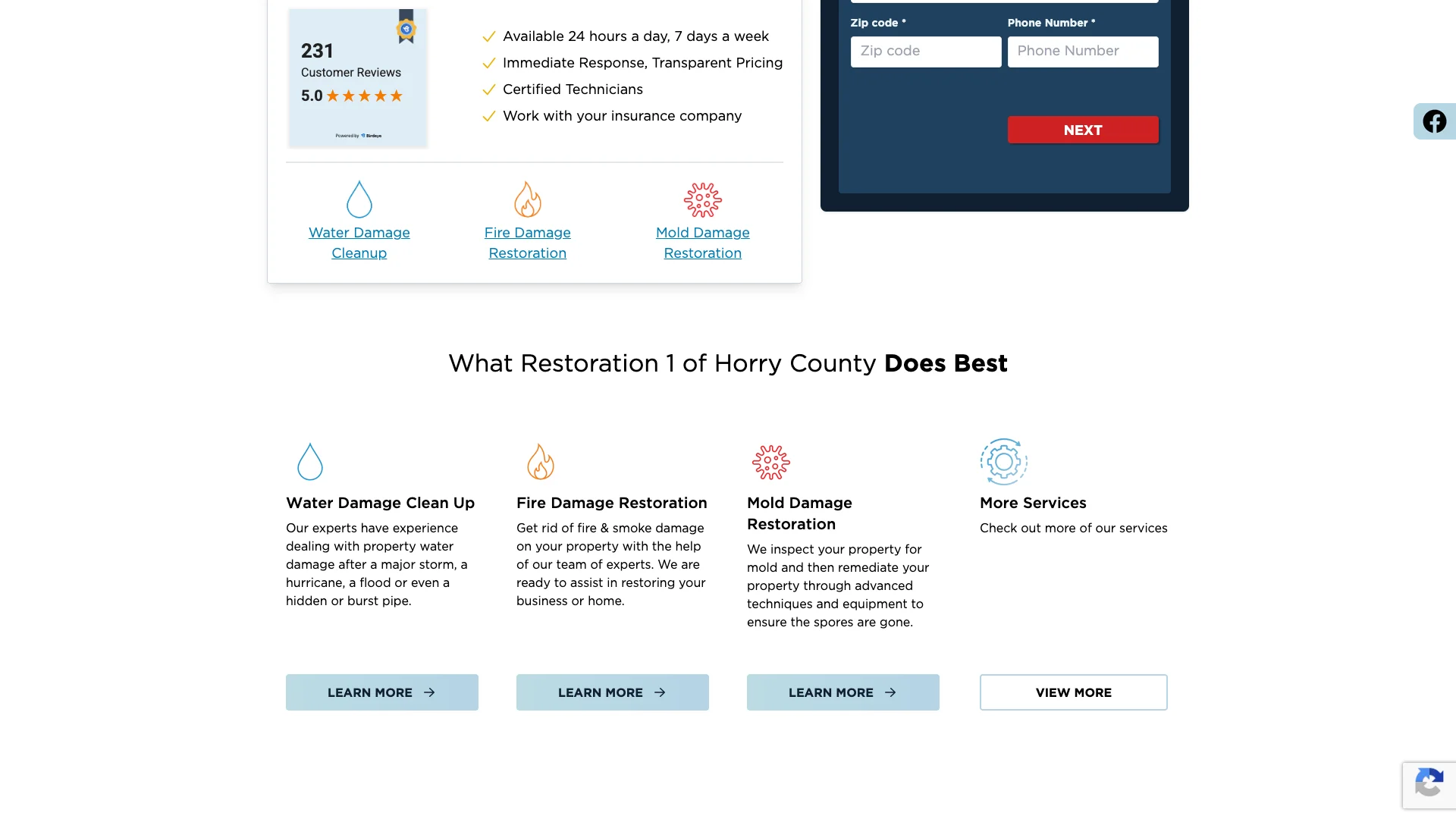
Two out of six trust signal types are present on the location pages. That's not a complete trust stack, but the two that are present are the two that matter most for local service pages: Google Reviews (social proof from real customers) and trust badges (proof of licensure and quality). A homeowner deciding between restoration companies in Myrtle Beach gets star ratings and certification signals before they hit the form. That's the minimum viable trust setup for local pages, and Restoration 1 delivers it.
Comparison
"83% of consumers use Google to find local business reviews; 74% use two or more review platforms when researching."
— BrightLocal (2025)
The code labels are the standout detail. ProfessionalService tells Google the page represents a professional service business. City tells Google the specific city where that service operates. Together, they create a pairing that says "this is a professional restoration service in Myrtle Beach, South Carolina." That's exactly the kind of context Google needs to match the page to local search queries. When a homeowner searches "water damage restoration Myrtle Beach," Google has explicit signals from Restoration 1's code labels that this page is relevant. Most competitors rely on the page content alone to communicate that. Restoration 1 communicates it in the code too.
That ProfessionalService label is rare in the CRO Index. Most contractor sites use WebPage or LocalBusiness. ProfessionalService is more specific and more aligned with how Google categorizes service-based businesses. And when paired with the City label, it creates a location-specific signal that LocalBusiness alone doesn't provide.
What Restoration 1 does well
Restoration 1's location pages are the highlight of this teardown. And the combination of trust signals plus code labels makes them worth studying.
Google Reviews on location pages. Reviews are present on both tested location pages. For a franchise with locations across the country, having location-specific reviews on each location page is the right approach. A homeowner in Myrtle Beach sees reviews from other Myrtle Beach customers, not a national aggregate. That specificity builds local trust.
ProfessionalService + City code labels. This is the most location-aware code label setup we've seen in the restoration batch. Most competitors use generic WebPage labels that tell Google nothing about what the business does or where it operates. Restoration 1's labels explicitly say "professional service" and "Myrtle Beach." That's the kind of structured data that helps Google rank the page for hyper-local queries. And it's the kind of advantage that compounds across dozens or hundreds of location pages.
Two forms per location page. Two conversion opportunities on each location page. A homeowner scrolling through the content encounters a form early and another one deeper in the page. That's enough to capture both the quick-decision visitor and the thorough researcher who reads everything before acting.
Trust badges on every location page. Consistent badge placement alongside Google Reviews creates a two-layer trust signal: "we're certified" plus "our customers are happy." That combination is more persuasive than either signal alone, and Restoration 1 delivers both on every location page.
"64% of homeowners say having recommendations or references is a top-three factor in choosing a contractor."
— Houzz Inc. (2025)
What the gaps mean for restoration contractors
Restoration 1's teardown is a story about strong local pages with fixable performance problems. And for restoration contractors running franchise or multi-location websites, the lessons are directly applicable.
Fix the score variance between sibling locations. A 31-point gap (64 vs. 33) between two location pages on the same template means something page-specific is causing the problem. That's good news, because it means the template isn't broken. Find the extra scripts, unoptimized images, or heavy embeds on the North Myrtle Beach page and remove or optimize them. Then audit every other location page for the same issue. One fix could lift dozens of location pages out of the red zone.
Copy the ProfessionalService + City label strategy. If you're a restoration contractor with location pages, this is the code label setup to use. ProfessionalService tells Google what you do. City tells Google where you do it. Together, they give Google the exact information it needs to rank your page for local restoration queries. Most of your competitors are using generic WebPage labels or nothing at all. This is a competitive advantage that costs almost nothing to implement but improves local search visibility across every location page.
Add reviews to your blog pages too. Restoration 1's location pages have reviews. But the blog (the highest-traffic page at 2,300 monthly visitors) likely doesn't. A homeowner who discovers your brand through a blog post should see the same trust signals as a homeowner who lands on a location page. Reviews on blog content reinforce credibility at the moment of discovery, which is when it matters most.
Add a chat widget for emergency restoration. Both BELFOR and PuroClean are missing chat, and Restoration 1 is too. For a trade where emergencies drive leads, a chat widget captures the visitor who needs help in the next hour, not the next day. Restoration 1's location pages already have reviews, badges, and forms. Adding chat would make them genuinely complete conversion pages with four distinct paths: form, phone, chat, and the confidence from reviews to choose any of them.
Get performance data on the blog. The smoke alarm blog had no performance data available. Whether that's an indexing issue or a testing error, it's worth investigating. That blog drives 2,300 monthly visitors (6% of total traffic). If its Google score is in the red zone, it's eating a ranking penalty on PuroClean's highest-traffic content page. Run it through Google's test manually, fix whatever comes up, and monitor it monthly.
"48% of customers say that if a site does not work well on mobile, it signals the company does not care about their business."
— Google Consumer Insights (2018)
Frequently asked questions
How does Restoration 1 score on Google's mobile test?
The Myrtle Beach location page scored 64 out of 100. The North Myrtle Beach location page scored 33. That's a 31-point gap between two sibling pages, which suggests page-specific content is dragging the lower-scoring page down. The smoke alarm blog had no performance data available. Layout stability is 0.048 on both location pages, which is below the problem threshold but not perfect.
Does Restoration 1 display Google Reviews on its location pages?
Yes. Both tested location pages have Google Reviews present and trust badges present. The combination of visible reviews and ProfessionalService + City code labels makes Restoration 1's location pages some of the most local-search-optimized pages in the restoration batch of the CRO Index.
What is a ProfessionalService code label?
It's a hidden tag that tells Google the page represents a professional service business. When paired with a City label, it creates a signal that says "this is a professional restoration service in Myrtle Beach." That pairing helps Google match the page to location-specific search queries. Most restoration companies use basic WebPage labels. Restoration 1's setup is more specific and more useful for local rankings.
How much organic traffic does restoration1.com get?
According to Ahrefs data from March 2026, restoration1.com receives approximately 41,300 monthly organic visitors with an estimated traffic value of $220,800. The smoke alarm blog accounts for 2,300 visitors (6%). The Myrtle Beach location page accounts for 1,700 (5%). The North Myrtle Beach page accounts for 1,500 (4%). Traffic is distributed across the franchise's location and blog pages.