
What we found on pulte.com
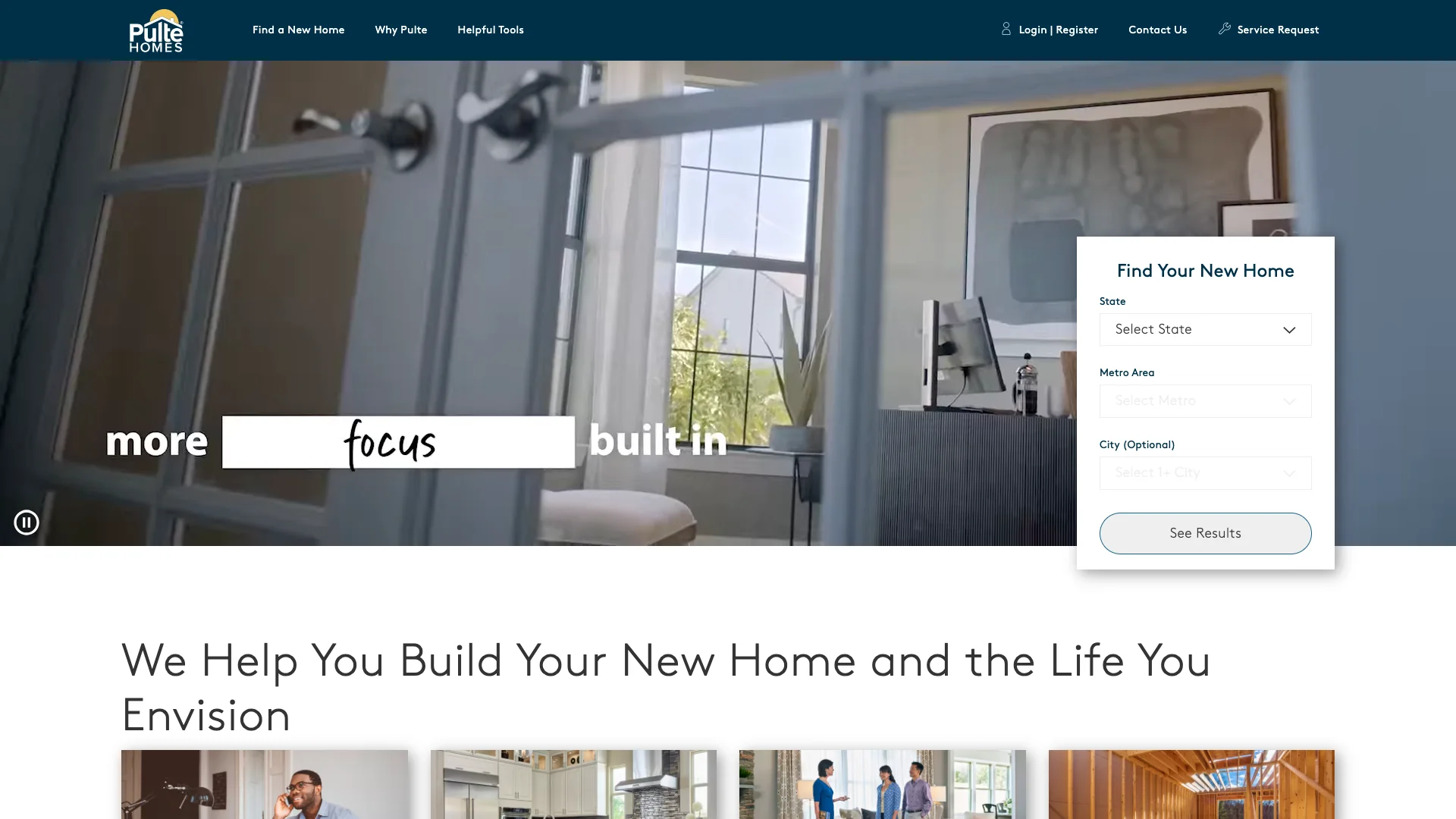
PulteGroup is a publicly traded home builder (NYSE: PHM) that operates as Pulte Homes. According to Ahrefs, pulte.com pulls 138.2K monthly organic visitors with an estimated traffic value of $162.4K.
We ran three pages through our standard teardown protocol. And the numbers told two stories at once. The first story is about load times so long you'd think the page was broken. The second is about a form so bloated it asks for your middle name and a password before you've even spoken to a sales rep.
The pages we tore down:
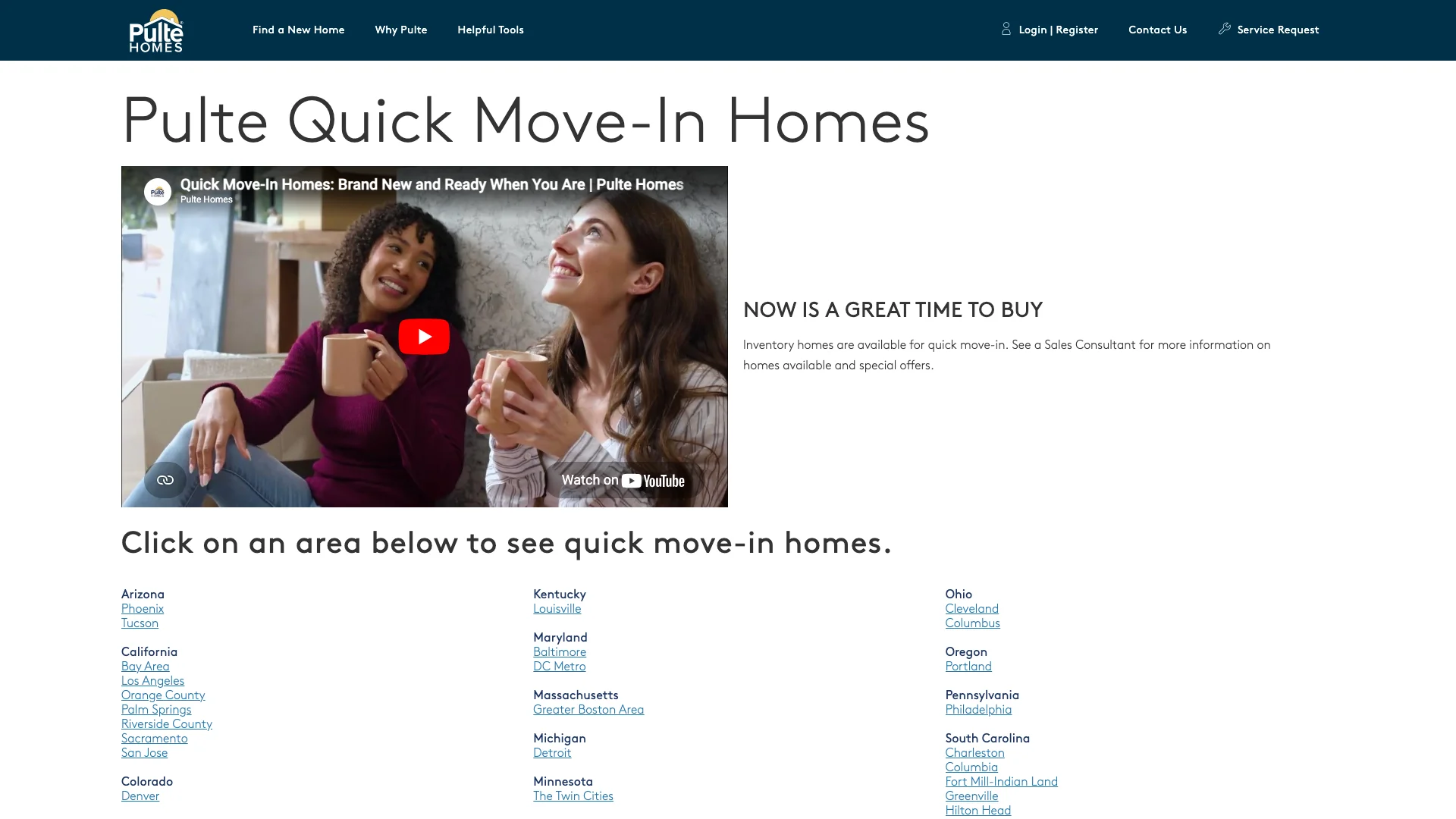
- /quick-move-in-homes — ready-to-close inventory homes (2.5K monthly organic visitors, 2% traffic share)
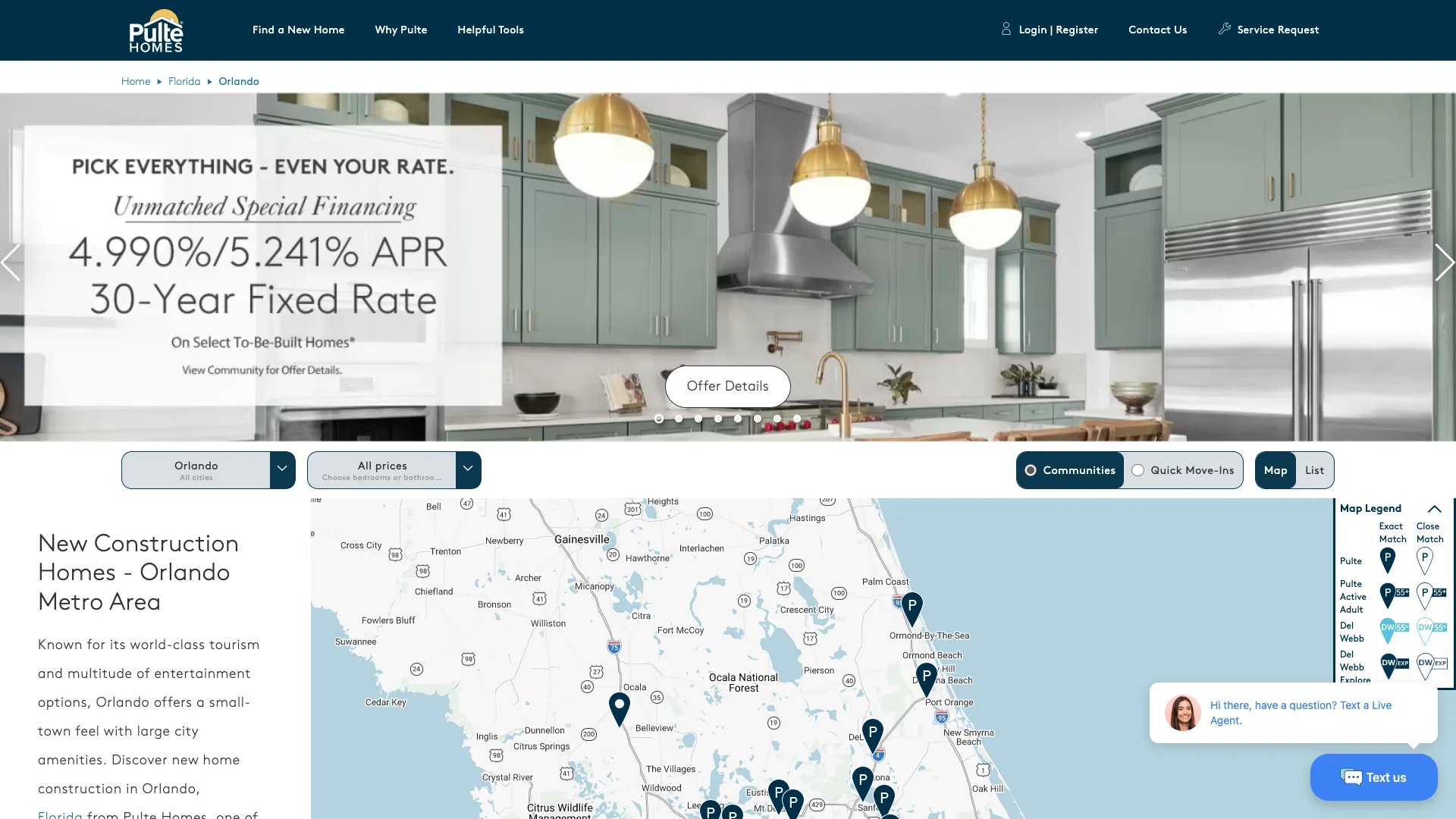
- /homes/florida/orlando — the Orlando metro communities page (2.1K monthly organic visitors, 2% traffic share)
- /build/custom-home-designs — interactive floor plans and design tools (2K monthly organic visitors, 1% traffic share)
A quick note on traffic distribution: unlike the other brands in this series, PulteGroup's traffic is highly distributed. No single page commands a large share. The top three pages combined represent just 5% of total domain traffic. That's typical for a builder with dozens of community-specific landing pages.
"In 2024, just 4% of U.S. homeowners undertook new home construction."
— Houzz Inc. (2025)
Performance: pages that don't finish loading
We've audited sites with slow load times before. Re-Bath's find-a-location page takes 27 seconds. West Shore Home's bathroom page takes 68 seconds. But PulteGroup manages to put two pages above the 40-second mark and one past the minute mark.
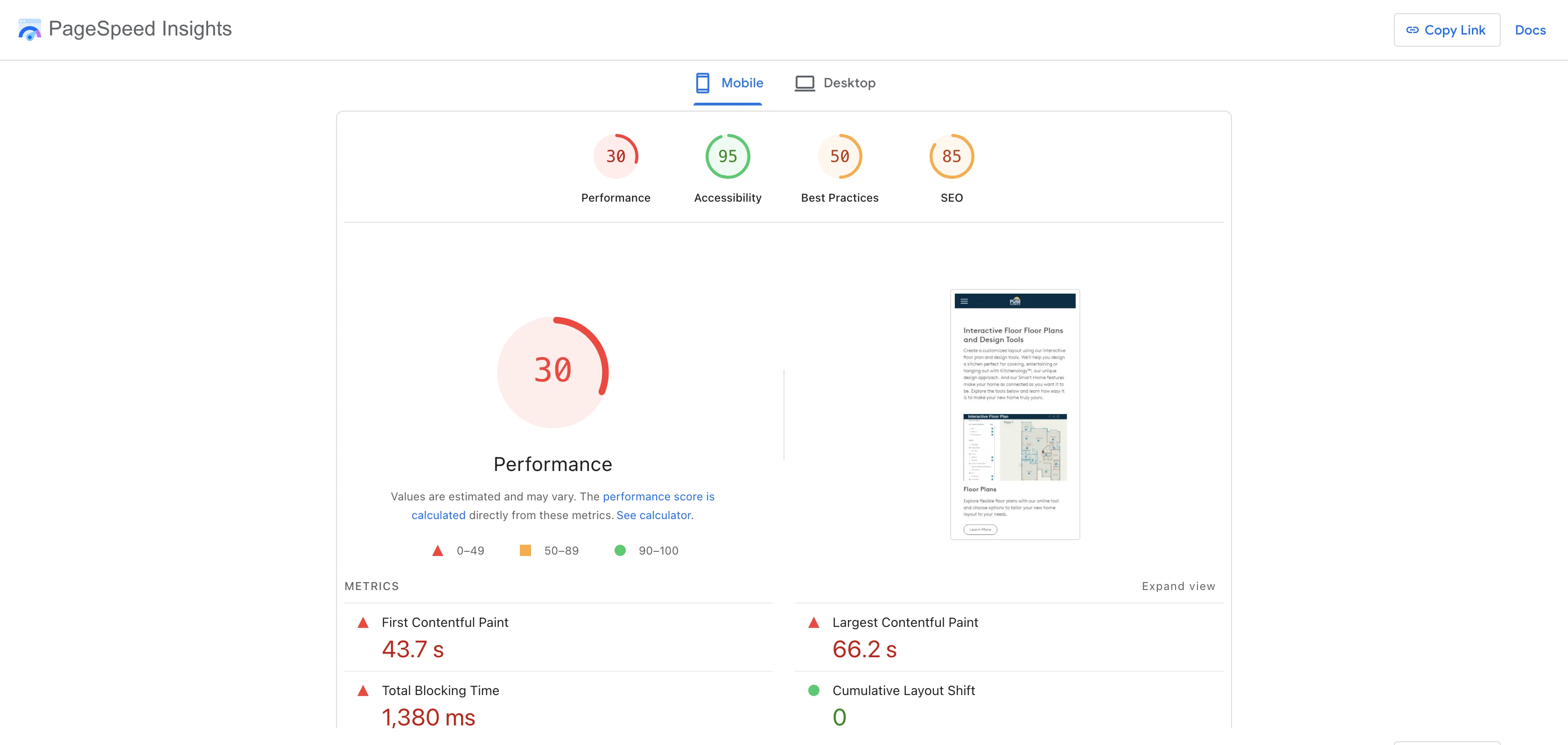
Custom home designs page (/build/custom-home-designs): Performance score 30/100. LCP of 66.2 seconds. FCP of 43.7 seconds. That means the first pixel of content doesn't appear until 44 seconds in, and the main content doesn't finish rendering until 66 seconds. Speed Index of 49.7 seconds. TBT of 1,380ms. CLS of 0.000 (no layout shift, at least).
Orlando communities page (/homes/florida/orlando): Performance score 25/100. LCP of 48.4 seconds. FCP of 22.8 seconds. TBT of 4,663ms — that's 4.6 seconds of Total Blocking Time where the browser can't respond to taps. Speed Index of 27.7 seconds. Accessibility score of 72/100, the lowest of the three pages.
Quick Move-In page (/quick-move-in-homes): Performance score 32/100. LCP of 43.0 seconds. FCP of 24.0 seconds. TBT of 1,129ms. Speed Index of 24.0 seconds. Accessibility of 88/100.
"Meeting Core Web Vitals standards reduced site abandonment rates by up to 24%."
— Google (2020)
To put this in context: Google considers an LCP of 2.5 seconds "good." PulteGroup's best-performing page takes 43 seconds. Their worst takes 66. These are Lighthouse lab scores on a simulated mid-range phone with throttled connectivity — the experience of a first-time visitor. And someone searching "new homes Orlando" for the first time is exactly the visitor PulteGroup needs to convert.
The FCP numbers are almost as telling. First Contentful Paint — when anything at all appears on screen — ranges from 22.8 to 43.7 seconds. On the custom designs page, a visitor stares at a blank or near-blank screen for 44 seconds before seeing any content. That's not "slow." That's a broken experience on mobile.
The 20-field form: an account registration disguised as a lead capture
Every page on pulte.com carries a 20-field form in the DOM. And calling it a "lead form" is generous. It's an account registration system that happens to also capture lead information.
The fields: Nickname. Middle Name. First Name. Last Name. Email. Zip Code. An "Outside US" checkbox. Phone. An "Is Realtor" checkbox. Broker Office. Broker ID. Password. Password Verify. A second password field (lowercase "password" — a different field than "Password"). Remember Me checkbox. Message textarea. And four select dropdowns.
Count them. Twenty fields. For someone who just wants to ask about new homes in Orlando.
And the Orlando page adds a separate 14-field form on top of the 20-field one. Plus a 3-field registration form. Plus a 3-field login form. That's four forms totaling 40 fields on a single page.
"22% of US online shoppers abandoned an order in the past quarter solely due to a too long or complicated checkout process."
— Baymard Institute (2024)
The intent behind the form is clear enough. PulteGroup wants to create user accounts so homebuyers can save communities, track designs, and interact with Pulte Mortgage. That's a CRM play. But from the homebuyer's perspective? They just want to know what's available in their zip code and what it costs. Asking for a password and a broker ID before that first conversation happens is asking for commitment before value.
And there's a design hierarchy problem. Best practice for contractor lead forms is 3-5 fields. Name, phone, maybe zip code and a brief "what do you need?" field. PulteGroup's form asks for 20. The difference between "tell me your name and I'll call you" and "create an account, set a password, identify yourself as a realtor or not, provide your broker credentials if applicable, then tell me what you're looking for" — that's the gap between a conversation starter and a bureaucratic process.
Trust signals: trust badges on one page, nothing on the rest
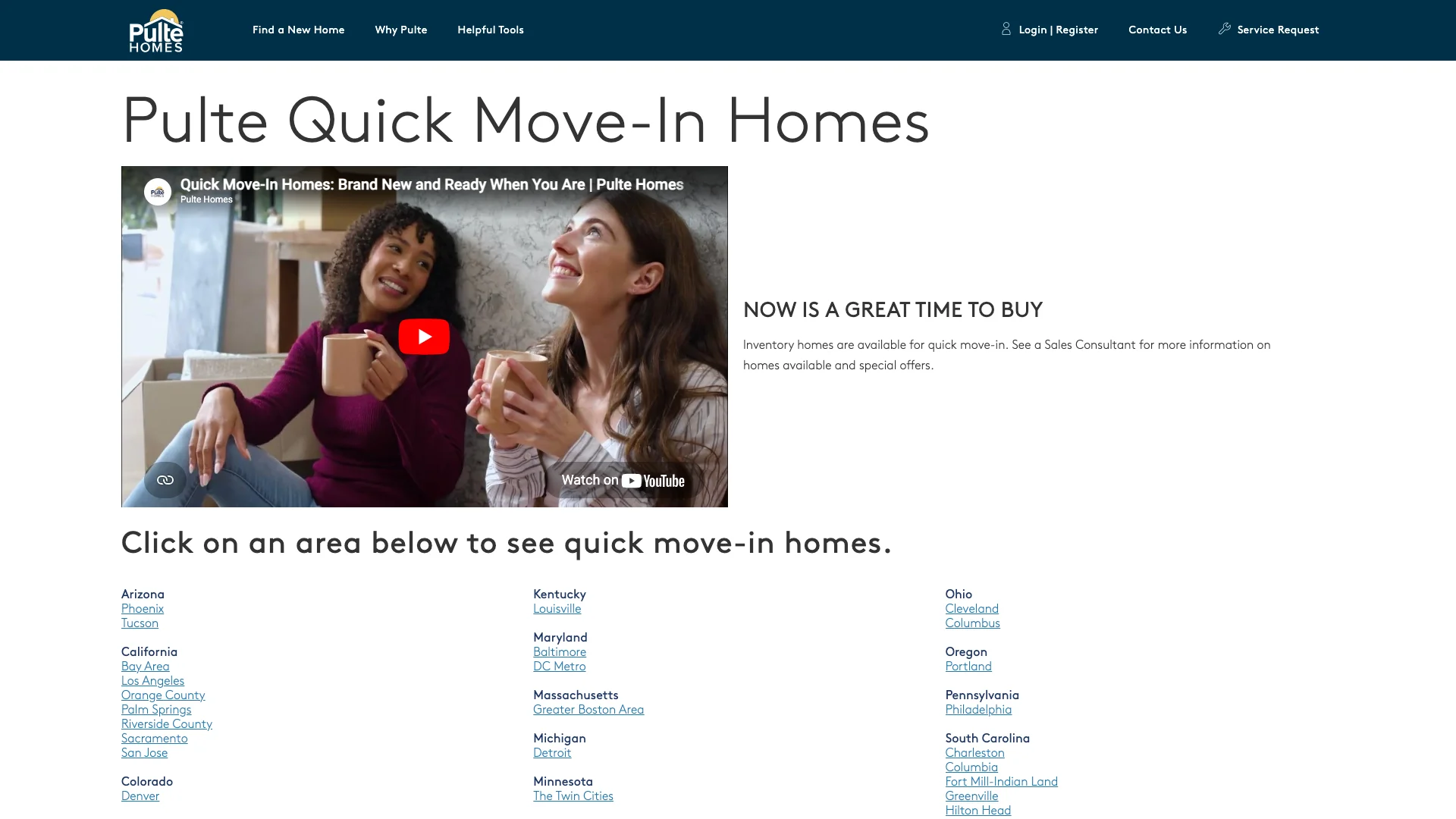
PulteGroup's trust signal inventory is thin. The Quick Move-In page has trust badges. The Orlando and custom designs pages have nothing. No trust badges, no BBB badge, no Google Reviews widget, no review count on any of the three pages.
For a publicly traded company selling homes in the $300K-$600K+ range, the absence of social proof on the website is striking. These aren't impulse purchases. A homebuyer is making the biggest financial decision of their life, and the company's website doesn't show them a single customer review, a single star rating, or a single third-party certification on the pages where they're browsing communities and floor plans.
"68% of consumers will only use a business with a rating of 4 or more stars."
— BrightLocal (2026)
The schema markup is similarly sparse. The Orlando page has Organization and BreadcrumbList schema. The Quick Move-In and custom designs pages have no schema at all. No Product schema for home listings. No LocalBusiness schema for community sales offices. No Review schema. For a site that's essentially a real estate platform, the structured data is doing very little work.
And the accessibility scores are all over the place. Quick Move-In: 88/100. Custom designs: 95/100. Orlando: 72/100. That 72 on the Orlando page means there are significant accessibility failures — likely around alt text, heading structure, or interactive elements — on a page that serves one of PulteGroup's biggest markets.
What PulteGroup does well
Despite the load times and the form bloat, PulteGroup executes on some fundamentals that local builders can study.
Content depth and page count. The Quick Move-In page has 2,604 words. The Orlando page has 4,241. The custom designs page has 2,152. And the site has community-specific pages for every market they serve. That's a content investment that signals authority to both Google and homebuyers. Most local builders have a single "communities" page. PulteGroup has one for every metro area.
Multiple conversion paths with context. The CTAs vary by page and intent: "Find a New Home," "Request an Appointment," "Request Info," "Contact Pulte Mortgage," "Get Directions," "Request Service." That's six different actions matched to different buyer stages. A browsing buyer clicks "Find a New Home." An interested buyer clicks "Request Info." A ready-to-buy buyer clicks "Request an Appointment." Most builder sites offer one CTA.
Dense internal linking. The Quick Move-In page has 213 internal links. The Orlando page has 156. The custom designs page has 131. Those are community cross-links, floor plan links, and resource page links that keep homebuyers browsing. Good for engagement metrics, good for SEO crawlability.
Zero layout shift. CLS of 0.000 on the Quick Move-In and custom designs pages, 0.002 on Orlando. The pages are slow to load, but once they arrive, they don't jump around. That's a development discipline that matters for usability even when overall performance is poor.
"In 2024, 90% of U.S. homeowners renovating their homes hired professional help."
— Houzz Inc. (2025)
What the gaps mean for local home builders

PulteGroup builds in communities with model homes, sales offices, and mortgage divisions. You probably build custom homes one at a time. That's a completely different business model, and it means PulteGroup's website problems create different opportunities for you than, say, Re-Bath's problems do for a bathroom contractor.
Your form should start a conversation, not create an account. PulteGroup's 20-field form asks for passwords and broker IDs because they're building a user portal. You don't need a user portal. You need a phone call. Three fields: name, phone, and "tell me about your project." That's it. The homebuyer who just found your site doesn't want to create an account. They want to talk to someone who builds houses.
Load time is a trust signal itself. PulteGroup's pages take 43-66 seconds to render. A homebuyer shopping for a $400K+ home on their phone and landing on a page that takes a full minute to load doesn't think "they must have a lot of great content loading." They think the site is broken. And they go back to Google. Your site loading in under 2 seconds says "this builder has their act together" before they read a single word.
Reviews should be visible on every page, not just claimed. PulteGroup shows zero review widgets on the pages we tested. If you have 20 Google reviews with a 4.8 average, that widget should appear in the header or sidebar of every single page. A homebuyer comparing you to PulteGroup sees their polished brand with zero visible reviews, and then sees your smaller brand with 20 visible five-star reviews. The review count wins that comparison more often than you'd think.
Schema markup for your community or portfolio pages. PulteGroup barely uses structured data. If you add LocalBusiness schema to your homepage, Product schema to your portfolio pages (with pricing, square footage, location), and Review schema with aggregate rating, you're giving Google rich-result signals that a publicly traded builder isn't providing. Star ratings in search results shift clicks.
"In 2024, 84% of U.S. homeowners funded their renovations using personal savings."
— Houzz Inc. (2025)
And there's the personal touch angle. PulteGroup is a corporation. Their sales process runs through community sales offices staffed by rotating reps. You're the builder. When a homebuyer meets you, they're meeting the person who'll actually build their house. Put that on the website. "I'm [Name], I've been building custom homes in [City] for [X] years, and when you call this number, you're talking to me." That sentence is structurally impossible for PulteGroup to write. It's your single biggest advantage, and it costs nothing to deploy.
Frequently asked questions
What is PulteGroup's website performance score?
The Quick Move-In page scored 32/100 on Google PageSpeed Insights (mobile) as of March 29, 2026, with an LCP of 43.0 seconds. The Orlando page scored 25/100 with an LCP of 48.4 seconds and a TBT of 4,663ms. The custom home designs page scored 30/100 with an LCP of 66.2 seconds and an FCP of 43.7 seconds. CLS was near zero on all pages (0.000 to 0.002).
How many form fields does PulteGroup's website have?
PulteGroup uses a 20-field form on every page that includes Nickname, Middle Name, First Name, Last Name, Email, Zip Code, Phone, an Outside US checkbox, an Is Realtor checkbox, Broker Office, Broker ID, Password, Password Verify, a remember-me checkbox, a message textarea, and four select dropdowns. The Orlando page also has a separate 14-field form plus login/registration forms, totaling 40 fields across four forms on a single page.
Can a local home builder compete with PulteGroup online?
Yes. PulteGroup has brand scale and national operations, but their website has performance scores of 25-32/100, a 20-field form that asks for passwords and broker IDs, zero Google Reviews or BBB badges on the pages we tested, and minimal schema markup. A local builder with a fast site (85+ performance), a 3-field contact form, visible reviews on every page, and structured data for their portfolio has a measurably better digital presence for homebuyers researching custom builds in a specific market.
How much organic traffic does pulte.com get?
According to Ahrefs data from our March 2026 collection, pulte.com receives approximately 138.2K monthly organic visitors with an estimated traffic value of $162.4K. Traffic is highly distributed across community-specific pages, with the Quick Move-In page accounting for 2.5K (2% share), Orlando for 2.1K (2%), and custom designs for 2K (1%).