What we found on premierpoolsandspas.com
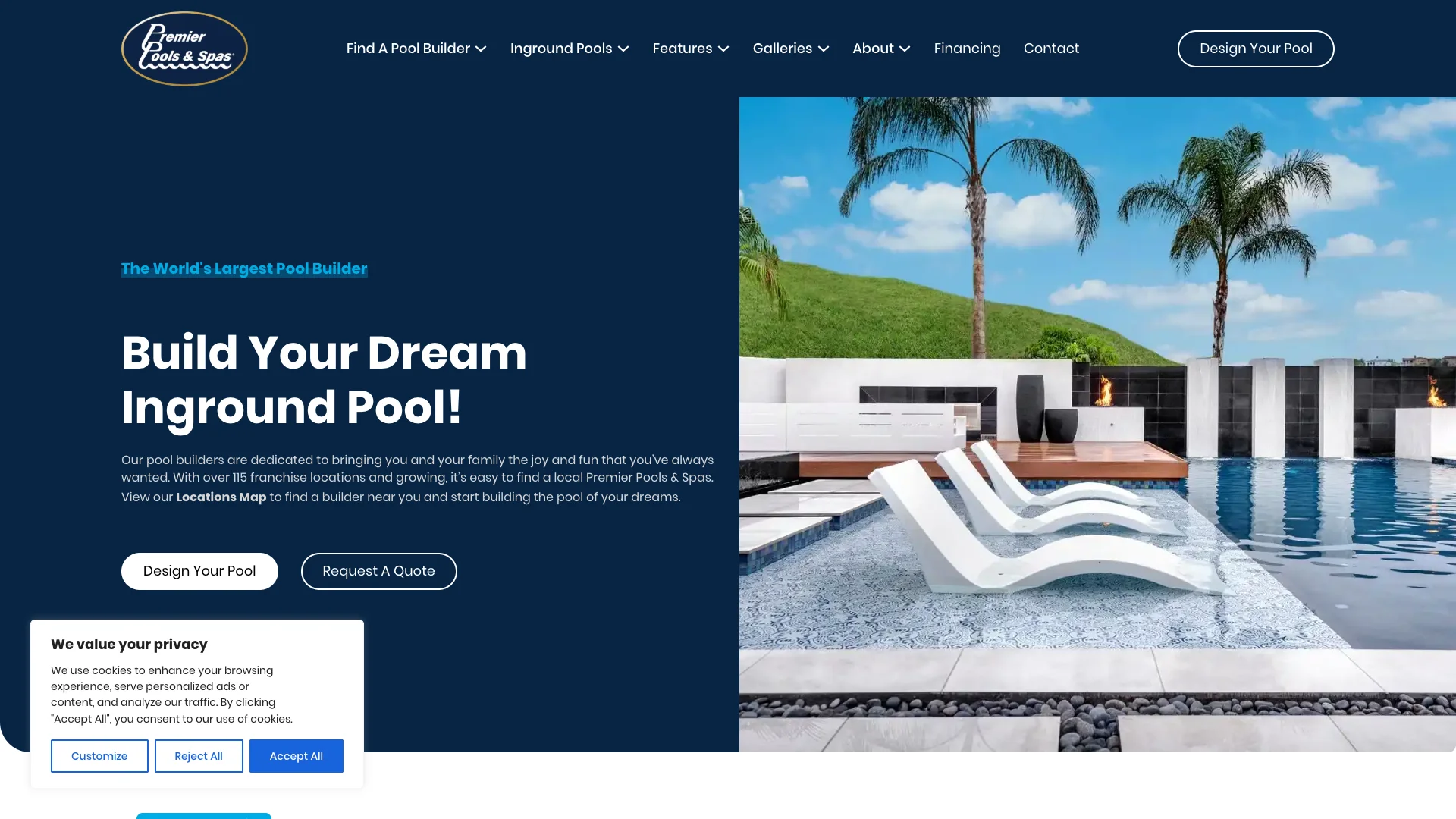
Premier Pools & Spas is a pool builder pulling 4.2K monthly organic visitors with an estimated traffic value of $5,500. And this teardown tells the exact opposite story of Cody Pools. Where Cody Pools has 15K visitors and zero forms, Premier actually has forms. One to two per page. But zero Google Reviews. Zero trust badges. The conversion infrastructure exists, but the trust layer doesn't.
The pages we tore down:
- Design Your Pool page, pulling 200 monthly organic visitors (5% traffic share, scored 39 on Google's mobile lab test, layout shift 0.000)
- Poolapalooza page, pulling 117 monthly visitors (3% share, scored 40, layout shift 0.010)
- Olympic diving pool blog, pulling 70 monthly visitors (2% share, scored 39, layout shift 0.004)
So a homeowner landing on any of these pages can fill out a form. That's good. But they won't see a single Google Review, a single trust badge, or any social proof reassuring them that Premier is a company worth contacting. And for pool projects costing $30K to $80K, that trust gap is a conversion killer.
The traffic distribution is worth noting too. The Design Your Pool page drives the most visitors (200), but that's only 5% of total site traffic. The Poolapalooza page pulls 3%. The Olympic diving blog pulls 2%. So the top three pages account for just 10% of total traffic. The remaining 90% is spread across other pages we didn't test. That means the form and trust signal issues we found might be better or worse on the rest of the site. But on the pages we did audit, the pattern is clear: forms yes, trust signals no.
"25% of homeowners say trusting contractors is their top challenge when planning home improvement projects."
— Houzz Inc. (2025)
Performance: 39 to 40 across the board
Google's mobile lab test simulates a slow phone on a throttled connection. The scores are worst-case, not real-world browsing conditions. But Google uses them as a ranking factor, so they directly impact where your pages appear in search results.
The Design Your Pool page scored 39. The Poolapalooza page scored 40. The Olympic diving pool blog scored 39. All three are in the red zone, and all three are virtually identical. That consistency tells you something important: the speed issue isn't page-specific. It's site-wide. The same underlying problems (heavy images, third-party scripts, unoptimized loading) are dragging every page down equally.
And that's actually useful information. A site where one page scores 80 and another scores 25 has page-specific problems that need individual diagnosis. But a site where every page scores 39-40 has a template-level problem. Fix the template, and every page improves at once. One optimization pass, site-wide results.
"53% of mobile users abandon sites that take longer than 3 seconds to load."
— Google / SOASTA (2017)
But layout stability is clean. The Design Your Pool page scores 0.000. The Olympic diving pool blog scores 0.004. The Poolapalooza page scores 0.010. None of these pages have content jumping around as they load. That's the one performance metric that homeowners actually feel on their own devices, and Premier handles it well.
The stability is especially important for pages with forms. If a form shifts position as the page loads, the homeowner might tap the wrong field or accidentally submit before they're ready. That creates frustration and abandonment. Premier's forms stay exactly where they are, which means the form experience itself is solid even if the page loads slowly.
The fix is straightforward. Compress the images (pool photography is beautiful but heavy). Defer non-essential scripts. Cut tracking pixels you aren't actively using. A site-wide optimization pass could push all three pages from 39-40 into the 65-80 range. For a site with 4.2K monthly visitors trying to grow, that speed improvement would unlock higher rankings across every page simultaneously.
Compounding effect
"Conversion rates drop approximately 12% for each additional second of page load time."
— Google / Deloitte (2020)
Lead capture: forms on every page, but nobody's saying "you can trust us"
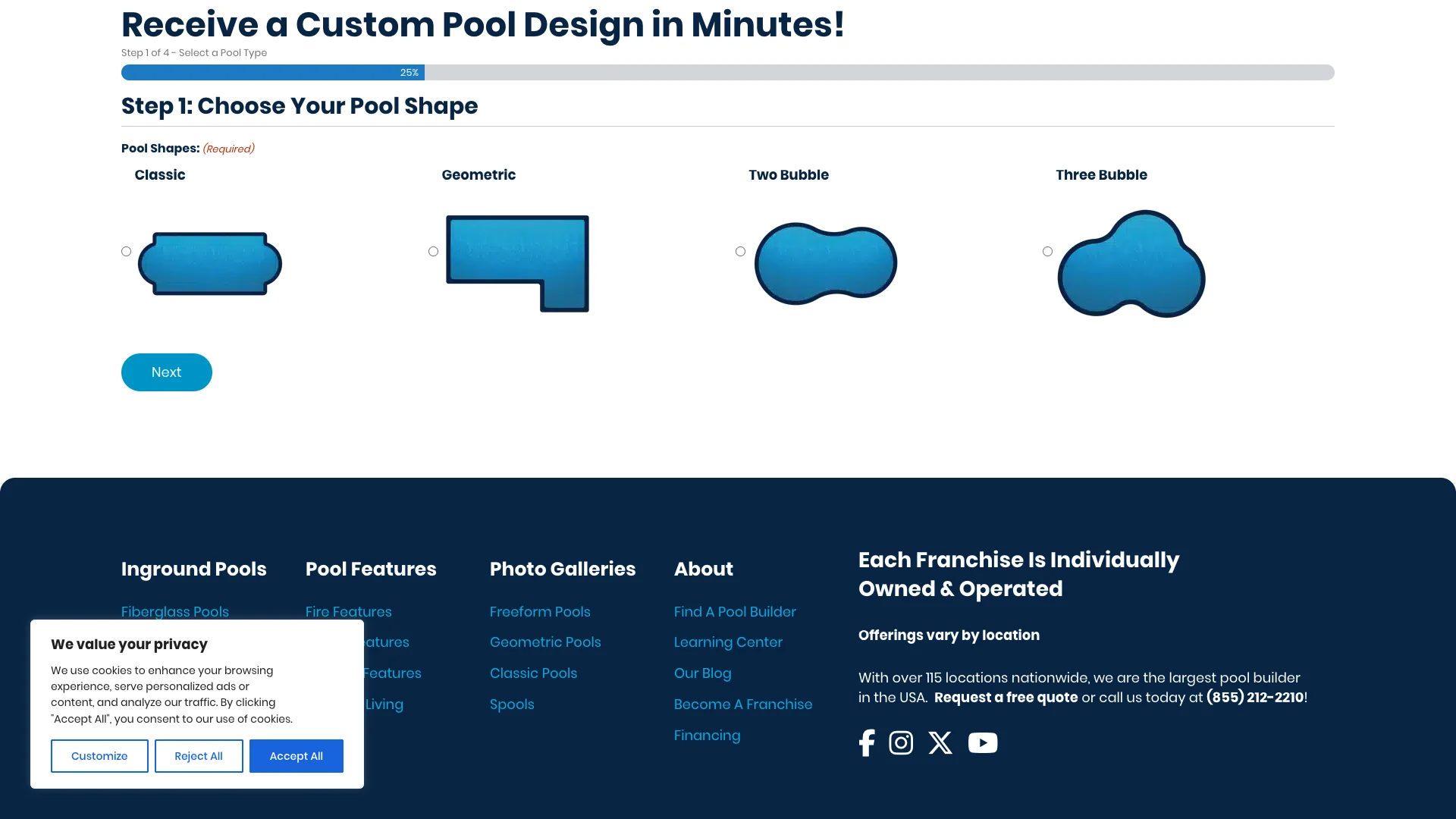
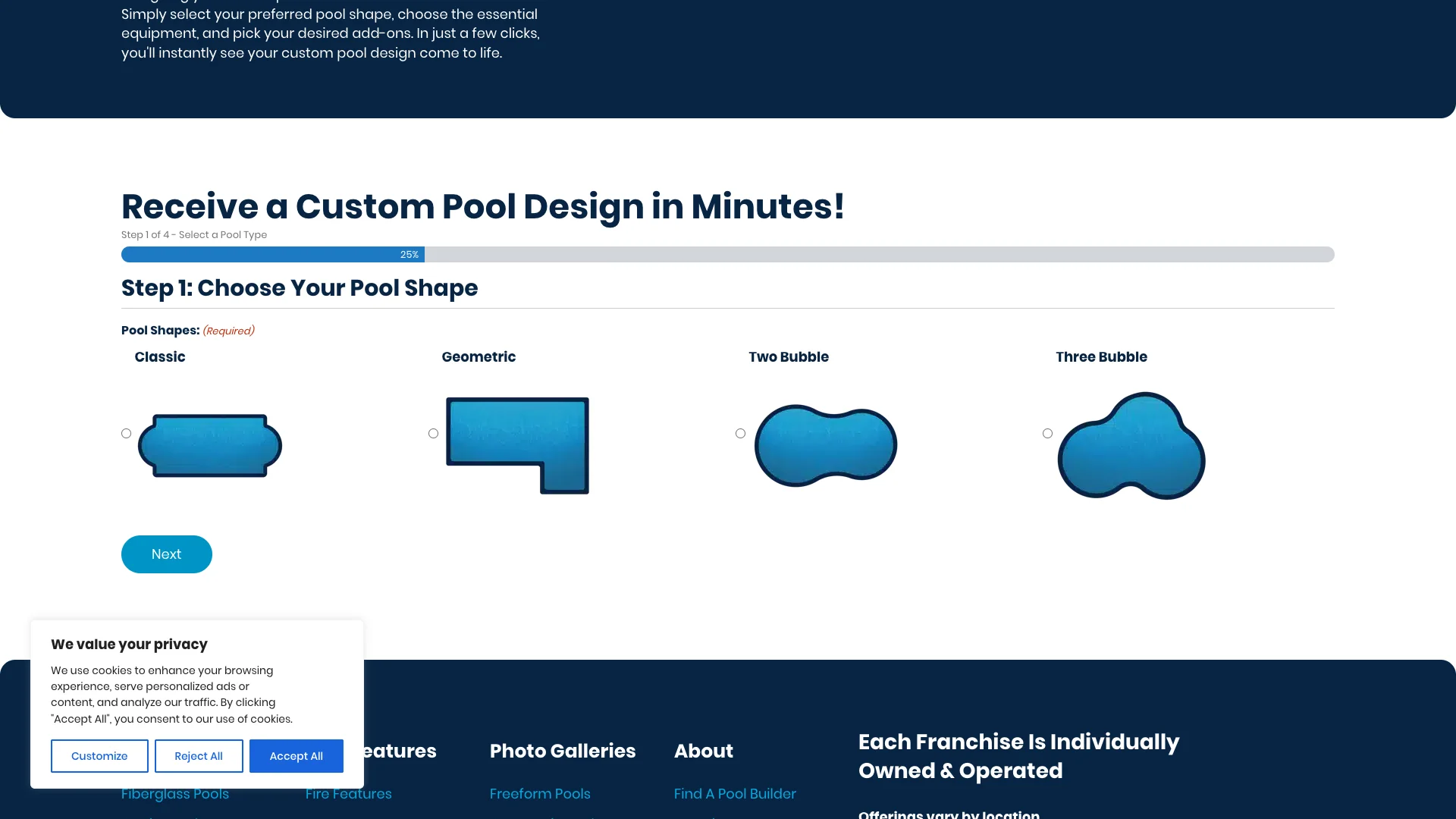
Premier Pools has 1 to 2 forms on every tested page. The Design Your Pool page has forms. The Poolapalooza page has forms. The Olympic diving pool blog has forms. And that puts Premier in a completely different category than Cody Pools (zero forms) and Presidential Pools (zero forms).
The form placement matters too. A homeowner browsing "Design Your Pool" is in active consideration mode. They're imagining what their pool could look like. They're thinking about shapes, finishes, features. Having a form right there on that page means the moment they decide "I want this," they can act on it without navigating to a separate contact page.
And the Poolapalooza page is a promotional page, which means it's designed to generate excitement and urgency. A form on that page captures the homeowner who's motivated by the promotion. The Olympic diving pool blog is educational content, and a form there captures the homeowner who's been reading and is ready to learn more. Each page targets a different mindset, and each page has a form for that mindset. That's smart.
"68% of users wouldn't submit a form if it required too much personal information."
— Baymard Institute (2024)
But a form without trust signals is like a checkout page without a security badge. The homeowner sees the form. They might even start filling it out. But then they look around the page. No Google Reviews. No star ratings. No trust badges. No "500+ pools built" counter. No social proof at all. And for a $30K-$80K decision, that absence creates hesitation. "Is this company legit? Do other homeowners recommend them? How do I know they won't disappear after I give them my phone number?"
So the forms exist. That's genuinely better than not having them. But the conversion rate on those forms is almost certainly lower than it should be, because there's nothing on the page telling the homeowner it's safe to submit. Warner's Decking has 252 reviews on every page. Cody Pools has reviews on 2 of 3. Premier has zero. And that zero is dragging the form conversion rate down.
Think of it this way. If Premier added Google Reviews to every page tomorrow, the form submission rate would almost certainly increase. Not because the form changed. Because the homeowner's confidence changed. Trust signals don't create leads. They remove the friction that prevents leads from converting.
And the Olympic diving pool blog is a missed content marketing opportunity. A homeowner reading about Olympic diving pools is probably not buying one. But they might be curious about pool sizes, depths, and designs. If that blog had a form positioned as "Curious what a pool would cost in your backyard? Get a free estimate," it would catch the reader who started with curiosity and ended with consideration. The blog content creates the interest. The form captures it. But without trust signals around the form, the capture rate drops.
Trust signals: zero reviews, zero badges, but rich hidden code labels
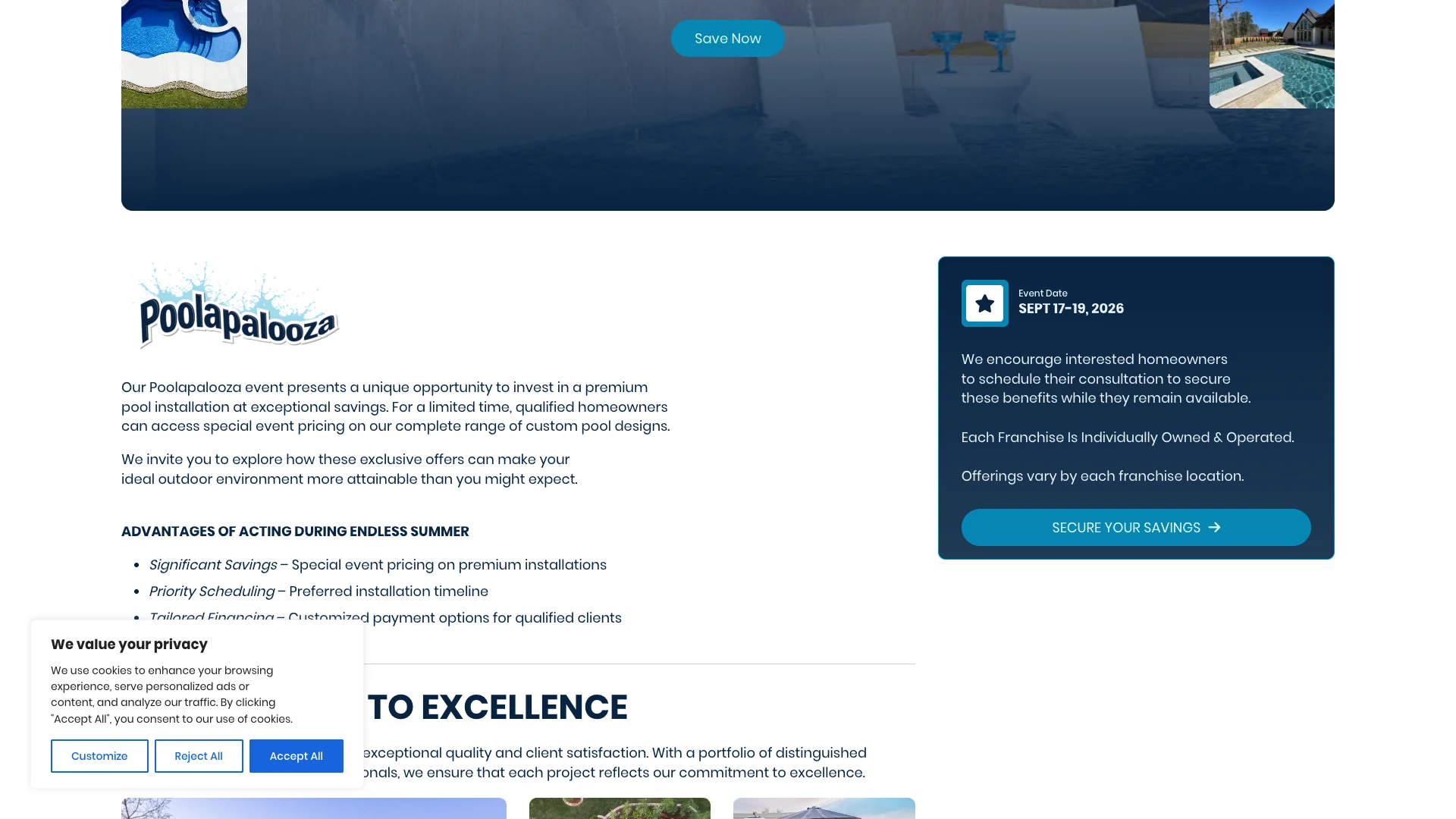
The trust signal audit on Premier Pools is stark. The results across all three pages:
- Google Reviews: Not found on any page.
- Trust badges: Not found on any page.
- Review widgets: Not found.
- Chat widget: Not found.
- BBB badge: Not found.
- Certifications: Not found.
Zero out of six trust signal types. On any page. That's the same trust signal score as Archadeck, which has 33K monthly visitors. But unlike Archadeck, Premier at least has forms. So the conversion path exists. The trust layer just doesn't.
And the absence is especially conspicuous because Premier is a franchise brand. They build pools across multiple markets. A franchise operation should have hundreds, if not thousands, of Google Reviews from satisfied customers across all locations. If those reviews exist on Google (and they almost certainly do), they just aren't being displayed on the website. That's the simplest fix in this entire teardown. Embed a Google Reviews widget. It takes less than an hour to install.
Comparison
"83% of consumers use Google to find local business reviews; 74% use two or more review platforms when researching."
— BrightLocal (2025)
Now, the hidden code labels are a different story entirely. Premier runs a rich label setup: Organization combined with Person (telling Google who the company is and who runs it), Article labels, VideoObject on one page (telling Google there's video content), and BlogPosting labels. That's a strong mix. The VideoObject label is especially notable because most contractor sites don't tell Google about their video content, which means Google can't feature those videos in video search results.
So Premier invested in the technical side. The forms work. The hidden code labels are well-structured. The layout stability is clean. But the one thing homeowners actually see and respond to (reviews, badges, social proof) is completely missing. It's a website built for search engines without being built for the humans who land on it. And the irony is that adding trust signals would probably improve search rankings too, because Google considers user engagement signals when determining page quality.
The VideoObject label on one page is a detail worth highlighting. Most pool builder sites have video content (pool tours, customer testimonials, before-and-after reveals), but they don't tell Google the video exists. Without the VideoObject label, Google treats the video like any other page element. With it, Google can feature the video in video search results, which is a separate traffic channel most pool builders aren't tapping. Premier has it on one page. They should have it on every page with video content.
And the Organization plus Person combination is smart because it connects the company to a real person. Google can show richer results when it knows both the company and the person behind it. For a franchise brand like Premier, that connection between the corporate entity and individual franchise owners could help with local search credibility. The labels are doing their job. The pages just aren't doing theirs.
What Premier Pools & Spas does well
Premier isn't a bad site. It's a lopsided one. The things it does well are genuinely well-executed, and other pool builders should take note.
Forms on every page. One to two forms per tested page. That's better than Cody Pools (zero), Presidential Pools (zero), and most of the pool builder batch. The homeowner can submit their information from any page without navigating elsewhere. That's the baseline for lead capture, and Premier meets it while two of three competitors in this batch don't.
Rich hidden code labels. Organization plus Person tells Google who the company is and who runs it. Article and BlogPosting labels tell Google what type of content each page contains. VideoObject tells Google there's video content eligible for video search results. That level of label specificity helps with rich search results, knowledge panels, and content categorization. Most competitor pool builders in this series don't have VideoObject labels at all. Premier does, and that's a legitimate advantage for video-related search queries.
Clean layout stability. 0.000 to 0.010 across all three pages. Content doesn't jump around as these pages load. That's especially important for pages with embedded forms, because a form that shifts position while loading can cause accidental taps and frustration on mobile devices. Premier's forms stay exactly where they are.
Consistent mobile scores. Yes, 39-40 is in the red zone. But the consistency means the fix is site-wide, not page-by-page. One optimization pass (compressing images, deferring scripts, cleaning up fonts) would improve every page at once. That's actually easier to fix than a site with wildly varying scores where you'd need to diagnose each page individually.
Page variety targeting different intents. The Design Your Pool page targets consideration-stage homeowners. The Poolapalooza page targets promotion-driven homeowners. The Olympic diving pool blog targets educational-content searchers. Three pages, three different audience intents, and all three have forms. That's a thoughtful content strategy that just needs trust signals to complete it.
"64% of homeowners say having recommendations or references is a top-three factor in choosing a contractor."
— Houzz Inc. (2025)
What the gaps mean for pool builders
Premier Pools is the mirror image of Cody Pools. Cody has traffic and trust but no forms. Premier has forms and code labels but no trust. If you combined the two, you'd have a great pool builder website. So the lesson for other pool builders is: you need both sides.
Add Google Reviews to every page. This is the single highest-impact change Premier could make. A Google Reviews widget showing real star ratings and real homeowner feedback, embedded on every page, would transform the conversion rate on those existing forms. The forms are already there. The homeowner just needs a reason to trust the company before filling them out. Warner's Decking (2.1K visitors) has 252 reviews on every page. Premier (4.2K visitors) has zero. That gap is costing Premier leads every day.
Add trust badges. Industry association logos, manufacturer certifications, warranty badges, "licensed and insured" badges. Whatever credentials Premier holds, they should be visible on every page. These badges don't require a widget or an integration. They're images with descriptive text. A designer could add them to the site template in an afternoon. And they compound with reviews: reviews say "other homeowners trust us," badges say "the industry certifies us."
Fix the site-wide speed issue. All three pages scoring 39-40 means the problem is in the shared template, not in individual page content. Compress the images site-wide. Defer the scripts site-wide. Optimize the fonts site-wide. One fix, every page benefits. And for a site trying to grow beyond 4.2K monthly visitors, faster pages mean higher rankings across the board.
Add a chat widget as a second conversion path. Forms are great for the homeowner who's ready to leave their info. But the homeowner who wants to ask a quick question before committing needs a different path. A chat widget gives them that. "How long does a pool take to build?" "Do you offer financing?" "Can I see your recent projects?" Those conversations lead to consultations. And right now, Premier offers only one conversion path: the form. Adding chat doubles the options.
"48% of customers say that if a site does not work well on mobile, it signals the company does not care about their business."
— Google Consumer Insights (2018)
Frequently asked questions
Does Premier Pools & Spas have contact forms?
Yes. Premier has 1 to 2 forms on every tested page. The Design Your Pool page, the Poolapalooza page, and the Olympic diving pool blog all include at least one form. That puts Premier ahead of Cody Pools and Presidential Pools, which both have zero forms on any tested page.
Does Premier Pools & Spas display Google Reviews?
No. Zero Google Reviews appear on any of the three tested pages. Zero trust badges appear either. Premier invested in forms and hidden code labels but completely missed the trust signal side. A homeowner can submit their info but has no social proof on the page to reassure them before they do.
How does Premier Pools & Spas score on Google's mobile test?
The Design Your Pool page scored 39. The Poolapalooza page scored 40. The Olympic diving pool blog scored 39. All three are in the red zone. Google uses these scores as a ranking factor, so all three pages are taking a search-ranking penalty. But layout stability is clean (0.000 to 0.010), so the pages don't jump around as they load.
How much organic traffic does premierpoolsandspas.com get?
According to Ahrefs data from March 2026, premierpoolsandspas.com receives approximately 4,200 monthly organic visitors with an estimated traffic value of $5,500. The Design Your Pool page accounts for 200 visitors (5% share). The Poolapalooza page accounts for 117 (3%). The Olympic diving pool blog accounts for 70 (2%). The top three pages account for about 10% of total traffic, with the rest spread across other pages.
What hidden code labels does Premier use?
Premier runs a rich hidden code label setup: Organization combined with Person, Article labels, VideoObject on one page, and BlogPosting labels. The VideoObject label is especially notable because it tells Google there's video content eligible for video search results, which is a separate traffic channel most pool builders aren't tapping. The Organization plus Person combination connects the company to a real person, which helps Google show richer results for branded searches. Most competitor pool builders in this series don't have VideoObject labels at all.
How does Premier compare to Cody Pools?
Premier and Cody Pools are exact opposites. Cody has 15.3K monthly visitors, Google Reviews, trust badges, and zero forms. Premier has 4.2K visitors, 1-2 forms per page, rich code labels, and zero reviews. Premier got the form side right. Cody got the trust side right. Neither got both. If you're a pool builder reading this, the takeaway is clear: you need forms AND trust signals on every page. One without the other leaves money on the table.