
What we found on madcitywindows.com
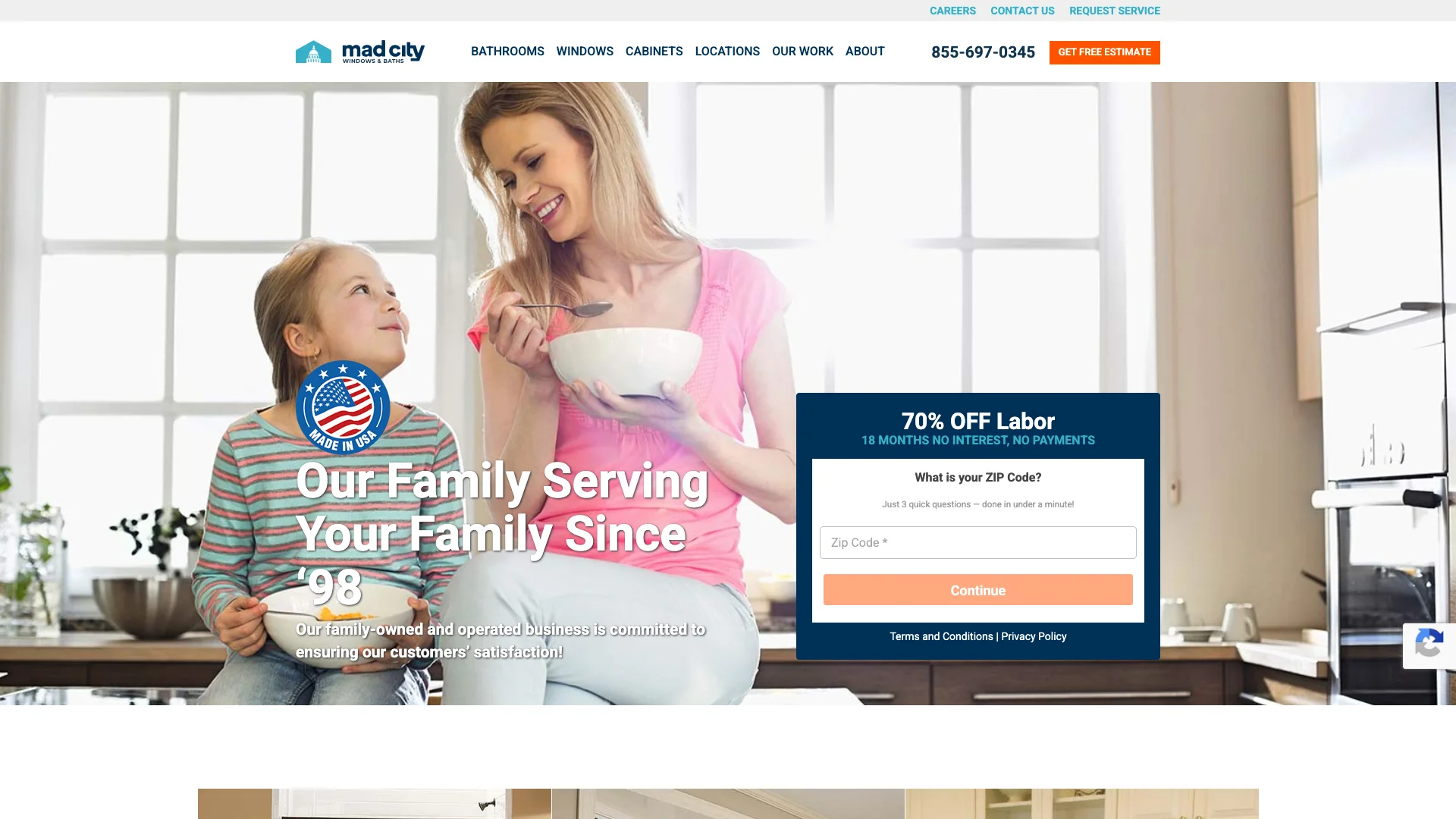
Mad City Windows and Baths is a regional window and bathroom remodeling franchise operating across multiple Midwest and Southeast markets. According to Ahrefs, madcitywindows.com pulls 6.5K monthly organic visitors with an estimated traffic value of $20.7K. And this is the positive story of the kitchen and bath franchise batch. Where Bath Tune-Up and Kitchen Tune-Up had zero reviews and zero trust badges, Mad City has 962 Google Reviews, review widgets on every page, trust badges on every page, and rich hidden code labels throughout. They actually invested in the trust layer.
The pages we tore down:
- Shower installation cost blog (571 monthly organic visitors, 9% traffic share, scored 47 out of 100, 3,279 words)
- Bathroom remodel cost blog (546 monthly visitors, 9% share, scored 38 out of 100, 4,367 words)
- Walk-in tubs cost blog (378 monthly visitors, 6% share, scored 35 out of 100, 3,811 words)
The story here is a franchise that does the trust signals right but has a quirk that undercuts the experience: 29 regional phone numbers rendered on every single page. We saw this same pattern on Happy Hiller earlier in the CRO Index series. When a franchise operates across many markets and renders every regional number on every page, the homeowner has to scan through dozens of phone numbers to find their local one. That is unnecessary friction on an otherwise strong site.
"25% of homeowners say trusting contractors is their top challenge when planning home improvement projects."
— Houzz Inc. (2025)
Performance: 35 to 47 with excellent layout stability
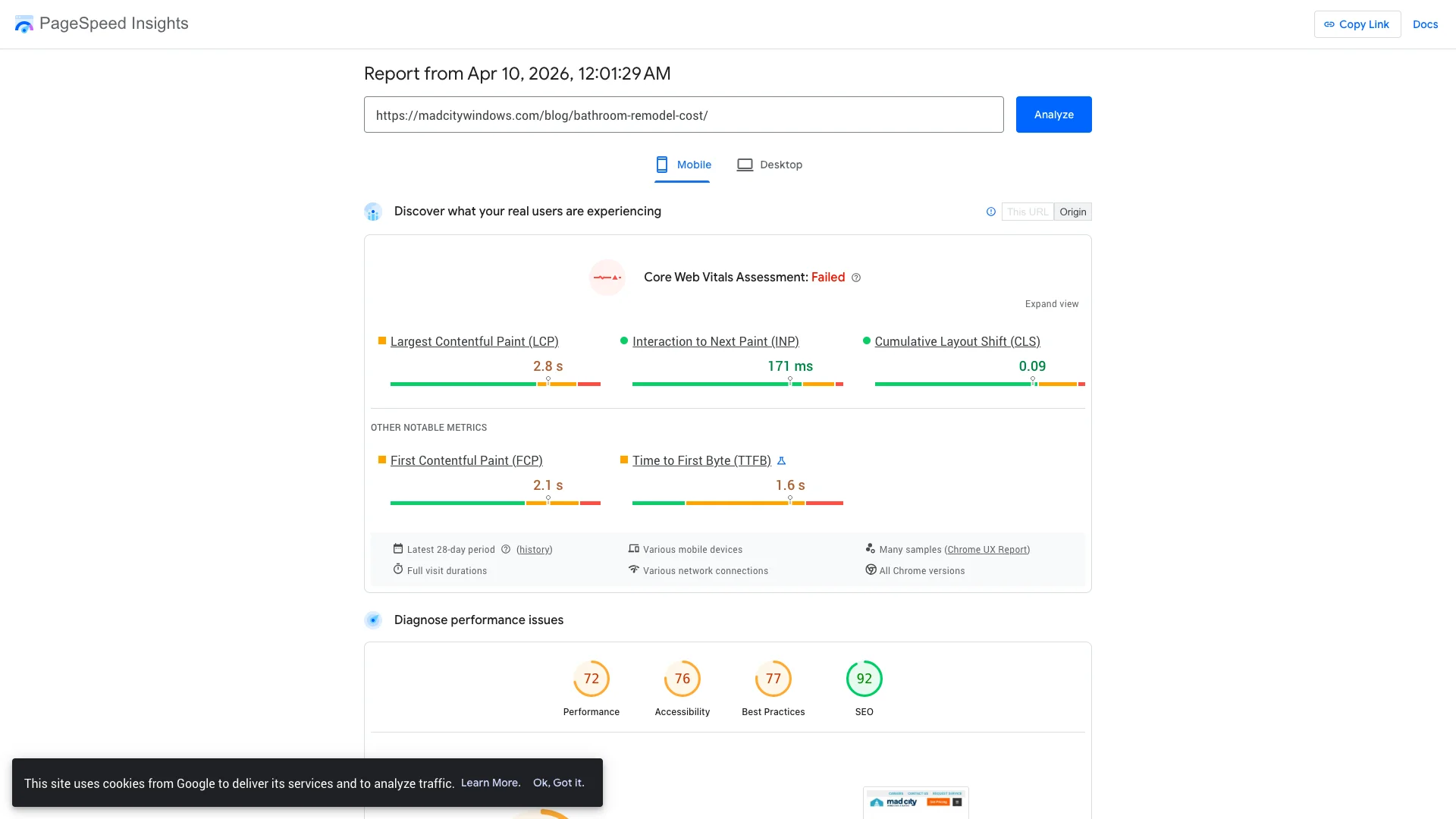
Quick framing note. Google's mobile lab test runs a simulated slow-phone scenario. The scores are worst-case numbers, not what a real homeowner on a fast phone experiences. The site probably feels fine on your phone. But Google uses these lab scores as a ranking factor, which means pages scoring below 50 are eating a search-ranking penalty.
The shower installation cost blog scored 47 out of 100. The bathroom remodel cost blog scored 38. The walk-in tubs cost blog scored 35. None of these pass Google's test, but the shower blog comes close to the orange zone (50+). For context across the CRO Index: these scores are mid-range for franchise sites. Better than Bath Tune-Up (which scored 20), worse than Mr. Electric's blog (which scored 72). Average for the category.
"53% of mobile users abandon sites that take longer than 3 seconds to load."
— Google / SOASTA (2017)
But here is where Mad City separates from the pack. Layout stability is essentially perfect across all three pages. The shower blog scores 0.002. The bathroom remodel blog scores 0.000. The walk-in tubs blog scores 0.000. Nothing jumps around as the page loads. No buttons shifting. No text sliding down. No images pushing content out of position. That is the one performance metric that maps directly to what a homeowner experiences on any device, and Mad City nails it.
Compare that to Bath Tune-Up (layout shift scores of 0.273 and 0.342) or Kitchen Tune-Up (0.118 on the Fort Worth page). Mad City proves that a franchise template can render without visible content jumping. The lab score is still in the red zone because of the sheer weight of the pages (3,279 to 4,367 words of content, multiple forms, review widgets, trust badges, 29 phone numbers), but the homeowner experience on a fast phone is stable and predictable. That matters.
Compounding effect
"Conversion rates drop approximately 12% for each additional second of page load time."
— Google / Deloitte (2020)
Lead capture: 4 forms per page, including a 9-field monster
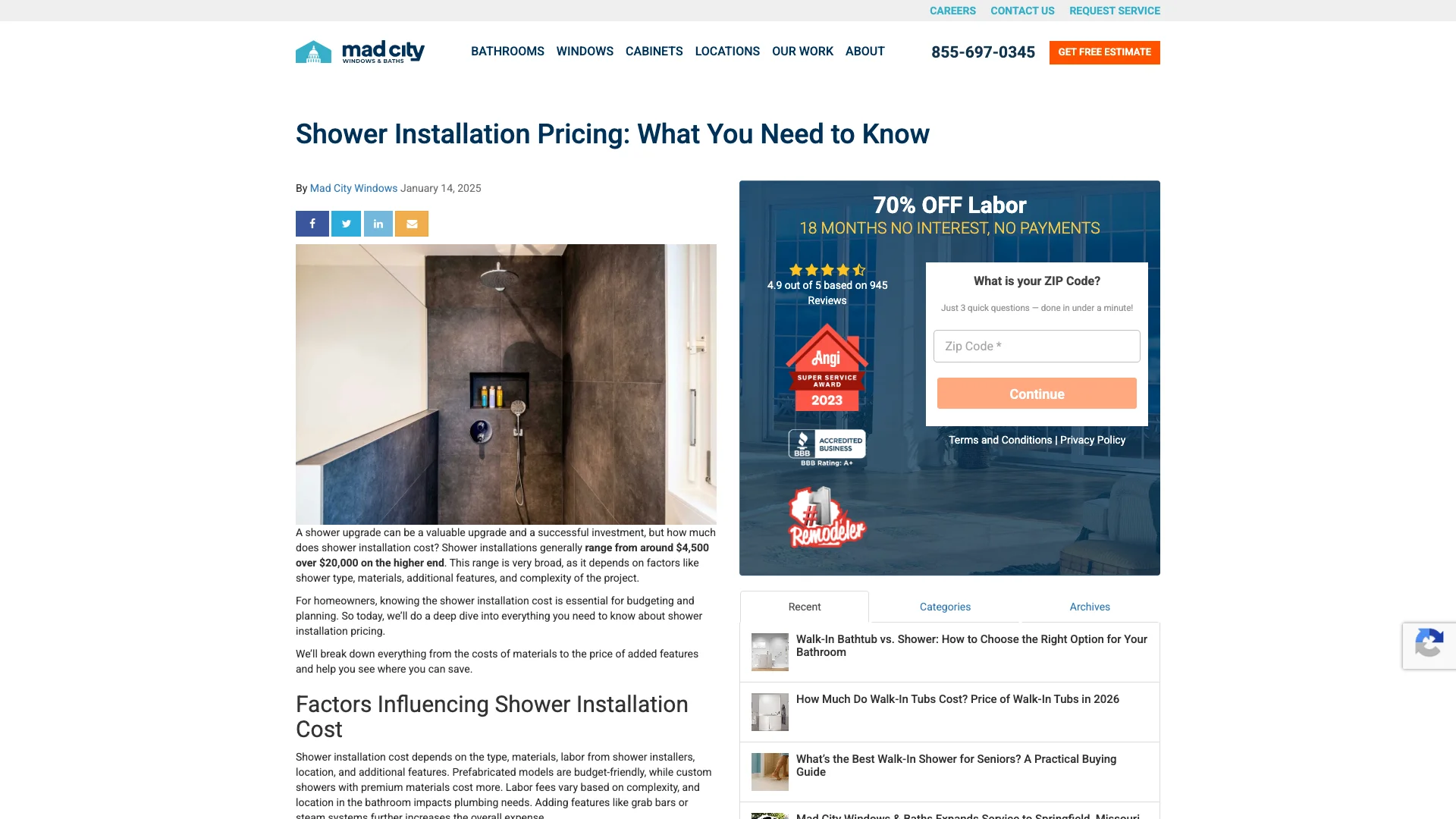
Mad City runs 4 form instances on every page we tested. That is one fewer than the Home Franchise Concepts brands (Bath Tune-Up and Kitchen Tune-Up each run 5), but the forms themselves are heavier. The inventory includes a 7-field form and a 9-field form with radio buttons for selecting the type of project (windows, baths, or both). The radio buttons add a decision step before the homeowner even starts filling in their contact details.
Nine fields plus radio buttons is a lot. For a homeowner researching "how much does shower installation cost" (which is the topic of the highest-traffic page), the intent is informational. They are gathering pricing information, not ready to schedule an estimate. Hitting them with a 9-field form at that stage is premature. A simpler capture (email address for a detailed pricing guide, or name and phone for a quick callback) would match the informational intent of the page better.
"68% of users would not submit a form if it required too much personal information."
— Baymard Institute (2024)
The chat widget is present on all three pages. That is a lighter-touch conversion path that works better for informational content. A homeowner reading a 4,000-word blog about bathroom remodel costs is more likely to type a quick question into a chat box than to fill out a 9-field form. The chat widget is doing the right job here. The 9-field form is doing the wrong job for this page type.
And then there are the 29 phone numbers. Every page renders 29 regional phone numbers, one for each market Mad City serves. We saw the same pattern on Happy Hiller earlier in the series. The homeowner has to visually scan a wall of phone numbers to find the one for their city. The fix is straightforward: detect the visitor's location (via IP or zip code entry) and show one number. Not 29. One.
Trust signals: 962 reviews, widgets, badges, and rich code labels
This is the section where Mad City stands apart from every other franchise we have torn down in this batch. The full trust signal audit:
- Google Reviews: Enabled. 962 reviews in the data.
- Review widgets: Present on all three pages.
- Trust badges: Present on all three pages.
- Chat widget: Present on all three pages.
- Hidden code labels: Six types per page (rich, detailed, well-structured).
962 Google Reviews. Displayed on the page. Visible to the homeowner. That is what trust looks like on a franchise website. Compare that to Bath Tune-Up (zero reviews), Kitchen Tune-Up (zero reviews), Mr. Electric (50 reviews hidden in the data, not rendered), and ARS/Rescue Rooter (134,039 reviews in the data, none displayed). Mad City actually shows theirs.
Comparison
"83% of consumers use Google to find local business reviews; 74% use two or more review platforms when researching."
— BrightLocal (2025)
The hidden code labels are equally strong. Six types per page. That means Google can read the page and understand not just "this is a website" but specifically what the business is, what services it offers, what the reviews say, and how the content is structured. For context, most franchise sites we have audited carry one or two label types. Mad City runs six. That level of markup detail gives Google significantly more to work with when building search results, knowledge panels, and rich snippets.
Trust badges are present on every page. We do not know the specific badge providers from the audit data, but the presence is consistent. Combined with the review widgets and the review count, the trust layer on Mad City is the strongest we have recorded in the kitchen and bath franchise batch. This is what it looks like when a franchise actually invests in the conversion signals that homeowners use to make decisions.
What Mad City Windows and Baths does well
Mad City is the most complete franchise site we have torn down in the kitchen and bath batch. The positives list is longer than usual.
962 Google Reviews, actually displayed. Not hidden in the data layer. Not buried in the code. Visible on the page, in a widget, where a homeowner can see the star rating and the review count without leaving the page. This is the single biggest competitive advantage Mad City has over every other franchise in this batch.
Perfect layout stability. 0.000 to 0.002 across all three pages. Nothing moves. The homeowner experience is clean and predictable on any device. This is what franchise sites should aim for, and Mad City delivers it.
Deep content. 3,279 words on the shower cost blog. 4,367 words on the bathroom remodel cost blog. 3,811 words on the walk-in tubs blog. These are substantial, keyword-rich articles that earn their organic traffic through genuine depth. A homeowner searching "how much does a bathroom remodel cost" lands on a 4,367-word answer. That is the kind of content that ranks and stays ranked.
Rich hidden code labels. Six types per page. That is the most comprehensive markup we have recorded on any franchise site in the CRO Index. Google has everything it needs to build rich search results, knowledge panels, and detailed business listings. Most franchises give Google the bare minimum. Mad City gives Google the full picture.
Trust badges and chat on every page. Consistent trust signals across all three tested pages. No gaps. No pages where the badges disappear or the chat widget fails to load. Consistency builds confidence because the homeowner gets the same experience regardless of which page they land on.
"64% of homeowners say having recommendations or references is a top-three factor in choosing a contractor."
— Houzz Inc. (2025)
What the gaps mean for local kitchen and bath contractors
Mad City is a harder competitor than Bath Tune-Up or Kitchen Tune-Up. They have reviews. They have trust badges. They have deep content. But there are still gaps you can exploit as a local contractor.
Beat them on Google's mobile test. Mad City's pages scored 35 to 47 out of 100. Yours should score 85+. Their pages are heavy because they are 3,000 to 4,000 words long with review widgets, trust badges, 29 phone numbers, and multiple form instances all loading at once. You can write 1,500 words of focused content for your specific service area, load one phone number, one form, one review widget, and score 85+ without sacrificing anything the homeowner needs.
Show one phone number, not 29. Mad City renders 29 regional phone numbers on every page. Your site has one phone number. That is an advantage, not a limitation. One number. Big. Prominent. Above the fold. No scanning required. The homeowner sees it, taps it, and connects. Mad City forces the homeowner to find their city in a list of 29. You eliminate that friction entirely.
Simplify the form. Mad City runs a 9-field form with radio buttons. Yours should be three fields: name, phone, zip. For a homeowner reading a blog about shower installation costs, three fields is a reasonable ask. Nine fields plus "select your project type" radio buttons is a job application. Match the form to the intent of the page, and you will capture leads the franchise form is losing.
"48% of customers say that if a site does not work well on mobile, it signals the company does not care about their business."
— Google Consumer Insights (2018)
Match their review count or get close. 962 Google Reviews is a high bar. But you do not need 962. You need enough to be credible. If you have 50 reviews with a 4.8-star average, display them prominently on every page. Fifty genuine reviews from local homeowners carry as much weight as 962 franchise-wide reviews, because the homeowner knows those 50 are from their neighbors, not from customers in a different state. Local reviews outperform franchise-wide reviews in the homeowner's decision-making process.
The competitive angle with Mad City is different from the other franchises in this batch. You are not competing against a site with zero trust signals. You are competing against a site that does trust well but has friction problems (29 phone numbers, 9-field forms, pages scoring in the 30s on Google's test). Your advantage is focus. One market. One phone number. One simple form. One fast page. The franchise has breadth. You have depth. And depth converts better when a homeowner is searching for "bathroom remodel [your city]" and wants to talk to a local contractor, not a regional call center.
Frequently asked questions
How does Mad City Windows and Baths score on Google's mobile test?
Mad City's shower installation cost blog scored 47 out of 100 on Google's mobile lab test. The bathroom remodel cost blog scored 38. The walk-in tubs cost blog scored 35. All three are in the red or orange zone. But the layout stability is excellent across all three pages (0.000 to 0.002), which means nothing jumps around as the page loads. The lab score is low because the pages are heavy (3,000 to 4,000 words, multiple forms, review widgets, trust badges, and 29 phone numbers all loading at once), but the homeowner experience on a fast phone is stable.
Does Mad City Windows and Baths show Google Reviews on their pages?
Yes. Mad City is one of the few franchises in the CRO Index that actually displays Google Reviews. The audit found 962 reviews with review widgets present on all three pages we tested. Trust badges are also present on all three pages. This is the strongest trust signal profile we have recorded in the kitchen and bath franchise batch, and it stands in sharp contrast to Bath Tune-Up and Kitchen Tune-Up (both zero reviews on every page).
Why does Mad City Windows show 29 phone numbers on every page?
Mad City operates across multiple regional markets (Midwest and Southeast), and each market has its own local phone number. All 29 regional numbers render on every page rather than detecting the visitor's location and showing just one. We saw the same pattern on Happy Hiller earlier in the CRO Index series. The fix is to detect the visitor's location and show only the relevant number, but franchise templates often take the simpler approach of showing everything to every visitor.
How much organic traffic does madcitywindows.com get?
According to Ahrefs data from our March 2026 collection, madcitywindows.com receives approximately 6.5K monthly organic visitors with an estimated traffic value of $20.7K. The shower installation cost blog accounts for 571 of that (9% share). The bathroom remodel cost blog accounts for 546 (9%). The walk-in tubs cost blog accounts for 378 visitors (6%). All three tested pages are informational cost-focused blog posts, which tells you Mad City is earning traffic through pricing content that homeowners are actively searching for.