
What we found on lennar.com
Lennar is a publicly traded company (NYSE: LEN) that builds and sells new construction homes across the United States. They're one of the largest home builders in the country. According to Ahrefs, the domain pulls 281.6K monthly organic visitors with an estimated traffic value of $172.1K. And they're selling homes that start well above $400,000.
So we ran their site through our standard teardown protocol. Three pages. PageSpeed Insights API for performance. Manual form-field counts. Trust signal audits. Navigation structure analysis. And the thing that stood out first wasn't a number. It was an absence.
No lead capture forms. On any of the three pages we audited. A company selling half-million-dollar homes, and the website doesn't ask for your name.
The pages we tore down:
- NextGen page — their multigenerational home concept (6.7K monthly organic visitors, 2% traffic share, 412 words, 37 internal links)
- San Antonio page — local market landing page (4.6K monthly organic visitors, 2% traffic share, 119 words, 39 internal links)
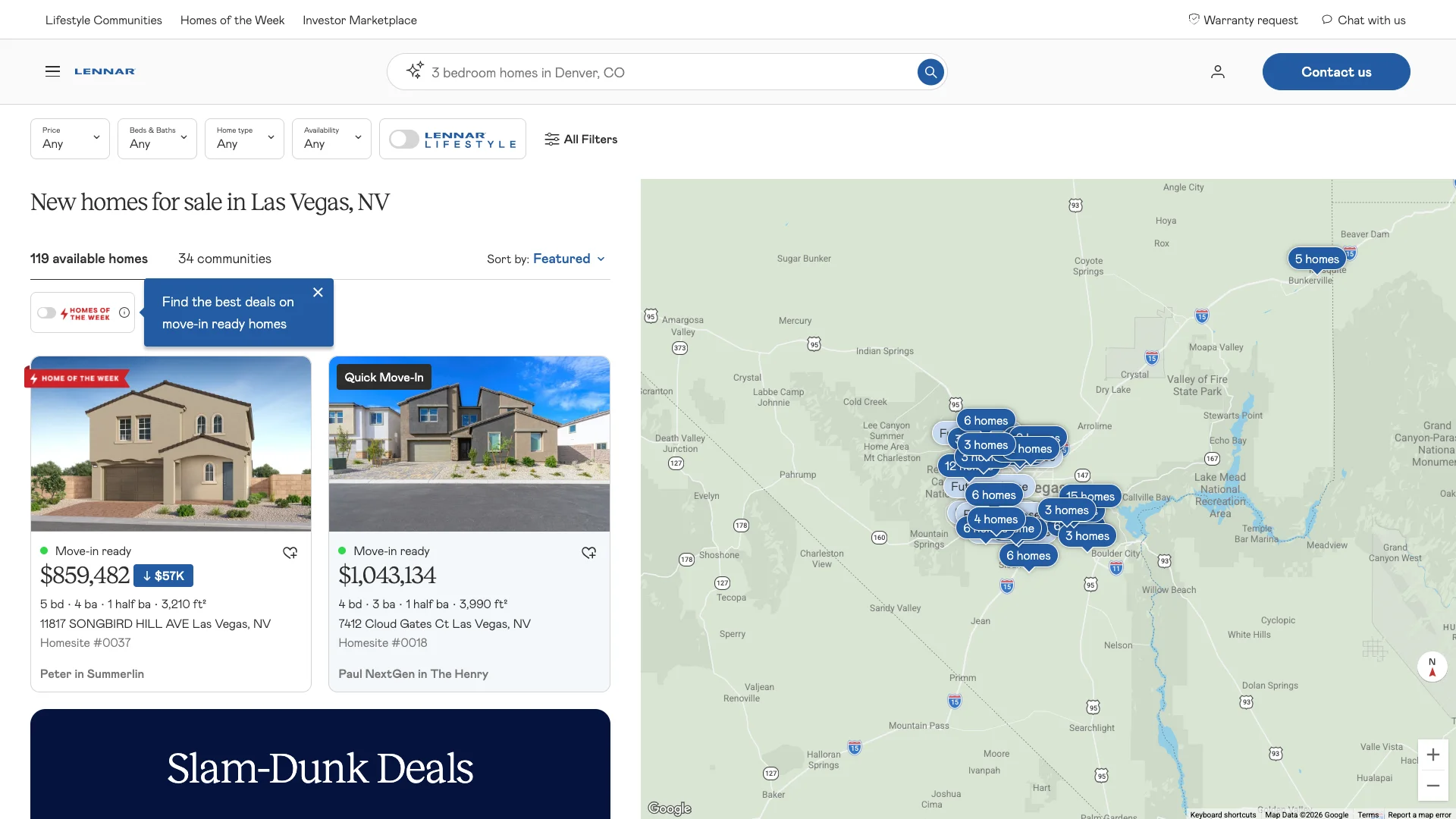
- Las Vegas page — local market landing page (4.4K monthly organic visitors, 2% traffic share, 119 words, 39 internal links)
"In 2024, just 4% of U.S. homeowners undertook new home construction."
— Houzz Inc. (2025)
Performance: 28 to 31 out of 100
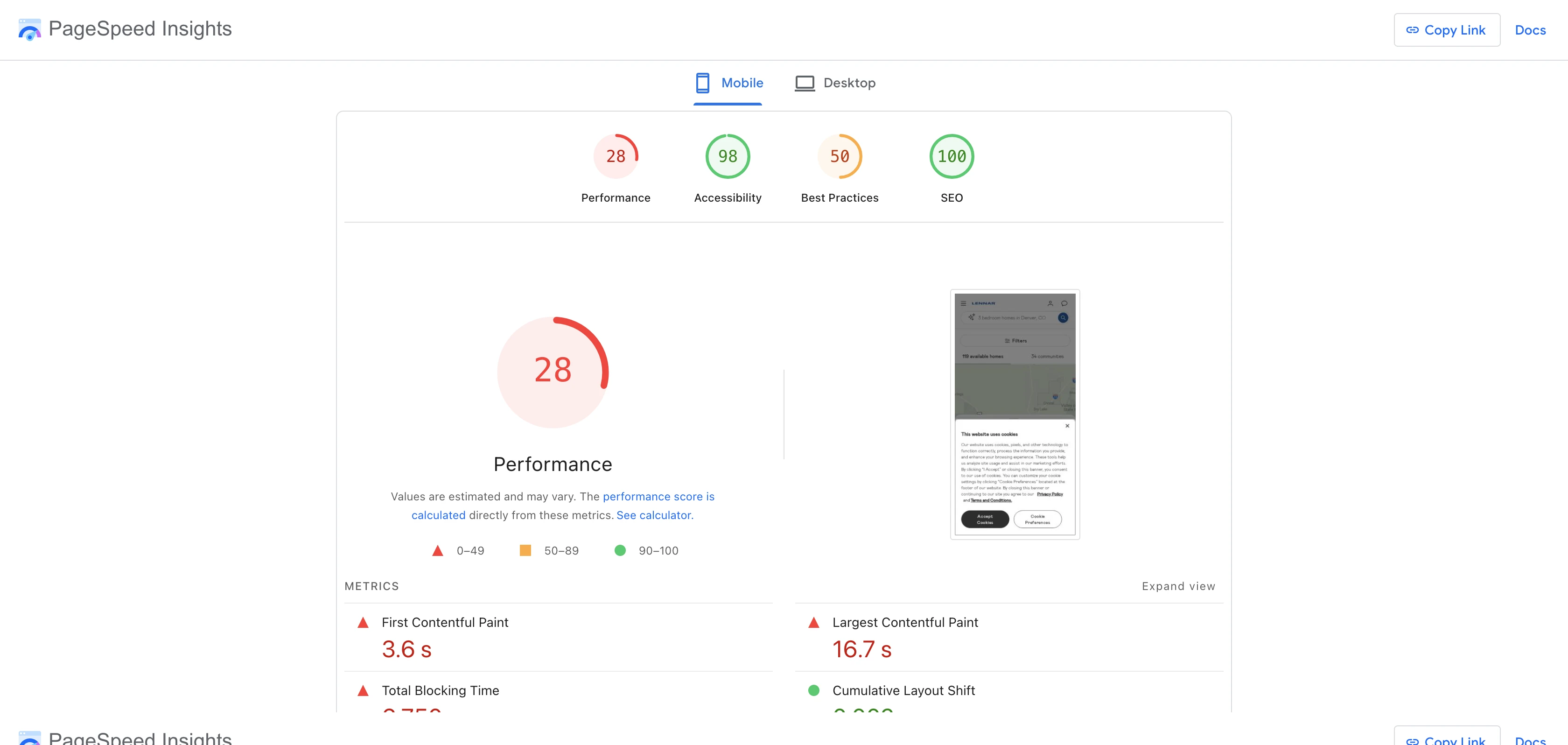
None of the three pages cracked 32 on mobile performance, though the Las Vegas page improved to 28. But the individual metrics tell the real story.
Las Vegas page: Performance score 28/100. LCP of 16.7 seconds. FCP of 11.6 seconds. TBT of 6,750ms. Speed Index of 18.7 seconds. Accessibility score of 98 — the highest of the three. So the page is accessible. It's just slow. Really slow. A homeowner searching "new homes Las Vegas" waits nearly 17 seconds to see the main content render on mobile.
San Antonio page: Performance score 27/100. LCP of 14.5 seconds. FCP of 4.4 seconds. But here's the number that matters: TBT of 6,099 milliseconds. That's six full seconds where the browser's main thread is blocked. You can't scroll. You can't tap. You can't do anything. The page is technically loaded, but it's frozen. And this page has a Google Reviews widget — the only one across all three pages we checked — which likely contributes to that blocking time.
NextGen page: Performance score 31/100. LCP of 14.1 seconds. FCP of 7.3 seconds. TBT of 1,347ms. Speed Index of 10.7 seconds. CLS of 0.001. This is the "best" performer of the three, and its main content still takes 14 seconds to appear.
"53% of mobile users abandon sites that take longer than 3 seconds to load."
— Google / SOASTA (2017)
Worth noting — these are Lighthouse lab scores simulating a first-time visitor on a throttled mobile connection. Returning visitors with cached assets will have a better experience. But a homeowner who just searched "Lennar homes San Antonio" and tapped through for the first time? They're getting a page that won't respond to input for six seconds. That's not a minor delay. That's a test of patience most people fail.
(Side note: all three pages had CLS scores under 0.002. So the layout stays stable. The content just takes a geological age to arrive.)
Lead capture: search fields aren't lead forms
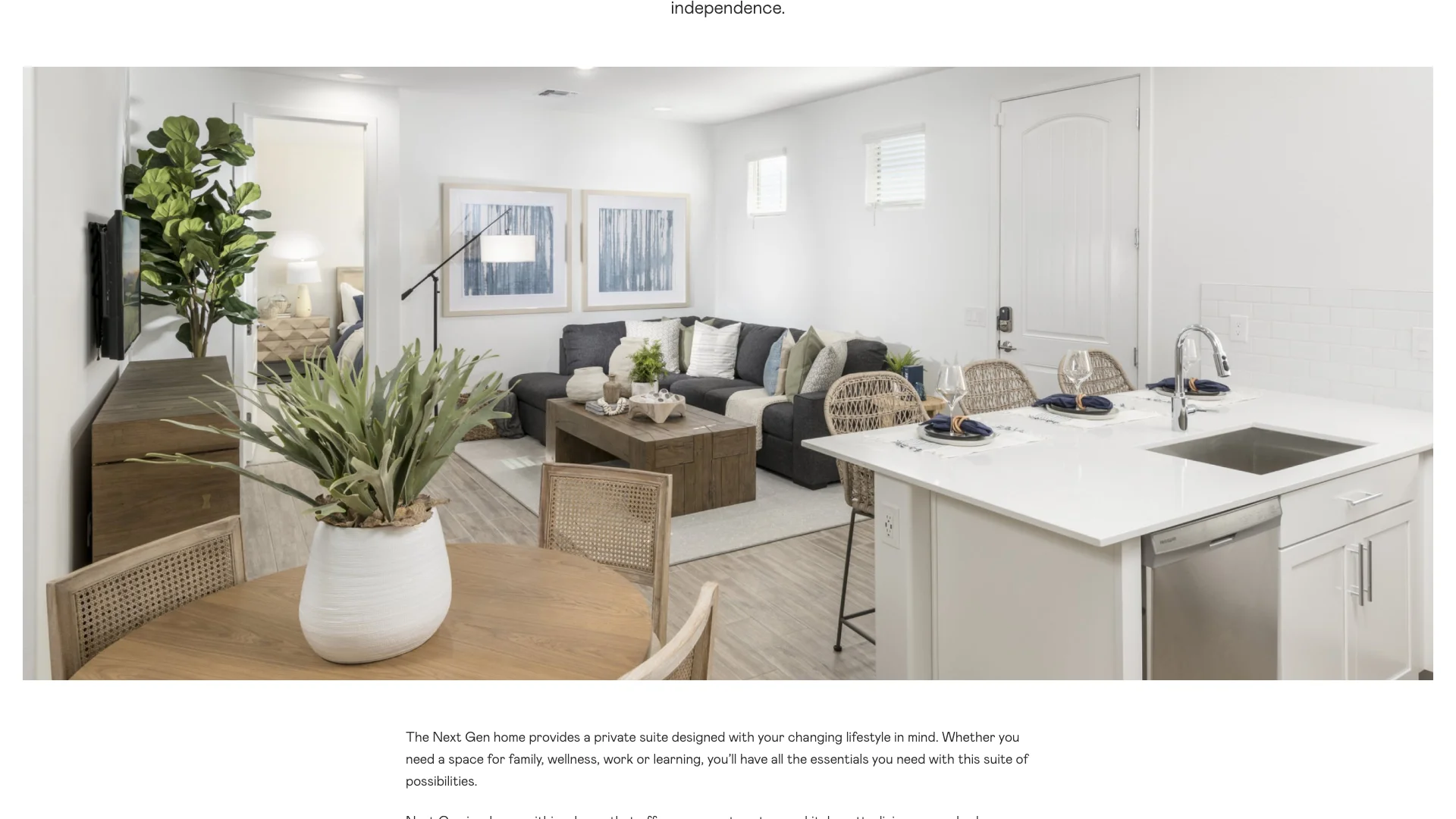
Every page we audited carries the same conversion mechanism: a single search field. Type in a location, browse listings. That's it. No name field. No email field. No phone field. No "Request Information" form. No "Schedule a Tour" form. No inline lead capture of any kind.
And that's a choice. Lennar routes homebuyers through their own sales centers and model homes. The website functions as a listing portal — search, browse, visit in person. But from a conversion rate perspective, you're letting every visitor who isn't ready to drive to a sales center leave without a trace.
The CTAs that do exist sit in the navigation and footer: Contact a Consultant, Contact Us, Warranty/Service Request, Privacy Request. But none of them appear as inline forms on the pages themselves. A homeowner browsing NextGen homes — Lennar's multigenerational concept — reads 412 words and hits a search field. No "Get pricing for NextGen homes in your area." No "Talk to a home consultant." Just search.
The San Antonio and Las Vegas pages are even thinner. 119 words each. Thirty-nine internal links. And one search field. That's a page built for SEO crawlers, not for homebuyers.
Compounding effect
"Conversion rates drop approximately 12% for each additional second of page load time."
— Google / Deloitte (2020)
And the NextGen page doesn't display a phone number at all. San Antonio shows (210) 393-8095. Las Vegas shows (800) 509-9720. But NextGen — the concept page, the one with the most content and the most unique value proposition — gives a homeowner no way to call.
Trust signals: one page out of three
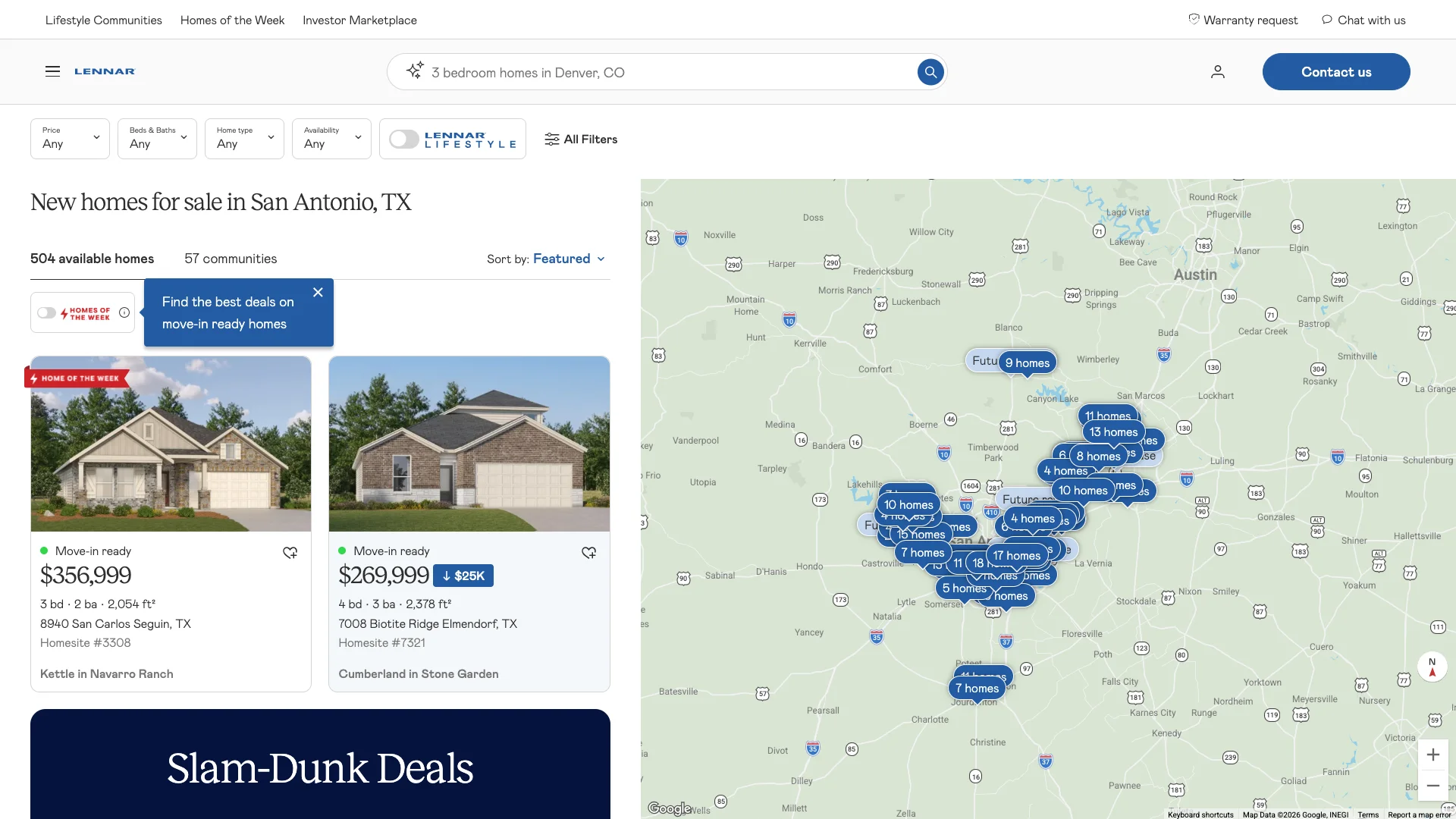
The San Antonio page has a Google Reviews widget. That's the full trust signal inventory across all three pages.
No BBB badge anywhere. No trust badges. No certifications displayed. No review counts. No chat widget. No awards. No "trusted by X families" messaging. The Las Vegas page — nothing. The NextGen page — nothing. Just San Antonio with its Google Reviews, and even that comes at a performance cost. That TBT of 6,099ms on San Antonio? The reviews widget is likely part of the problem.
This is a company that builds thousands of homes per year. They have reviews. They have awards. They have certifications. But the website doesn't surface any of it on the pages that homebuyers actually land on.
"68% of consumers will only use a business with a rating of 4 or more stars."
— BrightLocal (2026)
And the inconsistency is almost worse than a complete absence. If you land on the San Antonio page, you see social proof. If you land on Las Vegas — same type of page, same layout, same 119 words — you see none. It signals that the reviews widget was a one-off implementation, not a systematic decision. The homeowner doesn't know that. They just know one page feels more trustworthy than the other.
Schema markup follows the same pattern. San Antonio and Las Vegas carry basic WebPage schema. NextGen has nothing. No LocalBusiness schema. No Product schema for home listings. No Review schema to surface star ratings in search results. For a company whose product listings start at $400,000, that's structured data left on the table.
What Lennar does well
A teardown that only lists problems isn't useful. Lennar gets several things right, and if you're a local home builder, these are worth studying.
Accessibility scores. Las Vegas scored 98/100 on accessibility. San Antonio scored 94/100. NextGen scored 85/100. Those are strong numbers, especially for a site with complex listing interfaces. Contrast ratios, ARIA labels, keyboard navigation — Lennar's front-end team invested here. Most contractor sites don't break 70.
Market-specific landing pages. Lennar builds dedicated pages for every market they operate in. San Antonio gets its own page. Las Vegas gets its own page. That's basic, but most national builders route everything through search. Lennar gives each market a crawlable, linkable URL. Good for local SEO. Good for paid campaigns that need a dedicated landing page.
NextGen as a concept page. The NextGen multigenerational home concept gets its own page with 412 words of content explaining the home-within-a-home model. That's a differentiated product with a differentiated page. Most builders would bury this in a blog post or a PDF brochure. Lennar gave it a dedicated URL with its own content. Smart information architecture.
Internal linking density. All three pages carry 37-39 internal links. That's consistent cross-linking across communities, floor plans, and market pages. For a site with hundreds of active listings, that link architecture helps both users and crawlers navigate between related content.
"In 2024, 84% of U.S. homeowners funded their renovations using personal savings."
— Houzz Inc. (2025)
What the gaps mean for local home builders

Lennar is a production builder. You're a custom home builder. They sell volume. You sell craftsmanship and personal attention. And their website gaps map directly to your competitive advantages.
Add real lead capture forms. Lennar has zero forms on the pages we audited. Just search fields. If you put a 3-field contact form — name, phone, project type — on your homepage and service pages, you're already capturing leads that Lennar's site architecture can't. A homeowner who isn't ready to visit a model home might still fill out a quick form. Lennar gives them no option to do that.
Show reviews on every page. Lennar has Google Reviews on one page out of three. And even that implementation drags TBT to 6,099ms. You can embed a lightweight review widget — or even static review screenshots — on every page without the performance hit. Display your Google rating, your review count, and two or three pull quotes. That's the social proof Lennar's pages are missing.
Beat their content depth. The San Antonio and Las Vegas pages have 119 words each. The NextGen page has 412. Your service pages should have 800-1,200 words minimum — covering your process, your materials, your timeline, your pricing framework, and your differentiators. When a homeowner compares your 1,000-word custom home page to Lennar's 119-word market listing, the depth signals expertise.
Win on speed. Lennar's pages score 27-31/100 on mobile performance. LCP ranges from 14.1 to 16.7 seconds. A properly optimized contractor site should score 85+ with LCP under 2.5 seconds. Every second counts. If your page loads in 2 seconds and Lennar's takes 17, the homeowner feels the difference before they read a word.
"25% of homeowners say trusting contractors is their top challenge."
— Houzz Inc. (2025)
And there's a schema opportunity. Lennar uses basic WebPage schema on two pages and nothing on the third. No LocalBusiness. No Product schema for listings. No Review schema. You can implement LocalBusiness schema with your service area, Review schema pulling your Google rating, and FAQ schema on your service pages. That's structured data Lennar hasn't claimed — and it can earn you rich snippets in search results they're not competing for.
The positioning angle is straightforward. Only 4% of homeowners undertake new home construction in a given year (Houzz 2025). That's a small pool of high-value buyers. And 25% of homeowners say trusting their contractor is the top challenge. Lennar's website doesn't solve for trust on most of its pages. Your site can. Reviews on every page. A real contact form. Content that explains your process. A page that loads in under 3 seconds. That's how you win the homeowner who's comparing you to a publicly traded builder with a $400,000 starting price and a website that can't capture a lead.
Frequently asked questions
What is Lennar's website performance score?
The Las Vegas page scored 28/100 on Google PageSpeed Insights (mobile) as of March 2026. The San Antonio page scored 27/100, and the NextGen page scored 31/100. LCP ranged from 14.1 to 16.7 seconds across the three pages. The San Antonio page recorded a Total Blocking Time of 6,099 milliseconds — meaning the browser's main thread was blocked for over six seconds. All three pages had minimal layout shift (CLS under 0.002).
Does Lennar's website have lead capture forms?
No. Across the three pages we audited, Lennar has no traditional lead capture forms. Each page contains a single search field for finding homes by location. The primary CTAs — Contact a Consultant, Contact Us, Warranty/Service Request — exist in the navigation and footer, but no inline forms appear on the landing pages themselves. The NextGen page doesn't even display a phone number.
Can a local home builder compete with Lennar online?
Yes — and the gaps make it easier than you'd expect. Lennar is a production builder selling through sales centers and model homes. Their website functions as a listing portal, not a lead generation engine. A local custom home builder with a fast site (85+ performance score), visible Google reviews on every page, a 3-field contact form, and 800+ words of content per service page delivers a meaningfully better digital experience. You're not competing with Lennar's brand recognition. You're competing for the homeowner who wants a builder they can actually talk to.
How much organic traffic does lennar.com get?
According to Ahrefs data from our March 2026 collection, lennar.com receives approximately 281.6K monthly organic visitors with an estimated traffic value of $172.1K. The NextGen page accounts for 6.7K of that (2% share), the San Antonio page accounts for 4.6K (2%), and the Las Vegas page accounts for 4.4K (2%). The traffic is spread across hundreds of market-specific pages rather than concentrated on a few high-volume product pages.