What we found on lawndoctor.com
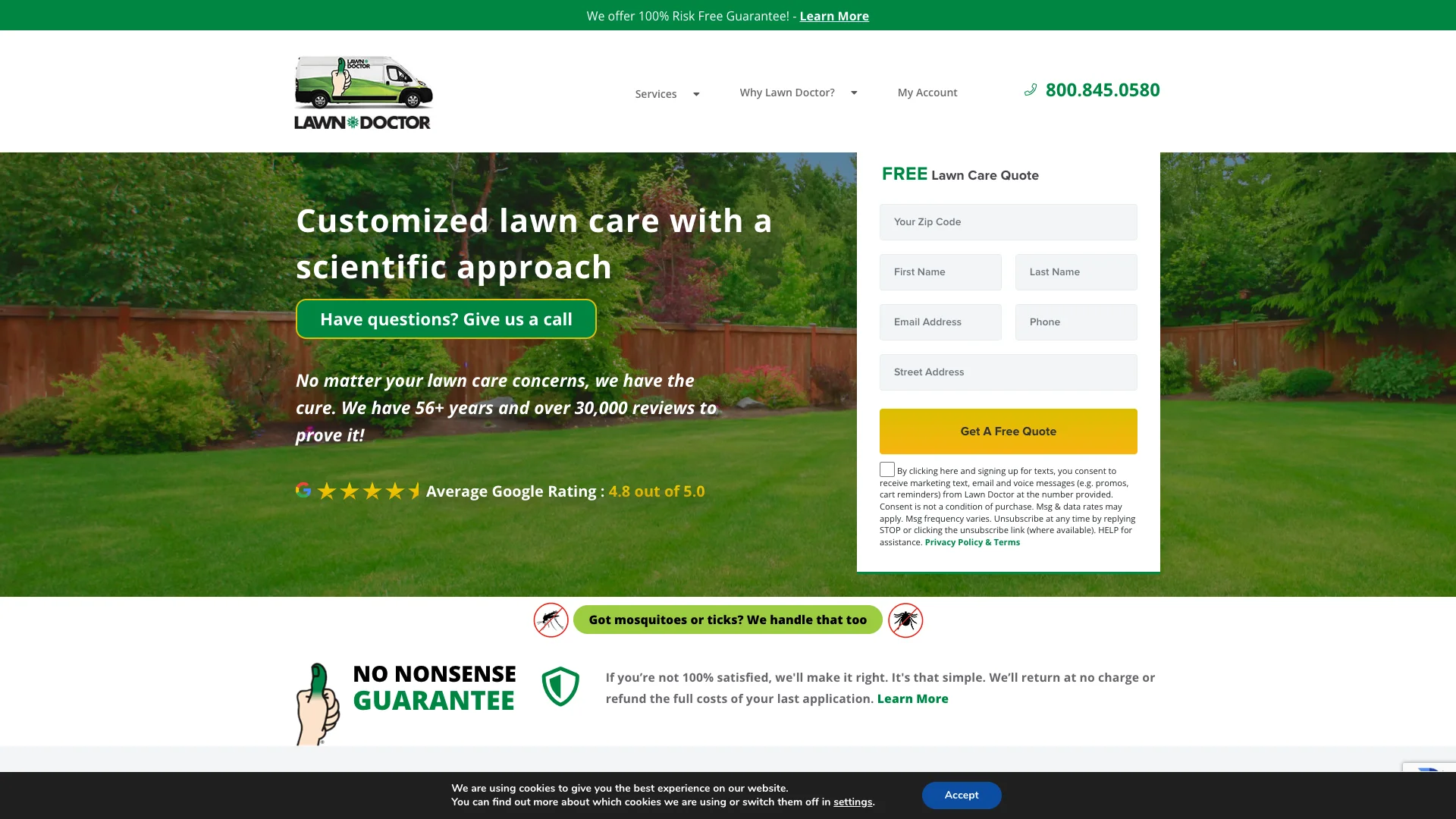
Lawn Doctor is a national lawn care franchise with locations across the United States. According to Ahrefs, lawndoctor.com pulls 135.7K monthly organic visitors with an estimated traffic value of $327.5K. That puts it near the top of the landscaping batch by raw traffic numbers. But traffic and conversion readiness aren't the same thing.
The pages we tore down:
- /lawn-care/, the primary lawn care service page (43.9K monthly organic visitors, scored 27 on Google's mobile lab test, layout shift 0.000, 3 forms)
- /weed-control/, the weed control service page (3.9K monthly visitors, scored 28, layout shift 0.000, 3 forms)
- /lawn-fertilization/, the lawn fertilization service page (2.9K monthly visitors, scored 27, layout shift 0.000, 3 forms)
And the pattern across all three pages is consistent. Clean layout stability. Three forms per page. Scores in the mid-to-high 20s on Google's mobile lab test. Zero Google Reviews. Zero trust badges. Zero review widgets. So Lawn Doctor has the traffic, has the forms, has the stable layouts. But there isn't a single trust signal on any of these pages telling the homeowner that other customers had a good experience.
That creates a strange dynamic. A homeowner searches "lawn care near me," clicks through to a professional-looking page from a recognizable brand, reads about the service, and then has to decide whether to hand over their phone number. And the page gives them zero social proof to make that decision easier. No star ratings. No review count. No customer names. Just a form and a promise.
Lawn Doctor isn't a startup. It's been operating for decades, has franchise locations in dozens of states, and commands a traffic value of $327.5K per month. That kind of domain authority doesn't happen by accident. But the website's conversion infrastructure hasn't kept pace with the brand's growth.
The pages rank well because of domain authority and content volume. They just don't convert well because the trust layer is completely absent. And that's the tension that runs through every section of this teardown: strong foundation, missing persuasion.
"25% of homeowners say trusting contractors is their top challenge when planning home improvement projects."
— Houzz Inc. (2025)
Performance: averaging 27 on Google's mobile lab test
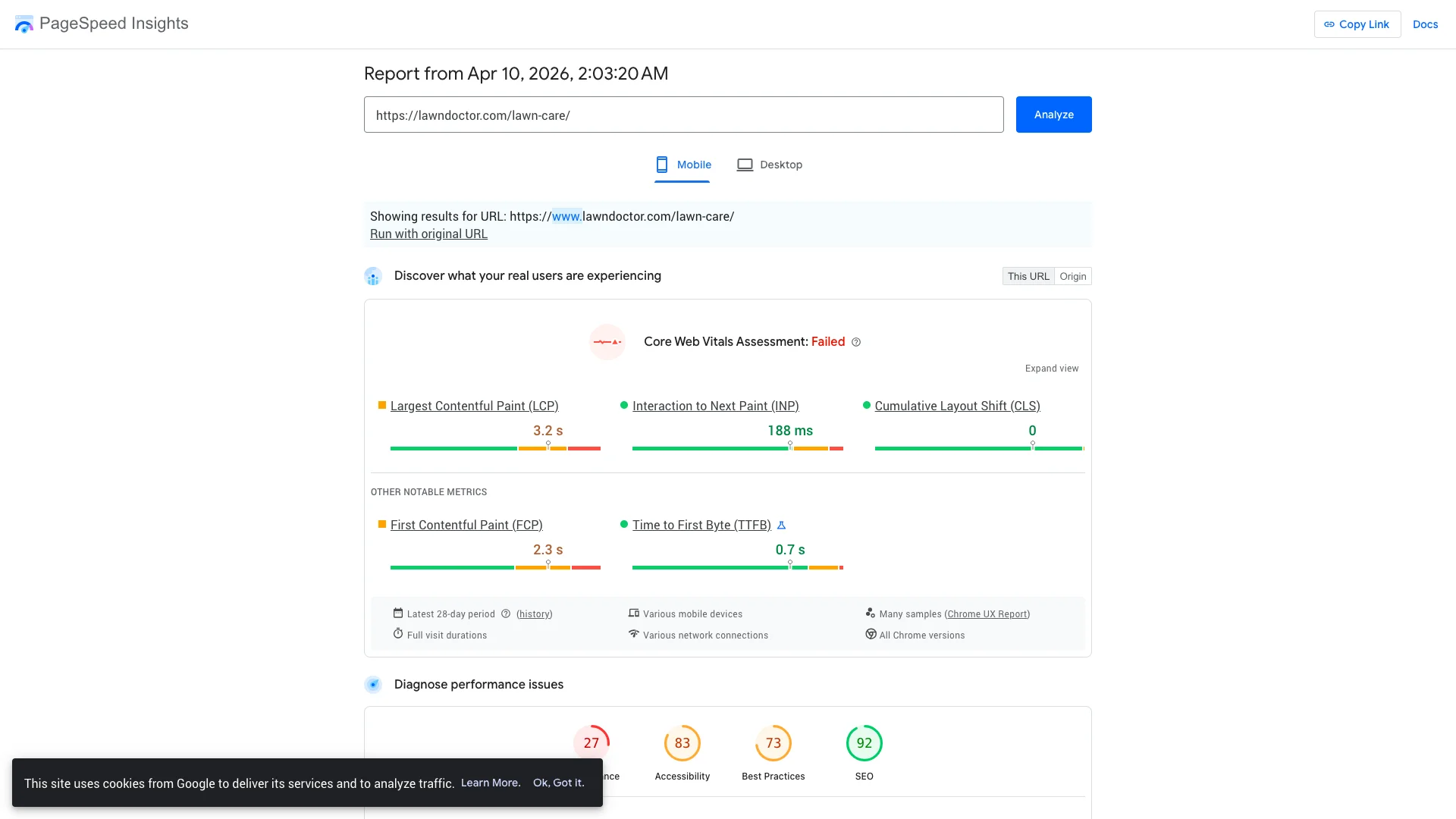
Google PageSpeed Insights runs a simulated slow-phone lab test. The scores are worst-case, not what you see on your phone with WiFi. But Google uses them as a ranking factor in search results.
The lawn care page scored 27. The weed control page scored 28. The lawn fertilization page scored 27. All three are deep in the red zone. And for a site pulling 135K monthly visitors, those scores mean Google is actively penalizing these pages in search rankings. Imagine how much more traffic Lawn Doctor would get if the scores were in the green.
To put those numbers in context: a score of 27 means the page takes a long time to become interactive on a simulated mid-range phone with a slow connection. The largest content element takes too long to paint. The main thread is blocked for too long. These are the metrics Google measures, and all of them are failing on these three pages.
"53% of mobile users abandon sites that take longer than 3 seconds to load."
— Google / SOASTA (2017)
But layout stability is perfect. All three pages score 0.000 on layout shift, which means content doesn't jump around at all as the pages load. That's the gold standard. Homeowners won't accidentally tap the wrong button because something shifted at the last second. So the structure is solid. The problem is raw page weight and script loading that Google's mobile lab test penalizes hard.
And here's why that matters for a brand this size. The lawn care page alone pulls 43.9K monthly visitors. That single page accounts for roughly a third of all organic traffic to the entire domain. If that page scored 75 instead of 27, Google would rank it higher for more keyword variations, which could push that number past 60K or 70K monthly visitors. At Lawn Doctor's traffic value per visitor, that's tens of thousands of dollars in additional monthly traffic value from a single page improvement.
The weed control page pulls 3.9K visitors and the fertilization page pulls 2.9K. Those are secondary pages, but they're still substantial traffic generators. And all three share the same performance profile: low scores, high stability, zero shift. That consistency suggests the template itself is the bottleneck, not individual page decisions. Fix the template's script loading and image handling, and every page on the site benefits.
For a franchise this size, fixing those scores is a straightforward engineering project. Defer the tracking scripts, compress the images, lazy-load anything below the fold. Getting from 27 to 70+ on Google's mobile lab test would unlock ranking positions that Lawn Doctor is currently leaving on the table. And with 135K monthly visitors already, even a small ranking improvement on the lawn care page translates to thousands of additional visits per month.
Compounding effect
"Conversion rates drop approximately 12% for each additional second of page load time."
— Google / Deloitte (2020)
Lead capture: 3 forms per page, no trust to back them up
The form count is strong. Three forms on every tested page. That means a homeowner scrolling through the lawn care page hits multiple opportunities to leave their information without ever needing to navigate away. That's above average for the landscaping batch, and it shows that Lawn Doctor's template is built with lead capture in mind.
But forms only work when the homeowner trusts the company enough to fill them out. And on these pages, there's nothing reinforcing that trust. No star ratings next to the form. No "rated 4.8 by 2,000+ customers" badge. No testimonial snippet. Just a form sitting in a vacuum, asking for personal information from a stranger on the internet.
Think about the homeowner's experience. They searched "lawn care near me," landed on a professional-looking page, read about the service, and scrolled to the form. Now they're deciding whether to type in their name and phone number. What's pushing them to do it? On most high-converting service pages, the answer is social proof right next to the form. On Lawn Doctor's pages, the answer is nothing. The form is asking for trust it hasn't earned on that page.
"68% of users wouldn't submit a form if it required too much personal information."
— Baymard Institute (2024)
And there's a compounding problem. When you have three forms per page and none of them have social proof nearby, you're giving the homeowner three chances to feel uncertain instead of three chances to convert. Each form they scroll past without filling out reinforces the decision not to engage. A single testimonial or star rating next to even one of those forms would change the dynamic for the entire page.
The math here is worth spelling out. If Lawn Doctor converts 2% of its 43.9K lawn care page visitors with zero trust signals, that's 878 leads per month. If adding Google Reviews next to the top form bumps that rate to 3%, that's 1,317 leads. An extra 439 leads per month from a widget that takes 30 minutes to install. For a franchise charging $50-$80 per lawn treatment, those leads add up fast.
And the form fields themselves matter. If the forms are asking for name, phone, email, address, property size, and service type, that's a lot of fields for a homeowner who hasn't been given a reason to trust the company. Fewer fields with trust signals beats more fields without them. The goal is to get the homeowner into the sales conversation, not to collect a complete customer profile on the first touch.
Trust signals: a Google rating is there, but the full trust stack isn't
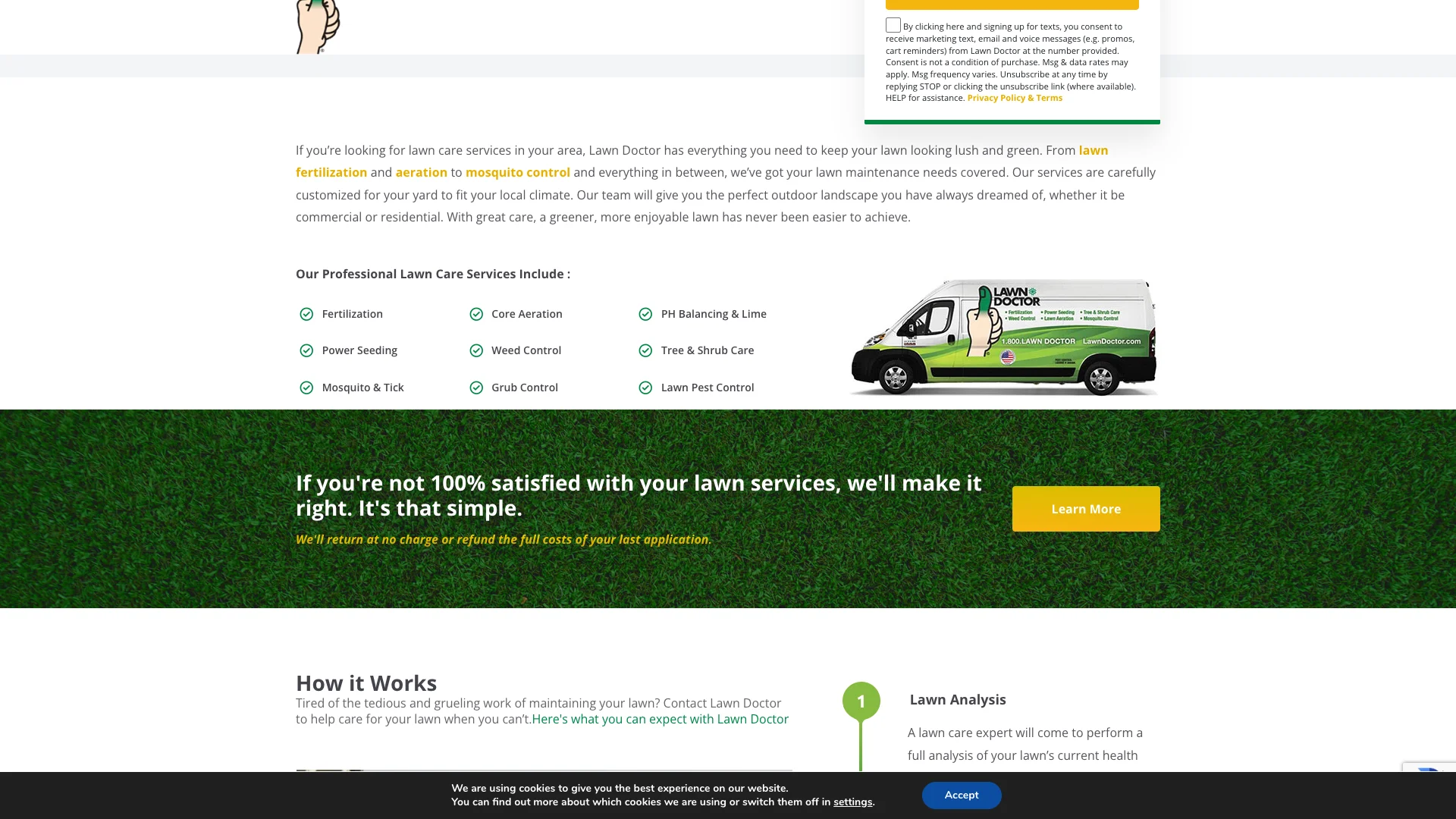
A correction from our initial data: our automated scraper reported zero review elements on Lawn Doctor's pages. But Chrome browser verification found that the lawn care page displays "Average Google Rating: 4.7 out of 5.0" with yellow star icons. So there IS a trust signal on the page that the scraper missed (it loads via JavaScript after the initial page render, which is why the automated tool didn't catch it).
That changes the story from "zero trust signals" to "one trust signal, but minimal." The 4.7 Google rating display is a real trust element. It tells the homeowner that Lawn Doctor has strong aggregate reviews. But it's a text line with stars, not a full review widget where the homeowner can read actual customer quotes, see review counts, or click through to Google. And beyond the rating display, the rest of the trust stack is still empty:
- Google Rating display: Present ("Average Google Rating: 4.7 out of 5.0" with star icons).
- Full review widget with customer quotes: Not present.
- Trust badges: Not present on any page.
- Chat widget: Not present on any page.
- BBB badge: Not found.
- Certifications: Not found.
So Lawn Doctor is doing more than zero, which is better than what we initially reported. But there's still a significant gap between displaying a single aggregate rating line and building a full trust stack. A homeowner sees "4.7 stars" and thinks "okay, they're rated well." But they can't read specific reviews, they can't see how many reviews that 4.7 is based on, and they can't click through to verify it independently. The rating creates initial credibility. A full review widget with customer names, dates, and specific quotes would close the deal.
Comparison
"83% of consumers use Google to find local business reviews; 74% use two or more review platforms when researching."
— BrightLocal (2025)
The hidden code labels are basic. Navigation and site hierarchy labels are present, but there's nothing trade-specific telling Google that Lawn Doctor is a lawn care service provider. Adding a "home and construction business" hidden code label or a "local business" label with service descriptions would help Google understand what each page is actually about beyond just the text content.
And for a franchise operating in dozens of markets, each location page should carry a "local business" hidden code label with the specific city, state, and service area. That tells Google exactly where each franchise operates, which helps with local search visibility. Without those labels, Google has to infer the service area from the text content alone, and inference is always less reliable than explicit signals.
What Lawn Doctor does well
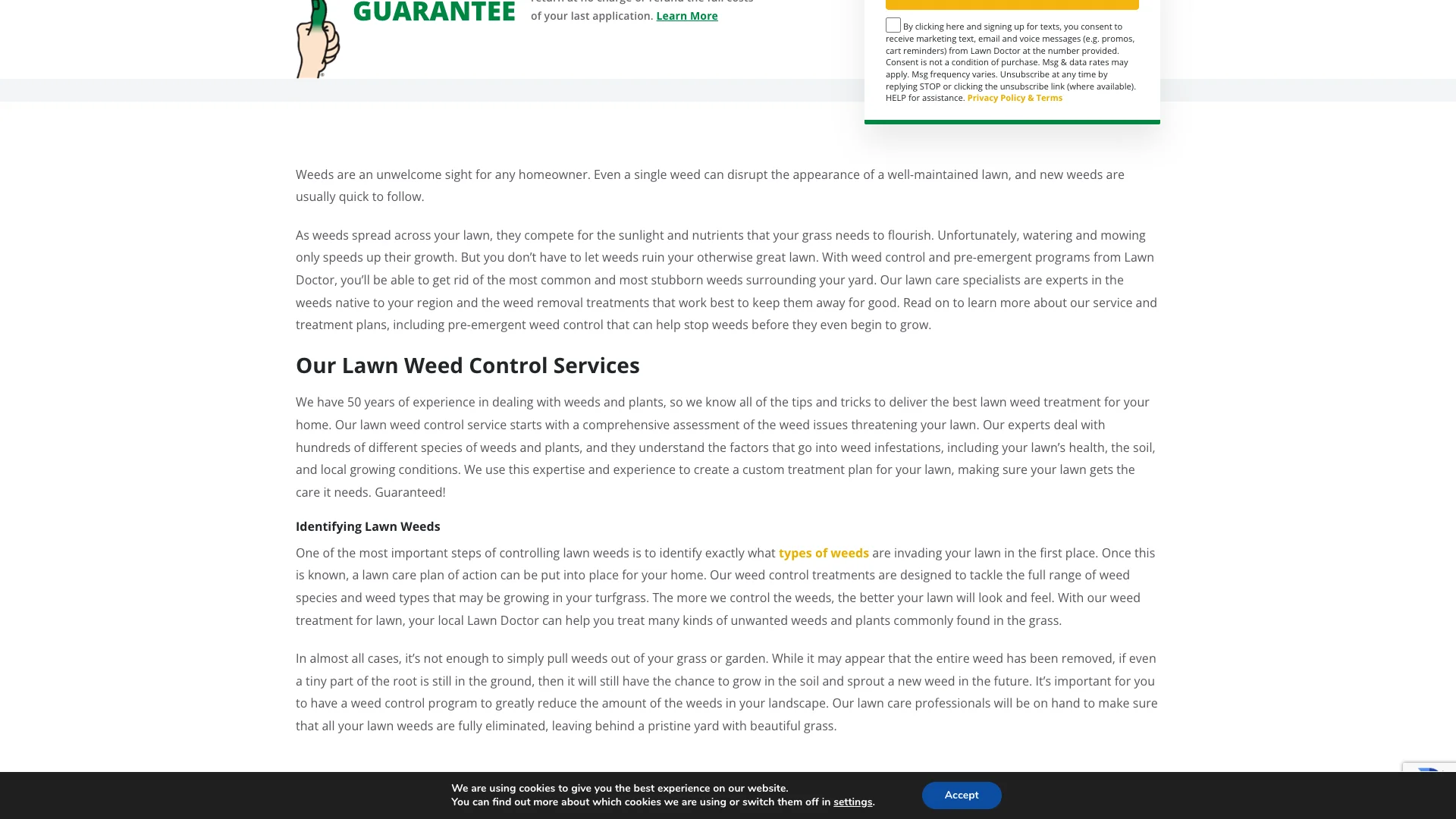
Lawn Doctor isn't all gaps. The things it gets right are foundational, and they're worth calling out.
Perfect layout stability. 0.000 across all three pages. Content doesn't jump around at all. That's better than most franchise brands in this series. The pages are structurally sound, and homeowners aren't getting frustrated by shifting elements as the page loads. For context, other brands in this series have layout shift scores above 0.2, which means content jumping around nearly twice the acceptable limit. Lawn Doctor has zero shift. That's not accidental. That's a well-built template.
Three forms per page. Consistent lead capture infrastructure on every service page. The homeowner doesn't have to hunt for a way to request service. The forms are there, positioned throughout the content. That's a template decision that shows intentional conversion design, even if the trust signals aren't backing the forms up yet.
Clean content structure. The pages are organized, readable, and service-focused. No cluttered sidebars. No competing pop-ups. No autoplay videos. Just content and forms in a clean layout. That's a solid foundation to build trust signals onto. Adding reviews and badges to a clean layout is much easier than adding them to a cluttered one.
Traffic volume proves the brand. 135K monthly visitors means Google already trusts the domain. The authority is there. The content is ranking. The technical infrastructure is working at scale. All that's missing is the persuasion layer that turns those visitors into leads.
Consistent template across service pages. All three tested pages follow the same layout, same form placement, same structure. That consistency means any improvement to the template (adding reviews, fixing speed, adding badges) automatically applies to every service page on the site. One template fix, dozens of pages improved. That's the advantage of a well-structured franchise website.
"64% of homeowners say having recommendations or references is a top-three factor in choosing a contractor."
— Houzz Inc. (2025)
What the gaps mean for landscaping contractors
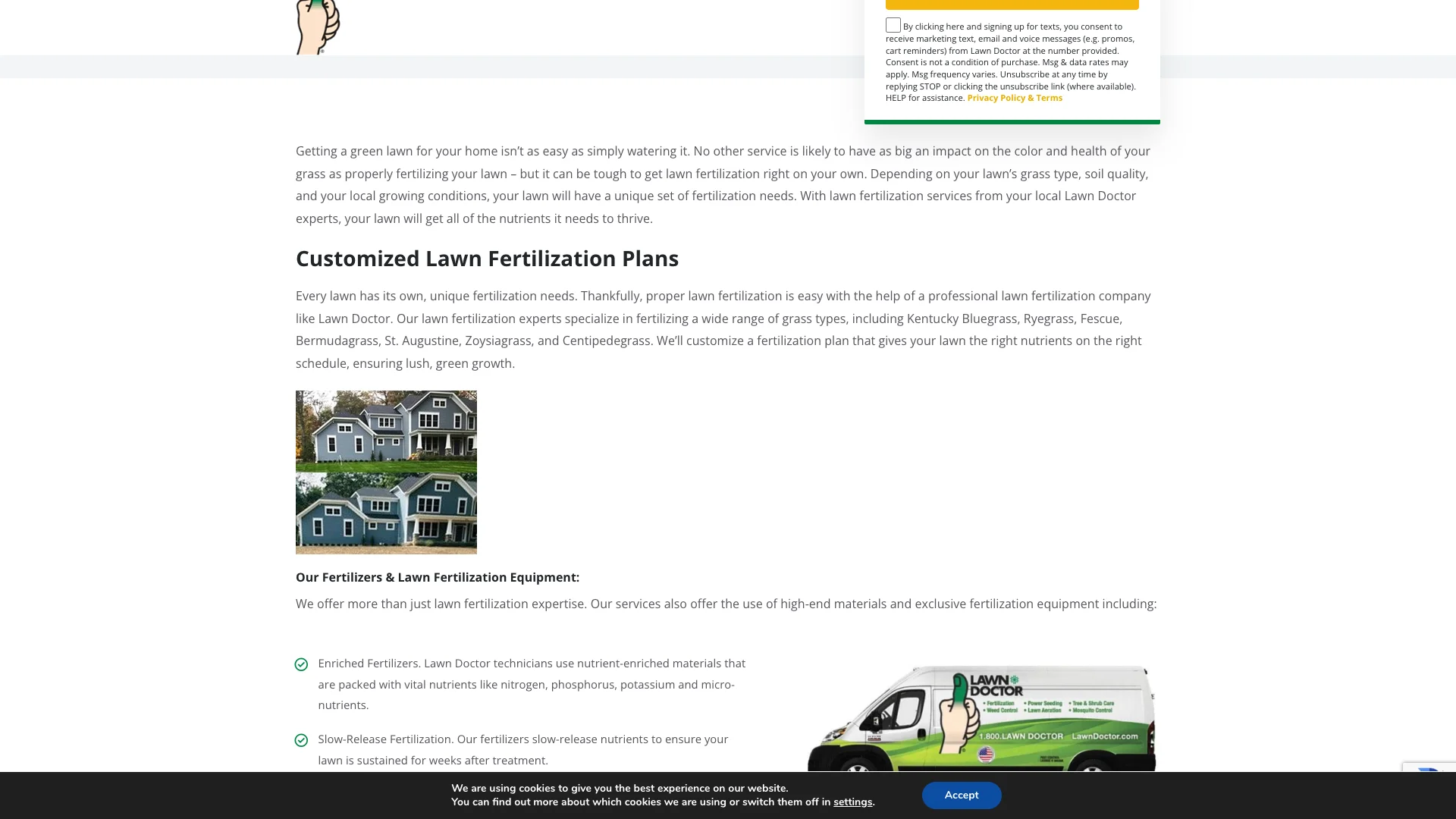
Lawn Doctor is a case study in what happens when you get the infrastructure right but skip the persuasion layer. If you're a landscaping contractor looking at this teardown, the lessons are clear.
Don't copy the trust gap. Lawn Doctor proves that traffic alone doesn't mean conversions. 135K monthly visitors with zero reviews on the page means a lot of people are landing, reading, and leaving without filling out those three forms. If you're building or rebuilding your site, put Google Reviews and trust badges on every service page before you launch. Not after. Before.
Fix page speed before it compounds. A score of 27 on Google's mobile lab test means Google is actively holding Lawn Doctor back in search rankings. For a site with this much authority, even a 20-point improvement in mobile scores could unlock thousands of additional monthly visitors. If your own site scores below 50, that's where your next marketing dollar should go. Compress images. Defer scripts. Lazy-load below-the-fold content. These aren't mysterious changes. They're standard performance optimizations that any competent developer can implement in a week.
Put social proof next to the form. Lawn Doctor has three forms per page with nothing around them saying "other homeowners loved this service." Even a simple star rating and review count next to the top form would change the conversion math. "Rated 4.7 by 1,200+ homeowners" next to a zip code entry field does more work than a paragraph of sales copy.
Add trade-specific hidden code labels. Google's hidden code labels help search engines understand what your business actually does. Lawn Doctor's pages carry basic navigation labels but nothing that says "lawn care service" or "landscaping business." Adding those labels takes 15 minutes and gives Google explicit signals about your trade category. For local landscapers, adding a "local business" label with your city and service area helps Google match your page to "near me" searches.
Install a chat widget. For a lawn care business, the homeowner's first question is usually "what does it cost?" or "do you service my area?" A chat widget answers that question in real time instead of asking the homeowner to fill out a form and wait for a callback. It's a second conversion path that catches the homeowner who isn't ready to commit but is ready to ask. And for seasonal services like lawn care, the homeowner who asks in March becomes the recurring customer from April through October.
"48% of customers say that if a site does not work well on mobile, it signals the company does not care about their business."
— Google Consumer Insights (2018)
Frequently asked questions
How does Lawn Doctor score on Google's mobile test?
The lawn care page scored 27 out of 100 on Google PageSpeed Insights mobile. The weed control page scored 28. The lawn fertilization page scored 27. All three are deep in the red zone. Google uses these scores as a ranking factor, so all three pages are taking a penalty despite strong traffic numbers. But layout stability is perfect (0.000 across all three), so content doesn't jump around as the pages load.
Does Lawn Doctor display Google Reviews on its website?
No. All three tested pages returned zero trust signals. No Google Reviews, no review widgets, no trust badges, no chat widget. For a brand with 135K monthly visitors, that's a significant gap between traffic and conversion readiness. The reviews almost certainly exist across Lawn Doctor's franchise locations. They're just not embedded on the website.
How many forms does Lawn Doctor have per page?
Each tested page has 3 forms. That's above average for the landscaping batch and shows the template is built with lead capture in mind. The gap isn't form count. It's the absence of trust signals to make homeowners comfortable filling those forms out.
How much organic traffic does lawndoctor.com get?
According to Ahrefs data from March 2026, lawndoctor.com receives approximately 135.7K monthly organic visitors with an estimated traffic value of $327.5K. The lawn care page alone accounts for 43.9K of those visitors, making it the highest-traffic page on the site by a wide margin.