
What we found on kitchentuneup.com
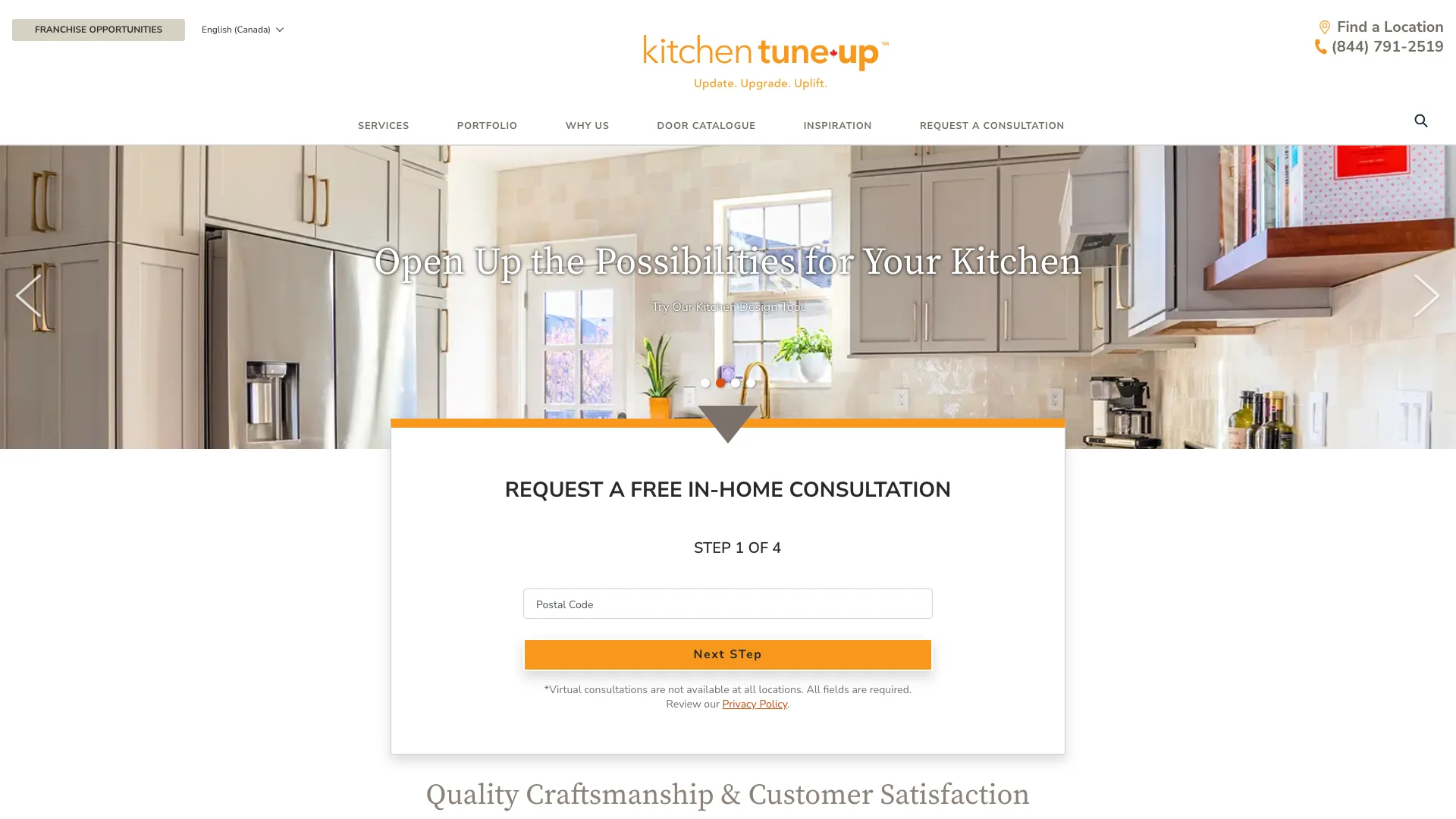
Kitchen Tune-Up is a kitchen remodeling franchise operating under Home Franchise Concepts (same parent company as Bath Tune-Up, which we just tore down in this batch). According to Ahrefs, kitchentuneup.com pulls 13.9K monthly organic visitors with an estimated traffic value of $31.8K. That is a significantly larger footprint than its sister brand. But the template is the same. The form structure is the same. And the problems are the same.
The pages we tore down:
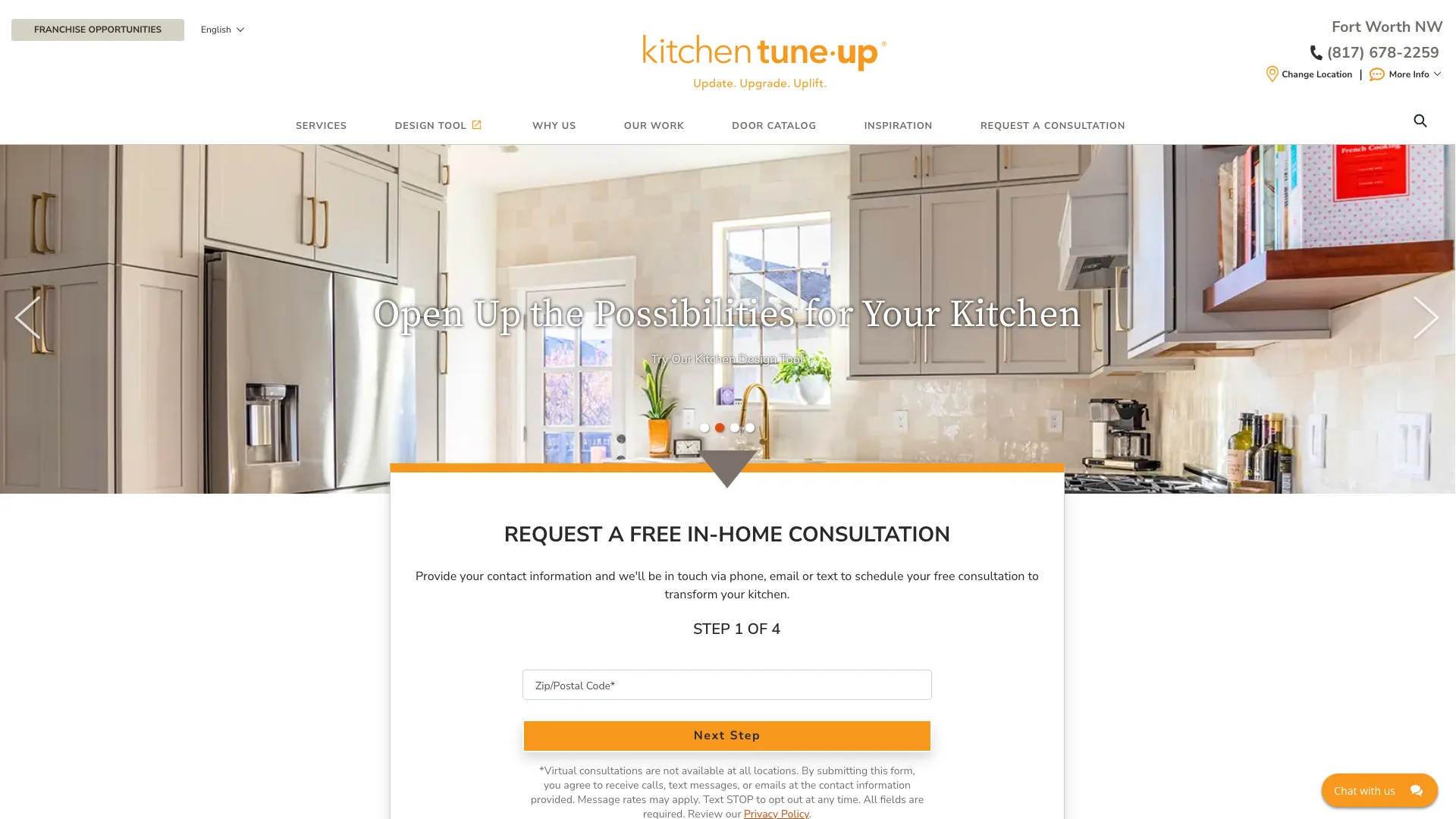
- Fort Worth NW location page (479 monthly organic visitors, 4% traffic share, scored 29 out of 100 on Google's mobile lab test)
- Cabinet Painting service page (428 monthly visitors, 3% share, scored 40 out of 100)
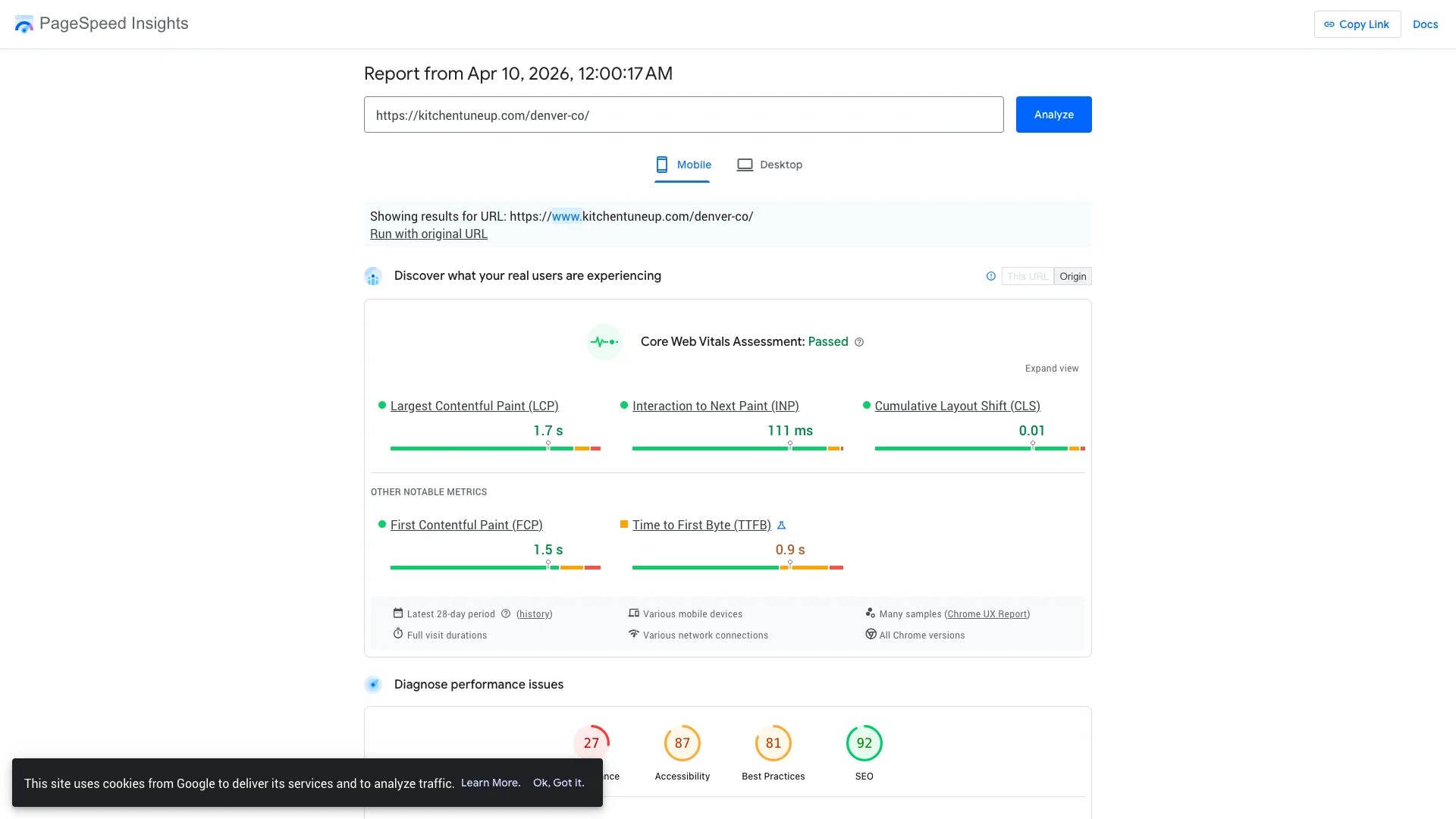
- Denver CO location page (402 monthly visitors, 3% share, scored 36 out of 100)
And this is a companion teardown to the Bath Tune-Up article. Same parent company. Same franchise template. Same 5-form-per-page structure. We are tearing down both brands side by side because the pattern is instructive: when two franchises share a template, they share the same conversion problems. The interesting detail on Kitchen Tune-Up is the layout shift inconsistency. One page scores a perfect 0.000. Another fails at 0.118. Same template, different behavior. That variance tells you the problem is specific and fixable, not baked into the platform.
"25% of homeowners say trusting contractors is their top challenge when planning home improvement projects."
— Houzz Inc. (2025)
Performance: 29, 36, and 40 across three pages
Quick framing note. Google's mobile lab test runs a simulated slow-phone scenario. The scores are worst-case numbers, not what a real homeowner on a fast phone experiences. The site probably feels fine when you open it yourself. But Google uses these lab scores as a ranking factor, which means every page scoring below 50 is eating a real search-ranking penalty that pushes it down in the results.
The Fort Worth NW location page scored 29 out of 100. That is nearly identical to Bath Tune-Up's Charlotte location page (also 29). Same template, same score. The Denver CO location page scored 36, which is marginally better but still deep in the red zone. The Cabinet Painting service page scored 40, which is the best of the three but still a failing grade by any standard.
"53% of mobile users abandon sites that take longer than 3 seconds to load."
— Google / SOASTA (2017)
Now, the layout shift story on Kitchen Tune-Up is genuinely interesting. The Cabinet Painting service page scores 0.000 on layout shift. Perfect. Nothing moves. The Denver location page scores 0.077, which passes Google's 0.1 threshold. And the Fort Worth location page scores 0.118, which fails. Three pages on the same template, three different layout shift results. That inconsistency means the shifting is not a template-level problem. It is a content-level problem: specific images, specific form placements, or specific widget injections on the Fort Worth page are causing the content to jump around as the page loads.
For a homeowner, the practical difference is this: on the Cabinet Painting page, everything stays put while the page loads. On the Fort Worth page, content jumps around as the page loads, which means buttons and phone numbers shift position while you are trying to tap them. One page feels solid. The other feels unreliable. Same company, same template, different outcomes based on what content modules are loaded.
Compounding effect
"Conversion rates drop approximately 12% for each additional second of page load time."
— Google / Deloitte (2020)
Lead capture: the same 5-form template as Bath Tune-Up
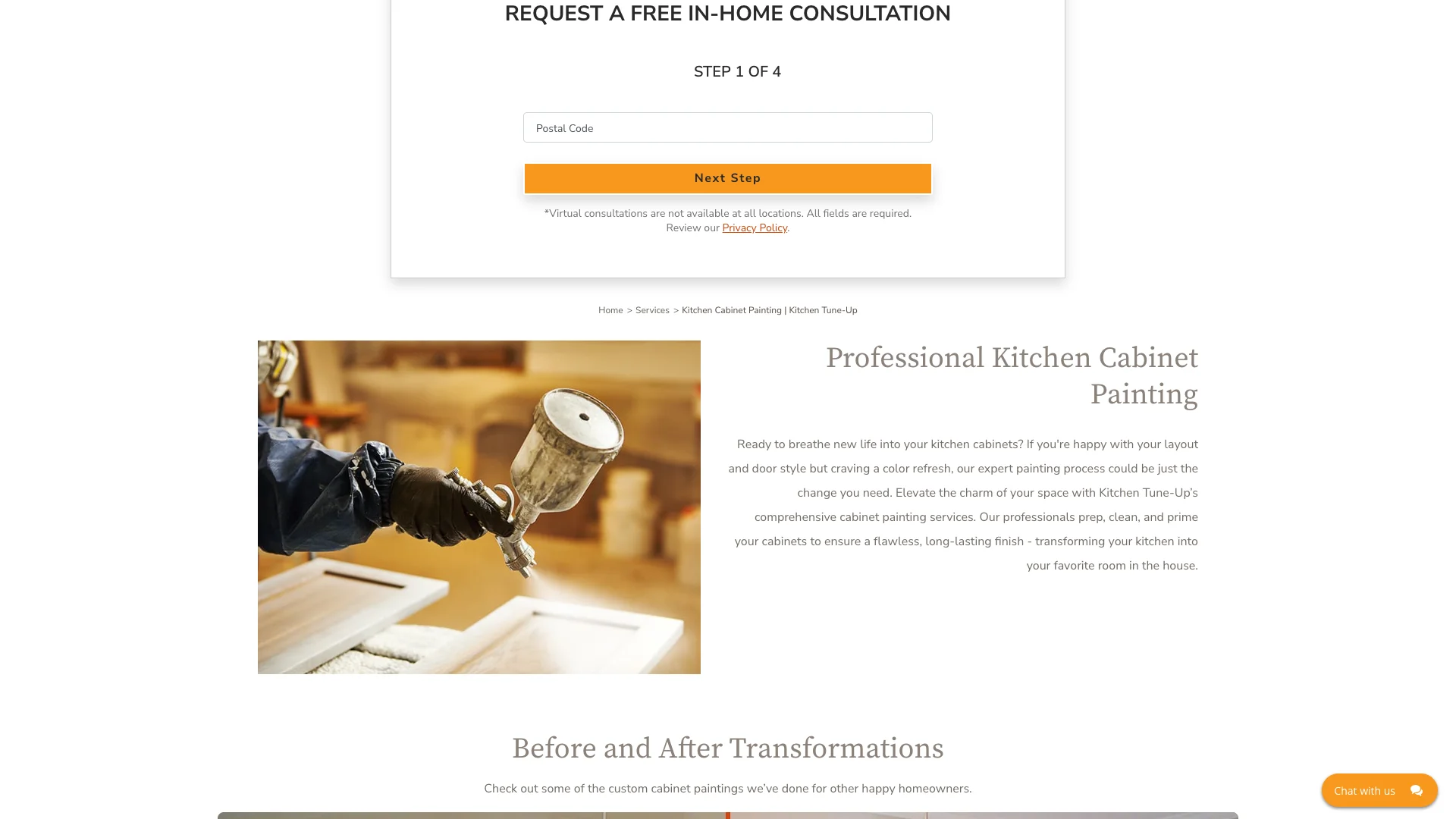
Kitchen Tune-Up runs 5 form instances per page. Same franchise template as Bath Tune-Up. Same form structure. Same 5-field primary contact form (first name, last name, email, phone, zip code). If you read the Bath Tune-Up teardown, you already know the pattern. The form fields are properly named for browser autofill. The field count (five) is reasonable for a kitchen remodel lead, if not ideal.
The chat widget is present across the pages we tested. That gives homeowners a second conversion path beyond the form, which is the right idea. And the phone number is visible in the navigation. Three paths to conversion: form, chat, phone. That coverage is solid.
"68% of users would not submit a form if it required too much personal information."
— Baymard Institute (2024)
But the same problem we flagged on Bath Tune-Up applies here. The form has no clear value proposition attached to it. No "get your free estimate in 24 hours." No "we will call you within 2 hours." No promise of what happens next. The form just sits there, asking for your information without telling you what you get in return. For a kitchen remodel (which is a $15,000 to $40,000 decision for most homeowners), the trust bar is high. The form needs to earn the submission, not just request it.
One data quirk: the phone number rendered in the audit data as (218) 668-188411, which is a parse artifact. The real number is 866-818-8411. Same parsing issue as Bath Tune-Up. Same template, same data-layer quirk. The number displays correctly on the live site, but the underlying markup could be cleaner.
Trust signals: zero reviews, zero badges, mixed code labels
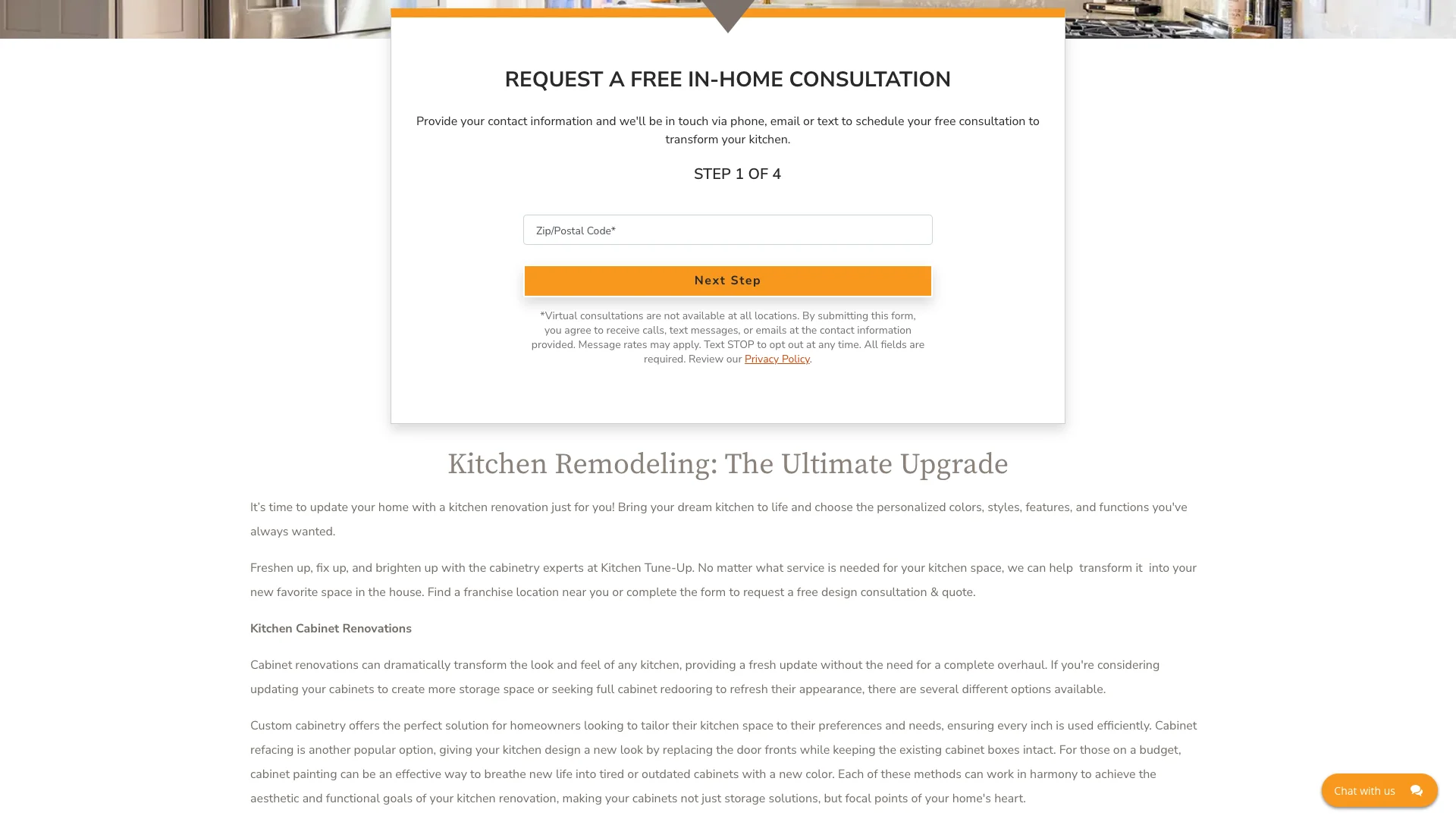
The trust signal audit on Kitchen Tune-Up matches Bath Tune-Up almost exactly:
- Google Reviews: Chrome verification found 19 review elements and a "Testimonial" section rendered via JavaScript.
- Star rating: Not found on any page.
- Review count: Zero on every page.
- Review widgets: Present (detected via Chrome browser verification, missed by initial scraper due to JavaScript rendering).
- BBB badge: Not found on any page.
- Trust badges: Not found on any page.
- Chat widget: Present on all three pages.
Same parent company. Same template. Same trust signal gaps. A homeowner comparing Kitchen Tune-Up's Fort Worth location page to an independent contractor who displays 47 Google Reviews with a 4.9-star rating is going to trust the independent contractor. Every time. Brand recognition helps, but visible social proof wins.
Comparison
"83% of consumers use Google to find local business reviews; 74% use two or more review platforms when researching."
— BrightLocal (2025)
The hidden code labels are a mixed bag. The two location pages (Fort Worth and Denver) carry both LocalBusiness and Organization labels, which is the same decent setup we saw on Bath Tune-Up. Google can read those and understand the page represents a local business. But the Cabinet Painting service page only carries an Organization label. No LocalBusiness label. No service-type label. So Google knows the page belongs to an organization but does not know it is a specific local service offering. That inconsistency across page types (location pages get two labels, service pages get one) means the service pages are leaving search visibility on the table.
What Kitchen Tune-Up does well
A teardown that just lists problems is not useful. Kitchen Tune-Up has a few bright spots that are worth calling out.
The Cabinet Painting page has perfect layout stability. A 0.000 layout shift score on the Cabinet Painting service page. Nothing moves. Nothing jumps. The page loads and every element stays exactly where it belongs. That proves the template can be stable. If the Fort Worth location page shifts at 0.118, the fix is not a platform overhaul. It is figuring out which specific module on that page is causing the movement and pinning it down.
Larger traffic footprint than Bath Tune-Up. 13.9K monthly organic visitors and a $31.8K traffic value. That is six times the traffic of its sister brand on the same template. Kitchen Tune-Up has built real organic authority in the kitchen remodeling space, which means the SEO team knows how to create content that ranks. The conversion infrastructure just needs to catch up.
Three conversion paths on every page. Form, chat, phone. All three are present and accessible on every page we tested. That is the right coverage for a kitchen remodeling franchise. The paths exist. They just need better positioning and clearer value propositions to actually convert.
Properly structured form fields. The 5-field contact form has correctly named fields that work with browser autofill. A homeowner on their phone can tap the first field and have all five populated in one second. That is a small detail that most franchise templates get wrong, and Kitchen Tune-Up gets it right.
"64% of homeowners say having recommendations or references is a top-three factor in choosing a contractor."
— Houzz Inc. (2025)
What the gaps mean for local kitchen and bath contractors
Kitchen Tune-Up is a national franchise with 13.9K monthly visitors. You are a local kitchen and bath contractor. And the template they are running has the same holes their sister brand has, which means your playbook is the same.
Score 85+ on Google's mobile test. Kitchen Tune-Up's pages scored 29, 36, and 40 out of 100. Yours should score 85+. Compress your hero images to under 100KB. Move tracking scripts so they load after the page appears. Audit every third-party widget. A page scoring 85+ outranks a franchise page scoring in the 30s for the same "kitchen remodeling [city]" query. That is not theory. That is how Google's ranking factor works.
Display Google Reviews on every service page. Kitchen Tune-Up has zero reviews visible on any page. Your site should show a Google Reviews widget with your star rating, review count, and a link to read all reviews. Put it above the fold on every service page and every location page. If you have 30 reviews, put them on the page. The franchise is showing zero. Thirty beats zero every single time a homeowner is comparing options.
Eliminate layout shift entirely. The Fort Worth page has content that jumps around as the page loads (layout shift 0.118, above Google's 0.1 limit). Your page should load with zero visible movement. Set explicit dimensions on every image. Preload your web fonts. Make sure no widget injects content that pushes the page down after the initial render. A stable page feels trustworthy. A shifting page feels like the contractor cut corners.
"48% of customers say that if a site does not work well on mobile, it signals the company does not care about their business."
— Google Consumer Insights (2018)
Add specific business-type code labels. Kitchen Tune-Up uses generic LocalBusiness and Organization labels on the location pages, and only Organization on the service page. Your site should use the most specific label Google supports for your business type, plus FAQ labels on every Q&A section, plus review labels that display your star rating directly in Google search results. These invisible labels take a developer a few hours to add and they give you richer, more prominent search listings than a franchise running generic labels.
The competitive angle is the same as Bath Tune-Up, just at a larger scale. Kitchen Tune-Up has six times the traffic but the same template problems. Same zero-review pages. Same failing scores on Google's test. Same layout shift issues on location pages. Your advantage is that you own your site, you can fix these things in a week, and the franchise cannot because every change has to go through a corporate template that serves hundreds of locations. Move fast. They cannot.
Frequently asked questions
How does Kitchen Tune-Up score on Google's mobile test?
Kitchen Tune-Up's Fort Worth NW location page scored 29 out of 100 on Google's mobile lab test. The Denver CO location page scored 36. The Cabinet Painting service page scored 40. All three fail Google's test, though the service page gets closest to a passing grade. For context, the same parent company's Bath Tune-Up brand scored 20 on a location page, so Kitchen Tune-Up is marginally better but still in the red zone across the board.
Does Kitchen Tune-Up show Google Reviews on their pages?
No. The audit found zero Google Reviews widgets, zero star ratings, and zero review counts displayed on any of the three pages we tested. The chat widget is present on all three pages, but the social proof a homeowner looks for when choosing a kitchen remodeler (visible reviews, star ratings, a link to read real customer experiences) is completely absent.
Is Kitchen Tune-Up related to Bath Tune-Up?
Yes. Both brands are owned by Home Franchise Concepts. They share the same franchise template, the same 5-form-per-page structure, and the same trust signal gaps. Kitchen Tune-Up has a significantly larger traffic footprint (13.9K monthly visitors versus 2.2K for Bath Tune-Up), but the underlying website problems are identical. We tore down both brands in the same batch specifically to show how a shared template creates shared conversion problems.
How much organic traffic does kitchentuneup.com get?
According to Ahrefs data from our March 2026 collection, kitchentuneup.com receives approximately 13.9K monthly organic visitors with an estimated traffic value of $31.8K. The Fort Worth NW location page accounts for 479 of that (4% share). The Cabinet Painting service page accounts for 428 (3%). The Denver CO location page accounts for 402 visitors (3%).