What we found on idealsiding.com
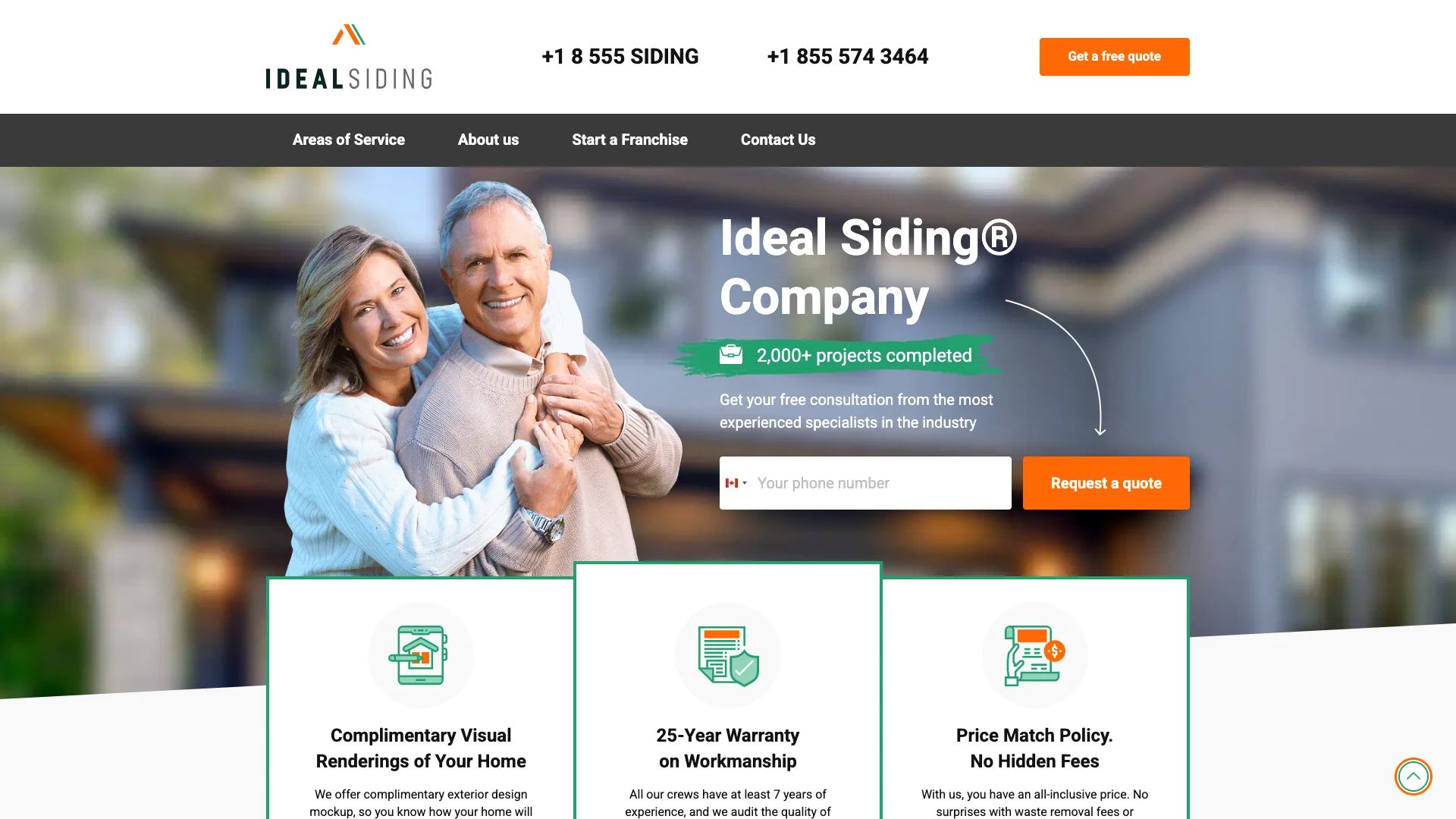
Ideal Siding is a siding contractor operating across multiple markets, including franchise locations in Georgia and Texas. According to Ahrefs, idealsiding.com pulls 1.2K monthly organic visitors with an estimated traffic value of $2.9K. That puts it squarely in the small-brand tier of the CRO Index. But the trust signal story on this one caught our attention.
The pages we tore down:
- Franchise page, covering the Ideal Siding franchise opportunity (48 monthly organic visitors, 7% traffic share, scored 36 on Google's mobile lab test)
- Marietta/Roswell location page, targeting homeowners in the Marietta and Roswell, Georgia area (36 monthly visitors, 5% share, scored 55)
- Dallas location page, targeting the Dallas, Texas market (30 monthly visitors, 4% share, scored 41)
And the trust signal audit came back with a clean split. Google Reviews are rendering on every tested page. Layout stability is 0.000 across all three pages (content doesn't jump around at all as the pages load). The location pages carry 4 forms each. Content depth runs 2,571 to 2,984 words per page. But there are zero trust badges on any page. No BBB seals, no manufacturer certifications, no warranty badges, no industry association logos. So the review side is locked. The badge side is completely empty.
That split is interesting because it tells you something about priorities. Somebody at Ideal Siding decided Google Reviews mattered enough to embed on every page. And they were right. But nobody followed through with the visual trust layer that sits alongside those reviews. Reviews prove that customers exist. Badges prove that the industry recognizes you. Together, they form a complete trust signal stack. Separately, they're each doing half the job.
And the franchise model adds another layer. Ideal Siding operates across multiple cities, which means every location page is competing against local siding companies in that specific market. In Marietta, they're up against local crews with deep community ties. In Dallas, they're competing with established siding companies that have been serving the DFW area for decades. Google Reviews on every page is how a franchise brand competes with that local advantage. It shows that real customers in those markets had real experiences. But without badges (manufacturer certifications, insurance verification, license numbers), the local competitor who displays both reviews and badges still has the edge.
"25% of homeowners say trusting contractors is their top challenge when planning home improvement projects."
— Houzz Inc. (2025)
Performance: 36 to 55 on Google's mobile lab test
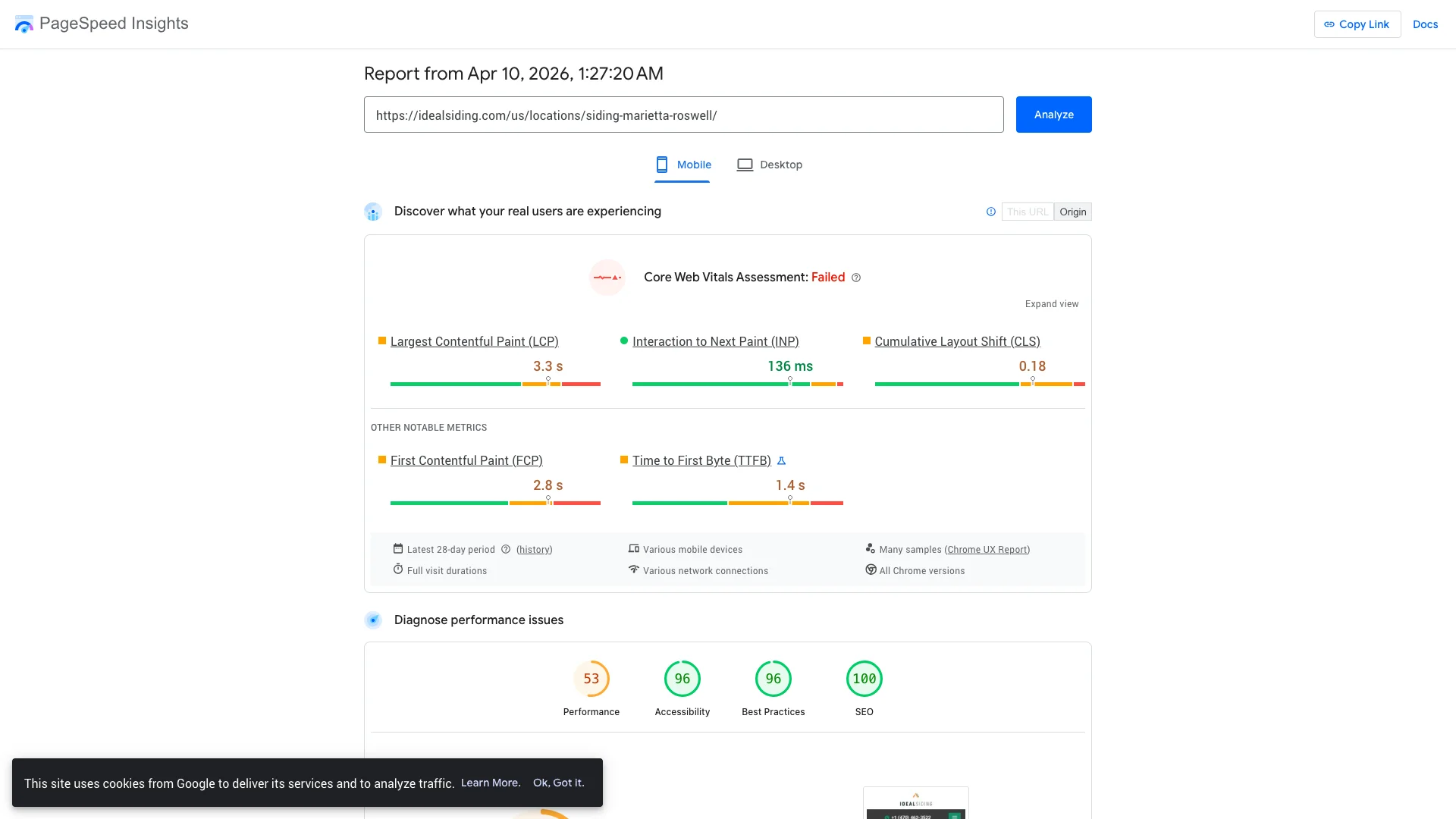
Google PageSpeed Insights runs a simulated slow-phone lab test. The scores are worst-case, not what you see on your phone with WiFi. But Google uses them as a ranking factor in search results.
The franchise page scored 36 out of 100. The Dallas location page scored 41. Both are in the red zone, and both are eating a search-ranking penalty because of it. The Marietta/Roswell page scored 55, which crosses the threshold where Google stops applying the heaviest penalties. So one out of three pages is in a tolerable range.
"53% of mobile users abandon sites that take longer than 3 seconds to load."
— Google / SOASTA (2017)
But the layout stability story is where Ideal Siding stands out. Every page scored 0.000 on cumulative layout shift. That means content doesn't move at all as the pages load. No images popping in and shoving text down. No ad slots expanding after the page renders. No sticky headers recalculating and bouncing everything below them. That's the one performance metric homeowners can actually feel on their own device, and Ideal Siding nails it on every page.
The franchise page at 36 is the weakest link. That page probably carries heavier scripts (franchise lead forms, tracking pixels for franchise marketing) that drag the score down. Getting that page from 36 to 70+ would require deferring the heavy scripts and compressing images. And for a page that exists to attract franchise buyers, not homeowners, the performance penalty matters less for consumer search rankings. But it still matters for the franchise-buyer experience. A person evaluating a franchise opportunity is evaluating the brand. If the brand's own website loads slowly, that raises questions about the brand's technical capabilities.
The gap between the Marietta page (55) and the Dallas page (41) is also worth investigating. Both are location pages. Both should be running the same template. But one scores 14 points higher than the other. That difference likely comes down to image sizes, the number of third-party scripts loaded on that specific page, or a component that's present on the Dallas page but not the Marietta page. Whatever it is, Ideal Siding should find it and standardize the faster version across all locations.
For a franchise brand, this score inconsistency matters more than it would for a single-location company. If a potential franchise buyer compares the Marietta page (55) with the Dallas page (41) and notices one loads noticeably faster, it raises questions about whether the brand has standardized its technology across locations. And that's exactly the kind of operational consistency a franchise buyer is evaluating. The consumer pages need to be fast for conversions. The franchise page needs to be fast for credibility.
Compounding effect
"Conversion rates drop approximately 12% for each additional second of page load time."
— Google / Deloitte (2020)
Lead capture: 4 forms on location pages, 1 on the franchise page
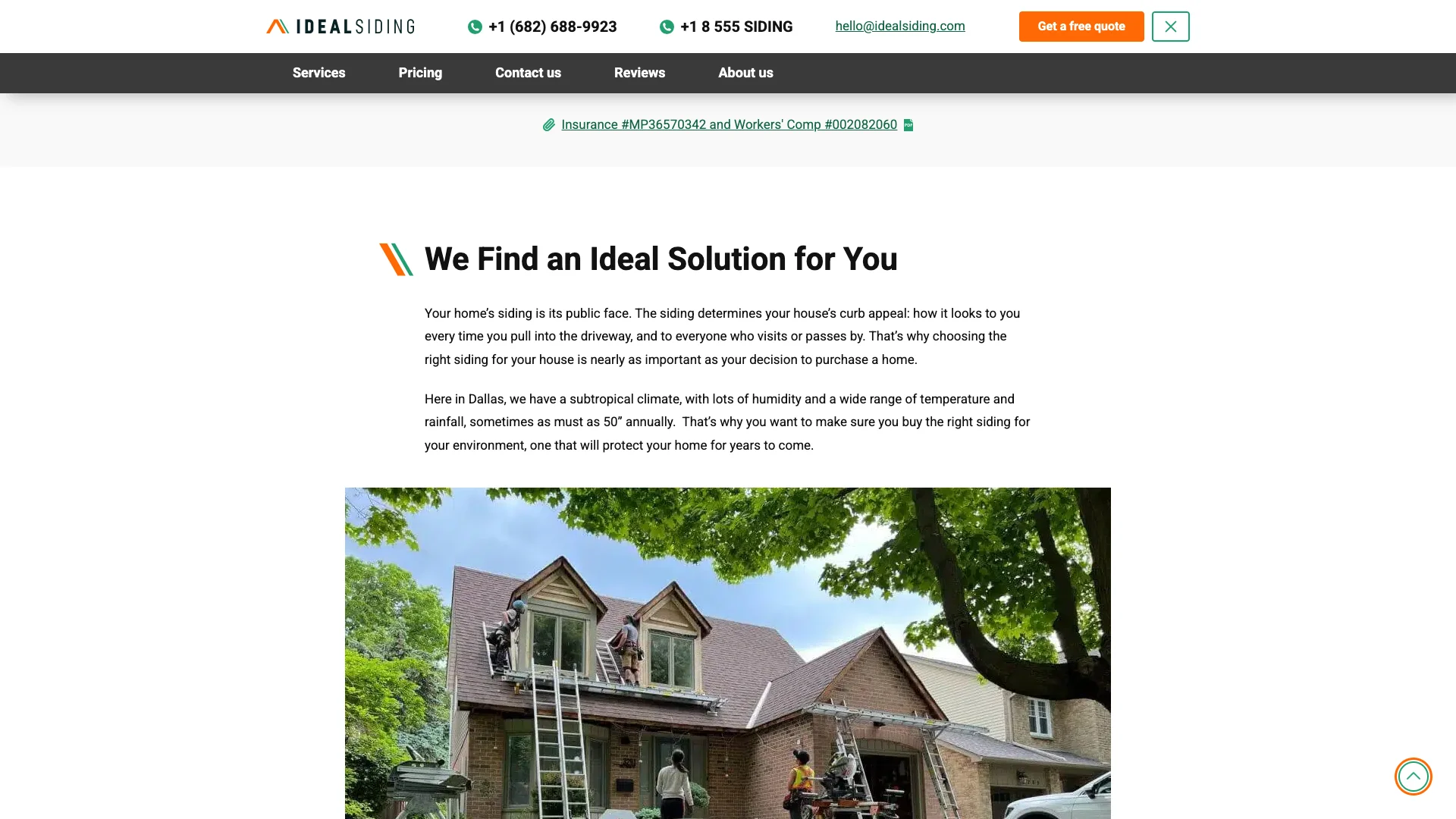
The form inventory on Ideal Siding splits by page type. The franchise page has 1 form. The Marietta/Roswell and Dallas location pages each have 4 forms. That's a smart distribution. The location pages are where homeowners land, and 4 forms means a homeowner doesn't have to scroll back to the top to find a way to leave their information.
Four forms per location page is solid coverage. It means there's likely a form in the hero, one mid-page, one near the bottom, and one more somewhere in between. That covers the homeowner who's ready to act immediately, the one who needs to read a bit first, and the one who scrolls all the way down before deciding. Most siding contractors in this series run 1 to 2 forms per page. Ideal Siding is doubling that on the pages where it matters most.
"68% of users wouldn't submit a form if it required too much personal information."
— Baymard Institute (2024)
The franchise page with 1 form makes sense too. That page targets a different audience (potential franchise owners, not homeowners), and the conversion path is different. A franchise buyer is going to do more research before filling out a form. One well-placed form is enough for that audience.
So the form strategy is good. The question is whether those forms are converting, and that depends on what the forms ask for. If the location page forms are 3-field (name, phone, zip), they'll convert better than a 7-field form asking for project details, timeline, budget range, and how the homeowner heard about them. Fewer fields, more submissions. That's the trade-off every siding contractor needs to make.
And there's a missed opportunity worth flagging. The franchise page has 1 form, and that's fine for franchise buyers. But if any organic traffic lands on that page from homeowners who searched for "siding franchise near me" or "siding company near me," those homeowners don't have a clear path to a service page. A "Looking for siding installation? Find your local Ideal Siding" link near the form would catch those misrouted visitors and send them somewhere they can actually convert.
The 4-form setup on the location pages also creates an interesting comparison with other brands in this series. Dreamstyle Remodeling runs 6 forms per page. Renewal by Andersen runs 1 form on most pages. Window World runs 3. Ideal Siding sits in the range that most CRO practitioners would call the sweet spot: enough forms to cover every scroll depth without overwhelming the page. And the content depth (2,571 to 2,984 words) gives each form enough context around it to justify the ask. A form surrounded by 700 words of relevant content feels like a natural next step. A form surrounded by 150 words feels like a pop-up ad.
Trust signals: Google Reviews present, badges absent
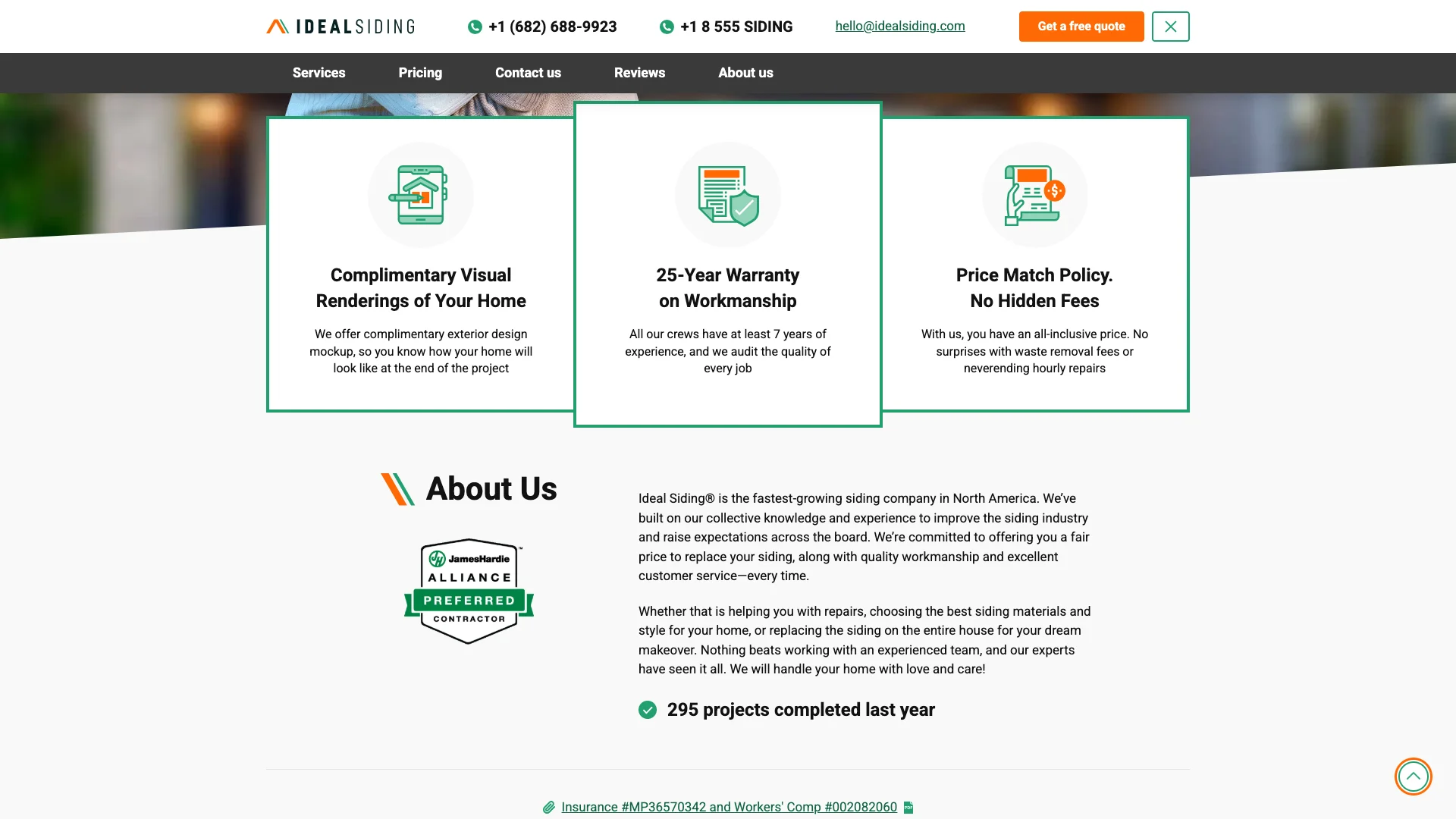
The trust signal audit across all three pages shows a clear pattern:
- Google Reviews: Present on all three pages.
- Trust badges: Not found on any page.
- Review widgets: Not found separately (reviews render through the Google Reviews integration).
- Chat widget: Not found.
- BBB badge: Not found.
- Certifications: Not found.
So one out of six trust signal types is present. And that one type (Google Reviews) is on every page, which is better than most brands that have reviews on zero pages. But the absence of trust badges is a gap. Siding contractors work with manufacturer-certified products (James Hardie, LP SmartSide, CertainTeed). Those manufacturers offer certification badges. If Ideal Siding is a certified installer for any of those brands, that badge should be on every location page.
Comparison
"83% of consumers use Google to find local business reviews; 74% use two or more review platforms when researching."
— BrightLocal (2025)
The hidden code labels are minimal. The pages carry navigation and site hierarchy labels, but nothing trade-specific. Google doesn't see a "home improvement business" or "contractor" label on these pages. Adding a "local business" or "home improvement service" label to the location pages would help Google understand what these pages are and who they serve. That's a 15-minute fix for a developer, and it improves how the pages show up in search results.
And there's no chat widget on any page. For a siding company where the average project runs $8,000 to $15,000+, some homeowners want to ask a quick question before committing to a form. "Do you install James Hardie fiber cement?" "Do you serve my zip code?" "How long does a typical siding job take?" A chat widget catches that homeowner. Without one, Ideal Siding is relying entirely on forms and phone calls. That's two conversion paths when there should be three.
The siding industry specifically rewards trust badges because the product is on the outside of the home. Homeowners can see it every day. They're going to live with the results for 20 to 40 years. So the stakes feel higher to the homeowner, and the need for reassurance is stronger. A James Hardie certification badge doesn't just say "we're certified." It says "the manufacturer trusts us to install their product, and they'll back our work with their warranty." That's a powerful message that Google Reviews alone can't deliver. Reviews say the company did good work. Badges say the company is qualified to do the work in the first place. Ideal Siding has the first part. Adding the second would close the trust loop.
"64% of homeowners say having recommendations or references is a top-three factor in choosing a contractor."
— Houzz Inc. (2025)
What Ideal Siding does well
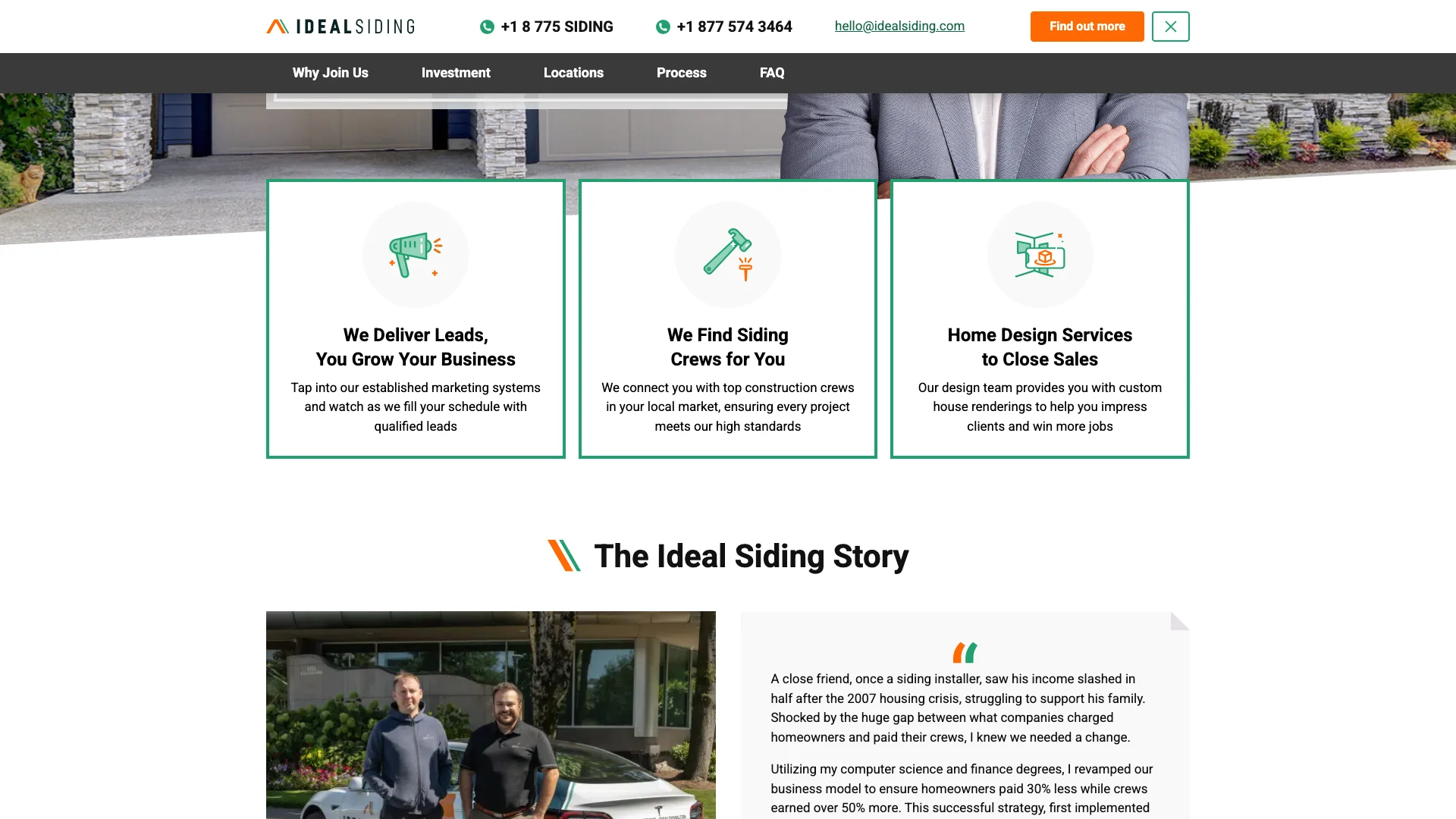
Ideal Siding is a small brand that gets three things right. And those three things are worth calling out because most small siding contractors don't get any of them right.
Google Reviews on every page. All three tested pages render Google Reviews. That's not common at this traffic level. Most small contractors either don't have a review widget installed, or they have one on the homepage and nowhere else. Ideal Siding has reviews on the franchise page, the Marietta location, and the Dallas location. A homeowner landing on any of those pages sees social proof immediately. And that immediate visibility matters. A homeowner who sees reviews within the first 5 seconds of landing on a page is more likely to keep scrolling than one who sees only a logo and a stock photo.
Perfect layout stability. 0.000 across all three pages. Content doesn't jump around as the pages load. That's the gold standard for cumulative layout shift, and it means the development team (or the template they're using) handles images, fonts, and dynamic elements correctly. Compare that to brands like Renewal by Andersen, where one page hits a layout shift of 0.198 (content jumping around nearly 2x the acceptable limit). Ideal Siding, with 1.2K monthly visitors, delivers a more stable experience than a brand with 59K visitors.
Deep content on location pages. 2,571 words on the Marietta page. 2,984 on the Dallas page. That's substantive. It's not thin 300-word boilerplate with a city name swapped in. It's real content that gives Google something to rank and gives homeowners something to read. Content depth matters more for local search than most siding contractors realize. Google wants to serve the most helpful page for a query like "siding installation Marietta GA." A 2,571-word page covering materials, process, timeline, pricing factors, and local considerations is objectively more helpful than a 400-word page that says "We install siding in Marietta. Call us."
And the consistency across locations is worth noting. Both location pages are in the 2,500 to 3,000 word range. That suggests Ideal Siding isn't just writing one location page and swapping the city name. They're investing in content that speaks to each market. That investment pays off in search rankings, and it pays off in homeowner confidence. A Dallas homeowner reading 2,984 words of siding content specific to the DFW area feels like the company knows their market. That's a conversion advantage that 300-word boilerplate can never provide.
"64% of homeowners say having recommendations or references is a top-three factor in choosing a contractor."
— Houzz Inc. (2025)
What the gaps mean for siding contractors
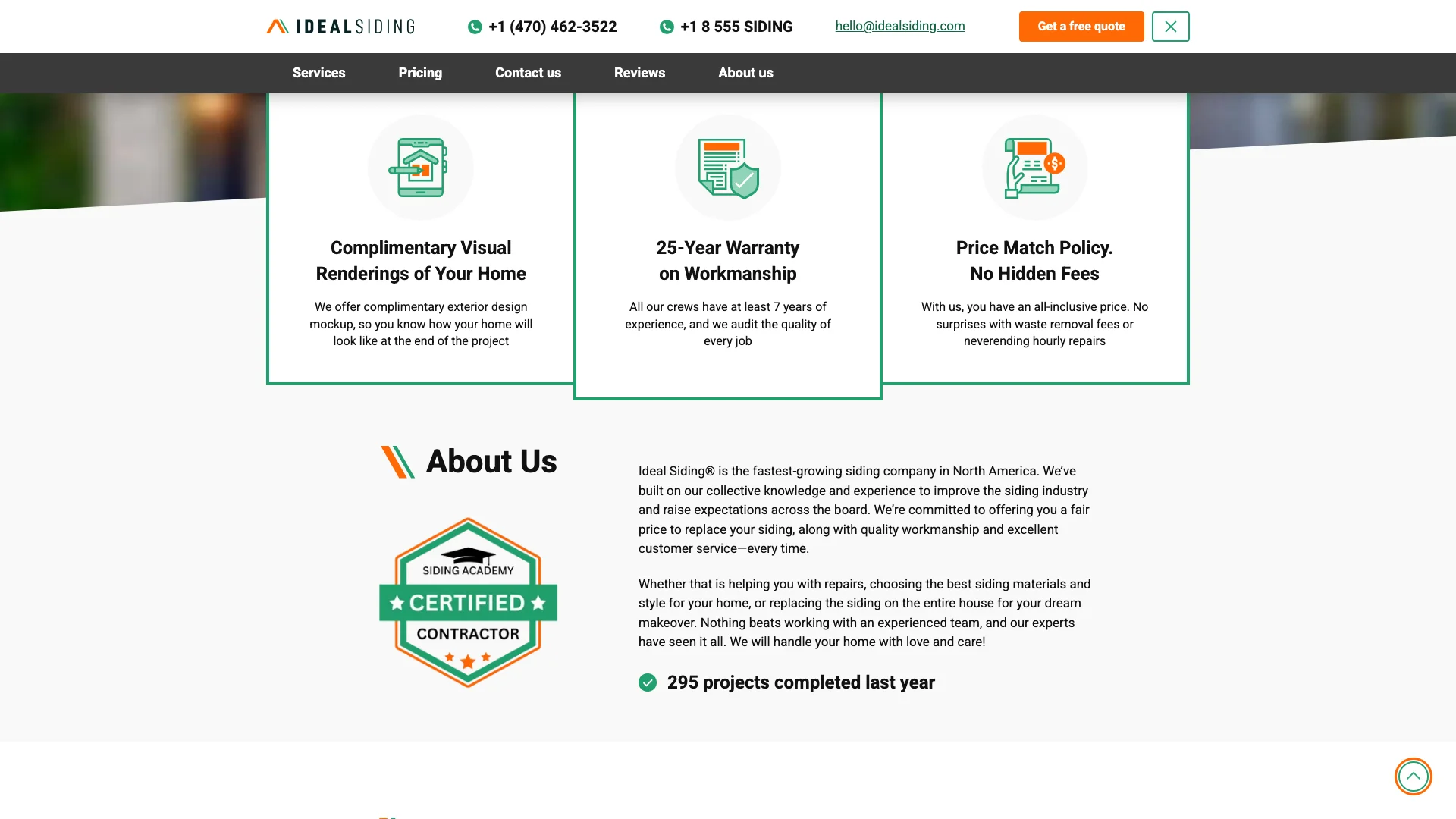
Ideal Siding is a useful benchmark if you're a siding contractor running location pages. They've got reviews and content depth locked. The gaps are all on the visual trust layer. And those gaps are fixable in a weekend.
Add trust badges to every location page. If you're a James Hardie Elite Preferred contractor, that badge should be on every page. Same for LP SmartSide, CertainTeed, or whatever manufacturer you're certified with. Same for your state contractor license number. Same for your insurance and bonding information. A homeowner who sees Google Reviews plus manufacturer certification badges plus a license number is significantly more likely to fill out that form than a homeowner who sees reviews alone. Ideal Siding has the reviews. The badges would complete the trust stack.
Add a chat widget. The location pages have 4 forms, which is good. But some homeowners don't want to fill out a form. They want to ask a quick question first. A chat widget gives that homeowner a conversion path that doesn't require committing to a form submission. And most chat widgets are free or low-cost. It's a 30-minute installation for a significant conversion path addition.
Fix the franchise page speed. 36 on Google's mobile lab test is in the red zone. If Ideal Siding is running paid ads to the franchise page (which most franchise brands do), every percentage point of speed improvement reduces bounce rate and increases franchise lead form submissions. Defer the tracking scripts, compress the images, and lazy-load anything below the fold. That page should be at 70+ for the money being spent to drive traffic to it.
Standardize performance across location pages. The Marietta page scores 55. The Dallas page scores 41. Same template, different scores. Find the difference and fix it. If the Marietta page uses compressed images and the Dallas page doesn't, compress the Dallas images. If the Dallas page loads an extra tracking script, remove it. Every location page should perform like your best location page. That's a 14-point improvement on the Dallas page for what's likely a simple configuration change.
Add trade-specific hidden code labels. The pages don't carry a "local business" or "home improvement service" label that tells Google what the business actually does. That's a missed signal. Adding a "local business" label with the business name, address, phone number, service area, and service type takes a developer 15 minutes and gives Google structured data it can use to surface the pages in local search results and knowledge panels.
Don't add badges you haven't earned. This sounds obvious, but it's worth saying. If you're not James Hardie certified, don't put a James Hardie badge on your site. If you don't have a BBB accreditation, don't display a BBB seal. Fake badges are worse than no badges because they create liability. Only display certifications you actually hold. But if you do hold them and they're not on your website, you're leaving trust on the table. The gap between "I have this certification" and "homeowners can see this certification" is usually just a conversation with whoever manages your website.
"48% of customers say that if a site does not work well on mobile, it signals the company does not care about their business."
— Google Consumer Insights (2018)
Frequently asked questions
Does Ideal Siding display Google Reviews on its pages?
Yes. All three tested pages returned Google Reviews as present. The franchise page, the Marietta/Roswell location page, and the Dallas location page all render Google Reviews. That's unusual for a brand pulling only 1.2K monthly visitors. Most small siding contractors don't have review widgets on any page, let alone every page they run.
How does Ideal Siding score on Google's mobile lab test?
The franchise page scored 36 out of 100. The Marietta/Roswell location scored 55. The Dallas location scored 41. The Marietta page is the only one above the 50-point threshold. All three pages have perfect layout stability (0.000), so content doesn't jump around as the pages load. The gap between the Marietta and Dallas scores suggests an optimization inconsistency across location pages.
How many forms does Ideal Siding have on its pages?
The franchise page has 1 form. The Marietta/Roswell and Dallas location pages each have 4 forms. That's solid form coverage for location pages. A homeowner landing on either location page has multiple opportunities to submit their information without scrolling back to the top. Most siding contractors run 1 to 2 forms per page, so Ideal Siding's 4-form setup puts it in the upper tier of the CRO Index for form coverage.
How much organic traffic does idealsiding.com get?
According to Ahrefs data from March 2026, idealsiding.com receives approximately 1.2K monthly organic visitors with an estimated traffic value of $2.9K. The franchise page accounts for 48 visitors (7% share). The Marietta/Roswell location accounts for 36 (5%). The Dallas location accounts for 30 (4%). The remaining traffic is distributed across other location and service pages on the site.