What we found on decks.ca
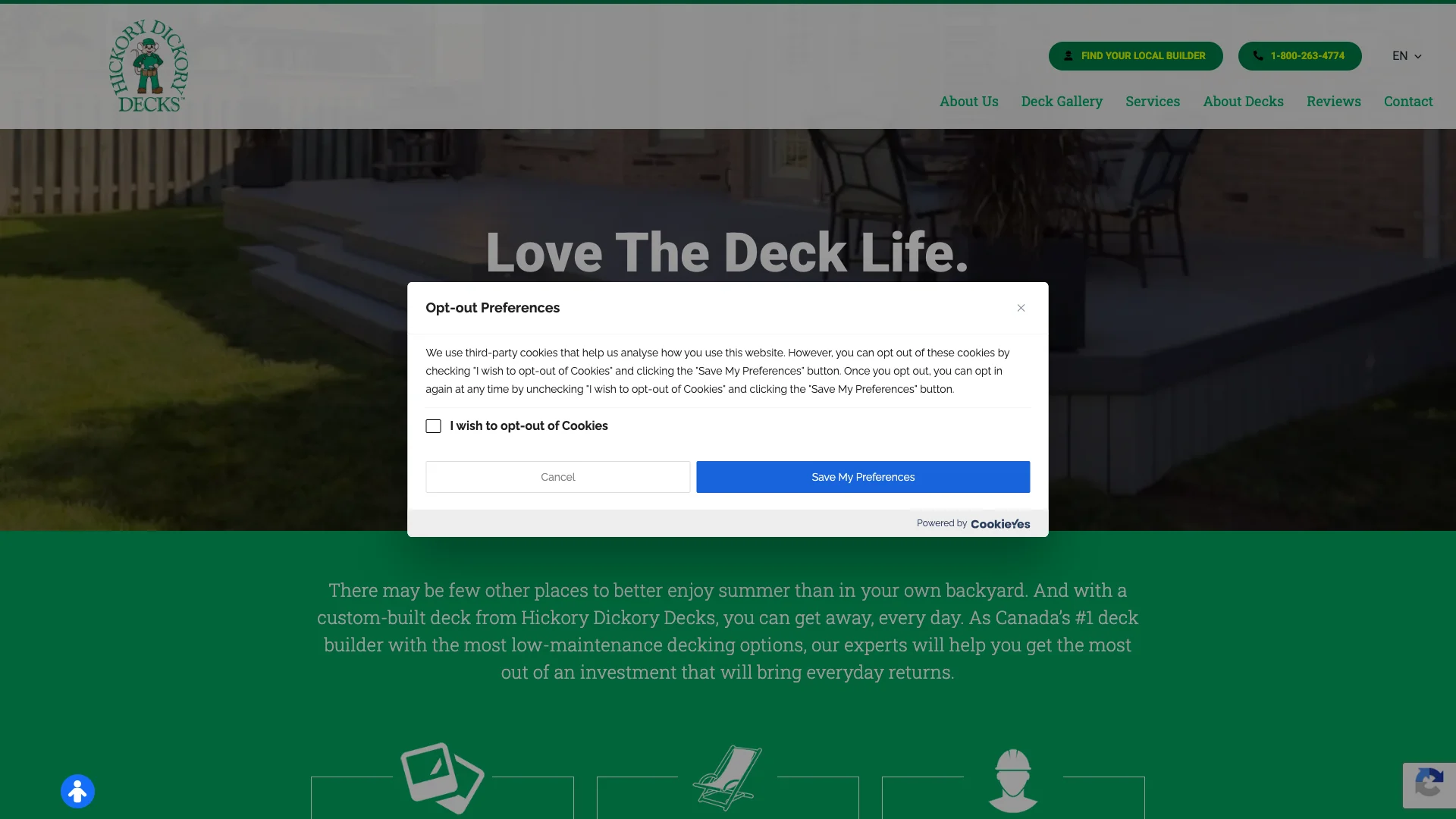
Hickory Dickory Decks is a Canadian deck building franchise operating primarily in Ontario and surrounding provinces. According to Ahrefs, decks.ca pulls 2.4K monthly organic visitors with an estimated traffic value of $3.4K (Canadian). A smaller brand than the American franchises in this series, but the trust signal setup is worth studying.
The pages we tore down:
- /blog/deck-railing-requirements/, an informational blog on Canadian deck railing code requirements (142 monthly organic visitors, 7% traffic share)
- /mississauga/, the Mississauga, Ontario franchise location page (75 monthly visitors, 4% share)
- /ottawa/, the Ottawa, Ontario franchise location page (69 monthly visitors, 3% share)
And the audit came back with a split personality. On the trust side, Hickory Dickory is doing things most of the bigger brands in this series aren't doing: Google Reviews rendering on every page, review widgets present, a chat widget on every page, and action-oriented CTAs like "GET A DECK QUOTE" and "FIND YOUR LOCAL BUILDER." On the performance side, the scores are in the 35 to 40 range, and one location page had no performance data collected at all (the test simply didn't complete on the Mississauga page).
"25% of homeowners say trusting contractors is their top challenge when planning home improvement projects."
— Houzz Inc. (2025)
Performance: 35 to 40 on Google's mobile test, one page with no data
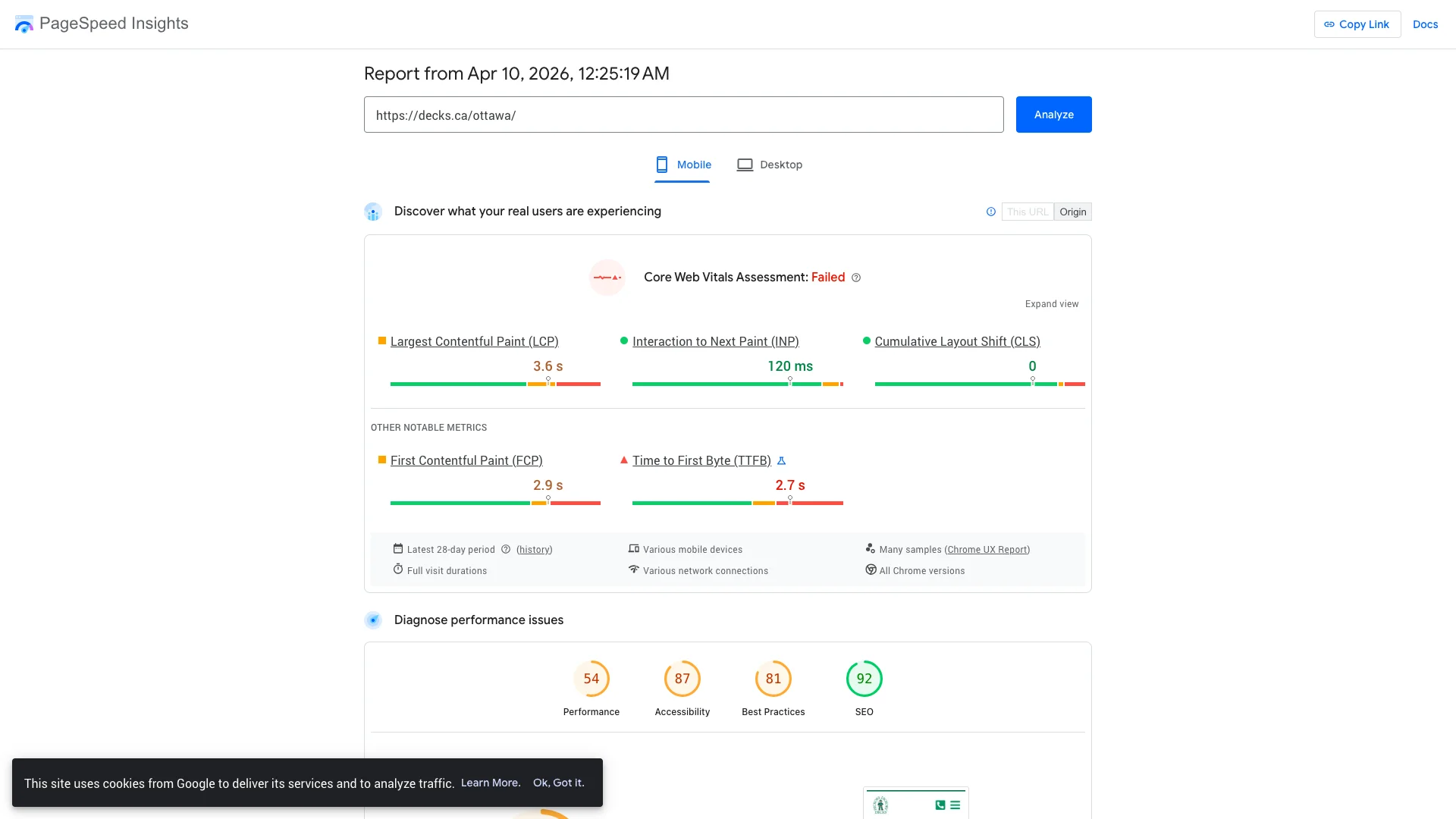
Google PageSpeed Insights runs a simulated slow-phone lab test. The scores are worst-case, not what you see on your phone with WiFi. But Google uses them as a ranking factor.
The deck railing blog scored 40 out of 100. The Ottawa location page scored 35. The Mississauga location page returned no performance data at all (the PageSpeed test didn't complete during our collection window). So we have two data points instead of three, and both of them are in the red zone.
"53% of mobile users abandon sites that take longer than 3 seconds to load."
— Google / SOASTA (2017)
Layout stability is clean. The blog scored 0.000 on layout shift (content doesn't jump around at all as the page loads). The Ottawa page scored 0.034, which is well within Google's acceptable limit of 0.1. So the one performance metric homeowners can actually feel on their own device isn't a problem on Hickory Dickory's site. The issue is the overall page weight, which hurts search rankings and punishes homeowners on slow connections.
Content depth is modest: 894 words on the railing blog, 1,258 on the Mississauga page, 1,280 on Ottawa. Not thin, but not the kind of 3,000+ word depth that earns rankings for competitive long-tail queries. The railing blog is competing against much heavier content pieces for "deck railing requirements" searches.
Compounding effect
"Conversion rates drop approximately 12% for each additional second of page load time."
— Google / Deloitte (2020)
Lead capture: strong CTAs, minimal forms
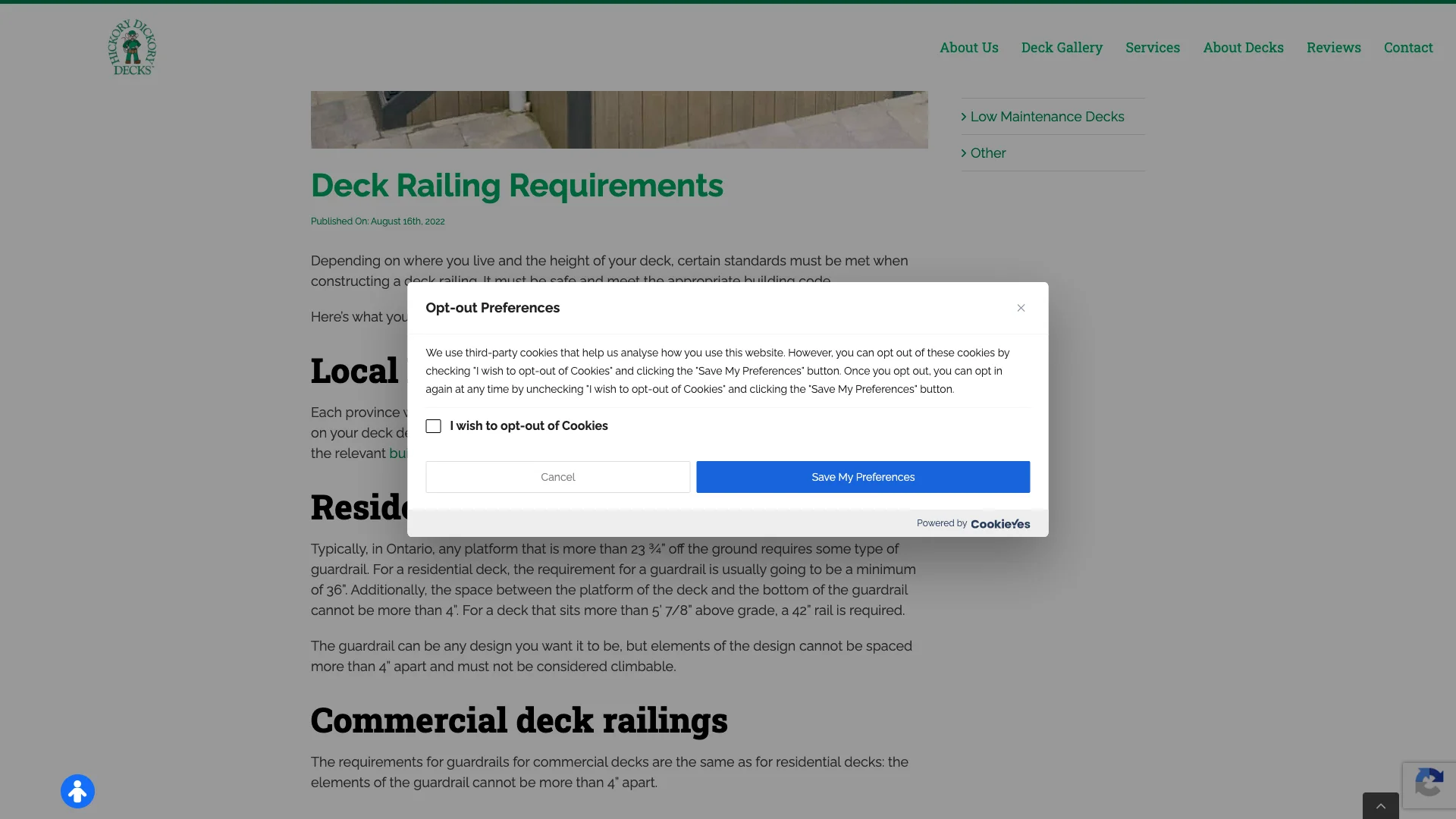
The blog post has zero forms. The two location pages each have one form (a single-field input). So the inline form inventory is minimal. But the CTA inventory is strong. Across the three pages, the primary action paths are:
- "FIND YOUR LOCAL BUILDER"
- "GET A DECK QUOTE"
- "FIND MY LOCAL BUILDER"
- "REQUEST A CONSULTATION"
- "Contact"
Those are some of the best-written CTA labels in the entire series. "GET A DECK QUOTE" is direct, specific, and action-oriented. "FIND YOUR LOCAL BUILDER" answers the homeowner's exact question. Compare that to "Submit and Continue" (Mr. Electric) or "Schedule Service" (Aire Serv) or the seven variations of "Contact Us" on Petro. Hickory Dickory's CTAs actually describe what happens when you tap them.
"68% of users wouldn't submit a form if it required too much personal information."
— Baymard Institute (2024)
The phone number (800) 263-4774 is visible in the navigation on all three pages. So the conversion path is: see the reviews, read the content, tap "GET A DECK QUOTE" or call the 800 number. That is a clean funnel. The missing piece is an inline form on the blog post (where the homeowner researching railing requirements might not be ready to call but would leave their info for a callback).
Trust signals: reviews on every page, no badges
Hickory Dickory does the one thing most franchises in this series don't: Google Reviews are present on every page we tested. Review widgets are rendering. The homeowner landing on any of these three pages sees some form of social proof from other customers. No specific review count was returned in our data, and no BBB badge is visible, but the review widget itself is there.
- Google Reviews: Present on all three pages.
- Review widgets: Present on all three pages.
- Chat widget: Present on all three pages.
- Trust badges: Not found on any page.
- BBB badge: Not found.
- Certifications: Not found.
Comparison
"83% of consumers use Google to find local business reviews; 74% use two or more review platforms when researching."
— BrightLocal (2025)
The hidden code labels are minimal. The blog post carries a "news article" label (which tells Google the page is a news-style article). The two location pages carry no code labels at all. So Google knows the blog is an article, but Google doesn't know that the location pages represent a deck building business in Mississauga or Ottawa. For local search, that's a gap.
What Hickory Dickory Decks does well
Google Reviews on every page. In a series where most brands hide, forget, or simply don't implement their review widgets, Hickory Dickory has them on every tested page. That is a meaningful competitive advantage over the bigger brands in this teardown batch.
Chat widget on every page. A homeowner who doesn't want to call and doesn't want to fill out a form can start a text conversation. That is a third conversion path that most of the brands in this series don't offer.
Action-oriented CTAs. "GET A DECK QUOTE" and "FIND YOUR LOCAL BUILDER" are specific, clear, and tell the homeowner exactly what happens next. That is better CTA copy than most of the multi-billion-dollar franchises in this series.
Clean layout stability. Content doesn't jump around as the pages load. On the blog especially (0.000 layout shift), the homeowner reading the railing requirements article sees a stable page that doesn't rearrange itself. That is the one performance metric that matters to a real user on a real device.
"64% of homeowners say having recommendations or references is a top-three factor in choosing a contractor."
— Houzz Inc. (2025)
What the gaps mean for local deck builders
Hickory Dickory is a franchise with good trust instincts and poor page speed. You can have both the trust signals AND the speed.
Copy their review widget placement, then beat their Google score. Display your Google Reviews on every page (Hickory Dickory does this right). Then score 85+ on Google's mobile test by shrinking your images, moving tracking scripts to load after the page appears, and cutting unnecessary page weight. You get the trust advantage Hickory Dickory has plus the ranking advantage they don't.
Add an inline form to your blog posts. Hickory Dickory's blog has zero forms. A homeowner reading "deck railing requirements" who decides they need professional help should be able to leave their info right there on the article. Three fields: name, phone, zip. Above the fold. Right next to the CTA.
Add location-specific hidden code labels. The location pages carry no code labels telling Google they represent a deck building business. Yours should tell Google you are a deck builder in a specific city. Google supports a label for construction businesses and local businesses with service areas. Those labels help you show up in "deck builder near me" searches.
Write longer content on your blog. Hickory Dickory's railing blog is 894 words. The top-ranking pages for "deck railing requirements" are 2,000 to 3,000 words. If you want to outrank a franchise on a specific long-tail query, write the most thorough answer to the question the homeowner is searching for. 894 words is a good start. 2,500 words with diagrams and code references is better.
"48% of customers say that if a site doesn't work well on mobile, it signals the company doesn't care about their business."
— Google Consumer Insights (2018)
Frequently asked questions
How does Hickory Dickory Decks score on Google's mobile test?
The deck railing requirements blog scored 40 out of 100 on Google PageSpeed Insights mobile. The Ottawa location page scored 35. The Mississauga location page had no performance data collected (the test didn't complete). Both measured pages are in the red zone and eating a search-ranking penalty.
Does Hickory Dickory Decks display Google Reviews?
Yes. All three tested pages returned Google Reviews as present, with review widgets rendering. That puts Hickory Dickory in the minority of brands in this CRO Index series that actually display their reviews on the pages homeowners land on.
Does Hickory Dickory Decks have contact forms?
The blog has zero forms. Each location page has one form with a single field. The primary conversion paths are strong CTAs ("GET A DECK QUOTE," "FIND YOUR LOCAL BUILDER," "REQUEST A CONSULTATION") and the (800) 263-4774 phone number in the navigation.
How much organic traffic does decks.ca get?
According to Ahrefs data from March 2026, decks.ca receives approximately 2.4K monthly organic visitors with an estimated traffic value of $3.4K (Canadian). The railing blog accounts for 142 visitors (7% share), and the Mississauga and Ottawa location pages account for 75 and 69 visitors respectively.