What we found on eriehome.com
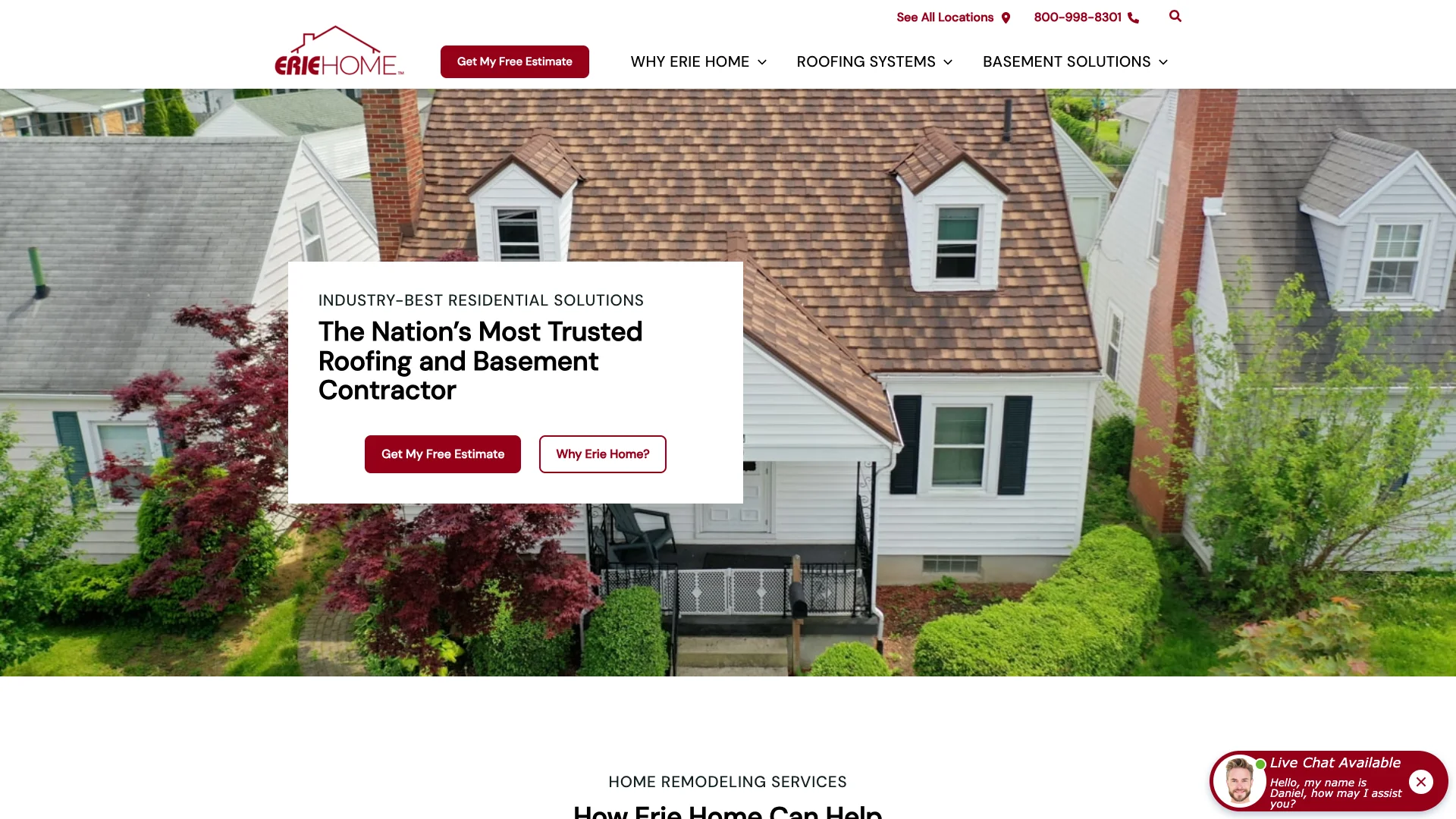
Erie Home is a roofing company. According to Ahrefs, the domain pulls 28.2K monthly organic visitors with an estimated traffic value of $93.1K. That's the smallest traffic number in this nine-company teardown series. But the story here isn't about traffic volume — it's about what happens when the traffic arrives.
We ran three pages through our standard teardown protocol. Two blog posts and a service page. And the pattern that emerged was consistent: the phone number and a chat widget are doing all the conversion work, because there's nothing else.
The pages we tore down:
- /blog/how-to-repair-an-asphalt-shingle-roof-3-steps/ — DIY repair guide (1.5K monthly organic visitors, 5% traffic share)
- /roofing/metal-roofing/ — metal roofing service page (1.4K monthly organic visitors, 5% traffic share)
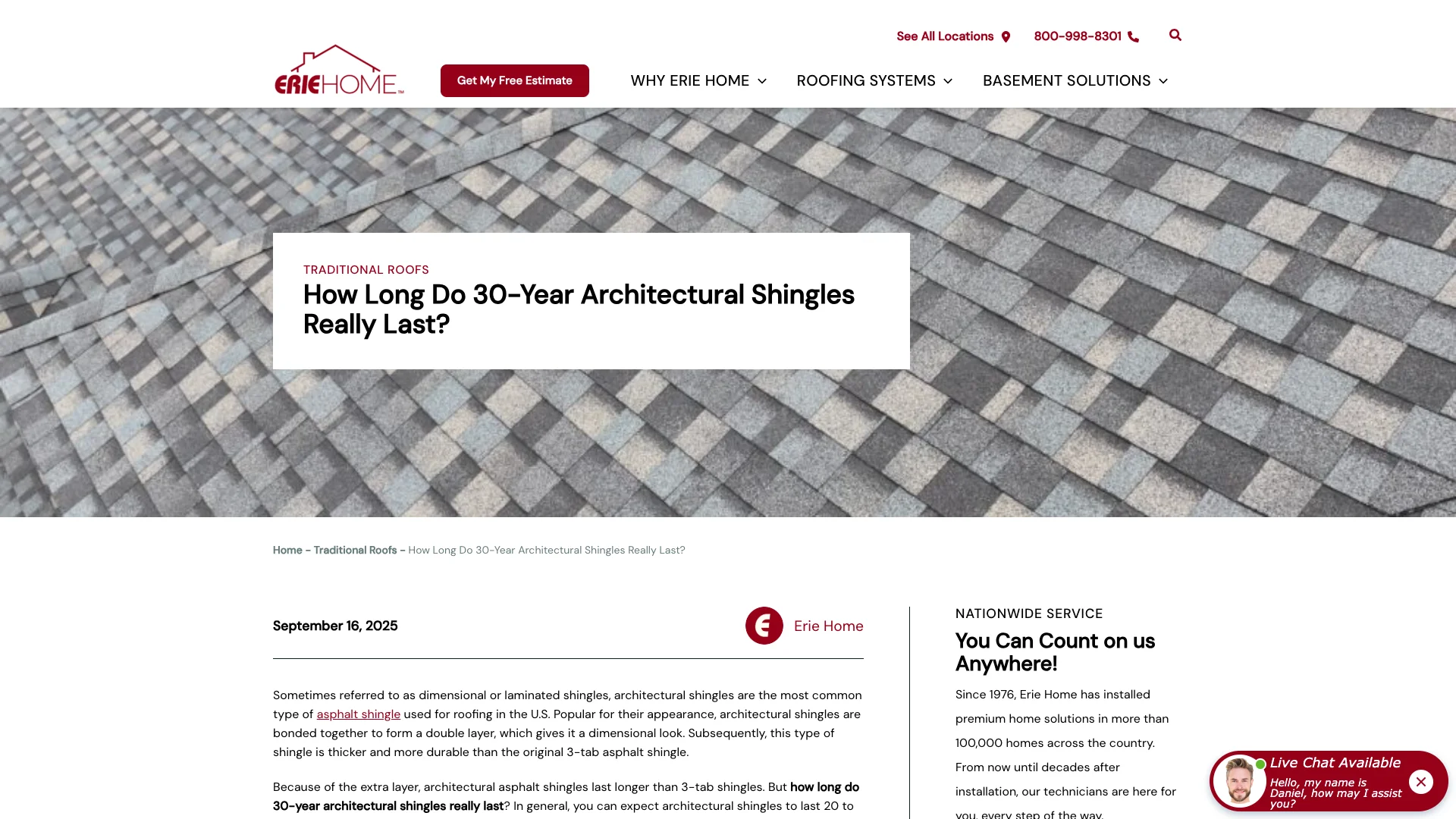
- /blog/how-long-do-30-year-architectural-shingles-really-last/ — shingle lifespan guide (1.3K monthly organic visitors, 5% traffic share)
Spending
"In 2024, 22% of renovating homeowners undertook roofing upgrades, with a median spend of $13,000."
— Houzz Inc. (2025)
Performance: 33 to 39 out of 100
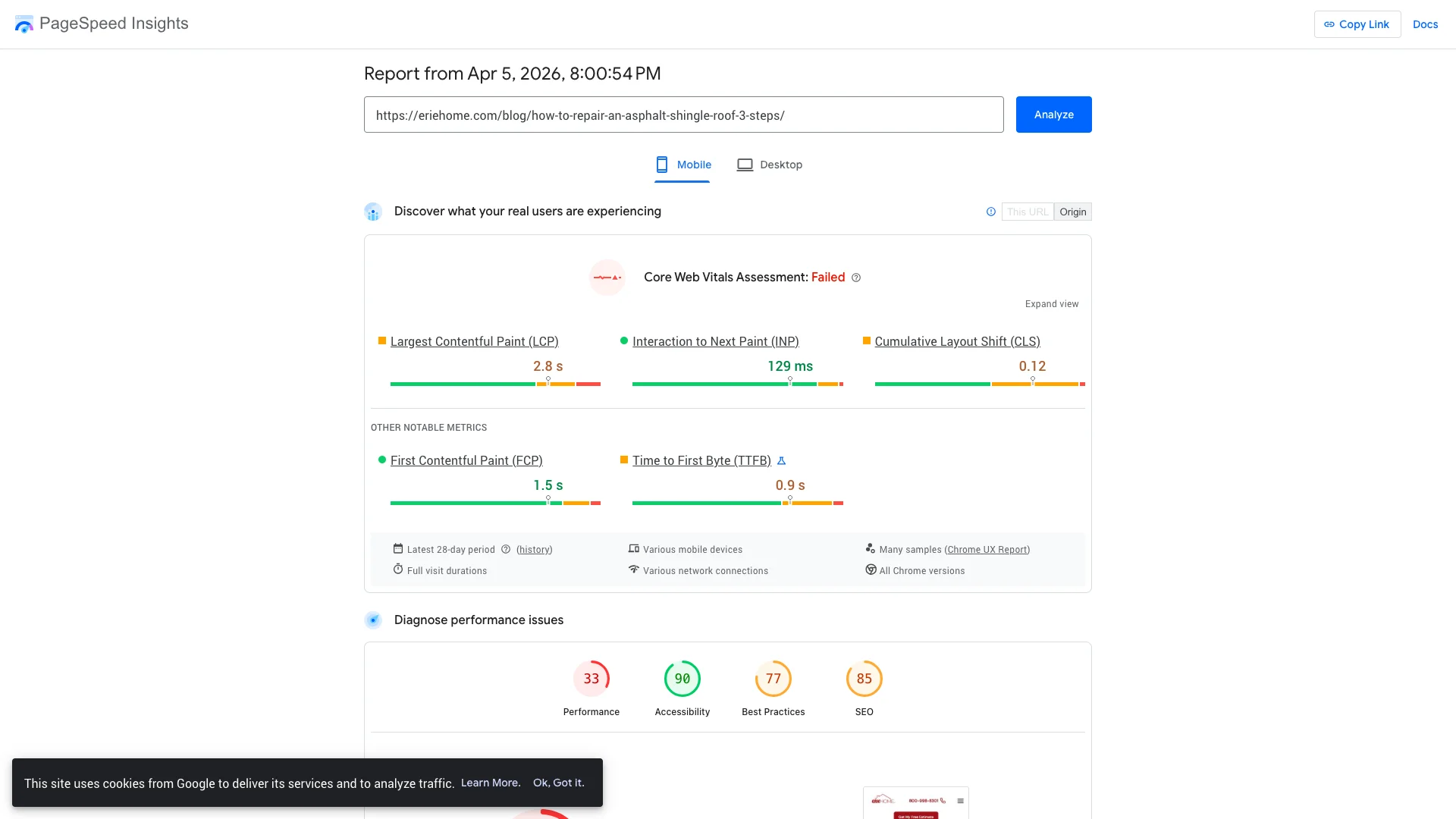
Erie Home's performance story splits into two distinct experiences. The service page loads decently. The blog pages don't.
Asphalt shingle repair blog: Performance score 33/100. LCP of 30.2 seconds. FCP of 8.8 seconds. CLS of 0.094 (nearly four times the "good" threshold). TBT of 1,251ms. Speed Index of 10.8 seconds. This is the highest-traffic page on the site. And the main content doesn't render for 30 seconds on a first mobile visit.
Metal roofing service page (/roofing/metal-roofing/): Performance score 39/100. LCP of 6.0 seconds. FCP of 3.2 seconds. CLS of 0.094. TBT of 1,426ms. Speed Index of 6.1 seconds. This is the best-performing page in the set — and the only service page we tested. The LCP of 6.0 seconds is still 2.4 times Google's "good" threshold, but it's dramatically better than the blog pages.
Architectural shingles blog: Performance score 36/100. LCP of 27.7 seconds. FCP of 12.4 seconds. CLS of 0.094. TBT of 707ms. Speed Index of 12.4 seconds.
The CLS number is identical across all three pages: 0.094. That's a sitewide template issue — something in the layout shifts consistently by the same amount on every page. Probably a header element, a hero image, or an ad unit that loads after initial render and pushes content down. It's fixable. And it's been the same value on every page we tested, which means it's been there a while.
"53% of mobile users abandon sites that take longer than 3 seconds to load."
— Google / SOASTA (2017)
Lead capture: phone, chat, and hope
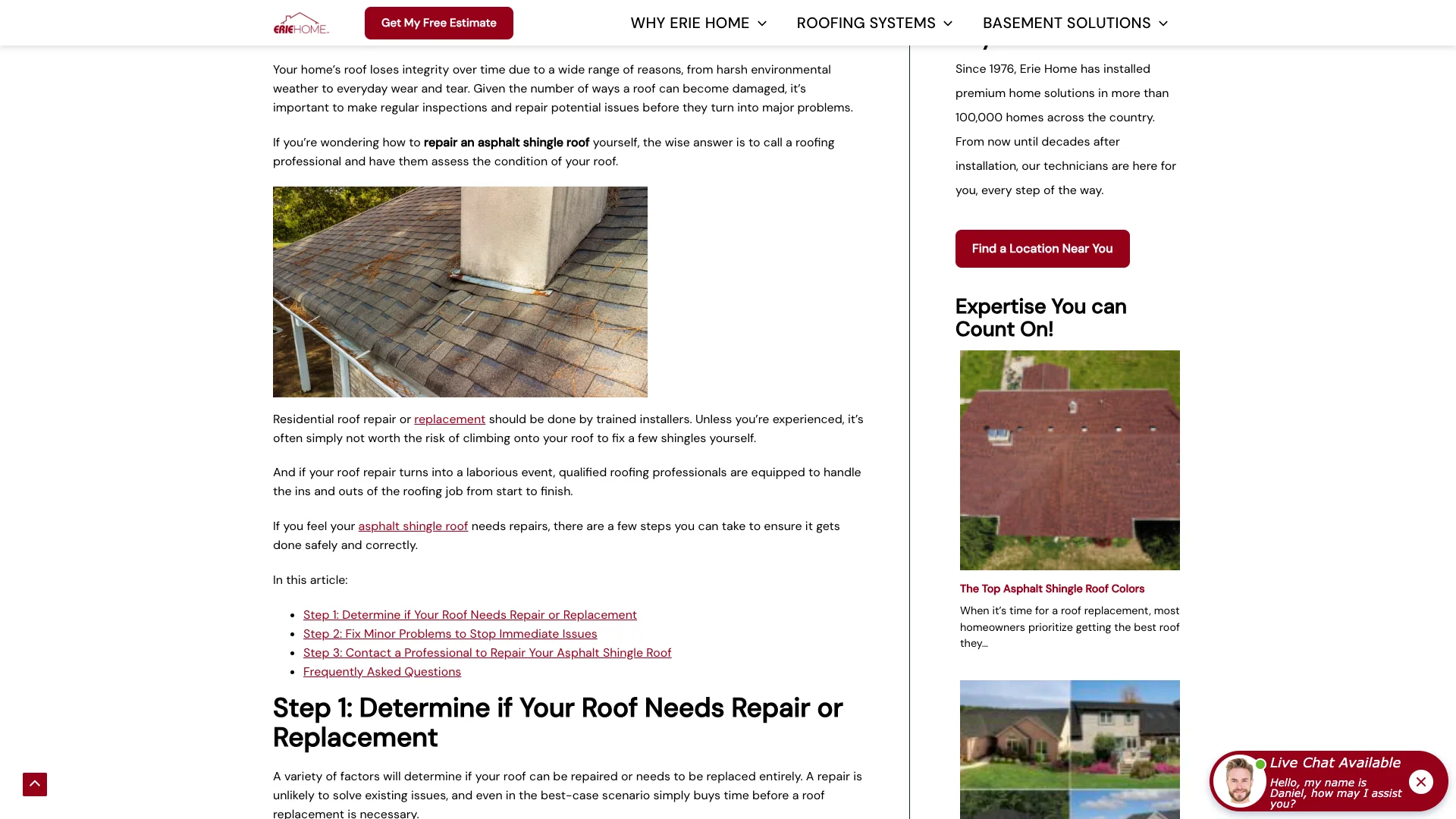
Erie Home has zero embedded lead capture forms on the pages we tested. Across all three — two blog posts and the metal roofing service page — the only form elements are search bars. The same "Search..." input that powers the site's internal search. No "get a quote" form inline with the blog content. No email capture in the sidebar. Nothing on the page itself that lets a homeowner hand over their info without navigating somewhere else first.
The conversion paths that do exist: the phone number (800) 998-8301 appears in the navigation on every page (phone in nav: yes). A "Get My Free Estimate" CTA button sits in the nav. And a chat widget appears on all three pages. That's it. Phone, CTA button, chat.
And the "Get My Free Estimate" CTA does lead to an actual form — we followed the link. It's a 5-field request-an-estimate page (name, email, phone, zip, project type) with a reasonable field count. Nothing egregious. The problem isn't the form itself. The problem is that it lives on a separate page instead of being embedded where homeowners actually land. A visitor reading the shingle repair blog has to notice the nav CTA, click it, wait for the new page to load (on a site where pages already take 30 seconds on mobile), and then fill out the form. That's three extra hurdles between intent and submission.
And here's the thing about the chat widget — it's actually the strongest conversion element on the tested pages. Unlike the phone number (which requires the visitor to stop browsing and make a call) and unlike the CTA button (which punts them to a separate form page), the chat widget is always present, always visible, and allows low-commitment interaction. A homeowner reading about shingle repair at 10 PM can type a question into the chat without committing to anything. That's a smart conversion path for informational content.
But chat and a nav CTA are the only paths. No inline "request a callback" form. No "get a free quote" form embedded at the bottom of the blog post with name, phone, and zip code pre-filled. No email capture in the sidebar. A homeowner who reads the blog post, decides they need a professional, but doesn't want to call or navigate to a separate estimate page? They leave. And Erie Home has no way to follow up. No email for a nurture sequence. No phone number to call back. Gone.
"68% of users would not submit a form if it required too much personal information."
— Baymard Institute (2024)
Trust signals: visible on some pages, gone on others
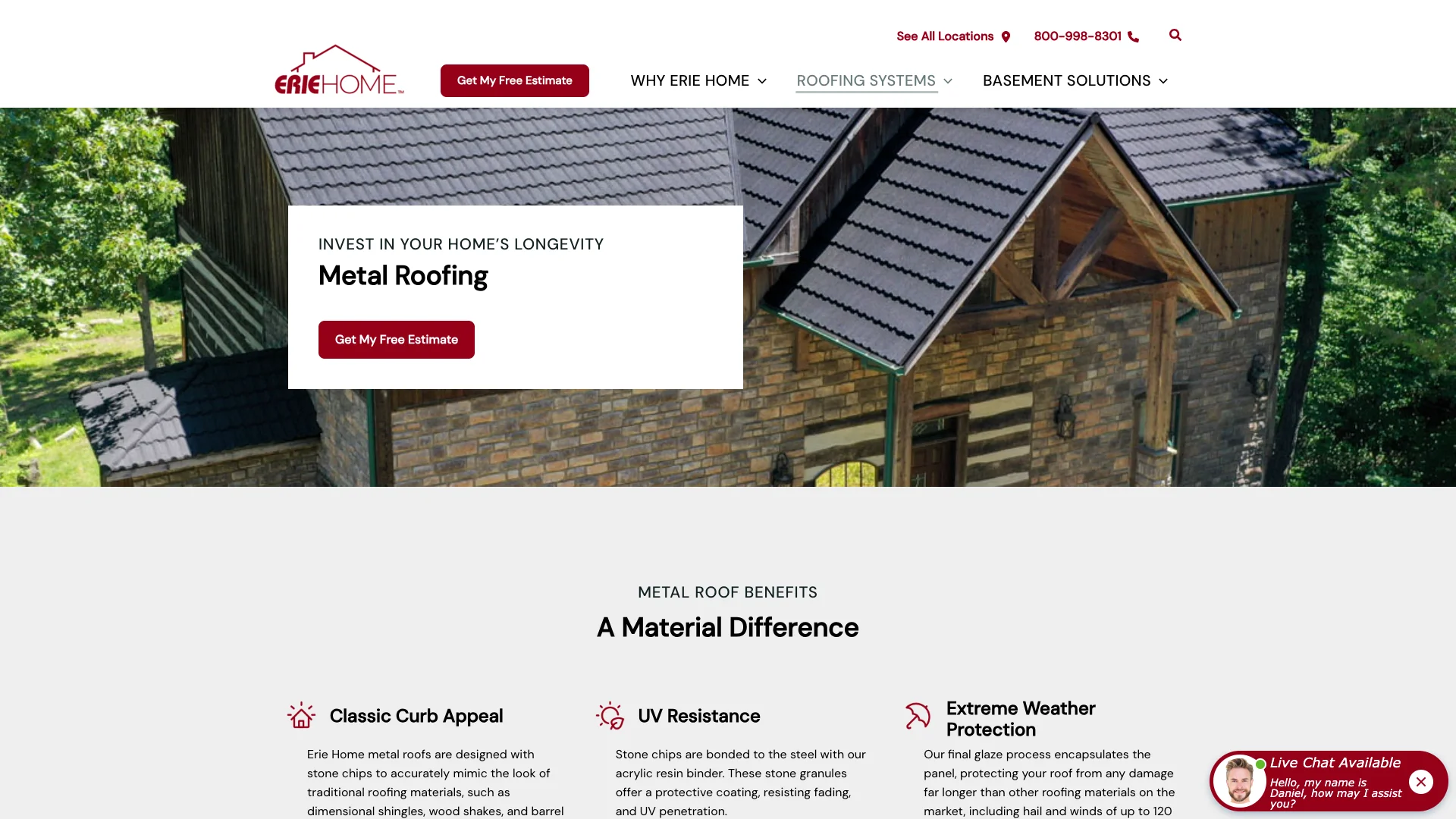
Erie Home's trust signals follow the same inconsistency pattern we've seen across this series. The metal roofing service page has Google Reviews widget, trust badges, and a review widget present. The blog pages have none of those — the asphalt repair blog shows no reviews, no badges, no trust signals at all. The architectural shingles blog has trust badges but no Google Reviews.
So a homeowner's journey might look like this: they search "how to repair asphalt shingles," land on the blog post (no trust signals), read the content, click through to the metal roofing page (trust signals present), and finally see that other people have used this company. But the blog page — the one with the most traffic — has no social proof visible. The trust signals appear after the homeowner has already decided to dig deeper. For the ones who bounce from the blog page without clicking further, those trust signals never existed.
Comparison
"97% of consumers read reviews when browsing for businesses online. 41% 'always' read reviews, up from 29% in 2025."
— BrightLocal (2026)
No BBB badge on any page we tested. No certifications displayed. And the review counts returned "NOT_FOUND" in our scrape — meaning either the counts aren't rendered in standard format or they're loaded dynamically in a way that doesn't surface to automated tools.
On the positive side, the accessibility scores are solid: 90-91/100 across all pages. And the schema markup is surprisingly thorough — the blog pages carry Place, HomeAndConstructionBusiness, Organization, WebSite, ImageObject, BreadcrumbList, WebPage, Person, Article, and VideoObject schemas. The metal roofing page adds Service and FAQPage to that list. That's 8-10 schema types per page, which is more structured data than most contractors deploy sitewide.
What Erie Home does well
Despite the performance gaps and missing forms, Erie Home gets several things right that local roofers should study.
Blog content that answers real questions. "How to Repair an Asphalt Shingle Roof (3 Steps)" and "How Long Do 30-Year Architectural Shingles Really Last?" — those are exactly what homeowners type into Google. The blog pages have 1,241-1,336 words each. They're not thin content. They answer specific questions with enough detail to be useful. And they rank well enough to pull 1,300-1,500 visitors each per month. Most roofing contractors we audit don't have a blog at all.
Schema markup depth. Eight to ten schema types per page is remarkable for a roofing company. Article schema on blog posts. Service and FAQPage schema on the metal roofing page. VideoObject for embedded videos. Person schema for author attribution. That structured data tells Google exactly what each page is, who wrote it, and what it covers. It's the kind of technical SEO investment that most contractors skip entirely.
Chat widget on every page. The chat widget appears consistently across blog posts and service pages. For informational content — where the visitor is in research mode, not buy mode — chat is actually the right conversion tool. It's lower commitment than a phone call. It's available outside business hours. And it captures the visitor's interest at the exact moment they're engaged with the content.
Phone in nav with CTA. The phone number (800) 998-8301 and "Get My Free Estimate" button appear in the navigation on every page. That's a conversion-ready nav that makes the next step visible at all times. A homeowner who finishes reading the blog post and decides they need a professional can see the phone number and CTA without scrolling.
Spending
"The median spend on roofing upgrades in 2024 was 8% higher than in 2023 (median $13,000 in 2024)."
— Houzz Inc. (2025)
What the gaps mean for local roofers

Erie Home's traffic is modest — 28.2K monthly visitors is smaller than most local contractors would expect from a national brand. But the lessons from this teardown apply to any roofer competing for the same homeowner searches.
Embed the form. Don't hide it behind the nav. Erie Home's blog posts rank and drive traffic. But there's no lead form embedded on any blog page. The "Get My Free Estimate" nav CTA does open a 5-field form on a separate page, so the form itself exists — it's just on the wrong page. If you write a post answering "how to repair asphalt shingles" and add a 3-field form at the bottom ("Not a DIY project? Get a free estimate — name, phone, zip code"), you've created a conversion path that Erie Home's blog doesn't offer. The homeowner reads the repair steps, realizes they'd rather hire someone, and submits their info without leaving the page. That's a warm lead from organic content, captured at the exact moment intent flipped.
Fix your blog page speed. Erie Home's blog pages take 27-30 seconds to render. If your blog loads in under 3 seconds, every homeowner who searches for roofing questions and lands on your content has a better experience than the one Erie Home offers. And Google notices. Core Web Vitals are a ranking signal. A fast blog post about shingle repair competes directly with Erie Home's slow one.
Trust signals on every page, including blog posts. Erie Home's blog pages show no reviews or badges. Your Google review widget, BBB badge, and license number should appear in a sidebar or header on every page — blog posts included. A homeowner reading your roofing advice who also sees "4.9 stars, 37 reviews" in the sidebar is already forming an opinion about whether to call you. Don't save that social proof for service pages only.
Steal the chat widget idea. But add a form too. Erie Home's chat widget is their strongest conversion element on blog pages. If you add both a chat widget and a lead capture form, you've covered two different visitor preferences: the person who wants to ask a question right now (chat) and the person who wants to leave their info and get a call tomorrow (form). Erie Home only covers one of those.
Compounding effect
"Conversion rates drop approximately 12% for each additional second of page load time."
— Google / Deloitte (2020)
The median roofing upgrade costs $13,000 (Houzz 2025), up 8% from the prior year. Every blog visitor who reads about shingle repair and leaves without seeing a form, a review count, or a fast-loading page is a potential $13,000 job that went back to Google. Your blog doesn't need Erie Home's traffic. It needs to convert a higher percentage of the traffic it does get. And right now, Erie Home is showing you exactly where the conversion gaps are.
Frequently asked questions
What is Erie Home's website performance score?
The asphalt shingle repair blog scored 33/100 on Google PageSpeed Insights (mobile) as of March 29, 2026, with an LCP of 30.2 seconds. The metal roofing service page scored 39/100 with a significantly better LCP of 6.0 seconds. The architectural shingles blog scored 36/100 with an LCP of 27.7 seconds. CLS was 0.094 on all three pages — a consistent sitewide layout shift issue. Accessibility ranged from 90-91/100.
Does Erie Home have lead capture forms?
Not embedded on the pages we tested. The two blog posts and the metal roofing service page contain zero inline lead capture forms — the only form elements are search bars for internal site search. The "Get My Free Estimate" CTA button in the navigation does link to an actual form: a 5-field estimate request page (name, email, phone, zip, project type) with a reasonable field count. It's not a bad form — it's just on a separate page instead of being embedded where homeowners actually land. Conversion on the tested pages runs through the phone number (800) 998-8301, the nav CTA (which opens the separate estimate form), and a chat widget that appears on every page.
Can a local roofer compete with Erie Home online?
Yes. Erie Home has national operations, but their blog pages take 27-30 seconds to load, they have zero embedded lead forms on the landing pages (the only lead form lives on a separate estimate page linked from the nav CTA), and trust signals appear inconsistently (Google Reviews on the metal roofing page but not on blog pages). A local roofer with a fast blog (under 3 seconds), a lead form embedded on every page including blog posts, and consistent reviews in the sidebar has a measurably better conversion infrastructure than Erie Home currently deploys on the pages homeowners actually land on.
How much organic traffic does eriehome.com get?
According to Ahrefs data from our March 2026 collection, eriehome.com receives approximately 28.2K monthly organic visitors with an estimated traffic value of $93.1K. Traffic is distributed across blog content and service pages, with the top three pages accounting for about 15% of total traffic (1.3-1.5K visitors each).