What we found on dreamstylewindows.com
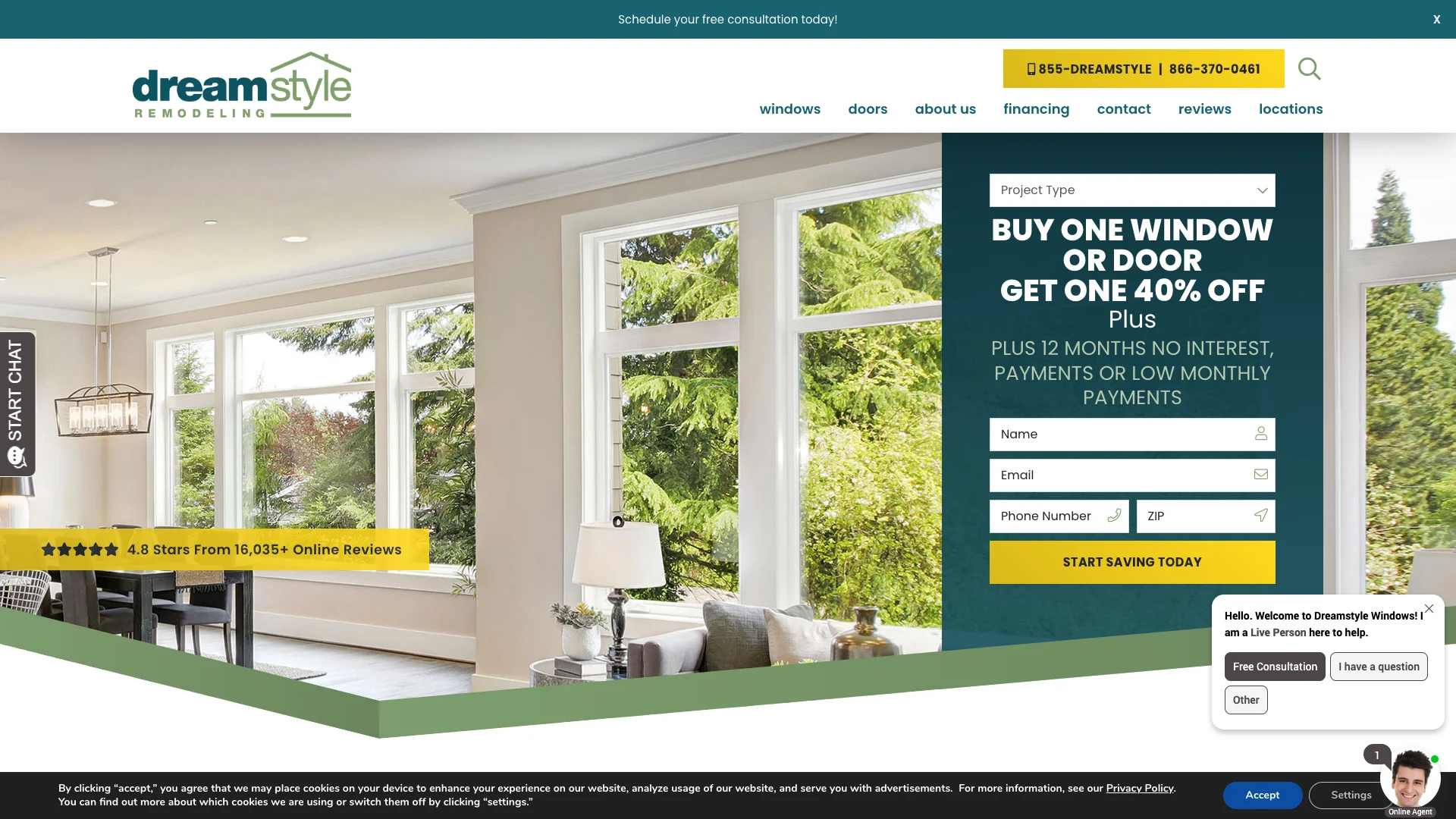
Dreamstyle Remodeling is a window and door contractor operating across the Southwest, covering Colorado, Idaho, and Arizona. According to Ahrefs, dreamstylewindows.com pulls 119 monthly organic visitors with an estimated traffic value of $435. That makes it one of the smallest brands in the CRO Index. But the form strategy on this site is unlike anything else in the series.
The pages we tore down:
- Exterior doors Colorado Springs, a location-specific door replacement page (49 monthly organic visitors, 35% traffic share, scored 51 on Google's mobile lab test, 6 forms)
- Replacement windows Meridian, a location-specific window replacement page for Meridian, Idaho (25 monthly visitors, 18% share, scored 52, 6 forms)
- Patio doors Prescott Valley, a location-specific patio door page for Prescott Valley, Arizona (9 monthly visitors, 6% share, scored 71, 6 forms)
Six forms on every page. That's the number. And the patio doors page scored 71 on Google's mobile lab test, which is higher than what most of the big national brands in this series manage. But there's a flip side. Zero Google Reviews on any page. Zero trust badges. Zero chat widgets. Zero hidden code labels that tell Google what the business does. So Dreamstyle is placing more forms per page than brands 100x their size, but there's nothing around those forms to convince a homeowner to actually fill them out.
That contrast tells the story of this teardown. Dreamstyle invested heavily in the conversion infrastructure (6 forms, decent page speed, clean layout stability) without investing in the trust layer that makes that infrastructure convert. It's like building a showroom with 6 cash registers but no product displays. The checkout process is ready. The buying motivation isn't.
"25% of homeowners say trusting contractors is their top challenge when planning home improvement projects."
— Houzz Inc. (2025)
Performance: 51 to 71 on Google's mobile lab test
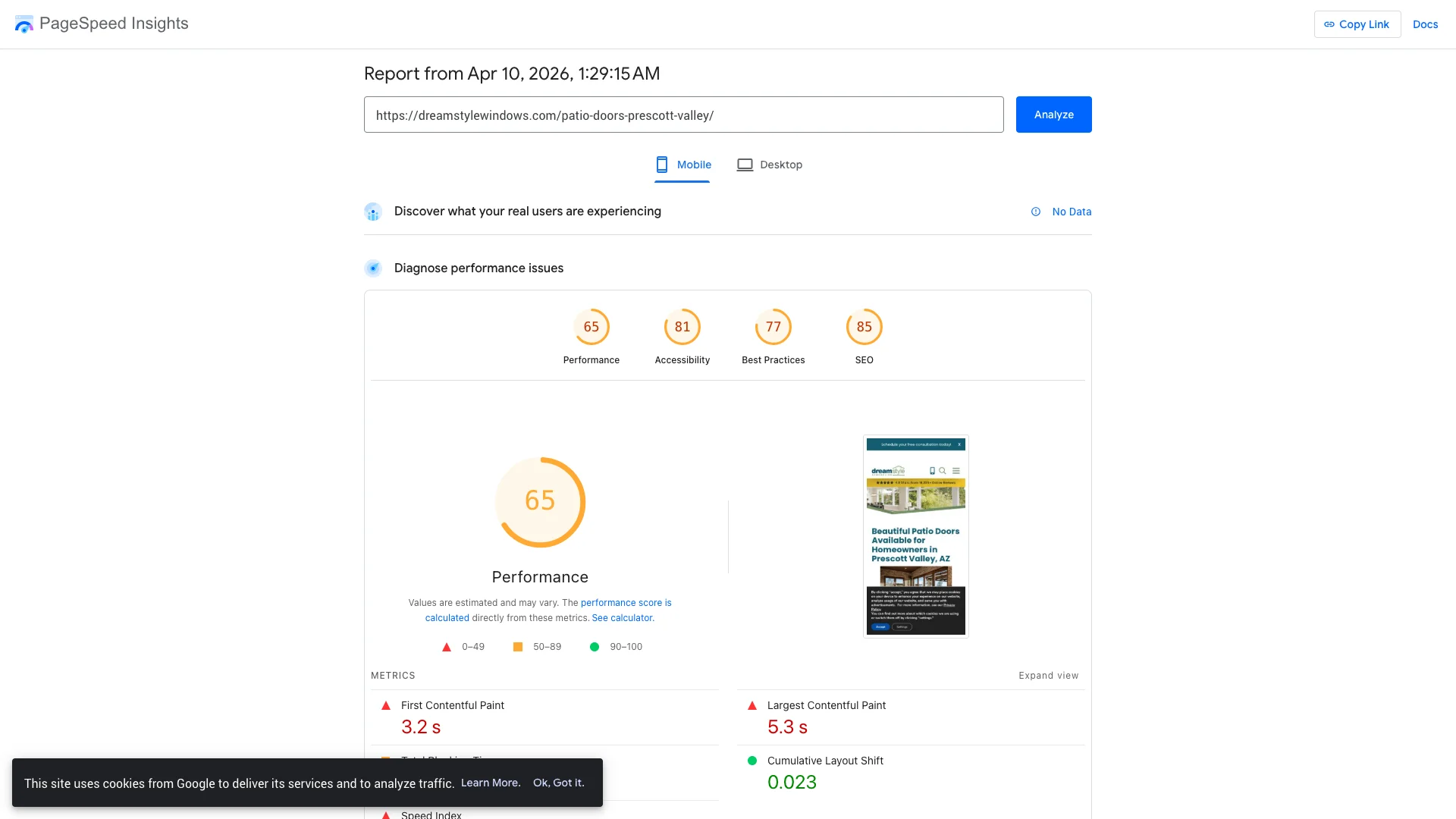
Google PageSpeed Insights runs a simulated slow-phone lab test. The scores are worst-case, not what you see on your phone with WiFi. But Google uses them as a ranking factor in search results.
The exterior doors Colorado Springs page scored 51. The replacement windows Meridian page scored 52. Both are just above the threshold where Google stops applying the heaviest penalties. But the patio doors Prescott Valley page scored 71. That's in the orange-to-green transition zone, and it's higher than what brands like Window World (52-59), Renewal by Andersen (38-40), and most of the Neighborly franchises manage on their best pages.
"53% of mobile users abandon sites that take longer than 3 seconds to load."
— Google / SOASTA (2017)
Layout stability is clean across the board. The Colorado Springs page scores 0.023. The Meridian page scores 0.032. The Prescott Valley page scores 0.023. All three are well under the 0.1 threshold where content jumps around enough for homeowners to notice. None are perfect 0.000 (Ideal Siding's standard), but all are in the "good" range. A homeowner loading these pages won't see text jumping around or images pushing content down the screen.
So the Prescott Valley page is proof that a small brand can hit a decent performance score. The question is why that page scores 20 points higher than the other two. It's likely lighter on third-party scripts, or the images are better compressed, or the page template is slightly different. Whatever the reason, Dreamstyle should figure out what's different about that page and apply the same approach to the Colorado Springs and Meridian pages. A 20-point improvement on two pages for what might be a template-level change is one of the highest-leverage fixes available.
And for a brand with only 119 monthly visitors, page speed matters more per visitor than it does for a brand with 100K visitors. Every ranking position gained from better page speed brings proportionally more incremental traffic to a small brand. If the Colorado Springs and Meridian pages matched the Prescott Valley page at 71, those two pages could realistically jump 2-3 positions in search results for their target queries. On a base of 25-49 monthly visitors, even a 30% increase is meaningful.
Compounding effect
"Conversion rates drop approximately 12% for each additional second of page load time."
— Google / Deloitte (2020)
Lead capture: 6 forms per page, everywhere
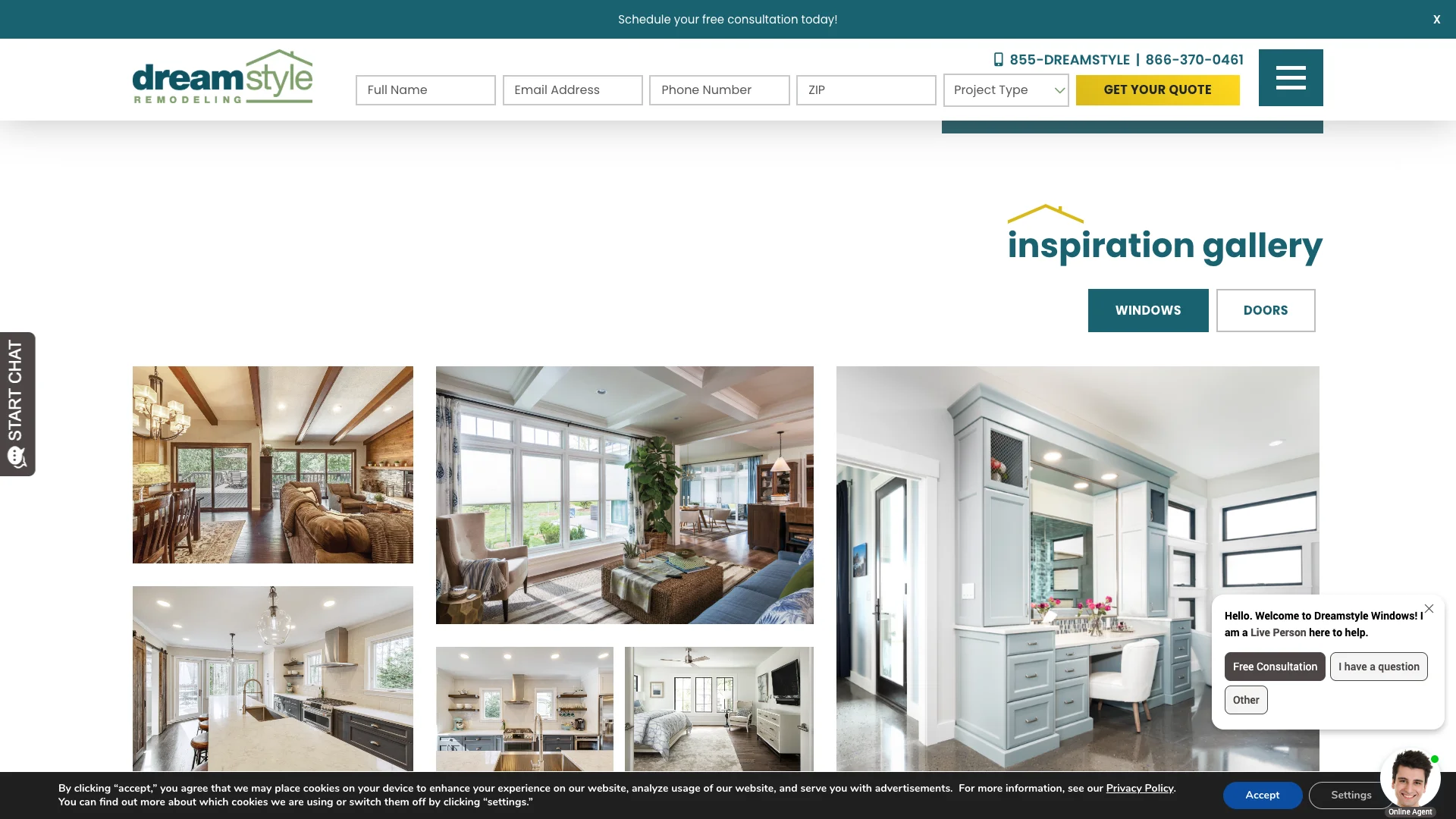
Six forms on every tested page. That's the most aggressive form strategy in the entire CRO Index series. Most contractor sites run 1 to 3 forms per page. Dreamstyle runs 6. With content averaging 1,958 to 2,014 words per page, that means a homeowner encounters a form roughly every 330 words of content. You can't scroll more than a screen or two without seeing a form.
Is that too many? It depends on the execution. If all 6 forms are identical (same fields, same CTA, same design), then yes, it's repetitive and might feel pushy to some homeowners. But if the forms are varied (a quick-quote form in the hero, a project estimator mid-page, a consultation request near the bottom, a callback form in the sidebar), then 6 forms means 6 different conversion paths for 6 different homeowner mindsets.
"68% of users wouldn't submit a form if it required too much personal information."
— Baymard Institute (2024)
And the math favors more forms. If a page with 1 form converts at 2% and a page with 3 forms converts at 4% (because the additional forms catch homeowners at different scroll depths), then a page with 6 forms should convert at something close to 5-6% if the forms are well-placed and not annoying. The key is whether the additional forms add friction (homeowner gets annoyed and leaves) or reduce friction (homeowner sees a form exactly when they're ready to act).
For a brand with only 119 monthly visitors, every form submission matters more. Dreamstyle can't afford to lose a single qualified visitor to bad form placement. Six forms per page is an aggressive response to that reality. It's the approach that says "we don't get enough traffic to waste any of it, so we're going to put a conversion path in front of every visitor at every scroll depth."
But there's a diminishing return that's worth acknowledging. Going from 1 form to 3 forms is a significant conversion lift. Going from 3 to 6 is a smaller lift with more risk. The risk is that a homeowner scrolling past their fourth form without a single review, badge, or testimonial in between starts to wonder why this company is trying so hard to collect their phone number. Forms without trust signals can feel aggressive rather than helpful. The trust layer isn't just about building confidence. It's about making the forms feel safe to fill out.
Trust signals: nothing around the forms
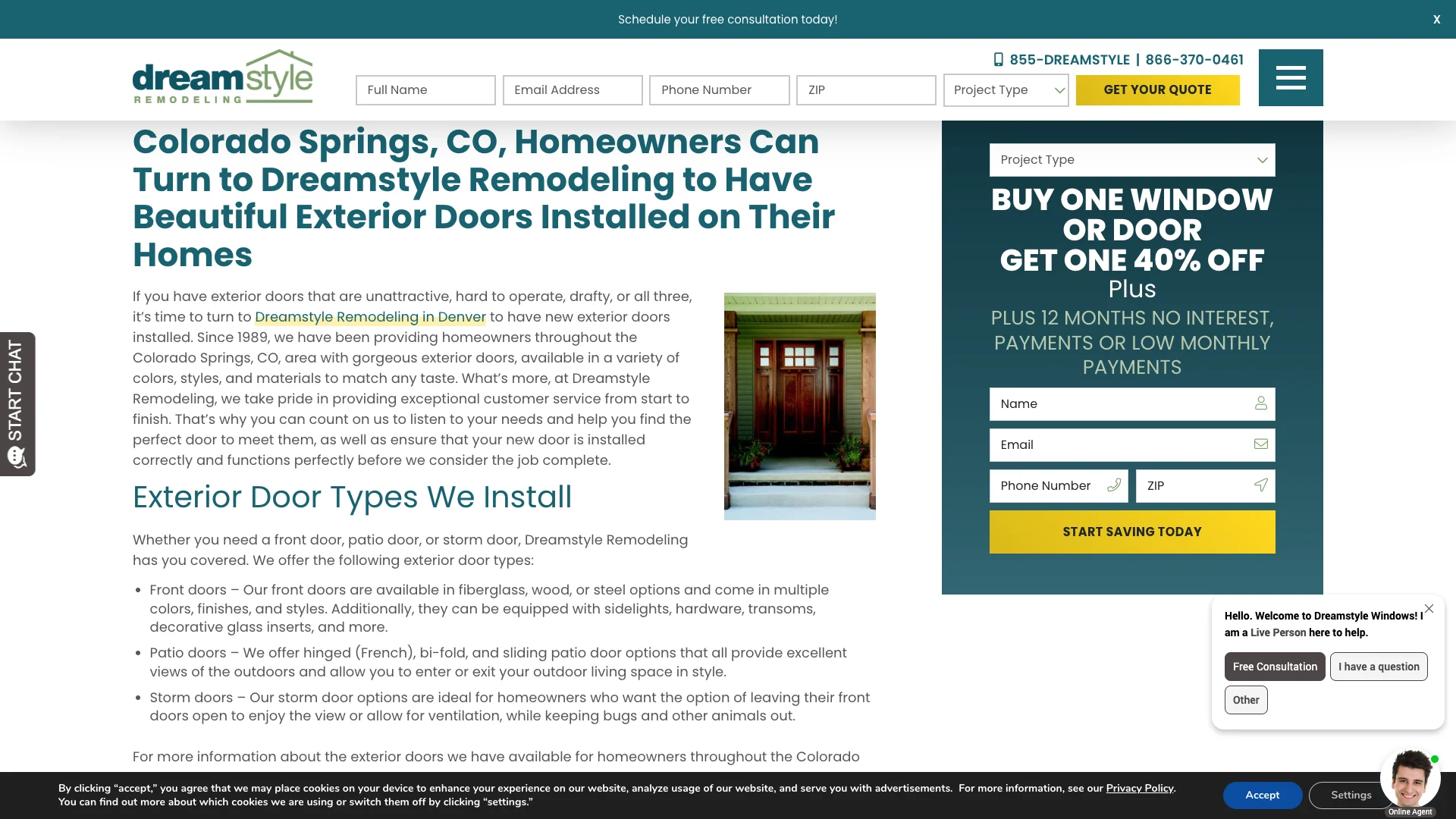
The trust signal audit across all three pages is empty:
- Google Reviews: Chrome verification found 21 review elements and 71 star rating elements rendered via JavaScript.
- Trust badges: Not found on any page.
- Review widgets: Not found on any page.
- Chat widget: Not found on any page.
- BBB badge: Not found.
- Certifications: Not found.
Zero out of six trust signal types. And that creates a specific problem when combined with the 6-form strategy. A homeowner lands on the page. They see a form immediately. They scroll past it. They see another form. They scroll past it. They see a third form. At no point between those forms does the homeowner see a Google Review, a manufacturer certification badge, a warranty seal, or any other signal that says "this company is legitimate and other homeowners have been satisfied."
Comparison
"83% of consumers use Google to find local business reviews; 74% use two or more review platforms when researching."
— BrightLocal (2025)
The forms are asking for a commitment (homeowner's contact information) without providing social proof in return. That's a conversion leak. The homeowner has to take Dreamstyle's word for it that they're worth contacting. Compare that to a setup where a Google Reviews widget sits between forms 2 and 3, showing 4.8 stars from 200+ reviews. That review widget gives the homeowner the confidence to fill out form 3 that they didn't have after skipping form 2.
The hidden code labels are empty too. No "local business" label. No "product" label. Nothing that tells Google these are service pages for a window and door contractor in Colorado, Idaho, and Arizona. Adding trade-specific labels would help Google understand what these pages are and potentially surface them in richer search result formats.
And there's a practical consequence of missing trust signals for a brand this small. When you only get 119 visitors a month, each visitor who leaves without converting is a proportionally larger loss. If 5 out of 119 visitors would have converted with a Google Reviews widget present, that's a 4% conversion rate improvement. On 119 visitors, that's 5 additional leads per month. At an average siding or window project value of $10,000 to $15,000, those 5 leads represent $50,000 to $75,000 in potential revenue. The review widget costs nothing. The missed revenue is real.
What Dreamstyle does well
Dreamstyle is a tiny brand doing three things that most contractors at any size don't do. And those three things are worth studying because they prove that budget isn't the bottleneck for good website execution.
Maximum form coverage. Six forms per page means a homeowner can't miss the conversion path. It's an aggressive strategy, but for a brand with 119 monthly visitors, it's the right kind of aggressive. Every visitor who lands on a Dreamstyle page and scrolls past the hero still encounters 5 more opportunities to convert. Most contractor sites have the opposite problem: a single form buried at the bottom of a long page that 90% of visitors never scroll to.
A 71 on the Prescott Valley page. That score puts a 119-visitor brand ahead of Window World (100K visitors, scores 52-59), ahead of Renewal by Andersen (59K visitors, scores 38-40), and ahead of most of the Neighborly franchise brands. It proves that page speed isn't a budget problem. It's a technical discipline problem. A small brand with a well-built page template can outperform a national franchise with a bloated one.
"64% of homeowners say having recommendations or references is a top-three factor in choosing a contractor."
— Houzz Inc. (2025)
Consistent content depth. 1,958 to 2,014 words per page across all three location pages. That's not thin boilerplate. It's substantive enough to earn rankings for location-specific window and door queries. And the consistency matters. All three pages are within 56 words of each other, which suggests Dreamstyle is using a content template that enforces a minimum depth. That discipline produces better search results than the random 400-to-2,000 word range you see on most multi-location contractor sites.
Together, these three strengths form a conversion machine that's missing one critical input: trust. The machine can capture leads. It can load fast. It can serve deep content. It just can't convince a homeowner to use it yet. And that's the most fixable gap in this entire teardown.
What the gaps mean for window contractors
Dreamstyle is a useful study in priorities. They went all-in on form placement and page performance. They skipped trust signals entirely. If you're a window contractor reading this, the lesson is about which piece to build first.
Add Google Reviews before adding more forms. If you already have 2 or 3 forms per page, adding a fourth won't move conversions as much as adding a Google Reviews widget between forms 1 and 2. The review widget gives the homeowner a reason to fill out the form. The additional form just gives them another chance to do something they weren't confident enough to do the first time. Reviews create confidence. More forms create more opportunities. But only if the confidence is already there.
Put trust badges next to forms. If you have a manufacturer certification (Andersen, Pella, Milgard, ENERGY STAR Partner), put the badge directly next to or immediately above the form. Not in the footer. Not on a separate "About Us" page. Right next to the form. A homeowner who sees "Andersen Certified Installer" plus 4.8 stars from Google Reviews plus a 3-field form is going to convert at a higher rate than a homeowner who sees just a form. Dreamstyle has the forms. Adding the badges would complete the conversion path.
Study the Prescott Valley page. That page scored 71 on Google's mobile lab test while the other two scored 51 and 52. Something about that page is lighter, faster, or better optimized. If you're running a multi-location site, audit each page individually. Don't assume your template performs the same across every location. Find your best-performing page, figure out why it's faster, and apply those learnings to every other page.
Add hidden code labels. A "local business" label with the business name, address, phone number, and service area. A "service" label for each service type (window replacement, door installation, patio doors). These hidden code labels help Google understand what your pages are and show them in richer search result formats. Dreamstyle has none. Any window contractor who adds them is giving Google more structured information than Dreamstyle provides.
Consider whether 6 forms is right for your brand. Dreamstyle's 6-form strategy makes sense for a brand with 119 visitors that can't afford to lose a single one. But if you're getting 1,000+ visitors a month, 3 to 4 forms per page is probably the sweet spot. Beyond that, the additional forms start to crowd the content and can make the page feel like it's asking for something rather than offering something. Match your form count to your traffic volume and your trust signal strength. More trust signals let you get away with fewer forms because each form converts at a higher rate.
"48% of customers say that if a site does not work well on mobile, it signals the company does not care about their business."
— Google Consumer Insights (2018)
Frequently asked questions
Why does Dreamstyle Remodeling have 6 forms per page?
Every tested page on dreamstylewindows.com runs 6 form instances. That means a homeowner scrolling through any page encounters a form roughly every 330 words. The strategy ensures no homeowner finishes reading without seeing multiple opportunities to leave their information. Most contractor sites run 1 to 3 forms per page. Dreamstyle triples the average.
How does Dreamstyle Remodeling score on Google's mobile lab test?
The exterior doors Colorado Springs page scored 51. The replacement windows Meridian page scored 52. The patio doors Prescott Valley page scored 71. The Prescott Valley page is the standout, scoring above the threshold where most ranking penalties drop off. For a brand with only 119 monthly visitors, a 71 is unusually strong.
Does Dreamstyle Remodeling display Google Reviews?
No. All three tested pages returned Google Reviews as not present. Zero review widgets, zero trust badges, zero chat widgets. The trust signal layer is completely empty. Dreamstyle has strong form coverage and decent performance, but no social proof visible anywhere on the tested pages.
How much organic traffic does dreamstylewindows.com get?
According to Ahrefs data from March 2026, dreamstylewindows.com receives approximately 119 monthly organic visitors with an estimated traffic value of $435. The exterior doors Colorado Springs page accounts for 49 visitors (35% share). Replacement windows Meridian accounts for 25 (18%). Patio doors Prescott Valley accounts for 9 (6%).