
What we found on drhorton.com
D.R. Horton is the largest homebuilder in the United States. And by every traffic metric, drhorton.com is the biggest brand in the entire CRO Index. According to Ahrefs, the site pulls 250.9K monthly organic visitors with an estimated traffic value of $177.1K. Nobody else in this series comes close on raw volume.
The pages we tore down:
- Homepage, the main landing page (96.6K monthly organic visitors, 43% traffic share, scored 34 out of 100 on Google's mobile lab test, layout shift 0.012)
- /florida, the Florida state page (3.1K monthly visitors, 1% share, Google's mobile lab test score not collected)
- /texas, the Texas state page (2.4K monthly visitors, 1% share, Google's mobile lab test score not collected)
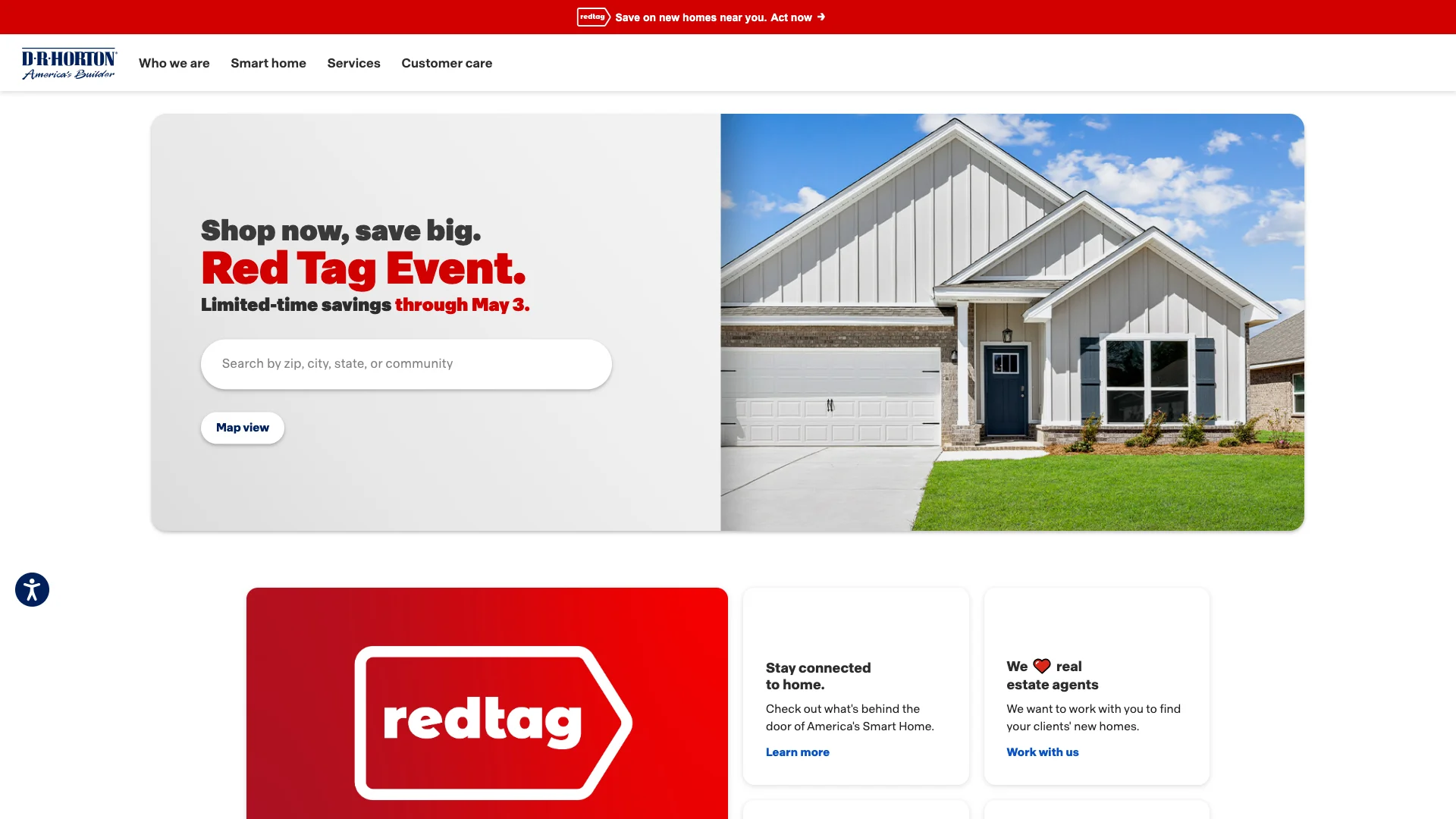
But the conversion story doesn't match the traffic story. The homepage has a search bar and 248 words. That's it. No phone number visible. No contact form on the page. No chat widget. A homeowner who lands on the D.R. Horton homepage can search for communities by location, but they can't call, can't chat, and can't leave their information without navigating deeper into the site.
"25% of homeowners say trusting contractors is their top challenge when planning home improvement projects."
— Houzz Inc. (2025)
Performance: 34 on the homepage, state pages untested
Google's mobile lab test simulates a slow phone on a throttled connection. The scores are worst-case, not what you'd see on your phone with WiFi. But Google uses them as a ranking factor in search results.
The homepage scored 34 out of 100. That's in the red zone, and it means Google is applying a search-ranking penalty to the page that drives 43% of all organic traffic. For the /florida and /texas state pages, Google's mobile lab test scores were not collected during our testing window.
"53% of mobile users abandon sites that take longer than 3 seconds to load."
— Google / SOASTA (2017)
And here's what makes drhorton.com interesting from a performance standpoint. The CrUX real-user data (which measures actual visitors on actual devices) actually passes. Largest Contentful Paint is 2 seconds. Layout shift is 0. So real homeowners visiting on real phones aren't experiencing a slow or jumpy page. The lab test penalizes the page, but the real-world experience is fine.
Layout shift on the homepage measured 0.012 in our lab test. That's well under the 0.1 threshold. Content doesn't jump around as the page loads. For a site with this much traffic, that kind of stability matters because every layout shift is a potential bounce.
Compounding effect
"Conversion rates drop approximately 12% for each additional second of page load time."
— Google / Deloitte (2020)
Lead capture: a search bar, a hidden form, and 11 fields on the contact page
The homepage has one interactive element: a search bar for finding communities by location. No form. No phone number. No chat. A homeowner who arrives from Google and wants to talk to someone has to navigate away from the homepage to find any conversion path at all.
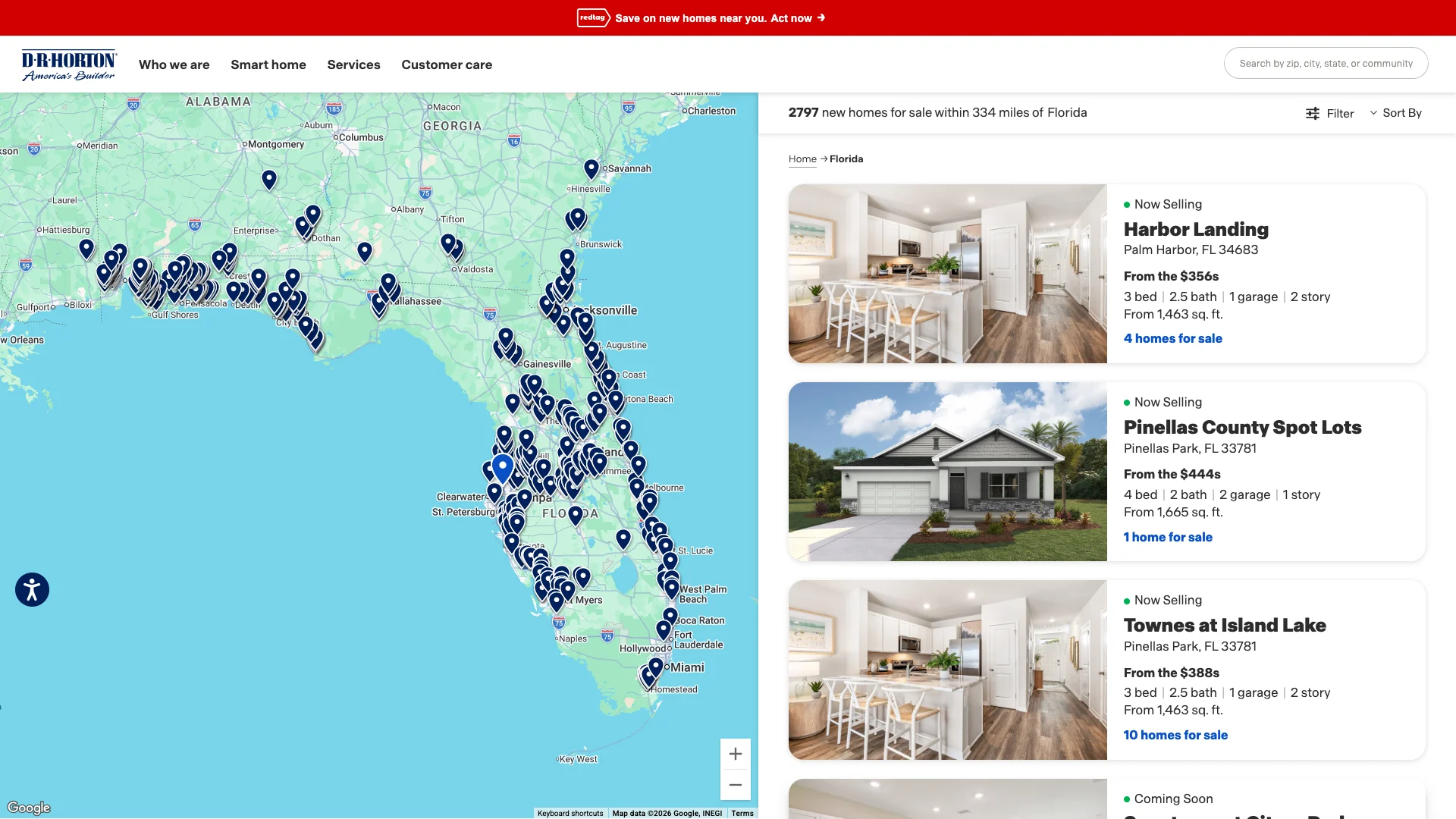
The /florida state page has something we don't usually see. There's a lead qualification form collapsed in the page's code at zero width and zero height. It asks for budget, bedrooms, bathrooms, and timeline. It's not visible on the state page itself. It probably opens on community detail pages when a visitor clicks "Get information." So the form exists, but it's hidden behind at least two clicks from the state page.
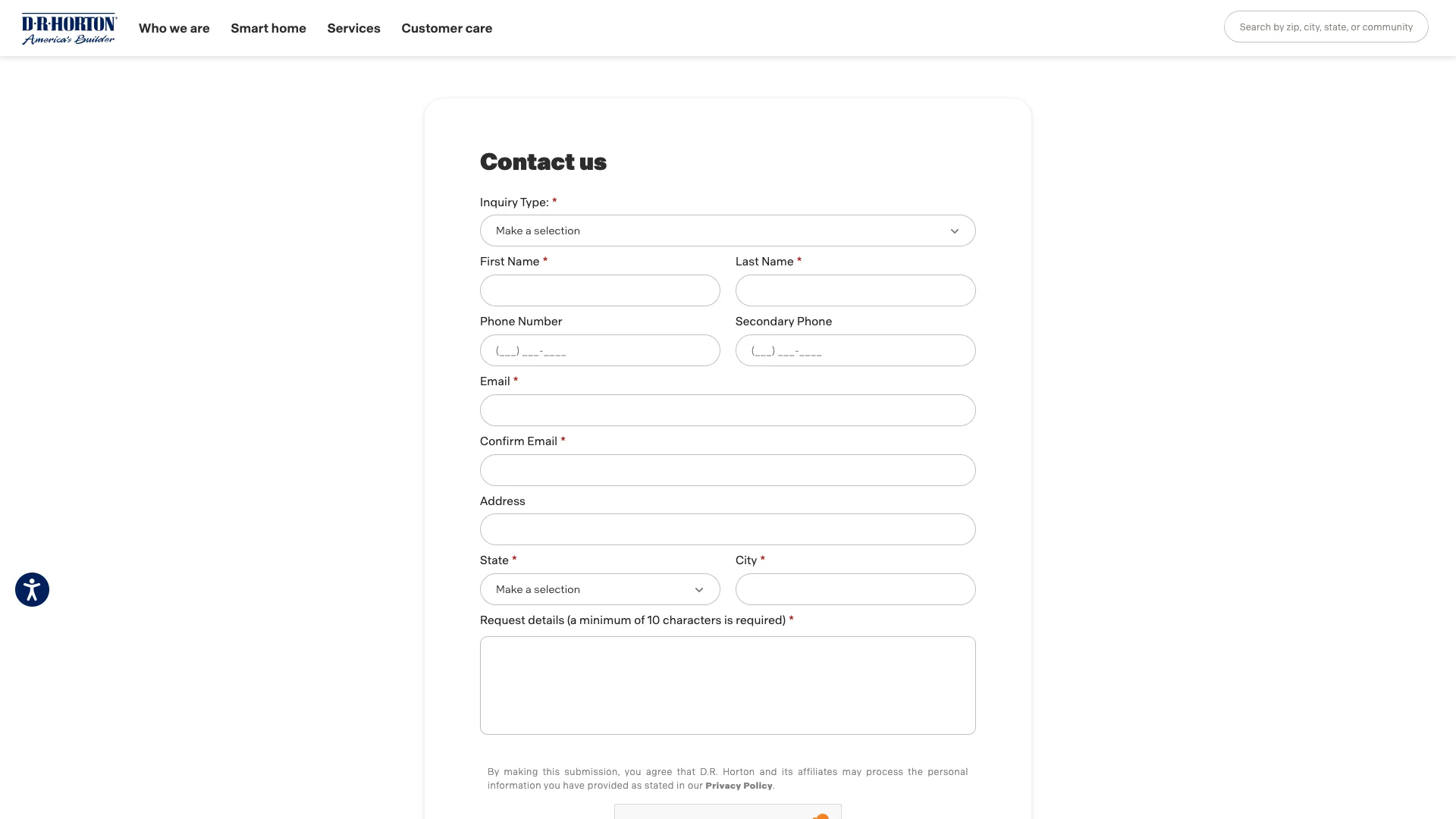
The /contact-us page has the main conversion form. And it's an 11-field single-page form: inquiry type, first name, last name, phone, secondary phone, email, confirm email, address, state, city, and request details. That's a lot to ask from someone who just wants to learn about new construction in their area.
"68% of users wouldn't submit a form if it required too much personal information."
— Baymard Institute (2024)
Compare that to Groundworks, which uses a 1-field hero entry (just a postal code) followed by a 4-step multi-step form. Or Goettl, which opens a multi-step booking modal from a single "Book Now" button. D.R. Horton asks for 11 fields on one page, including a secondary phone number and a "confirm email" field. Every extra field is friction. And friction on a site with 250K monthly visitors means you're leaving a lot of leads on the table.
Trust signals: badges present, but no reviews and no phone
The trust signal audit across the tested pages:
- Trust badges: Present.
- Google Reviews: Not found on any tested page.
- Review widgets: Not found.
- BBB badge: Not found.
- Phone number: Not visible anywhere on the tested pages.
- Chat widget: Not found.
One out of six trust signal types is present. Trust badges exist, but there are no reviews, no BBB accreditation displayed, no phone number, and no chat widget on any of the pages we tested. For the biggest homebuilder in the country, that's a surprisingly thin trust stack.
Comparison
"83% of consumers use Google to find local business reviews; 74% use two or more review platforms when researching."
— BrightLocal (2025)
The hidden code labels are minimal. State pages carry a "State" label, and the site has WebPage and BreadcrumbList labels. But there's no LocalBusiness, no HomeBuilder, no Organization label with review aggregation. Google knows drhorton.com has state pages and breadcrumb navigation. Google doesn't know from the labels that D.R. Horton is a home builder, what their rating is, or how many reviews they have.
What D.R. Horton does well
D.R. Horton operates at a scale none of the other brands in this series can match. And there are structural decisions that work at that scale.
Real-user performance passes. CrUX data shows LCP at 2 seconds and layout shift at 0. So even though Google's mobile lab test returns a 34, actual visitors on actual phones aren't experiencing a slow or jumpy site. The gap between lab score and real-world performance suggests the lab test is penalizing scripts and resources that don't actually block the user experience.
Clean layout stability. Layout shift of 0.012 on the homepage. Content doesn't jump around at all. That's better than most brands in this series, including several with much higher lab scores.
Hidden lead qualification form. The budget/bedrooms/bathrooms/timeline form on the /florida page is actually smart from a qualification standpoint. It asks the right questions to filter serious buyers from browsers. The problem isn't the form itself. The problem is that it's hidden behind multiple clicks and invisible on the state page.
State-level pages for every market. Dedicated /florida and /texas pages (and presumably every other state D.R. Horton operates in) give Google state-specific content to rank. That's a structural SEO advantage most home builders don't have.
"64% of homeowners say having recommendations or references is a top-three factor in choosing a contractor."
— Houzz Inc. (2025)
What the gaps mean for home builders
D.R. Horton proves that traffic alone doesn't equal conversions. You can drive 250K monthly visitors to a site and still lose leads if there's no visible way to contact you from the homepage. So what can smaller home builders learn?
Put a phone number on every page. D.R. Horton doesn't display a phone number on any of the pages we tested. If you're a custom home builder with 500 or 5,000 monthly visitors, your phone number should be in the header of every single page. It's the simplest conversion path you can offer, and a homeowner who wants to call shouldn't have to hunt for it.
Don't hide the lead form. The budget/bedrooms/bathrooms/timeline form on the /florida page is a good form. It asks qualifying questions that help you prioritize callbacks. But it's collapsed at zero width and zero height, invisible unless a visitor navigates to a community detail page and clicks "Get information." Surface that form on the state pages. Surface it on the homepage. Let the homeowner who already knows their budget and timeline tell you upfront.
Cut the contact form to 5 fields or fewer. The 11-field contact form on /contact-us asks for a secondary phone number and a "confirm email" field. Those two fields alone probably cost D.R. Horton measurable lead volume. Name, email, phone, zip, and a brief message. That's all you need to start a conversation.
Add Google Reviews to the homepage. Zero review signals on any tested page. For a builder with thousands of completed homes, that's a missed trust opportunity. A review widget on the homepage, even a simple aggregate star rating, gives the homeowner immediate social proof.
"48% of customers say that if a site does not work well on mobile, it signals the company does not care about their business."
— Google Consumer Insights (2018)
Frequently asked questions
How does drhorton.com score on Google's mobile test?
The homepage scored 34 out of 100 on Google's mobile lab test, which Google uses as a ranking factor. Layout shift scored 0.012, which is well under the acceptable limit. The /florida and /texas state pages were not tested because scores were not collected for those pages. But CrUX real-user data passes with LCP at 2 seconds and layout shift at 0.
Does D.R. Horton have a contact form?
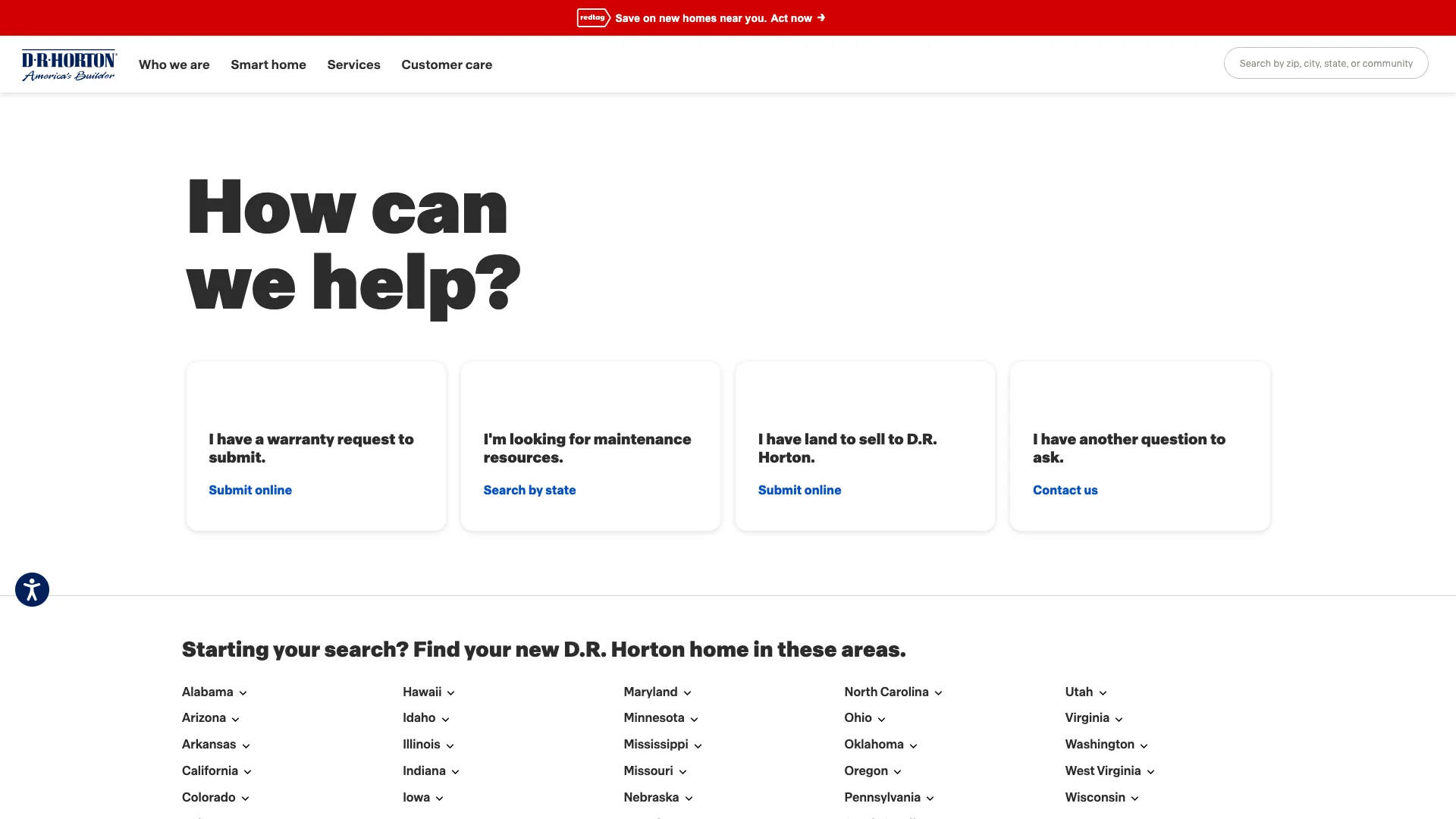
Yes, but you have to find it. The /contact-us page has an 11-field single-page form asking for inquiry type, first name, last name, phone, secondary phone, email, confirm email, address, state, city, and request details. The /florida state page also has a hidden lead qualification form collapsed in the page code, which likely opens on community detail pages when visitors click "Get information."
Is D.R. Horton the biggest brand in the CRO Index?
Yes. With 250.9K monthly organic visitors and a traffic value of $177.1K, D.R. Horton is the largest brand in the CRO Index by traffic volume. But the homepage has just 248 words and a search bar, no phone number is visible, and the contact form is buried on a separate page with 11 fields.
How much organic traffic does drhorton.com get?
According to Ahrefs data from March 2026, drhorton.com receives approximately 250.9K monthly organic visitors with an estimated traffic value of $177.1K. The homepage alone accounts for 96.6K visitors (43% share). The /florida state page gets 3.1K (1%). The /texas state page gets 2.4K (1%). Almost half the traffic hits the homepage, which has no conversion path beyond a search bar.