
What we found on codypools.com
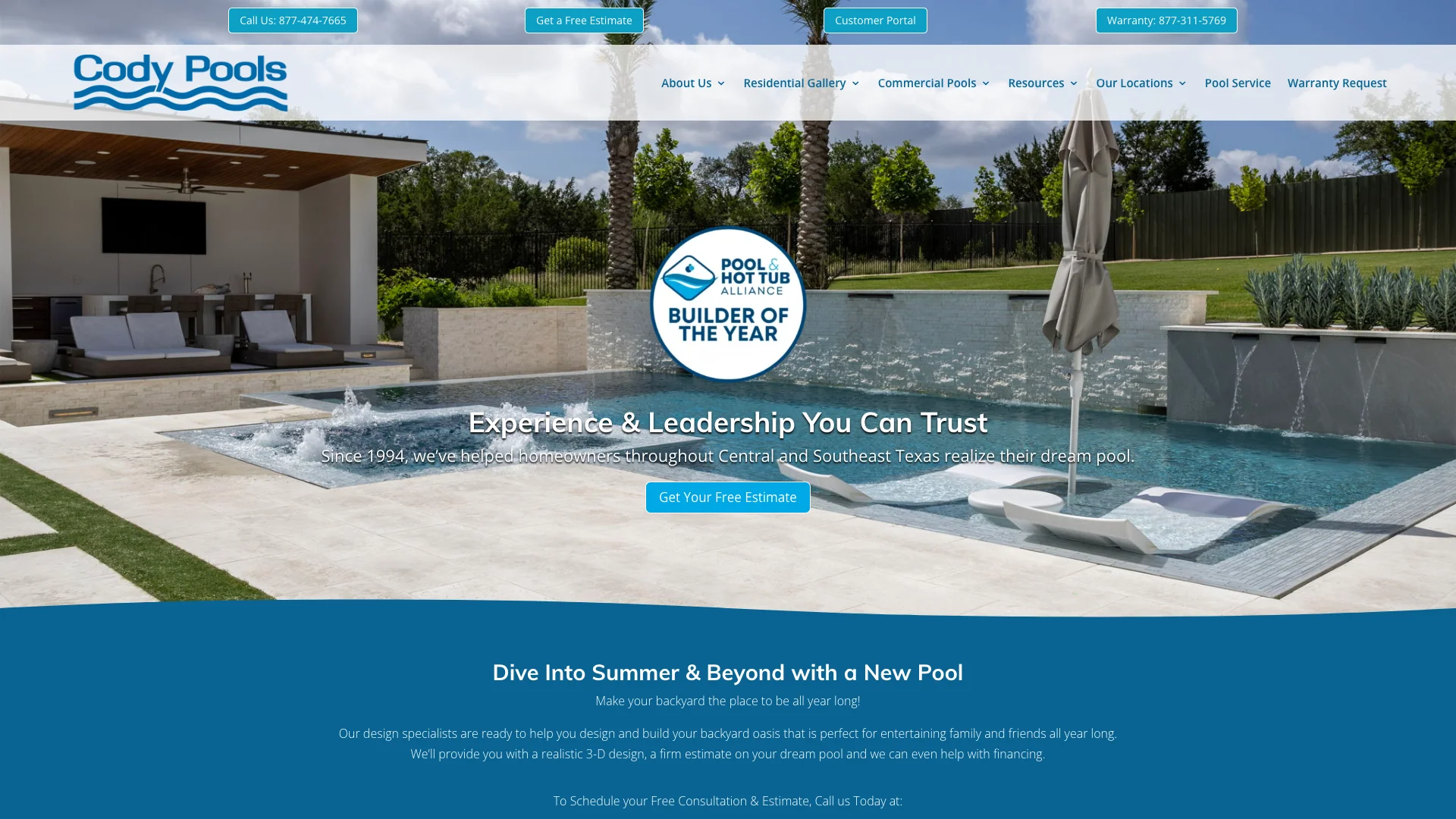
Cody Pools is a pool builder pulling 15.3K monthly organic visitors with an estimated traffic value of $47,400. That's serious traffic for a pool builder. And the traffic value tells you the keywords driving those visitors are worth real money. But the conversion side of this site has a gap so big it's hard to miss: zero contact forms across all three pages we tested.
The pages we tore down:
- Houston pool builder location page, pulling 916 monthly organic visitors (6% traffic share, scored 39 on Google's mobile lab test, layout shift 0.000)
- Florida subdomain, pulling 689 monthly visitors (5% share, no data collected during testing)
- Swimming pool designs page, pulling 555 monthly visitors (4% share, scored 46, layout shift 0.000)
So here's the situation. Cody Pools sells swimming pools that typically cost $30,000 to $80,000. That's a major home investment. And the only way a homeowner can reach them from these pages is by picking up the phone. No contact form. No quote request form. No "tell us about your project" form. Nothing.
For context, $47,400 in traffic value means these pages are ranking for keywords that advertisers would pay $47,400 per month to target with Google Ads. Cody Pools is getting that traffic for free through organic search. But without forms, the site is converting only the fraction of visitors who are willing to make a phone call. And research consistently shows that most website visitors won't call. They'll fill out a form, they'll start a chat, they'll send an email. But calling a company they've never spoken to? That's a higher commitment than most people are ready for.
"25% of homeowners say trusting contractors is their top challenge when planning home improvement projects."
— Houzz Inc. (2025)
Performance: 39 to 46 on Google's mobile lab test
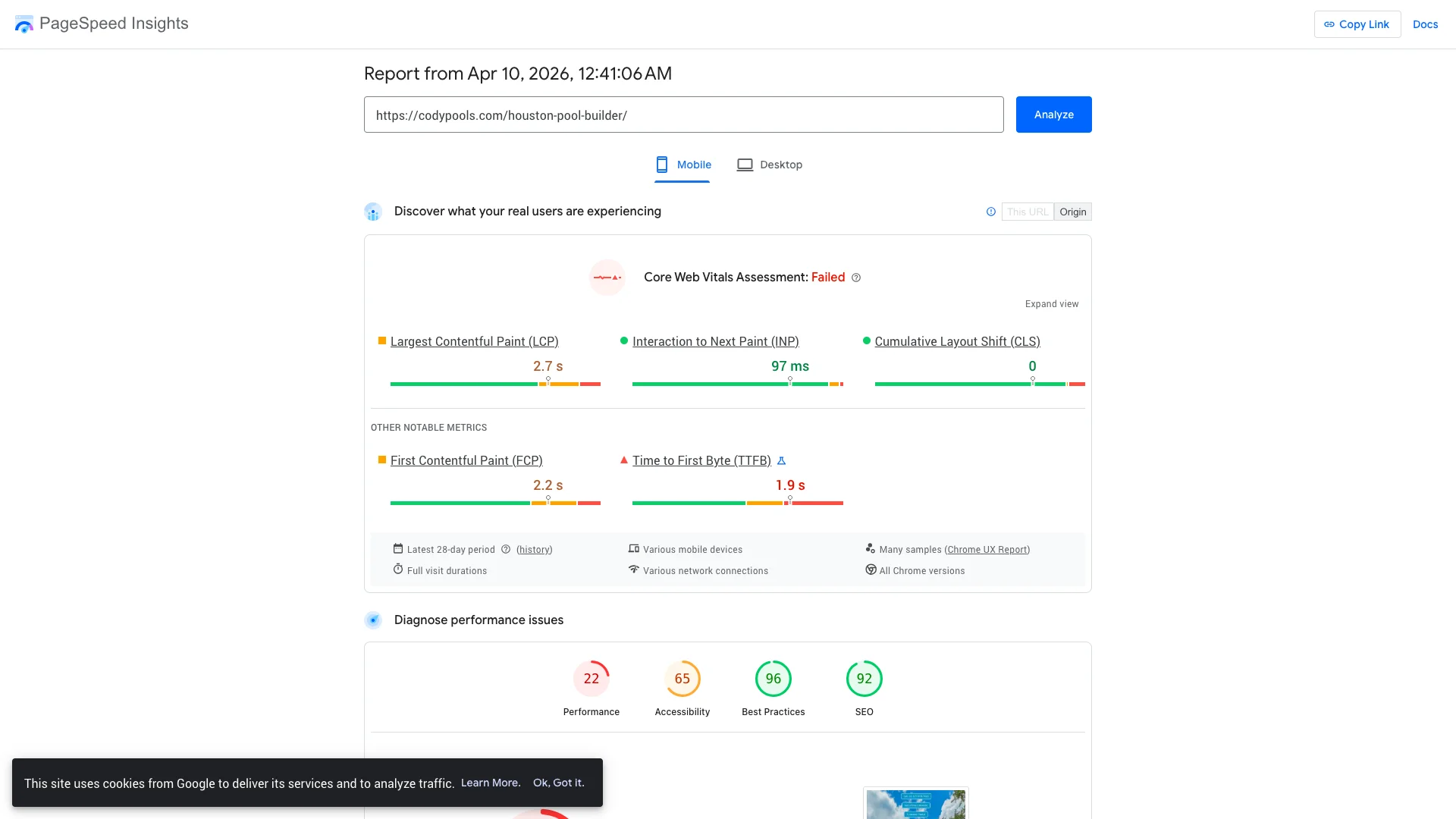
Google's mobile lab test simulates a slow phone on a throttled connection. The scores represent worst-case loading conditions, not what you see on your own phone. But Google uses them as a ranking factor, so they directly affect where your pages show up in search results.
The Houston pool builder page scored 39 out of 100. The swimming pool designs page scored 46. Both are in the red zone. The Florida subdomain returned no data during our test, so we can't score it. But two red-zone scores on a site with 15.3K monthly visitors means Google is penalizing these pages in search rankings right now.
And that penalty matters more for a high-traffic site than a small one. When you're already ranking for valuable keywords, a speed improvement doesn't just maintain your position. It pushes you higher. Cody Pools is leaving organic traffic on the table by running pages that Google considers slow. Moving from 39 to 70+ on the Houston page could mean hundreds more monthly visitors from the same keywords, at zero additional cost.
"53% of mobile users abandon sites that take longer than 3 seconds to load."
— Google / SOASTA (2017)
The good news is layout stability. Both scored pages hit 0.000 on layout shift. Content doesn't jump around at all as these pages load. That matters because pool builders rely on image-heavy pages (galleries, project showcases, before-and-after photos), and those images are exactly the kind of content that causes layout shift on most sites. Cody Pools handles it cleanly.
So the performance story is mixed. The pages load slowly by Google's standards, but they load stably. The speed issue is fixable. Compressing the pool project images, deferring third-party scripts, and cleaning up the heaviest resources could push both pages from the red zone into the 60-75 range. And for a site already pulling 15.3K visitors, faster pages would mean higher rankings and even more traffic from the same keywords.
The Florida subdomain returning no data is its own concern. If a page can't complete a standard performance test, it's possible Google's crawlers are having similar issues indexing or evaluating that page. That's worth investigating separately.
Compounding effect
"Conversion rates drop approximately 12% for each additional second of page load time."
— Google / Deloitte (2020)
Lead capture: 15,300 visitors and nowhere to submit your info
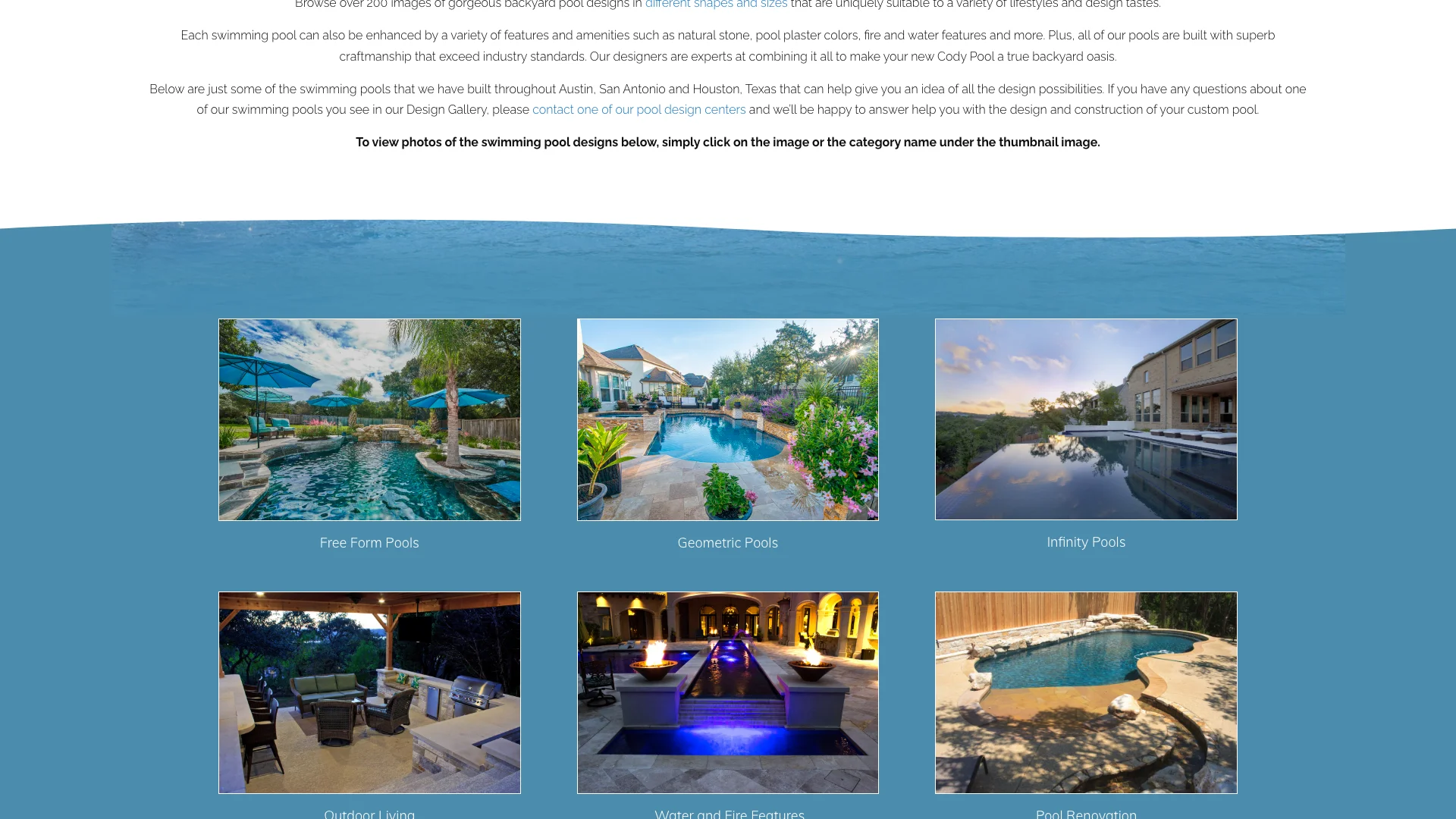
This is the gap that defines this teardown. Zero contact forms across all three tested pages. And we aren't talking about a roofing company selling $8,000 jobs. Cody Pools sells swimming pools. $30,000 to $80,000 projects. The kind of purchase a homeowner researches for months before committing.
And that research-stage homeowner is exactly who's landing on these pages. The Houston pool builder page targets local search. The swimming pool designs page targets inspiration-stage queries. The Florida subdomain targets a different market entirely. All three page types attract visitors who are considering a pool but aren't ready to commit. They want to browse, compare, and get a feel for the company before making contact.
But the only conversion path available is a phone call. And the problem with phone-only conversion is that it filters out everyone who isn't ready to talk to a salesperson right now. The homeowner browsing pool designs at 10 PM on a Tuesday isn't going to call. The homeowner comparing three pool builders isn't going to call each one. The homeowner who wants a ballpark price before scheduling a consultation isn't going to call for it.
"68% of users wouldn't submit a form if it required too much personal information."
— Baymard Institute (2024)
Let's put a number on it. At 15,300 monthly visitors with an industry-average form conversion rate of 2-3%, adding forms could generate 300 to 450 form submissions per month. Even if only 10% of those submissions turn into consultations, that's 30 to 45 new consultation requests monthly. At pool-project price points ($30K-$80K) and typical close rates, the revenue impact is significant. And right now, all of that potential is going to zero because there's no form.
A 3-field form on the designs page ("Love what you see? Tell us about your backyard.") would capture the browsing visitor. A quote request form on the Houston page ("Get a free pool estimate for your Houston property.") would capture the local searcher. These aren't complicated forms. Name, phone, zip code. Maybe a dropdown for pool type. But right now, none of them exist.
And the Florida subdomain makes the case even stronger. If Cody Pools is investing in a separate subdomain for the Florida market, they clearly want Florida leads. But a Florida homeowner who finds that page and wants a pool consultation has no form to fill out. They have to call a company in another state. For a high-ticket, local-service business, that's an unnecessary barrier. A Florida-specific form ("Interested in a pool for your Florida home? Tell us about your property.") would make the multi-market strategy actually convert.
The math is simple. At 15,300 monthly visitors, even a modest 2% form conversion rate generates 306 leads per month. At average pool project values ($40K-$60K midrange), that's millions in potential pipeline. And right now, that pipeline is invisible because there's no form to collect it. Phone calls capture some of it. But "some" isn't enough when you're already winning the traffic game.
Trust signals: Google Reviews on 2 of 3, one page returns no data
The trust signal audit on Cody Pools is partially strong. The results across the three pages:
- Google Reviews: TRUE on the Houston page and the designs page. No data on the Florida subdomain.
- Trust badges: Present on the Houston page and the designs page. No data on Florida.
- Chat widget: Not found.
- BBB badge: Not found.
- Review widgets: Not found.
- Certifications: Not found.
So on the pages where we could collect data, Cody Pools has Google Reviews and trust badges. That's a solid foundation. But the Florida subdomain is a black box. It returned no data during our audit, which usually means the page either loaded too slowly to complete the test, used a different site architecture than the main domain, or blocked our testing tools.
The two-out-of-three trust signal coverage creates an inconsistent experience. A homeowner who lands on the Houston page sees reviews and badges. A homeowner who lands on the Florida subdomain sees... we don't know. And for a multi-market pool builder, consistency matters. Every market page should deliver the same trust experience. Otherwise you're converting well in Houston and potentially losing leads in Florida.
Comparison
"83% of consumers use Google to find local business reviews; 74% use two or more review platforms when researching."
— BrightLocal (2025)
The hidden code labels are decent. Cody Pools runs 5 label types including Organization. That tells Google what the company is, which helps with branded search results and knowledge panel eligibility. But the labels don't include anything pool-specific or trade-specific, which means Google knows Cody Pools is an organization but doesn't get a clear signal that it's specifically a pool builder. Adding a more specific business type label would help Google surface Cody Pools for trade-specific queries.
For a pool builder with 15.3K monthly visitors, the trust signal situation is strong enough on the auditable pages. The gap is consistency. If every page on the site matched the Houston page's trust signal setup (Google Reviews plus trust badges), the entire site would present a unified, trustworthy experience. Right now, a homeowner might see reviews on one page and nothing on the next. That inconsistency creates doubt.
What Cody Pools does well
Despite the form gap, Cody Pools gets several things right that other pool builders should study.
Real organic traffic at scale. 15.3K monthly visitors with a $47.4K traffic value. That's not bought traffic. That's organic search traffic from homeowners actively searching for pool-related terms. The Houston location page, the designs page, and the Florida market page all pull meaningful visitor counts. Most pool builders in this series don't come close to these numbers. And $47.4K in traffic value means Cody Pools would need to spend that much on Google Ads every month to get equivalent visibility.
Clean layout stability. 0.000 on both scored pages. For a pool builder site with image-heavy galleries and project showcases, that's impressive. The pages don't jump around as they load, which means the homeowner browsing pool designs gets a smooth visual experience. Many competitor sites in this series can't manage that. Presidential Pools hits 0.107 and 0.111 on two of three pages. Cody Pools hits 0.000 on both.
Google Reviews on auditable pages. Both the Houston page and the designs page returned Google Reviews as TRUE with trust badges present. That gives the homeowner social proof right alongside the service content. And for a $30K-$80K purchase, social proof matters more than almost anything else on the page. The homeowner isn't just buying a product. They're hiring a company to tear up their backyard and build something that will be there for 20 years.
Multi-market presence. The Florida subdomain shows Cody Pools operates across multiple markets. A multi-market pool builder needs location-specific pages to rank locally, and Cody Pools has that infrastructure in place (even if the Florida subdomain didn't return data during our test). Having dedicated pages for each market is the right structural approach for local search visibility.
Strong traffic-to-value ratio. At $3.09 per organic visitor ($47.4K / 15.3K), Cody Pools is attracting commercially valuable traffic. The keywords driving visitors to this site have high commercial intent, meaning the homeowners landing on these pages are closer to a purchase decision than average. That makes the form gap even more costly, because the traffic quality is there but the conversion mechanism isn't.
"64% of homeowners say having recommendations or references is a top-three factor in choosing a contractor."
— Houzz Inc. (2025)
What the gaps mean for pool builders
Cody Pools has the traffic most pool builders dream about. But traffic without conversion infrastructure is just a vanity metric. The fixes are straightforward, and the upside is enormous.
Add contact forms to every page. This is the single biggest opportunity on the entire site. A 3-field form on the Houston page, the designs page, and the Florida page would give every visitor a way to submit their information without picking up the phone. For a company selling $30K-$80K projects, even converting 1% of those 15.3K monthly visitors into form submissions would generate 150+ leads per month. At pool-project close rates, that's significant revenue sitting untouched.
Fix the Florida subdomain. It returned no data during our audit, which means either the page didn't load properly, the architecture is different from the main domain, or something is blocking standard testing tools. If a page can't be tested, it's likely giving Google crawlers the same problems. Audit the Florida subdomain separately, make sure it loads cleanly, and ensure the same trust signals (Google Reviews, trust badges) are present. A multi-market pool builder can't afford a dead zone in one of its key markets.
Push Google's mobile scores above 50. Scores of 39 and 46 are in the red zone. For a site with 15.3K monthly visitors, improving page speed could unlock even more organic traffic. Compress the pool gallery images, defer non-essential scripts, and optimize the largest images that load above the fold. Getting from 39 to 70+ on the Houston page alone could mean hundreds more monthly visitors from the same keywords.
Add a chat widget. If forms aren't ready yet, a chat widget gives the browsing homeowner a low-commitment way to ask questions. "How much does a pool cost in Houston?" "Do you build saltwater pools?" "What's your timeline look like?" Those are the questions that lead to consultations, and a chat widget captures them in real time. Premier Pools has forms but no chat. Cody Pools has neither. The first pool builder in this batch to offer both will have a serious conversion advantage.
Add trade-specific hidden code labels. Cody Pools has Organization labels but nothing that tells Google it's specifically a pool builder. Adding a more specific business type label (like the ones Warner's Decking uses for deck building) would help Google understand the trade and surface Cody Pools for pool-specific searches. The traffic is already strong. Better labels would strengthen it further.
"48% of customers say that if a site does not work well on mobile, it signals the company does not care about their business."
— Google Consumer Insights (2018)
Frequently asked questions
Does Cody Pools have contact forms on their website?
No. Across all three pages we tested on codypools.com, there are zero contact forms. The Houston pool builder page, the Florida subdomain, and the swimming pool designs page all lack any form where a homeowner can submit their information. For a company selling $30K to $80K pool projects, that means every lead has to call. And most website visitors won't.
How does Cody Pools score on Google's mobile test?
The Houston pool builder page scored 39 out of 100. The swimming pool designs page scored 46. Both are in the red zone. The Florida subdomain returned no data during testing. Google uses these scores as a ranking factor, so both scored pages are taking a search-ranking penalty. But layout stability is clean at 0.000 on both pages.
Does Cody Pools display Google Reviews?
Yes, on 2 of 3 auditable pages. The Houston pool builder page and the swimming pool designs page both show Google Reviews as TRUE with trust badges present. The Florida subdomain returned no data, so we can't confirm its trust signal status. Consistency across all markets would strengthen the overall trust experience.
How much organic traffic does codypools.com get?
According to Ahrefs data from March 2026, codypools.com receives approximately 15,300 monthly organic visitors with an estimated traffic value of $47,400. The Houston pool builder page accounts for 916 visitors (6% share). The Florida subdomain accounts for 689 (5%). The swimming pool designs page accounts for 555 (4%). The traffic is substantial, but the lack of contact forms limits how much of it converts into actual leads.
How does Cody Pools compare to Premier Pools?
Cody Pools and Premier Pools are mirror images of each other. Cody has 15.3K monthly visitors, Google Reviews on 2 of 3 pages, trust badges, and zero contact forms. Premier has 4.2K monthly visitors, 1-2 forms on every page, rich hidden code labels, and zero Google Reviews. Cody has the traffic and the trust. Premier has the forms and the code labels. Neither has both. The pool builder that combines Cody's traffic and trust with Premier's forms and code labels would have the strongest site in the batch.
What would adding forms do for Cody Pools?
At 15,300 monthly visitors, even a conservative 2% form conversion rate would generate approximately 306 form submissions per month. For a pool builder selling $30K-$80K projects, that's a substantial lead pipeline. And the traffic is already commercially valuable (keywords worth $47.4K per month in ad equivalent value). Adding forms doesn't generate new traffic. It captures the value that's already there but currently walking out the door.