
What we found on belfor.com
BELFOR Property Restoration is one of the largest restoration companies in North America. According to Ahrefs, belfor.com pulls 183,400 monthly organic visitors with an estimated traffic value of $606,500. That makes BELFOR the second-biggest brand in the entire CRO Index by traffic value. Only one other company in this series generates more dollar value from organic search.
The pages we tore down:
- Water damage page (26,600 monthly organic visitors, 19% traffic share, scored 50 on Google's mobile lab test)
- Fire damage page (21,900 monthly visitors, 15% share, scored 60)
- Mold removal page (16,700 monthly visitors, 12% share, scored 66)
Just those three service pages account for 65,200 monthly visitors. That's more total traffic than most entire contractor websites in this series. And the pages are doing several things right: decent Google scores, perfect layout stability, and three forms per page. But the trust layer is completely missing. Zero Google Reviews on any page. Zero trust badges. Zero review widgets. For a brand this size, that gap between traffic volume and trust signals is one of the largest we've measured.
"25% of homeowners say trusting contractors is their top challenge when planning home improvement projects."
— Houzz Inc. (2025)
Performance: 50 to 66 on Google's mobile test
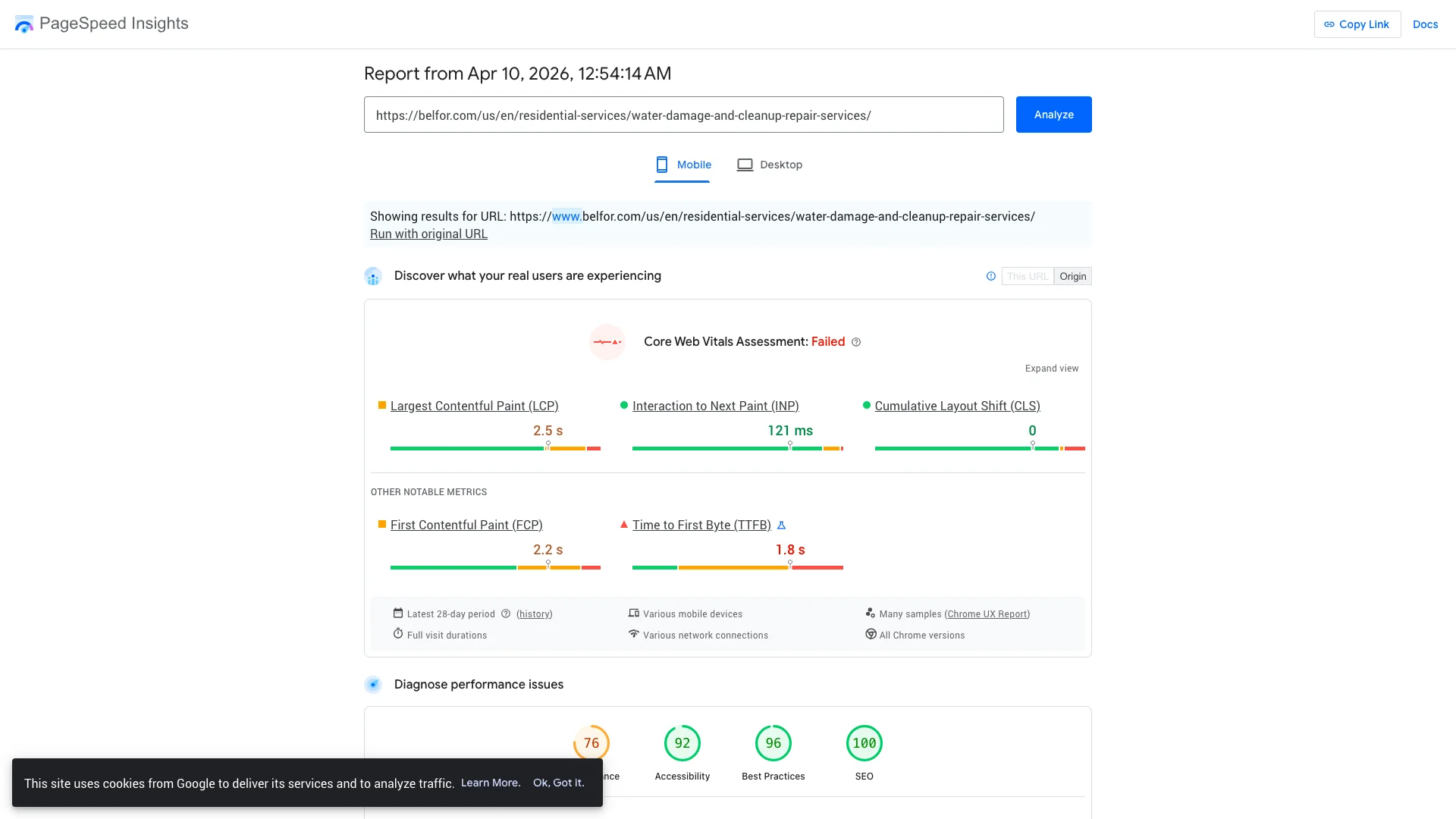
Google PageSpeed Insights runs a simulated slow-phone lab test. The scores are worst-case, not what you see on your phone with WiFi. But Google uses them as a ranking factor in search results.
The mold removal page scored 66 out of 100. The fire damage page scored 60. The water damage page scored 50. All three are in the orange zone (50-89), which means they're decent but not great. For a brand generating $606K in monthly traffic value, those scores are good enough to maintain rankings but not good enough to dominate them. Getting into the green zone (90+) would reduce the ranking penalty and likely push these already high-traffic pages even higher in search results.
"53% of mobile users abandon sites that take longer than 3 seconds to load."
— Google / SOASTA (2017)
But layout stability is where BELFOR is flawless. The water damage page scores 0.000. The fire damage page scores 0.002. The mold removal page scores 0.004. Content doesn't move at all as these pages load. For service pages pulling 16,000 to 26,000 monthly visitors each, that stability matters. A homeowner who lands on the water damage page during an emergency isn't going to lose the phone number because an image pushed it off screen. The page loads clean and stays clean.
The hidden code labels are basic: WebPage and BreadcrumbList. Those tell Google the page exists and where it sits in the site hierarchy. But there's no LocalBusiness, no Service, no FAQPage. For a restoration company, adding a Service label that says "this page is about water damage restoration" would give Google more context about what BELFOR actually does. And for a brand this size, that additional context could unlock rich results in search that the current basic labels don't support.
Compounding effect
"Conversion rates drop approximately 12% for each additional second of page load time."
— Google / Deloitte (2020)
Lead capture: three forms per page
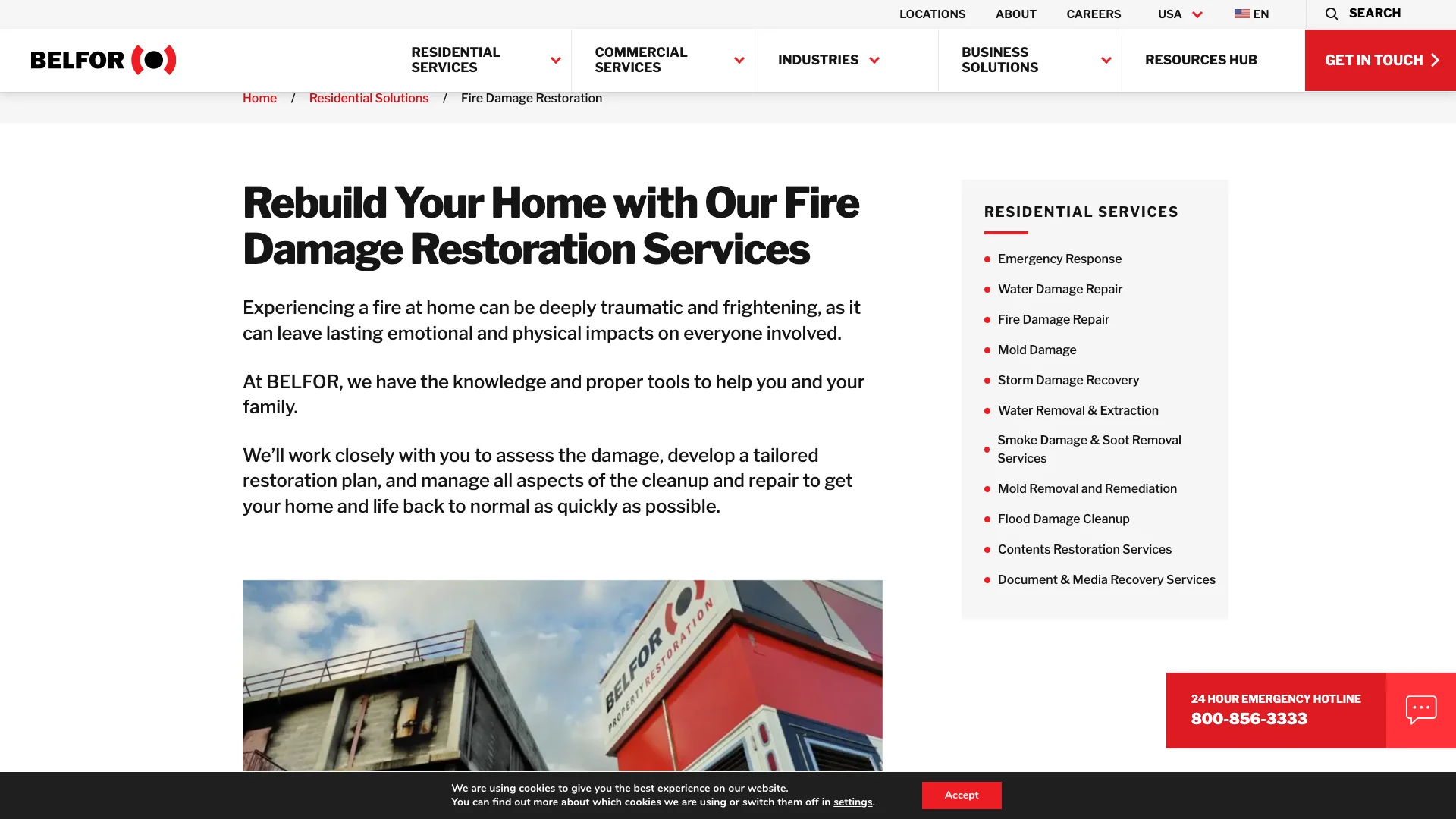
BELFOR has three forms on every tested page. That's more than most brands in the CRO Index, and it's the right approach for high-traffic service pages. A homeowner who lands on the water damage page during an active emergency needs a way to reach BELFOR immediately. Three forms mean three opportunities on the same page, which reduces the chance that a visitor scrolls past the only form and leaves.
"68% of users wouldn't submit a form if it required too much personal information."
— Baymard Institute (2024)
And the form placement matters when you're dealing with 26,600 monthly visitors on a single page. If even 1% of those visitors convert, that's 266 leads per month from one page. If the conversion rate bumps to 3% (which is achievable with proper trust signals and form optimization), that's 798 leads per month. From one page. The math at BELFOR's traffic scale makes every conversion rate improvement worth real money.
What's missing is a chat widget. Restoration is an emergency trade. When a homeowner's basement is flooding, they don't want to fill out a form and wait for a callback. They want to talk to someone right now. A live chat or a prominent "Call Now" sticky bar on mobile would capture the emergency-intent visitor who needs help in the next 30 minutes, not the next 24 hours. Three forms is a solid foundation. But emergency restoration needs that instant-contact layer on top of it.
Trust signals: the biggest miss at this traffic scale
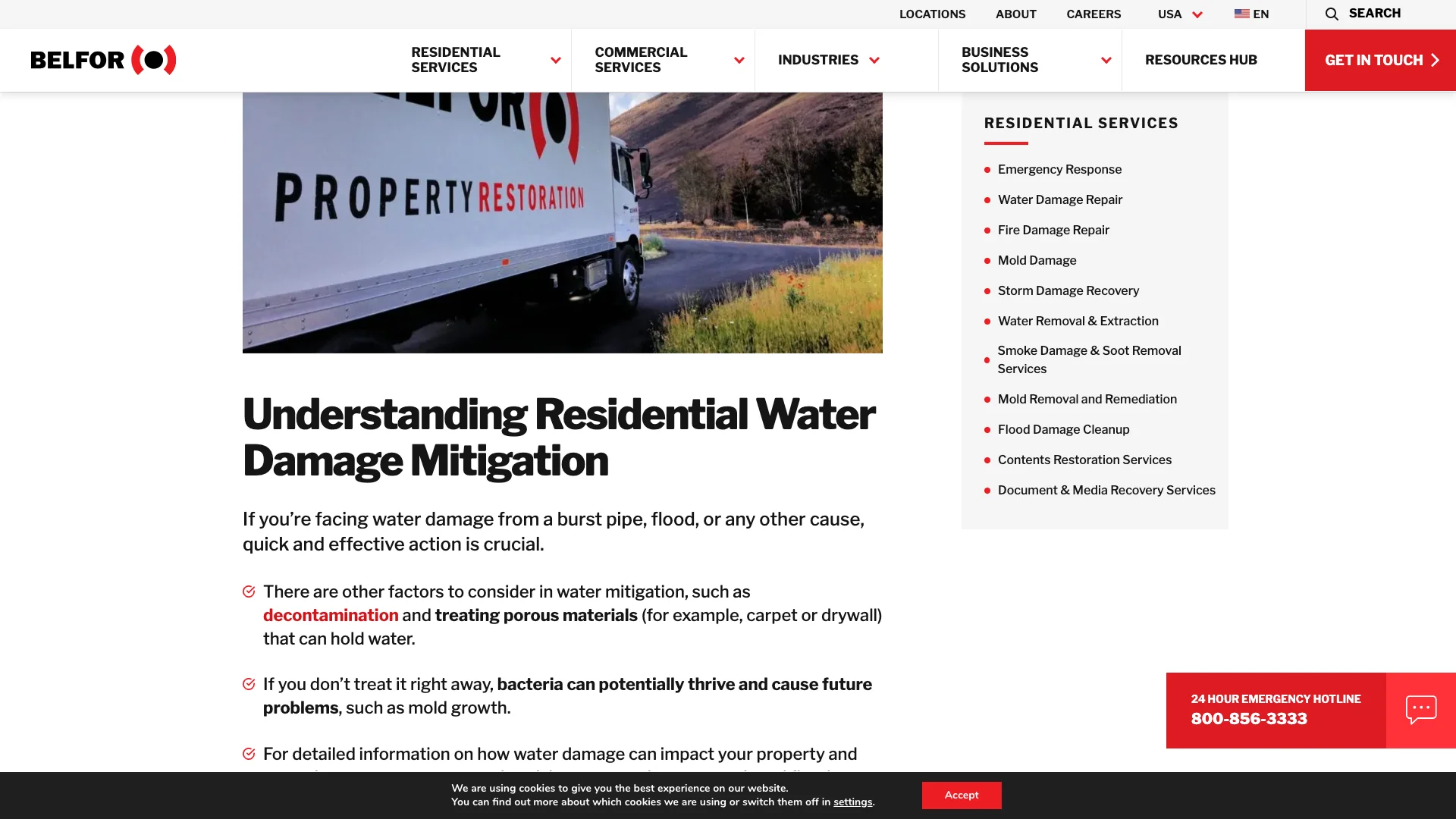
The trust signal audit across all three pages:
- Google Reviews: Not found on any page.
- Review widgets: Not found on any page.
- Trust badges: Not found on any page.
- Chat widget: Not found on any page.
- BBB badge: Not found.
- Certifications: Not found.
Zero out of six. On a site pulling 183,400 monthly visitors. That's the finding that defines this teardown.
Comparison
"83% of consumers use Google to find local business reviews; 74% use two or more review platforms when researching."
— BrightLocal (2025)
BELFOR almost certainly has thousands of customer reviews across Google, Yelp, and the BBB. They're one of the largest restoration companies on the continent. But none of those reviews are visible on the service pages we tested. A homeowner who lands on the water damage page sees the service description, sees the forms, but sees no proof that other homeowners have used BELFOR and had a good experience. And in restoration, trust matters more than in almost any other trade. You're letting a company into your damaged home. You're trusting them with insurance claims. You need to know other people had a good outcome.
The code labels are basic too. WebPage and BreadcrumbList. No LocalBusiness, no Service, no AggregateRating. BELFOR's size and review volume would support an AggregateRating label (the star rating that shows up in Google search results). But without the label, Google can't display it. So BELFOR's search listings show up as plain blue links while smaller competitors with the right labels show up with gold stars. At 183K monthly visitors, even a small improvement in click-through rate from star ratings would translate to thousands of additional visitors per month.
What BELFOR does well
BELFOR's strengths are scale, form strategy, and page stability. And at their traffic volume, those strengths generate real business value even with the trust gaps.
Three forms per page is the right approach. Most brands in the CRO Index have zero or one form on their service pages. BELFOR has three. That means a homeowner scrolling through the water damage content encounters a conversion opportunity at multiple points. For pages pulling 16,000 to 26,000 monthly visitors, each additional form placement increases the odds of capturing a lead.
Perfect layout stability. 0.000 to 0.002 across all three pages. Content doesn't shift at all. For emergency restoration pages where a homeowner might be reading on their phone during an active water or fire event, stability means the phone number and the form stay exactly where the homeowner expects them. That's not a vanity metric. That's a practical advantage when someone needs help immediately.
Decent Google scores for high-traffic pages. 50 to 66 is the orange zone, not the red. Most contractor sites in this series score in the 20s and 30s. BELFOR's pages load faster than the average, which is part of why they rank for competitive terms like "water damage restoration" and "fire damage restoration." Those aren't easy keywords to hold, and decent page speed is one of the factors keeping BELFOR in the top positions.
Traffic scale that validates the content strategy. 65,200 monthly visitors across just three service pages. Whatever BELFOR is doing with their content and their domain authority, it's working. The pages rank, the traffic flows, and the forms are there to capture it. The gap is entirely on the trust side.
"64% of homeowners say having recommendations or references is a top-three factor in choosing a contractor."
— Houzz Inc. (2025)
What the gaps mean for restoration contractors
BELFOR's teardown is a cautionary tale about traffic without trust. And if you're a restoration contractor, the lessons are practical and immediate.
Reviews matter more in restoration than in almost any other trade. A homeowner dealing with water damage, fire damage, or mold is stressed, vulnerable, and making a fast decision. They're not comparing paint colors or deck materials. They're choosing who to let into their damaged home. Google Reviews on the service page give them the confidence to pick up the phone. BELFOR's traffic proves the content strategy works. Adding reviews would prove the service works too. If you're a restoration contractor with good reviews on Google, put them on every service page. Don't make homeowners leave your site to find proof that you're trustworthy.
Add a chat widget or sticky call bar for emergency pages. Restoration is an emergency trade. Forms are fine for planned projects, but a homeowner with a flooded basement at 2 AM needs to talk to someone now. A live chat widget or a sticky "Call Now" bar on mobile captures the visitor who won't wait for a form response. BELFOR has three forms per page, which is solid. But adding an instant-contact option would capture the emergency segment that forms miss.
Upgrade the code labels. WebPage and BreadcrumbList are the bare minimum. BELFOR's pages should carry Service labels (telling Google "this page is about water damage restoration"), LocalBusiness labels (telling Google where BELFOR operates), and AggregateRating labels (telling Google to show star ratings in search results). At 183K monthly visitors, the click-through rate improvement from star ratings alone could add thousands of additional visitors per month.
Don't assume traffic equals trust. BELFOR gets 183K monthly visitors. But a visitor who lands on the page and sees no reviews, no badges, and no social proof is less likely to convert than a visitor who lands on a competitor's page and sees 4.8 stars from 500 reviews. Traffic is the top of the funnel. Trust is what moves people through it. If your site has traffic but your conversion rate is low, the first place to look is your trust signal stack.
"48% of customers say that if a site does not work well on mobile, it signals the company does not care about their business."
— Google Consumer Insights (2018)
Frequently asked questions
How does BELFOR score on Google's mobile test?
The water damage page scored 50 out of 100. The fire damage page scored 60. The mold removal page scored 66. All three are in the orange zone (50-89), which is decent for service pages. Layout stability is perfect at 0.000 to 0.002, so content doesn't jump around as the pages load.
Does BELFOR display Google Reviews on its website?
No. All three tested pages returned zero Google Reviews, zero review widgets, and zero trust badges. For a brand pulling 183,400 monthly visitors with a traffic value of $606,500, the absence of social proof is a significant missed opportunity.
How many forms does BELFOR have on its service pages?
Each tested page has 3 forms. That's more conversion paths than most brands in the CRO Index, and it's the right approach for high-traffic service pages. But there's no chat widget, which matters for an emergency trade like restoration where homeowners often need help immediately.
How much organic traffic does belfor.com get?
According to Ahrefs data from March 2026, belfor.com receives approximately 183,400 monthly organic visitors with an estimated traffic value of $606,500. The water damage page alone accounts for 26,600 visitors (19% share). The fire damage page accounts for 21,900 (15%). The mold removal page accounts for 16,700 (12%). Just three pages drive over 65,000 monthly visitors.