
What we found on acehandymanservices.com
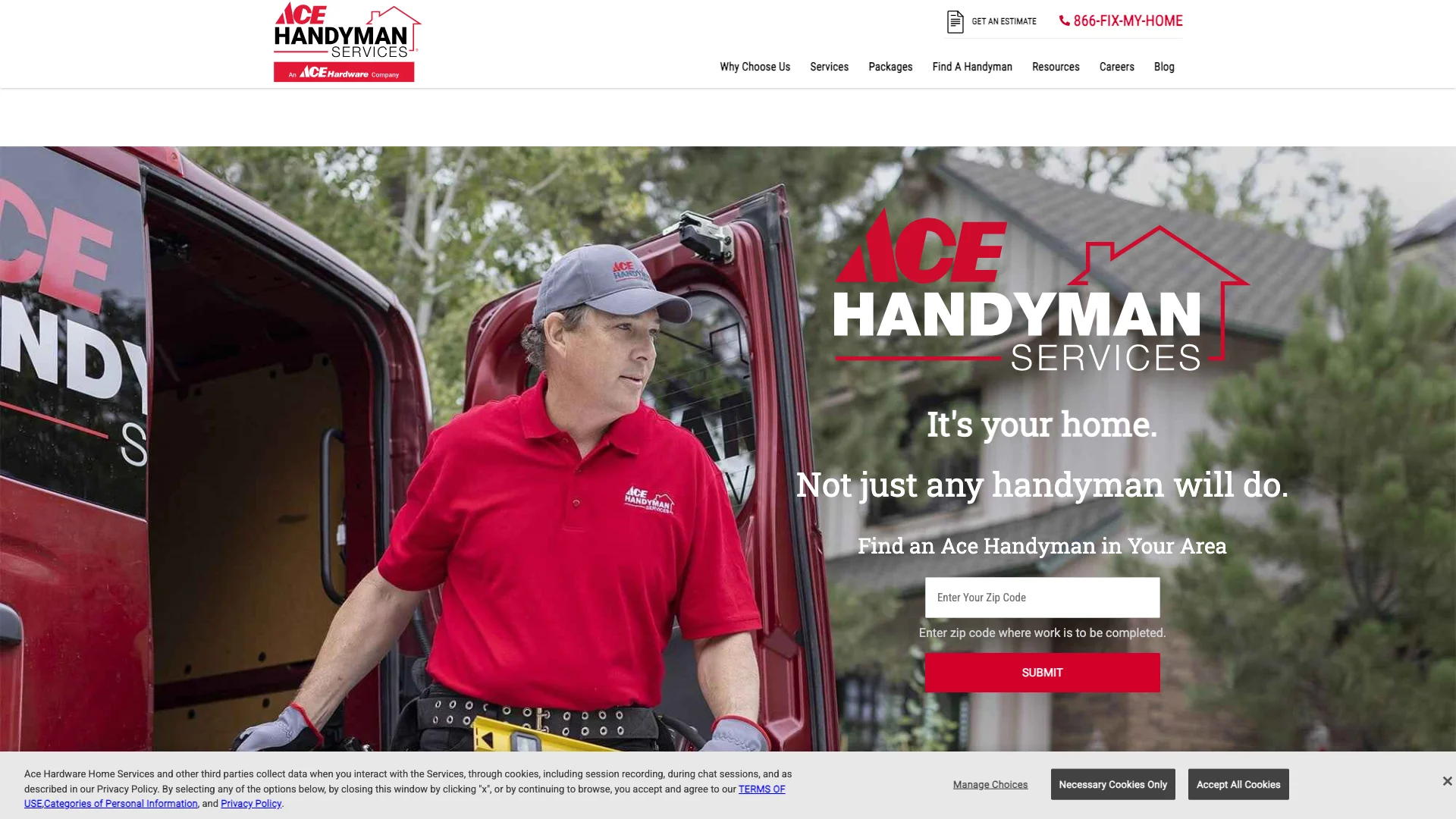
Ace Handyman Services is a national handyman franchise (formerly Handyman Matters). According to Ahrefs, acehandymanservices.com pulls 16,800 monthly organic visitors with an estimated traffic value of $33,500. And unlike some franchise brands where the corporate site is a thin shell, Ace Handyman's pages have real substance to them.
The pages we tore down:
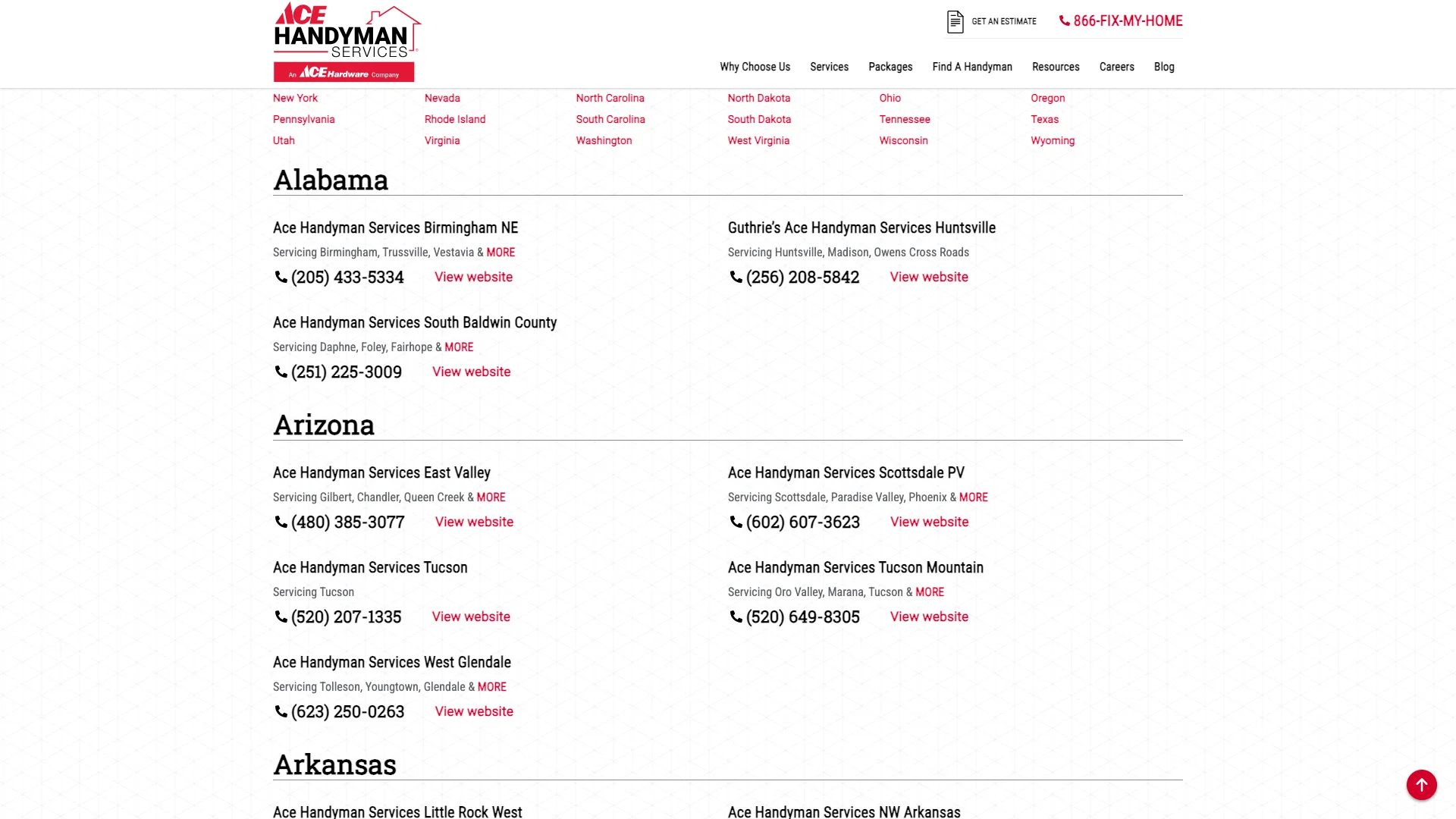
- Offices page (1,100 monthly organic visitors, scored 89 on Google's mobile lab test, layout shift 0.000, 5,077 words of content, 1 form)
- Carpentry page (315 monthly visitors, scored 93, layout shift 0.001, 1,423 words, 10 form fields plus "Schedule an Appointment" CTA)
- Services page (186 monthly visitors, scored 89, layout shift 0.051, 502 words, 1 form)
So the pages are fast. The content runs deep on the offices page (5,077 words is more than most blog posts). And forms exist on every tested page with "GET AN ESTIMATE" as the primary call to action. But here's the gap: zero Google Reviews on any page. Zero trust badges. Zero BBB badges. Zero social proof of any kind. A homeowner lands on a page that loads fast, has content, and gives them a way to request an estimate. But nothing on the page tells them whether other homeowners had a good experience.
"25% of homeowners say trusting contractors is their top challenge when planning home improvement projects."
— Houzz Inc. (2025)
Performance: 89 to 93 on Google's mobile lab test
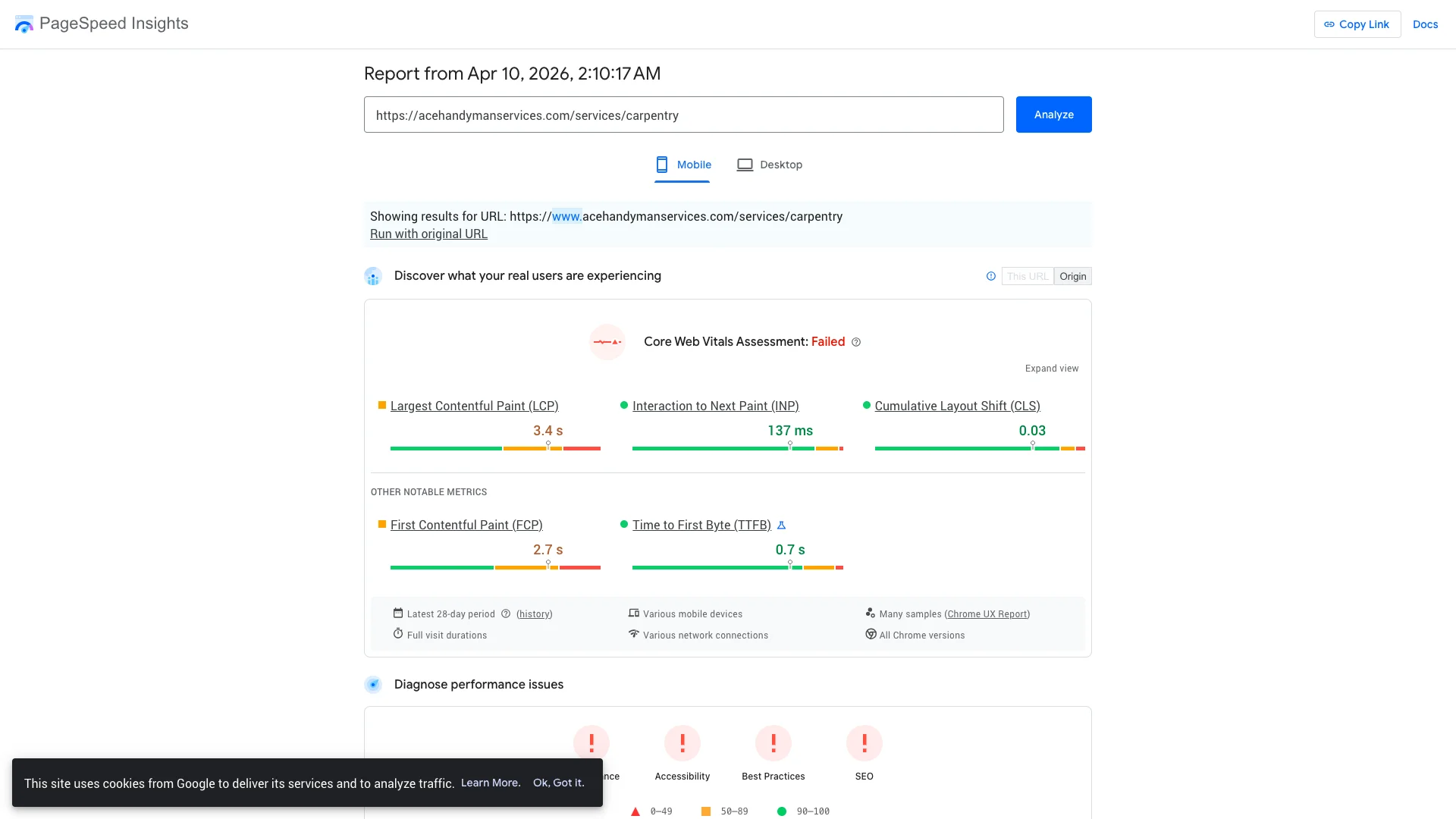
Google PageSpeed Insights runs a simulated slow-phone lab test. The scores are worst-case, not what you see on your phone with WiFi. But Google uses them as a ranking factor in search results.
The offices page scored 89. The carpentry page scored 93. The services page scored 89. All three are solidly in the green zone. And layout stability is near-perfect: 0.000 on the offices page, 0.001 on the carpentry page, and 0.051 on the services page. Content doesn't jump around as these pages load.
"53% of mobile users abandon sites that take longer than 3 seconds to load."
— Google / SOASTA (2017)
What makes this impressive is that the pages aren't empty. The offices page carries 5,077 words. That's a substantial page by any standard. And it still scores 89. Most franchise sites we've tested load heavier templates with corporate tracking scripts, A/B testing tools, and third-party integrations that drag scores into the 30s and 40s. Ace Handyman's template is clean enough to carry real content without a speed penalty.
The carpentry page scored 93, which puts it among the fastest pages in the CRO Index. And it does that with 1,423 words of content and a 10-field form. So this isn't a case where the speed comes from emptiness. Ace Handyman has genuinely figured out how to build fast pages that also have substance. That's rare in this series.
Compounding effect
"Conversion rates drop approximately 12% for each additional second of page load time."
— Google / Deloitte (2020)
Lead capture: forms on every page, strong CTAs
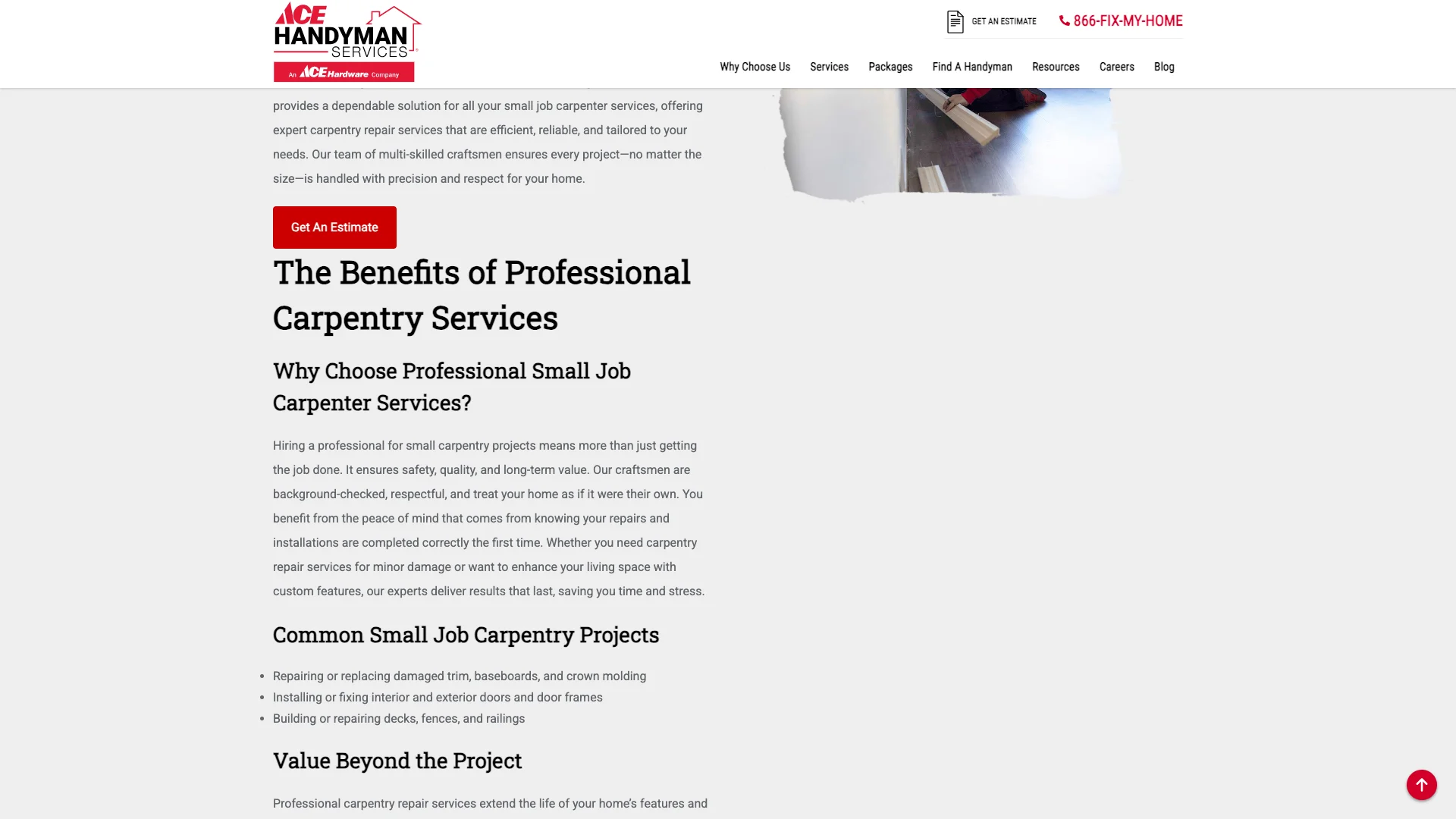
Every tested page has a form. The offices page has a single-field form. The services page has a similar setup. And the carpentry page goes deeper with 10 form fields and a "Schedule an Appointment" option alongside the standard "GET AN ESTIMATE" button.
That's a solid lead capture setup. A homeowner who lands on any of these pages has a clear path to conversion. They don't have to hunt for a contact page or navigate away from the content they came to read. The form is right there.
"68% of users wouldn't submit a form if it required too much personal information."
— Baymard Institute (2024)
One thing worth noting: the carpentry page's 10-field form is on the heavier side. Research from Baymard shows that form completion rates drop as fields increase. But for a handyman service where the scope of work varies widely, asking a few extra questions upfront (room count, service type, preferred date) can actually improve lead quality by filtering out tire-kickers. So the field count isn't automatically a problem. It depends on whether those 10 fields are all necessary or whether some are friction that could be moved to a follow-up call.
Trust signals: the one gap that matters
This is where the teardown pivots. Because everything else on these pages is competent. Speed is excellent. Content depth is real. Forms exist. CTAs are visible. And then you check for social proof and the audit comes back empty.
- Google Reviews: Not found on any page.
- Review widgets: Not found on any page.
- Trust badges: Not found on any page.
- Chat widget: Not found.
- BBB badge: Not found.
- Certifications: Not found.
Zero out of six on a national franchise brand with 16,800 monthly visitors. A homeowner reads the content, sees the form, and has to decide whether to submit their information based purely on the brand name. No star rating. No review count. No "trusted by X homeowners" badge. Nothing that says "other people hired these guys and it went well."
Comparison
"83% of consumers use Google to find local business reviews; 74% use two or more review platforms when researching."
— BrightLocal (2025)
And Ace Handyman almost certainly HAS reviews. They're a national franchise with locations across the country. Individual franchise locations likely have Google Business Profiles with dozens or hundreds of reviews. But those reviews aren't rendered on the website pages themselves. So a homeowner who finds the carpentry page through organic search has to leave the site, go to Google Maps, search for their local Ace Handyman, find the reviews there, come back, and then fill out the form. Most won't. They'll just leave.
What Ace Handyman does well
Speed with substance. Scoring 89 to 93 on Google's mobile lab test while carrying 502 to 5,077 words of content is genuinely impressive. Most brands in the CRO Index that score above 80 do it by stripping away features. Ace Handyman does it by building a clean template. That's harder and more useful.
Consistent lead capture. Forms and "GET AN ESTIMATE" CTAs on every tested page. No dead ends. No pages where the homeowner has content but no way to act on it. That consistency matters more than any individual form's design.
Content depth on the offices page. 5,077 words is a serious investment in content. That kind of depth gives Google plenty to index and gives homeowners real information about services, locations, and what to expect. It's the kind of page that can rank for dozens of long-tail keywords simultaneously.
"64% of homeowners say having recommendations or references is a top-three factor in choosing a contractor."
— Houzz Inc. (2025)
Near-perfect layout stability. 0.000 on the offices page. 0.001 on the carpentry page. Content doesn't shift as the page loads. That's a user experience win that most visitors won't consciously notice but will feel. Pages that don't jump around feel more trustworthy than pages that rearrange themselves under your thumb.
What the gaps mean for handyman companies
Ace Handyman is one good addition away from having some of the strongest pages in the CRO Index. The speed is there. The content is there. The forms are there. And the one thing missing is the one thing homeowners care about most when picking a contractor: proof that other homeowners had a good experience.
Add Google Reviews to every service page. A Google Reviews embed widget is free. Put it above the fold with the star count and review count visible. 83% of consumers use Google to find local business reviews (BrightLocal 2025). Bring those reviews to the page the homeowner is already on instead of making them leave to find them.
Add trust badges. Industry association badges, insurance verification, warranty badges. They cost nothing to display, they add almost no page weight (so the 89-93 scores won't drop), and they answer the question the homeowner is asking silently: "Is this company legitimate?"
Consider adding hidden code labels. The pages we tested don't carry labels that tell Google what kind of business Ace Handyman is. Adding a "local business" or "home and construction business" label takes 10 minutes and gives Google explicit context about what the page is about. With 16,800 monthly visitors already, those labels could improve how the pages appear in search results.
"48% of customers say that if a site does not work well on mobile, it signals the company does not care about their business."
— Google Consumer Insights (2018)
The blueprint is almost complete. If you're a handyman company or general contractor, Ace Handyman shows you what a well-built franchise page template looks like: fast, stable, content-rich, with clear conversion paths. The gap is social proof. Add it, and you've got a page that checks every box.
Frequently asked questions
How does Ace Handyman score on Google's mobile test?
The offices page scored 89 out of 100 on Google PageSpeed Insights mobile. The carpentry page scored 93. The services page scored 89. All three are solidly in the green zone. The carpentry page ranks among the fastest in the entire CRO Index, and it carries 1,423 words of content plus a 10-field form. Speed doesn't require emptiness.
Does Ace Handyman have forms on its pages?
Yes. Every tested page has at least one form with a "GET AN ESTIMATE" call to action. The carpentry page has 10 form fields plus a "Schedule an Appointment" option. Lead capture paths exist on every page we checked.
Does Ace Handyman display Google Reviews on its website?
No. Across all three tested pages, there are zero Google Reviews widgets, zero star ratings, zero review counts, and zero trust badges. The pages have strong content and forms, but no social proof. That's the single biggest gap in the entire teardown.
How much organic traffic does acehandymanservices.com get?
According to Ahrefs data from March 2026, acehandymanservices.com receives approximately 16,800 monthly organic visitors with an estimated traffic value of $33,500. The offices page accounts for 1,100 of those visitors (6.5% share). The carpentry page accounts for 315 (1.9%). The services page accounts for 186 (1.1%).