0
contractor sites graded, one A
Across the whole CRO Index, a single site earned an A. The median landed at a D. The grade gap is a conversion gap.
You're getting clicks in San Diego. They're just not calling. We rebuild your site around the one job that matters: turning a visitor into a booked job.
Starts with a Site Inspection, so you see the plan before any build begins.
“Patient, on point, straightforward. Did amazing work. Would 100% recommend.” — Ruben Mederos, HyperTemp HVAC
“Responsive, creative, exceeded expectations. Already seeing greater engagement from our clients.” — George Jeorgy, Jeorgy's Landscape Construction
“Top-tier professionalism, real web design expertise, ideas I hadn't considered. Confidently recommend.” — Aws Nassani, Four Eleven Contracting



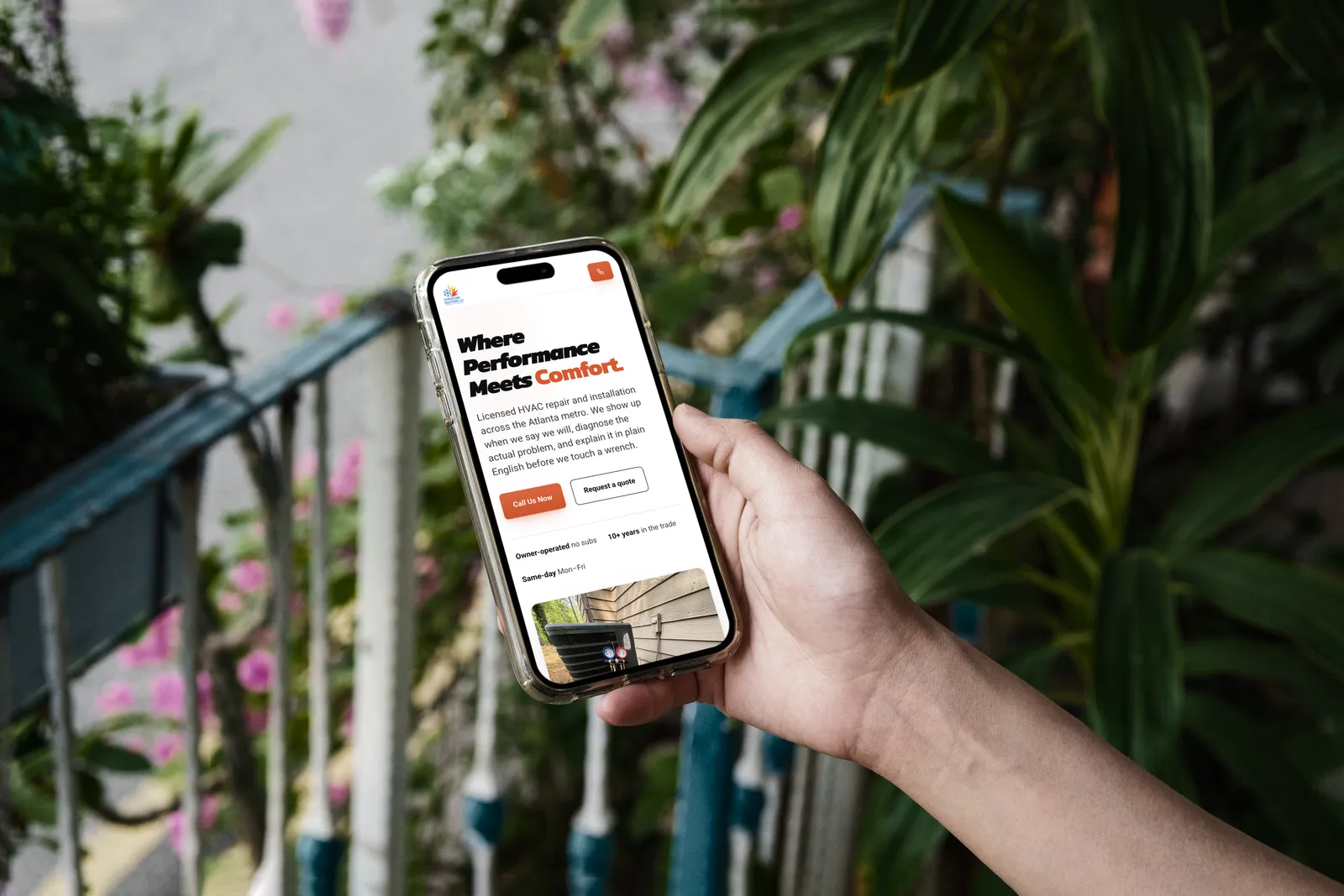
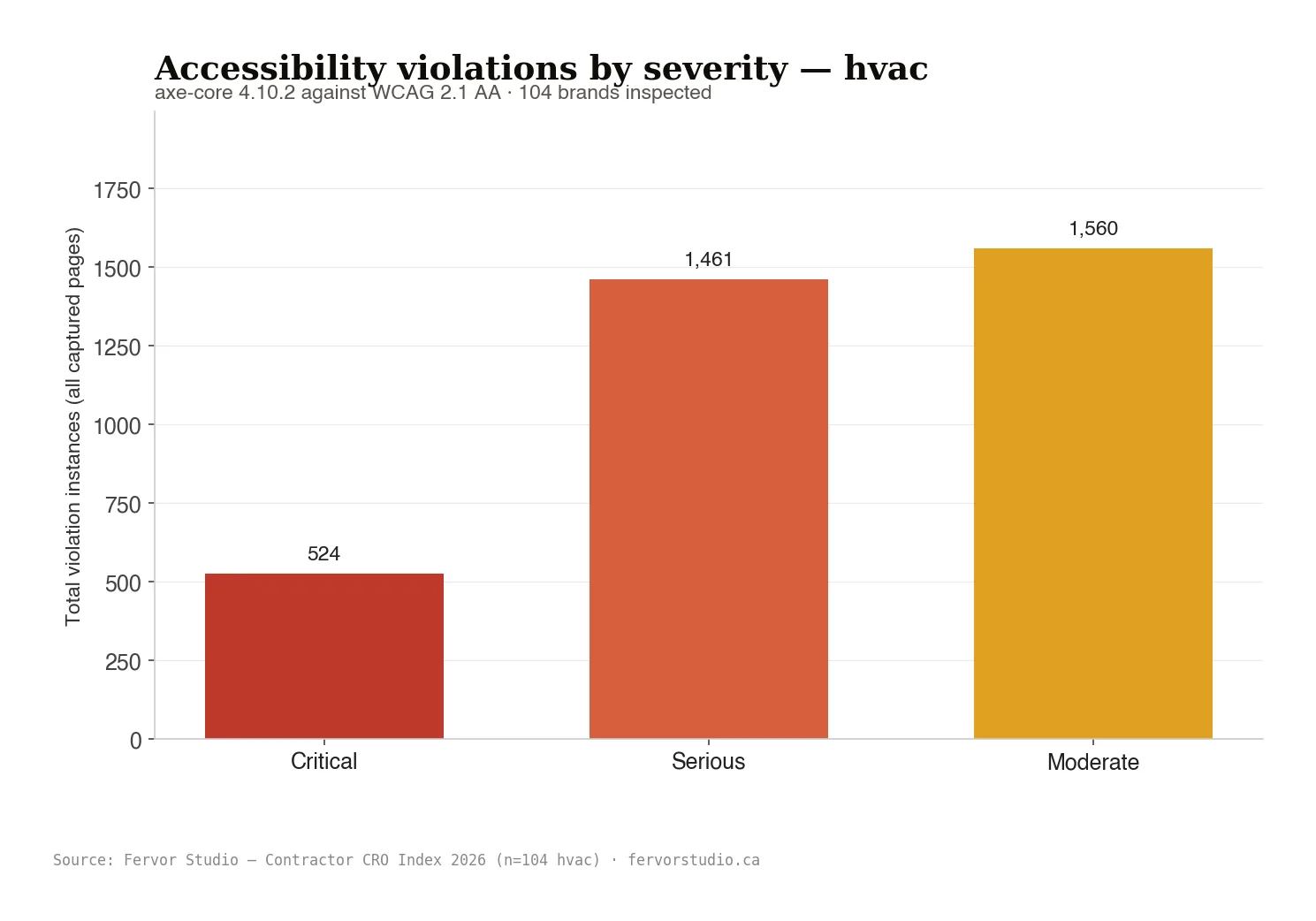
64.4% of HVAC sites we tested fail a critical accessibility check
Digital State of the HVAC Industry 2026A grade out of 380 contractor sites
We graded 380 of them against one framework. Exactly one earned an A: Crown Industrial Roofing in Toronto, at 90 out of 100. The rest left money on the table. Here is what separates the top from the bottom.
The local detail
Every angle below comes from how San Diego actually searches, buys, and regulates — built into the page, not bolted on.
San Diego HVAC contractors lose website visitors in three predictable scenarios.
San Diego is one of the only US metros where two homeowners on the same Tuesday afternoon can have a 20°F+ temperature differential.
Over 65% of HVAC contractor website traffic comes from phones.
Speed is the foundation.
Most San Diego HVAC sites have one Services page with bullet points.
San Diego is a trust-stack market.
San Diego County covers 4,526 square miles and 18 incorporated cities.
"18% of home services calls go unanswered on weekdays, while 41% go unanswered on weekends." — Invoca (2025)
You've already paid an HVAC website design agency or two. And if you run a HVAC shop in San Diego, the second one promised better than the first, then quietly stopped sending design revisions around month four. So you're back to staring at a template site that loads in 8 seconds on mobile, watching cost-per-call climb on Google Ads, wondering if HVAC website design San Diego is even a real specialty or just a generic web build with "San Diego" find-and-replaced. This page covers what HVAC website design San Diego actually requires when it's built for the San Diego market: sub-2-second mobile load times for inland heat-day searches, click-to-call placement that works on a marine-layer June morning, the coastal-vs-inland conversion paths most agencies miss entirely, CSLB C-20 trust display, and the rebate-calculator content that turns a Hillcrest homeowner browsing TECH Clean California into a booked consultation.
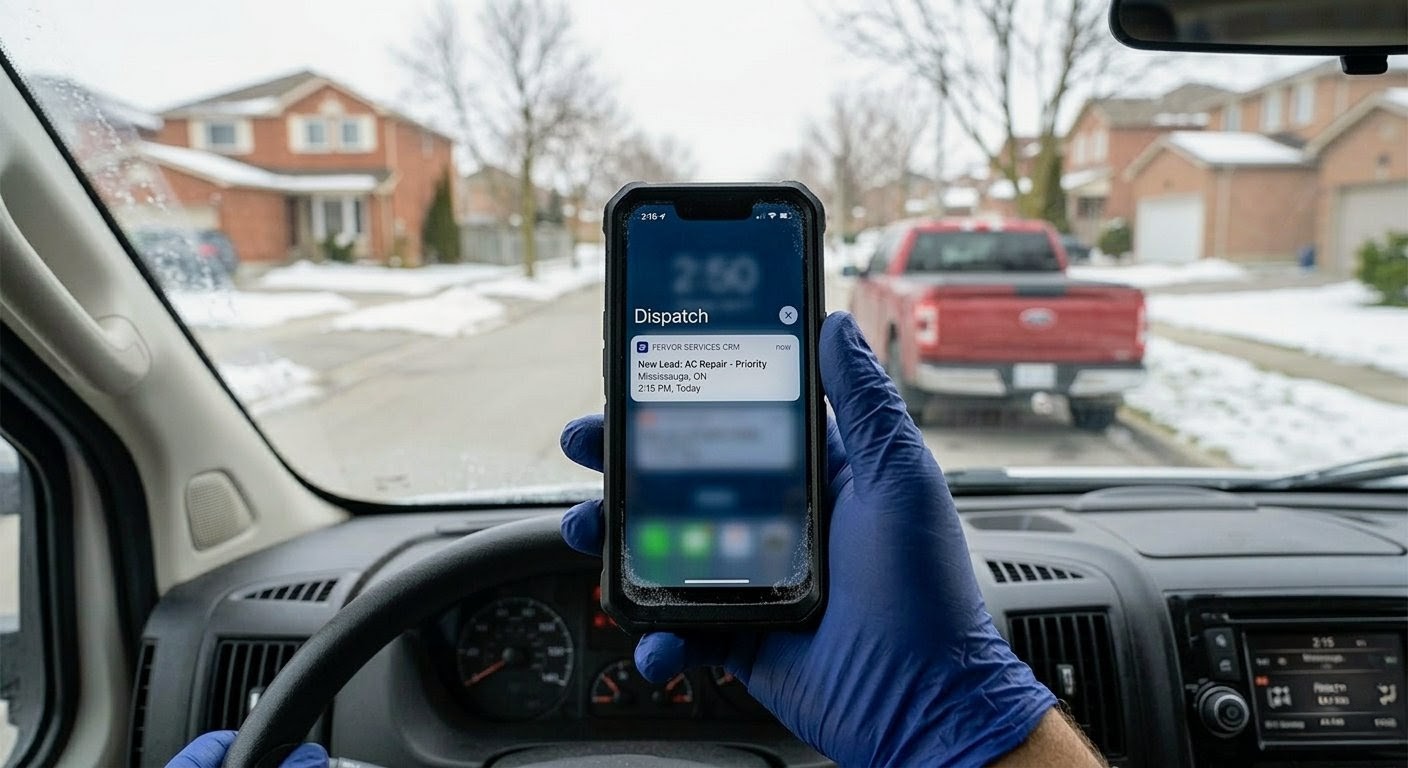
San Diego HVAC contractors lose website visitors in three predictable scenarios. A homeowner in La Jolla scrolls a salt-air-corroded condenser problem on her phone at 7am, and your site takes 9 seconds to load. A Poway family searches "AC repair Poway" at 2pm during a 100°F September heat dome, and your phone number sits five scrolls below the fold. And a Sorrento Valley homeowner Googles "HEART rebate heat pump San Diego" looking for the rebate-eligible contractor list, and your site has zero rebate content. If your HVAC website design San Diego work doesn't load fast, doesn't put your phone number where her thumb already is, and doesn't answer the rebate question her browser tab is open to, the call books with the contractor whose site did. So the first question for any HVAC website design San Diego engagement is whether your site loads under 2 seconds on a 4G phone, whether the booking path is single-thumb operable, and whether your rebate, coastal-grade, and CSLB content answers a San Diego buyer's specific search. Most San Diego HVAC shops fail at least two of three.
"A 10-second delay will often make users leave a site immediately. You can easily lose half your sales simply because your site is a few seconds too slow." — Nielsen Norman Group (2020)
That's half your visitors walking because your site loads too slow. And most San Diego HVAC contractor sites are running on shared hosting with uncompressed images, third-party tag-manager bloat, and seventeen tracking scripts loading before your phone number paints. Every second of delay past 1.5 seconds on mobile is roughly an 8% conversion drop on home-services traffic, which means a 6-second load isn't slow — it's a 35-40% revenue cut on every visitor who lands.
San Diego is one of the only US metros where two homeowners on the same Tuesday afternoon can have a 20°F+ temperature differential. La Jolla is at 75°F with marine layer fog. Poway is at 95°F with Santa Ana flow. Both are searching HVAC. Both are landing on your site. And both want completely different things. So a real HVAC website design San Diego build doesn't drop them into the same generic homepage funnel. It splits them.
The La Jolla homeowner is shopping coastal-grade install. She wants to know if your condenser coatings hold up to salt air. She wants to see equipment makes (Mitsubishi Hyper-Heat, Carrier Infinity, Bosch IDS Premium) with anti-corrosion options. And she wants photos of your crew on a Coronado or Pacific Beach job, not a stock photo of a furnace in a Minneapolis basement.
The Poway homeowner is shopping AC repair, fast. He wants your phone number above the fold. He wants a 24-hour response promise (or a clear after-hours fee structure). And he wants a real "AC repair Poway" page that loads instantly, not a generic "Heating and Cooling" landing page that funnels every search into the same form.
The Sorrento Valley homeowner is shopping rebate eligibility. She wants HEART program walkthroughs, TECH Clean California enrollment verification, HEEHRA income-threshold math, and the IRA 25C tax-credit calculation laid out in plain English. She wants to know if you're on the TECH-enrolled contractor list and whether the December 2023 and January 2024 flood-impact priority lane applies to her ZIP. So the hvac website design san diego shop that ships one homepage and four service pages misses every one of these visitor types.
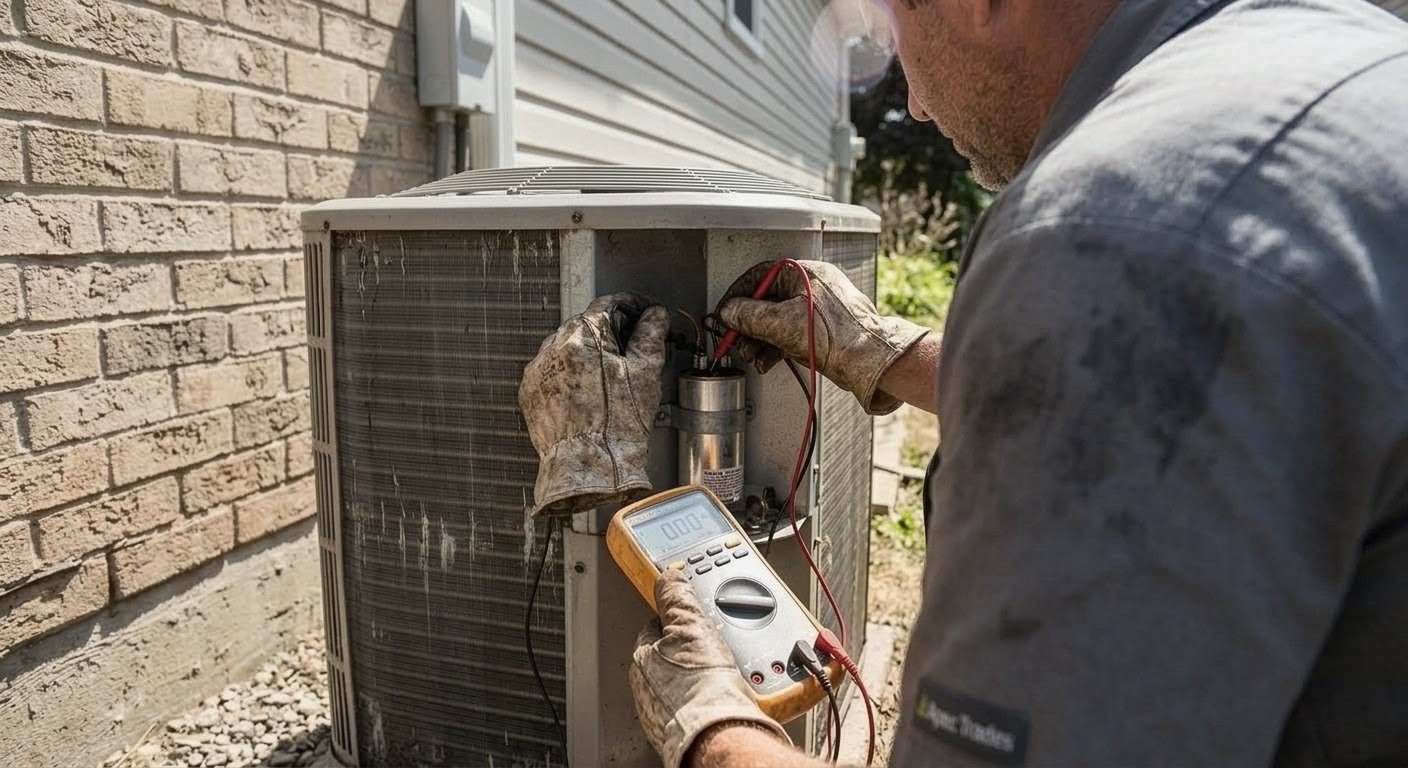
Over 65% of HVAC contractor website traffic comes from phones. In San Diego, that share runs closer to 70% — partly because the metro's lifestyle is outdoor-heavy and people Google contractors from a beach, a backyard, or a hiking trail in Mission Trails just as often as from a desktop. Your HVAC website design San Diego build has to assume the visitor is on a 6-inch screen, possibly outside in bright sun, possibly with one hand holding a baby or a dog leash, possibly with bad cell signal in Sunset Cliffs or East County canyon country.
"Phone calls convert to 10-15x more revenue than web leads for home services businesses." — BIA/Kelsey + Forrester (2025)
Phone calls convert at 10-15x the revenue of form fills. So every design decision (where you place the phone number, how big the tap target is, whether it's sticky or static) directly impacts revenue. Click-to-call has to be flat-out easy on every viewport: a 44px minimum tap target, phone number in the sticky header on every scroll position, phone number repeated under every H2 break, and a second floating CTA that surfaces after 30% scroll depth.
The form is the backup, not the hero. Forms exist for after-hours visitors, for people who want to schedule a non-emergency tune-up next Wednesday, for the small percentage who genuinely prefer typing. But for the 7am La Jolla homeowner staring at a salt-air-corroded condenser, the phone number is the conversion path. So your hvac website design san diego layout should make calling so frictionless that not calling feels like an extra step.
Speed is the foundation. Your buyer is in a moment of urgency: a 100°F Poway afternoon, a humid La Jolla mini-split that quit overnight, a Carmel Valley smart thermostat throwing an error code. Patience is gone before they even land on your site.
"Three critical response time thresholds: 0.1 seconds feels instantaneous. 1.0 second keeps flow of thought. 10 seconds is the limit." — Nielsen Norman Group (2024)
Ten seconds is the absolute ceiling. And yet: pull up most San Diego HVAC contractor sites on Google PageSpeed Insights right now. Watch the mobile scores. Most are sitting at 30-50, which translates to 6-12 second load times on a real 4G connection. That's not a website. That's lead repellent. A San Diego HVAC website design built right targets sub-2-second Largest Contentful Paint on mobile. Not 4 seconds. Not "fast enough." Under two.
Achieving that load time takes Astro static-site generation (the framework Fervor builds on, deployed to Cloudflare's global edge, which serves your site from the closest edge node, usually the LAX or Phoenix edge for San Diego buyers, both within 30ms latency). Image optimization at build time (every photo compressed to WebP/AVIF, sized to actual render dimensions, lazy-loaded below the fold). Minimal JavaScript (no Bootstrap, no jQuery, no third-party page-builder runtime). And CSS scoped to the actual page, not a 400KB Tailwind dump. The result: a site that paints in 1.2-1.6 seconds on mobile across San Diego, holds 95+ on PageSpeed, and converts a measurable percentage more visitors than the 8-second WordPress template it replaced.
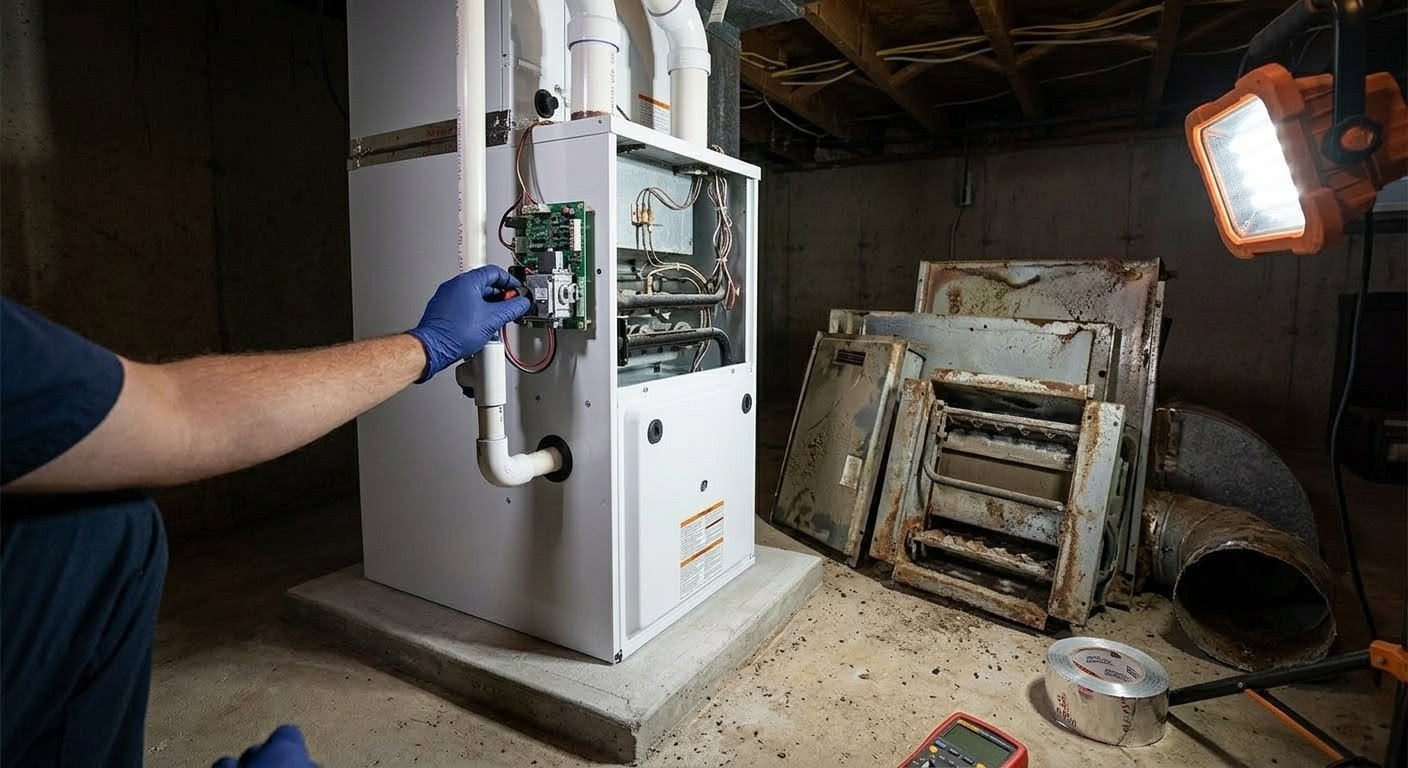
Most San Diego HVAC sites have one Services page with bullet points. A real HVAC website design San Diego build gives every major equipment type its own dedicated page with its own meta, schema, photos, internal links, and conversion path.
"U.S. heat pump shipments grew at an annual rate of 20.5% through May 2025, reaching 4.2 million units annually; heat pumps outsold gas furnaces in 2025." — Air-Conditioning, Heating, and Refrigeration Institute (AHRI) (2025)
So heat pumps have outsold gas furnaces nationally and the share is even higher in San Diego, where Title 24 and TECH Clean California have effectively made heat pumps the default new install. Your service-page architecture starts with a serious heat pump page covering ducted high-SEER2 systems for Carmel Valley and Poway homes that have ductwork, ductless mini-splits for the no-ductwork majority across Hillcrest, North Park, Mission Hills, and pre-1970s coastal stock, and coastal-grade variants for La Jolla, Carlsbad, Coronado, Mission Beach, and Imperial Beach installs.
"An ENERGY STAR-certified air-source heat pump can deliver up to three times more heat energy than the electrical energy it consumes." — U.S. Department of Energy / ENERGY STAR (2026)
Three-to-one efficiency is the line that closes a heat pump install for a Carmel Valley homeowner staring at a $300 August SDG&E bill. So your design has to put the math somewhere visible, not bury it in a blog post no visitor finds. A real HVAC website design San Diego build embeds an interactive rebate-stack calculator on the heat pump page itself: HEART eligibility quiz, TECH Clean California enrollment check, HEEHRA income-threshold lookup, IRA 25C credit math. (We've watched rebate calculators lift heat-pump-page conversion rate by 4-7x on contractor sites that previously had a static "rebates available!" callout.)
Other dedicated pages: ductless mini-split installation (the dominant retrofit pattern across coastal San Diego, including the no-ductwork bungalow stock in North Park, Hillcrest, and Mission Hills), AC install + repair (the inland Poway, Santee, and El Cajon focus), whole-home dehumidifiers (less critical than Houston but real in marine-layer summer mornings when coastal RH hits 80%+), HEPA + MERV-13 IAQ products (wildfire-smoke-season demand spike), tankless water heaters, hot water tanks, and light commercial rooftop units (Kearny Mesa industrial). Each gets its own meta, schema, photos, internal links to neighborhood pages, and conversion path.
San Diego is a trust-stack market. Buyers in La Jolla, Rancho Santa Fe, Coronado, and Del Mar verify license numbers on the CSLB lookup before they'll book. They check Yelp reviews. And they scan your site for ADA compliance issues their adult kids told them to look for. So a real HVAC website design San Diego build treats trust as visible architecture, not a "License # 123456" line in the footer.
The CSLB C-20 Warm-Air Heating, Ventilating and Air-Conditioning classification is California's gating signal. The C-20 requires four years of full-time journey-level experience in the last 10, the C-20 trade exam, and the Law & Business exam. A real barrier to entry. So your design should display the C-20 number prominently in the header (not the footer), link directly to the CSLB license lookup, and explain on a dedicated About / License page what the C-20 covers and why an unlicensed handyman doing AC swaps is operating outside California state law. Most San Diego HVAC sites bury this. The contractor whose site surfaces it converts more -band buyers.
"25% of homeowners say trusting contractors is their top challenge when planning home improvement projects." — Houzz Inc. (2025)
One in four prospects scoring you on trust, not skill. So the design layer matters as much as the copy. Real client photos (your crew, your branded vans, real San Diego jobs, not a stock photo of a smiling tech in front of a Lennox unit). Your CSLB number visible without scrolling. Recent reviews surfaced (with response from your team, demonstrating you actually engage). Schema markup that feeds Google's rich-result blocks. And a real BBB, NiceJob, Yelp, and Houzz badge stack, not the fake "As Seen On" logo wall that signals desperation.
And ADA compliance is the second California-specific layer. Title III of the ADA, plus California's Unruh Civil Rights Act, exposes your business to lawsuit risk if your site fails accessibility standards. Real HVAC website design San Diego work means alt text on every image, semantic HTML structure (real h1 / h2 / h3 hierarchy, not just visually styled divs), 4.5:1 minimum color contrast, keyboard-navigable forms, ARIA labels on all interactive elements, and visible focus indicators. (We've watched plaintiff-firm bots scan California contractor sites for ADA violations and file demand letters within 60 days of a non-compliant launch. The fix at design time is essentially zero cost. The fix after a demand letter is $5,000-$25,000.)
San Diego County covers 4,526 square miles and 18 incorporated cities. So one homepage targeting "San Diego" is not a service-area strategy. It's a placeholder. Real HVAC website design San Diego work builds dedicated service-area pages by quadrant, each anchored in real neighborhood characteristics, with photos of crews on real jobs in that quadrant.
Coastal Premium: La Jolla, Rancho Santa Fe, Coronado, Del Mar, Mission Beach. Page leads with coastal-grade equipment specs (anti-corrosion coil coatings, Mitsubishi Hyper-Heat, Carrier Infinity), no-ductwork mini-split retrofits, salt-air premature-failure prevention content, and rebate-stack walkthroughs.
Inner-City Older Stock: Hillcrest, North Park, Mission Hills, Bankers Hill, South Park, Old Town, Golden Hill. Pre-1940s housing, ductless mini-split heavy, ADU permit activity rising. Page covers bungalow-court multi-unit retrofit content, narrow-lot install constraints, and line-set routing for second-story Mission Hills jobs.
Mid-City + Mission Valley: Mission Valley, Kearny Mesa, Clairemont, Linda Vista, Serra Mesa. 1960s-1980s housing, mixed ductwork condition, replacement-on-failure behavior. Page covers rooftop unit demand for Kearny Mesa light commercial.
Carmel Valley + Sorrento Valley: tech-corridor master-planned. Newer ducted construction. Smart-thermostat integration, premium specs, HEART rebate flood-priority lane (Sorrento Valley was directly impacted by December 2023 and January 2024 flooding).
Inland Cooling-Dominant: Poway, Santee, El Cajon, Escondido, Lakeside, Lemon Grove, Spring Valley. Inland heat exposure (95°F+ September days), traditional ducted AC dominant, real gas-furnace install volume. Page leads with 95°F September design-day sizing and emergency response time.
South Bay: Chula Vista (~280K population, the county's #2 city), Imperial Beach, National City, Bonita, Otay Ranch. Family-and-value market, growing Otay Ranch master-planned demand, HEART eligibility high.
North County: Carlsbad, Oceanside, Encinitas, Solana Beach, Vista, San Marcos. Coastal western half, inland eastern half. Page covers the regional split with separate equipment-spec rationale for each.
Each service-area page links to the trade hub and back, mentions specific local landmarks (Balboa Park, Petco Park, Torrey Pines, Sunset Cliffs, Mt Soledad, the Coronado Bridge, USS Midway, Mission Bay, the Cuyamaca Mountains for East County), and uses photos of real jobs in that quadrant. So the san diego web design company that ships rebadged Phoenix or Houston pages with "San Diego" find-and-replaced is leaving signal entirely on the table.
"18% of home services calls go unanswered on weekdays, while 41% go unanswered on weekends." — Invoca (2025)
Forty-one percent of home-services calls go unanswered on weekends. When do San Diego HVAC emergencies happen most? Friday nights, Saturday afternoons, Sunday mornings — exactly when most contractors are least staffed to answer. So your HVAC website design San Diego work has to account for this. After-hours functionality that goes beyond "we'll call you back Monday." Real-time online booking with availability windows. A clearly labeled emergency dispatch number routed to your on-call tech. A simple "leave your number, we'll call within 15 minutes" workflow integrated with your ServiceTitan, Housecall Pro, or Jobber dispatch. A chat widget that's actually staffed (or honest about its hours). Each of these is a design decision that determines whether the Saturday-afternoon Poway emergency call books with you or with the contractor down the I-15.
"40% of home services consumers who call from search make a purchase." — Google via Invoca (2025)
Forty percent of home-services search calls convert. So every percentage point you lift on click-to-call rate compounds straight to revenue. Your hvac web design san diego layout should make calling so obvious, so fast, and so effortless that the visitor calls before they finish reading the page.
Five steps. No mystery. No "creative discovery process" that's really just a sales call with mood boards.
We score your current HVAC site across six conversion categories: speed, mobile usability, click-to-call placement, service-page architecture, trust-stack visibility, and ADA compliance. You'll see exactly where San Diego visitors are dropping off, how your site loads on a real 4G connection in Poway, how your competitors stack up, and what it'd take to move you from a 30-50 PageSpeed score to a 90+. About three days. You own the report regardless of what happens next.
We study your San Diego market. Who's ranking? What does their booking path look like? What rebate content exists? We look at your ServiceTitan dispatch (or Housecall Pro, or Jobber) to understand your actual job mix, average ticket, and seasonal patterns. A site built for a coastal La Jolla shop doing 60% premium heat-pump retrofits looks different from one built for a Poway shop doing 60% inland AC service.
Site structure, page hierarchy, every word of copy. Every service page, service-area page, and rebate-calculator page mapped to real San Diego search demand and real conversion paths. Coastal-grade vs inland-heat content paths split before the design starts. CSLB C-20 trust placement designed in. ADA compliance built into the semantic structure, not bolted on after launch.
Astro static-site framework deployed to Cloudflare's global edge. Sub-2-second Largest Contentful Paint on mobile. Click-to-call placement tested on actual phones with the thumb-zone rule: if a homeowner can't tap your phone number with one hand at 2pm during a 100°F Poway afternoon, the CTA fails. ADA compliance verified with axe-core and manual screen-reader testing. Schema stack built (Organization, Service, FAQPage, BreadcrumbList) on every page.
Your site launches with CallRail tracking in place, all logins transferred, and documentation for routine updates. You own the domain, content, hosting, GBP, everything. And if you want compound growth from ongoing seasonal content and HVAC website design San Diego maintenance, Performance Partner picks up where the build leaves off.
Three engagement options for HVAC website design San Diego, all built on website ownership and no long-term contracts. Booked by Design is the headline rebuild. The two SEO-direct options ride on top once the site is live.
Booked by Design™ — $9,997-$12,997 for HVAC. 30-60 days. Full site rebuild including service pages, San Diego quadrant location pages, rebate-calculator integration, schema stack, ADA-compliant semantic structure, sub-2-second mobile load, GBP setup, and review system installation. Day-one ownership of domain, content, and hosting. This is the lead engagement for HVAC website design San Diego work.
The Local Pick — $2,497 one-time, ~14 days from kickoff to handoff. If your existing site works structurally but your San Diego local presence is invisible: GBP optimized, citations built and corrected across Yelp, BBB San Diego, YellowPages.com, Angi, IHACI, and the TECH Clean California enrolled-contractor directory, NiceJob review system configured, and HEART + TECH + HEEHRA + 25C rebate content layered onto your existing pages. No retainer attached.
Performance Partner™ — $1,497-$3,997/month, ongoing. Quarterly content additions targeting San Diego search volume (regional service-area pages, coastal-grade install content, rebate-cycle content as HEART expands), GBP photo and post management, NiceJob review automation, citation maintenance, and monthly call-volume reporting tied to revenue. This is what compounds.
"The NAHB/Westlake Royal Remodeling Market Index posted a reading of 64 in the fourth quarter of 2025, up four points compared to the previous quarter, with rising costs and customer hesitation flagged as key challenges." — National Association of Home Builders (NAHB) (2026)
Remodeling sentiment is up. So San Diego HVAC contractors who built proper website infrastructure now keep eating share as electrification rebates expand and HEART scales out. The ones still on a 2018 WordPress template with an 8-second mobile load time feel the squeeze first because their cost-per-call climbs while their conversion rate doesn't budge. So San Diego HVAC website design built this way compounds. Done cheap, it evaporates the moment a competitor's site loads faster.
Booked by Design runs 30-60 days from kickoff to launch. Discovery takes about a week. Content architecture and copy run 2-3 weeks. Design and development run 2-4 weeks. Launch and handoff take 3-5 days. The Local Pick is ~14 days from kickoff to handoff.
Booked by Design rebuild is $9,997-$12,997. The Local Pick is $2,497 one-time. Performance Partner is $1,497-$3,997/month ongoing. All include website ownership transferred on day one. No long-term contract on any tier.
Yes. Domain, content, hosting credentials, GBP, citation directory logins, all transferred on day one. If you ever leave Fervor, you take everything. Most agencies don't operate that way.
San Diego's mild Mediterranean climate, the 20°F coastal-to-inland temperature differential on the same day, the no-ductwork pre-1970s housing stock that drives mini-split retrofit dominance west of I-15, salt-air corrosion across La Jolla and Coronado, the HEART program's flood-priority rollout in 2024-2026, the TECH Clean California + HEEHRA + 25C rebate stack, and the CSLB C-20 trust-display requirement — all of it makes San Diego a different design problem. Generic California templates miss most of it. So your HVAC website design San Diego work has to speak to coastal vs inland, mini-split-dominant retrofit, HEART eligibility, CSLB C-20 verification, and ADA compliance, or it reads like a Los Angeles page rebadged.
The evidence
 Read the full report →
 0
contractor sites graded, one A
Across the whole CRO Index, a single site earned an A. The median landed at a D. The grade gap is a conversion gap.
0 %
of HVAC sites fail a critical accessibility check
Scored against WCAG 2.1 AA with axe-core. A page that blocks a screen reader also blocks a paying customer.
Fervor HVAC State of the Industry, 2026
0 %
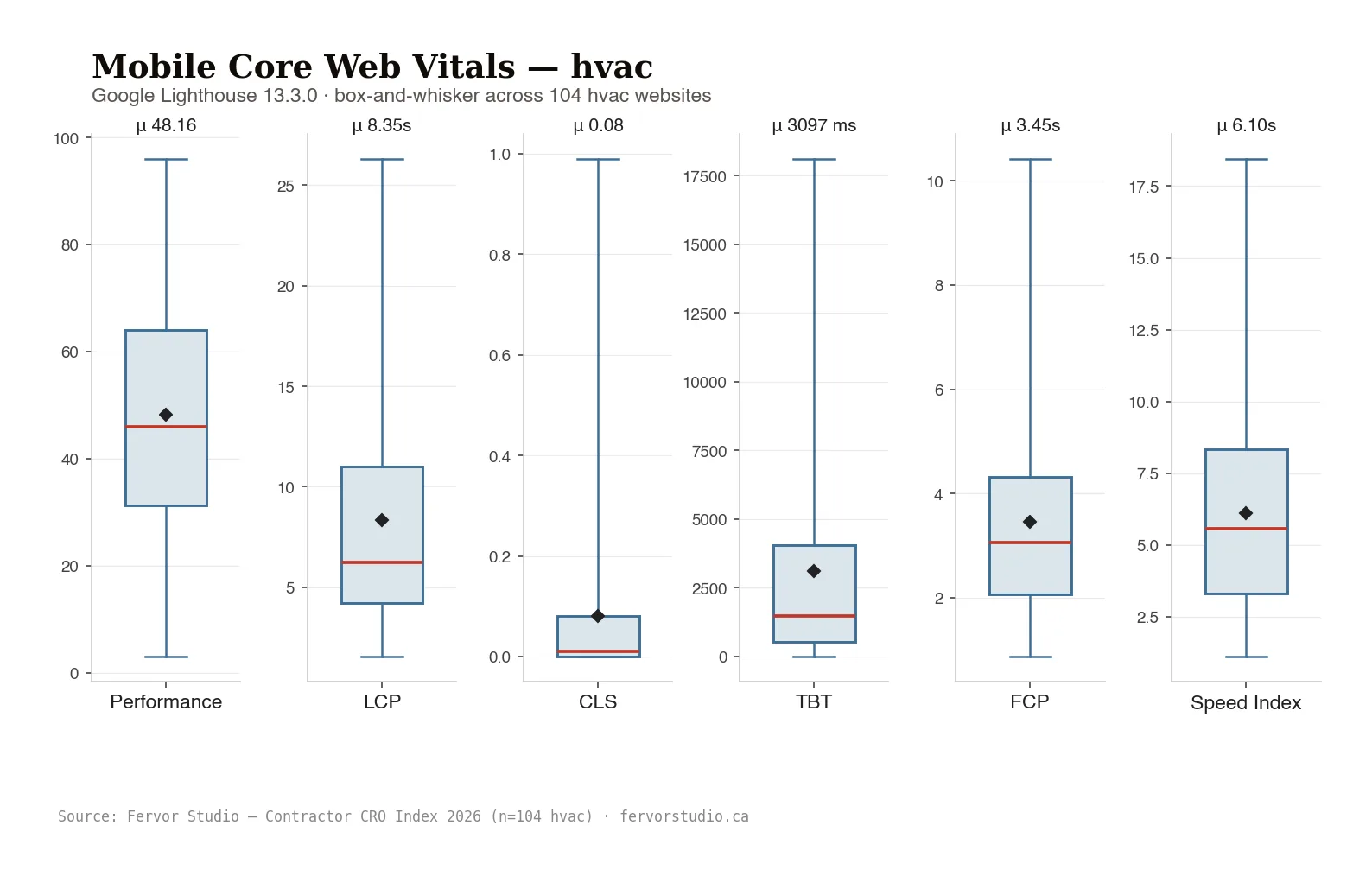
miss Google's mobile load-speed bar
Median mobile load lands at 6.24 seconds. Most of your traffic is on a phone, and most of them are gone before the hero paints.
Fervor HVAC State of the Industry, 2026
0 /100
is the average HVAC grade
That is a D. The sites booking the work are not the ones with the biggest crews. They are the ones a few points higher on the things homeowners feel.
Two ways to start
Tell us where you are. We point you at the right next step — no sales call to get there.
Client review
“Nay did an amazing job, you know. He was really patient. He got the work done the way I told him and he was just on point with the website. Pretty straightforward process. No going around the bush. He just did amazing work and I would 100% recommend.”
How Fervor can help
Complete website system built to convert storm leads, planned projects, and research-phase homeowners into booked jobs.
Identify and patch the top conversion killers on your existing site. No full rebuild needed.
Monthly SEO, content, and CRO. Fixed deliverables. No credits, no rollover. The compound growth engine.
GBP optimization, citation building, and review system foundation. The infrastructure that gets you into the Map Pack.
One conversion-built landing page for the referrals, paid clicks, and cold-call leads you send. They land on a page built to book them, not your generic homepage.
Your move
Tell us where you are. We point you at the right next step — no sales call to get there.
Keep going