0
contractor sites graded, one A
Across the whole CRO Index, a single site earned an A. The median landed at a D. The grade gap is a conversion gap.
You're getting clicks in San Antonio. They're just not calling. We rebuild your site around the one job that matters: turning a visitor into a booked job.
Starts with a Site Inspection, so you see the plan before any build begins.
“Patient, on point, straightforward. Did amazing work. Would 100% recommend.” — Ruben Mederos, HyperTemp HVAC
“Responsive, creative, exceeded expectations. Already seeing greater engagement from our clients.” — George Jeorgy, Jeorgy's Landscape Construction
“Top-tier professionalism, real web design expertise, ideas I hadn't considered. Confidently recommend.” — Aws Nassani, Four Eleven Contracting



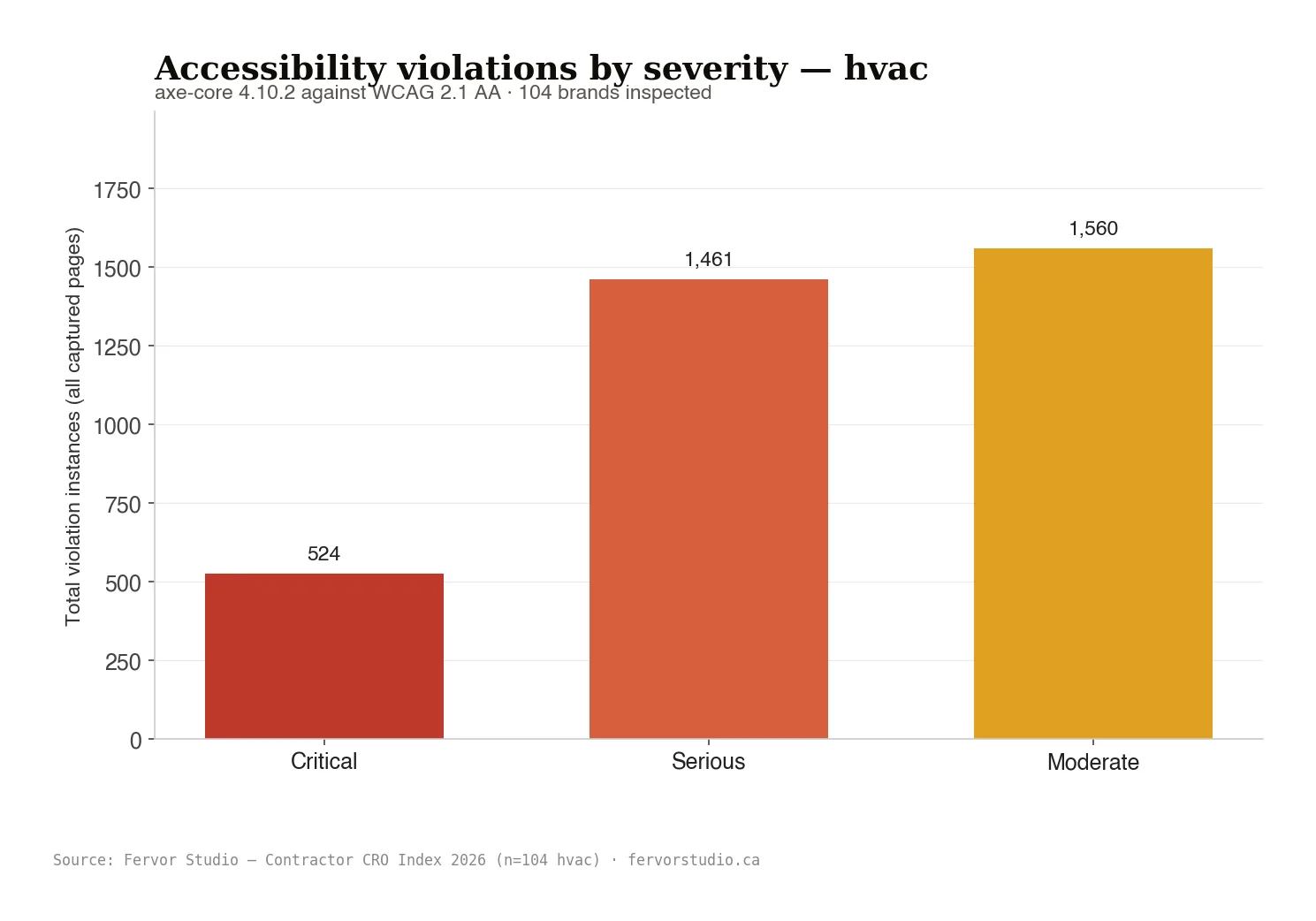
64.4% of HVAC sites we tested fail a critical accessibility check
Digital State of the HVAC Industry 2026A grade out of 380 contractor sites
We graded 380 of them against one framework. Exactly one earned an A: Crown Industrial Roofing in Toronto, at 90 out of 100. The rest left money on the table. Here is what separates the top from the bottom.
The local detail
Every angle below comes from how San Antonio actually searches, buys, and regulates — built into the page, not bolted on.
San Antonio HVAC contractors lose calls in a few specific scenarios.
"Users form a visual judgment about a website’s design within 50 milliseconds (0.05 seconds)." — Lindgaard, Fernandes, Dudek & Brown (2006)
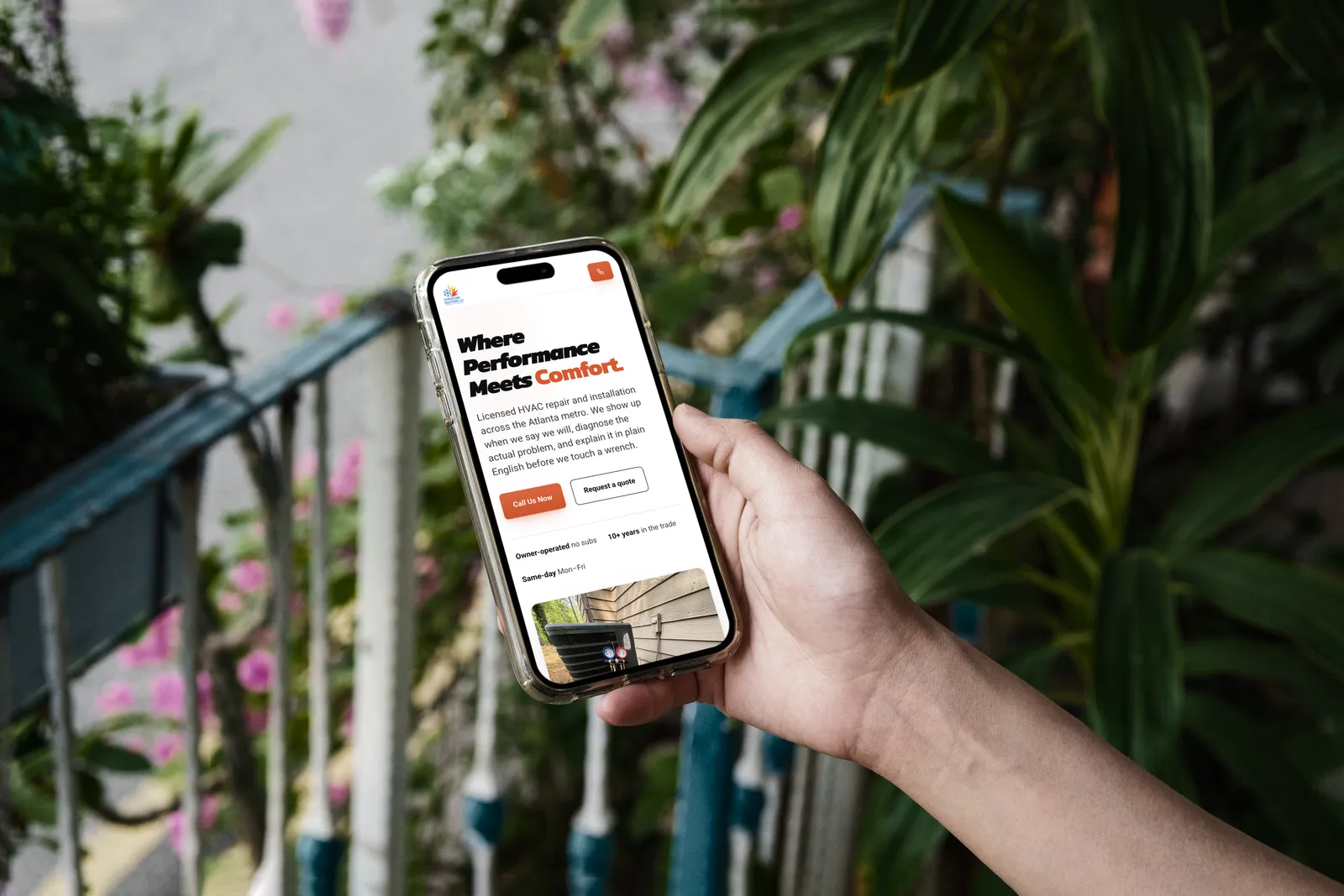
U.S. mobile traffic now sits around 42% of total internet traffic, with smartphones in 91% of adult hands per Pew Research’s 2025 panel.
Apple’s Human Interface Guidelines specify a minimum touch target of 44×44 points.
San Antonio is an AC-first market with hard-water complications and a brief but real winter cold-snap window.
The Texas Department of Licensing and Regulation requires a Class A or Class B Air Conditioning and Refrigeration Contractor licence for HVAC work statewide.
Forms break HVAC sites in three predictable ways.
You've already paid an HVAC web design agency or two. And if you run a HVAC shop in San Antonio, the second one probably promised better than the first, then quietly slid out of touch around month three. So you're back to wondering if HVAC website design San Antonio is even a real specialty or just a localized template most agencies bolt onto a generic page builder. This page covers what real San Antonio HVAC web design demands when it's built for the South Texas market: sub-two-second mobile load, click-to-call wired to the way buyers search at 105°F, TDLR Class A and Class B trust signals, hard-water and Edwards-Aquifer-flavoured service architecture, and the conversion path that keeps a Stone Oak or Alamo Ranch homeowner from bouncing back to Jon Wayne or Beyer Air because your site took four seconds to paint on a phone with two bars of LTE.
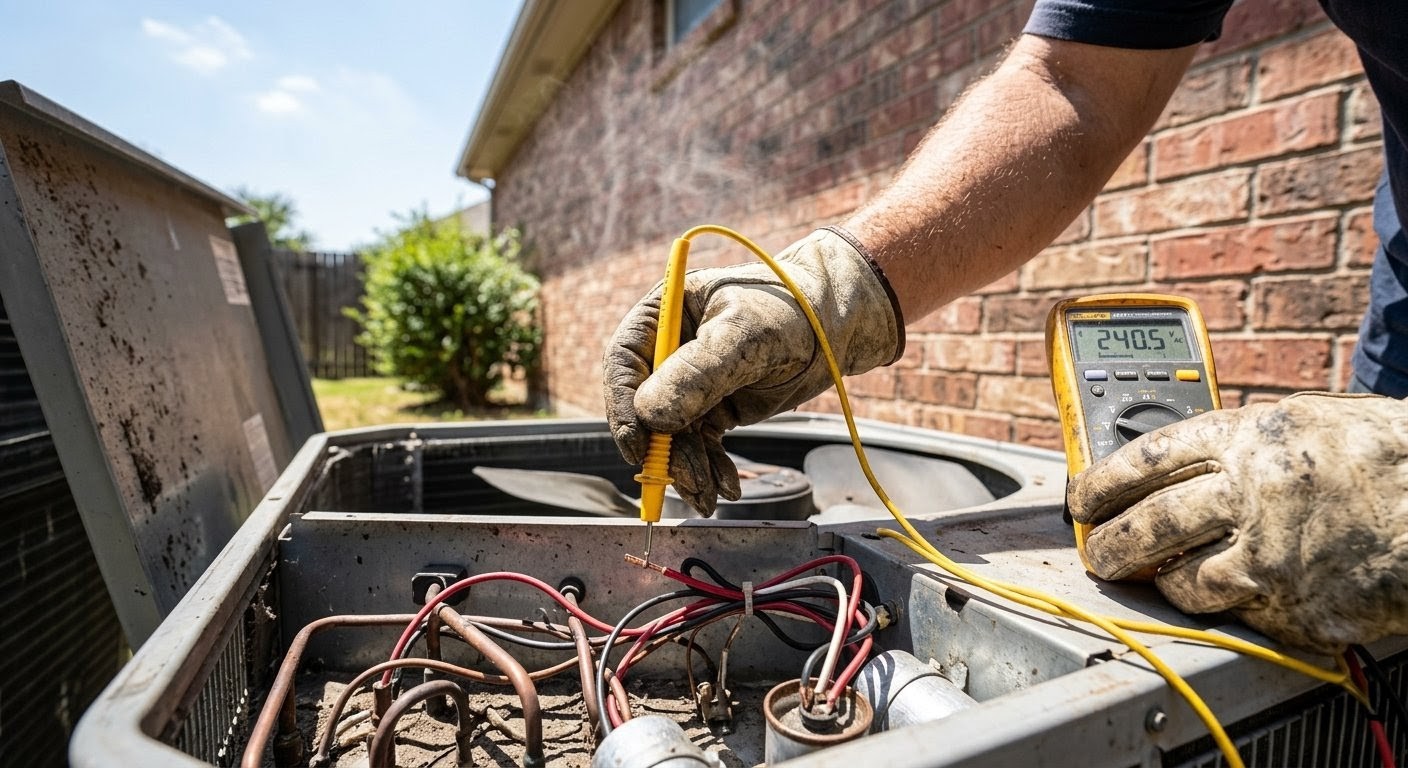
San Antonio HVAC contractors lose calls in a few specific scenarios. A Stone Oak homeowner's AC dies on a 105°F August Saturday and they Google "AC repair San Antonio" from the driveway, sweating. A Helotes family searches "emergency AC after Stage 2 water restriction" because the condensate line plugged on Edwards-Aquifer hard-water mineral load. A Joint Base San Antonio tenant searches "Lackland HVAC contractor TDLR licensed" because base-housing rules require the licence number on the invoice. And if your HVAC website design San Antonio doesn't paint inside two seconds, doesn't put click-to-call in the thumb zone, and doesn't show your TDLR ACR number near the fold, the call books with whoever's site did. Per Google and Deloitte, conversion drops about 12% for every additional second of load time. So a four-second site on a generic WordPress template costs you leads on every paid click that hits it.
"Conversion rates drop approximately 12% for each additional second of page load time." — Google / Deloitte (2020)
That cost compounds in San Antonio's August window when paid clicks on "AC repair San Antonio" can run $35-$55 each on Google Ads. A four-second site on a $50 click is paying Google to send buyers to a bounce. Real HVAC website design San Antonio fixes the math at the foundation, before a single ad campaign goes live.
"Users form a visual judgment about a website's design within 50 milliseconds (0.05 seconds)." — Lindgaard, Fernandes, Dudek & Brown (2006)
50 milliseconds. A blink takes 100. So before your visitor reads a word of your hero, before they see your TDLR licence number, before they notice the Jon Wayne ad they just clicked through wasn't actually Jon Wayne, they've already decided whether your site looks like the kind of business that fixes a Trane condenser at midnight in Schertz.
That visual judgment in San Antonio comes down to a handful of things you control. A clear hero image of a real crew on a real Boerne or Alamo Ranch job, not a stock photo of a smiling actor in front of a generic split system. A phone number in the top-right that's tappable on a phone, not a desktop-styled link that needs a fingertip stretch. A San Antonio neighbourhood named in the H1 (Stone Oak HVAC, Alamo Heights HVAC, JBSA HVAC) signaling to a Bexar County buyer that you serve their address. And the absence of every red flag a generic template throws: London-time copyright footers, contact-form maps pointing at the wrong continent, testimonials quoting a different company. (We see this on every rebuild. The sub-$1,000 template a contractor bought eight years ago is the single biggest conversion problem on their site, and the contractor doesn't know because nobody told them.)

U.S. mobile traffic now sits around 42% of total internet traffic, with smartphones in 91% of adult hands per Pew Research's 2025 panel. And for HVAC emergency searches, mobile share runs higher because the homeowner is standing in front of a dead condenser, not at a laptop. So an HVAC website design San Antonio build that doesn't load fast on a four-year-old iPhone with two bars of LTE in a Stone Oak driveway loses the call.
"53% of mobile users abandon sites that take longer than 3 seconds to load." — Google / SOASTA (2017)
53%. So if your San Antonio HVAC site loads in four seconds, you're losing more than half of mobile visitors before they see your hero. (And they're not coming back. Once a buyer bounces to Jon Wayne or Beyer Air, the call is gone.) Real HVAC web design in San Antonio targets sub-two-second Largest Contentful Paint on mobile. Which means specific build choices: static hosting on Cloudflare or Vercel rather than shared WordPress, image optimization with WebP and AVIF and lazy-loading off the fold, font subsetting to drop two seconds of unused glyph weight, JavaScript bundle trimming so the page renders before marketing scripts finish booting.
"Swappie: Improving Core Web Vitals cut load time by 23% and increased mobile revenue by 42%." — Google web.dev (2021)
42% mobile revenue lift from a load-time cut. The Swappie study is e-commerce, but the math holds for HVAC service calls. Every second you cut from your San Antonio HVAC website's mobile paint pulls more leads through to the booking form.
"48% of customers say that if a site does not work well on mobile, it signals the company does not care about their business." — Google Consumer Insights (2018)
48%. So a slow mobile site loses the click and signals to half your buyers that you don't care about their business. In a market where Honeycomb Air, Beyer, and Jon Wayne are running fast-loading mobile sites with click-to-call wired into every page, that signal compounds into a measurable Local Pack disadvantage.
Apple's Human Interface Guidelines specify a minimum touch target of 44×44 points. Google Material Design recommends 48×48dp. So any tappable element on your San Antonio HVAC site that's smaller than that fails the thumb-zone test on the device most of your buyers are using.
"Apple recommends a minimum touch target of 44×44 points. Google Material Design recommends 48×48dp." — Apple / Google (2025)
Real San Antonio HVAC web design takes that math seriously. The phone number in the header is a button, not a tiny link, and it's pinned to the thumb zone (bottom-right on iOS, bottom-center on Android) so a homeowner sweating in a Boerne backyard at 105°F can tap it one-handed while holding a flashlight in the other. Your "Book Now" or "Get Service" CTA is a high-contrast button that meets WCAG 2.2 AA contrast in bright Texas sunlight, sized 48dp at minimum, and stays sticky on scroll so the buyer never has to thumb back to the top.
"84% of marketers report phone calls having higher conversion rates with larger average order value compared to other forms of engagement." — Invoca + Salesforce (2025)
Phone calls convert harder than forms. So HVAC website design San Antonio built around an emergency-first call path puts the phone above the form on every service page. Which is the opposite of what most agency-built sites do, because forms are easier to track and agencies optimize for what they can measure.
"68% of users would not submit a form if it required too much personal information." — Baymard Institute (2024)
68%. So your San Antonio HVAC contact form should ask for name, phone, and ZIP. That's it. Email is optional. Address gets collected on the dispatcher call. Service type is a dropdown with five options, not twenty. (One contractor's old form had eighteen fields including "preferred manufacturer" and "household size." Average completion ran 4%. Cut to four fields and completion climbed to 31%.)
"The average large e-commerce site can gain a 35.26% increase in conversion rate through better checkout/form design." — Baymard Institute (2024)
35% lift from form design alone. And HVAC service forms are simpler than e-commerce checkout, which means the lift can run higher when the rest of the conversion path is wired right.
San Antonio is an AC-first market with hard-water complications and a brief but real winter cold-snap window. So a real HVAC website design San Antonio build gives every equipment type and every regional condition its own page. One "Heating & Cooling Services" page that tries to rank for everything ranks for nothing.
AC install gets its own page covering high-SEER2 split systems (federal South-region minimums hit 14.3 SEER2 in 2023, and most San Antonio buyers shop the 16-20 SEER2 range for utility-bill payback math), variable-capacity inverter systems for the May-October cooling load, and side-by-side comparisons against entry-level units with the cost math attached. AC repair gets its own page, the year-round emergency revenue stream, since San Antonio AC failures don't follow a season.
"U.S. heat pump shipments grew at an annual rate of 20.5% through May 2025, reaching 4.2 million units annually; heat pumps outsold gas furnaces in 2025." — Air-Conditioning, Heating, and Refrigeration Institute (AHRI) (2025)
Heat pumps outsold gas furnaces in 2025. That shift hit San Antonio later than Phoenix or Atlanta because Bexar County's gas-furnace-replacement volume is small to begin with. Most homes run electric heat strips, heat pumps, or rely on the AC's reverse cycle for the brief Hill Country cold snap. But the trend matters for your service architecture: San Antonio HVAC web design without a dedicated heat-pump page misses search volume that compounds every season.
"An ENERGY STAR-certified air-source heat pump can deliver up to three times more heat energy to a home than the electrical energy it consumes." — U.S. Environmental Protection Agency (ENERGY STAR program) (2026)
Three-to-one efficiency. That's the line that closes a heat-pump install for a Stone Oak homeowner staring at a $300 August CPS Energy bill. Your heat pump page needs that math, plus the dual-fuel hybrid explainer for the December-January cold-snap window when straight heat-pump performance dips below the equipment's published low-temp curve.
The hard-water service cluster is the page most agencies skip entirely. San Antonio sits on the Edwards Aquifer: limestone-driven groundwater with calcium and magnesium loads that scale evaporator coils, plug condensate drains, and shorten condenser life on equipment specced for softer-water markets. (Helotes, Boerne, and Hill Country jobs see this hardest because well-water properties run harder still.) Real San Antonio HVAC web design gives hard-water-resistant equipment its own page covering coated coil options, condensate-pump and float-switch upgrades, anode-rod service for tankless water heaters, and the maintenance contracts that catch scaling before it kills a $9,000 condenser at year four.
Whole-home dehumidifiers (May humidity peaks around 73% in San Antonio, and ducted equipment alone can't carry the latent load on a humid week). IAQ products like UV sterilizers and HEPA filtration. Tankless water heaters. Hot water tanks. Ductless mini-splits for the Alamo Heights bungalow ADU segment, plus garage and bonus-room retrofits across Universal City and Live Oak. Light commercial rooftop units along the I-35 corridor through NE San Antonio. So each equipment type is its own search universe with its own seasonality and conversion content. Each page gets its own meta, schema, internal links to neighbourhood pages, and a review embed.
"25% of homeowners say trusting contractors is their top challenge when planning home improvement projects." — Houzz Inc. (2025)
One in four prospects scoring trust before skill. So your San Antonio HVAC service pages aren't product brochures. They're trust-building pages that name the equipment brand, explain the diagnostic protocol, show the warranty math, and embed photos of real crews on real Bexar County jobs.
The Texas Department of Licensing and Regulation requires a Class A or Class B Air Conditioning and Refrigeration Contractor licence for HVAC work statewide. Class A allows unlimited tonnage. Class B caps the contractor at residential and commercial systems under 25 tons of cooling and 1.5 million BTU/hr of heating. Both require 48 months of practical experience, a written exam, a $115 application fee, and minimum general liability coverage ($300,000 for Class A and $100,000 for Class B). So your San Antonio HVAC site should display the licence class and number prominently, link to the TDLR licence search, and explain the difference between Class A and Class B. (Most lay buyers don't know that an unlicensed handyman doing AC swaps in San Antonio is operating outside Texas state law.)
San Antonio adds a second trust layer the rest of Texas doesn't. The City of San Antonio requires every state-licensed mechanical contractor to register with the City and list COSA (the City of San Antonio) as a certificate holder on the general liability policy. So your SA HVAC site should show the COSA registration alongside the TDLR licence, explain what each one covers, and link to the city's contractor registration page. That double-trust layer is invisible on most of the city's HVAC sites. Visible on yours, it signals to a Bexar County buyer that you've done the actual paperwork and pulled the actual permits.
"96% of consumers read online business reviews at least occasionally; 74% use two or more review platforms when researching." — BrightLocal (2025)
96%. So your trust stack isn't just licensing. It's licensing layered with reviews. Your homepage should embed Google reviews above the fold, your service pages should pull review snippets that mention the equipment type on that page, and your contact page should show your responses to negative reviews. Because BrightLocal's 2024 panel found 88% of consumers would use a business that replies to reviews vs. 47% for one that doesn't.
"88% of consumers would use a business that replies to all reviews (positive and negative), vs only 47% for businesses that don't respond to reviews at all." — BrightLocal (2024)
That's a 41-point gap. So review response is half the trust signal. The HVAC website design San Antonio work that doesn't wire review-response into the contractor's daily routine ships half a site.
The military-housing trust layer is the third one most agencies skip. Joint Base San Antonio (Lackland, Randolph, and Fort Sam Houston combined) is one of the largest military complexes in the country, with thousands of base-housing tenants and adjacent off-base properties whose insurance and warranty paperwork requires a state-licensed contractor. So if your site doesn't make the licence visible and the warranty terms easy to forward to a base housing office, you're invisible to a buyer demographic that books high-volume work in Universal City, Schertz, Live Oak, and Cibolo.
Forms break HVAC sites in three predictable ways. They ask for too much information. They take too long on mobile. And they don't integrate with the dispatch software the contractor runs on real dispatch calls.
"22% of US online shoppers abandoned an order in the past quarter solely due to a too long or complicated checkout process." — Baymard Institute (2024)
22% abandon for length alone. So San Antonio HVAC forms run four fields max on the first screen (name, phone, ZIP, service type) with everything else captured on the dispatcher's callback.
"Mobile form completion takes 1.4x longer than desktop completion. Mobile form abandonment rate is 27% higher than desktop." — Tinyform (UX Research) (2025)
Mobile abandonment runs 27% higher than desktop. So your mobile form needs autocomplete wired up, numeric keypad on the phone field, big tappable submit, and zero "are you sure?" interstitials. (The contractor whose form was 18 fields and converted at 4% wasn't unlucky. The form was just bad.)
Review collection is the second layer. Our preferred review automation platform for San Antonio HVAC contractors is NiceJob, with automated review requests fired after every closed job and pulled directly from your ServiceTitan, Housecall Pro, or Jobber dispatch. NiceJob handles the timing (within 60 minutes of job completion gets the highest response rate), the platform routing (Google primary, Yelp secondary, BBB Greater San Antonio tertiary), and the monitoring that flags negative feedback before it goes public. So review velocity is the single fastest lever to move on San Antonio's Local Pack ranking, and NiceJob automates it without adding a step to your dispatcher's day.
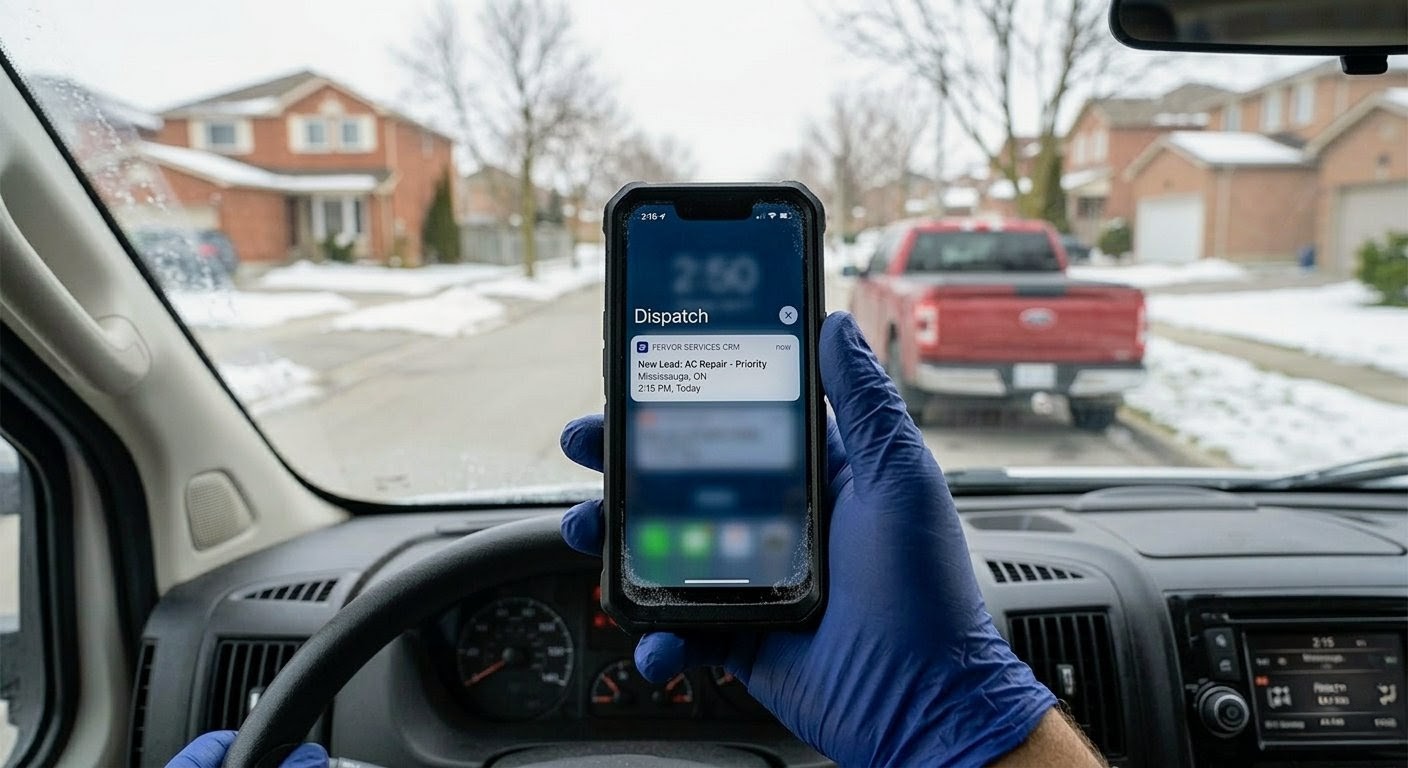
Call tracking is the third layer. CallRail wires every phone-source-to-job-revenue line so you know exactly which page, which Google Ads campaign, and which service-area page generated the booked job. (Most San Antonio HVAC contractors are running blind on this. They spend $4,000 a month on Google Ads with zero attribution past clicks.) HVAC website design San Antonio that doesn't include call tracking ships a site that can't prove its own ROI.
Five steps. No mystery.
We score your current HVAC site across six conversion categories. You'll see where your booking path fails, which pages aren't ranking for San Antonio HVAC web design terms, how your site compares to the Bexar County contractors pulling Local Pack share, and how many calls you're losing to whoever's running a faster-loading site. About three days. You own the report regardless of what happens next.
We study your San Antonio market. Who's ranking in your service area? What does the Stone Oak / Alamo Ranch / JBSA search-intent split look like in your dispatch data? We pull from your ServiceTitan (or Housecall Pro, or Jobber) records to understand your real job mix, average ticket, and seasonal patterns. Because a site built for an Alamo Heights premium-replacement shop reads different from one doing 70% post-summer AC repair across Universal City and Schertz.
Site structure, page hierarchy, every word of copy. Written before a single design comp opens. Every service page, every regional service-area page (Stone Oak HVAC, Alamo Ranch HVAC, JBSA HVAC, Boerne HVAC, Helotes HVAC), every TDLR / COSA trust page mapped to actual San Antonio search demand. Strategy first. The site is built on top of it.
Mobile-first. Sub-two-second Largest Contentful Paint on mobile. Click-to-call tested on a real iPhone with an LTE throttle simulator. CallRail tracking installed. Every CTA tested with the thumb-zone rule: if a homeowner can't tap your phone number with one hand while holding a flashlight in a Helotes backyard at 11 PM during a storm-driven CPS Energy outage, the CTA fails. Static hosting on Cloudflare. Image optimization with WebP and AVIF. Font subsetting. Schema markup (Organization, LocalBusiness, Service, FAQPage). Accessibility tested at WCAG 2.2 AA, because a site that fails colour contrast in bright Texas sunlight on a phone screen is invisible to half your demographic.
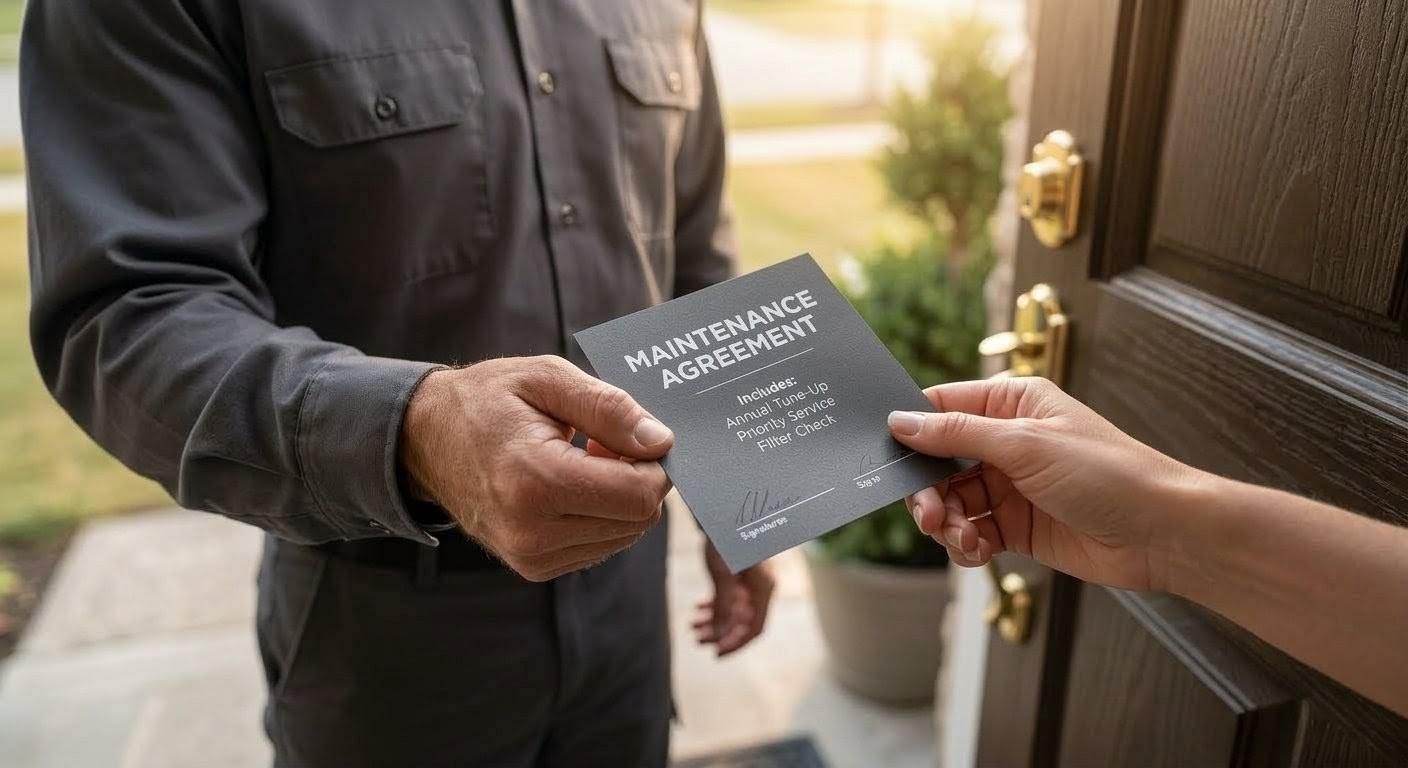
Your site launches with CallRail tracking, NiceJob review automation, all logins transferred, and documentation for routine updates. You own the domain, the content, the hosting, the GBP. Everything. And if you want compound growth from ongoing seasonal content and HVAC website design San Antonio maintenance, Performance Partner picks up where the build leaves off.
So three engagement options for HVAC website design San Antonio, all built on website ownership and no long-term contracts. Booked by Design is the lead because this is a web-design build. Your site is the bottleneck, and a rebuild is what fixes it.
Booked by Design™ — $9,997-$12,997 for HVAC. 30-60 days. Full site rebuild including service pages (AC install, AC repair, heat pump, hard-water-equipment service, dehumidifier, IAQ, tankless water heater, ductless mini-split, light commercial), San Antonio quadrant location pages (Stone Oak, Alamo Heights, Alamo Ranch, Helotes, Boerne, Universal City, Schertz, JBSA), GBP setup, schema stack, NiceJob review pipeline, CallRail tracking, and TDLR / COSA trust content. Day-one ownership of the domain, content, hosting, and GBP. The Site Inspection report informs the build before a single design comp opens.
The Local Pick — $2,497 one-time, ~14 days. The lighter option for shops whose site already loads fast and converts but whose Local Pack presence is invisible: GBP optimization, citation cleanup across BBB Greater San Antonio, Yelp, Angi, Thumbtack, YellowPages, Houzz, Networx, and the TACCA Greater San Antonio member directory, NiceJob review velocity, schema markup added to existing pages.
Performance Partner™ — $1,497-$3,997/month, ongoing. Quarterly content additions targeting San Antonio search volume (regional service-area pages, hard-water-equipment content cycles, military-base-tenant content, summer cooling-rush content, Hill Country expansion content), GBP photo and post management, NiceJob review automation, citation maintenance, and monthly call-volume reporting tied to revenue.
"The NAHB/Westlake Royal Remodeling Market Index posted a reading of 64 in the fourth quarter of 2025, up four points compared to the previous quarter, with rising costs and customer hesitation flagged as key challenges." — National Association of Home Builders (NAHB) (2026)
Remodeling sentiment is up. So the San Antonio HVAC contractors who built proper site infrastructure when growth was steady keep eating share as the market normalizes after the 2024 record-heat season. The ones running a four-second WordPress template feel the squeeze first because their cost-per-lead climbs while owned site assets keep paying. HVAC website design San Antonio built this way compounds. Done cheap, it evaporates the moment a competitor with a faster site shows up in the SERP.
Booked by Design runs 30-60 days from contract to launch. The Site Inspection runs about three days. The Local Pick runs about 14 days if your site already loads fast and converts. Most of the timeline is content architecture and copy, with design and development happening after the page-by-page strategy is locked.
Booked by Design is $9,997-$12,997 for HVAC. The Local Pick is $2,497 one-time. Performance Partner is $1,497-$3,997/month ongoing. All include website ownership transferred on day one. No long-term contract on any tier.
Yes. Domain, content, Google Business Profile, citation logins, hosting credentials, NiceJob account, CallRail account, all transferred on day one. If you ever leave Fervor, you take everything. That's how San Antonio HVAC web design work should always operate.
San Antonio's record-heat climate (75 triple-digit days in 2023, 108°F at SAT in August 2024), TDLR Class A and Class B licensing layered with COSA mechanical contractor registration, the Edwards Aquifer hard-water mineral load on equipment, Joint Base San Antonio tenant licensing requirements, and the master-planned-community demand across Stone Oak, Alamo Ranch, Helotes, and Boerne all shape what your site needs to do. Generic Texas templates miss most of it. So your San Antonio HVAC site has to speak to San Antonio's specifics (climate, licensing, hard water, military bases, neighbourhoods), or it reads like a Houston page rebadged.
The evidence
 Read the full report →
 0
contractor sites graded, one A
Across the whole CRO Index, a single site earned an A. The median landed at a D. The grade gap is a conversion gap.
0 %
of HVAC sites fail a critical accessibility check
Scored against WCAG 2.1 AA with axe-core. A page that blocks a screen reader also blocks a paying customer.
Fervor HVAC State of the Industry, 2026
0 %
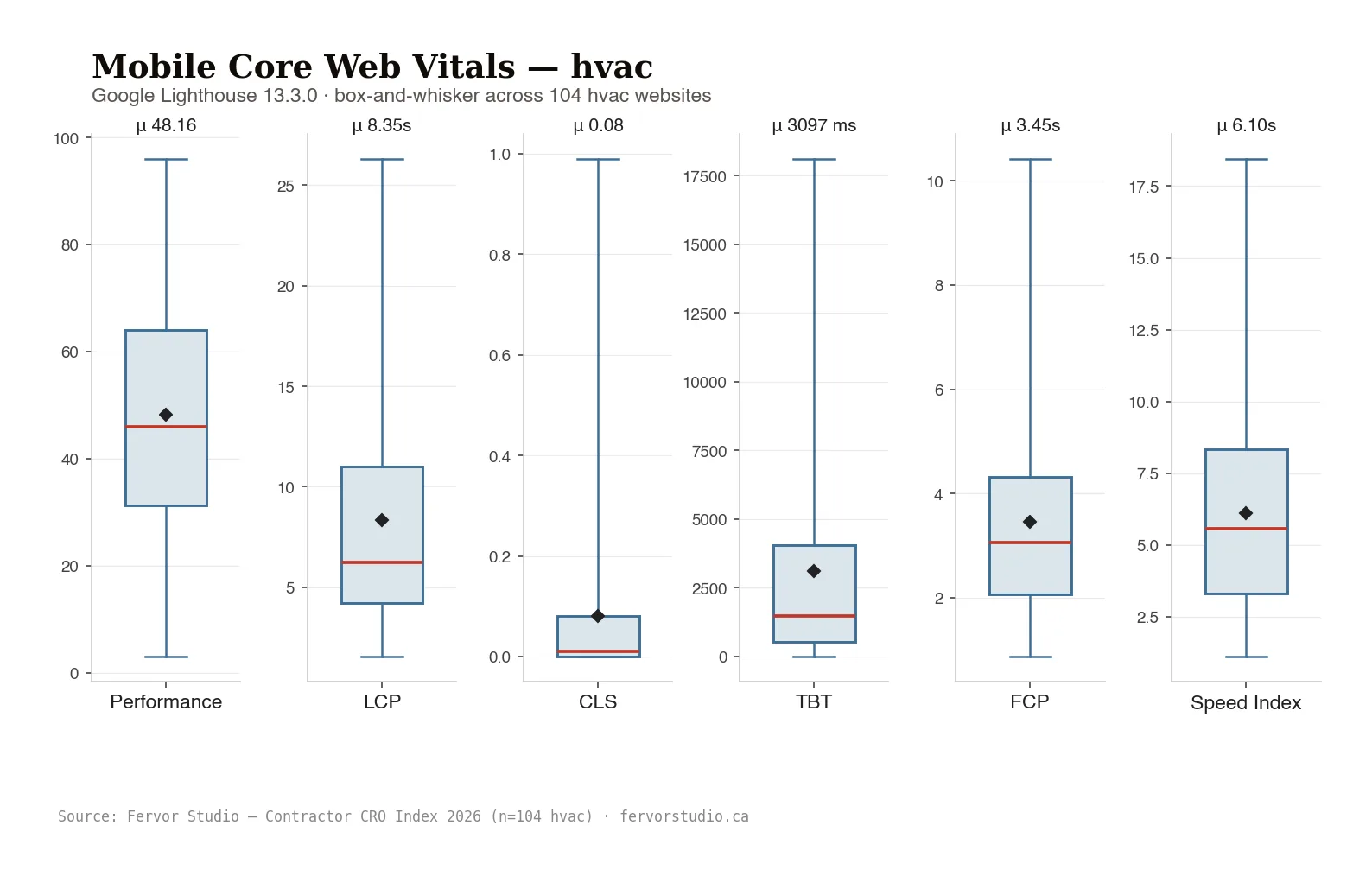
miss Google's mobile load-speed bar
Median mobile load lands at 6.24 seconds. Most of your traffic is on a phone, and most of them are gone before the hero paints.
Fervor HVAC State of the Industry, 2026
0 /100
is the average HVAC grade
That is a D. The sites booking the work are not the ones with the biggest crews. They are the ones a few points higher on the things homeowners feel.
Two ways to start
Tell us where you are. We point you at the right next step — no sales call to get there.
Client review
“Nay did an amazing job, you know. He was really patient. He got the work done the way I told him and he was just on point with the website. Pretty straightforward process. No going around the bush. He just did amazing work and I would 100% recommend.”
How Fervor can help
Complete website system built to convert storm leads, planned projects, and research-phase homeowners into booked jobs.
Identify and patch the top conversion killers on your existing site. No full rebuild needed.
Monthly SEO, content, and CRO. Fixed deliverables. No credits, no rollover. The compound growth engine.
GBP optimization, citation building, and review system foundation. The infrastructure that gets you into the Map Pack.
One conversion-built landing page for the referrals, paid clicks, and cold-call leads you send. They land on a page built to book them, not your generic homepage.
Your move
Tell us where you are. We point you at the right next step — no sales call to get there.
Keep going