0
contractor sites graded, one A
Across the whole CRO Index, a single site earned an A. The median landed at a D. The grade gap is a conversion gap.
You're getting clicks in Phoenix. They're just not calling. We rebuild your site around the one job that matters: turning a visitor into a booked job.
Starts with a Site Inspection, so you see the plan before any build begins.
“Patient, on point, straightforward. Did amazing work. Would 100% recommend.” — Ruben Mederos, HyperTemp HVAC
“Responsive, creative, exceeded expectations. Already seeing greater engagement from our clients.” — George Jeorgy, Jeorgy's Landscape Construction
“Top-tier professionalism, real web design expertise, ideas I hadn't considered. Confidently recommend.” — Aws Nassani, Four Eleven Contracting




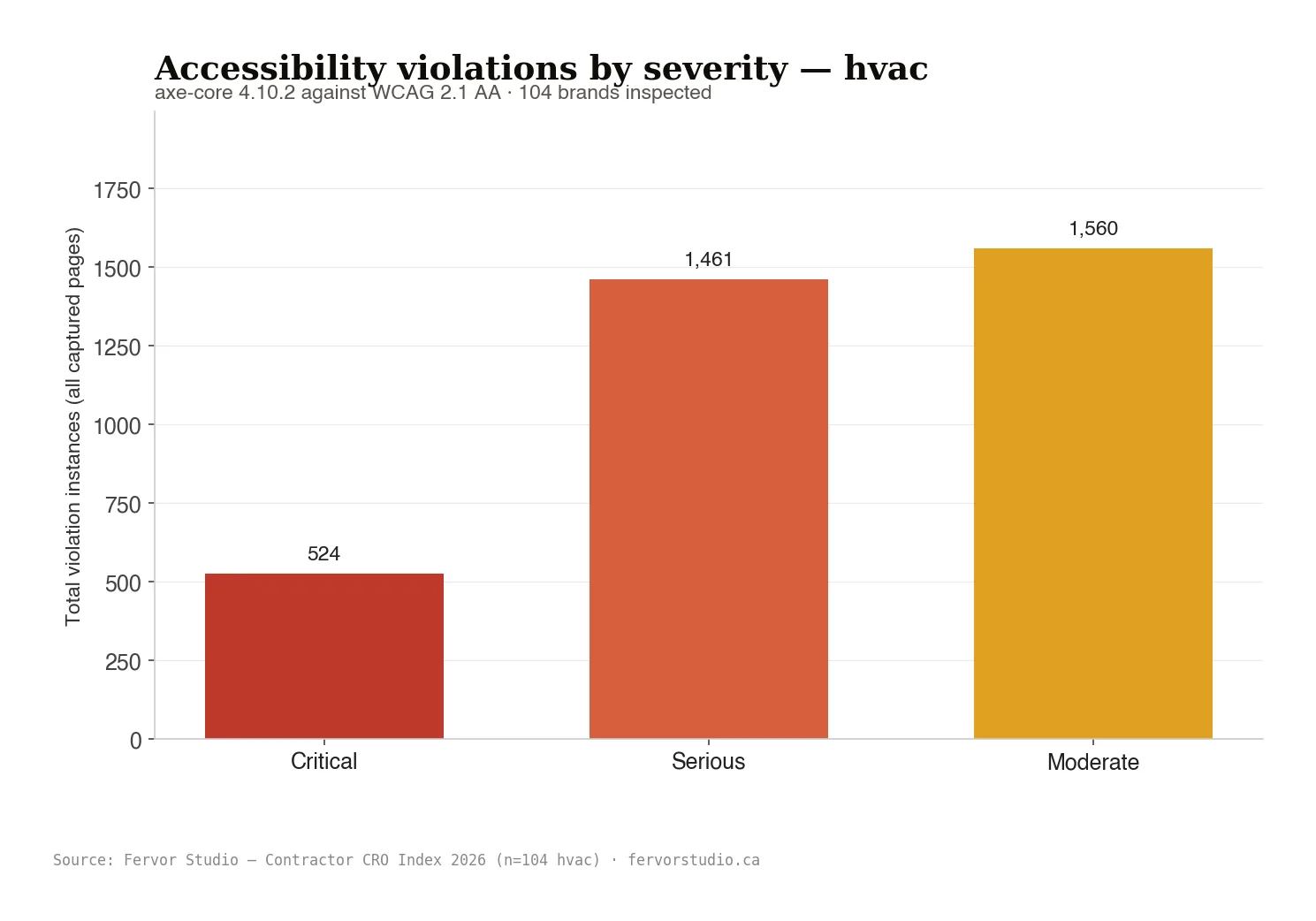
64.4% of HVAC sites we tested fail a critical accessibility check
Digital State of the HVAC Industry 2026A grade out of 380 contractor sites
We graded 380 of them against one framework. Exactly one earned an A: Crown Industrial Roofing in Toronto, at 90 out of 100. The rest left money on the table. Here is what separates the top from the bottom.
The local detail
Every angle below comes from how Phoenix actually searches, buys, and regulates — built into the page, not bolted on.
Phoenix doesn't have one busy season — it has several: extreme-heat cooling season (May-September) → emergency AC repair (life-safety at 110F+), AC replacement, compressor failure; monsoon season (mid-June-September) → post-haboob condenser cleaning, dust-clogged coils, surge damage; mild winter + shoulder season (November-March) → heat pump tune-up, AC pre-season inspection, snowbird second-home service. The pages are built so each one is already ranking when it hits.
Homeowners search rebates before they call: SRP Cool Cash AC/heat pump rebate (live), SRP Bring Your Own Thermostat (BYOT) (live) and Efficiency Arizona (federal HEAR, income-qualified) (live). We surface only what's actually live and link the source, instead of quoting numbers that expired.
Arizona Registrar of Contractors (ROC). The site states it plainly — the trust signal local buyers look for before they book.
Metro Phoenix is split between SRP (most of the East Valley + parts of Phoenix) and APS (much of Phoenix proper + West Valley). Rebate eligibility follows the utility, so service-area pages should say which utility a neighbourhood sits in.
Condensers spec'd for 115F+ ambient operation (standard-rated units lose capacity above 95F), Variable-capacity systems for SRP Cool Cash top-tier rebates and Monsoon/haboob dust mitigation: condenser coil cleaning plans + higher-MERV filtration. The build speaks to the systems Phoenix homeowners actually buy, not a generic catalogue.
Phoenix HVAC websites lose calls in three predictable scenarios.
Phoenix is the speed test no other US HVAC market punishes harder.
Forms are a backup.
You've already paid for one HVAC website that quietly stopped paying you back. And if you run a HVAC shop in Phoenix, the second build probably looked nicer than the first, then started loading like a 2003 stack the moment somebody opened it on a phone in a Goodyear driveway at 115°F. So you're back to running Google Ads to plug the gap, watching cost-per-call climb every monsoon season, wondering if HVAC website design Phoenix is even a real specialty or just a generic web design template that gets the word "Phoenix" find-and-replaced into the hero headline. This page covers what HVAC website design Phoenix actually requires when it's built for the Sonoran Desert market. Sub-2-second mobile load times in 113-day heat waves. Sticky click-to-call that survives a hot phone screen. An ROC license number visible before the fold. Monsoon-prep and haboob-recovery content built into the site architecture. And where the typical hvac web design Phoenix template falls apart on contact with a 115°F July afternoon and a 60,000-customer power outage.
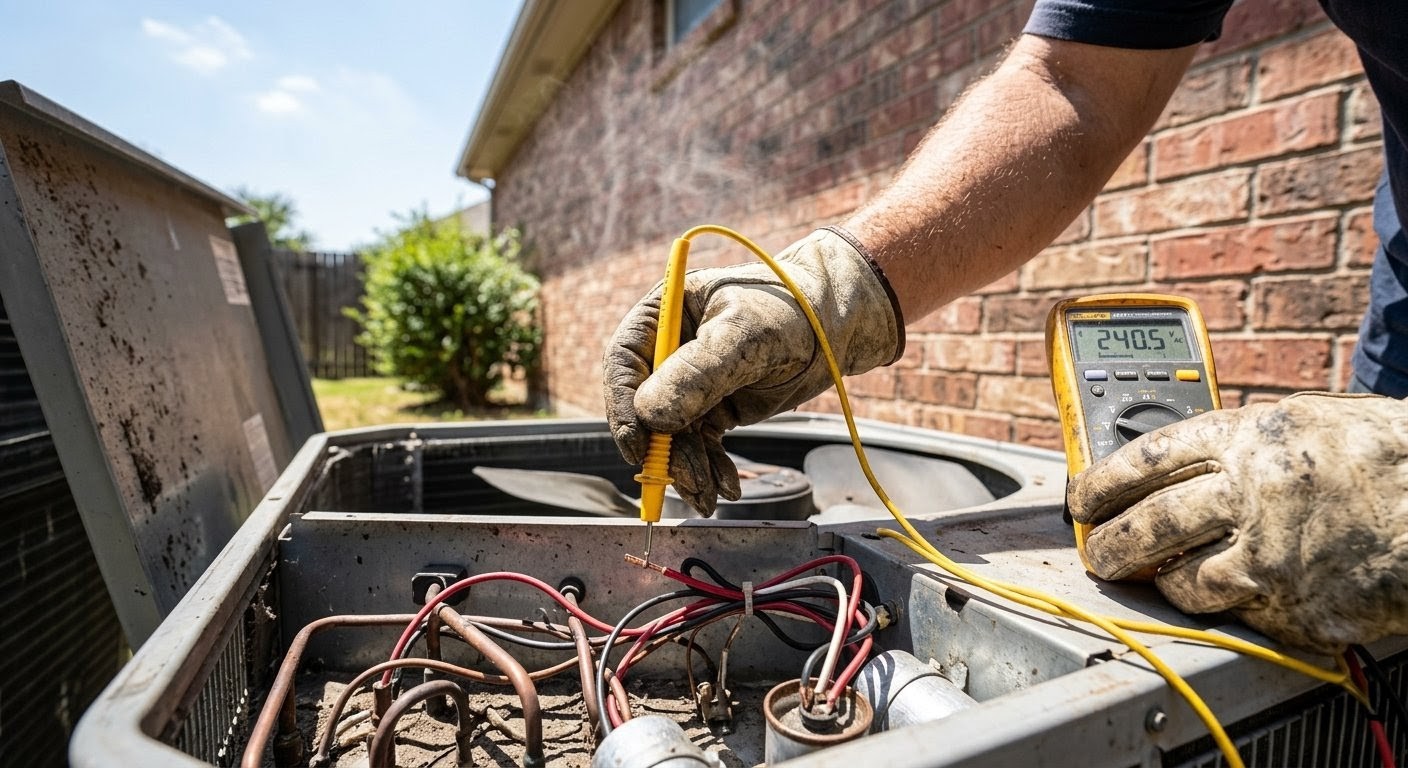
Phoenix HVAC websites lose calls in three predictable scenarios. A homeowner's AC quits on a 115°F Saturday in Arcadia and they pull up your site one-handed while standing in the kitchen. The August 26, 2025 haboob knocks out power for ten-plus hours across central Maricopa County and a Chandler family searches "emergency AC after dust storm Phoenix" on a phone at 9% battery. A Paradise Valley homeowner whose fifteen-year-old condenser finally quits during a monsoon week opens five contractor sites in five tabs and closes four of them inside seven seconds. If your HVAC website design Phoenix work doesn't survive any of those moments (fast, mobile-first, click-to-call above the fold, trust signals visible without scrolling), the call books with the contractor whose site did. So the first question for any HVAC website design Phoenix engagement is whether your homepage answers a 115°F panic in the first screen. Most Phoenix HVAC sites don't.
"25% of homeowners say trusting contractors is their top challenge when planning home improvement projects." — Houzz Inc. (2025)
One in four homeowners is scoring you on something other than skill. They're scoring trust before they ever read a word of your service descriptions. And in a Phoenix metro of 4.83 million people with hundreds of HVAC shops fighting for the same heat-wave search volume, that trust scoring happens visually in the first screenful: license number visible, real Phoenix photos (not stock), review count, recent activity. The hvac website design Phoenix work that ignores the visual trust layer loses to the work that doesn't.
"91% of U.S. adults own a smartphone; overall U.S. internet traffic in January 2026 ran desktop 55.93%, mobile 41.95%, tablet 2.04%." — Pew Research Center (2025)
Roughly 42% of your traffic is mobile in aggregate. But for a Phoenix HVAC contractor specifically, where most emergency searches happen during a 115°F afternoon when nobody is sitting at a desk, that share runs higher. Closer to 70%. So the homepage that opens fast on a phone, with a tappable phone number above the fold, captures the call. The one that loads a 6MB hero image and a video carousel doesn't. (And the gap isn't subtle. It's the difference between two calls a day in monsoon week and twenty.)
Phoenix is the speed test no other US HVAC market punishes harder. The Aug 26, 2025 haboob knocked out power to over 60,000 Maricopa County customers for hours, dropped cell tower coverage in pockets across the Salt River Valley, and produced a documented spike in carbon-monoxide and heat-illness emergency calls during the outage window. So the phone in a homeowner's hand is hot, the LTE signal is weak, the battery is half-dead, and your site has about three seconds to load before they hit back and try the next contractor.
"53% of mobile users abandon sites that take longer than 3 seconds to load." — Google / SOASTA (2017)
Half your mobile traffic is gone at three seconds. And in Phoenix that threshold feels generous because the underlying conditions run worse than the benchmark assumed. Slower carrier handoffs in the East Valley new-build corridors. Dust-storm signal interference during haboob events. Throttled connection speeds inside concrete-heavy commercial properties along Loop 101. The hvac website design Phoenix that targets two seconds, not three, gives itself room.
"Conversion rates drop approximately 12% for each additional second of page load time." — Google / Deloitte (2020)
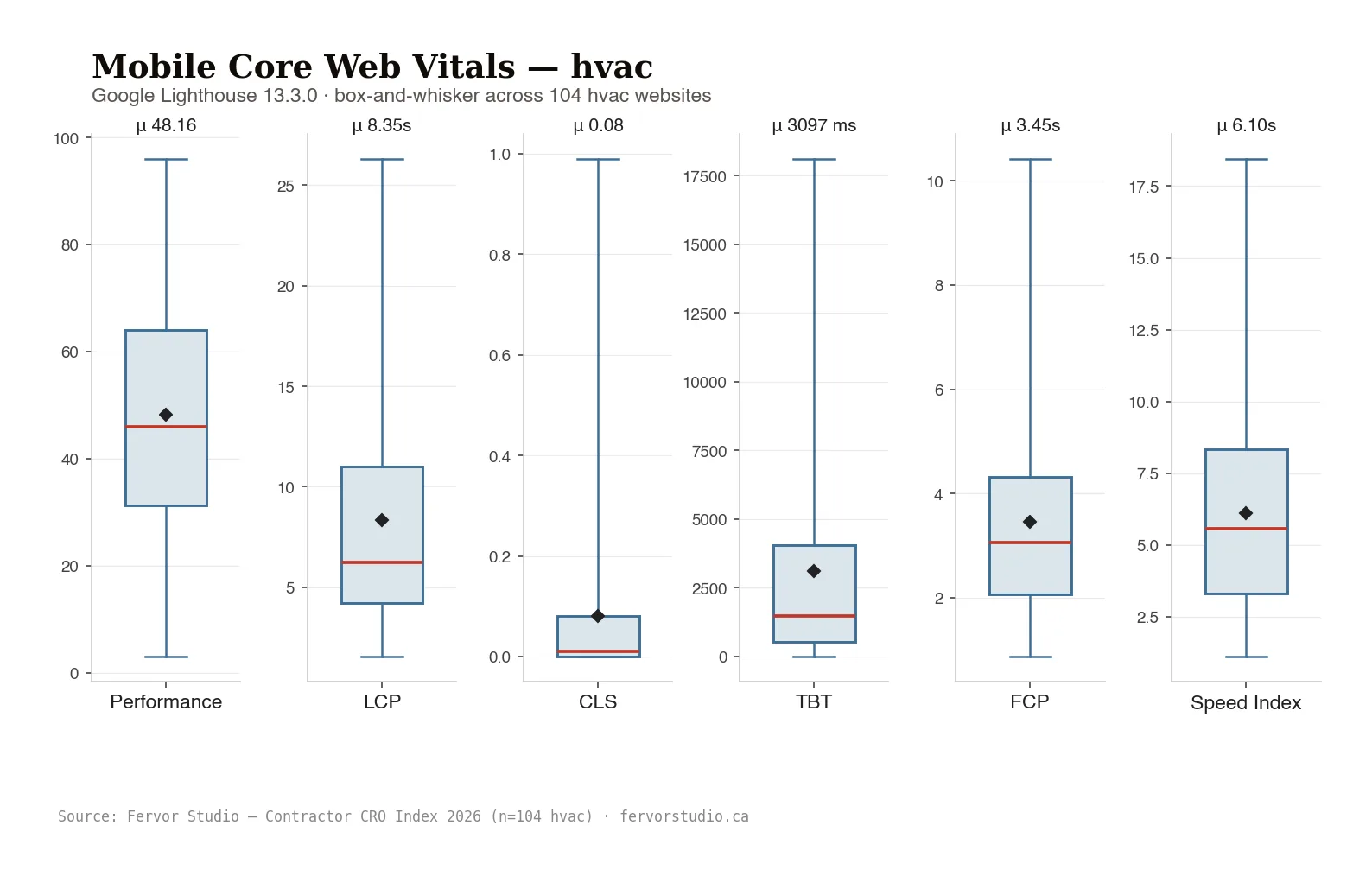
And a 12%-per-second conversion drop isn't a curve you want to be on the wrong side of when your average install ticket is $10,000-$20,000 and your AC repair ticket runs $400-$1,200. So if your site takes six seconds to load on a phone instead of two, you've quietly given up roughly half your potential conversions before anyone has read your headline. Most Phoenix HVAC websites we audit run between 7 and 12 seconds on mobile. The math is brutal.
"A 10-second delay will often make users leave a site immediately. You can easily lose half your sales simply because your site is a few seconds too slow." — Nielsen Norman Group (2020)
Half your sales. Gone before anyone read what you do. That's the cost of running on a $300 template plus three SEO plugins plus a video hero plus a chat widget plus a lead-magnet popup plus shared hosting. Each of those was sold to you as a feature. Together they're killing your phone.
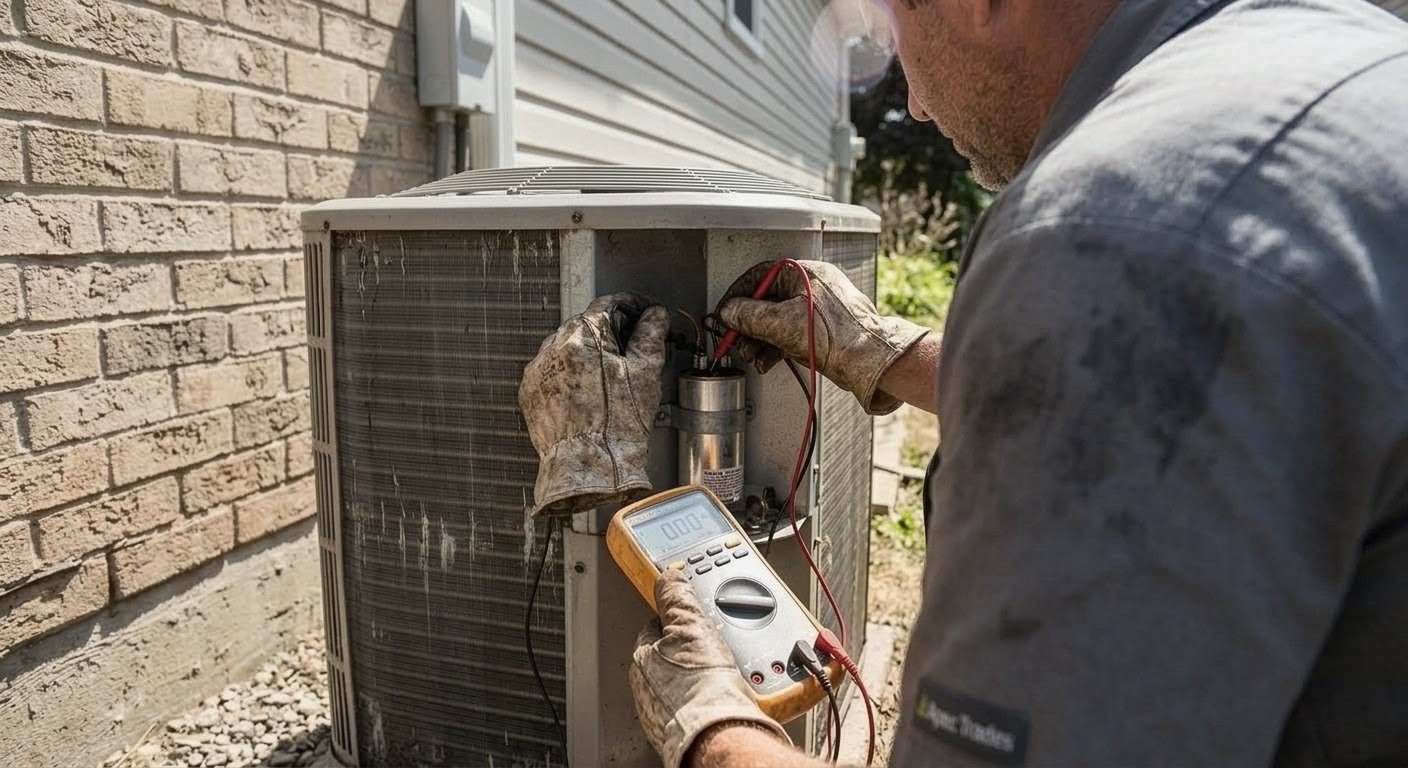
Forms are a backup. The phone call is the conversion in Phoenix HVAC. Period.
"Phone calls convert to 10-15x more revenue than web leads for home services businesses. Callers convert 30% faster than web leads. Caller retention rate is 28% higher than web lead retention rate." — BIA/Kelsey + Forrester (via Invoca) (2025)
Ten to fifteen times more revenue from a call than a form. So every layout decision on the page either makes the call effortless or it doesn't. Sticky phone-number bar at the top, tappable on every scroll position. Click-to-call wired into every CTA, not just the contact-page button. Phone number rendered as a real tel: link, not an image. Tap targets sized to Apple's 44×44 minimum, ideally larger for AC-emergency CTAs because nobody's tapping carefully when their house is 95°F at 11pm in July.
"40% of home services consumers who call from search make a purchase. Consumers searching for plumbing, appliance repair, and fencing services are most likely to call after making a search." — Google (via Invoca) (2025)
And four in ten who call from search buy. So when your hvac website design Phoenix work makes the phone tap effortless during a monsoon-season AC failure, you're catching a buyer who's already pre-qualified by the search query they typed. Forms catch the slow-research buyer planning a $15,000 installation in October. The call catches the $400 emergency at 7pm on a Tuesday. Both matter. But forms-first design loses Phoenix because Phoenix is an emergency-first market.
"18% of home services calls go unanswered on weekdays, while 41% go unanswered on weekends. Each unanswered call is revenue left on the table and a lead handed to a competitor." — Invoca (2025)
Forty-one percent on weekends. Phoenix AC failures don't take Saturdays off. And neither does the haboob calendar between June 15 and September 30. So your hvac website design Phoenix has to capture the after-hours intent without a live answer: a one-tap callback request the homeowner can fire off in eight seconds, a clear "we'll call back inside 30 minutes" promise, and an automated SMS acknowledgement so they don't open the next contractor's site while waiting. Most Phoenix HVAC sites have a contact form with twelve fields and zero after-hours UX. Both lose the call.
Phoenix is an AC-first market. Furnace replacement is a small slice of revenue here. Most homes run electric heat strips or heat pumps, and the heating season is six weeks long if you stretch it. So your service-page architecture starts with a real AC install page covering high-SEER2 split systems (federal minimums hit 14.3 SEER2 in 2023 for the Southwest, and most Phoenix buyers shop in the 16-20 SEER2 range for $0.13/kWh APS rate math), variable-capacity inverter systems for the relentless May-September cooling load, and side-by-side comparisons against entry-level units with the payback math on the page, not buried in a PDF.
"U.S. heat pump shipments grew at an annual rate of 20.5% through May 2025, reaching 4.2 million units annually; heat pumps outsold gas furnaces in 2025." — Air-Conditioning, Heating, and Refrigeration Institute (AHRI) (2025)
And heat pumps are taking real share even in cooling-dominant Phoenix, pushed by APS Cool Rewards and SRP Cool Cash rebates plus the federal IRA 25C credit. But most Phoenix HVAC contractor websites still bury the heat pump conversation under one paragraph on a generic services page. So the hvac website design Phoenix that gives heat pumps a dedicated URL, with rebate-stack math on the page, before-and-after install photos in real Phoenix homes, and the ROC C-39 license number on the spec sheet, captures a search bucket that's compounding every quarter.
AC repair gets its own page (the year-round Phoenix emergency revenue stream). Whole-home dust filtration (Phoenix monsoon haboobs deposit measurable particulate on outdoor coils, and a major event can raise head pressure 10-15% and push compressor amperage past design limits). IAQ products like UV sterilizers and HEPA filtration for valley-fever-aware homeowners. Evaporative coolers (still a real revenue line in Maryvale, Glendale, and parts of West Valley where dry-air operation works). Mini-splits (Encanto bungalow ADU segment, plus garage retrofits across Chandler, Gilbert, and Goodyear new-build communities). Tankless water heaters. Light commercial rooftop units (NW Phoenix and Tolleson industrial). Each one is its own URL, its own meta, its own schema, and its own conversion-built layout. (The mistake most Phoenix HVAC sites make is one big "Services" page with eight bullet points. Google reads that as one page about everything, which means it ranks for nothing specific.)
The Phoenix-specific service page almost no other agency builds: monsoon and haboob recovery. The Aug 26, 2025 dust storm dropped enough particulate across central Maricopa County to spike head pressure on tens of thousands of outdoor units overnight. Pre-monsoon coil-clean visits between April and June are a distinct service window most Phoenix HVAC websites never even mention. So a real Phoenix HVAC website builds a dedicated monsoon-prep page covering pre-season coil cleaning, post-haboob inspection protocols, surge protection for variable-speed compressors during outage events, and dust-resistant filtration upgrades for homes near South Mountain, Camelback, and the desert-edge communities of San Tan Valley and Apache Junction.
And the page has to display the Arizona Registrar of Contractors license number prominently (C-39 for residential, CR-39 for dual classification) with a link to the ROC license lookup. Arizona requires a state license for any HVAC job over $1,000, and Phoenix homeowners are unusually license-aware because the ROC's complaint pipeline gets local press coverage every monsoon season when storm-chaser contractors swarm the metro. So your About page, footer, and trust block all need the license number visible. Most Phoenix HVAC site templates we audit hide the license number behind a "Credentials" link three clicks deep, or worse, omit it entirely.
Phoenix HVAC demand isn't one curve; it's three. Your hvac website design Phoenix has to ride all of them.
Extreme summer cooling (May-September dominant). Phoenix logged a record 113 consecutive 100°F+ days in summer 2024, with 70 days at or above 110°F per local 12News and Arizona Mirror reporting. So the contractor whose site loads in two seconds during a 115°F August afternoon and surfaces "AC repair near me" within the first screenful captures more revenue in two weeks than most Phoenix HVAC shops book in two months. AC install, AC repair, condenser replacement, refrigerant recharge. Every one of these is its own conversion path on the site.
Monsoon damage and haboob recovery (June 15 - September 30). Search intent: dust-storm coil cleaning, post-haboob inspection, surge-related compressor failure, lightning damage. The August 26, 2025 haboob alone affected 60,000+ Maricopa County customers, and similar events run on a multi-year cadence. The Phoenix HVAC site that ranks for "post-haboob AC service Phoenix" or "monsoon coil cleaning Chandler" captures a demand stream most generic hvac web design Phoenix shops don't even know exists.
Mild winter cold-snap mode (December-February). Phoenix winters are short but real. Overnight lows touch 35°F in north-central Phoenix and the foothills near Cave Creek and Carefree. Heat strip failures, heat pump short-cycling, and emergency furnace calls all live here. The page volume is smaller, but the conversion intent is high (and the equipment ticket runs higher because most pre-2010 Phoenix HVAC stock isn't optimized for cold operation).
Each demand mode plays out across Phoenix differently. So real hvac website design Phoenix builds individual service-area pages by metro region, each anchored in real neighbourhood characteristics:
North-Central Premium: Paradise Valley, Arcadia, Biltmore, North Central Phoenix, Camelback East. Wealthier customer base, premium equipment specs (variable-capacity Trane XV20i, Carrier Infinity, Lennox Signature), dual-fuel premium installs, and the highest-ticket replacement segment in the metro.
Inner-City Older Stock: Encanto, Central City, Maryvale, parts of Glendale's older grid. Pre-1970 housing, ductwork retrofit constraints, mini-split heavy, evaporative-cooler legacy still in service. Conversion-grade installs in these zones require a different content angle. Replacing a swamp cooler with a heat pump is a different sales conversation than replacing a 2008 split system.
East Valley Premium Suburbs — Scottsdale, Tempe, Chandler, Gilbert, Mesa, Ahwatukee. Master-planned communities, faster replacement-on-failure behaviour, premium two-stage equipment, smart thermostat integration. Goodyear and Avondale on the West Valley side run similar profiles for the post-2010 master-planned subsegments.
Far East Valley New Construction — Queen Creek, San Tan Valley, Apache Junction, Florence, Maricopa. Active new-build expansion (Floreo / Teravalis master plan opened phase one in 2025 with roughly 5,000 lots over 3,029 acres). New-construction install demand plus a fresh service-area opportunity that most Phoenix HVAC sites haven't built service-area pages for yet.
West Valley — Goodyear, Avondale, Glendale, Surprise, Buckeye, Litchfield Park. Mixed master-planned and older grid, growing strongly, evaporative-cooler crossover plus AC retrofit demand.
Surrounding markets — Cave Creek, Carefree, Anthem, Sun City, Sun City West. The retiree-heavy and foothill-cooler corridors that the city-only Phoenix HVAC site misses entirely.
Each page links to the trade hub and back, references real local landmarks (Loop 101, Loop 202, the I-10 corridor, US 60, Sky Harbor International, Camelback Mountain, South Mountain, Talking Stick Resort), and uses photos of crews on real Phoenix jobs in that zone. The marketing agency for HVAC contractors Phoenix hires that ships rebadged Las Vegas or Tucson location pages with "Phoenix" find-and-replaced is leaving the entire local-relevance signal on the floor.
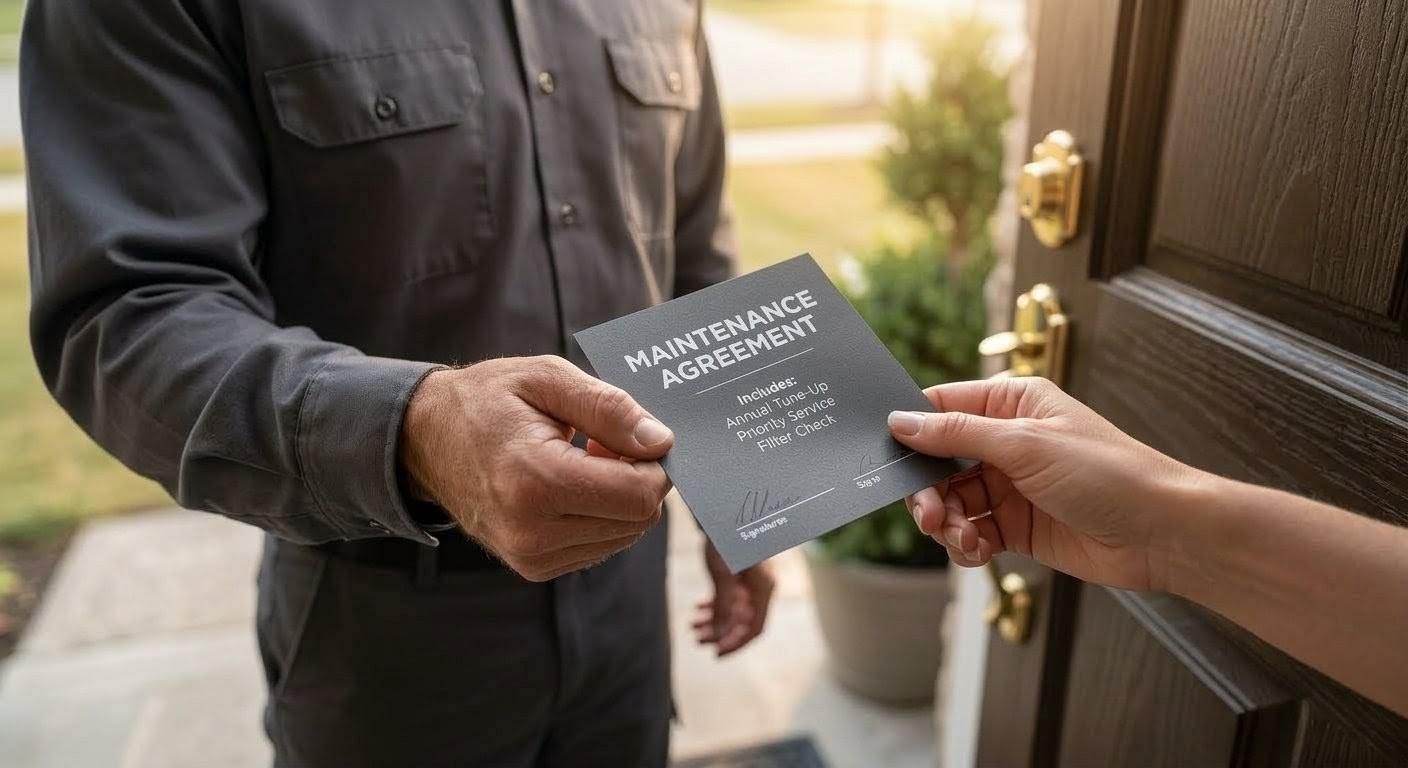
The Phoenix homeowner staring at five contractor sites at 11pm during a monsoon week is running a fast trust check. License number visible in under three seconds? Real photos of crews in Phoenix neighbourhoods (not stock photos of smiling families pointing at thermostats)? Recent reviews with response history? If your hvac website design Phoenix work answers all three above the fold, you're inside the consideration set. If it's missing any of them, you're closed and they're on the next tab.
Per BrightLocal's 2025 Local Consumer Review Survey, 96% of consumers read online business reviews at least occasionally and 74% use two or more review platforms when researching. So your Phoenix HVAC site needs review embeds wired in (Google primary, Yelp secondary, BBB tertiary) with current data, not screenshots from 2021. NiceJob handles the automation pipeline most Phoenix HVAC contractors haven't built yet. Review requests fire 60 minutes after a closed job, routed to Google first, monitoring for negative feedback before it goes public.
"88% of consumers would use a business that replies to all reviews (positive and negative), vs only 47% for businesses that don't respond to reviews at all." — BrightLocal (2024)
An 88-versus-47 spread. So your review-response history is half the trust signal. A 4.7-star rating with no responses signals dormancy. A 4.6-star rating with consistent responses signals active business. The Phoenix HVAC site that surfaces both rating AND response cadence on the homepage outperforms the one with just a generic five-star widget.
And photo authenticity reads instantly. A stock photo of a smiling tech in a green polo on a generic suburban porch reads false. A real photo of your crew installing a Trane XV20i in a Paradise Valley equipment closet, captioned with the neighbourhood and the date, reads true. The photo cadence on Phoenix HVAC websites separates the booked-out from the dormant. Weekly minimum, every week of the year, real Phoenix backdrops (saguaros, palo verdes, foothill terrain, monsoon clouds). All visual signals the homeowner has seen out their own window.
Five steps. No mystery. No "creative discovery process" that's really just a sales call with mood boards.
We score your current Phoenix HVAC site across six conversion categories. You'll see exactly where your AC-emergency booking path fails, which pages aren't loading inside three seconds on mobile LTE, how your site stacks against the Phoenix HVAC contractors actually getting calls during haboob week, and the dollar value of the calls you're losing every month. Free. About three days. You own the report regardless of what happens next.
We study your Phoenix market and your shop. We pull your ServiceTitan data (or Housecall Pro, or Jobber) to map your real job mix, average ticket, seasonal volume, and the neighbourhoods producing your highest-margin work. So a North-Central Phoenix shop doing 70% premium replacement in Paradise Valley and Arcadia gets a different site than an East Valley shop doing 60% AC repair across Chandler, Gilbert, and Mesa.
Site map, page hierarchy, every word of copy. Written before any visual design. Each service page, each Phoenix neighbourhood page, the monsoon-prep page, the heat-pump page. All of it mapped to actual Phoenix search intent and the conversion path your buyer is on. HVAC website design Phoenix isn't bolted on after the colour palette is approved. It's the foundation the visual design wraps around.
Mobile-first. Sub-2-second load times on a phone, on LTE, in 115°F. Sticky click-to-call on every page. Tap targets sized for sweaty thumbs. Forms with five fields, not twelve. ROC license number above the fold. Real Phoenix photos sourced from your actual job archive (or shot fresh if you don't have one). Every CTA tested with the thumb-zone rule: if a homeowner can't tap your phone number with one hand while standing in a Goodyear driveway at 2pm in July, the CTA fails.
Your site launches with CallRail tracking installed, ServiceTitan-compatible call routing wired in, all logins transferred, and documentation for routine updates. You own the domain, the content, the hosting, the GBP, everything. So if you ever leave Fervor, you take the whole stack with you. And if you want compound growth from ongoing seasonal content, monsoon-cycle updates, and Performance Partner-driven SEO additions, that picks up where the build leaves off.
Three engagement options, all built on website ownership and zero long-term contracts. Booked by Design is the lead because this is a web design page. That's where the foundation gets built. The Local Pick and Performance Partner ride on top once the foundation is in place.
Booked by Design™ — $9,997-$12,997 for HVAC. 30-60 days. Full site rebuild on a fast modern stack: mobile-first design, sub-2-second mobile load, sticky click-to-call, full Phoenix neighbourhood location pages (Paradise Valley, Arcadia, Scottsdale, Chandler, Gilbert, Mesa, Goodyear, Queen Creek), per-equipment service pages, monsoon-prep page, heat-pump rebate page, ROC license display, NiceJob review system, schema stack, and CallRail tracking. Day-one ownership of every asset. This is the lead for an HVAC website design Phoenix engagement.
The Local Pick — $2,497 one-time, ~14 days. The optional layer on top of the rebuild (or for shops whose site already converts but whose Phoenix local presence is invisible): GBP optimized for the right Phoenix neighbourhood service areas, citations built and corrected across Yelp, BBB Serving the Pacific Southwest, YellowPages.com, Angi, Thumbtack, Houzz, the ACCA member directory, the Metro Phoenix PHCC member directory, and the Mechanical Trade Contractors of Arizona (MTCAZ) chapter listing. Schema markup verified, NAP standardized.
Performance Partner™ — $1,497-$3,997/month, ongoing. Quarterly content additions targeting Phoenix-specific search volume (regional service-area pages by quadrant, monsoon-prep cycles, dust-filtration content, heat-pump retrofit conversion content), GBP photo and post management, NiceJob review automation, citation maintenance, and monthly call-volume reporting tied to revenue. This is what compounds. Every quarter your owned Phoenix HVAC website assets pay more, while Google Ads spend keeps climbing.
"The NAHB/Westlake Royal Remodeling Market Index posted a reading of 64 in the fourth quarter of 2025, up four points compared to the previous quarter, with rising costs and customer hesitation flagged as key challenges." — National Association of Home Builders (NAHB) (2026)
Remodeling sentiment is up. So the Phoenix HVAC contractors who built proper website infrastructure now keep eating share as the market normalizes through 2026. The shops still running on a 2018 template and buying Angi credit feel the squeeze first because their cost-per-lead climbs every monsoon while the contractors with owned, fast, conversion-built Phoenix HVAC websites keep cashing checks. Phoenix HVAC marketing built this way compounds. Done cheap, it evaporates the moment the Google Ads card gets declined.
Booked by Design runs 30-60 days end-to-end for a full rebuild including service pages, Phoenix neighbourhood pages, monsoon-prep content, heat-pump rebate content, GBP setup, schema stack, review system, and CallRail. Faster timelines exist but they almost always skip the Phoenix-specific work that makes the site rank locally. Slower timelines usually mean the agency is bottlenecked on revisions, not strategy.
Booked by Design rebuild is $9,997-$12,997 for HVAC, 30-60 days, day-one ownership. The Local Pick is $2,497 one-time if your site already converts and you just need the Phoenix local presence layer. Performance Partner is $1,497-$3,997/month ongoing. No long-term contract on any tier. No royalty fees, no "we keep your domain," no hostage hosting.
Yes. Domain, content, Google Business Profile, hosting credentials, citation directory logins, CallRail account, NiceJob account. All transferred on day one. So if you ever leave Fervor, you take the whole stack with you. That's how hvac website design Phoenix work should always operate. Most Phoenix-area agencies don't run it that way, which is why so many contractor websites end up locked to one vendor.
Phoenix's 113-day 100°F+ heat dome, the monsoon-and-haboob calendar between June 15 and September 30, the Aug 26 2025 haboob's 60,000-customer outage profile, the APS Cool Rewards plus SRP Cool Cash plus federal IRA 25C rebate stack, the Floreo / Teravalis new-construction expansion across Queen Creek and the Far East Valley, plus the ROC C-39 / CR-39 license trust signal. All of it makes Phoenix a different web design build than Tucson or Las Vegas. Generic Sun Belt templates miss most of it. So your hvac website design Phoenix has to speak to Phoenix's specifics: neighbourhoods, climate, monsoon prep, rebates, license display, local citation directories. Otherwise it reads like a Las Vegas page rebadged with "Phoenix" in the H1.
The evidence
 Read the full report →
 0
contractor sites graded, one A
Across the whole CRO Index, a single site earned an A. The median landed at a D. The grade gap is a conversion gap.
0 %
of HVAC sites fail a critical accessibility check
Scored against WCAG 2.1 AA with axe-core. A page that blocks a screen reader also blocks a paying customer.
Fervor HVAC State of the Industry, 2026
0 %
miss Google's mobile load-speed bar
Median mobile load lands at 6.24 seconds. Most of your traffic is on a phone, and most of them are gone before the hero paints.
Fervor HVAC State of the Industry, 2026
0 /100
is the average HVAC grade
That is a D. The sites booking the work are not the ones with the biggest crews. They are the ones a few points higher on the things homeowners feel.
Two ways to start
Tell us where you are. We point you at the right next step — no sales call to get there.
Client review
“Nay did an amazing job, you know. He was really patient. He got the work done the way I told him and he was just on point with the website. Pretty straightforward process. No going around the bush. He just did amazing work and I would 100% recommend.”
How Fervor can help
Complete website system built to convert storm leads, planned projects, and research-phase homeowners into booked jobs.
Identify and patch the top conversion killers on your existing site. No full rebuild needed.
Monthly SEO, content, and CRO. Fixed deliverables. No credits, no rollover. The compound growth engine.
GBP optimization, citation building, and review system foundation. The infrastructure that gets you into the Map Pack.
One conversion-built landing page for the referrals, paid clicks, and cold-call leads you send. They land on a page built to book them, not your generic homepage.
Your move
Tell us where you are. We point you at the right next step — no sales call to get there.
Keep going